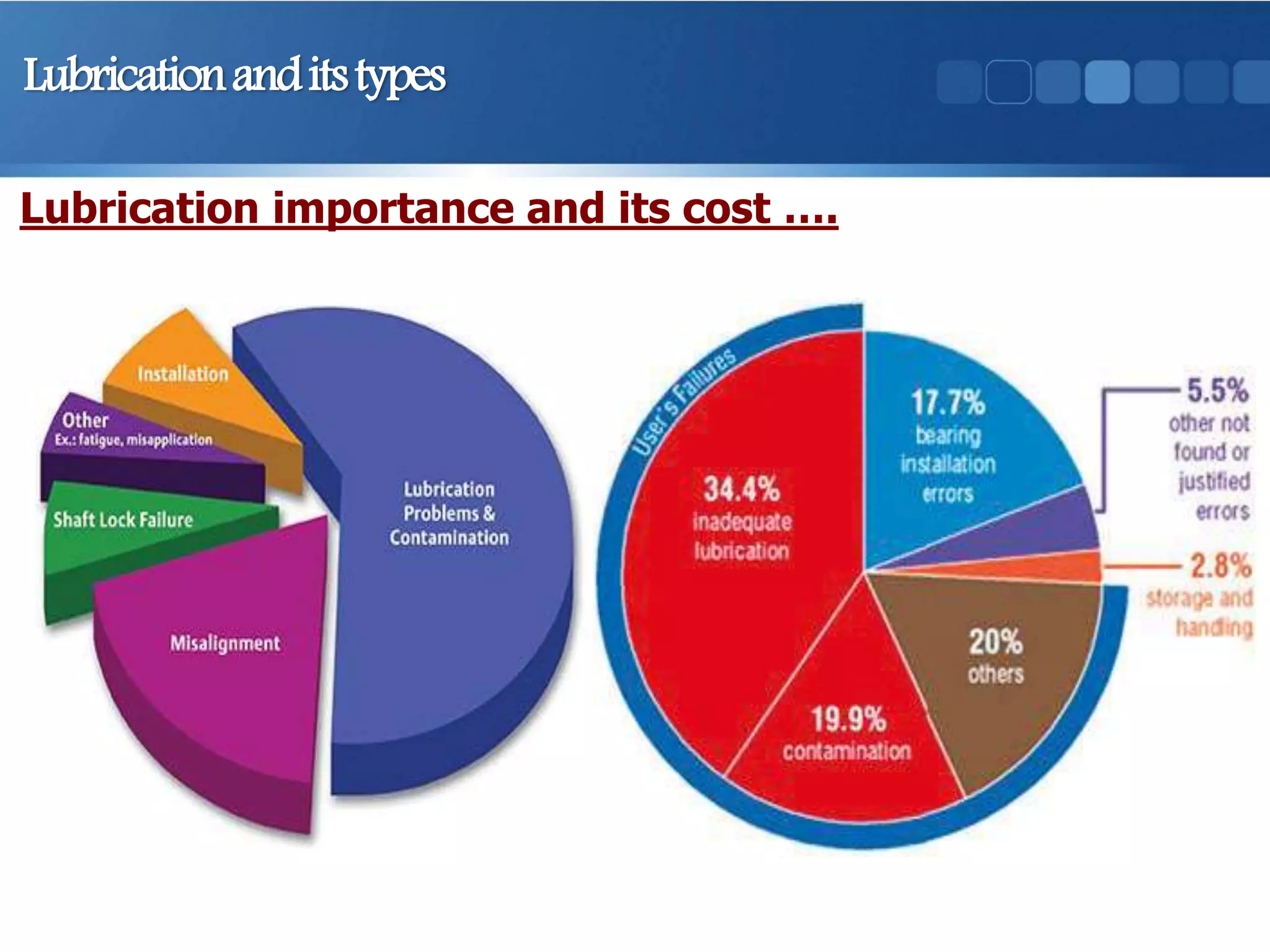
The document discusses lubrication and its types. It defines lubrication as reducing wear between surfaces in contact by interposing a lubricant between them. Lubricants are classified based on their physical state. The main types of lubrication are hydrodynamic, hydrostatic, elastohydrodynamic, boundary, mixed, and extreme pressure lubrication. Each type is distinguished by the nature of motion and separation between surfaces, with hydrodynamic providing the greatest separation by a fluid film and boundary having the least separation with potential metal-to-metal contact. Proper lubrication reduces friction and wear, generates less heat, increases machinery life, and reduces energy consumption.
Introduction to lubrication, types, importance of reducing friction, and classification of lubricants.
Friction as a resistive force; lubrication as a technique to minimize wear between surfaces.
Need for lubrication: reducing friction, wear, heat, machinery lifespan, energy consumption, and sealing.
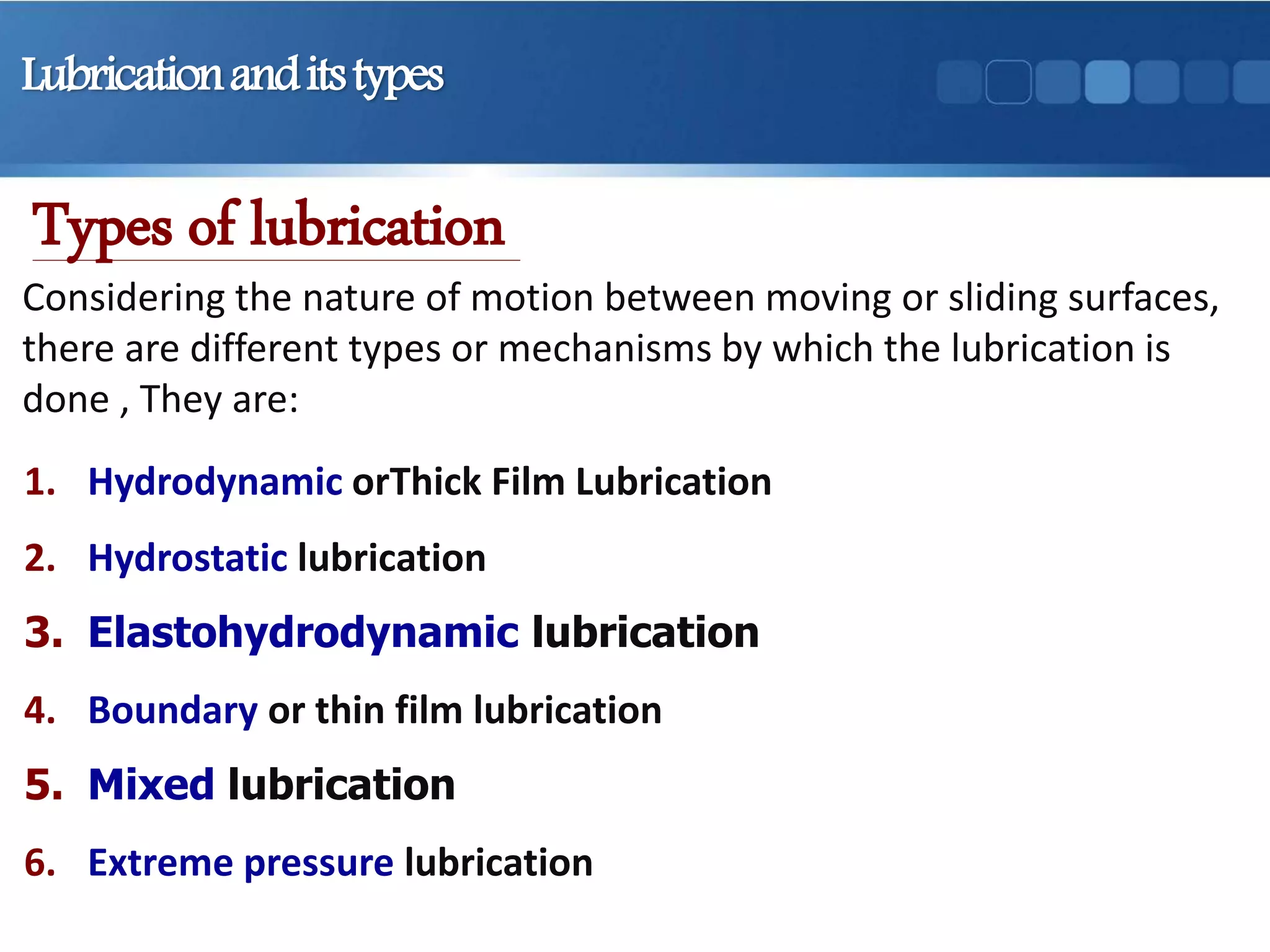
Different lubrication methods categorized based on surface motion: hydrodynamic, hydrostatic, elastohydrodynamic, boundary, mixed, and extreme pressure.
Hydrodynamic lubrication: uses continuous oil film under pressure; applications include delicate instruments and bearings.
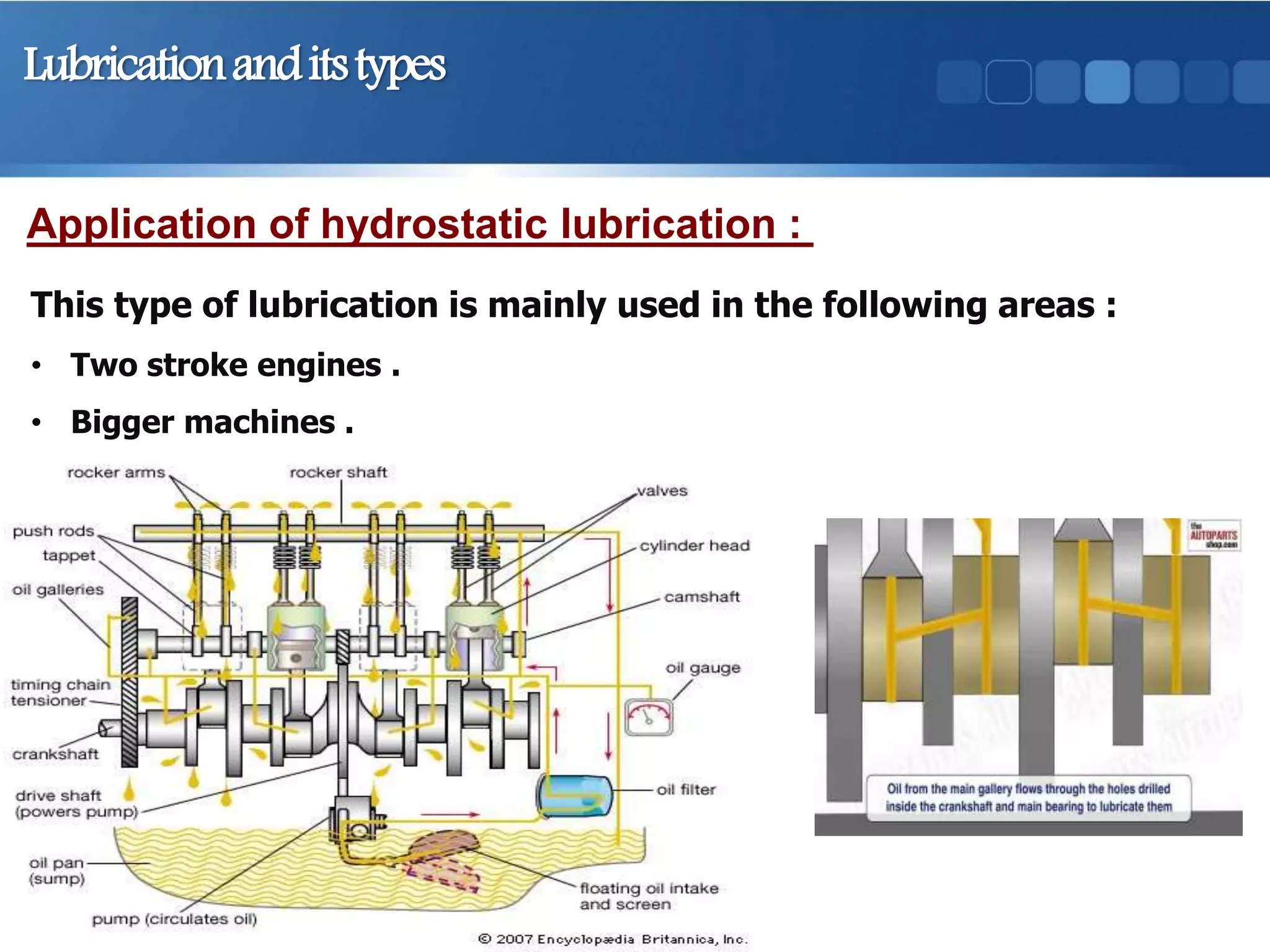
Hydrostatic lubrication relies on external oil pressure; used in large machinery and two-stroke engines.
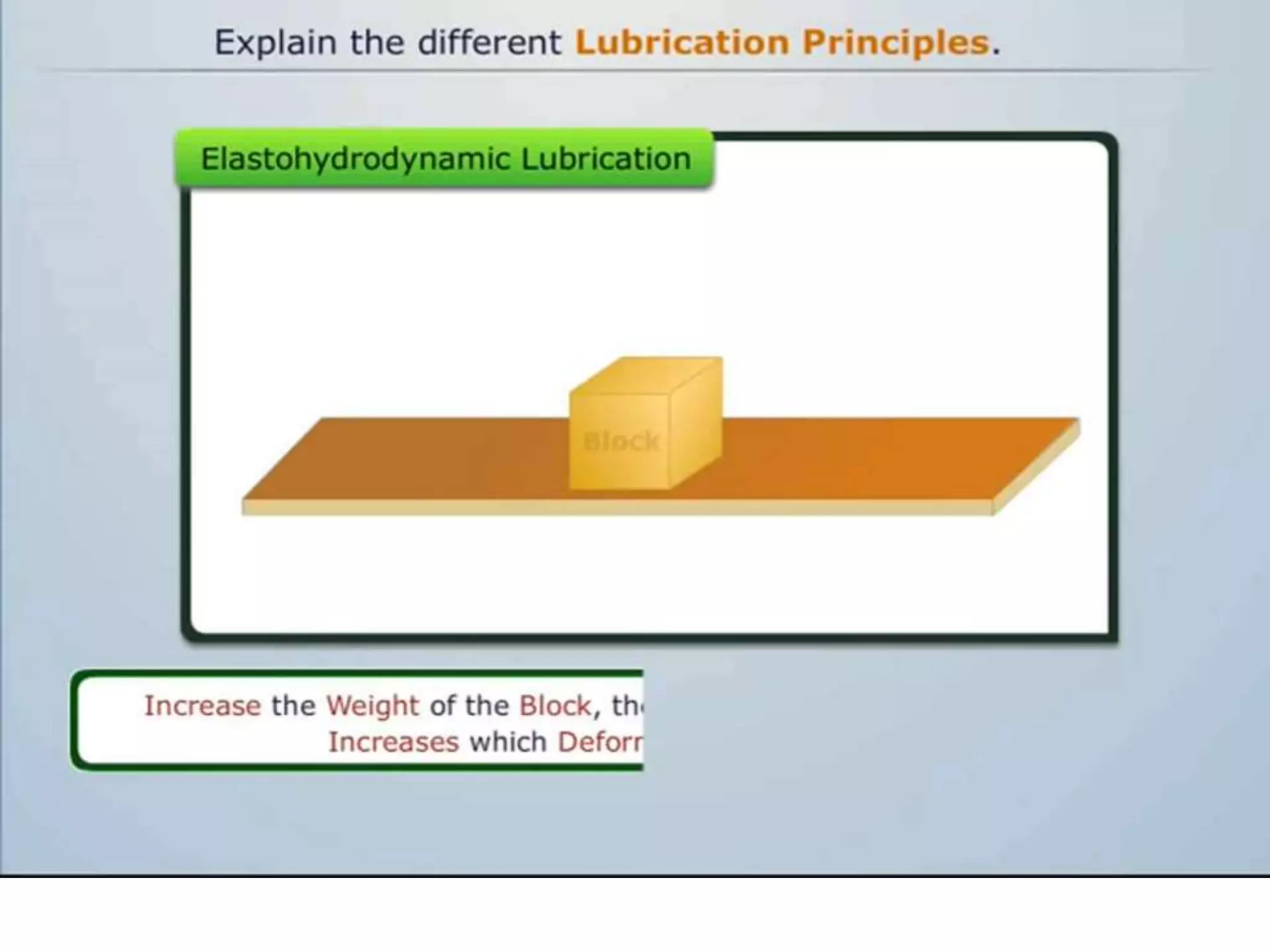
Elastohydrodynamic lubrication occurs under heavy loads; improves load capacity through elastic deformation.Boundary lubrication features minimal film thickness; occurs under specific speed and load conditions.Mixed lubrication is a transition phase where surfaces are partly separated and partly in contact.
Extreme pressure lubrication is for high load and temperature; includes additives to reduce friction and wear.
Summary of lubrication types related to load and speed; discusses the importance and cost of lubrication.Final thoughts on lubrication's significance; open for questions.
Lubricationanditstypes
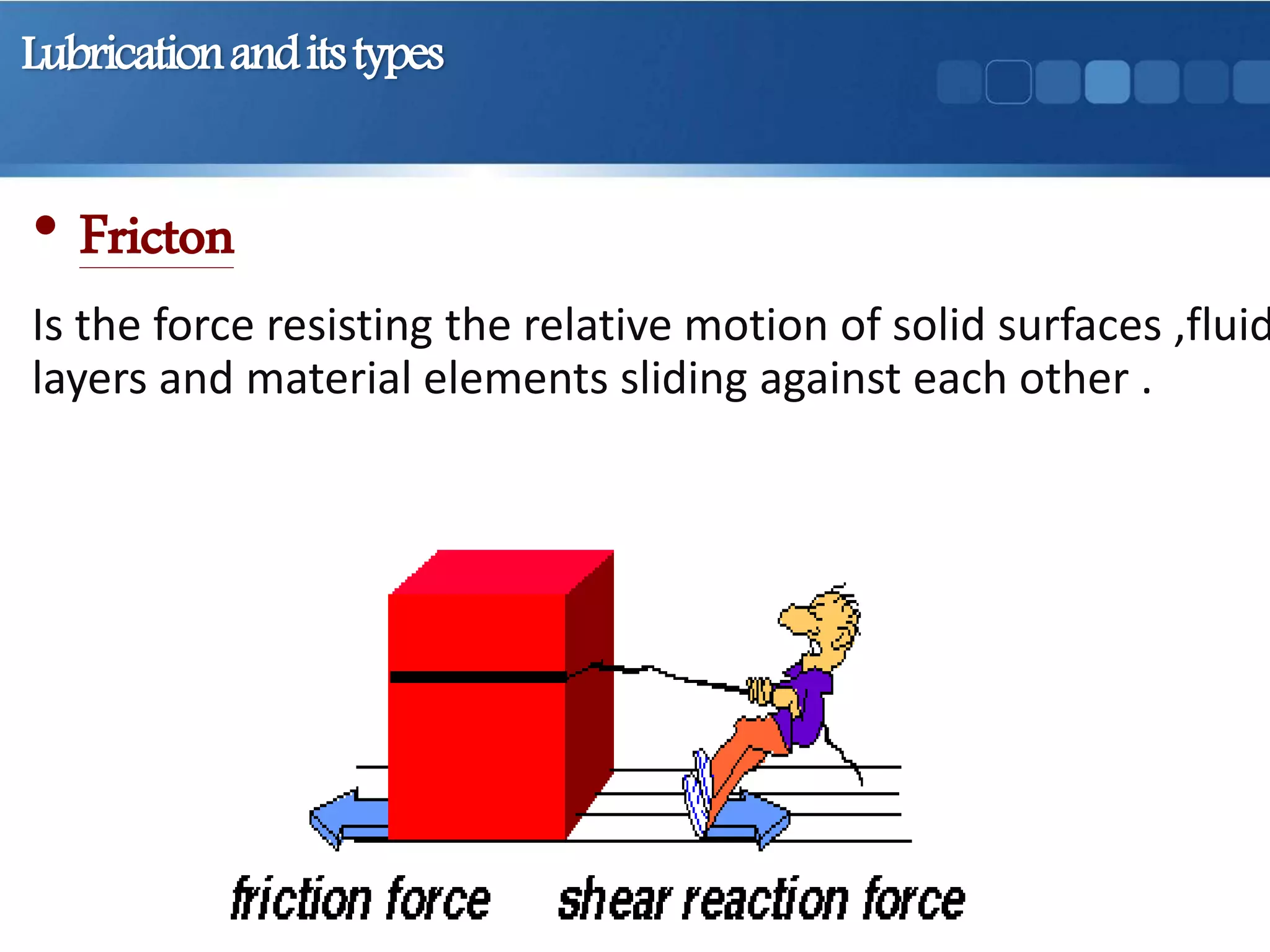
• Fricton
Is theforce resisting the relative motion of solid surfaces ,fluid
layers and material elements sliding against each other .
4.
Lubricationanditstypes
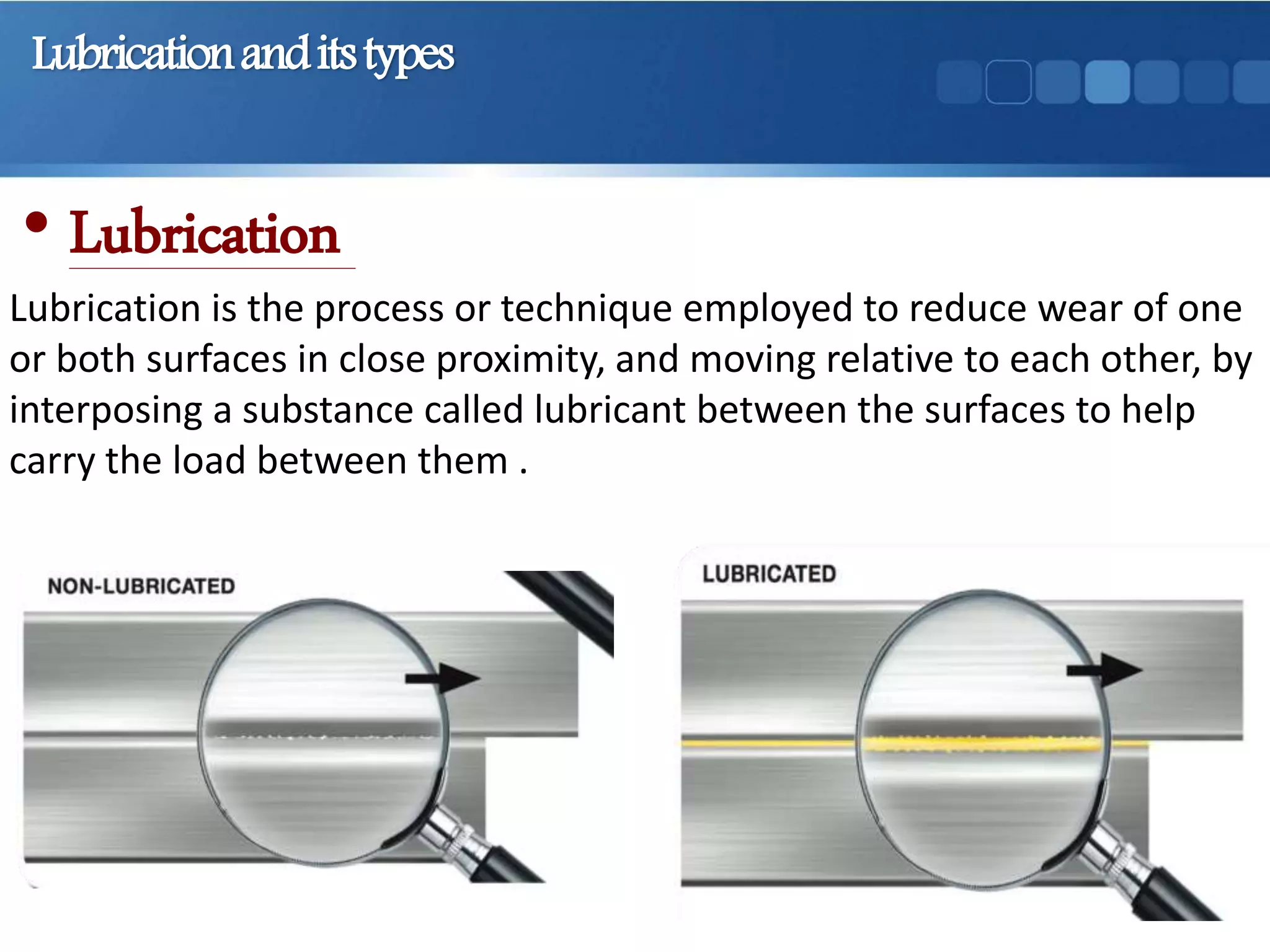
• Lubrication
Lubrication isthe process or technique employed to reduce wear of one
or both surfaces in close proximity, and moving relative to each other, by
interposing a substance called lubricant between the surfaces to help
carry the load between them .
6.
Lubricationanditstypes
• Why lubricationis needed ???
• Friction / Wear
• Heat generation
• Increases life of machinery
• Reduces energy consumption
• Material protection
• Sealing
Lubricationanditstypes
Types of lubrication
Consideringthe nature of motion between moving or sliding surfaces,
there are different types or mechanisms by which the lubrication is
done , They are:
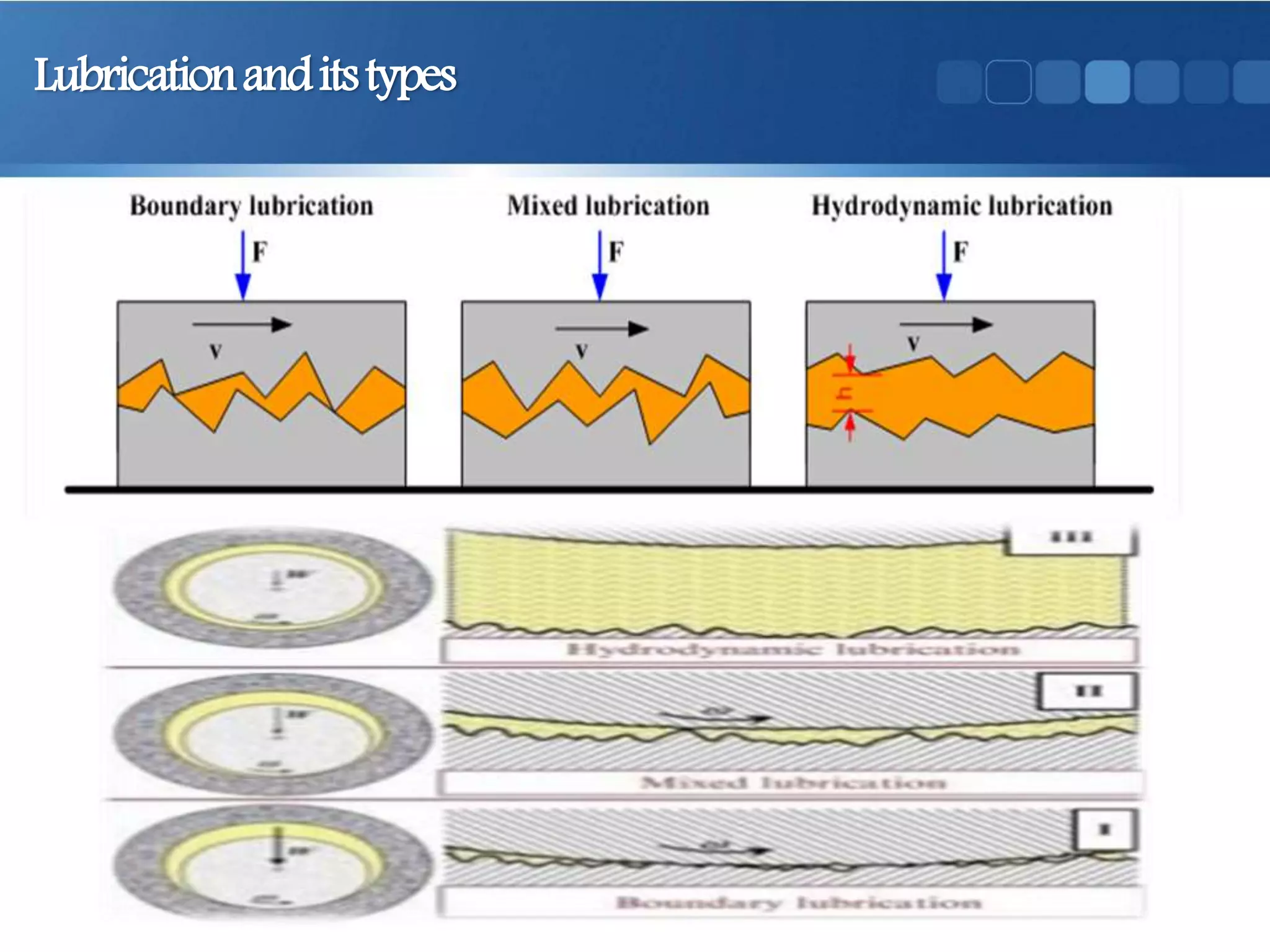
1. Hydrodynamic orThick Film Lubrication
2. Hydrostatic lubrication
3. Elastohydrodynamic lubrication
4. Boundary or thin film lubrication
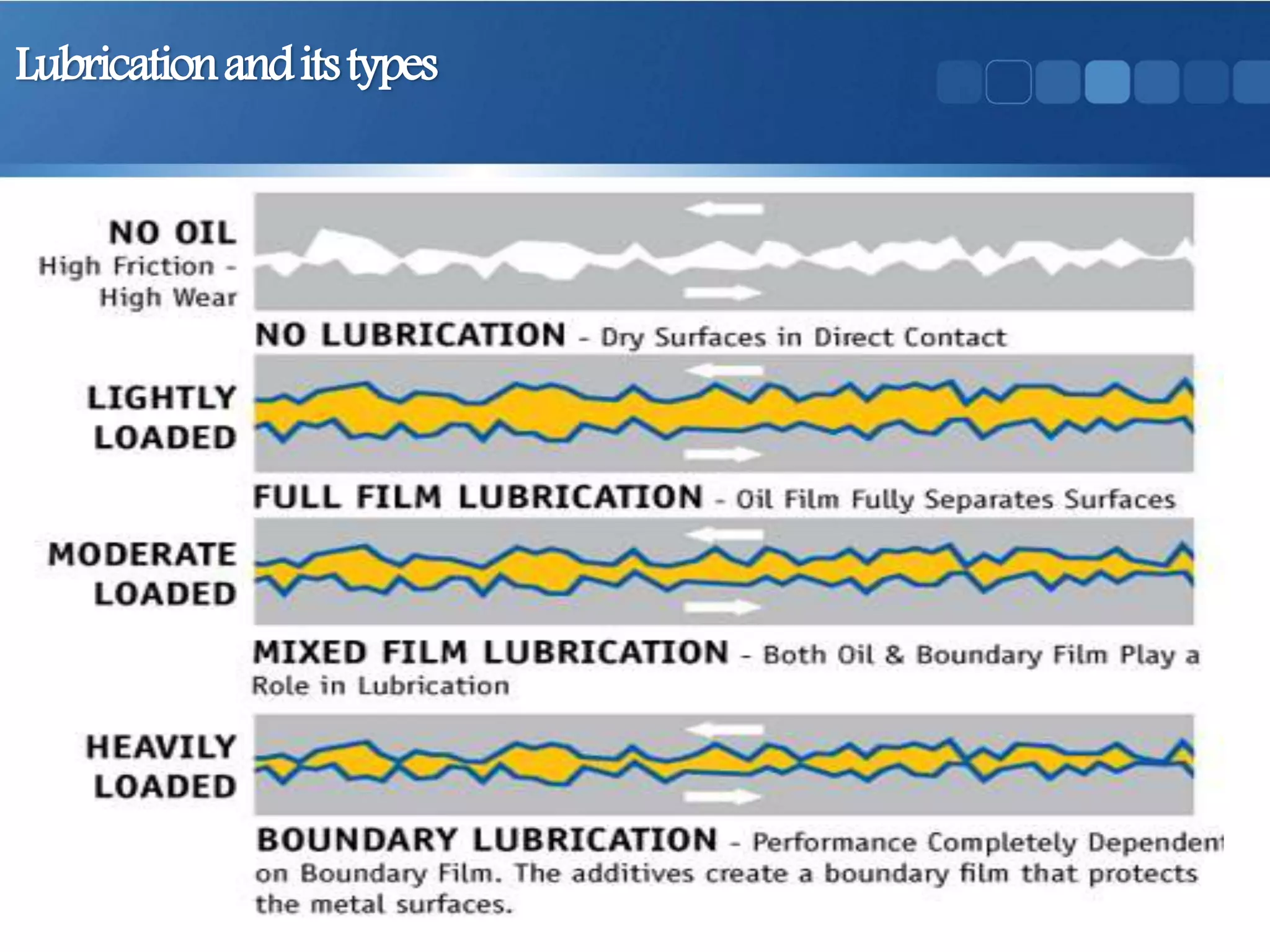
5. Mixed lubrication
6. Extreme pressure lubrication
9.
Lubricationanditstypes
1. Hydrodynamic or(Thick Film Lubrication)
• is exist when the moving surfaces are separated by the pressure of a continuous
unbroken film or layer of lubrication.
• In this type , the load is taken completely by the oil film.
• It depends on the relative speed between the surfaces, oil viscosity, load, and
clearance between the moving or sliding surfaces.
12.
Lubricationanditstypes
Application of hydrodynamiclubrication :
Delicate instruments.
Light machines like watches, clocks, guns, sewing machines.
Scientific instruments .
Large plain bearings like pedestal bearings, main bearing of diesel
engine .
الحساسه او الدقيقه االجهزه
القياس واجهزه الميكروسكوب مثل الحساسه العلميه االجهزه
13.
Lubricationanditstypes
2 . Hydrostaticlubrication
• It is essentially a form of hydrodynamic lubrication .
• But the film instead of being self-generated, the separating
pressure is supplied by an external oil pump .
• Hydrostatic lubrication depends on the inlet pressure of oil and
clearance between the surfaces .
Lubricationanditstypes
3. Elastohydrodynamic lubrication
•Is developed in heavily loaded rolling contacts .
• film.
• High pressure results in increasing viscosity of lubricant , which
improves load capacity .
• The contacting surface is elastically deformed,distributing the load
over a greater area .
19.
Examples of machineryapplications that operate under EHL are:
• rolling element bearings, gear teeth and cam contacts (rolling)
where high rolling contact loads occur.
Lubricationanditstypes
20.
Lubricationanditstypes
4. Boundary orthin film lubrication
• Lubrication film is insufficient to separate the contacting surfaces.
• the oil film thickness is so small .
• metal to metal contact occurs between the moving surfaces .
Lubricationanditstypes
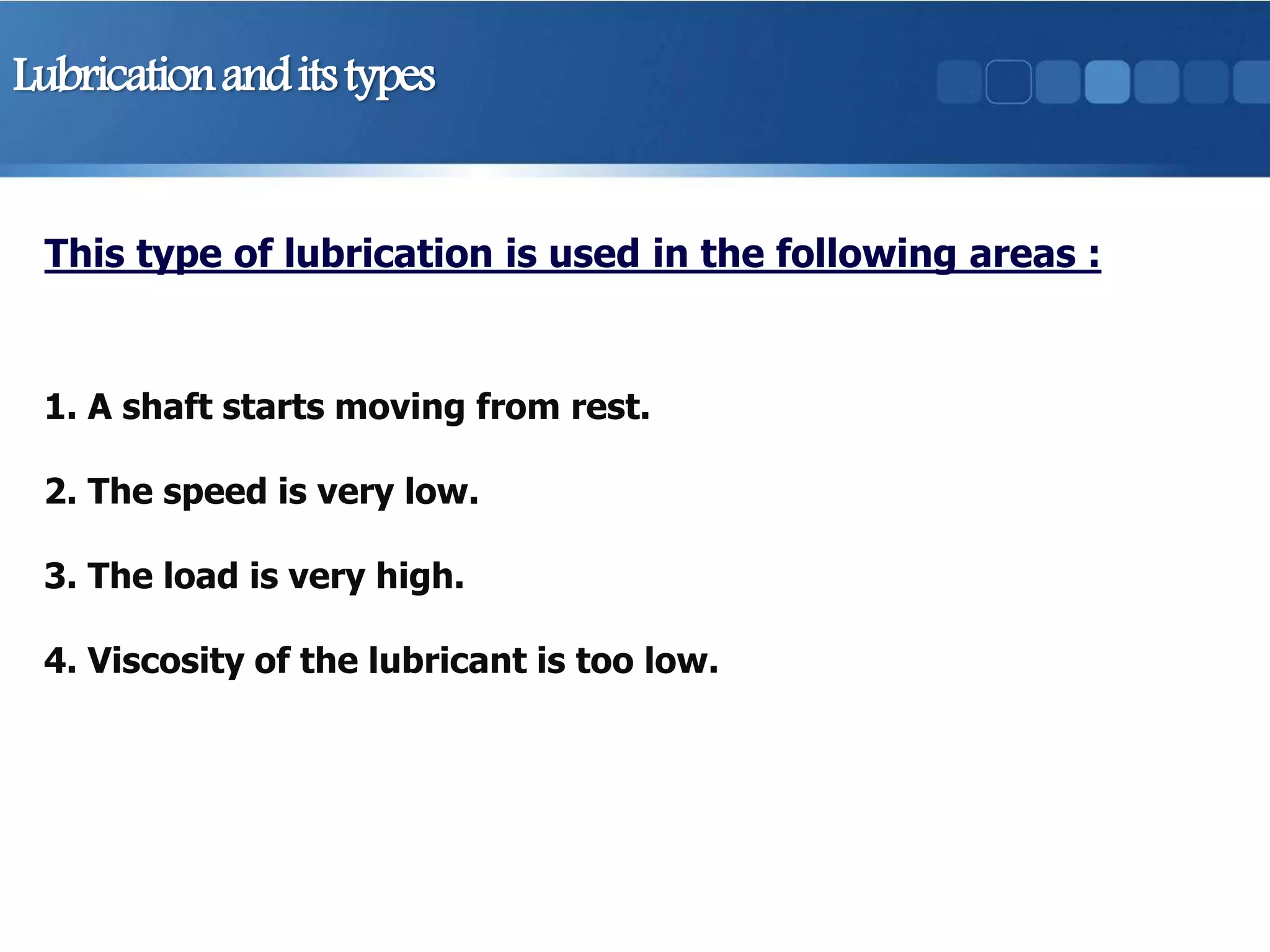
This type oflubrication is used in the following areas :
1. A shaft starts moving from rest.
2. The speed is very low.
3. The load is very high.
4. Viscosity of the lubricant is too low.
Lubricationanditstypes
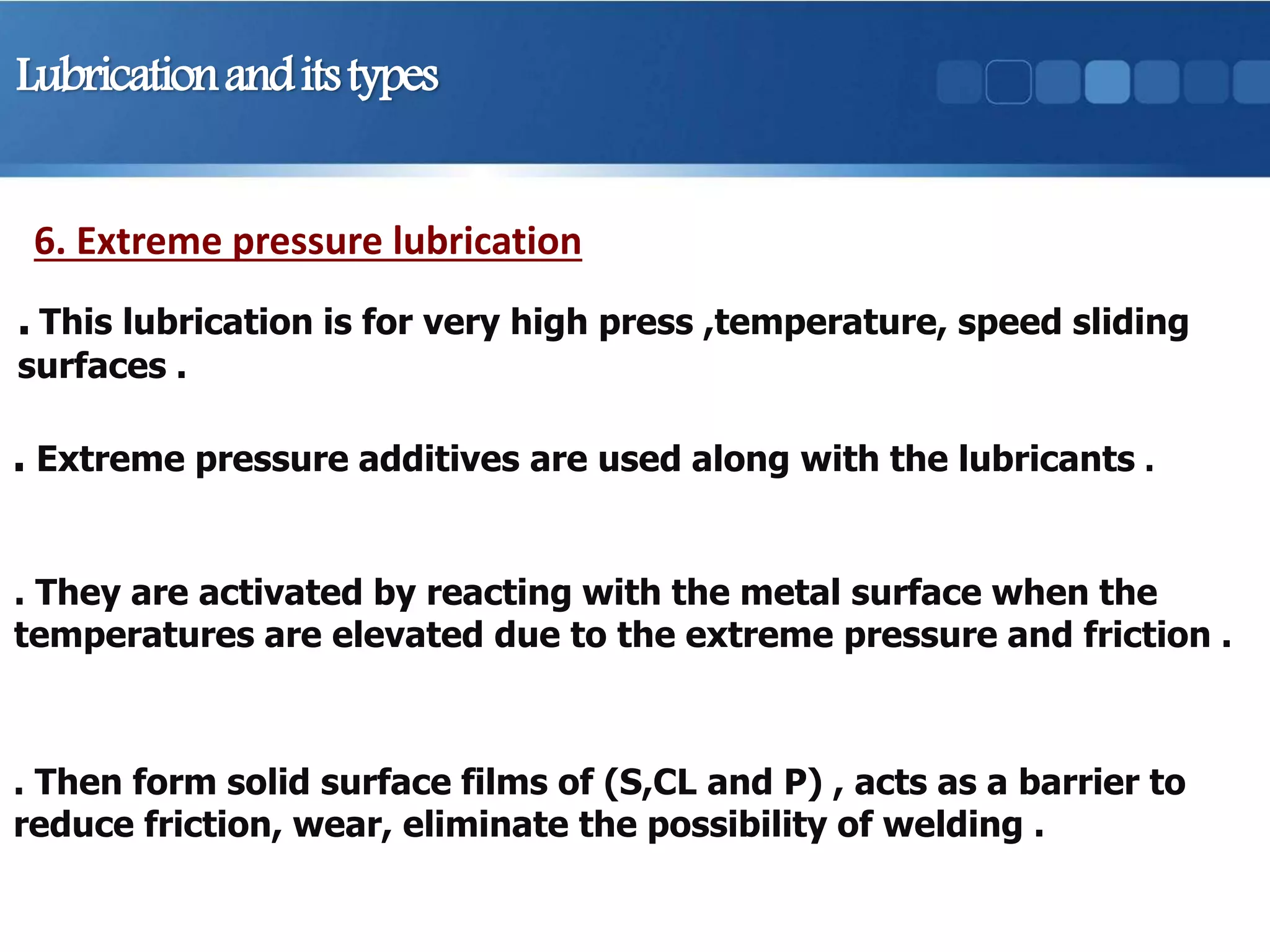
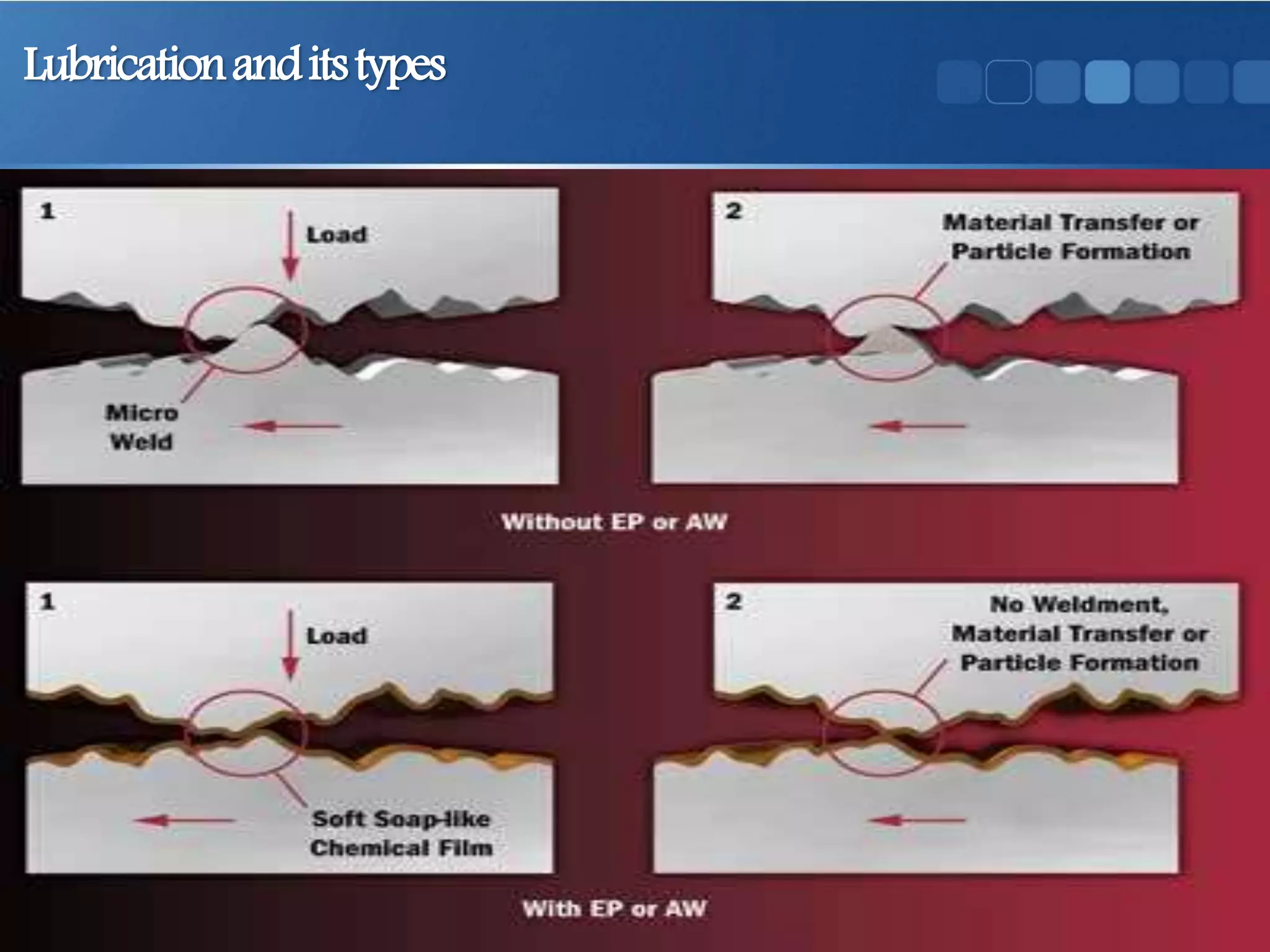
6. Extreme pressurelubrication
. This lubrication is for very high press ,temperature, speed sliding
surfaces .
. Extreme pressure additives are used along with the lubricants .
. Then form solid surface films of (S,CL and P) , acts as a barrier to
reduce friction, wear, eliminate the possibility of welding .
. They are activated by reacting with the metal surface when the
temperatures are elevated due to the extreme pressure and friction .