Principles of tribology
Wear
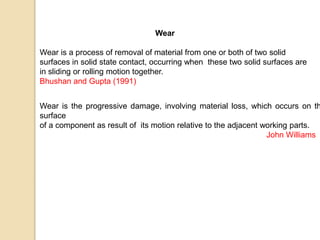
Wear is a process of removal of material from one or both of two solid
surfaces in solid state contact, occurring when these two solid surfaces are
in sliding or rolling motion together.
Bhushan and Gupta (1991)
Wear is the progressive damage, involving material loss, which occurs on th
surface
of a component as result of its motion relative to the adjacent working parts.
John Williams
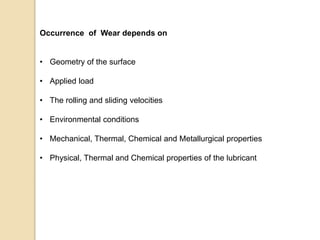
Occurrence of Wear depends on
• Geometry of the surface
• Applied load
• The rolling and sliding velocities
• Environmental conditions
• Mechanical, Thermal, Chemical and Metallurgical properties
• Physical, Thermal and Chemical properties of the lubricant
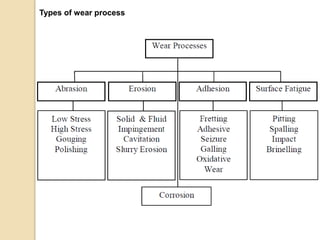
Types of wear process
Abrasive wear
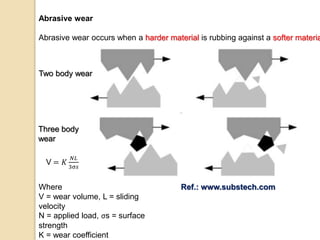
Abrasive wear occurs when a harder material is rubbing against a softer materia
V = 𝐾
𝑁𝐿
3σ𝑠
Where
V = wear volume, L = sliding
velocity
N = applied load, σs = surface
strength
K = wear coefficient
Ref.: www.substech.com
Two body wear
Three body
wear
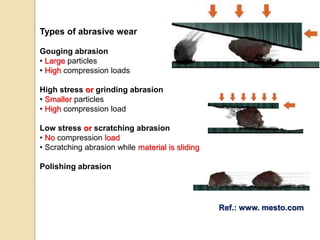
Types of abrasive wear
Gouging abrasion
• Large particles
• High compression loads
High stress or grinding abrasion
• Smaller particles
• High compression load
Low stress or scratching abrasion
• No compression load
• Scratching abrasion while material is sliding
Polishing abrasion
Ref.: www. mesto.com
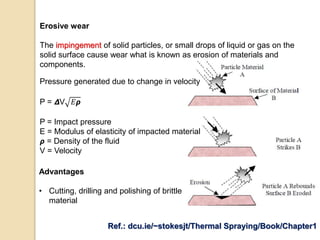
Erosive wear
The impingement of solid particles, or small drops of liquid or gas on the
solid surface cause wear what is known as erosion of materials and
components.
Pressure generated due to change in velocity
P = 𝞓V 𝐸𝞺
P = Impact pressure
E = Modulus of elasticity of impacted material
𝞺 = Density of the fluid
V = Velocity
Advantages
• Cutting, drilling and polishing of brittle
material
Ref.: dcu.ie/~stokesjt/Thermal Spraying/Book/Chapter1
Types of erosion
Solid particle erosion
Surface wear by impingement of solid particles carried by a gas or fluid.
e.g. Wear of helicopter blade leading edges in dusty environments.
• Liquid drop erosion
Surface wear by impingement of liquid drops.
e.g. Wear of centrifugal gas compressor blades by condensate droplets.
• Cavitation erosion
Surface wear in a flowing liquid by the generation and implosive collapse of
gas bubbles.
e.g. Fluid-handling machines as marine propellers, dam slipways, gates, and
all other hydraulic turbines.
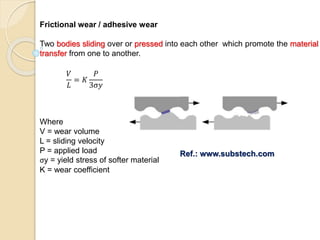
Frictional wear / adhesive wear
Two bodies sliding over or pressed into each other which promote the material
transfer from one to another.
𝑉
𝐿
= 𝐾
𝑃
3σ𝑦
Where
V = wear volume
L = sliding velocity
P = applied load
σy = yield stress of softer material
K = wear coefficient
Ref.: www.substech.com
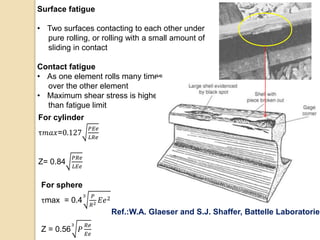
Surface fatigue
• Two surfaces contacting to each other under
pure rolling, or rolling with a small amount of
sliding in contact
Contact fatigue
• As one element rolls many times
over the other element
• Maximum shear stress is higher
than fatigue limit
For cylinder
τ𝑚𝑎𝑥=0.127
𝑃𝐸𝑒
𝐿𝑅𝑒
Z= 0.84
𝑃𝑅𝑒
𝐿𝐸𝑒
For sphere
τmax = 0.4
3 𝑃
𝑅2 𝐸𝑒2
Z = 0.56
3
𝑃
𝑅𝑒
𝐸𝑒
Ref.:W.A. Glaeser and S.J. Shaffer, Battelle Laboratories
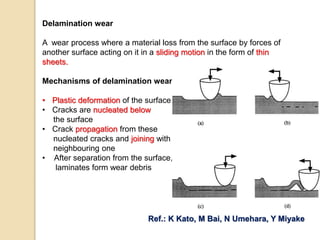
Delamination wear
A wear process where a material loss from the surface by forces of
another surface acting on it in a sliding motion in the form of thin
sheets.
Mechanisms of delamination wear
• Plastic deformation of the surface
• Cracks are nucleated below
the surface
• Crack propagation from these
nucleated cracks and joining with
neighbouring one
• After separation from the surface,
laminates form wear debris
Ref.: K Kato, M Bai, N Umehara, Y Miyake
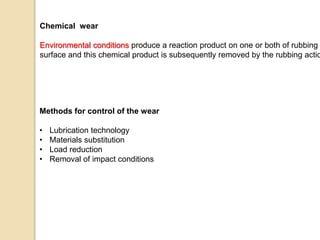
Chemical wear
Environmental conditions produce a reaction product on one or both of rubbing
surface and this chemical product is subsequently removed by the rubbing actio
Methods for control of the wear
• Lubrication technology
• Materials substitution
• Load reduction
• Removal of impact conditions
References
• Effect of internal stress of CNx coating on its wear in sliding friction - K
Kato, M Bai, N Umehara, Y Miyake
• TRIBOLOGY: THE SCIENCE OF COMBATTING WEAR - William A
Glaeser (Member, STLE), Richard C Erickson (Member, STLE), Keith F
Dufrane (Member, STLE) and
Jerrold W Kannel Battelle Columbus, Ohio
• Classification of wear mechanisms/models - K Kato
• www.rermwiki.com
• W.A. Glaeser and S.J. Shaffer, Battelle Laboratories
• www.substec.com
• Friction and lubrication in mechanical design – A. A. Seireg
• ocw.mit.edu/courses/mechanical-engineering/2-800-tribology
• dcu.ie/~stokesjt/Thermal Spraying/Book/Chapter1
• Wikipedia
Wear

Wear

  • 1.
  • 2.
    Wear Wear is aprocess of removal of material from one or both of two solid surfaces in solid state contact, occurring when these two solid surfaces are in sliding or rolling motion together. Bhushan and Gupta (1991) Wear is the progressive damage, involving material loss, which occurs on th surface of a component as result of its motion relative to the adjacent working parts. John Williams
  • 3.
    Occurrence of Weardepends on • Geometry of the surface • Applied load • The rolling and sliding velocities • Environmental conditions • Mechanical, Thermal, Chemical and Metallurgical properties • Physical, Thermal and Chemical properties of the lubricant
  • 4.
  • 5.
    Abrasive wear Abrasive wearoccurs when a harder material is rubbing against a softer materia V = 𝐾 𝑁𝐿 3σ𝑠 Where V = wear volume, L = sliding velocity N = applied load, σs = surface strength K = wear coefficient Ref.: www.substech.com Two body wear Three body wear
  • 6.
    Types of abrasivewear Gouging abrasion • Large particles • High compression loads High stress or grinding abrasion • Smaller particles • High compression load Low stress or scratching abrasion • No compression load • Scratching abrasion while material is sliding Polishing abrasion Ref.: www. mesto.com
  • 7.
    Erosive wear The impingementof solid particles, or small drops of liquid or gas on the solid surface cause wear what is known as erosion of materials and components. Pressure generated due to change in velocity P = 𝞓V 𝐸𝞺 P = Impact pressure E = Modulus of elasticity of impacted material 𝞺 = Density of the fluid V = Velocity Advantages • Cutting, drilling and polishing of brittle material Ref.: dcu.ie/~stokesjt/Thermal Spraying/Book/Chapter1
  • 8.
    Types of erosion Solidparticle erosion Surface wear by impingement of solid particles carried by a gas or fluid. e.g. Wear of helicopter blade leading edges in dusty environments. • Liquid drop erosion Surface wear by impingement of liquid drops. e.g. Wear of centrifugal gas compressor blades by condensate droplets. • Cavitation erosion Surface wear in a flowing liquid by the generation and implosive collapse of gas bubbles. e.g. Fluid-handling machines as marine propellers, dam slipways, gates, and all other hydraulic turbines.
  • 9.
    Frictional wear /adhesive wear Two bodies sliding over or pressed into each other which promote the material transfer from one to another. 𝑉 𝐿 = 𝐾 𝑃 3σ𝑦 Where V = wear volume L = sliding velocity P = applied load σy = yield stress of softer material K = wear coefficient Ref.: www.substech.com
  • 10.
    Surface fatigue • Twosurfaces contacting to each other under pure rolling, or rolling with a small amount of sliding in contact Contact fatigue • As one element rolls many times over the other element • Maximum shear stress is higher than fatigue limit For cylinder τ𝑚𝑎𝑥=0.127 𝑃𝐸𝑒 𝐿𝑅𝑒 Z= 0.84 𝑃𝑅𝑒 𝐿𝐸𝑒 For sphere τmax = 0.4 3 𝑃 𝑅2 𝐸𝑒2 Z = 0.56 3 𝑃 𝑅𝑒 𝐸𝑒 Ref.:W.A. Glaeser and S.J. Shaffer, Battelle Laboratories
  • 11.
    Delamination wear A wearprocess where a material loss from the surface by forces of another surface acting on it in a sliding motion in the form of thin sheets. Mechanisms of delamination wear • Plastic deformation of the surface • Cracks are nucleated below the surface • Crack propagation from these nucleated cracks and joining with neighbouring one • After separation from the surface, laminates form wear debris Ref.: K Kato, M Bai, N Umehara, Y Miyake
  • 12.
    Chemical wear Environmental conditionsproduce a reaction product on one or both of rubbing surface and this chemical product is subsequently removed by the rubbing actio Methods for control of the wear • Lubrication technology • Materials substitution • Load reduction • Removal of impact conditions
  • 13.
    References • Effect ofinternal stress of CNx coating on its wear in sliding friction - K Kato, M Bai, N Umehara, Y Miyake • TRIBOLOGY: THE SCIENCE OF COMBATTING WEAR - William A Glaeser (Member, STLE), Richard C Erickson (Member, STLE), Keith F Dufrane (Member, STLE) and Jerrold W Kannel Battelle Columbus, Ohio • Classification of wear mechanisms/models - K Kato • www.rermwiki.com • W.A. Glaeser and S.J. Shaffer, Battelle Laboratories • www.substec.com • Friction and lubrication in mechanical design – A. A. Seireg • ocw.mit.edu/courses/mechanical-engineering/2-800-tribology • dcu.ie/~stokesjt/Thermal Spraying/Book/Chapter1 • Wikipedia