Madhuram Bambhaniya
ME-2
126540319569
Wear
Wear
 Wear is a process of removal of material from one or both of two solid
surfaces in solid state contact, occurring when these two solid surfaces are
in sliding or rolling motivation
 Wear is the progressive damage, involving material loss, whic
occurs on the surface
 of a compent as result of its motion relative to the adjacen
working p
Occurrence of Wear depends on
• Geometry of the surface
• Applied load
• The rolling and sliding velocities
• Environmental conditions
• Mechanical, Thermal, Chemical and Metallurgical properties
• Physical, Thermal and Chemical properties of the lubricant
Types of wear process
Abrasive wear
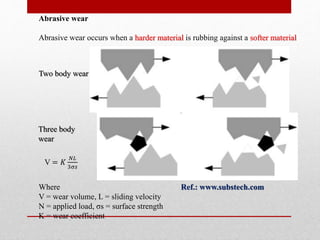
Abrasive wear occurs when a harder material is rubbing against a softer material
V = 𝐾
𝑁𝐿
3σ𝑠
Where
V = wear volume, L = sliding velocity
N = applied load, σs = surface strength
K = wear coefficient
Ref.: www.substech.com
Two body wear
Three body
wear
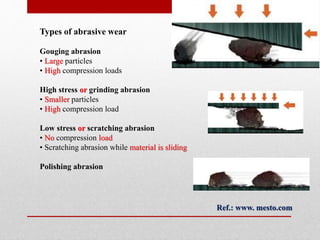
Types of abrasive wear
Gouging abrasion
• Large particles
• High compression loads
High stress or grinding abrasion
• Smaller particles
• High compression load
Low stress or scratching abrasion
• No compression load
• Scratching abrasion while material is sliding
Polishing abrasion
Ref.: www. mesto.com
Types of erosion
Solid particle erosion
Surface wear by impingement of solid particles carried by a gas or fluid.
e.g. Wear of helicopter blade leading edges in dusty environments.
• Liquid drop erosion
Surface wear by impingement of liquid drops.
e.g. Wear of centrifugal gas compressor blades by condensate droplets.
• Cavitation erosion
Surface wear in a flowing liquid by the generation and implosive collapse of
gas bubbles.
e.g. Fluid-handling machines as marine propellers, dam slipways, gates, and
all other hydraulic turbines.
Surface fatigue
• Two surfaces contacting to each other under
pure rolling, or rolling with a small amount of
sliding in contact
Contact fatigue
• As one element rolls many times
over the other element
• Maximum shear stress is higher
than fatigue limit
For cylinder
τ𝑚𝑎𝑥=0.127
𝑃𝐸𝑒
𝐿𝑅𝑒
Z= 0.84
𝑃𝑅𝑒
𝐿𝐸𝑒
For sphere
τmax = 0.4
3 𝑃
𝑅2 𝐸𝑒2
Z = 0.56
3
𝑃
𝑅𝑒
𝐸𝑒
Ref.:W.A. Glaeser and S.J. Shaffer, Battelle Laboratories
Wear ppt

Wear ppt

  • 1.
  • 2.
    Wear  Wear isa process of removal of material from one or both of two solid surfaces in solid state contact, occurring when these two solid surfaces are in sliding or rolling motivation  Wear is the progressive damage, involving material loss, whic occurs on the surface  of a compent as result of its motion relative to the adjacen working p
  • 3.
    Occurrence of Weardepends on • Geometry of the surface • Applied load • The rolling and sliding velocities • Environmental conditions • Mechanical, Thermal, Chemical and Metallurgical properties • Physical, Thermal and Chemical properties of the lubricant
  • 4.
  • 5.
    Abrasive wear Abrasive wearoccurs when a harder material is rubbing against a softer material V = 𝐾 𝑁𝐿 3σ𝑠 Where V = wear volume, L = sliding velocity N = applied load, σs = surface strength K = wear coefficient Ref.: www.substech.com Two body wear Three body wear
  • 6.
    Types of abrasivewear Gouging abrasion • Large particles • High compression loads High stress or grinding abrasion • Smaller particles • High compression load Low stress or scratching abrasion • No compression load • Scratching abrasion while material is sliding Polishing abrasion Ref.: www. mesto.com
  • 7.
    Types of erosion Solidparticle erosion Surface wear by impingement of solid particles carried by a gas or fluid. e.g. Wear of helicopter blade leading edges in dusty environments. • Liquid drop erosion Surface wear by impingement of liquid drops. e.g. Wear of centrifugal gas compressor blades by condensate droplets. • Cavitation erosion Surface wear in a flowing liquid by the generation and implosive collapse of gas bubbles. e.g. Fluid-handling machines as marine propellers, dam slipways, gates, and all other hydraulic turbines.
  • 8.
    Surface fatigue • Twosurfaces contacting to each other under pure rolling, or rolling with a small amount of sliding in contact Contact fatigue • As one element rolls many times over the other element • Maximum shear stress is higher than fatigue limit For cylinder τ𝑚𝑎𝑥=0.127 𝑃𝐸𝑒 𝐿𝑅𝑒 Z= 0.84 𝑃𝑅𝑒 𝐿𝐸𝑒 For sphere τmax = 0.4 3 𝑃 𝑅2 𝐸𝑒2 Z = 0.56 3 𝑃 𝑅𝑒 𝐸𝑒 Ref.:W.A. Glaeser and S.J. Shaffer, Battelle Laboratories