
Engr. Tarique Ahmed Memon
Lecturer @ Department of Mechanical Engineering
Quaid-e-Awam University of Engineering, Science &
Technology (QUEST) Campus Larkano, Sindh, Pakistan.
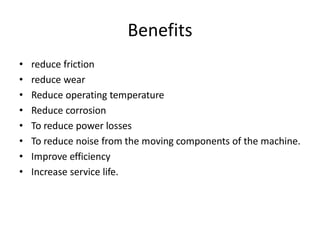
Benefits
• reduce friction
• reduce wear
• Reduce operating temperature
• Reduce corrosion
• To reduce power losses
• To reduce noise from the moving components of the machine.
• Improve efficiency
• Increase service life.
Lubrication
• Any substance introduced between two moving surfaces with a
view to reduce the friction (or frictional resistance) between them,
is known as a lubricant.
• Lubrication plays a most vital role in our great and complex
civilization.
• Every moving part of machine is subjected to friction and wear.
• Friction consumes and wastes energy.
• Wear causes changes in dimensions, and eventual breakdown of
machine element and the entire machine and all that depends
upon it.
• The aspect of loss of energy due to friction is surprisingly large.
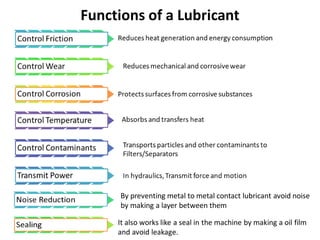
Functions of a Lubricant
By preventing metal to metal contact lubricant avoid noise
by making a layer between them
It also works like a seal in the machine by making a oil film
and avoid leakage.
Types of Lubrication
• Boundary or Thin Film Lubrication
• Hydrostatic Lubrication
• Hydrodynamic or Thick Film Lubrication
• Elasto hydrodynamic Lubrication
• Mixed Lubrication
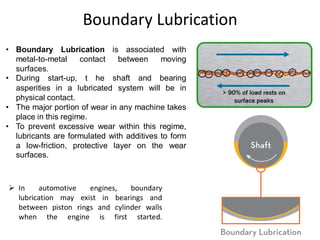
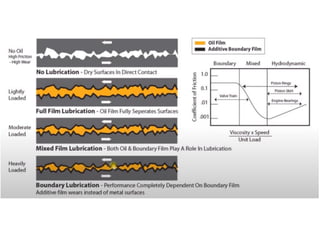
Boundary Lubrication
• Boundary Lubrication is associated with
metal-to-metal contact between moving
surfaces.
• During start-up, t he shaft and bearing
asperities in a lubricated system will be in
physical contact.
• The major portion of wear in any machine takes
place in this regime.
• To prevent excessive wear within this regime,
lubricants are formulated with additives to form
a low-friction, protective layer on the wear
surfaces.
 In automotive engines, boundary
lubrication may exist in bearings and
between piston rings and cylinder walls
when the engine is first started.
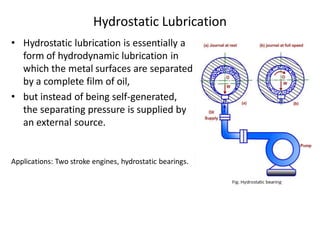
Hydrostatic Lubrication
• Hydrostatic lubrication is essentially a
form of hydrodynamic lubrication in
which the metal surfaces are separated
by a complete film of oil,
• but instead of being self-generated,
the separating pressure is supplied by
an external source.
Applications: Two stroke engines, hydrostatic bearings.
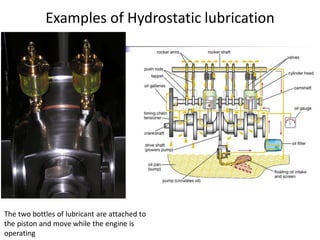
Examples of Hydrostatic lubrication
The two bottles of lubricant are attached to
the piston and move while the engine is
operating
Hydrodynamic or Thick Film Lubrication
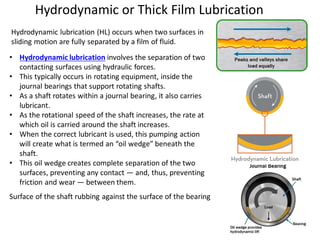
Surface of the shaft rubbing against the surface of the bearing
Hydrodynamic lubrication (HL) occurs when two surfaces in
sliding motion are fully separated by a film of fluid.
• Hydrodynamic lubrication involves the separation of two
contacting surfaces using hydraulic forces.
• This typically occurs in rotating equipment, inside the
journal bearings that support rotating shafts.
• As a shaft rotates within a journal bearing, it also carries
lubricant.
• As the rotational speed of the shaft increases, the rate at
which oil is carried around the shaft increases.
• When the correct lubricant is used, this pumping action
will create what is termed an “oil wedge” beneath the
shaft.
• This oil wedge creates complete separation of the two
surfaces, preventing any contact — and, thus, preventing
friction and wear — between them.
Elasto hydrodynamic Lubrication
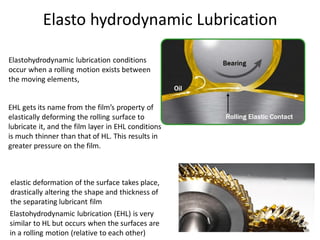
Elastohydrodynamic lubrication conditions
occur when a rolling motion exists between
the moving elements,
Elastohydrodynamic lubrication (EHL) is very
similar to HL but occurs when the surfaces are
in a rolling motion (relative to each other)
EHL gets its name from the film’s property of
elastically deforming the rolling surface to
lubricate it, and the film layer in EHL conditions
is much thinner than that of HL. This results in
greater pressure on the film.
elastic deformation of the surface takes place,
drastically altering the shape and thickness of
the separating lubricant film
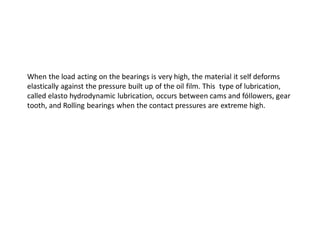
When the load acting on the bearings is very high, the material it self deforms
elastically against the pressure built up of the oil film. This type of lubrication,
called elasto hydrodynamic lubrication, occurs between cams and fóIlowers, gear
tooth, and Rolling bearings when the contact pressures are extreme high.
Mixed Lubrication
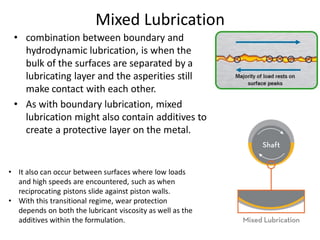
• combination between boundary and
hydrodynamic lubrication, is when the
bulk of the surfaces are separated by a
lubricating layer and the asperities still
make contact with each other.
• As with boundary lubrication, mixed
lubrication might also contain additives to
create a protective layer on the metal.
• It also can occur between surfaces where low loads
and high speeds are encountered, such as when
reciprocating pistons slide against piston walls.
• With this transitional regime, wear protection
depends on both the lubricant viscosity as well as the
additives within the formulation.
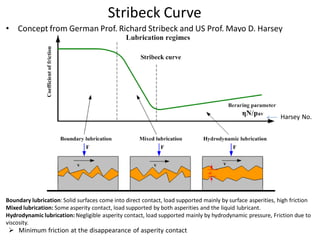
Stribeck Curve
• Concept from German Prof. Richard Stribeck and US Prof. Mayo D. Harsey
Boundary lubrication: Solid surfaces come into direct contact, load supported mainly by surface asperities, high friction
Mixed lubrication: Some asperity contact, load supported by both asperities and the liquid lubricant.
Hydrodynamic lubrication: Negligible asperity contact, load supported mainly by hydrodynamic pressure, Friction due to
viscosity.
 Minimum friction at the disappearance of asperity contact
Harsey No.
THE END

Lubrication,Types & Stribeck Curve

  • 1.
    Engr. Tarique AhmedMemon Lecturer @ Department of Mechanical Engineering Quaid-e-Awam University of Engineering, Science & Technology (QUEST) Campus Larkano, Sindh, Pakistan.
  • 2.
    Benefits • reduce friction •reduce wear • Reduce operating temperature • Reduce corrosion • To reduce power losses • To reduce noise from the moving components of the machine. • Improve efficiency • Increase service life.
  • 3.
    Lubrication • Any substanceintroduced between two moving surfaces with a view to reduce the friction (or frictional resistance) between them, is known as a lubricant. • Lubrication plays a most vital role in our great and complex civilization. • Every moving part of machine is subjected to friction and wear. • Friction consumes and wastes energy. • Wear causes changes in dimensions, and eventual breakdown of machine element and the entire machine and all that depends upon it. • The aspect of loss of energy due to friction is surprisingly large.
  • 4.
    Functions of aLubricant By preventing metal to metal contact lubricant avoid noise by making a layer between them It also works like a seal in the machine by making a oil film and avoid leakage.
  • 5.
    Types of Lubrication •Boundary or Thin Film Lubrication • Hydrostatic Lubrication • Hydrodynamic or Thick Film Lubrication • Elasto hydrodynamic Lubrication • Mixed Lubrication
  • 6.
    Boundary Lubrication • BoundaryLubrication is associated with metal-to-metal contact between moving surfaces. • During start-up, t he shaft and bearing asperities in a lubricated system will be in physical contact. • The major portion of wear in any machine takes place in this regime. • To prevent excessive wear within this regime, lubricants are formulated with additives to form a low-friction, protective layer on the wear surfaces.  In automotive engines, boundary lubrication may exist in bearings and between piston rings and cylinder walls when the engine is first started.
  • 7.
    Hydrostatic Lubrication • Hydrostaticlubrication is essentially a form of hydrodynamic lubrication in which the metal surfaces are separated by a complete film of oil, • but instead of being self-generated, the separating pressure is supplied by an external source. Applications: Two stroke engines, hydrostatic bearings.
  • 8.
    Examples of Hydrostaticlubrication The two bottles of lubricant are attached to the piston and move while the engine is operating
  • 9.
    Hydrodynamic or ThickFilm Lubrication Surface of the shaft rubbing against the surface of the bearing Hydrodynamic lubrication (HL) occurs when two surfaces in sliding motion are fully separated by a film of fluid. • Hydrodynamic lubrication involves the separation of two contacting surfaces using hydraulic forces. • This typically occurs in rotating equipment, inside the journal bearings that support rotating shafts. • As a shaft rotates within a journal bearing, it also carries lubricant. • As the rotational speed of the shaft increases, the rate at which oil is carried around the shaft increases. • When the correct lubricant is used, this pumping action will create what is termed an “oil wedge” beneath the shaft. • This oil wedge creates complete separation of the two surfaces, preventing any contact — and, thus, preventing friction and wear — between them.
  • 10.
    Elasto hydrodynamic Lubrication Elastohydrodynamiclubrication conditions occur when a rolling motion exists between the moving elements, Elastohydrodynamic lubrication (EHL) is very similar to HL but occurs when the surfaces are in a rolling motion (relative to each other) EHL gets its name from the film’s property of elastically deforming the rolling surface to lubricate it, and the film layer in EHL conditions is much thinner than that of HL. This results in greater pressure on the film. elastic deformation of the surface takes place, drastically altering the shape and thickness of the separating lubricant film
  • 11.
    When the loadacting on the bearings is very high, the material it self deforms elastically against the pressure built up of the oil film. This type of lubrication, called elasto hydrodynamic lubrication, occurs between cams and fóIlowers, gear tooth, and Rolling bearings when the contact pressures are extreme high.
  • 12.
    Mixed Lubrication • combinationbetween boundary and hydrodynamic lubrication, is when the bulk of the surfaces are separated by a lubricating layer and the asperities still make contact with each other. • As with boundary lubrication, mixed lubrication might also contain additives to create a protective layer on the metal. • It also can occur between surfaces where low loads and high speeds are encountered, such as when reciprocating pistons slide against piston walls. • With this transitional regime, wear protection depends on both the lubricant viscosity as well as the additives within the formulation.
  • 14.
    Stribeck Curve • Conceptfrom German Prof. Richard Stribeck and US Prof. Mayo D. Harsey Boundary lubrication: Solid surfaces come into direct contact, load supported mainly by surface asperities, high friction Mixed lubrication: Some asperity contact, load supported by both asperities and the liquid lubricant. Hydrodynamic lubrication: Negligible asperity contact, load supported mainly by hydrodynamic pressure, Friction due to viscosity.  Minimum friction at the disappearance of asperity contact Harsey No.
  • 15.