Presentation on Wear Measurement
Irwin O. Toppo
Mechanical engineering
Indian Institute of Science,
Bangalore, India
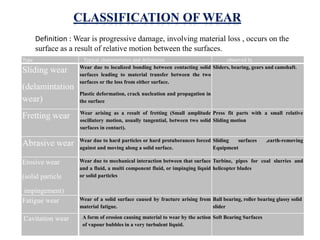
Type Typical characteristics and definitions observed In
Sliding wear
(delamintation
wear)
Wear due to localized bonding between contacting solid
surfaces leading to material transfer between the two
surfaces or the loss from either surface.
Plastic deformation, crack nucleation and propagation in
the surface
Sliders, bearing, gears and camshaft.
Fretting wear Wear arising as a result of fretting (Small amplitude
oscillatory motion, usually tangential, between two solid
surfaces in contact).
Press fit parts with a small relative
Sliding motion
Abrasive wear Wear due to hard particles or hard protuberances forced
against and moving along a solid surface.
Sliding surfaces ,earth-removing
Equipment
Erosive wear
(solid particle
impingement)
Wear due to mechanical interaction between that surface
and a fluid, a multi component fluid, or impinging liquid
or solid particles
Turbine, pipes for coal slurries and
helicopter blades
Fatigue wear Wear of a solid surface caused by fracture arising from
material fatigue.
Ball bearing, roller bearing glassy solid
slider
Cavitation wear A form of erosion causing material to wear by the action
of vapour bubbles in a very turbulent liquid.
Soft Bearing Surfaces
Definition : Wear is progressive damage, involving material loss , occurs on the
surface as a result of relative motion between the surfaces.
Wear Measurement
 Archard wear Equation :
Wα w =wear
w = Normal Load on contact
H= surface hardness of the wearing material
K= wear coefficient (dimensionless)
W= K
= is called Dimensional wear constant
Unit =(volume )/(Load/meter)
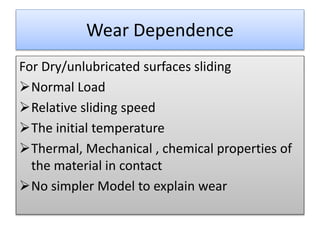
Wear Dependence
For Dry/unlubricated surfaces sliding
Normal Load
Relative sliding speed
The initial temperature
Thermal, Mechanical , chemical properties of
the material in contact
No simpler Model to explain wear
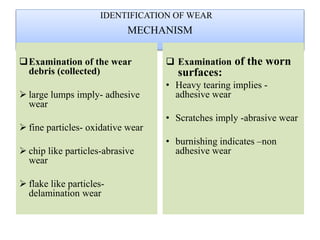
MECHANISM
Examination of the wear
debris (collected)
 large lumps imply- adhesive
wear
 fine particles- oxidative wear
 chip like particles-abrasive
wear
 flake like particles-
delamination wear
 Examination of the worn
surfaces:
• Heavy tearing implies -
adhesive wear
• Scratches imply -abrasive wear
• burnishing indicates –non
adhesive wear
IDENTIFICATION OF WEAR
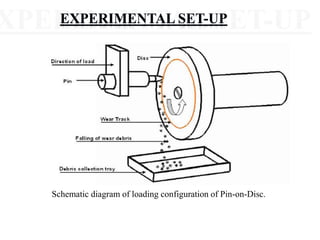
Schematic diagram of loading configuration of Pin-on-Disc.
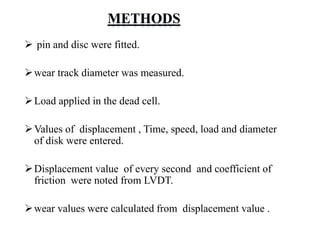
 pin and disc were fitted.
wear track diameter was measured.
Load applied in the dead cell.
Values of displacement , Time, speed, load and diameter
of disk were entered.
Displacement value of every second and coefficient of
friction were noted from LVDT.
wear values were calculated from displacement value .
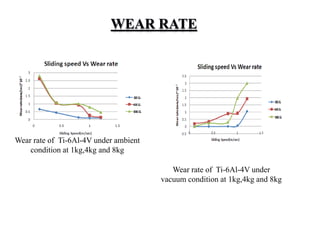
Wear rate of Ti-6Al-4V under
vacuum condition at 1kg,4kg and 8kg
Wear rate of Ti-6Al-4V under ambient
condition at 1kg,4kg and 8kg
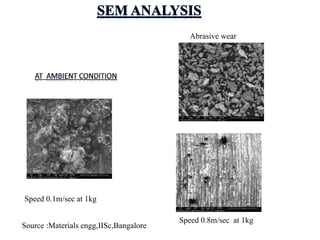
Speed 0.8m/sec at 1kg
Speed 0.1m/sec at 1kg
Abrasive wear
Source :Materials engg,IISc,Bangalore
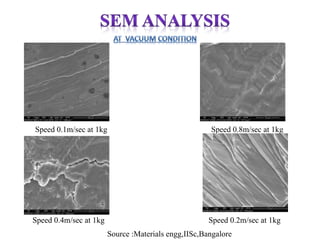
Speed 0.8m/sec at 1kgSpeed 0.1m/sec at 1kg
Speed 0.4m/sec at 1kg Speed 0.2m/sec at 1kg
Source :Materials engg,IISc,Bangalore
SAMPLE CALCULATIONS
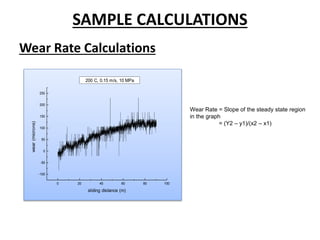
Wear Rate Calculations
0 20 40 60 80 100
-100
-50
0
50
100
150
200
250
200 C, 0.15 m/s, 10 MPa
wear(microns)
sliding distance (m)
Wear Rate = Slope of the steady state region
in the graph
= (Y2 – y1)/(x2 – x1)
Case study from Tribology international journal
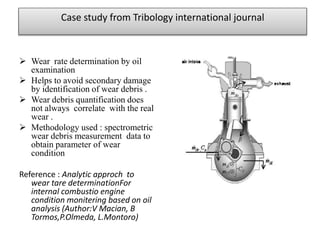
 Wear rate determination by oil
examination
 Helps to avoid secondary damage
by identification of wear debris .
 Wear debris quantification does
not always correlate with the real
wear .
 Methodology used : spectrometric
wear debris measurement data to
obtain parameter of wear
condition
Reference : Analytic approch to
wear tare determinationFor
internal combustio engine
condition monitering based on oil
analysis (Author:V Macian, B
Tormos,P.Olmeda, L.Montoro)
Case study from Tribology
international journal
 The spectrometer purpose is to determine the
elemental content of each debris particle .
 Inductively Coupled Plasma (ICP) spectrometer is
used , typically maximum size of 5 micron can be
measured .
 Quantative information (concentration) is related to
the amount of electromagnetic radiation that is
emitted while qualitative information (which element
is present is related to the wavelength at which
radiation is emitted .
Thank You

Wear measurement

  • 1.
    Presentation on WearMeasurement Irwin O. Toppo Mechanical engineering Indian Institute of Science, Bangalore, India
  • 2.
    Type Typical characteristicsand definitions observed In Sliding wear (delamintation wear) Wear due to localized bonding between contacting solid surfaces leading to material transfer between the two surfaces or the loss from either surface. Plastic deformation, crack nucleation and propagation in the surface Sliders, bearing, gears and camshaft. Fretting wear Wear arising as a result of fretting (Small amplitude oscillatory motion, usually tangential, between two solid surfaces in contact). Press fit parts with a small relative Sliding motion Abrasive wear Wear due to hard particles or hard protuberances forced against and moving along a solid surface. Sliding surfaces ,earth-removing Equipment Erosive wear (solid particle impingement) Wear due to mechanical interaction between that surface and a fluid, a multi component fluid, or impinging liquid or solid particles Turbine, pipes for coal slurries and helicopter blades Fatigue wear Wear of a solid surface caused by fracture arising from material fatigue. Ball bearing, roller bearing glassy solid slider Cavitation wear A form of erosion causing material to wear by the action of vapour bubbles in a very turbulent liquid. Soft Bearing Surfaces Definition : Wear is progressive damage, involving material loss , occurs on the surface as a result of relative motion between the surfaces.
  • 3.
    Wear Measurement  Archardwear Equation : Wα w =wear w = Normal Load on contact H= surface hardness of the wearing material K= wear coefficient (dimensionless) W= K = is called Dimensional wear constant Unit =(volume )/(Load/meter)
  • 4.
    Wear Dependence For Dry/unlubricatedsurfaces sliding Normal Load Relative sliding speed The initial temperature Thermal, Mechanical , chemical properties of the material in contact No simpler Model to explain wear
  • 5.
    MECHANISM Examination of thewear debris (collected)  large lumps imply- adhesive wear  fine particles- oxidative wear  chip like particles-abrasive wear  flake like particles- delamination wear  Examination of the worn surfaces: • Heavy tearing implies - adhesive wear • Scratches imply -abrasive wear • burnishing indicates –non adhesive wear IDENTIFICATION OF WEAR
  • 6.
    Schematic diagram ofloading configuration of Pin-on-Disc.
  • 7.
     pin anddisc were fitted. wear track diameter was measured. Load applied in the dead cell. Values of displacement , Time, speed, load and diameter of disk were entered. Displacement value of every second and coefficient of friction were noted from LVDT. wear values were calculated from displacement value .
  • 8.
    Wear rate ofTi-6Al-4V under vacuum condition at 1kg,4kg and 8kg Wear rate of Ti-6Al-4V under ambient condition at 1kg,4kg and 8kg
  • 9.
    Speed 0.8m/sec at1kg Speed 0.1m/sec at 1kg Abrasive wear Source :Materials engg,IISc,Bangalore
  • 10.
    Speed 0.8m/sec at1kgSpeed 0.1m/sec at 1kg Speed 0.4m/sec at 1kg Speed 0.2m/sec at 1kg Source :Materials engg,IISc,Bangalore
  • 11.
    SAMPLE CALCULATIONS Wear RateCalculations 0 20 40 60 80 100 -100 -50 0 50 100 150 200 250 200 C, 0.15 m/s, 10 MPa wear(microns) sliding distance (m) Wear Rate = Slope of the steady state region in the graph = (Y2 – y1)/(x2 – x1)
  • 12.
    Case study fromTribology international journal  Wear rate determination by oil examination  Helps to avoid secondary damage by identification of wear debris .  Wear debris quantification does not always correlate with the real wear .  Methodology used : spectrometric wear debris measurement data to obtain parameter of wear condition Reference : Analytic approch to wear tare determinationFor internal combustio engine condition monitering based on oil analysis (Author:V Macian, B Tormos,P.Olmeda, L.Montoro)
  • 13.
    Case study fromTribology international journal  The spectrometer purpose is to determine the elemental content of each debris particle .  Inductively Coupled Plasma (ICP) spectrometer is used , typically maximum size of 5 micron can be measured .  Quantative information (concentration) is related to the amount of electromagnetic radiation that is emitted while qualitative information (which element is present is related to the wavelength at which radiation is emitted .
  • 14.