2/20/2016
ECM
• Electrochemical Machining is one of the most potential
unconventional machining process. Though it is a new
process for metal working, the basic principle had been
well known for a long time. This process may be
considered as the reverse of electroplating with some
modifications. Further, it is based on the principle of
electrolysis.
• In electrochemical material removal an electrical field
in an electrolyte destroys the atomic bonds of the
material.
2
2/20/2016
ECM
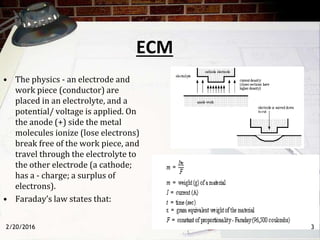
• The physics - an electrode and
work piece (conductor) are
placed in an electrolyte, and a
potential/ voltage is applied. On
the anode (+) side the metal
molecules ionize (lose electrons)
break free of the work piece, and
travel through the electrolyte to
the other electrode (a cathode;
has a - charge; a surplus of
electrons).
• Faraday’s law states that:
3
2/20/2016
ECM
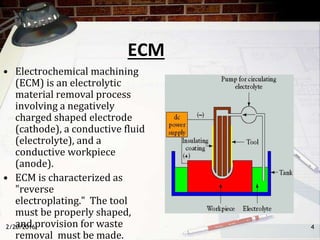
• Electrochemical machining
(ECM) is an electrolytic
material removal process
involving a negatively
charged shaped electrode
(cathode), a conductive fluid
(electrolyte), and a
conductive workpiece
(anode).
• ECM is characterized as
"reverse
electroplating." The tool
must be properly shaped,
and provision for waste
removal must be made.
4
2/20/2016
ECM
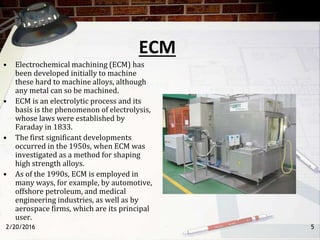
• Electrochemical machining (ECM) has
been developed initially to machine
these hard to machine alloys, although
any metal can so be machined.
• ECM is an electrolytic process and its
basis is the phenomenon of electrolysis,
whose laws were established by
Faraday in 1833.
• The first significant developments
occurred in the 1950s, when ECM was
investigated as a method for shaping
high strength alloys.
• As of the 1990s, ECM is employed in
many ways, for example, by automotive,
offshore petroleum, and medical
engineering industries, as well as by
aerospace firms, which are its principal
user.
5
2/20/2016
TOOL AND MECHANISM
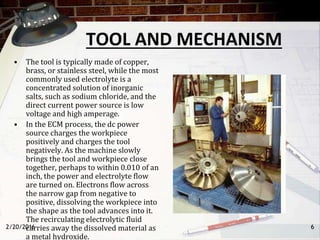
• The tool is typically made of copper,
brass, or stainless steel, while the most
commonly used electrolyte is a
concentrated solution of inorganic
salts, such as sodium chloride, and the
direct current power source is low
voltage and high amperage.
• In the ECM process, the dc power
source charges the workpiece
positively and charges the tool
negatively. As the machine slowly
brings the tool and workpiece close
together, perhaps to within 0.010 of an
inch, the power and electrolyte flow
are turned on. Electrons flow across
the narrow gap from negative to
positive, dissolving the workpiece into
the shape as the tool advances into it.
The recirculating electrolytic fluid
carries away the dissolved material as
a metal hydroxide.
6
2/20/2016
WORKING PRINCIPLE
• In ECM one employs a cathode electrode shaped to provide the
complementary structure in an anode work piece.
• A highly conductive electrolyte stream separates the cutting tool from the
work piece, and metal removal is accomplished by passing a dc current of up
to 100A/cm2 through the salt solution cell. As the cathode tool approaches
the anode work piece it erodes its complementary shape in it. Thus complex
shapes may be made from a material such as soft copper and used to
produce negative duplicates of it. The process is also called electrochemical
sinking.
• The pressurized electrolyte (concentrated solutions of inorganic salts such as
sodium chloride, potassium chloride, and sodium nitrate) passes at high
speed (10 to 60 m/s) through the gap (about 0.1 to 0.6 mm) between the
work piece and the tool to prevent metal ions from plating onto the cathode
tool and to remove the heat that is generated as a result of the high current
flow.
7
2/20/2016
WORKING PRINCIPLE
• The cathode is advanced into the anode work piece at a rate matching the
dissolution rate, which is between 0.5 and 10 mm/min when applying
current densities of 10 to 100 A/cm2. The supply voltage commonly used in
ECM ranges from 5 to 20 V, the lower values being used for finish machining (
creating of a final smooth surface) and the higher voltages for rough
machining. The rate of material removal is the same for hard or soft
materials, and surface finishes are between 0.3 and 1 µm. These cutting
speeds and surface finishes are comparable to those of EDM.
• The cathode tool must have these four characteristics: be machinable, rigid
(high Young's modulus), be a good conductor and have good corrosion
resistance. The three most common cathode materials used are copper,
brass, and stainless steel.
• Because there is no actual contact between the tool and the work, the tool
does not have to be harder than the work, as in traditional machining
methods. Hence, this is one of the few ways to machine very hard material;
another is spark-discharge machining.
8
2/20/2016
ECM: Advantages
• Components are not subject to
either thermal or mechanical
stress.
• There is no tool wear in ECM.
• Non-rigid and open work pieces
can be machined easily as there is
no contact between the tool and
workpiece.
• Complex geometrical shapes can
be machined repeatedly and
accurately
• ECM is a time saving process when
compared with conventional
machining
• During drilling, deep holes can be
made or several holes at once.
• ECM deburring can debur difficult to
access areas of parts.
• Fragile parts which cannot take
more loads and also brittle material
which tend to develop cracks during
machining can be machined easily
in ECM
• Surface finishes of 25 µ in. can be
achieved in ECM
9
APPLICATIONS
 ECM is used for
• Die sinking
• Profiling and contouring
• Trepanning
• Grinding
• Drilling
• Micro-machining
2/20/2016 10
2/20/2016
ECM
• We close off this section
with a Table comparing
EDM with ECM, using
conventional mechanical
machining
• In this Table we list
metal removal rates
(MRR), tolerance,
surface finish and
damage depth, and
required power.
11
2/20/2016
COMPARISION
TABLE Machining Characteristics of EDM and ECM
PROCESS MRR TOLERANCE SURFACE FINISH DAMAGE DEPT H POWER
mm3
/min micron micron micron watts
ECM 15,000 50 0.1-2.5 5 100,000
EDM 800 15 0.2-1.2 125 2700
CNC 50,000 50 0.5-5 25 3000
Note: MRR = metal removal rate; tolerance = tolerance maintained; surface finish =
surface finish required; damage depth = depth of surface damage; ECM =
electrochemical machining; EDM = electro-discharge machining; CNC = computer
numerical control machining.
12
2/20/2016
CONCLUSION
• The metal removal rate by ECM is much higher than that of the EDM
machining with a metal removal rate 0.3 that of CNC, whereas EDM is
only a small fraction of the CNC material removal rate.
• Power requirements for ECM are comparatively high.
• The tolerance obtained by EDM and ECM is within the range of CNC
machining, which means satisfactory dimensional accuracy can be
maintained. All processes obtain satisfactory surface finishes. Depth of
surface damage is very small for ECM, whereas it is very high in the case
of EDM. For this reason, ECM can be employed for making dies and
punches.
• Capital cost for ECM is very high when compared to conventional CNC
machining and EDM has also a higher tooling cost than the other
machining processes.
13
2/20/2016 14

Electrochemical Machining (ECM)

  • 2.
    2/20/2016 ECM • Electrochemical Machiningis one of the most potential unconventional machining process. Though it is a new process for metal working, the basic principle had been well known for a long time. This process may be considered as the reverse of electroplating with some modifications. Further, it is based on the principle of electrolysis. • In electrochemical material removal an electrical field in an electrolyte destroys the atomic bonds of the material. 2
  • 3.
    2/20/2016 ECM • The physics- an electrode and work piece (conductor) are placed in an electrolyte, and a potential/ voltage is applied. On the anode (+) side the metal molecules ionize (lose electrons) break free of the work piece, and travel through the electrolyte to the other electrode (a cathode; has a - charge; a surplus of electrons). • Faraday’s law states that: 3
  • 4.
    2/20/2016 ECM • Electrochemical machining (ECM)is an electrolytic material removal process involving a negatively charged shaped electrode (cathode), a conductive fluid (electrolyte), and a conductive workpiece (anode). • ECM is characterized as "reverse electroplating." The tool must be properly shaped, and provision for waste removal must be made. 4
  • 5.
    2/20/2016 ECM • Electrochemical machining(ECM) has been developed initially to machine these hard to machine alloys, although any metal can so be machined. • ECM is an electrolytic process and its basis is the phenomenon of electrolysis, whose laws were established by Faraday in 1833. • The first significant developments occurred in the 1950s, when ECM was investigated as a method for shaping high strength alloys. • As of the 1990s, ECM is employed in many ways, for example, by automotive, offshore petroleum, and medical engineering industries, as well as by aerospace firms, which are its principal user. 5
  • 6.
    2/20/2016 TOOL AND MECHANISM •The tool is typically made of copper, brass, or stainless steel, while the most commonly used electrolyte is a concentrated solution of inorganic salts, such as sodium chloride, and the direct current power source is low voltage and high amperage. • In the ECM process, the dc power source charges the workpiece positively and charges the tool negatively. As the machine slowly brings the tool and workpiece close together, perhaps to within 0.010 of an inch, the power and electrolyte flow are turned on. Electrons flow across the narrow gap from negative to positive, dissolving the workpiece into the shape as the tool advances into it. The recirculating electrolytic fluid carries away the dissolved material as a metal hydroxide. 6
  • 7.
    2/20/2016 WORKING PRINCIPLE • InECM one employs a cathode electrode shaped to provide the complementary structure in an anode work piece. • A highly conductive electrolyte stream separates the cutting tool from the work piece, and metal removal is accomplished by passing a dc current of up to 100A/cm2 through the salt solution cell. As the cathode tool approaches the anode work piece it erodes its complementary shape in it. Thus complex shapes may be made from a material such as soft copper and used to produce negative duplicates of it. The process is also called electrochemical sinking. • The pressurized electrolyte (concentrated solutions of inorganic salts such as sodium chloride, potassium chloride, and sodium nitrate) passes at high speed (10 to 60 m/s) through the gap (about 0.1 to 0.6 mm) between the work piece and the tool to prevent metal ions from plating onto the cathode tool and to remove the heat that is generated as a result of the high current flow. 7
  • 8.
    2/20/2016 WORKING PRINCIPLE • Thecathode is advanced into the anode work piece at a rate matching the dissolution rate, which is between 0.5 and 10 mm/min when applying current densities of 10 to 100 A/cm2. The supply voltage commonly used in ECM ranges from 5 to 20 V, the lower values being used for finish machining ( creating of a final smooth surface) and the higher voltages for rough machining. The rate of material removal is the same for hard or soft materials, and surface finishes are between 0.3 and 1 µm. These cutting speeds and surface finishes are comparable to those of EDM. • The cathode tool must have these four characteristics: be machinable, rigid (high Young's modulus), be a good conductor and have good corrosion resistance. The three most common cathode materials used are copper, brass, and stainless steel. • Because there is no actual contact between the tool and the work, the tool does not have to be harder than the work, as in traditional machining methods. Hence, this is one of the few ways to machine very hard material; another is spark-discharge machining. 8
  • 9.
    2/20/2016 ECM: Advantages • Componentsare not subject to either thermal or mechanical stress. • There is no tool wear in ECM. • Non-rigid and open work pieces can be machined easily as there is no contact between the tool and workpiece. • Complex geometrical shapes can be machined repeatedly and accurately • ECM is a time saving process when compared with conventional machining • During drilling, deep holes can be made or several holes at once. • ECM deburring can debur difficult to access areas of parts. • Fragile parts which cannot take more loads and also brittle material which tend to develop cracks during machining can be machined easily in ECM • Surface finishes of 25 µ in. can be achieved in ECM 9
  • 10.
    APPLICATIONS  ECM isused for • Die sinking • Profiling and contouring • Trepanning • Grinding • Drilling • Micro-machining 2/20/2016 10
  • 11.
    2/20/2016 ECM • We closeoff this section with a Table comparing EDM with ECM, using conventional mechanical machining • In this Table we list metal removal rates (MRR), tolerance, surface finish and damage depth, and required power. 11
  • 12.
    2/20/2016 COMPARISION TABLE Machining Characteristicsof EDM and ECM PROCESS MRR TOLERANCE SURFACE FINISH DAMAGE DEPT H POWER mm3 /min micron micron micron watts ECM 15,000 50 0.1-2.5 5 100,000 EDM 800 15 0.2-1.2 125 2700 CNC 50,000 50 0.5-5 25 3000 Note: MRR = metal removal rate; tolerance = tolerance maintained; surface finish = surface finish required; damage depth = depth of surface damage; ECM = electrochemical machining; EDM = electro-discharge machining; CNC = computer numerical control machining. 12
  • 13.
    2/20/2016 CONCLUSION • The metalremoval rate by ECM is much higher than that of the EDM machining with a metal removal rate 0.3 that of CNC, whereas EDM is only a small fraction of the CNC material removal rate. • Power requirements for ECM are comparatively high. • The tolerance obtained by EDM and ECM is within the range of CNC machining, which means satisfactory dimensional accuracy can be maintained. All processes obtain satisfactory surface finishes. Depth of surface damage is very small for ECM, whereas it is very high in the case of EDM. For this reason, ECM can be employed for making dies and punches. • Capital cost for ECM is very high when compared to conventional CNC machining and EDM has also a higher tooling cost than the other machining processes. 13
  • 14.