Ibtisam Al Hoqani EM – R2 31/8/2010 Approach to Wide Complex Tachycardia
Outline : Basic ECG  What is  WCT Mechanisms of WCT Diagnostic criteria  Management Take home message
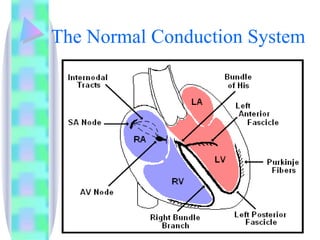
The Normal Conduction System
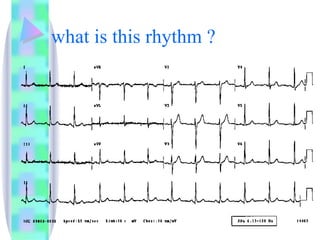
what is this rhythm ?
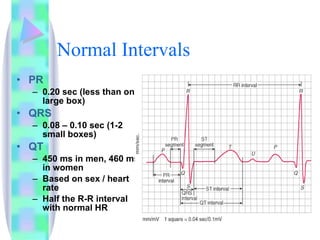
Normal Intervals PR 0.20 sec (less than one large box) QRS 0.08 – 0.10 sec (1-2 small boxes) QT 450 ms in men, 460 ms in women Based on sex / heart rate Half the R-R interval with normal HR
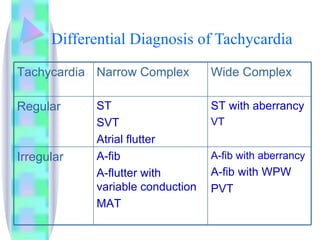
Differential Diagnosis of Tachycardia Tachycardia Narrow Complex Wide Complex Regular ST SVT Atrial flutter ST with aberrancy VT  Irregular  A-fib A-flutter with variable conduction MAT A-fib with aberrancy A-fib with WPW PVT
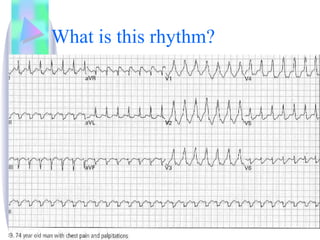
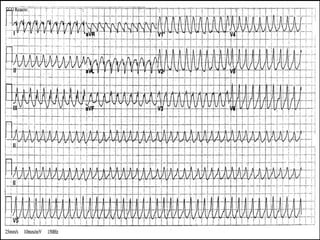
What is this rhythm?
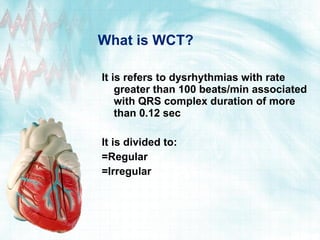
What is WCT? It is refers to dysrhythmias with rate greater than 100 beats/min associated with QRS complex duration of more than 0.12 sec It is divided to: =Regular =Irregular
 
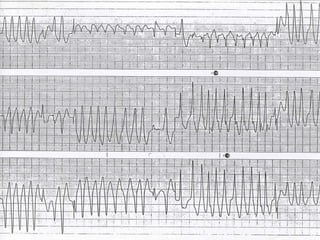
Causes of WCT :  Irregular WCT:  Afib  with BBB or IVCD (pre-existent or rate related) Afib  with anterograde conduction over accessory pathway in WPW Polymorphic VT ex: Torsades de pointes or due to Digitalis intoxication  Other causes of an irregular rhythm ( A flutter  with variable conduction,  MAT  etc) with BBB, WPW, IVCD
 
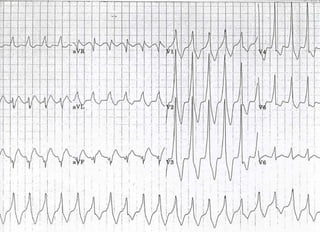
Causes of WCT: Regular rhythm: Ventricular driven rhythm: VT :  worst case  scenario Supraventricular rhythm with aberrant conduction: SVT  with BBB SVT with accessory pathway Ex: WPW
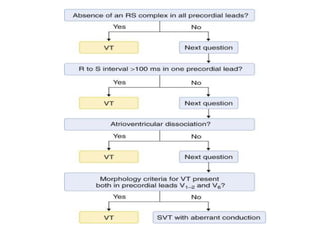
How to distinguish SVT from VT Focus History Physical examination ECG tracing Using specific Criteria : Wellens criteria  Brugada criteria
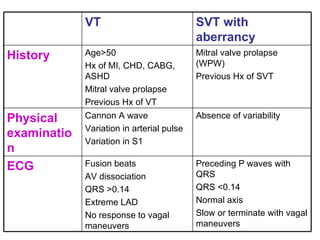
Preceding P waves with QRS QRS <0.14 Normal axis Slow or terminate with vagal maneuvers Fusion beats AV dissociation  QRS >0.14 Extreme LAD No response to vagal maneuvers ECG Absence of variability  Cannon A wave Variation in arterial pulse Variation in S1 Physical examination Mitral valve prolapse (WPW) Previous Hx of SVT Age>50 Hx of MI, CHD, CABG, ASHD Mitral valve prolapse Previous Hx of VT History SVT with aberrancy VT
 
 
Management of WCT   Any new onset symptomatic WCT is VT until proven otherwise
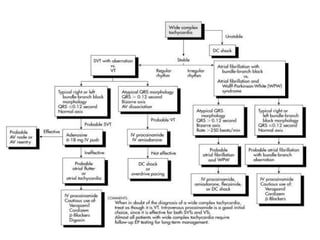
Management of WCT If the patient is hemodynamically unstable, the first - choice therapy for ventricular tachycardia (VT) is  synchronized direct-current (DC)  cardioversion  with 50 – 100 J If the patient is suffering from monomorphic VT and has a preserved heart function, the first-line treatment is  lidocaine . Alternatives include either  amiodarone  or  procainamide .
If the patient has polymorphic VT with a normal baseline QT interval, AHA guidelines state that the first steps are to treat ischemia and correct any electrolyte imbalance .  If cardiac function is impaired, use  amiodarone   or   lidocaine,   followed by   synchronized DC cardioversion
If the patient has polymorphic VT with a prolonged baseline QT interval, ACLS guidelines state that any electrolyte imbalance should be corrected .  Following this, any one of these treatments can be administered :  magnesium sulfate , overdrive pacing, or lidocaine
Long - term treatment of sustained ventricular arrhythmias includes placement of an  implantable  cardioverter -defibrillator (ICD)  and possible adjunctive therapy with amiodarone or  sotalol  in certain subsets of patients. Patients should be under the care of a cardiologist or electrophysiologist
 
Take home message Any new onset symptomatic WCT is VT until proven otherwise About 80% of all WCT are ventricular tachycardia In patients with known structural heart disease almost all WCT are ventricular tachycardia

WCT

  • 1.
    Ibtisam Al HoqaniEM – R2 31/8/2010 Approach to Wide Complex Tachycardia
  • 2.
    Outline : BasicECG What is WCT Mechanisms of WCT Diagnostic criteria Management Take home message
  • 3.
  • 4.
    what is thisrhythm ?
  • 5.
    Normal Intervals PR0.20 sec (less than one large box) QRS 0.08 – 0.10 sec (1-2 small boxes) QT 450 ms in men, 460 ms in women Based on sex / heart rate Half the R-R interval with normal HR
  • 6.
    Differential Diagnosis ofTachycardia Tachycardia Narrow Complex Wide Complex Regular ST SVT Atrial flutter ST with aberrancy VT Irregular A-fib A-flutter with variable conduction MAT A-fib with aberrancy A-fib with WPW PVT
  • 7.
    What is thisrhythm?
  • 8.
    What is WCT?It is refers to dysrhythmias with rate greater than 100 beats/min associated with QRS complex duration of more than 0.12 sec It is divided to: =Regular =Irregular
  • 9.
  • 10.
    Causes of WCT: Irregular WCT: Afib with BBB or IVCD (pre-existent or rate related) Afib with anterograde conduction over accessory pathway in WPW Polymorphic VT ex: Torsades de pointes or due to Digitalis intoxication Other causes of an irregular rhythm ( A flutter with variable conduction, MAT etc) with BBB, WPW, IVCD
  • 11.
  • 12.
    Causes of WCT:Regular rhythm: Ventricular driven rhythm: VT : worst case scenario Supraventricular rhythm with aberrant conduction: SVT with BBB SVT with accessory pathway Ex: WPW
  • 13.
    How to distinguishSVT from VT Focus History Physical examination ECG tracing Using specific Criteria : Wellens criteria Brugada criteria
  • 14.
    Preceding P waveswith QRS QRS <0.14 Normal axis Slow or terminate with vagal maneuvers Fusion beats AV dissociation QRS >0.14 Extreme LAD No response to vagal maneuvers ECG Absence of variability Cannon A wave Variation in arterial pulse Variation in S1 Physical examination Mitral valve prolapse (WPW) Previous Hx of SVT Age>50 Hx of MI, CHD, CABG, ASHD Mitral valve prolapse Previous Hx of VT History SVT with aberrancy VT
  • 15.
  • 16.
  • 17.
    Management of WCT Any new onset symptomatic WCT is VT until proven otherwise
  • 18.
    Management of WCTIf the patient is hemodynamically unstable, the first - choice therapy for ventricular tachycardia (VT) is synchronized direct-current (DC) cardioversion with 50 – 100 J If the patient is suffering from monomorphic VT and has a preserved heart function, the first-line treatment is lidocaine . Alternatives include either amiodarone or procainamide .
  • 19.
    If the patienthas polymorphic VT with a normal baseline QT interval, AHA guidelines state that the first steps are to treat ischemia and correct any electrolyte imbalance . If cardiac function is impaired, use amiodarone or lidocaine, followed by synchronized DC cardioversion
  • 20.
    If the patienthas polymorphic VT with a prolonged baseline QT interval, ACLS guidelines state that any electrolyte imbalance should be corrected . Following this, any one of these treatments can be administered : magnesium sulfate , overdrive pacing, or lidocaine
  • 21.
    Long - termtreatment of sustained ventricular arrhythmias includes placement of an implantable cardioverter -defibrillator (ICD) and possible adjunctive therapy with amiodarone or sotalol in certain subsets of patients. Patients should be under the care of a cardiologist or electrophysiologist
  • 22.
  • 23.
    Take home messageAny new onset symptomatic WCT is VT until proven otherwise About 80% of all WCT are ventricular tachycardia In patients with known structural heart disease almost all WCT are ventricular tachycardia