CLINICAL PRACTICE


 Evaluation and Initial Treatment
 of Supraventricular Tachycardia

                    2012;367:1438-48.
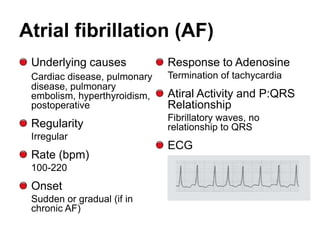
Atrial fibrillation (AF)
 Underlying causes            Response to Adenosine
 Cardiac disease, pulmonary   Termination of tachycardia
 disease, pulmonary
 embolism, hyperthyroidism,   Atiral Activity and P:QRS
 postoperative                Relationship
                              Fibrillatory waves, no
 Regularity                   relationship to QRS
 Irregular
                              ECG
 Rate (bpm)
 100-220
 Onset
 Sudden or gradual (if in
 chronic AF)
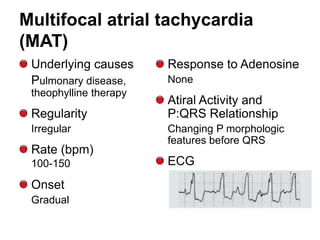
Multifocal atrial tachycardia
(MAT)
 Underlying causes      Response to Adenosine
 Pulmonary disease,     None
 theophylline therapy
                        Atiral Activity and
 Regularity             P:QRS Relationship
 Irregular              Changing P morphologic
                        features before QRS
 Rate (bpm)
 100-150                ECG
 Onset
 Gradual
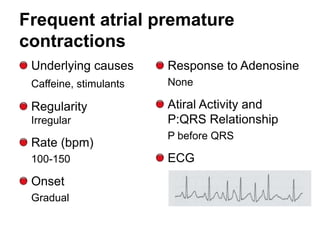
Frequent atrial premature
contractions
 Underlying causes      Response to Adenosine
 Caffeine, stimulants   None

 Regularity             Atiral Activity and
 Irregular              P:QRS Relationship
                        P before QRS
 Rate (bpm)
 100-150                ECG
 Onset
 Gradual
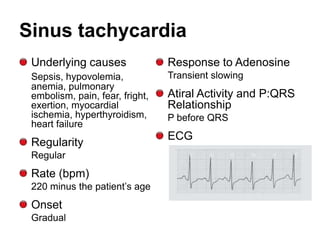
Sinus tachycardia
 Underlying causes               Response to Adenosine
 Sepsis, hypovolemia,            Transient slowing
 anemia, pulmonary
 embolism, pain, fear, fright,   Atiral Activity and P:QRS
 exertion, myocardial            Relationship
 ischemia, hyperthyroidism,      P before QRS
 heart failure
                                 ECG
 Regularity
 Regular
 Rate (bpm)
 220 minus the patient’s age
 Onset
 Gradual
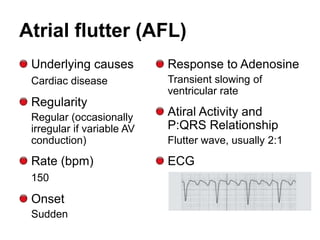
Atrial flutter (AFL)
 Underlying causes          Response to Adenosine
 Cardiac disease            Transient slowing of
                            ventricular rate
 Regularity
 Regular (occasionally      Atiral Activity and
 irregular if variable AV   P:QRS Relationship
 conduction)                Flutter wave, usually 2:1
 Rate (bpm)                 ECG
 150

 Onset
 Sudden
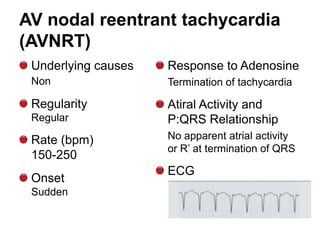
AV nodal reentrant tachycardia
(AVNRT)
 Underlying causes   Response to Adenosine
 Non                 Termination of tachycardia

 Regularity          Atiral Activity and
 Regular             P:QRS Relationship
 Rate (bpm)          No apparent atrial activity
                     or R’ at termination of QRS
 150-250
                     ECG
 Onset
 Sudden
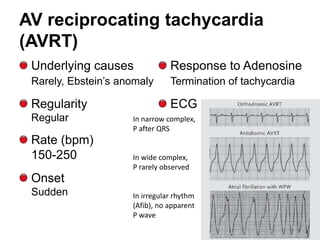
AV reciprocating tachycardia
(AVRT)
 Underlying causes              Response to Adenosine
 Rarely, Ebstein’s anomaly      Termination of tachycardia

 Regularity                     ECG
 Regular             In narrow complex,
                     P after QRS
 Rate (bpm)
 150-250             In wide complex,
                     P rarely observed
 Onset
 Sudden              In irregular rhythm
                     (Afib), no apparent
                     P wave
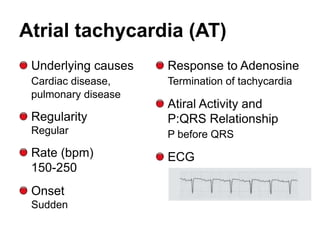
Atrial tachycardia (AT)
 Underlying causes   Response to Adenosine
 Cardiac disease,    Termination of tachycardia
 pulmonary disease
                     Atiral Activity and
 Regularity          P:QRS Relationship
 Regular             P before QRS
 Rate (bpm)          ECG
 150-250
 Onset
 Sudden
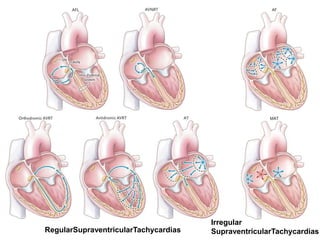
Irregular
RegularSupraventricularTachycardias   SupraventricularTachycardias
Differential Diagnosis of
Supraventricular Tachycardias
 The initial differential diagnosis of supraventricular
 tachycardias should focus on the ventricular response
 characteristics of regularity, rate, and rapidity of onset,
 not on the atrial depolarization from the ECG.
 The regular supraventricular tachycardias include
 sinus tachycardia, atrial flutter, atrioventricular nodal
 reentrant tachycardia, atrioventricular reciprocating
 tachycardia, and atrial tachycardia.
 The irregular supraventricular tachycardias are atrial
 fibrillation, atrial flutter with variable atrioventricular
 block, and multifocal atrial tachycardia; multiple atrial
 premature contractions can cause a similar
 presentation.
Differential Diagnosis of
Supraventricular Tachycardias
 Sudden onset and termination are
 characteristic of acute atrial fibrillation and
 atrial flutter, atrioventricular nodal reentrant
 tachycardia, atrioventricular reciprocating
 tachycardia, and atrial tachycardia.
 Gradual onset and recession occur with sinus
 tachycardia, chronic atrial fibrillation and atrial
 flutter, multifocal atrial tachycardia, and atrial
 premature contractions.
Differential Diagnosis of
Supraventricular Tachycardias
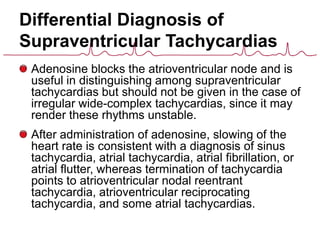
 Adenosine blocks the atrioventricular node and is
 useful in distinguishing among supraventricular
 tachycardias but should not be given in the case of
 irregular wide-complex tachycardias, since it may
 render these rhythms unstable.
 After administration of adenosine, slowing of the
 heart rate is consistent with a diagnosis of sinus
 tachycardia, atrial tachycardia, atrial fibrillation, or
 atrial flutter, whereas termination of tachycardia
 points to atrioventricular nodal reentrant
 tachycardia, atrioventricular reciprocating
 tachycardia, and some atrial tachycardias.
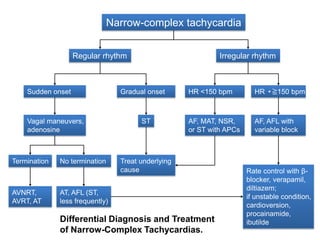
Narrow-complex tachycardia


                  Regular rhythm                             Irregular rhythm


       Sudden onset               Gradual onset     HR <150 bpm         HR •≧150 bpm


        Adenosine                      ST           AF, MAT, NSR,       AF, AFL with
                                                    or ST with APCs     variable block


Termination   No termination     Treat underlying
                                 cause                                Rate control with β-
                                                                      blocker, verapamil,
                                                                      diltiazem;
AVNRT,        AT, AFL (ST,
                                                                      if unstable condition,
AVRT, AT      less frequently)
                                                                      cardioversion,
                                                                      procainamide,
              Differential Diagnosis and Treatment                    ibutilde
              of Narrow-Complex Tachycardias.
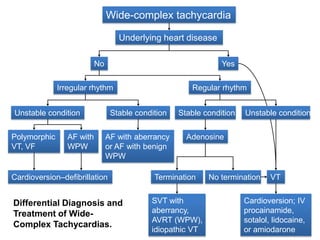
Wide-complex tachycardia

                                  Underlying heart disease

                          No                                   Yes

              Irregular rhythm                        Regular rhythm


Unstable condition              Stable condition   Stable condition   Unstable condition

Polymorphic     AF with        AF with aberrancy     Adenosine
VT, VF          WPW            or AF with benign
                               WPW

Cardioversion–defibrillation                Termination    No termination     VT


Differential Diagnosis and                 SVT with                   Cardioversion; IV
Treatment of Wide-                         aberrancy,                 procainamide,
                                           AVRT (WPW),                sotalol, lidocaine,
Complex Tachycardias.
                                           idiopathic VT              or amiodarone

Evaluation and Initial Treatment of Supraventricular Tachycardia

  • 1.
    CLINICAL PRACTICE Evaluationand Initial Treatment of Supraventricular Tachycardia 2012;367:1438-48.
  • 3.
    Atrial fibrillation (AF) Underlying causes Response to Adenosine Cardiac disease, pulmonary Termination of tachycardia disease, pulmonary embolism, hyperthyroidism, Atiral Activity and P:QRS postoperative Relationship Fibrillatory waves, no Regularity relationship to QRS Irregular ECG Rate (bpm) 100-220 Onset Sudden or gradual (if in chronic AF)
  • 4.
    Multifocal atrial tachycardia (MAT) Underlying causes Response to Adenosine Pulmonary disease, None theophylline therapy Atiral Activity and Regularity P:QRS Relationship Irregular Changing P morphologic features before QRS Rate (bpm) 100-150 ECG Onset Gradual
  • 5.
    Frequent atrial premature contractions Underlying causes Response to Adenosine Caffeine, stimulants None Regularity Atiral Activity and Irregular P:QRS Relationship P before QRS Rate (bpm) 100-150 ECG Onset Gradual
  • 6.
    Sinus tachycardia Underlyingcauses Response to Adenosine Sepsis, hypovolemia, Transient slowing anemia, pulmonary embolism, pain, fear, fright, Atiral Activity and P:QRS exertion, myocardial Relationship ischemia, hyperthyroidism, P before QRS heart failure ECG Regularity Regular Rate (bpm) 220 minus the patient’s age Onset Gradual
  • 7.
    Atrial flutter (AFL) Underlying causes Response to Adenosine Cardiac disease Transient slowing of ventricular rate Regularity Regular (occasionally Atiral Activity and irregular if variable AV P:QRS Relationship conduction) Flutter wave, usually 2:1 Rate (bpm) ECG 150 Onset Sudden
  • 8.
    AV nodal reentranttachycardia (AVNRT) Underlying causes Response to Adenosine Non Termination of tachycardia Regularity Atiral Activity and Regular P:QRS Relationship Rate (bpm) No apparent atrial activity or R’ at termination of QRS 150-250 ECG Onset Sudden
  • 9.
    AV reciprocating tachycardia (AVRT) Underlying causes Response to Adenosine Rarely, Ebstein’s anomaly Termination of tachycardia Regularity ECG Regular In narrow complex, P after QRS Rate (bpm) 150-250 In wide complex, P rarely observed Onset Sudden In irregular rhythm (Afib), no apparent P wave
  • 10.
    Atrial tachycardia (AT) Underlying causes Response to Adenosine Cardiac disease, Termination of tachycardia pulmonary disease Atiral Activity and Regularity P:QRS Relationship Regular P before QRS Rate (bpm) ECG 150-250 Onset Sudden
  • 11.
  • 12.
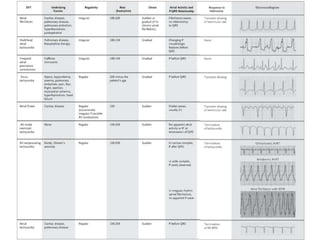
    Differential Diagnosis of SupraventricularTachycardias The initial differential diagnosis of supraventricular tachycardias should focus on the ventricular response characteristics of regularity, rate, and rapidity of onset, not on the atrial depolarization from the ECG. The regular supraventricular tachycardias include sinus tachycardia, atrial flutter, atrioventricular nodal reentrant tachycardia, atrioventricular reciprocating tachycardia, and atrial tachycardia. The irregular supraventricular tachycardias are atrial fibrillation, atrial flutter with variable atrioventricular block, and multifocal atrial tachycardia; multiple atrial premature contractions can cause a similar presentation.
  • 13.
    Differential Diagnosis of SupraventricularTachycardias Sudden onset and termination are characteristic of acute atrial fibrillation and atrial flutter, atrioventricular nodal reentrant tachycardia, atrioventricular reciprocating tachycardia, and atrial tachycardia. Gradual onset and recession occur with sinus tachycardia, chronic atrial fibrillation and atrial flutter, multifocal atrial tachycardia, and atrial premature contractions.
  • 14.
    Differential Diagnosis of SupraventricularTachycardias Adenosine blocks the atrioventricular node and is useful in distinguishing among supraventricular tachycardias but should not be given in the case of irregular wide-complex tachycardias, since it may render these rhythms unstable. After administration of adenosine, slowing of the heart rate is consistent with a diagnosis of sinus tachycardia, atrial tachycardia, atrial fibrillation, or atrial flutter, whereas termination of tachycardia points to atrioventricular nodal reentrant tachycardia, atrioventricular reciprocating tachycardia, and some atrial tachycardias.
  • 15.
    Narrow-complex tachycardia Regular rhythm Irregular rhythm Sudden onset Gradual onset HR <150 bpm HR •≧150 bpm Adenosine ST AF, MAT, NSR, AF, AFL with or ST with APCs variable block Termination No termination Treat underlying cause Rate control with β- blocker, verapamil, diltiazem; AVNRT, AT, AFL (ST, if unstable condition, AVRT, AT less frequently) cardioversion, procainamide, Differential Diagnosis and Treatment ibutilde of Narrow-Complex Tachycardias.
  • 16.
    Wide-complex tachycardia Underlying heart disease No Yes Irregular rhythm Regular rhythm Unstable condition Stable condition Stable condition Unstable condition Polymorphic AF with AF with aberrancy Adenosine VT, VF WPW or AF with benign WPW Cardioversion–defibrillation Termination No termination VT Differential Diagnosis and SVT with Cardioversion; IV Treatment of Wide- aberrancy, procainamide, AVRT (WPW), sotalol, lidocaine, Complex Tachycardias. idiopathic VT or amiodarone