Resuscitation in Special PopulationsMalik Al-Rawahi
ObjectivesResuscitation in Pediatric Population.Resuscitation in Pregnant Women.
Resuscitation in PediatricsPediatric Cardiac Arrest:Secondary to respiratory failure or arrest.Most Important Intervention:Oxygenation, ventilation.
Anatomy of the Pediatric AirwayRelatively larger head and tongue. More anterior larynx. Narrowest part of the airway: cricoid cartilage. Long epiglottis (floppy, omega shaped). Easily compressed trachea.
Airway EvaluationMallampatti Classification.Cormack and Lehane Grades.
Difficult pediatric airwaySyndromes: Trisomy 21, Mucopolysaccharidoses, Pierre-Robin. Trauma to head and neck. Possible epiglotitis. Radiation therapy. Masses in the neck.
AirwayHead-tilt/chin-lift.Big tongue; Forward jaw displacement critical.Avoid extreme hyperextension.With possible neck injury, jaw thrust.
BreathingLook-Listen-Feel.Limit to volume causing chest rise.Children usually underventilated.Use BVM only if proficient.Pedi BVM’s should not have pop-off valves.Do not use demand valve on children.Ventilate infants, children every 3 seconds.
CirculationInfants: brachial.Children: carotid.Infant chest compressions. 2 fingers.
1 finger width below nipple line.
1/2 - 1 inches.
At least 100/minute.CirculationChild chest compressions.One hand.
Lower half of sternum.
1 - 1.5 inches.
100/minute.Child CPR.Maintain continuous head tilt with hand on forehead.
Perform chin lift with other hand while ventilating.Best Sign of Effective VentilationChest Rise.Pulse with Each Compression.
Oxygen TherapyInitiate ASAP. Do not delay BLS to obtain oxygen.Use highest possible FiO2.No risk in short term100% O2.Humidify if possible.Avoids plugging airways, adjuncts.Endotracheal IntubationProper tube size.Newborn: 3.5 mm 4 months-1 year: 4.0 mmChild > 1 year: [(Age + 16 ) / 4]Children < 8 years old.Small tracheal diameter.
Narrow cricoid ring.
Uncufed tubes. Infants, small children.Narrow, soft epiglottis.
straight blade.Endotracheal IntubationAttempts not >30 seconds.Bradycardia: oxygenate, ventilate.Avoid hyperextension.Use sniffing position.Lift up; do not pry back.
Endotracheal IntubationConfirm placement by:Seeing tube go through cords.Chest rise.Equal breath sounds.No sounds over epigastrium.CO2 in exhaled air.
Endotracheal IntubationMark tube at corner of mouth.Avoid excessive head movement.Frequently reassess breath sounds.Ventilate to cause gentle chest rise.
Endotracheal IntubationDrug administration.Do not delay while attempting IV access.
Dilute with normal saline.
Stop compressions.
Inject through catheter passed beyond ETT.
Follow 10 rapid ventilations.CricothyrotomySurgical contraindicated in children <12.Narrowing of trachea at cricoid ring makes procedure hazardous.Use needle technique only.
Vascular Access, Scalp VeinsNo value in cardiac arrest.Useful in infants < 1 year.
Hand, Arm, Foot Veins22 gauge catheter for smaller children.Restrain extremity before attempting.Incise overlying skin with 19 gauge needle.
External JugularLife-threatening situations only.If vein perforates, do not go to other side.Risk of paratracheal hematoma, airway obstruction.Prevention of Fluid OverloadAvoid using bags over 250cc.Use mini-drip sets, Volutrols.Fluid resuscitation: 20cc/kg boluses.
Intraosseous CannulationPlacement of cannula into long bone intramedullary canal (marrow space).Indication:Vascular access required.
Peripheral site cannot be obtained.
In two attempts, or
After 90 seconds.Contraindications:Fractures.
Osteogenesis imperfecta.
Osteoporosis.
Failed attempt on same bone.Intraosseous CannulationSite:Anterior tibia.
1 - 3 cm below knee.
Medial to tibial tuberosity.RememberYou don’t need a line to give drugs during a code.Epinephrine, atropine, lidocaine can go down tube.
Defibrillation90% of pediatric cardiac arrest is:Asystole, or
Bradycardic PEA.Defibrillation seldom needed.Pediatric VF suggests:Electrolyte imbalances.
Drug toxicity.
Electrical injury.DefibrillationPaddle diameter:Infants: 4.5 cm.
Children: 8.0 cm.Largest paddles that contact entire chest wall without touching.If pediatric paddles unavailable, use adult.Energy Settings:Initial: 2 J/kg.
Repeat: 4 J/kg.CardioversionCardiovert only if signs of decreased perfusion.Energy settings:Initial: 0.5 - 1.0 J/kg.
Repeat: 2.0 J/kg.CardioversionNarrow-complex tachycardia, rate < 200Usually sinus tachycardia.
Look for treatable underlying cause.
Do not cardiovert.Narrow-complex tachycardia, rate > 230Usually supraventricular tachycardia.
Frequently associated with congenital conduction abnormalities.CardioversionNarrow-complex tachycardia, rate > 230If hemodynamically stable, transport.
Adenosine may be considered.Narrow-complex tachycardia, rate > 230If hemodynamically unstable, cardiovert.
If no conversion after two shocks, consider possibility rhythm is sinus tachycardia.Drug TherapyEpinephrine:Asystole, bradycardia PEA.
Stimulates electrical/mechanical activity.Epinephrine Dosage:IV or IO: 0.01 mg/kg 1:10,000.
ET: 0.1 mg/kg 1:1000.Drug TherapyAtropine:0.02 mg/kg IV or IO.
Double ET dose.
Minimum dose: 0.1 mg to avoid paradoxical bradycardia.
Maximum single dose:
Child: 0.5 mg.
Adolescent: 1mg.Drug TherapyMost bradycardias respond to:Oxygen.
Ventilation.For bradycardia 2o to hypoxia/ischemia, preferred first drug is epinephrine.
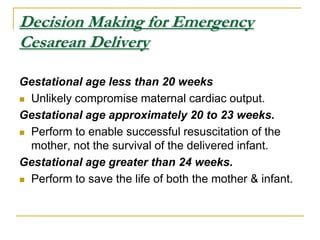
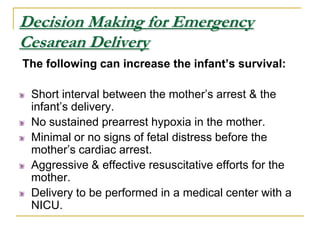
Resuscitation in PregnancyThere are two patients, mother & fetus.The best hope of fetal survival is maternal survival.Consider the physiologic changes.
Physiologic ChangesCompensate for increase metabolic demand.Prepare for blood loss at time of delivery.Alter presentation of injured women.Pregnant women is more vulnerable.Mask severity of injury.

Resuscitation in special populations