KHALED FAROUK; MD
A. PROFESSOR OF CRITICAL CARE MEDICINE
CAIRO UNIVERSITY
ECG for intensivests
A Story ?
You always need a story
When exactly in the timeline of your patient you
intersect?
Dose this changes his/her life?
More life or life no More
Loading...
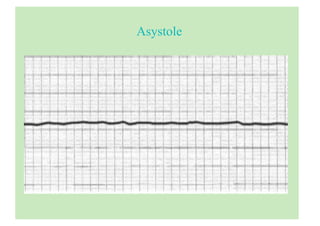
Asystole
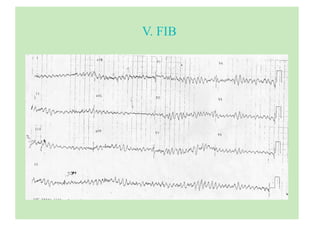
V. FIB
Loading...
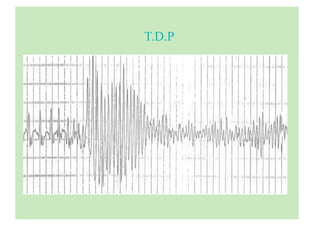
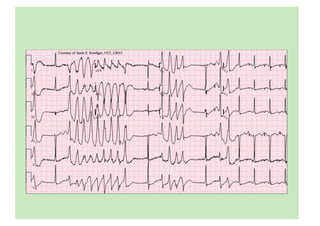
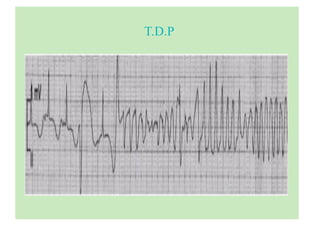
T.D.P
T.D.P
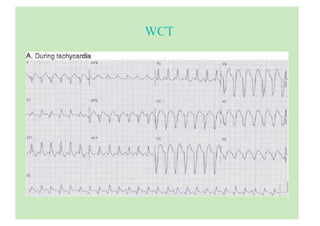
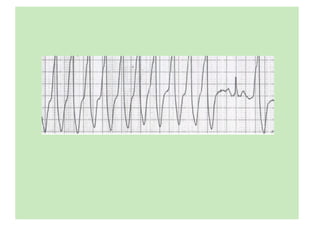
WCT
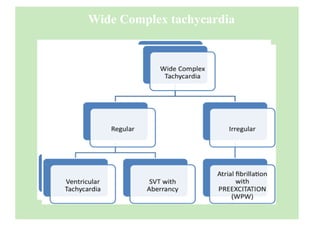
Wide Complex tachycardia
Loading...
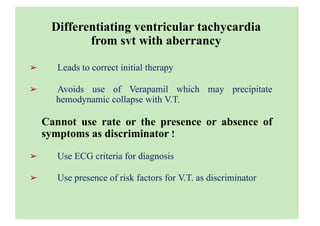
Differentiating ventricular tachycardia
from svt with aberrancy
➢ Leads to correct initial therapy
➢ Avoids use of Verapamil which may precipitate
hemodynamic collapse with V.T.
Cannot use rate or the presence or absence of
symptoms as discriminator !
➢ Use ECG criteria for diagnosis
➢ Use presence of risk factors for V.T. as discriminator
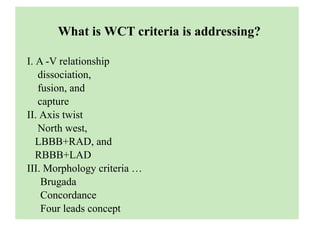
What is WCT criteria is addressing?
I. A -V relationship
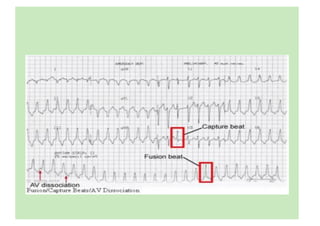
dissociation,
fusion, and
capture
II. Axis twist
North west,
LBBB+RAD, and
RBBB+LAD
III. Morphology criteria …
Brugada
Concordance
Four leads concept
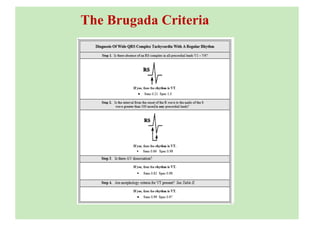
The Brugada Criteria
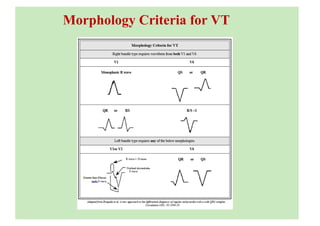
Morphology Criteria for VT
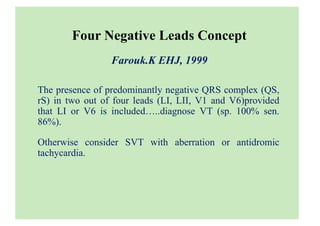
Four Negative Leads Concept
Farouk.K EHJ, 1999
The presence of predominantly negative QRS complex (QS,
rS) in two out of four leads (LI, LII, V1 and V6)provided
that LI or V6 is included…..diagnose VT (sp. 100% sen.
86%).
Otherwise consider SVT with aberration or antidromic
tachycardia.
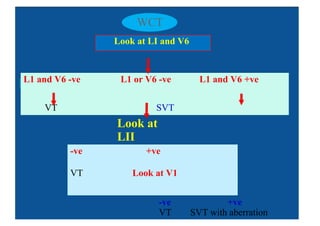
WCT
Look at LI and V6
-ve +ve
VT Look at V1
-ve +ve
VT SVT with aberration
L1 and V6 -ve L1 or V6 -ve L1 and V6 +ve
VT SVT
Look at
LII
Other ECG Criteria
B.Axis twist
➢ North - west QRS axis deviation
➢ RBBB morphology with LAD > - 300
➢ LBBB morphology with RAD > + 900
C. A_V relationship
➢ Fusion beats, capture beats
➢ Ventriculoatrial conduction with block
➢ Previous ECG show MI or previous ECG show that during
sinus rhythm, bifascular block is present, which changes in
configuration during tachycardia
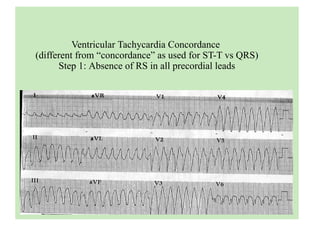
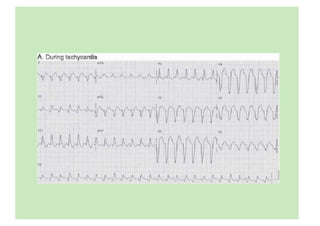
Ventricular Tachycardia Concordance
(different from “concordance” as used for ST-T vs QRS)
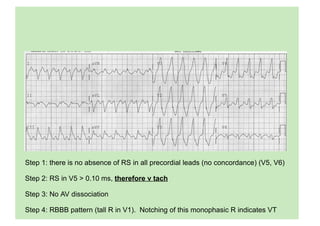
Step 1: Absence of RS in all precordial leads
Step 1: there is no absence of RS in all precordial leads (no concordance) (V5, V6)
Step 2: RS in V5 > 0.10 ms, therefore v tach
Step 3: No AV dissociation
Step 4: RBBB pattern (tall R in V1). Notching of this monophasic R indicates VT
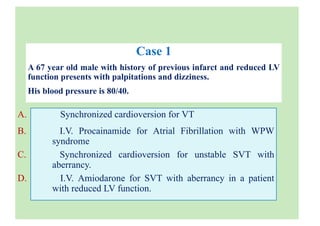
Case 1
A 67 year old male with history of previous infarct and reduced LV
function presents with palpitations and dizziness.
His blood pressure is 80/40.
A. Synchronized cardioversion for VT
B. I.V. Procainamide for Atrial Fibrillation with WPW
syndrome
C. Synchronized cardioversion for unstable SVT with
aberrancy.
D. I.V. Amiodarone for SVT with aberrancy in a patient
with reduced LV function.
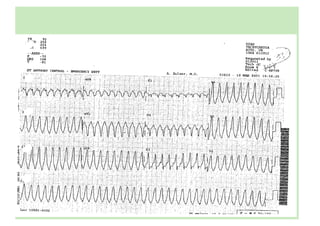
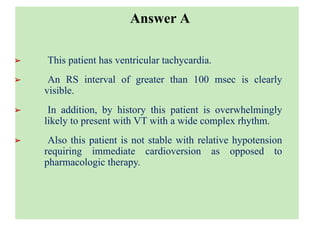
➢ This patient has ventricular tachycardia.
➢ An RS interval of greater than 100 msec is clearly
visible.
➢ In addition, by history this patient is overwhelmingly
likely to present with VT with a wide complex rhythm.
➢ Also this patient is not stable with relative hypotension
requiring immediate cardioversion as opposed to
pharmacologic therapy.
Answer A
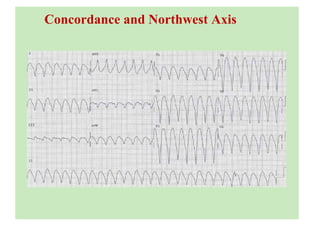
Concordance and Northwest Axis
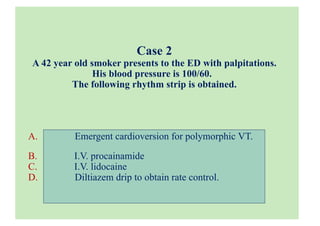
Case 2
A 42 year old smoker presents to the ED with palpitations.
His blood pressure is 100/60.
The following rhythm strip is obtained.
A. Emergent cardioversion for polymorphic VT.
B. I.V. procainamide
C. I.V. lidocaine
D. Diltiazem drip to obtain rate control.
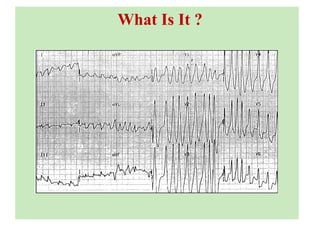
What Is It ?
Loading...
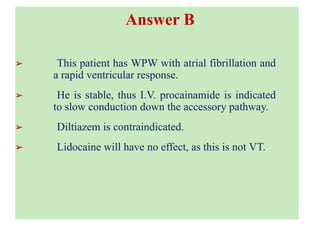
Answer B
➢ This patient has WPW with atrial fibrillation and
a rapid ventricular response.
➢ He is stable, thus I.V. procainamide is indicated
to slow conduction down the accessory pathway.
➢ Diltiazem is contraindicated.
➢ Lidocaine will have no effect, as this is not VT.
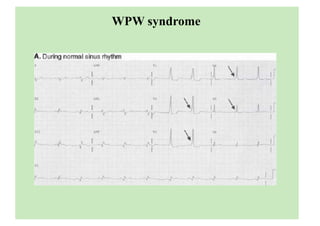
WPW syndrome
Case 3
A previously healthy 15-year old boy presents to ED with
sudden onset of palpitations while playing sport. On arrival
to ED he is alert and pain free with a good blood pressure.
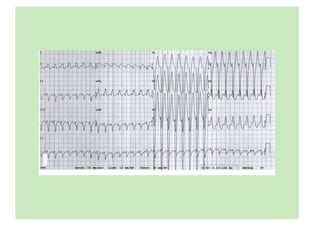
His ECG is shown below:
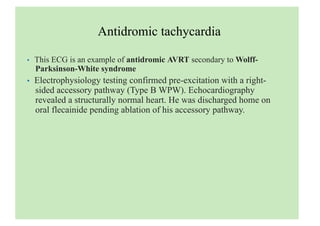
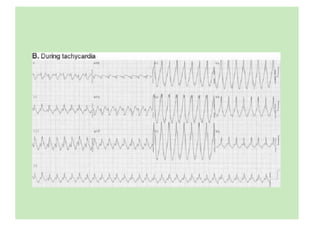
Antidromic tachycardia
• This ECG is an example of antidromic AVRT secondary to Wolff-
Parksinson-White syndrome
• Electrophysiology testing confirmed pre-excitation with a right-
sided accessory pathway (Type B WPW). Echocardiography
revealed a structurally normal heart. He was discharged home on
oral flecainide pending ablation of his accessory pathway.
Case 3
29 year old Female
Hx
Presented to the ER after 3 episodes of palpitations over 3 days,
and a feeling of impending doom
Hx of sudden cardiac death in uncle at age 45
No hx of syncope
PMHx
Healthy
Meds
No medications
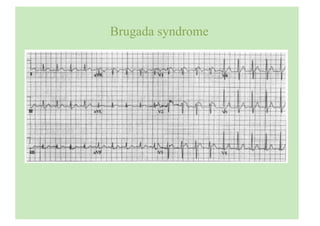
Brugada syndrome
Brugada syndrome
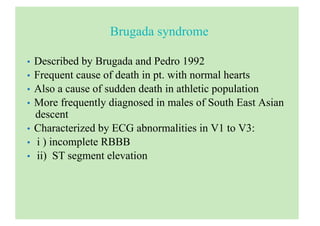
• Described by Brugada and Pedro 1992
• Frequent cause of death in pt. with normal hearts
• Also a cause of sudden death in athletic population
• More frequently diagnosed in males of South East Asian
descent
• Characterized by ECG abnormalities in V1 to V3:
• i ) incomplete RBBB
• ii) ST segment elevation
Brugada syndrome
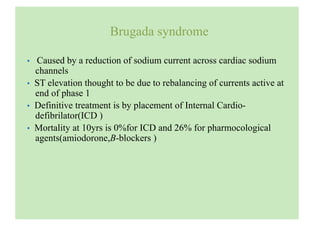
• Caused by a reduction of sodium current across cardiac sodium
channels
• ST elevation thought to be due to rebalancing of currents active at
end of phase 1
• Definitive treatment is by placement of Internal Cardio-
defibrilator(ICD )
• Mortality at 10yrs is 0%for ICD and 26% for pharmocological
agents(amiodorone,B-blockers )
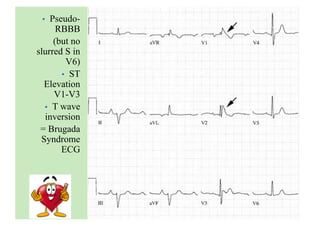
• Pseudo-
RBBB
(but no
slurred S in
V6)
• ST
Elevation
V1-V3
• T wave
inversion
= Brugada
Syndrome
ECG
Summary
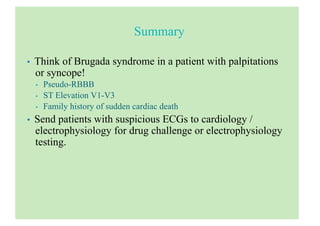
• Think of Brugada syndrome in a patient with palpitations
or syncope!
• Pseudo-RBBB
• ST Elevation V1-V3
• Family history of sudden cardiac death
• Send patients with suspicious ECGs to cardiology /
electrophysiology for drug challenge or electrophysiology
testing.
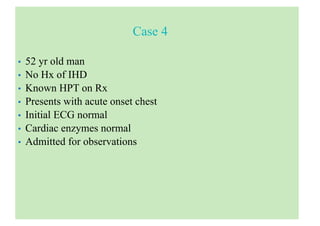
Case 4
• 52 yr old man
• No Hx of IHD
• Known HPT on Rx
• Presents with acute onset chest
• Initial ECG normal
• Cardiac enzymes normal
• Admitted for observations
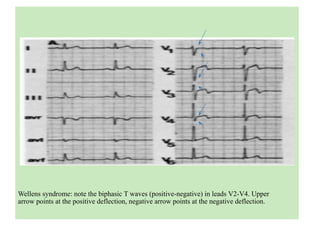
Wellens syndrome: note the biphasic T waves (positive-negative) in leads V2-V4. Upper
arrow points at the positive deflection, negative arrow points at the negative deflection.
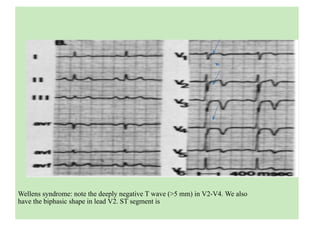
Wellens syndrome: note the deeply negative T wave (>5 mm) in V2-V4. We also
have the biphasic shape in lead V2. ST segment is
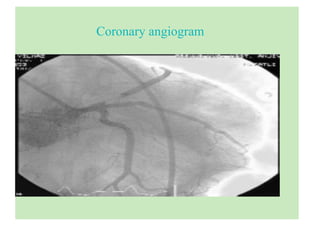
Coronary angiogram
Case 5
• A 30-year old female with a history of Conn’s syndrome
secondary to bilateral adrenal adenomas presents with
generalised weakness and muscle pains after a change in
her medications.
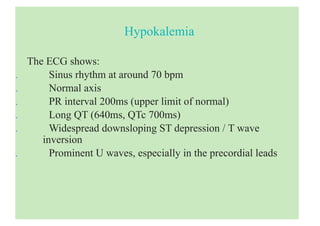
Hypokalemia
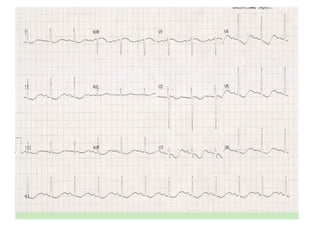
The ECG shows:
1. Sinus rhythm at around 70 bpm
2. Normal axis
3. PR interval 200ms (upper limit of normal)
4. Long QT (640ms, QTc 700ms)
5. Widespread downsloping ST depression / T wave
inversion
6. Prominent U waves, especially in the precordial leads
HARM NO ONE
Rule number one
Rule 1
• If you don’t have time shock or pace no more peace.
• Most of the time you have good time, you are in peace.
Rule number two
• Look at the toe
Rule 2
• Time is perfusion and flow don’t leave it low
Rule number three
• Master the key
Rule 3
Key may be:
Hx.
C/P
Criteria
Own records
Rule number four
• Never shut the door
Rule 4
• Arrhythmia patients are frequent comer and may
come late don’t use your hummer.
• Record your experience, send a free advice to your
college next visit, let him start where you finish .
Rule number five
• Search the wife
Rule 5
Salt :
Low salt brings insult.
Excess K+ is not ok.
Fat :
Excess fat is always bad.
Young widows are always sad.
Rule number six
• Use the tricks
Rule 6
C.S.M
Valsalva
Leg up
Fluids
Vasopressor
RT chest leads
Pacing
Echo Probe
Ask questions
Make the call
Rule number seven
• All and above ask the haven
ECG for the intensivists

ECG for the intensivists

  • 1.
    KHALED FAROUK; MD A.PROFESSOR OF CRITICAL CARE MEDICINE CAIRO UNIVERSITY ECG for intensivests
  • 2.
    A Story ? Youalways need a story When exactly in the timeline of your patient you intersect? Dose this changes his/her life? More life or life no More
  • 3.
  • 4.
  • 5.
  • 7.
  • 9.
  • 10.
  • 11.
    Loading... Differentiating ventricular tachycardia fromsvt with aberrancy ➢ Leads to correct initial therapy ➢ Avoids use of Verapamil which may precipitate hemodynamic collapse with V.T. Cannot use rate or the presence or absence of symptoms as discriminator ! ➢ Use ECG criteria for diagnosis ➢ Use presence of risk factors for V.T. as discriminator
  • 12.
    What is WCTcriteria is addressing? I. A -V relationship dissociation, fusion, and capture II. Axis twist North west, LBBB+RAD, and RBBB+LAD III. Morphology criteria … Brugada Concordance Four leads concept
  • 13.
  • 14.
  • 15.
    Four Negative LeadsConcept Farouk.K EHJ, 1999 The presence of predominantly negative QRS complex (QS, rS) in two out of four leads (LI, LII, V1 and V6)provided that LI or V6 is included…..diagnose VT (sp. 100% sen. 86%). Otherwise consider SVT with aberration or antidromic tachycardia.
  • 16.
    WCT Look at LIand V6 -ve +ve VT Look at V1 -ve +ve VT SVT with aberration L1 and V6 -ve L1 or V6 -ve L1 and V6 +ve VT SVT Look at LII
  • 17.
    Other ECG Criteria B.Axistwist ➢ North - west QRS axis deviation ➢ RBBB morphology with LAD > - 300 ➢ LBBB morphology with RAD > + 900 C. A_V relationship ➢ Fusion beats, capture beats ➢ Ventriculoatrial conduction with block ➢ Previous ECG show MI or previous ECG show that during sinus rhythm, bifascular block is present, which changes in configuration during tachycardia
  • 20.
    Ventricular Tachycardia Concordance (differentfrom “concordance” as used for ST-T vs QRS) Step 1: Absence of RS in all precordial leads
  • 21.
    Step 1: thereis no absence of RS in all precordial leads (no concordance) (V5, V6) Step 2: RS in V5 > 0.10 ms, therefore v tach Step 3: No AV dissociation Step 4: RBBB pattern (tall R in V1). Notching of this monophasic R indicates VT
  • 22.
    Case 1 A 67year old male with history of previous infarct and reduced LV function presents with palpitations and dizziness. His blood pressure is 80/40. A. Synchronized cardioversion for VT B. I.V. Procainamide for Atrial Fibrillation with WPW syndrome C. Synchronized cardioversion for unstable SVT with aberrancy. D. I.V. Amiodarone for SVT with aberrancy in a patient with reduced LV function.
  • 24.
    ➢ This patienthas ventricular tachycardia. ➢ An RS interval of greater than 100 msec is clearly visible. ➢ In addition, by history this patient is overwhelmingly likely to present with VT with a wide complex rhythm. ➢ Also this patient is not stable with relative hypotension requiring immediate cardioversion as opposed to pharmacologic therapy. Answer A
  • 26.
  • 27.
    Case 2 A 42year old smoker presents to the ED with palpitations. His blood pressure is 100/60. The following rhythm strip is obtained. A. Emergent cardioversion for polymorphic VT. B. I.V. procainamide C. I.V. lidocaine D. Diltiazem drip to obtain rate control.
  • 28.
  • 29.
    Loading... Answer B ➢ Thispatient has WPW with atrial fibrillation and a rapid ventricular response. ➢ He is stable, thus I.V. procainamide is indicated to slow conduction down the accessory pathway. ➢ Diltiazem is contraindicated. ➢ Lidocaine will have no effect, as this is not VT.
  • 30.
  • 31.
    Case 3 A previouslyhealthy 15-year old boy presents to ED with sudden onset of palpitations while playing sport. On arrival to ED he is alert and pain free with a good blood pressure. His ECG is shown below:
  • 33.
    Antidromic tachycardia • ThisECG is an example of antidromic AVRT secondary to Wolff- Parksinson-White syndrome • Electrophysiology testing confirmed pre-excitation with a right- sided accessory pathway (Type B WPW). Echocardiography revealed a structurally normal heart. He was discharged home on oral flecainide pending ablation of his accessory pathway.
  • 35.
    Case 3 29 yearold Female Hx Presented to the ER after 3 episodes of palpitations over 3 days, and a feeling of impending doom Hx of sudden cardiac death in uncle at age 45 No hx of syncope PMHx Healthy Meds No medications
  • 36.
  • 37.
    Brugada syndrome • Describedby Brugada and Pedro 1992 • Frequent cause of death in pt. with normal hearts • Also a cause of sudden death in athletic population • More frequently diagnosed in males of South East Asian descent • Characterized by ECG abnormalities in V1 to V3: • i ) incomplete RBBB • ii) ST segment elevation
  • 38.
    Brugada syndrome • Causedby a reduction of sodium current across cardiac sodium channels • ST elevation thought to be due to rebalancing of currents active at end of phase 1 • Definitive treatment is by placement of Internal Cardio- defibrilator(ICD ) • Mortality at 10yrs is 0%for ICD and 26% for pharmocological agents(amiodorone,B-blockers )
  • 39.
    • Pseudo- RBBB (but no slurredS in V6) • ST Elevation V1-V3 • T wave inversion = Brugada Syndrome ECG
  • 40.
    Summary • Think ofBrugada syndrome in a patient with palpitations or syncope! • Pseudo-RBBB • ST Elevation V1-V3 • Family history of sudden cardiac death • Send patients with suspicious ECGs to cardiology / electrophysiology for drug challenge or electrophysiology testing.
  • 41.
    Case 4 • 52yr old man • No Hx of IHD • Known HPT on Rx • Presents with acute onset chest • Initial ECG normal • Cardiac enzymes normal • Admitted for observations
  • 42.
    Wellens syndrome: notethe biphasic T waves (positive-negative) in leads V2-V4. Upper arrow points at the positive deflection, negative arrow points at the negative deflection.
  • 43.
    Wellens syndrome: notethe deeply negative T wave (>5 mm) in V2-V4. We also have the biphasic shape in lead V2. ST segment is
  • 44.
  • 45.
    Case 5 • A30-year old female with a history of Conn’s syndrome secondary to bilateral adrenal adenomas presents with generalised weakness and muscle pains after a change in her medications.
  • 47.
    Hypokalemia The ECG shows: 1.Sinus rhythm at around 70 bpm 2. Normal axis 3. PR interval 200ms (upper limit of normal) 4. Long QT (640ms, QTc 700ms) 5. Widespread downsloping ST depression / T wave inversion 6. Prominent U waves, especially in the precordial leads
  • 48.
    HARM NO ONE Rulenumber one
  • 49.
    Rule 1 • Ifyou don’t have time shock or pace no more peace. • Most of the time you have good time, you are in peace.
  • 50.
    Rule number two •Look at the toe
  • 51.
    Rule 2 • Timeis perfusion and flow don’t leave it low
  • 52.
    Rule number three •Master the key
  • 53.
    Rule 3 Key maybe: Hx. C/P Criteria Own records
  • 54.
    Rule number four •Never shut the door
  • 55.
    Rule 4 • Arrhythmiapatients are frequent comer and may come late don’t use your hummer. • Record your experience, send a free advice to your college next visit, let him start where you finish .
  • 56.
    Rule number five •Search the wife
  • 57.
    Rule 5 Salt : Lowsalt brings insult. Excess K+ is not ok. Fat : Excess fat is always bad. Young widows are always sad.
  • 58.
    Rule number six •Use the tricks
  • 59.
    Rule 6 C.S.M Valsalva Leg up Fluids Vasopressor RTchest leads Pacing Echo Probe Ask questions Make the call
  • 60.
    Rule number seven •All and above ask the haven