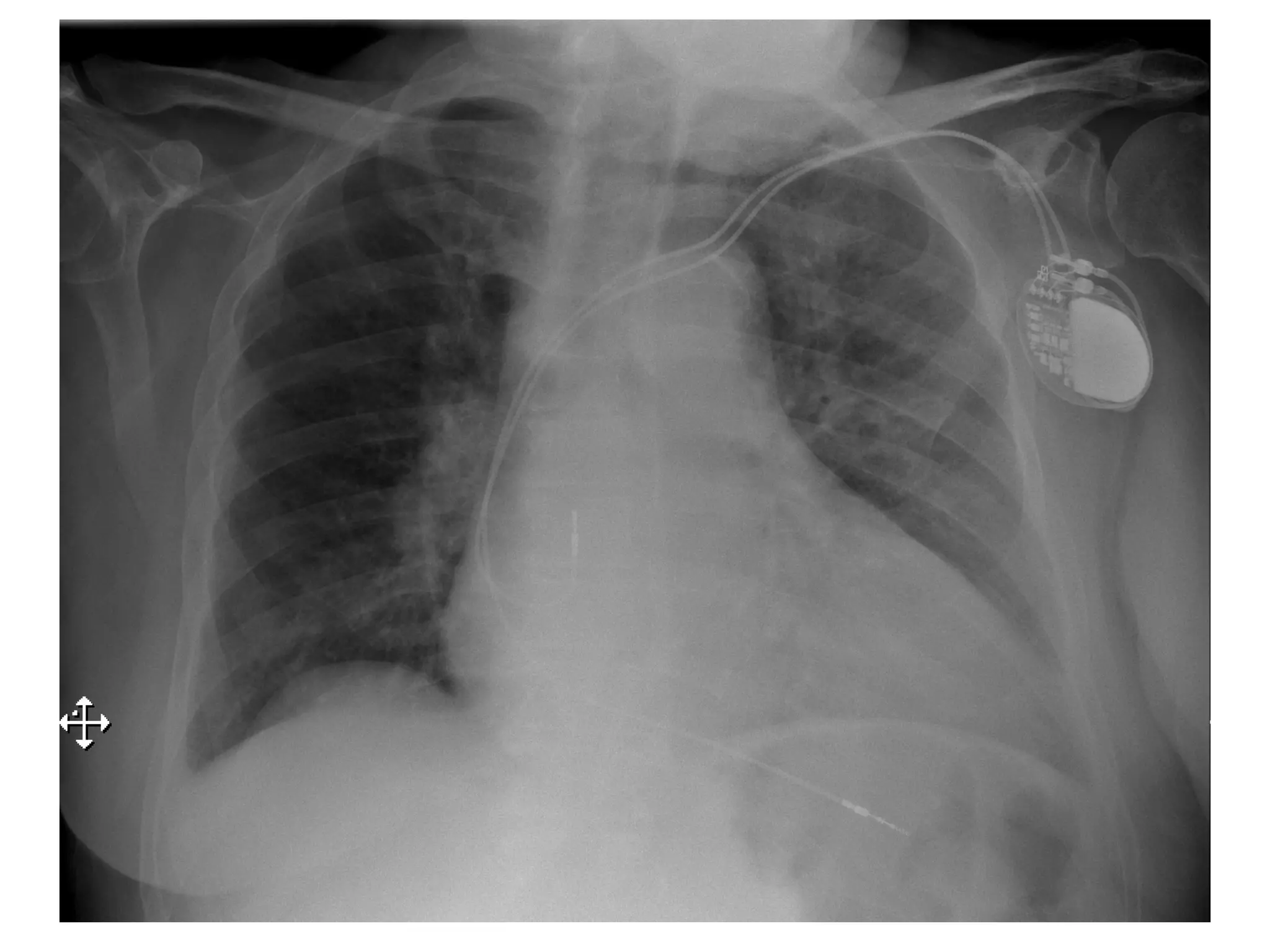
Cardiac Pace-Makers
 
Functions & Malfunctions (Part 1)
Salah Atta, MD
Professor of Cardiology
Outlines
• Historical background
• Indications of cardiac pacemaker implantation.
• Pacemaker terminology and components.
• Types of pacemakers and their Functions.
• Measurements during PM implantation.
• Pacemaker follow up and programmable
parameters.
• Pacemaker malfunctions and Pseudomalfunctions.
Historical Background
• The first clinical implantation into a human of a fully
implantable pacemaker was in 1958 at the
Karolinska Institute in Solna, Sweden.
• The first use of transvenous pacing in conjunction with an
implanted pacemaker was by Parsonnet in the USA ,
Lagergren in Sweden and Jean-Jaques Welti in France in 1962-
63
• The earliest devices all suffered from short life time
mercury battery.
• The development in 1970 of the lithium-iodide cell by
Wilson Greatbatch enabled longer PM lives.
Implant Evolution
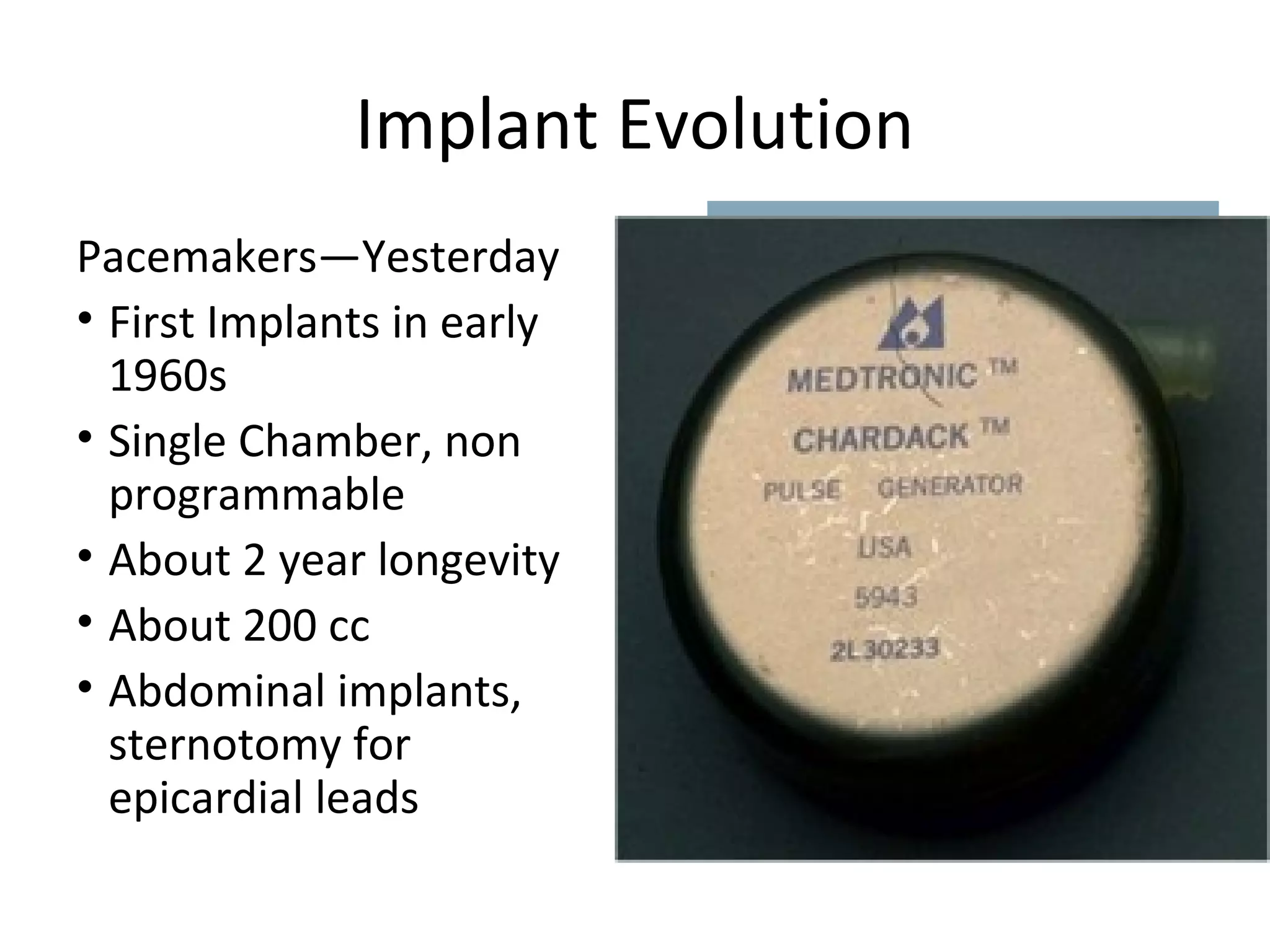
Pacemakers—Yesterday
• First Implants in early
1960s
• Single Chamber, non
programmable
• About 2 year longevity
• About 200 cc
• Abdominal implants,
sternotomy for
epicardial leads
Implant Evolution
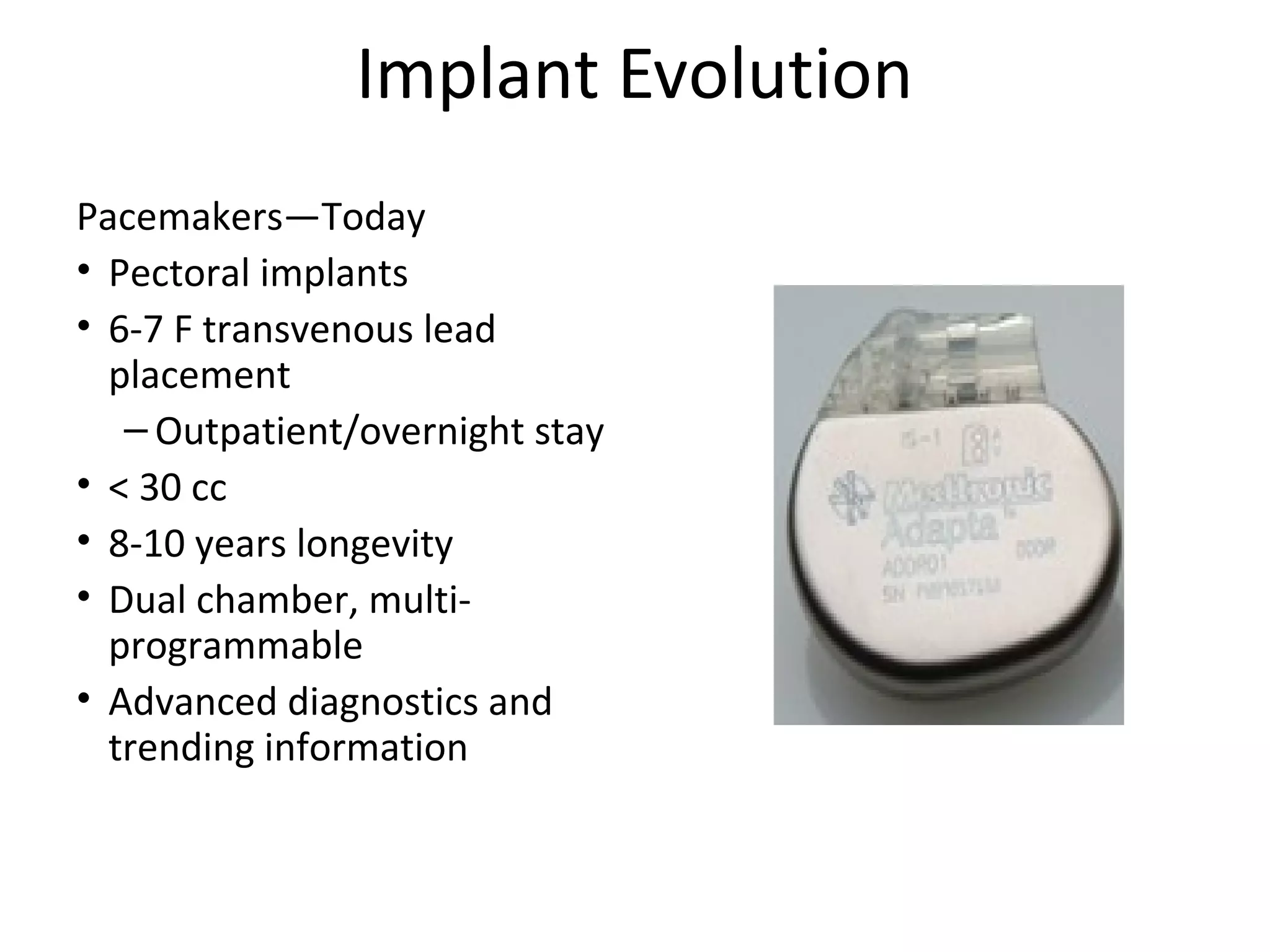
Pacemakers—Today
• Pectoral implants
• 6-7 F transvenous lead
placement
– Outpatient/overnight stay
• < 30 cc
• 8-10 years longevity
• Dual chamber, multi-
programmable
• Advanced diagnostics and
trending information
Aims of using Cardiac Pacemakers
• A satisfactory heart rate to maintain effective
cardiac output.
• A chrono-tropic physiological response.
• Atrio-ventricular synchronization.
• Inter-ventricular and intra-ventricular
synchronization.
• To treat or prevent arrhythmias.
7
Temporary Pacing
• Routes = Transvenous, transcutaneous, esophageal
Indications:
• Unstable brady-dysrhythmias
• Atrio-ventricular heart block
• Unstable tachydys-rhythmias 
Endpoint is reached after resolution of a reversible 
problem or permanent pacemaker implantation.
Indications for Permanent Pacemaker
Class I
• 3° or 2° AV block with associated symptomatic bradycardia.
• 3° and advanced 2° AV block associated with any of the
following:
Arrhythmias that require drugs resulting in
symptomatic bradycardia
Sinus pauses > 3 seconds
Asymptomatic escape rate < 40bpm while awake
• Type II 2° AV block with wide QRS, regardless of symptoms
• Sinus node dysfunction with documented symptomatic
bradycardia
• Symptomatic chronotropic incompetence (failure to
increase HR with exercise or increased metabolic demand)
Indications for Pacemaker
Class IIa
1. Syncope of unexplained origin when major abnormalities of sinus
node function are discovered or provoked during EP studies.
2. Asymptomatic 3° AV block with an awake ventricular rate > 40 bpm.
3. Asymptomatic type II 2° AV block.
Class Ia
-CRT for pts with NYHA Class III or IV heart failure, Ejection Fraction of <
35%,On optimal medical therapy, QRS > 120 ms wide ± Echo
evidence of ventricular dyssynchrony.
Class IIb
Hypertrophic obstructive cardiomyopathy without symptomatic
bradycardia.
Non indications for PPM
• These conditions include, among others,
syncope of undetermined etiology,
asymptomatic sinus bradycardia,
asymptomatic first-degree and second-degree
Mobitz I (Wenckebach) AV block, reversible
AV block, and long QT syndrome or torsades
de pointes due to a reversible cause.
11
Functions of a Pacemaker
• Provide the rate and rhythm the heart 
cannot produce (Pace)
• Detect intrinsic activity (sense)
• Detect physical activity and react 
accordingly (Rate Responsiveness)
• has a power source and a lead to carry the 
current to the heart muscle.
Pacing & Depolarization of Myocardial
Tissue
• The myocardium must be excitable
• The stimulus current density (current  per unit cross-
sectional area) must be sufficiently high & of sufficient 
duration and the lead should be in a good position with 
good contact with myocardium
• The pacemaker-generated impulse then relies on the 
intrinsic properties of cardiac specialized conduction & 
myocardial tissue for depolarization of the entire heart 
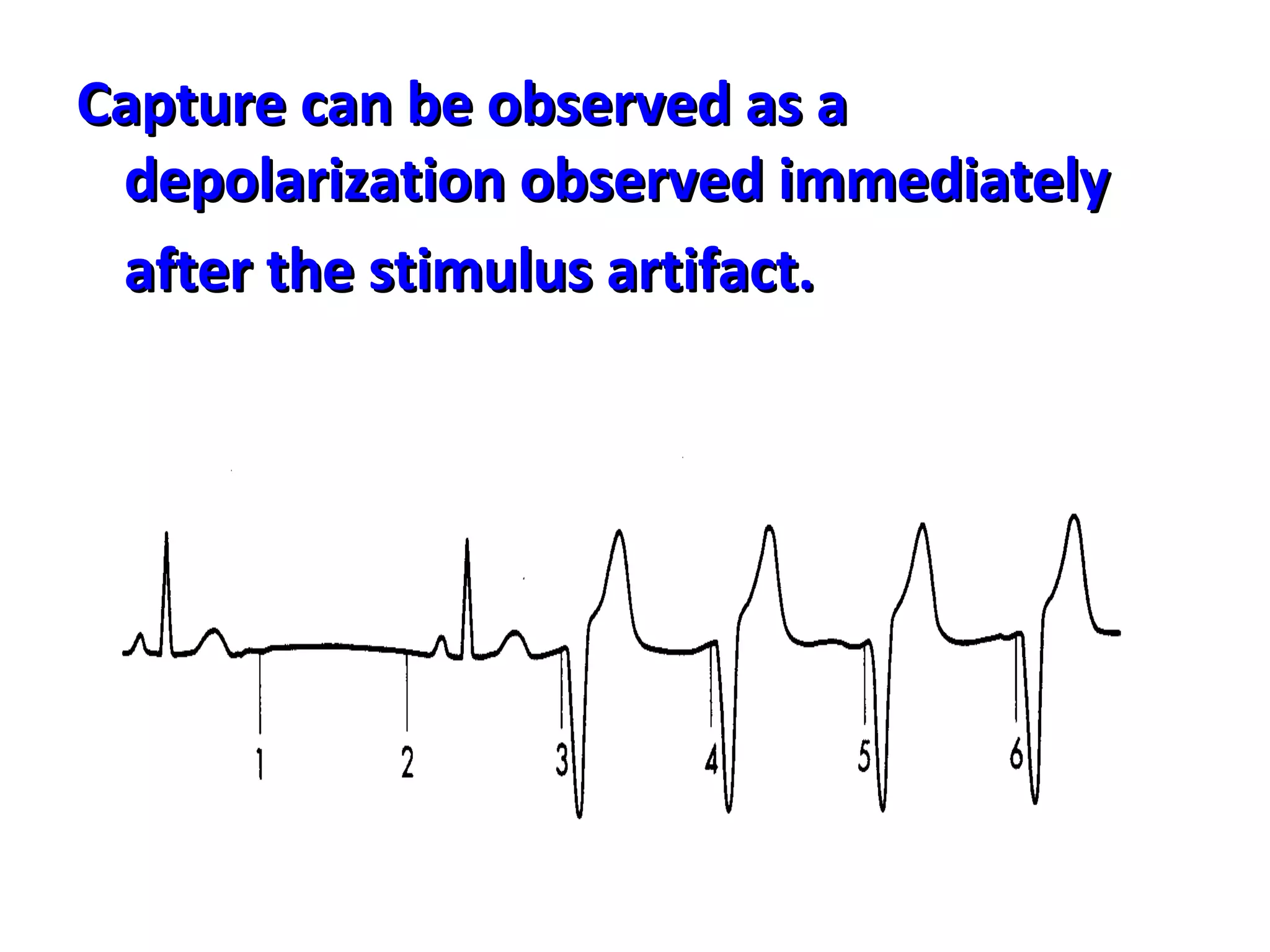
(Capture)
Capture can be observed as a Capture can be observed as a 
depolarization observed immediately depolarization observed immediately 
after the stimulus artifact.after the stimulus artifact.  
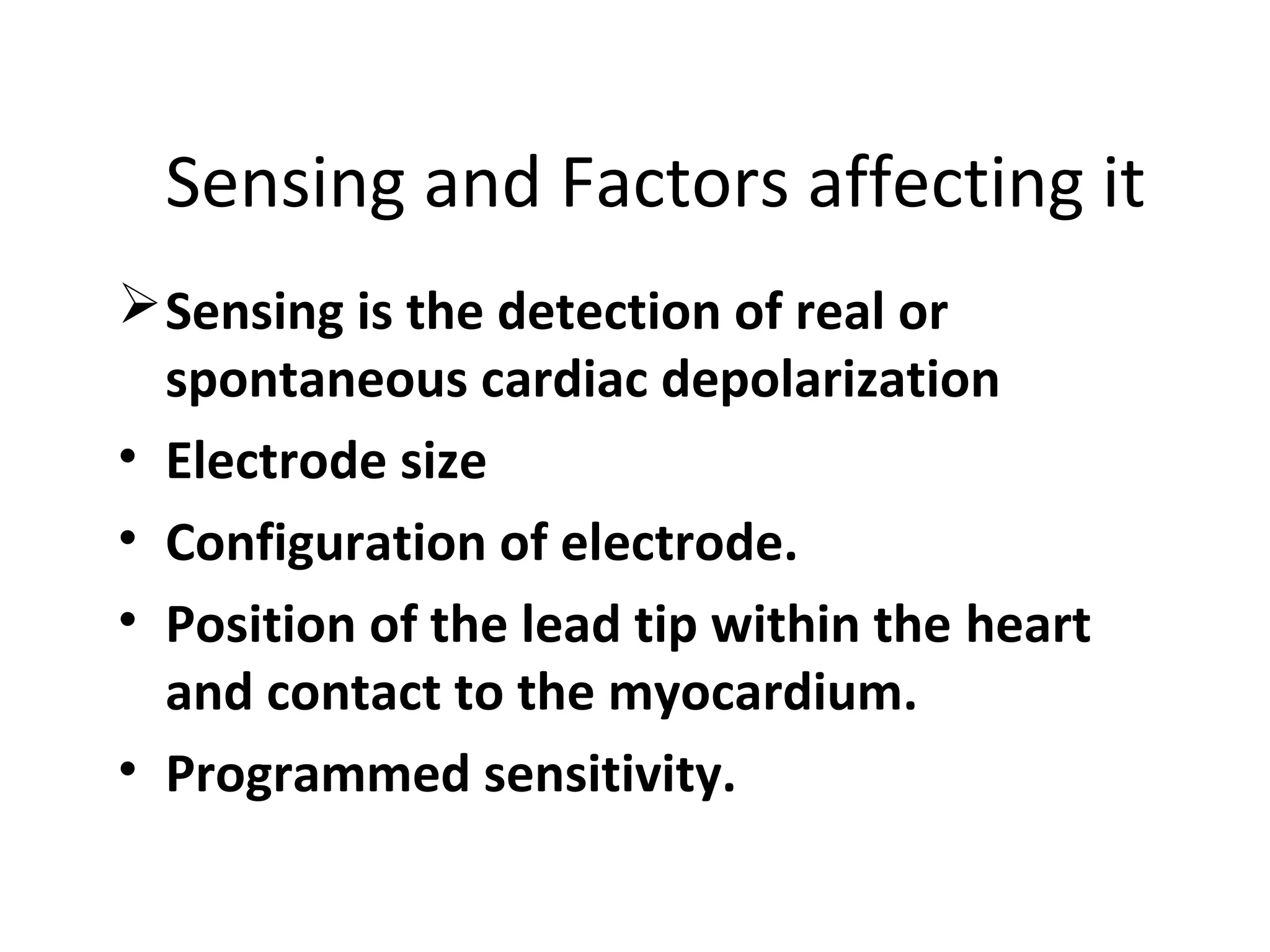
Sensing and Factors affecting it
Sensing is the detection of real or  
spontaneous cardiac depolarization
• Electrode size
• Configuration of electrode.
• Position of the lead tip within the heart 
and contact to the myocardium.
• Programmed sensitivity.
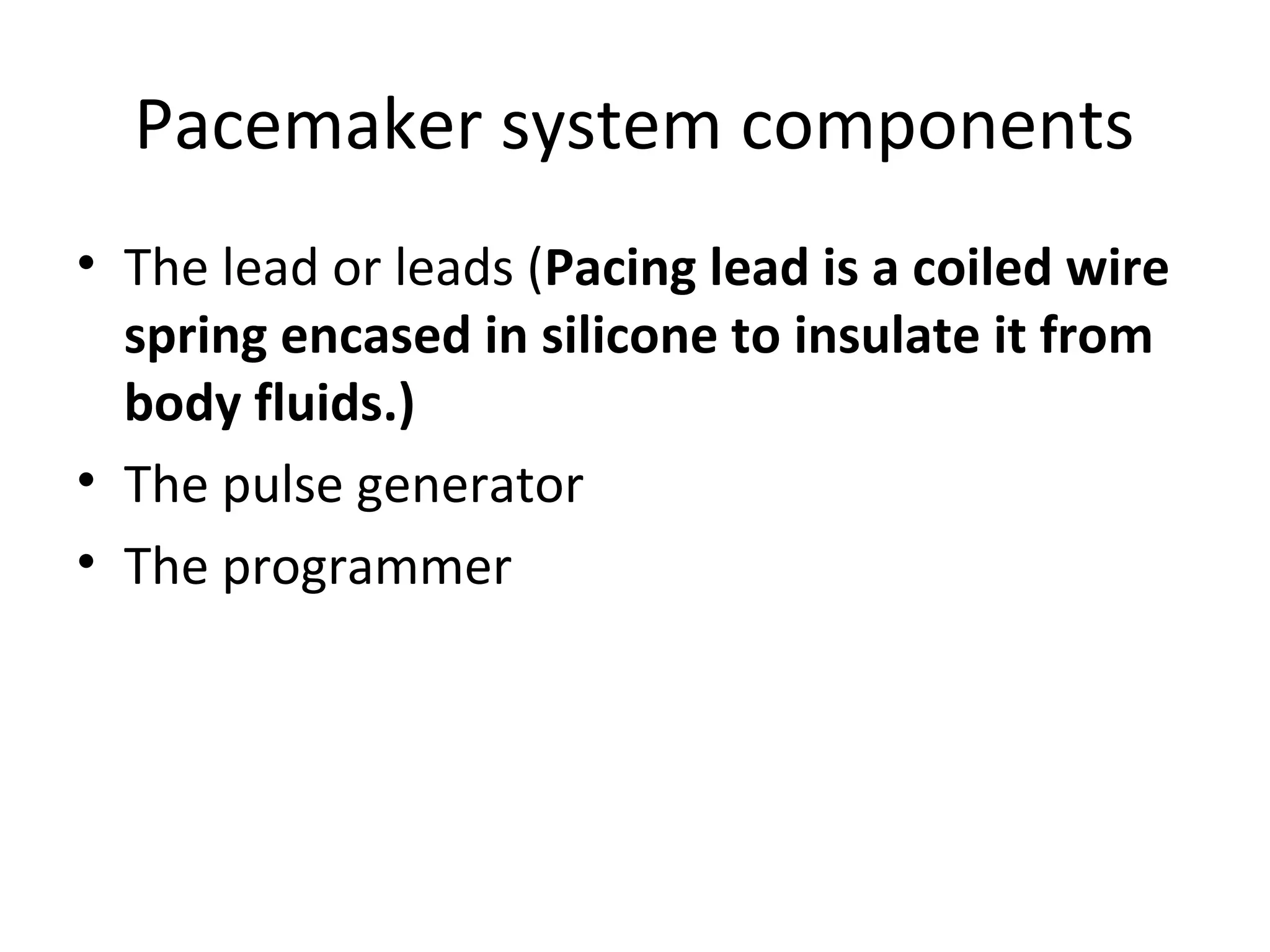
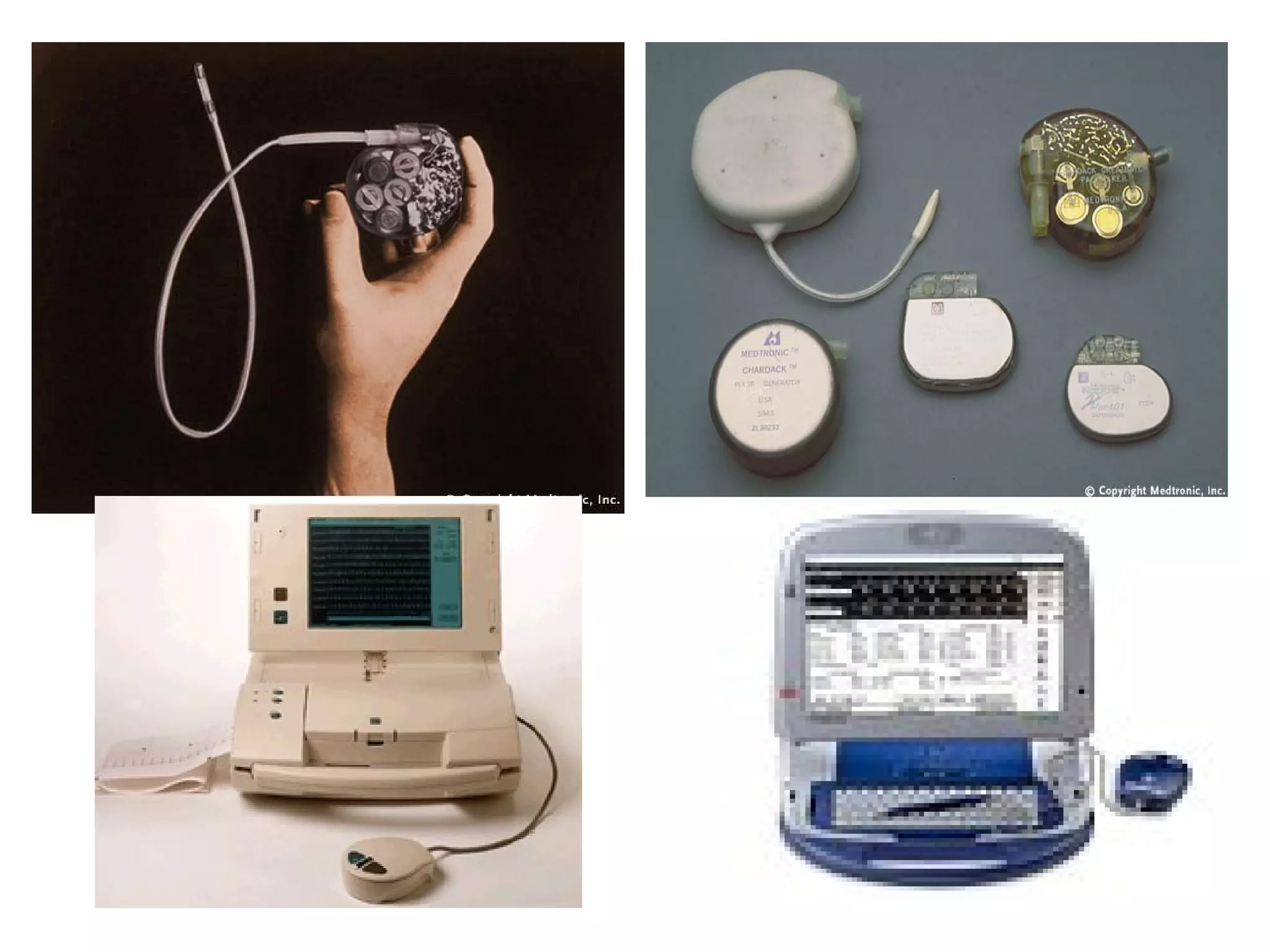
Pacemaker system components
• The lead or leads (Pacing lead is a coiled wire
spring encased in silicone to insulate it from
body fluids.)
• The pulse generator
• The programmer
Pacing Lead Technology
 Distal end attachment of the lead
• Active fixation
• Passive fixation
1. Chronic ventricular pacing thresholds
tend to be lower with passive lead, in part
because of tissue injury with active fixation.
2. Sensing characteristics are similar between
active & passive leads.
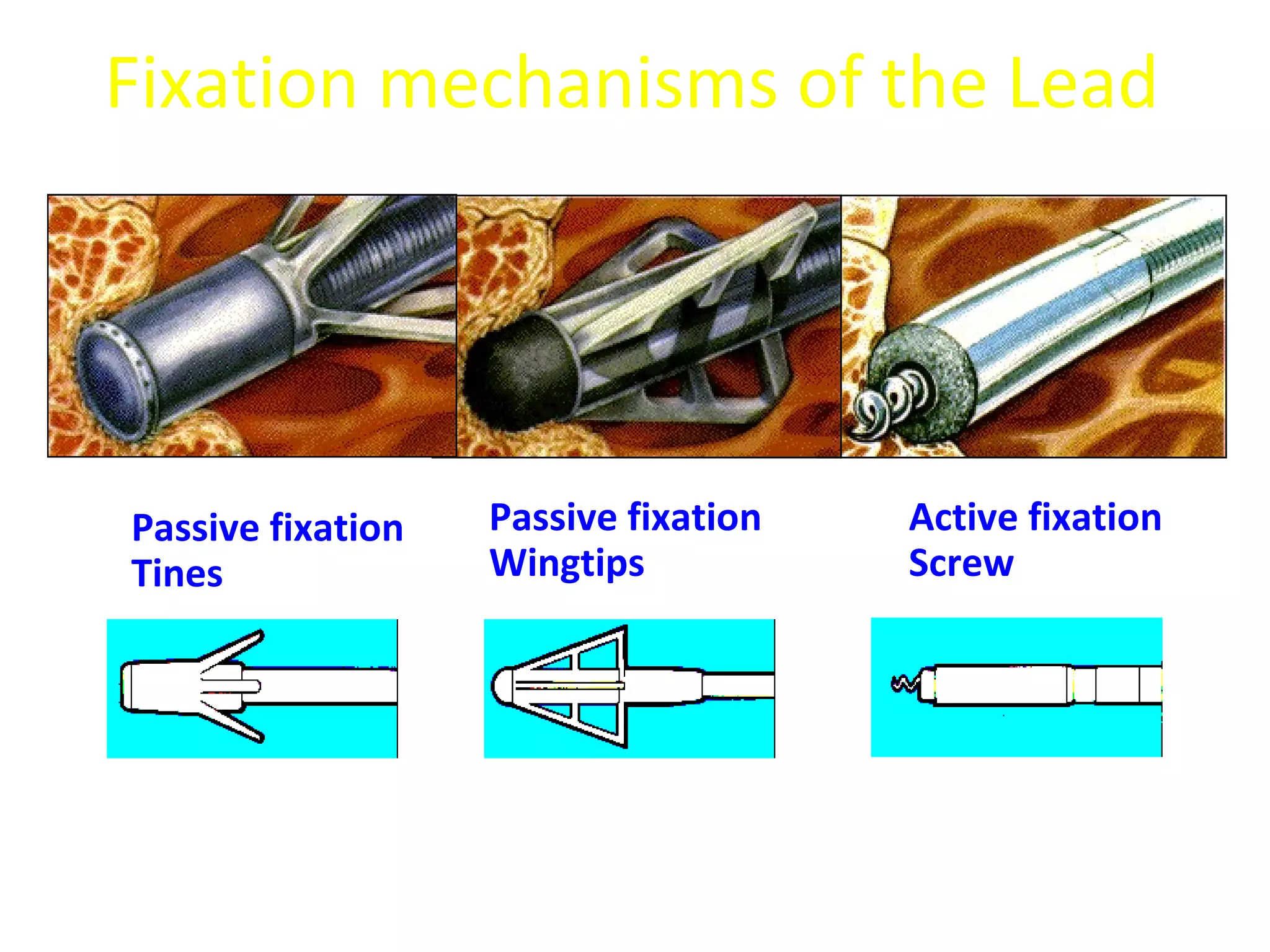
Fixation mechanisms of the Lead
Passive fixation
Wingtips
Active fixation
Screw
Passive fixation
Tines
-
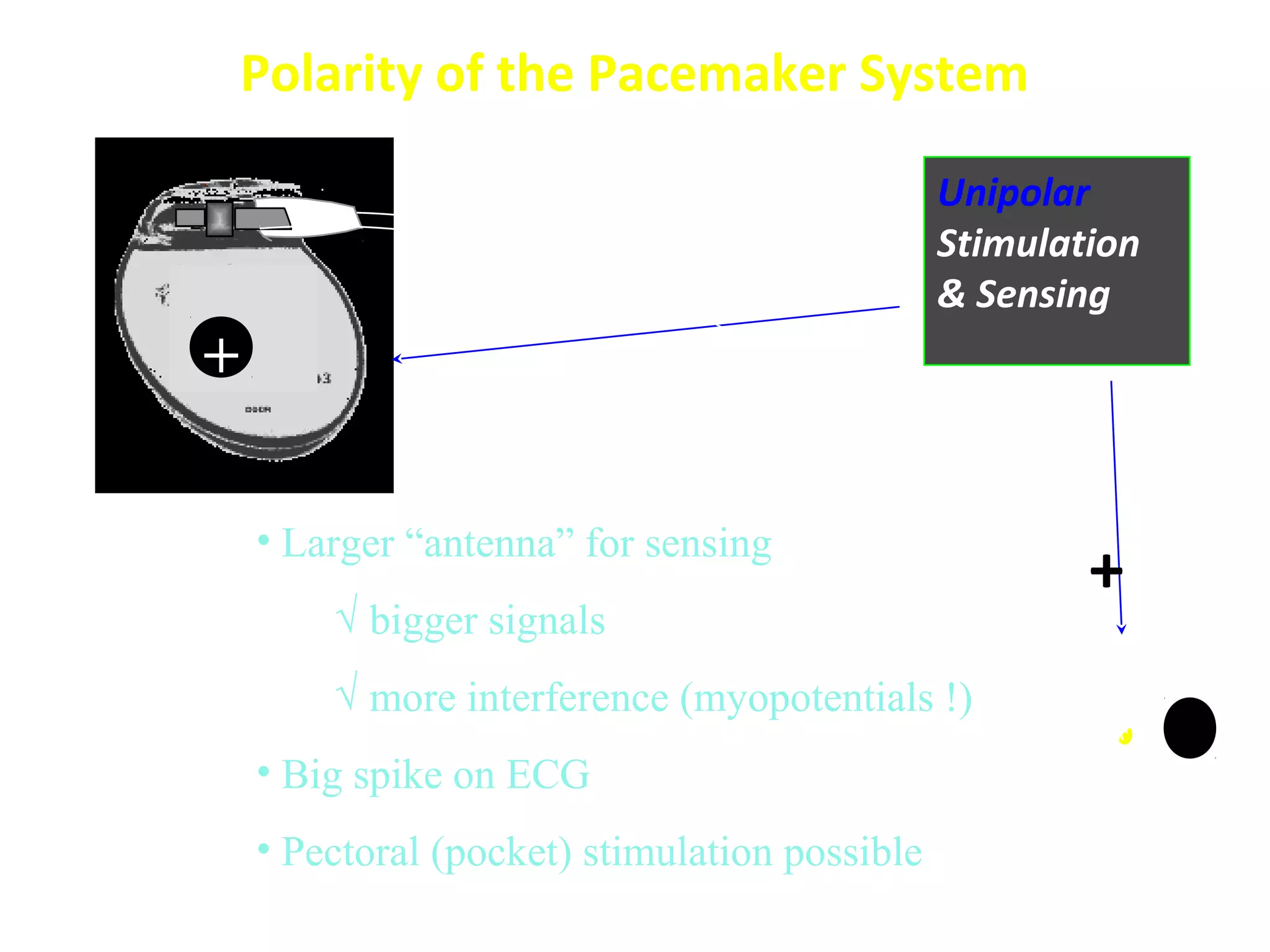
Unipolar
Stimulation
& Sensing
Polarity of the Pacemaker System
• Larger “antenna” for sensing
√ bigger signals
√ more interference (myopotentials !)
• Big spike on ECG
• Pectoral (pocket) stimulation possible
+
+
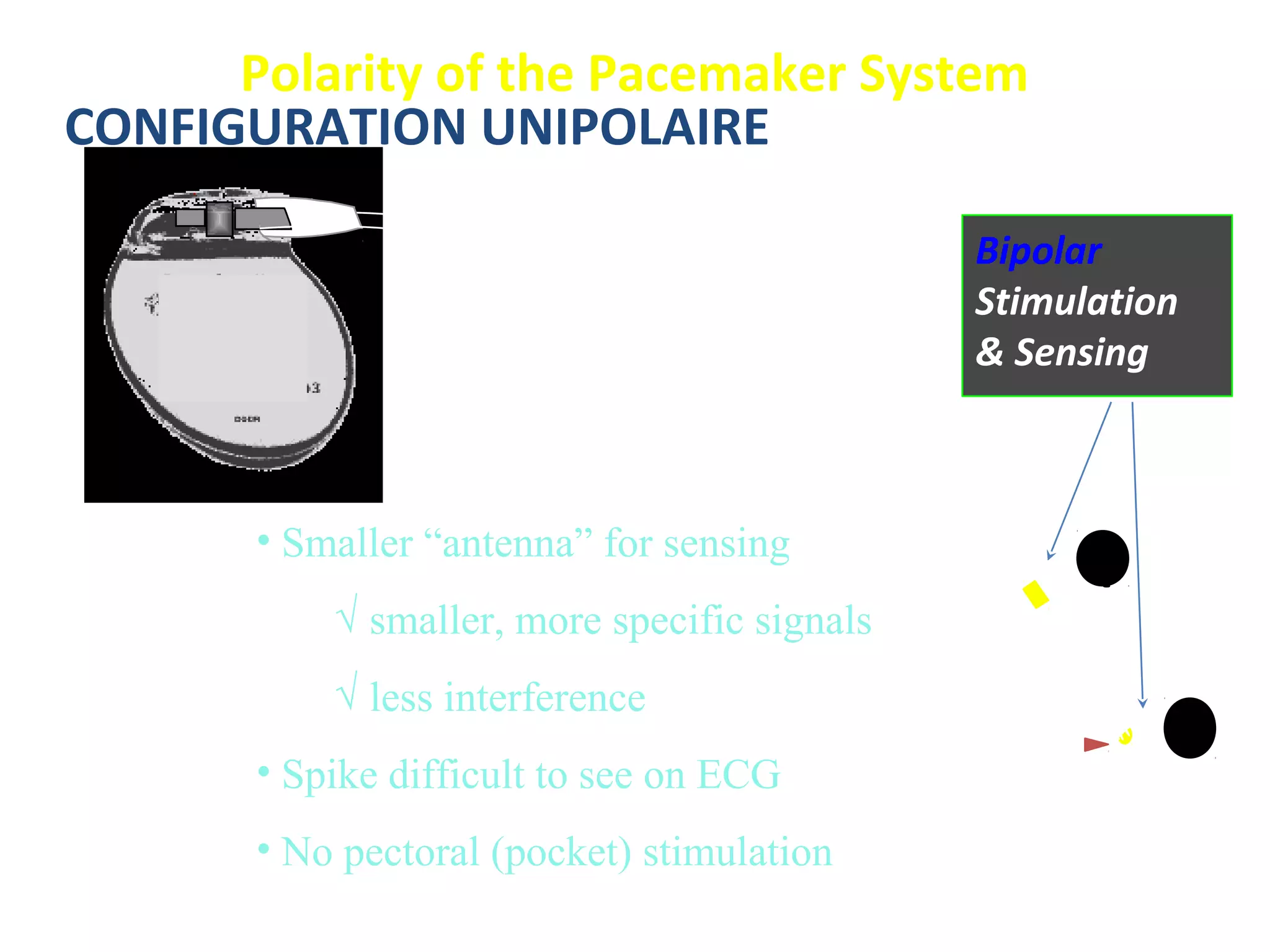
CONFIGURATION UNIPOLAIRE
-
Polarity of the Pacemaker System
Bipolar
Stimulation
& Sensing
+
• Smaller “antenna” for sensing
√ smaller, more specific signals
√ less interference
• Spike difficult to see on ECG
• No pectoral (pocket) stimulation
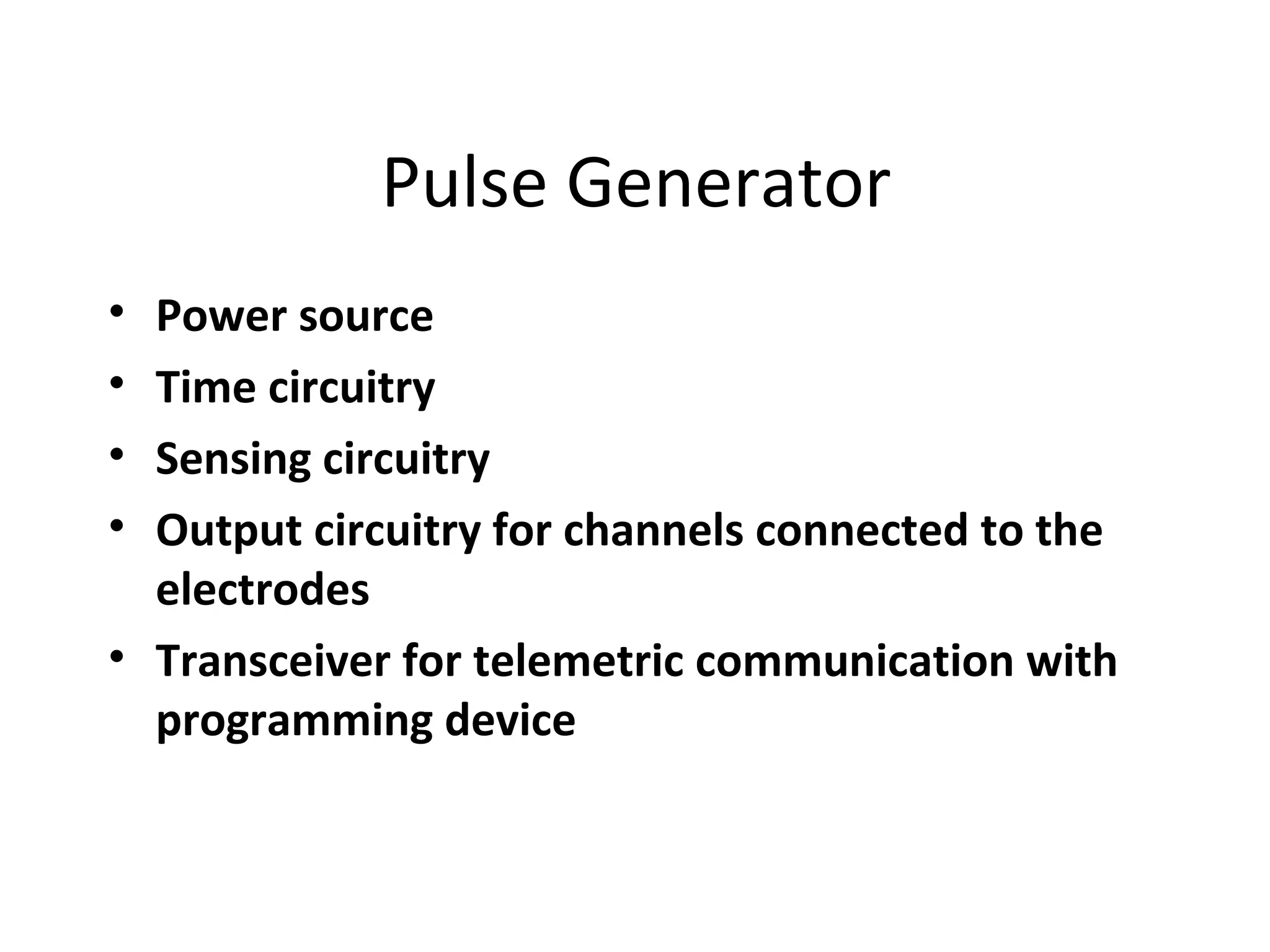
Pulse Generator
• Power source
• Time circuitry
• Sensing circuitry
• Output circuitry for channels connected to the
electrodes
• Transceiver for telemetric communication with
programming device
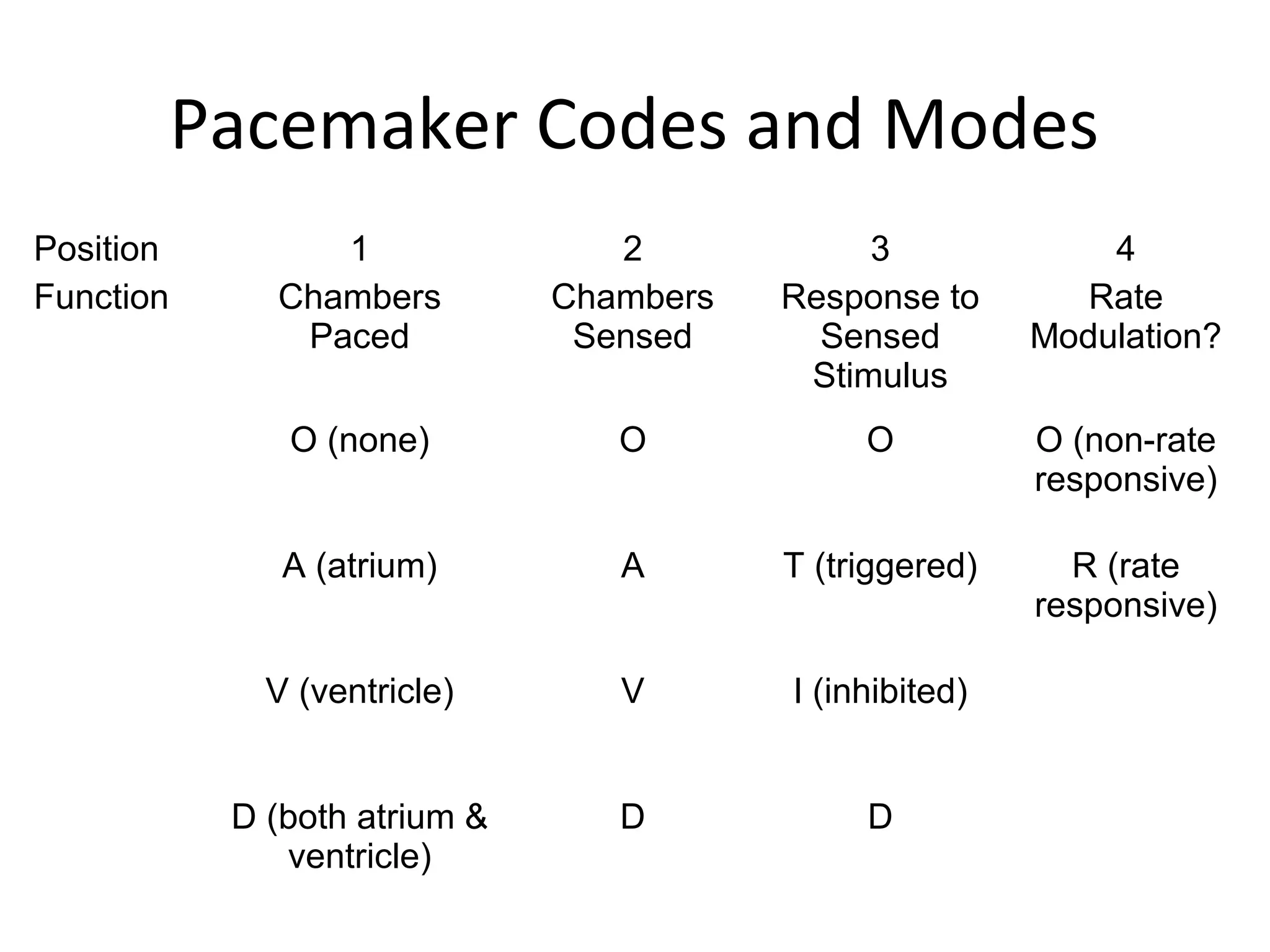
Pacemaker Codes and Modes
Position
Function
1
Chambers
Paced
2
Chambers
Sensed
3
Response to
Sensed
Stimulus
4
Rate
Modulation?
O (none) O O O (non-rate
responsive)
A (atrium) A T (triggered) R (rate
responsive)
V (ventricle) V I (inhibited)
D (both atrium &
ventricle)
D D
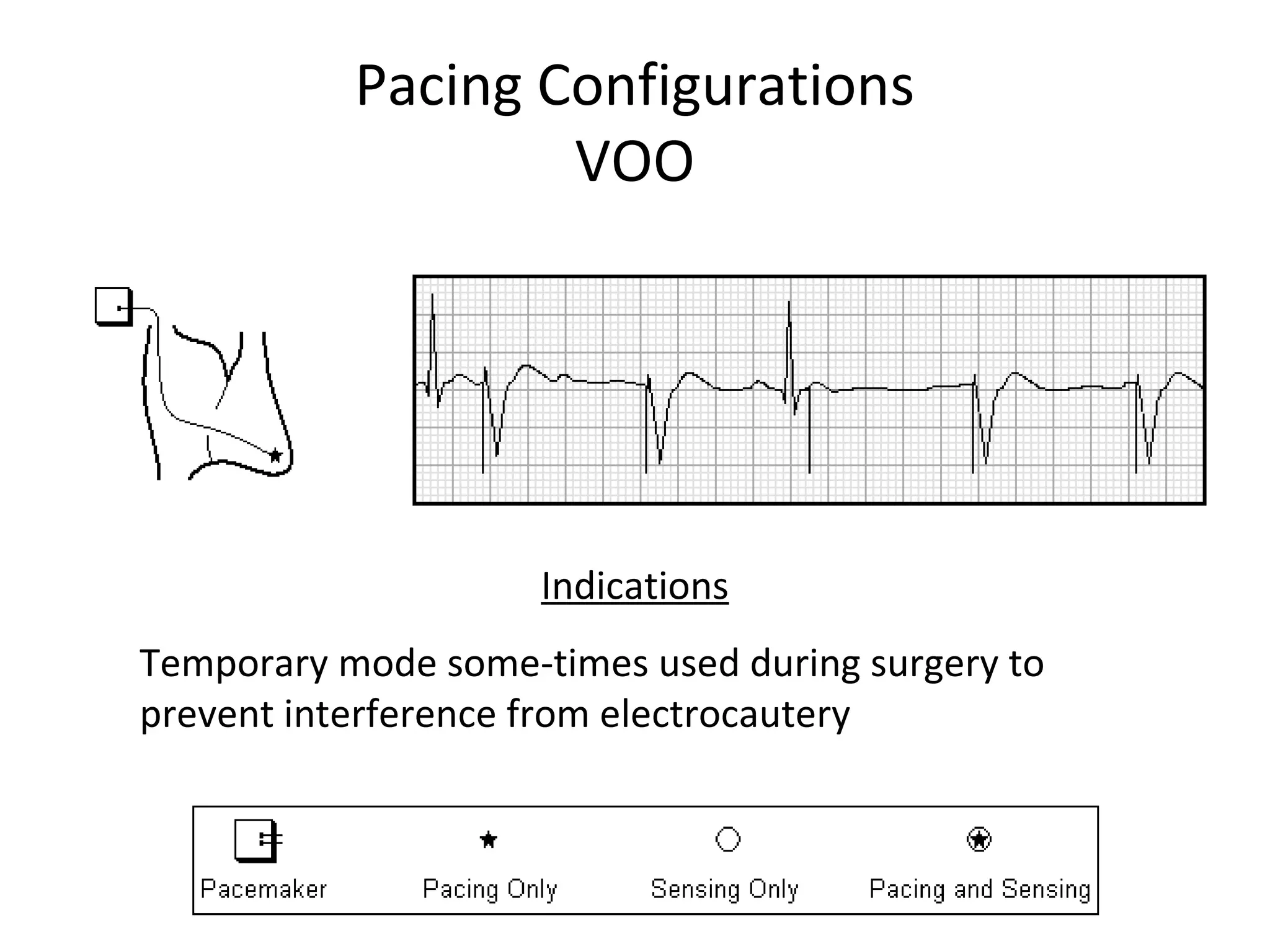
Pacing Configurations
VOO
Indications
Temporary mode some-times used during surgery to
prevent interference from electrocautery
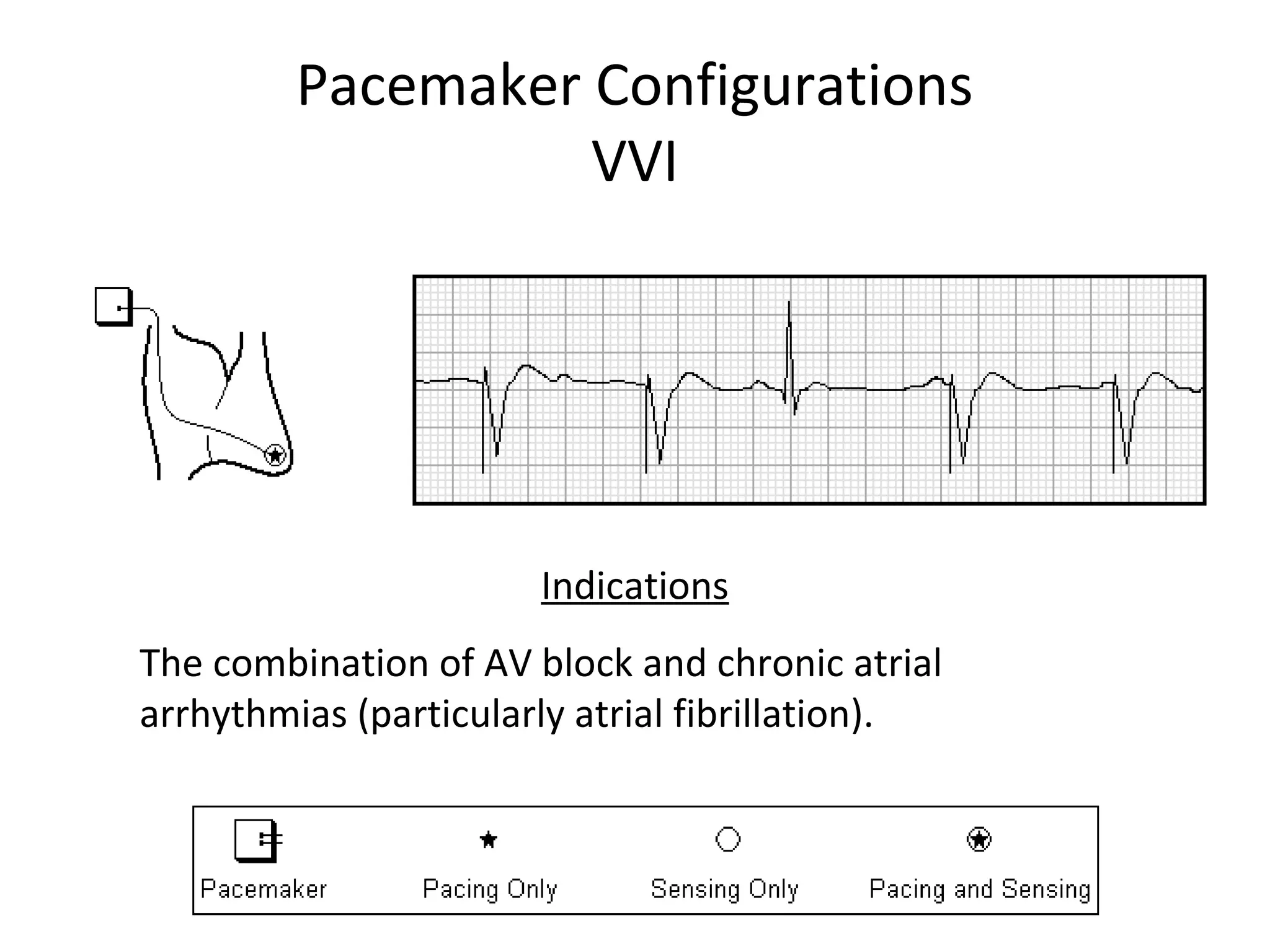
Pacemaker Configurations
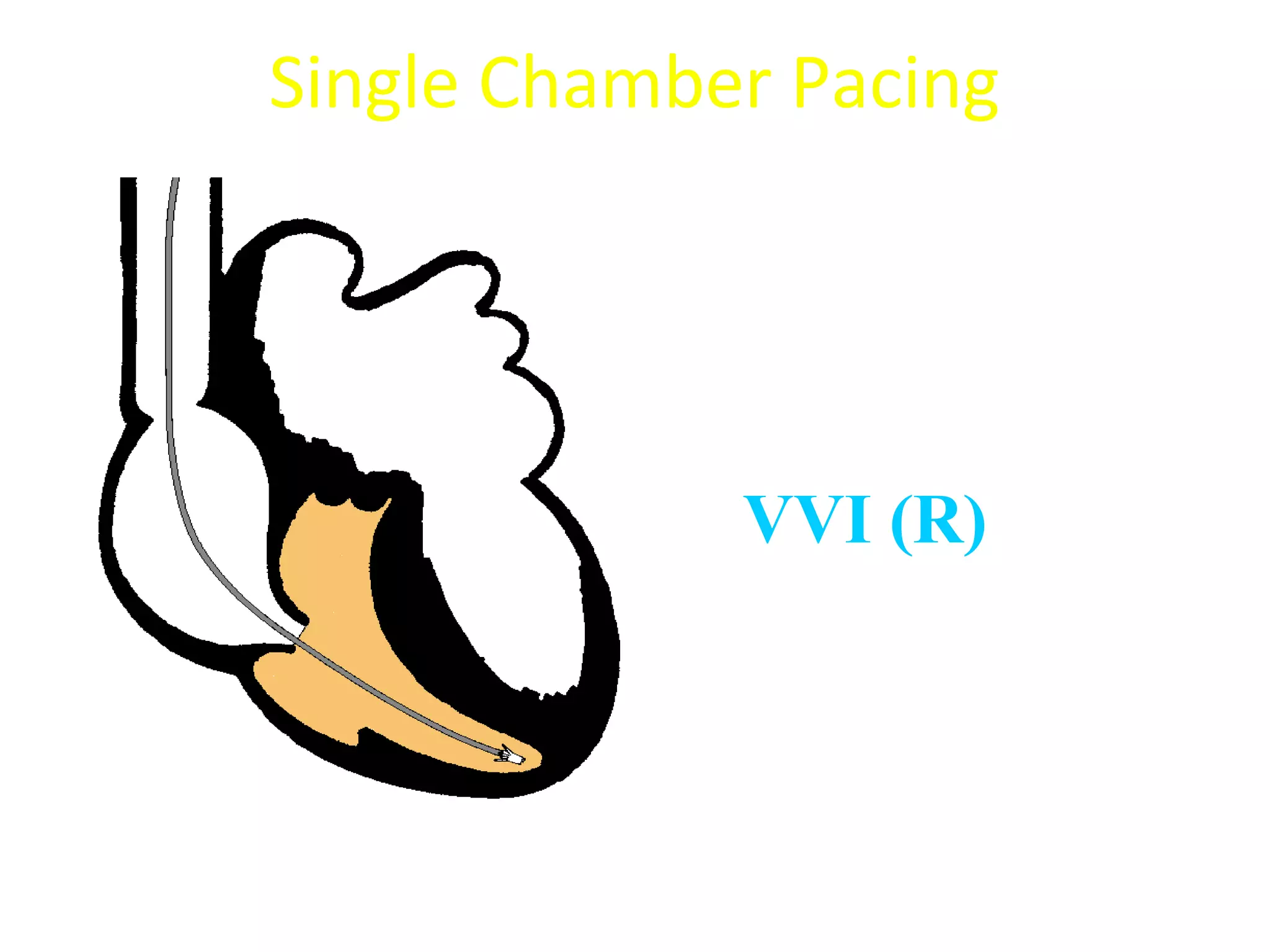
VVI
Indications
The combination of AV block and chronic atrial
arrhythmias (particularly atrial fibrillation).
Pacemaker Configurations
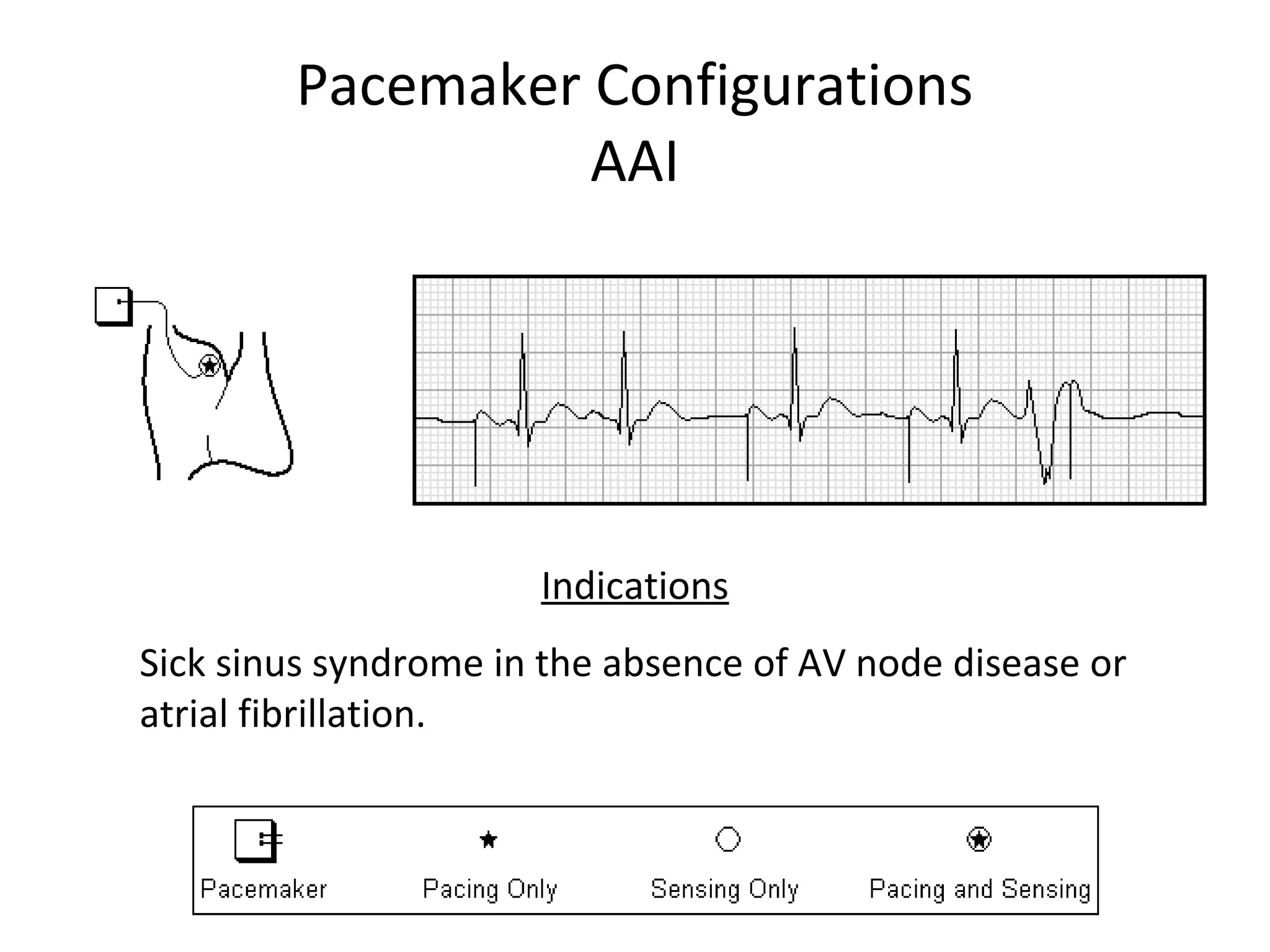
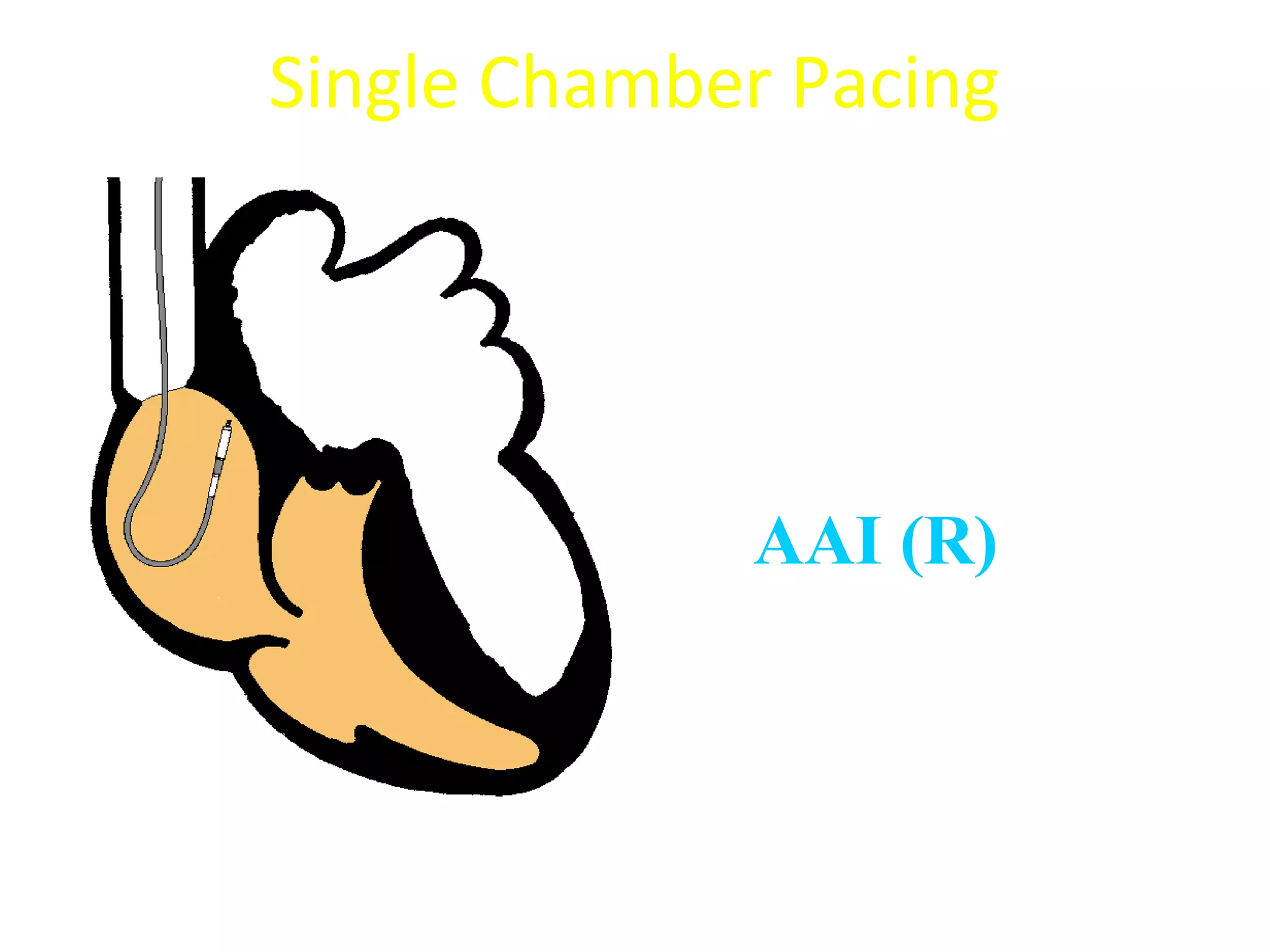
AAI
Indications
Sick sinus syndrome in the absence of AV node disease or
atrial fibrillation.
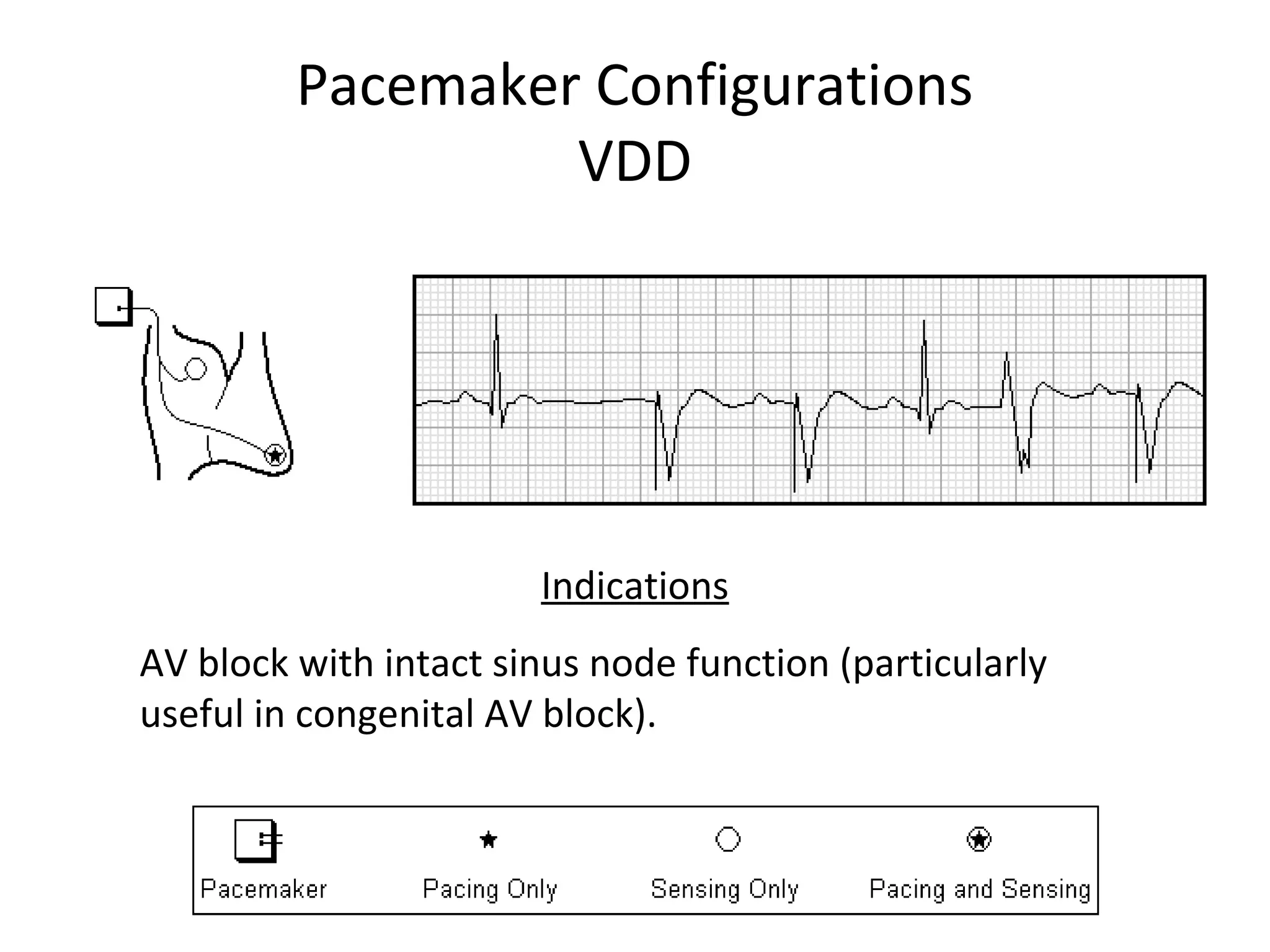
Pacemaker Configurations
VDD
Indications
AV block with intact sinus node function (particularly
useful in congenital AV block).
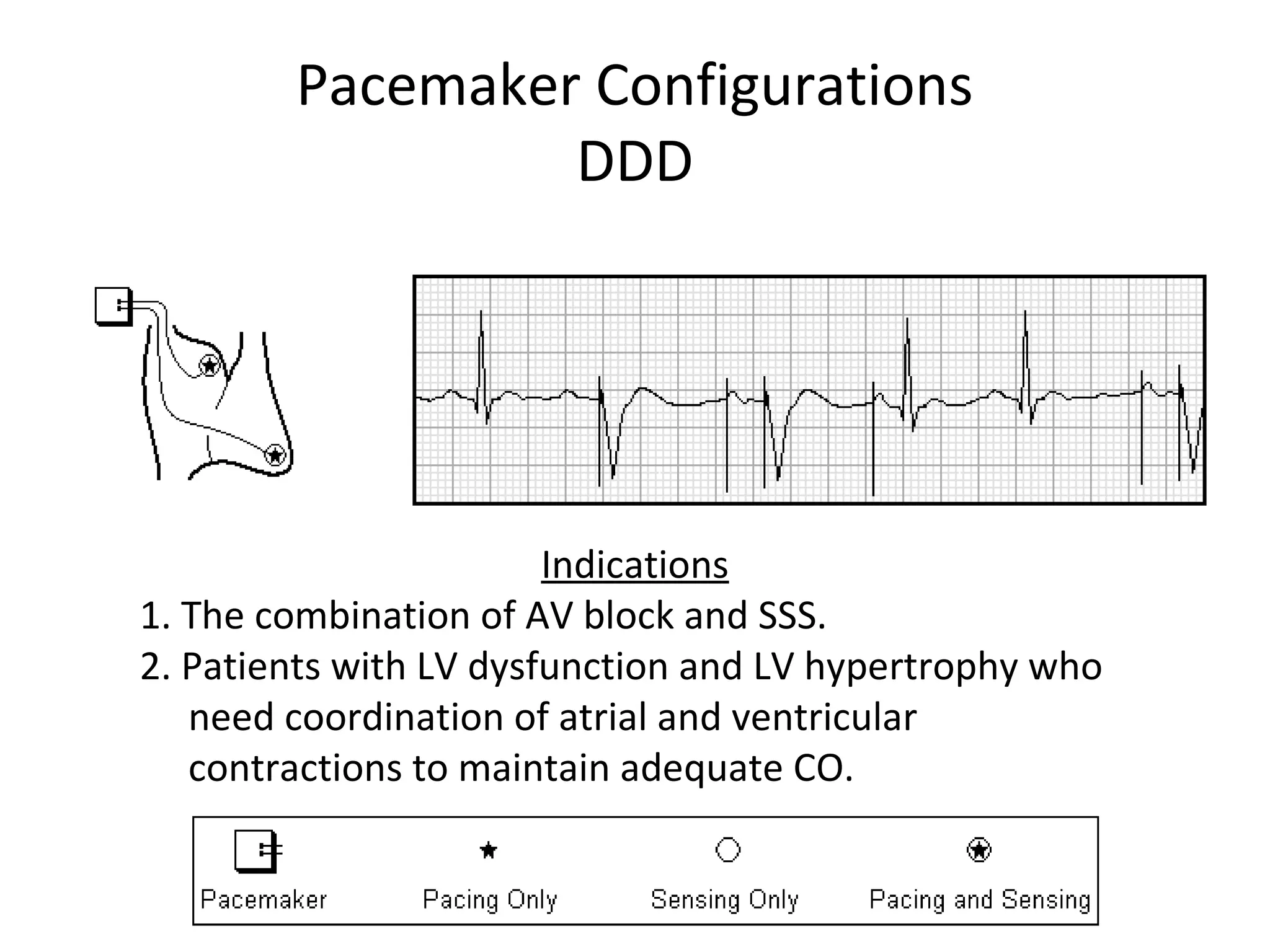
Pacemaker Configurations
DDD
Indications
1. The combination of AV block and SSS.
2. Patients with LV dysfunction and LV hypertrophy who
need coordination of atrial and ventricular
contractions to maintain adequate CO.
28
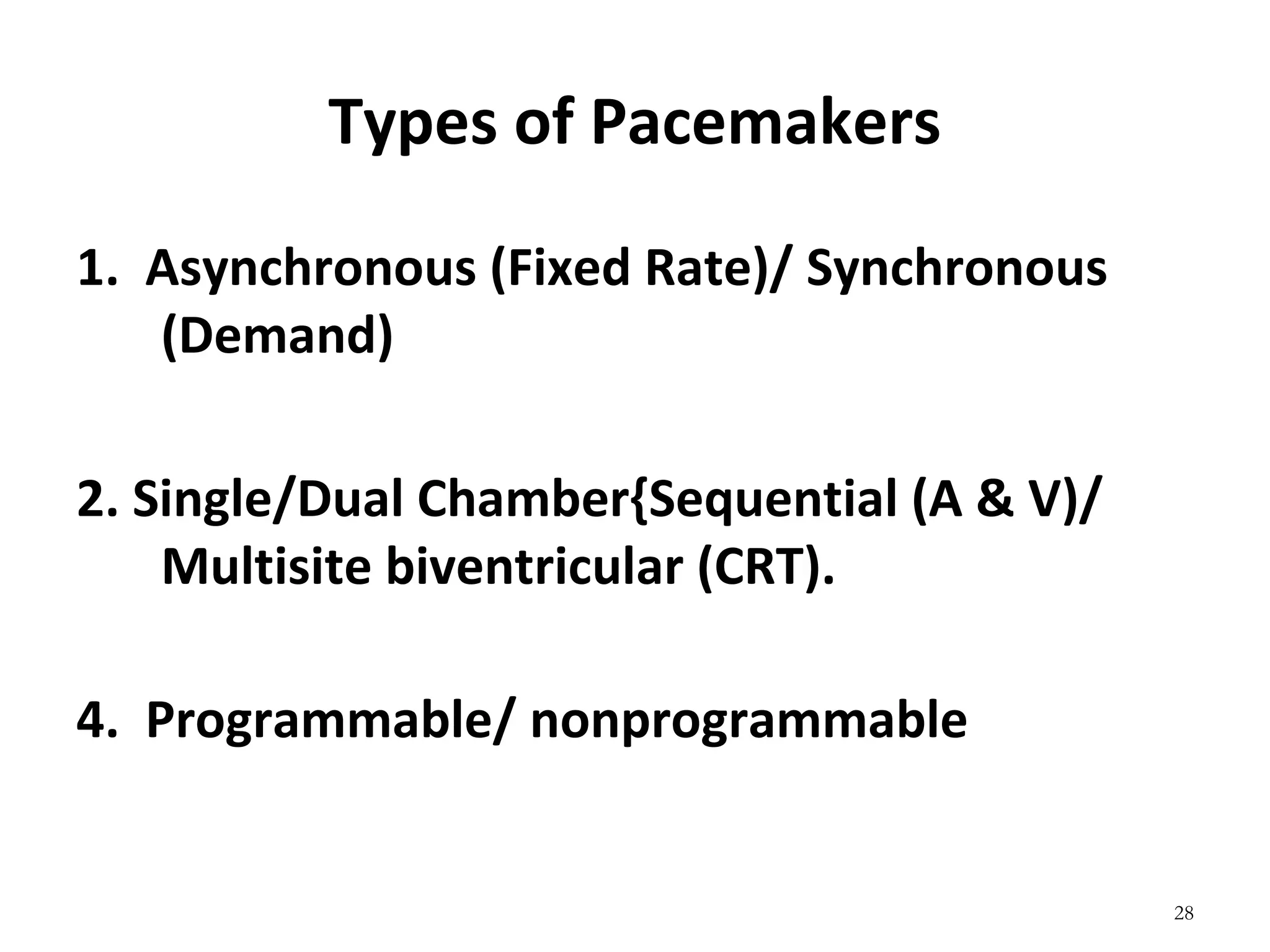
Types of Pacemakers
1. Asynchronous (Fixed Rate)/ Synchronous
(Demand)
2. Single/Dual Chamber{Sequential (A & V)/
Multisite biventricular (CRT).
4. Programmable/ nonprogrammable
29
Demand vs asynchronus
Demand pacer will pace only in the absence of
sensed intrinsic activity.
Asynchronous pacer modes not generally used
outside the OR as OR has multiple potential
sources of electrical interference which may
prevent normal function of demand pacers
and may induce serious arrhythmia.
Single Versus Dual chamber PM
Single chamber atrial pacing: Limited indications in pts
with SSS and intact conduction system or for
antitachycardia purposes.
Single Chamber Ventricular pacing (VVI):
less expensive, non physiological, loss of AV synchrony,
loss of around 25% of COP, 15% incidence of pacemaker
syndrome.
Prefered only in chronic atrial fibrillation and heart block
or those with very limited activity.
Single Chamber Pacing
AAI (R)
Single Chamber Pacing
VVI (R)
DUAL CHAMBER STIMULATION
Pacemaker Syndrome
• It is low cardiac output and heart failure like
manifestations that happens in about 15%
of pts with VVI pacemakers as a result of a
loss of AV synchrony..
Pacemaker Syndrome
The result of a loss of AV synchrony:
↓COP>>> supposed compensatory increase in
peripheral resistance but:
•atria contract against closed valves (Cannon
A waves), More if retrograde atrial activation.
•distension of the atria and PVs which results in a
reflex mediated decrease or defect in the
compensatory increase in the total peripheral
resistance and, thus, a fall in systolic blood pressure
and more ↓COP.
37
Pacemaker syndrome
1. Vertigo/Syncope,*Worsens with exercise
2. Unusual fatigue
3. Low B/P/ ↓ peripheral pulses
4. Cyanosis, 5. Jugular vein distention
6. Oliguria
7. Dyspnea/Orthopnea
8. Altered mental status
Treatment
….establishing normal atrioventricular synchrony.
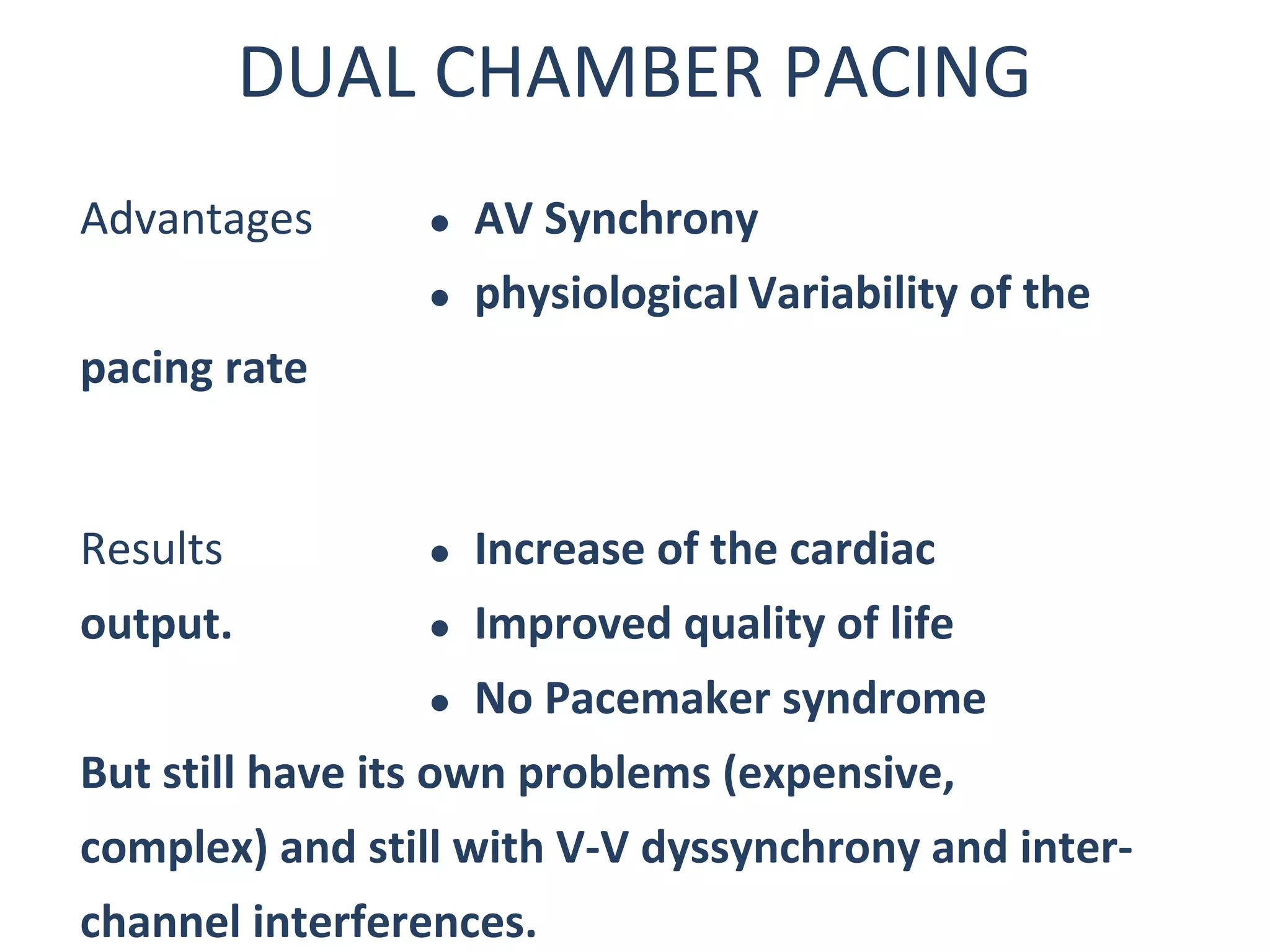
DUAL CHAMBER PACING
Advantages  AV Synchrony
 physiological Variability of the
pacing rate
Results  Increase of the cardiac
output.  Improved quality of life
 No Pacemaker syndrome
But still have its own problems (expensive,
complex) and still with V-V dyssynchrony and inter-
channel interferences.
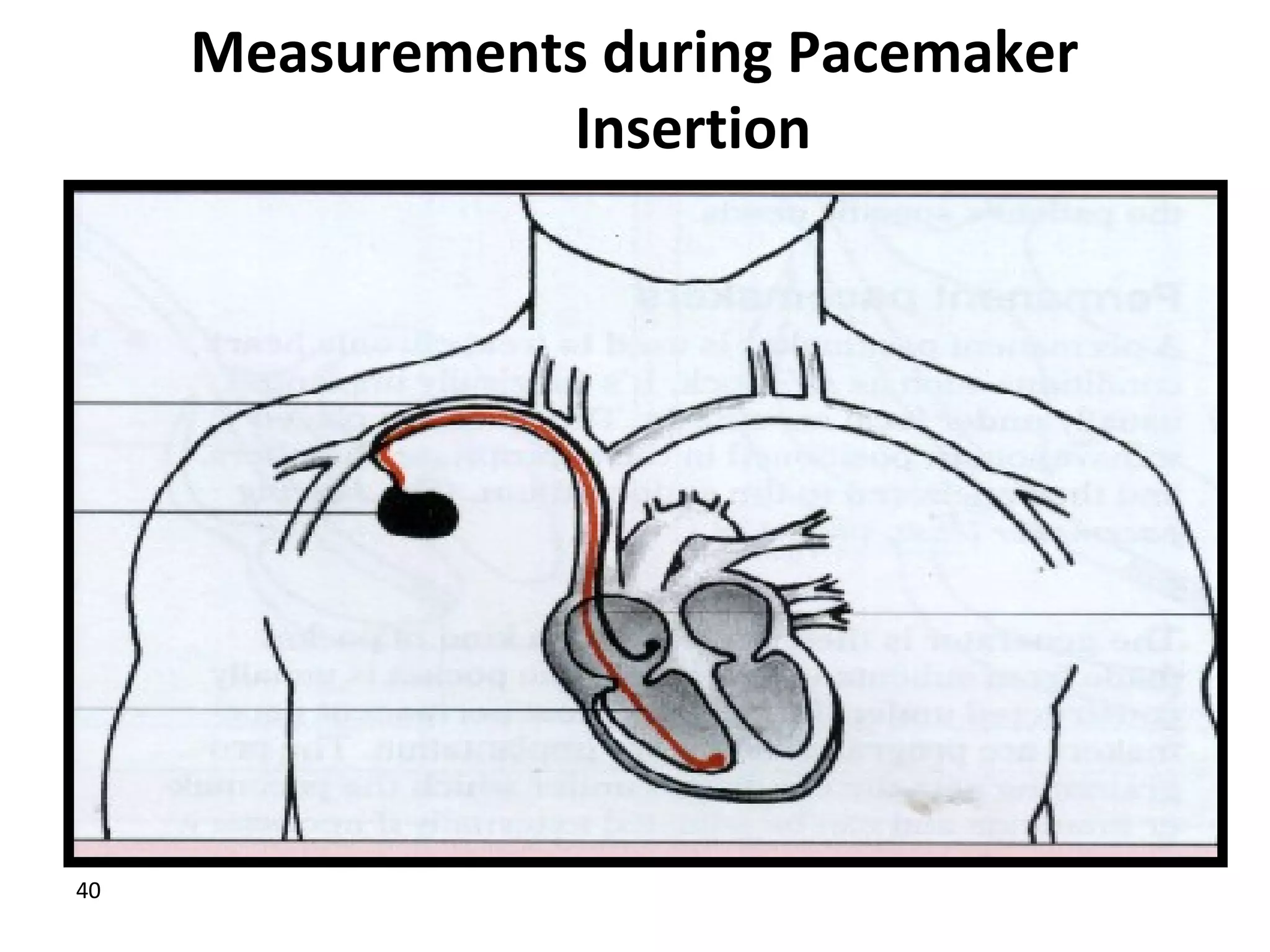
Pacemaker Implantation
• Permanent pacingPermanent pacing
– Access:Access:
- Subclavian- Subclavian
- Cephalic- Cephalic
40
Measurements during Pacemaker
Insertion
-Measurements-Measurements
• Impedance measurementImpedance measurement : 300 - 1000: 300 - 1000
ohms.... calculated / displayed.ohms.... calculated / displayed.
• Sensing threshold (localy sensed intrinsicSensing threshold (localy sensed intrinsic
electrogram)electrogram)
• Pacing thresholdPacing threshold
Pacemaker Implantation
Sensing Threshold
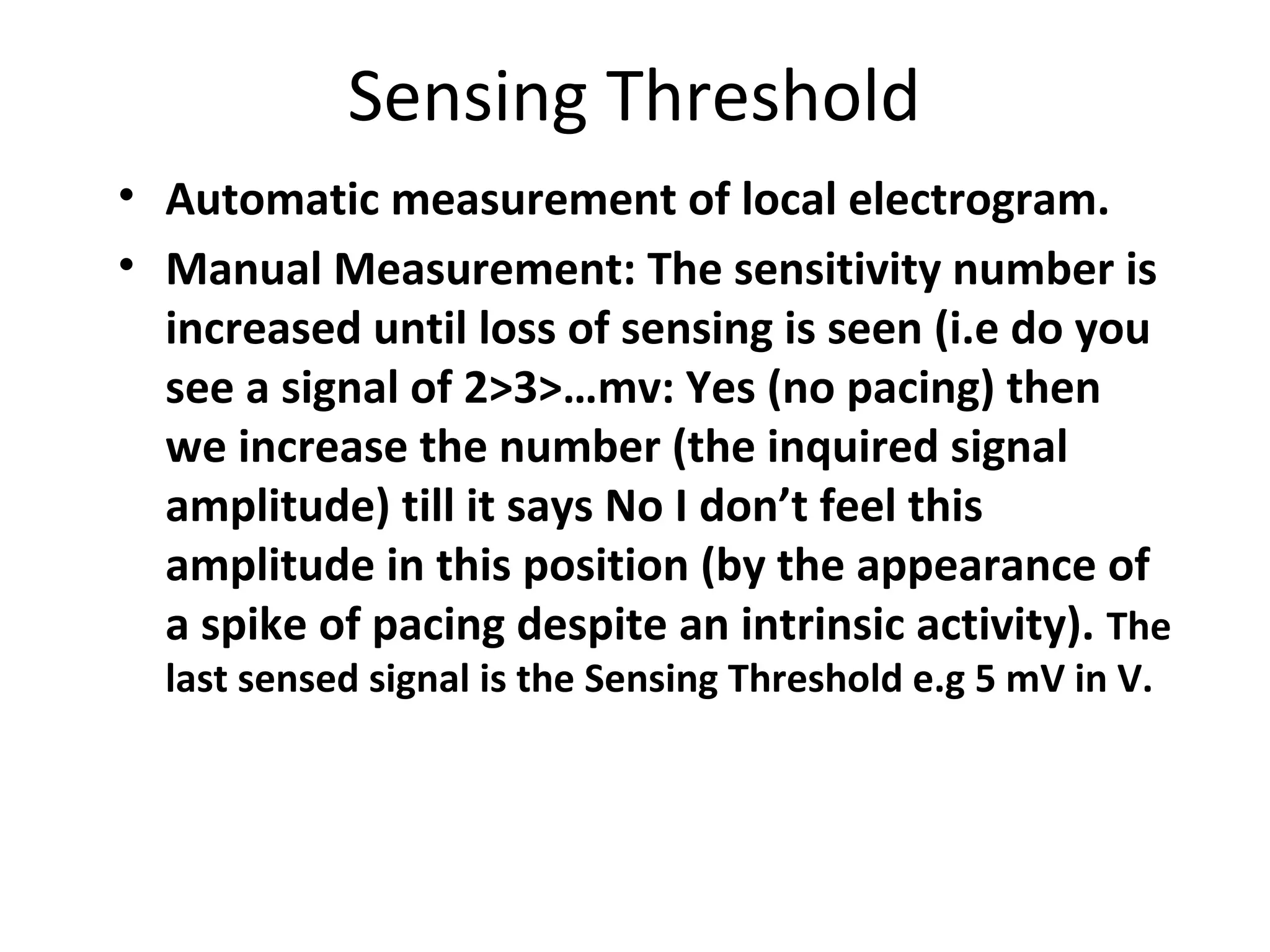
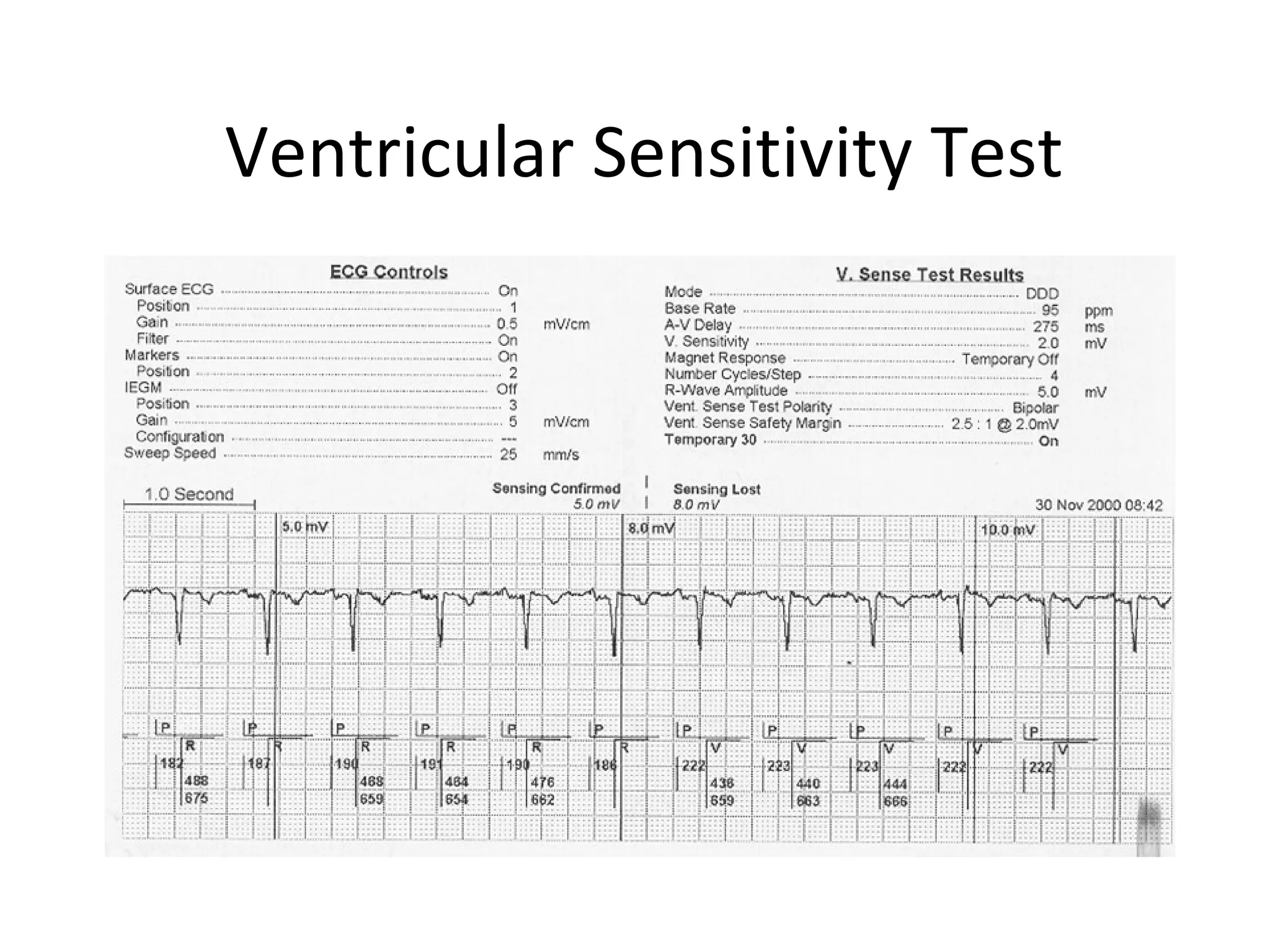
• Automatic measurement of local electrogram.
• Manual Measurement: The sensitivity number is
increased until loss of sensing is seen (i.e do you
see a signal of 2>3>…mv: Yes (no pacing) then
we increase the number (the inquired signal
amplitude) till it says No I don’t feel this
amplitude in this position (by the appearance of
a spike of pacing despite an intrinsic activity). The
last sensed signal is the Sensing Threshold e.g 5 mV in V.
Ventricular Sensitivity Test
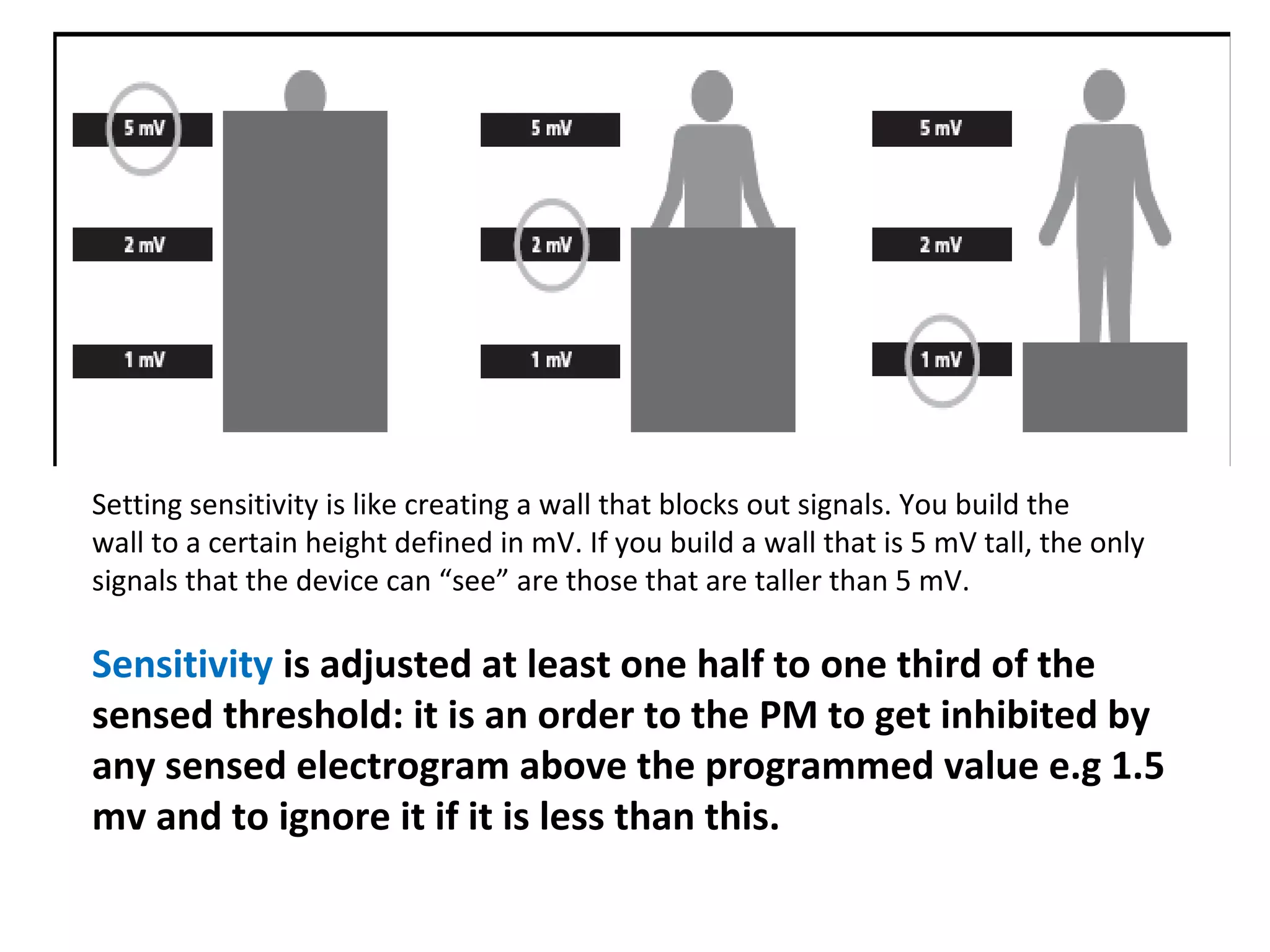
Setting sensitivity is like creating a wall that blocks out signals. You build the
wall to a certain height defined in mV. If you build a wall that is 5 mV tall, the only
signals that the device can “see” are those that are taller than 5 mV.
Sensitivity is adjusted at least one half to one third of the
sensed threshold: it is an order to the PM to get inhibited by
any sensed electrogram above the programmed value e.g 1.5
mv and to ignore it if it is less than this.
-Measurements-Measurements
• Impedance measurementImpedance measurement :: 300 - 1000300 - 1000
ohms.... calculated / displayedohms.... calculated / displayed
• Sensing threshold (localy sensed intrinsicSensing threshold (localy sensed intrinsic
electrogram)electrogram)
• Amplitude (Minimum : “P” - 2mV , “R” - 5mV)Amplitude (Minimum : “P” - 2mV , “R” - 5mV)
• Pacing thresholdPacing threshold
Pacemaker Implantation
46
Pacing threshold: the least amount of current
(mAmps) needed to evoke capture and get
an impulse (<1 mAmp)
Accordingly the pacing output by the PM is
adjusted at at least double this value (too
high threshold means too much electericity
and rapid Battery depletion.
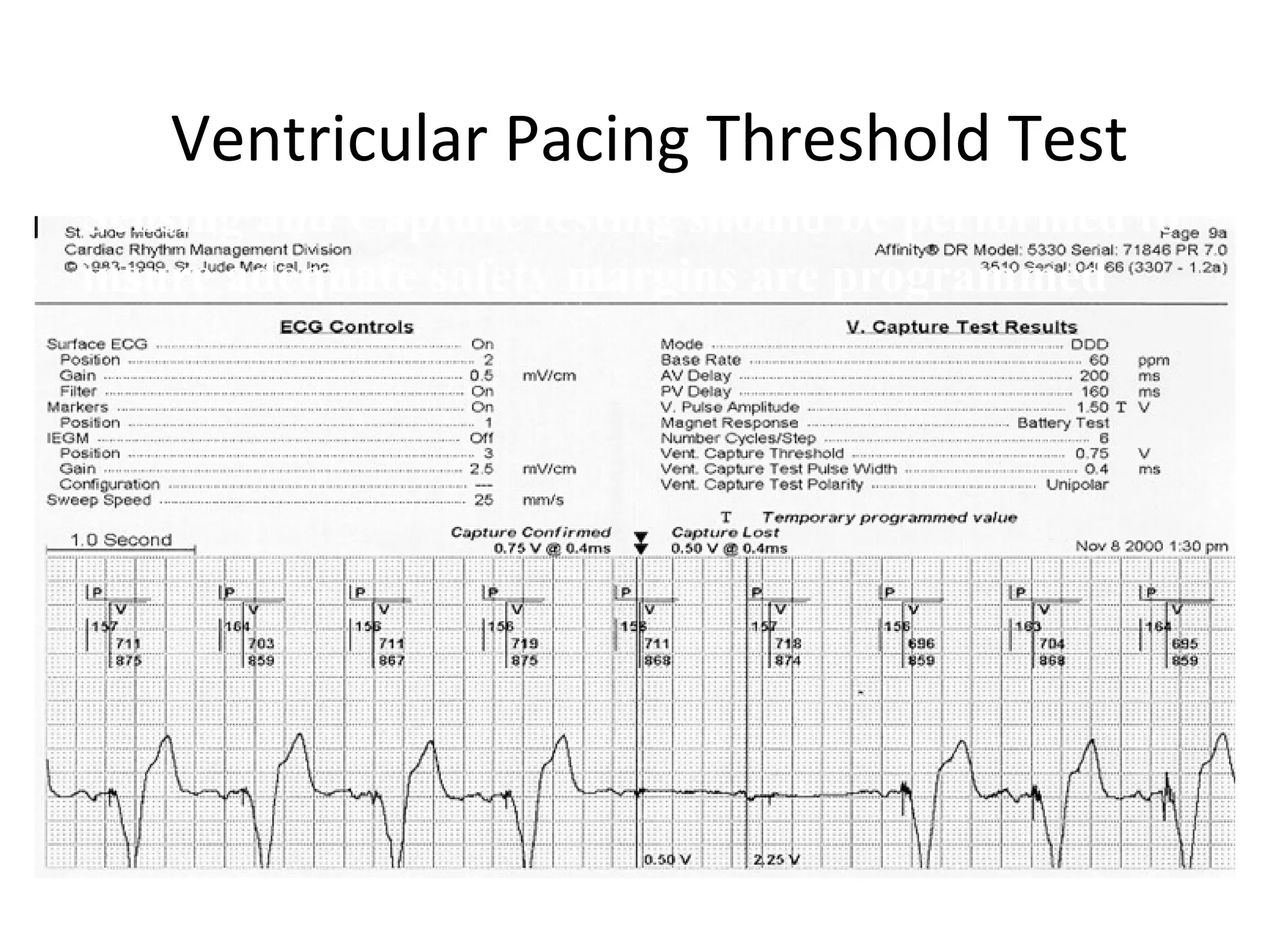
Ventricular Pacing Threshold Test
Sensing and Capture testing should be performed to
insure adequate safety margins are programmed
-Measurements-Measurements
• Impedance measurementImpedance measurement : 300 - 1000: 300 - 1000
ohms.... calculated / displayedohms.... calculated / displayed
• Sensing threshold (localy sensed intrinsicSensing threshold (localy sensed intrinsic
electrogram)electrogram)
• Amplitude (Minimum : “P” - 2mV , “R” - 5mV)Amplitude (Minimum : “P” - 2mV , “R” - 5mV)
• Pacing thresholdPacing threshold
• (Measured amplitude at 0.5 ms.)(Measured amplitude at 0.5 ms.)
• Paced rate > = 20 ppm above spontaneous ratePaced rate > = 20 ppm above spontaneous rate
• Decrement variable output : Threshold < 1V @ 0.5ms.Decrement variable output : Threshold < 1V @ 0.5ms.
Pacemaker Implantation
• MeasurementsMeasurements
– 3. Lead position and stability3. Lead position and stability
– 10V output for diaphragm stimulation test10V output for diaphragm stimulation test
– Lead sutured in position and well connected.Lead sutured in position and well connected.
– Re-measure sensing / pacing characteristicsRe-measure sensing / pacing characteristics
– Dual-chamber systemDual-chamber system
- Measure Retrograde Conduction Time- Measure Retrograde Conduction Time
– Confirm labeling informationConfirm labeling information
Pacemaker Implantation
– 4.Lead Connection4.Lead Connection
– Lead attached to IPG, setscrew tightened and sealedLead attached to IPG, setscrew tightened and sealed
with capwith cap
– IPG inserted into the pocketIPG inserted into the pocket
– Ascertain correct sensing / pacing function of system.Ascertain correct sensing / pacing function of system.
Apply magnet if required.Apply magnet if required.
– Complete all documentationComplete all documentation
- pacemaker clinic / hospital records- pacemaker clinic / hospital records
- manufacturer’s file / central database- manufacturer’s file / central database
Pacemaker Implantation
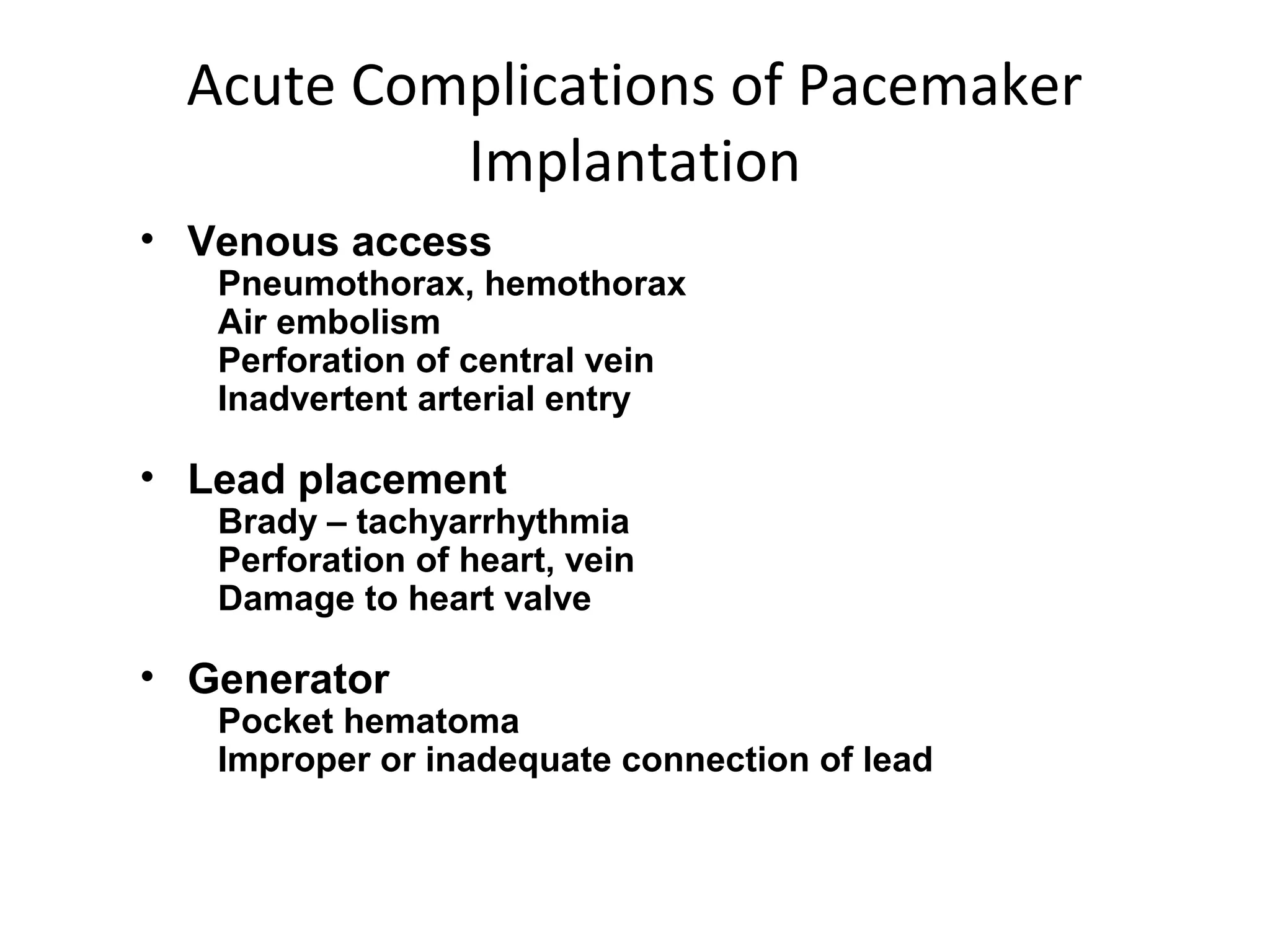
Acute Complications of Pacemaker
Implantation
• Venous access
Pneumothorax, hemothorax
Air embolism
Perforation of central vein
Inadvertent arterial entry
• Lead placement
Brady – tachyarrhythmia
Perforation of heart, vein
Damage to heart valve
• Generator
Pocket hematoma
Improper or inadequate connection of lead
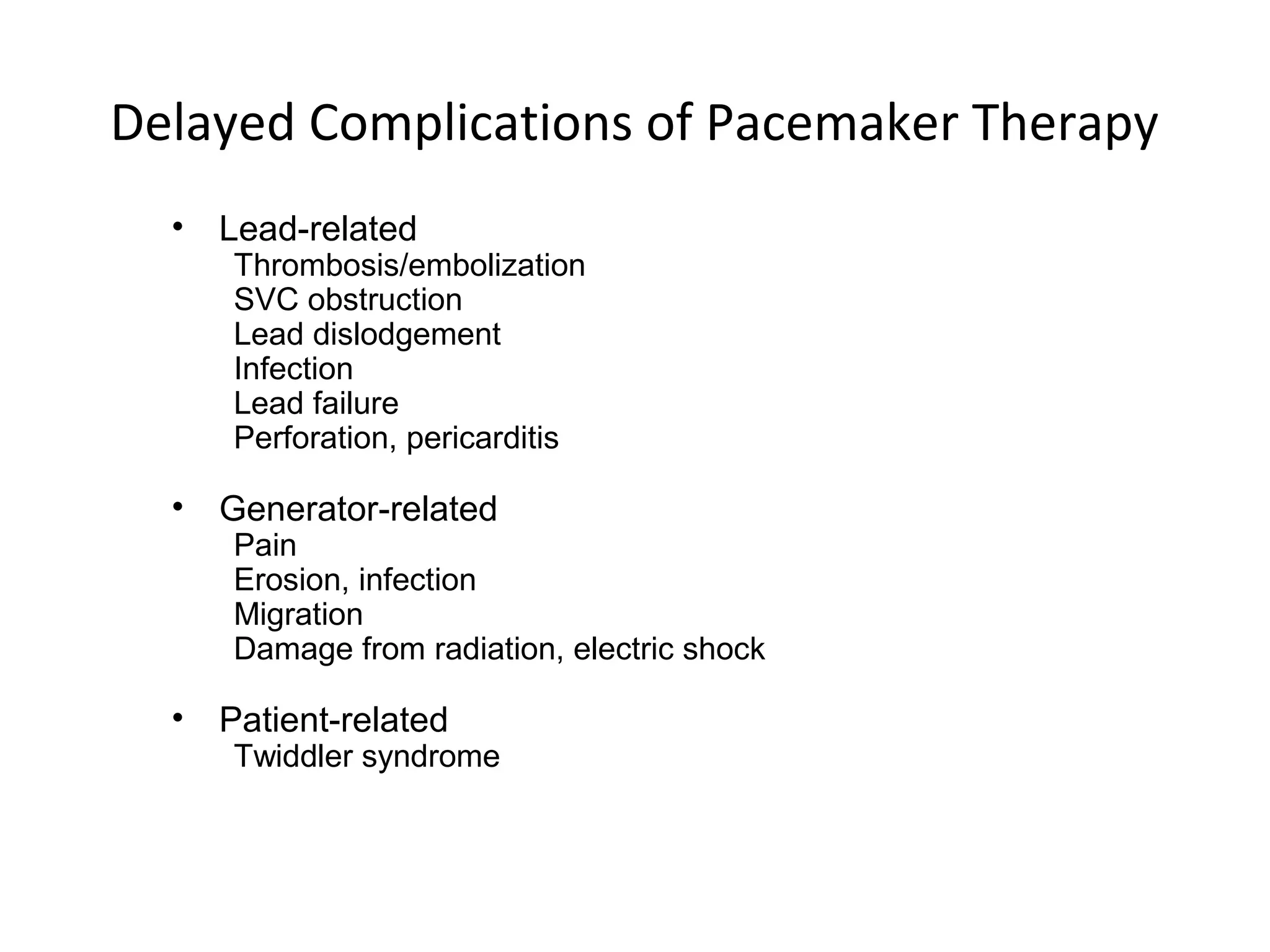
Delayed Complications of Pacemaker Therapy
• Lead-related
Thrombosis/embolization
SVC obstruction
Lead dislodgement
Infection
Lead failure
Perforation, pericarditis
• Generator-related
Pain
Erosion, infection
Migration
Damage from radiation, electric shock
• Patient-related
Twiddler syndrome
Thank you

Cardiac pace makerspart 1

  • 1.
    Cardiac Pace-Makers   Functions &Malfunctions (Part 1) Salah Atta, MD Professor of Cardiology
  • 2.
    Outlines • Historical background •Indications of cardiac pacemaker implantation. • Pacemaker terminology and components. • Types of pacemakers and their Functions. • Measurements during PM implantation. • Pacemaker follow up and programmable parameters. • Pacemaker malfunctions and Pseudomalfunctions.
  • 3.
    Historical Background • Thefirst clinical implantation into a human of a fully implantable pacemaker was in 1958 at the Karolinska Institute in Solna, Sweden. • The first use of transvenous pacing in conjunction with an implanted pacemaker was by Parsonnet in the USA , Lagergren in Sweden and Jean-Jaques Welti in France in 1962- 63 • The earliest devices all suffered from short life time mercury battery. • The development in 1970 of the lithium-iodide cell by Wilson Greatbatch enabled longer PM lives.
  • 4.
    Implant Evolution Pacemakers—Yesterday • FirstImplants in early 1960s • Single Chamber, non programmable • About 2 year longevity • About 200 cc • Abdominal implants, sternotomy for epicardial leads
  • 5.
    Implant Evolution Pacemakers—Today • Pectoralimplants • 6-7 F transvenous lead placement – Outpatient/overnight stay • < 30 cc • 8-10 years longevity • Dual chamber, multi- programmable • Advanced diagnostics and trending information
  • 6.
    Aims of usingCardiac Pacemakers • A satisfactory heart rate to maintain effective cardiac output. • A chrono-tropic physiological response. • Atrio-ventricular synchronization. • Inter-ventricular and intra-ventricular synchronization. • To treat or prevent arrhythmias.
  • 7.
    7 Temporary Pacing • Routes = Transvenous, transcutaneous, esophageal Indications: • Unstable brady-dysrhythmias •Atrio-ventricular heart block • Unstable tachydys-rhythmias  Endpoint is reached after resolution of a reversible  problem or permanent pacemaker implantation.
  • 8.
    Indications for PermanentPacemaker Class I • 3° or 2° AV block with associated symptomatic bradycardia. • 3° and advanced 2° AV block associated with any of the following: Arrhythmias that require drugs resulting in symptomatic bradycardia Sinus pauses > 3 seconds Asymptomatic escape rate < 40bpm while awake • Type II 2° AV block with wide QRS, regardless of symptoms • Sinus node dysfunction with documented symptomatic bradycardia • Symptomatic chronotropic incompetence (failure to increase HR with exercise or increased metabolic demand)
  • 9.
    Indications for Pacemaker ClassIIa 1. Syncope of unexplained origin when major abnormalities of sinus node function are discovered or provoked during EP studies. 2. Asymptomatic 3° AV block with an awake ventricular rate > 40 bpm. 3. Asymptomatic type II 2° AV block. Class Ia -CRT for pts with NYHA Class III or IV heart failure, Ejection Fraction of < 35%,On optimal medical therapy, QRS > 120 ms wide ± Echo evidence of ventricular dyssynchrony. Class IIb Hypertrophic obstructive cardiomyopathy without symptomatic bradycardia.
  • 10.
    Non indications forPPM • These conditions include, among others, syncope of undetermined etiology, asymptomatic sinus bradycardia, asymptomatic first-degree and second-degree Mobitz I (Wenckebach) AV block, reversible AV block, and long QT syndrome or torsades de pointes due to a reversible cause.
  • 11.
    11 Functions of a Pacemaker • Provide the rate and rhythm the heart  cannot produce (Pace) • Detect intrinsic activity (sense) •Detect physical activity and react  accordingly (Rate Responsiveness) • has a power source and a lead to carry the  current to the heart muscle.
  • 12.
    Pacing & Depolarizationof Myocardial Tissue • The myocardium must be excitable • The stimulus current density (current  per unit cross- sectional area) must be sufficiently high & of sufficient  duration and the lead should be in a good position with  good contact with myocardium • The pacemaker-generated impulse then relies on the  intrinsic properties of cardiac specialized conduction &  myocardial tissue for depolarization of the entire heart  (Capture)
  • 13.
  • 14.
    Sensing and Factorsaffecting it Sensing is the detection of real or   spontaneous cardiac depolarization • Electrode size • Configuration of electrode. • Position of the lead tip within the heart  and contact to the myocardium. • Programmed sensitivity.
  • 15.
    Pacemaker system components •The lead or leads (Pacing lead is a coiled wire spring encased in silicone to insulate it from body fluids.) • The pulse generator • The programmer
  • 17.
    Pacing Lead Technology Distal end attachment of the lead • Active fixation • Passive fixation 1. Chronic ventricular pacing thresholds tend to be lower with passive lead, in part because of tissue injury with active fixation. 2. Sensing characteristics are similar between active & passive leads.
  • 18.
    Fixation mechanisms ofthe Lead Passive fixation Wingtips Active fixation Screw Passive fixation Tines
  • 19.
    - Unipolar Stimulation & Sensing Polarity ofthe Pacemaker System • Larger “antenna” for sensing √ bigger signals √ more interference (myopotentials !) • Big spike on ECG • Pectoral (pocket) stimulation possible + +
  • 20.
    CONFIGURATION UNIPOLAIRE - Polarity ofthe Pacemaker System Bipolar Stimulation & Sensing + • Smaller “antenna” for sensing √ smaller, more specific signals √ less interference • Spike difficult to see on ECG • No pectoral (pocket) stimulation
  • 21.
    Pulse Generator • Powersource • Time circuitry • Sensing circuitry • Output circuitry for channels connected to the electrodes • Transceiver for telemetric communication with programming device
  • 22.
    Pacemaker Codes andModes Position Function 1 Chambers Paced 2 Chambers Sensed 3 Response to Sensed Stimulus 4 Rate Modulation? O (none) O O O (non-rate responsive) A (atrium) A T (triggered) R (rate responsive) V (ventricle) V I (inhibited) D (both atrium & ventricle) D D
  • 23.
    Pacing Configurations VOO Indications Temporary modesome-times used during surgery to prevent interference from electrocautery
  • 24.
    Pacemaker Configurations VVI Indications The combinationof AV block and chronic atrial arrhythmias (particularly atrial fibrillation).
  • 25.
    Pacemaker Configurations AAI Indications Sick sinussyndrome in the absence of AV node disease or atrial fibrillation.
  • 26.
    Pacemaker Configurations VDD Indications AV blockwith intact sinus node function (particularly useful in congenital AV block).
  • 27.
    Pacemaker Configurations DDD Indications 1. Thecombination of AV block and SSS. 2. Patients with LV dysfunction and LV hypertrophy who need coordination of atrial and ventricular contractions to maintain adequate CO.
  • 28.
    28 Types of Pacemakers 1.Asynchronous (Fixed Rate)/ Synchronous (Demand) 2. Single/Dual Chamber{Sequential (A & V)/ Multisite biventricular (CRT). 4. Programmable/ nonprogrammable
  • 29.
    29 Demand vs asynchronus Demandpacer will pace only in the absence of sensed intrinsic activity. Asynchronous pacer modes not generally used outside the OR as OR has multiple potential sources of electrical interference which may prevent normal function of demand pacers and may induce serious arrhythmia.
  • 30.
    Single Versus Dualchamber PM Single chamber atrial pacing: Limited indications in pts with SSS and intact conduction system or for antitachycardia purposes. Single Chamber Ventricular pacing (VVI): less expensive, non physiological, loss of AV synchrony, loss of around 25% of COP, 15% incidence of pacemaker syndrome. Prefered only in chronic atrial fibrillation and heart block or those with very limited activity.
  • 31.
  • 32.
  • 33.
  • 35.
    Pacemaker Syndrome • Itis low cardiac output and heart failure like manifestations that happens in about 15% of pts with VVI pacemakers as a result of a loss of AV synchrony..
  • 36.
    Pacemaker Syndrome The resultof a loss of AV synchrony: ↓COP>>> supposed compensatory increase in peripheral resistance but: •atria contract against closed valves (Cannon A waves), More if retrograde atrial activation. •distension of the atria and PVs which results in a reflex mediated decrease or defect in the compensatory increase in the total peripheral resistance and, thus, a fall in systolic blood pressure and more ↓COP.
  • 37.
    37 Pacemaker syndrome 1. Vertigo/Syncope,*Worsenswith exercise 2. Unusual fatigue 3. Low B/P/ ↓ peripheral pulses 4. Cyanosis, 5. Jugular vein distention 6. Oliguria 7. Dyspnea/Orthopnea 8. Altered mental status Treatment ….establishing normal atrioventricular synchrony.
  • 38.
    DUAL CHAMBER PACING Advantages AV Synchrony  physiological Variability of the pacing rate Results  Increase of the cardiac output.  Improved quality of life  No Pacemaker syndrome But still have its own problems (expensive, complex) and still with V-V dyssynchrony and inter- channel interferences.
  • 39.
    Pacemaker Implantation • PermanentpacingPermanent pacing – Access:Access: - Subclavian- Subclavian - Cephalic- Cephalic
  • 40.
  • 41.
    -Measurements-Measurements • Impedance measurementImpedancemeasurement : 300 - 1000: 300 - 1000 ohms.... calculated / displayed.ohms.... calculated / displayed. • Sensing threshold (localy sensed intrinsicSensing threshold (localy sensed intrinsic electrogram)electrogram) • Pacing thresholdPacing threshold Pacemaker Implantation
  • 42.
    Sensing Threshold • Automaticmeasurement of local electrogram. • Manual Measurement: The sensitivity number is increased until loss of sensing is seen (i.e do you see a signal of 2>3>…mv: Yes (no pacing) then we increase the number (the inquired signal amplitude) till it says No I don’t feel this amplitude in this position (by the appearance of a spike of pacing despite an intrinsic activity). The last sensed signal is the Sensing Threshold e.g 5 mV in V.
  • 43.
  • 44.
    Setting sensitivity islike creating a wall that blocks out signals. You build the wall to a certain height defined in mV. If you build a wall that is 5 mV tall, the only signals that the device can “see” are those that are taller than 5 mV. Sensitivity is adjusted at least one half to one third of the sensed threshold: it is an order to the PM to get inhibited by any sensed electrogram above the programmed value e.g 1.5 mv and to ignore it if it is less than this.
  • 45.
    -Measurements-Measurements • Impedance measurementImpedancemeasurement :: 300 - 1000300 - 1000 ohms.... calculated / displayedohms.... calculated / displayed • Sensing threshold (localy sensed intrinsicSensing threshold (localy sensed intrinsic electrogram)electrogram) • Amplitude (Minimum : “P” - 2mV , “R” - 5mV)Amplitude (Minimum : “P” - 2mV , “R” - 5mV) • Pacing thresholdPacing threshold Pacemaker Implantation
  • 46.
    46 Pacing threshold: theleast amount of current (mAmps) needed to evoke capture and get an impulse (<1 mAmp) Accordingly the pacing output by the PM is adjusted at at least double this value (too high threshold means too much electericity and rapid Battery depletion.
  • 47.
    Ventricular Pacing ThresholdTest Sensing and Capture testing should be performed to insure adequate safety margins are programmed
  • 48.
    -Measurements-Measurements • Impedance measurementImpedancemeasurement : 300 - 1000: 300 - 1000 ohms.... calculated / displayedohms.... calculated / displayed • Sensing threshold (localy sensed intrinsicSensing threshold (localy sensed intrinsic electrogram)electrogram) • Amplitude (Minimum : “P” - 2mV , “R” - 5mV)Amplitude (Minimum : “P” - 2mV , “R” - 5mV) • Pacing thresholdPacing threshold • (Measured amplitude at 0.5 ms.)(Measured amplitude at 0.5 ms.) • Paced rate > = 20 ppm above spontaneous ratePaced rate > = 20 ppm above spontaneous rate • Decrement variable output : Threshold < 1V @ 0.5ms.Decrement variable output : Threshold < 1V @ 0.5ms. Pacemaker Implantation
  • 49.
    • MeasurementsMeasurements – 3.Lead position and stability3. Lead position and stability – 10V output for diaphragm stimulation test10V output for diaphragm stimulation test – Lead sutured in position and well connected.Lead sutured in position and well connected. – Re-measure sensing / pacing characteristicsRe-measure sensing / pacing characteristics – Dual-chamber systemDual-chamber system - Measure Retrograde Conduction Time- Measure Retrograde Conduction Time – Confirm labeling informationConfirm labeling information Pacemaker Implantation
  • 50.
    – 4.Lead Connection4.LeadConnection – Lead attached to IPG, setscrew tightened and sealedLead attached to IPG, setscrew tightened and sealed with capwith cap – IPG inserted into the pocketIPG inserted into the pocket – Ascertain correct sensing / pacing function of system.Ascertain correct sensing / pacing function of system. Apply magnet if required.Apply magnet if required. – Complete all documentationComplete all documentation - pacemaker clinic / hospital records- pacemaker clinic / hospital records - manufacturer’s file / central database- manufacturer’s file / central database Pacemaker Implantation
  • 51.
    Acute Complications ofPacemaker Implantation • Venous access Pneumothorax, hemothorax Air embolism Perforation of central vein Inadvertent arterial entry • Lead placement Brady – tachyarrhythmia Perforation of heart, vein Damage to heart valve • Generator Pocket hematoma Improper or inadequate connection of lead
  • 52.
    Delayed Complications ofPacemaker Therapy • Lead-related Thrombosis/embolization SVC obstruction Lead dislodgement Infection Lead failure Perforation, pericarditis • Generator-related Pain Erosion, infection Migration Damage from radiation, electric shock • Patient-related Twiddler syndrome
  • 53.

Editor's Notes

  • #5 Student Notes In the beginning pacemakers were external devices and the leads ran from the heart to the device (outside of the body). The devices themselves were large (in fact they had to be pushed around on a cart), paced only one chamber, and were connected to an AC power source, which is to say - not portable. By the late 1950’s to early 60’s, smaller battery powered units were developed, and eventually, simple non-programmable implantable devices and leads were developed (one shown above on this slide). The earliest implantable models had about a 2 year battery longevity, and were rather large by today’s standards (200 cc versus Adapta SR06 9.7 cc). Instructor Notes
  • #6 Student Notes Today pacemakers are implanted in the pectoral region, and the leads are usually threaded through the subclavian vasculature into the RA and/or RV. The leads include fixation mechanisms to help keep them in the desired position. Typically patients are discharged the day following the implantation, which occurs under conscious sedation or very light anesthesia. The devices themselves are typically in the ~16 cc range, may last up to 10 years, and include many programmable therapies and diagnostics. Complications from pacemaker implantation are relatively rare, but as always, good nursing care is a must. Instructor Notes
  • #8 Transvenous optimal. With transcutaneous AV capture happens simultaneously. With esophageal, possibly only atrial capture .