Suad AL-Sulimani R3
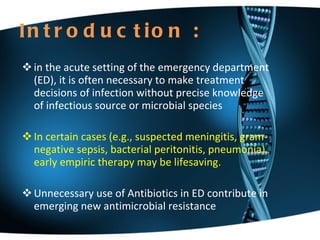
Introduction : in the acute setting of the emergency department (ED), it is often necessary to make treatment decisions of infection without precise knowledge of infectious source or microbial species In certain cases (e.g., suspected meningitis, gram-negative sepsis, bacterial peritonitis, pneumonia), early empiric therapy may be lifesaving. Unnecessary use of Antibiotics in ED contribute in emerging new antimicrobial resistance
Outline Basic knowledge of Antimicrobial Spectrum of activity . Discuss the indications of  frequently used antibiotics in Emergency  . Antibiotics guideline use in (UTI ,Meningitis , CAP  & soft tissue infection ) Evidence based Advances in Early ED Antibiotic use  . Review the most common drug interactions of the most commonly used Antibiotics
Gram +ve bacteria Cocci : =Strept: pyogen ,pnumoniae , viridans =Staph : aureus ,epidermus , saprophyticus Bacilli :  =clostridium  =Bacillus  = Listeria
Gram -ve bacteria Cocci : = Neisseria gonorrhea , Niesseria Meningitidis Bacilli :  =Klebsella , Ecoli , Enterobacter ,Psudomonus aerogenosa CoccoBacilli :  = H.influenzae , B.Pertussis
Spectrum of Activity Narrow-Spectrum Antimicrobial Wide-Spectrum Antimicrobial
` St Re pt enterococcus Staph .aeru M R S A H.Influ morexella niesseria Psudomonus  Gram –ve rods e.coli anaerob Penicillin Amoxacillin/Ampicillin + + 0 0 +/- 0 +(niesseria meningitis 0 0 0 Amoxicillin/calvu(oral  + + + 0 + + + 0 + + Tazobactaum /Pipracellin (iv ) + + + 0 + + + + + + Carbapenums (imepenu meropenum + +  e.fecalis only + 0 + + + + + +
` cephalosporins strptococcus enterococcus Staph .aerus MRSA H.influ morexella niesseria Psudomonus  Gram –ve rods  ecoli 1 st  generation Cephalexin  + 0 + 0 + not cephalexin +/- 0 0 0 2 nd  generation Cefuroxime , cefacolr + 0 + 0 + +  cefacolr +/- +/- 0 +/- 3 rd  generation  Ceftriaxone ,cefexime + 0 + 0 + + + +/- + 3 rd  generation (antipsudomonus  Ceftazidine  + 0 +/- 0 + + +/- + + 4 th  generation cefepime + 0 + 0 + + + + +
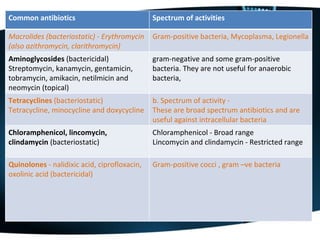
*/ Common antibiotics  Spectrum of activities Macrolides (bacteriostatic) - Erythromycin (also azithromycin, clarithromycin) Gram-positive bacteria, Mycoplasma, Legionella Aminoglycosides  (bactericidal)  Streptomycin, kanamycin, gentamicin, tobramycin, amikacin, netilmicin and neomycin (topical) gram-negative and some gram-positive bacteria. They are not useful for anaerobic bacteria, Tetracyclines  (bacteriostatic)  Tetracycline, minocycline and doxycycline b. Spectrum of activity -  These are broad spectrum antibiotics and are useful against intracellular bacteria Chloramphenicol, lincomycin, clindamycin  (bacteriostatic) Chloramphenicol - Broad range Lincomycin and clindamycin - Restricted range Quinolones  - nalidixic acid, ciprofloxacin, oxolinic acid (bactericidal) Gram-positive cocci , gram –ve bacteria
Oral Quinelones Flouroquinolones (cont.). Trovafloxacin. Covers Gm pos, neg, and anaerobes. Hepatotoxicity with prolonged use.  Absorption delayed by morphine. Moxifloxacin. Covers Gm pos, neg, and anaerobes. Good vs.  Clostridium  and  Bacteroides  – same range as metronidazole, and superior to clindamycin. QD dosing. Gatifloxicin. Covers Gm pos, neg, and anaerobes. Very similar to moxifloxacin, but  less expensive . QD dosing.
Urinary tract  infection
CYSTITIS & UTI COMMON ORGANISM : -   80-85% E.COLI  - 5-1-% STAPH SAPROPHYTICUS  -KLEBSIELLA & POTEU CAUSE MINORITY OF CASE
Evedience based advances  : Most of the b-lactams appear to be less effective  may yield increased incidences of recurrences and of adverse effects . Amoxicillin is thus no longer recommended as empirical therapy for uncomplicated UTI (the sanford guide for antimicrobial therapy 2010) CHARACTER OF PATIENTS  SUGGESTED NTIBIOTIC  DURATION Uncomplicated acute bacterial cystitis  1)Trimethoprim-sulfamethoxazole or trimethoprim .(IA) 2)Fluoroquinolones, ofloxacin (IA) , norfloxacin ,(AII  ciprofloxacin, AII and fleroxacin AII nitrofurantoin,) 3)b-lactams  (E,I). 3 DAYS  3-7 DAYS
Antibiotic therapy for three days was similar to prolonged therapy (≥5 days)  in achieving symptomatic cure, while prolonged treatment was more effective in obtaining bacteriologic cure. There is no  apparent benefit in extending therapy with TMP-SMX or a fluoroquinolone past three days , and adverse reactions are more common in patients treated with longer regimens.
Evedience based advances  : In randomized double-blind trial, bacteriologic and  clinical success higher for 7 days of CIP than for 14 days of TMP-SMX; failures correlated with  TMP-SMX in vitro resistance. Since  CIP worked with 7-day rx, suspect other FQs effective with 7 days of therapy;  Levo 750 mg FDA-approved for 5 days (the sanford guide for antimicrobial therapy 2010) CHARACTER OF PATIENTS  SUGGESTED NTIBIOTIC  DURATION Uncomplicated acute pyelonephritis  Resistance of E. coli to TMP/SMX 13-45% in collaborative ER study  (CID 47:1150, 2008). 1)oral fluoroquinolone ,  Levo 750 mg q24,  Oflox 400 mg bid,  Moxi NAI 400 mg q24h (A,II). 2)  CIP 500 mg bid or CIP-ER(AII) 1000 mg q24hpossibly If a gram-positive bacterium is the likely causative organism, amoxicillin or amoxicillin/clavulanic acid may be used alone (B,III) 2 weeks 7 days
Common organisms:  - Enterobacteriaceae, -P. aeruginosa, enterococci -rarely S. aureus (CID 42:46,2006) CHARACTER OF PATIENTS  SUGGESTED NTIBIOTIC  DURATION Complicated UTI/catheters Obstruction, reflux, azotemia, transplant, Foley catheterrelated, R/O obstruction (AMP + gent) or PIP-TZ (Tazocin ) or TC-CL  ticarcillin-clavulanate or  or IMP = imipenem-  or MER meropenem   (IV FQ: CIP, Gati, Levo) or Ceftaz or Cef 2-3weeks
Community Acquired Pneumonia (CAP )
Common organisms in CAP No co-morbidity :  Most common organism strept.pnumonae 2/3 of the cases ,Atypicals—M. pneumoniae, , viral Co-morbidity: Alcoholism:  S. pneumo,anaerobes, coliforms COPD:  H. influenzae,M. catarrhalis, S. pneumo IVDU:  Hematogenous S. aureus Post-CVA aspiration:  Oral flora, incl. S. pneumo Post- influenza :S. pneumo. And  S. aureus
Evidence based advances  : There is abundant evidence that  macrolide monotherapy  is highly effective in the treatment of CAP in outpatients with mild to moderately severe disease  For patients admitted  through  the emerg dose should be administered while still in the ED  .(Moderate recommendation; level III ) Clinical Infectious Diseases 2000;31:383–421 © 2000 by the Infectious Diseases Society of America.  Previously healthy and no risk factors for drug-resistant  S. pneumoniae (DRSP) infection A macrolide (azithromycin, clarithromycin, or erythromycin) (strong recommendation; level I evidence)  Doxycycline (weak recommendation; level III evidence)
Presence of comorbidities,  - chronic heart, lung,liver, or renal disease - diabetes mellitus; ---alcoholism; malignancies; asplenia; immunosuppressing  use of immunosuppressing drugs; use of antimicrobials within the previous 3 months (in which case an alternative from a different class should be selected) A respiratory fluoroquinolone (moxifloxacin, gemifloxacin,or levofloxacin  (level I evidence) A b-lactam plus a macrolide (strong recommendation  (level I evidence) alternatives include ceftriaxone, cefpodoxime, and cefuroxime [500 mg 2 times daily]; doxycycline [level II evidence]
Respiratory fluoroquinolones  (levofloxacin, moxifloxacin or gemifloxacin  were more likely to result in treatment success than the combination of a beta-lactam plus a macrolide  for the treatment of CAP that was mostly mild to moderate in severity (odds ratio, OR 1.39, 95% CI 1.02-1.90)
Bacterial Meningitis
Empiric Therapy—immunocompetent Age: Preterm to <1 mo Group B strep 49%, E. coli 18%, listeria 7%, AMP + cefotaxime  AMP + gentamicin Age: 1 mo– 50 yrs S. pneumo, meningococci, H. influenzae now very rare, listeria unlikely if young & immuno-competent (add ampicillin if suspect listeria: 2 gm IV q4h) Adult dosage: [( Cefotaxime 2 gm IV q4–6h OR ceftriaxone 2 gm IV q12h)] + ( dexamethasone) + Vanco [( MER 2 gm IV q8h) (Peds: 40 mg/kg IV q8h)] + IV dexamethasone + vanco
Age > 50 years or alcoholism or other deblitating illneesses , immunocompromized Strpt .Pnumoniae,listeria, gram –ve bacilli 1)AMP 2 gm IV q4h) + (ceftriaxone 2 gm IV q12h or cefotaxime 2 gm IV q6h) + vanco + IV Dexamethasone 2) MER 2 gm IV q8h + vanco + IV dexamethasone. Basilar skull fracture  S. pneumoniae ,  H. influenzae , group A beta-hemolytic streptococci  Vancomycin plus a third-generation cephalosporin•Δ  Penetrating trauma Staphylococcus aureus , coagulase-negative staphylococci (especially  Staphylococcus epidermidis ), aerobic gram-negative bacilli (including  Pseudomonas aeruginosa )  Vancomycin plus cefepime; OR vancomycin plus ceftazidime; OR vancomycin plus meropenem
Delay  in initial antibiotics in the emergency department (median delay of four hours)  was associated with a worsening of hypotension, altered mental status, and seizures  in about 15 percent of patients . Those patients whose delay in antibiotic therapy allowed their disease to advance from having zero or one to having two or three poor prognostic indicators had a significant increase in adverse outcomes.
patients with pneumococcal meningitis ,  a delay in antibiotic treatment of more than three hours after hospital admission was a strong and independent risk factor for mortality  (OR 14.1; 95% CI: 3.9 to 50.9). Delayed therapy was a greater risk factor than the isolation of a penicillin-resistant strain (OR 6.83; 95% CI 2.94-20.8) or a higher disease severity (OR 1.12; 95% CI 1.07-1.15)
Fever  Interval before Diagnosis, Prior Antibiotic Treatment, and Clinical Outcome for Young Children with Bacterial Meningitis Clinical Infectious Diseases 2001;32:566–572 retrospective chart review, we compared the fever interval that preceded diagnosis with the complication rate among  288 young children (age, 3–36 months )  Pneumococcus  species were associated with  the longest fever interval prior to diagnosis  of meningitis, the highest frequency of contact with a clinician before hospitalization, and the  highest rate of documented morbidity or mortality . For  S. pneumoniae,   there was an association between antibiotic treatment received at prior meetings with a clinician and a reduced rate of meningitis‐related complications (odds ratio, 0.14; ).  Antibiotic treatment during such meetings is associated with a substantial reduction in disease‐related sequelae.
Skin and Soft-Tissue Infections inthe Era of Resistance: MRSA and More
CA-MRSA: The New Epidemic A global emerging health problem 8-12% of MRSA infections Most involve skin & soft-tissue structures Commonly presents with spontaneous abscess Reported in severe infections: Bacteremia, Pneumonia (often necrotizing) Osteomyelitis Bursitis, arthritis,Meningitis Fridkin SK, et al.N Engl J Med. 2005;352:1436-1444. Pannaraj PS, et al.Clin Infect Dis. 2006;43:953-960.
Risk factors to develop CAMRSA soft tissue infection :   =   Antibiotic use (particularly cephalosporin and fluoroquinolone use) strongly correlates with the risk for MRSA colonization and infectio  = residents of long-term care facilities  =Homeless  =IV drug users  =Prisoners  =Military Personnel  =HIV patients  60% are abscess, 40% cellulitis , small persentage as impetigo Clin Infect Dis. 2007;45 Suppl 3:S171-6
Antibiotics & Abscesses - Not required for simple, uncomplicated cases - Indications for addition of antibiotics:    Major surrounding cellulitis   Signs of systemic toxicity   Facial abscess   Immunocompromised   Recurrent abscesses   Large abscess (≥ 5 cm) - Typical duration: 7-10 days The Sanford Guide: 2008, page 47. Lee MC, et al. Pediatr Infect Dis J. 2004;23:123-127. Ruhe JJ, et al.Clin Infect Dis. 2007;44:777-784 .
Skin and soft tissue infections  Parenteral therapy  •  Vancomycin (30 mg/kg IV every 24 hours in 2 equally divided doses; not to exceed 2 g/24 hours unless concentrations in serum are inappropriately low) •  Daptomycin (4 mg/kg IV once daily) •  Linezolid (600 mg IV twice daily) •  Tigecycline (100 mg IV once, thereafter 50 mg IV every 12 hours) Oral therapy  •  TMP-SMX (2 double-strength tablets orally twice daily) •  Doxycycline or minocycline (100 mg orally twice daily) •  Clindamycin* (300 to 450 mg orally every 6 to 8 hours) •  Linezolid (600 mg orally twice daily)
Sepsis
Cutoff  time of <1 hr  for early goal directed therapy  & administration of appropriate antibiotics in severe sepsis & septic shock initiated in emergency department are primary  determinant of mortality.
Effectivness of  Antibiotic administration within 1 hr  of hypotension was associated with better survival rate in septic shock
Antibiotics in sepsis  if Pseudomonas is an unlikely pathogen  vancomycin with one of the following: Cephalosporin, 3rd or 4th generation (eg, ceftriaxone  or cefotaxime) or Beta-lactam/beta-lactamase inhibitor (eg, piperacillin-tazobactam, ticarcillin-clavulanate or Carbapenem (eg, imipenem or meropenem
+ Pseudomonas is a possible pathogen, we combine vancomycin  Antipseudomonal cephalosporin (eg, ceftazidime, cefepime, or Antipseudomonal carbapenem (eg, imipenem, meropenem), or Antipseudomonal beta-lactam/beta-lactamase inhibitor (eg, piperacillin-tazobactam,ticarcillin-clavulanate), or Fluoroquinolone with good anti-pseudomonal activity (eg, ciprofloxacin), or Aminoglycoside (eg, gentamicin, amikacin), or Monobactam (eg, aztreonam)
Common antibiotic drug interaction
 
Take home massages  Basic knowledge of antibiotic spectrum of activity is required for infection management Advances in UTI treatment support using antibiotics for shorter course  Oral Flurquinelones are supported by evedience to be effective in treatment of CAP Early AB in meningitis is proven to reduce complications & improve outcome
Take home massages  MRSA soft tissue & wound infection is a newly emerging problem  Early Antibiotics in sepsis is part of early goal directed therapy
THANK YOU
Pregnancy Aerobic Gm-neg. bacilli & Staph. hemolyticus Screen 1st trimester. If positive, rx 3–7 days with  amox, nitrofurantoin, O Ceph, TMP-SMX, or TMP alone Screen monthly for recurrence. Some authorities treat continuously until delivery (stop TMP-SMX 2 wks before EDC). ↑ resistance of E. coli to TMP-SMX. Before and after invasive urologic intervention, e.g., Foley catheter Aerobic Gm-

Antibiotic in ED

  • 1.
  • 2.
    Introduction : inthe acute setting of the emergency department (ED), it is often necessary to make treatment decisions of infection without precise knowledge of infectious source or microbial species In certain cases (e.g., suspected meningitis, gram-negative sepsis, bacterial peritonitis, pneumonia), early empiric therapy may be lifesaving. Unnecessary use of Antibiotics in ED contribute in emerging new antimicrobial resistance
  • 3.
    Outline Basic knowledgeof Antimicrobial Spectrum of activity . Discuss the indications of frequently used antibiotics in Emergency . Antibiotics guideline use in (UTI ,Meningitis , CAP & soft tissue infection ) Evidence based Advances in Early ED Antibiotic use . Review the most common drug interactions of the most commonly used Antibiotics
  • 4.
    Gram +ve bacteriaCocci : =Strept: pyogen ,pnumoniae , viridans =Staph : aureus ,epidermus , saprophyticus Bacilli : =clostridium =Bacillus = Listeria
  • 5.
    Gram -ve bacteriaCocci : = Neisseria gonorrhea , Niesseria Meningitidis Bacilli : =Klebsella , Ecoli , Enterobacter ,Psudomonus aerogenosa CoccoBacilli : = H.influenzae , B.Pertussis
  • 6.
    Spectrum of ActivityNarrow-Spectrum Antimicrobial Wide-Spectrum Antimicrobial
  • 7.
    ` St Rept enterococcus Staph .aeru M R S A H.Influ morexella niesseria Psudomonus Gram –ve rods e.coli anaerob Penicillin Amoxacillin/Ampicillin + + 0 0 +/- 0 +(niesseria meningitis 0 0 0 Amoxicillin/calvu(oral + + + 0 + + + 0 + + Tazobactaum /Pipracellin (iv ) + + + 0 + + + + + + Carbapenums (imepenu meropenum + + e.fecalis only + 0 + + + + + +
  • 8.
    ` cephalosporins strptococcusenterococcus Staph .aerus MRSA H.influ morexella niesseria Psudomonus Gram –ve rods ecoli 1 st generation Cephalexin + 0 + 0 + not cephalexin +/- 0 0 0 2 nd generation Cefuroxime , cefacolr + 0 + 0 + + cefacolr +/- +/- 0 +/- 3 rd generation Ceftriaxone ,cefexime + 0 + 0 + + + +/- + 3 rd generation (antipsudomonus Ceftazidine + 0 +/- 0 + + +/- + + 4 th generation cefepime + 0 + 0 + + + + +
  • 9.
    */ Common antibiotics Spectrum of activities Macrolides (bacteriostatic) - Erythromycin (also azithromycin, clarithromycin) Gram-positive bacteria, Mycoplasma, Legionella Aminoglycosides (bactericidal) Streptomycin, kanamycin, gentamicin, tobramycin, amikacin, netilmicin and neomycin (topical) gram-negative and some gram-positive bacteria. They are not useful for anaerobic bacteria, Tetracyclines (bacteriostatic) Tetracycline, minocycline and doxycycline b. Spectrum of activity - These are broad spectrum antibiotics and are useful against intracellular bacteria Chloramphenicol, lincomycin, clindamycin (bacteriostatic) Chloramphenicol - Broad range Lincomycin and clindamycin - Restricted range Quinolones - nalidixic acid, ciprofloxacin, oxolinic acid (bactericidal) Gram-positive cocci , gram –ve bacteria
  • 10.
    Oral Quinelones Flouroquinolones(cont.). Trovafloxacin. Covers Gm pos, neg, and anaerobes. Hepatotoxicity with prolonged use. Absorption delayed by morphine. Moxifloxacin. Covers Gm pos, neg, and anaerobes. Good vs. Clostridium and Bacteroides – same range as metronidazole, and superior to clindamycin. QD dosing. Gatifloxicin. Covers Gm pos, neg, and anaerobes. Very similar to moxifloxacin, but less expensive . QD dosing.
  • 11.
    Urinary tract infection
  • 12.
    CYSTITIS & UTICOMMON ORGANISM : - 80-85% E.COLI - 5-1-% STAPH SAPROPHYTICUS -KLEBSIELLA & POTEU CAUSE MINORITY OF CASE
  • 13.
    Evedience based advances : Most of the b-lactams appear to be less effective may yield increased incidences of recurrences and of adverse effects . Amoxicillin is thus no longer recommended as empirical therapy for uncomplicated UTI (the sanford guide for antimicrobial therapy 2010) CHARACTER OF PATIENTS SUGGESTED NTIBIOTIC DURATION Uncomplicated acute bacterial cystitis 1)Trimethoprim-sulfamethoxazole or trimethoprim .(IA) 2)Fluoroquinolones, ofloxacin (IA) , norfloxacin ,(AII ciprofloxacin, AII and fleroxacin AII nitrofurantoin,) 3)b-lactams (E,I). 3 DAYS 3-7 DAYS
  • 14.
    Antibiotic therapy forthree days was similar to prolonged therapy (≥5 days) in achieving symptomatic cure, while prolonged treatment was more effective in obtaining bacteriologic cure. There is no apparent benefit in extending therapy with TMP-SMX or a fluoroquinolone past three days , and adverse reactions are more common in patients treated with longer regimens.
  • 15.
    Evedience based advances : In randomized double-blind trial, bacteriologic and clinical success higher for 7 days of CIP than for 14 days of TMP-SMX; failures correlated with TMP-SMX in vitro resistance. Since CIP worked with 7-day rx, suspect other FQs effective with 7 days of therapy; Levo 750 mg FDA-approved for 5 days (the sanford guide for antimicrobial therapy 2010) CHARACTER OF PATIENTS SUGGESTED NTIBIOTIC DURATION Uncomplicated acute pyelonephritis Resistance of E. coli to TMP/SMX 13-45% in collaborative ER study (CID 47:1150, 2008). 1)oral fluoroquinolone , Levo 750 mg q24, Oflox 400 mg bid, Moxi NAI 400 mg q24h (A,II). 2) CIP 500 mg bid or CIP-ER(AII) 1000 mg q24hpossibly If a gram-positive bacterium is the likely causative organism, amoxicillin or amoxicillin/clavulanic acid may be used alone (B,III) 2 weeks 7 days
  • 16.
    Common organisms: - Enterobacteriaceae, -P. aeruginosa, enterococci -rarely S. aureus (CID 42:46,2006) CHARACTER OF PATIENTS SUGGESTED NTIBIOTIC DURATION Complicated UTI/catheters Obstruction, reflux, azotemia, transplant, Foley catheterrelated, R/O obstruction (AMP + gent) or PIP-TZ (Tazocin ) or TC-CL ticarcillin-clavulanate or or IMP = imipenem- or MER meropenem (IV FQ: CIP, Gati, Levo) or Ceftaz or Cef 2-3weeks
  • 17.
  • 18.
    Common organisms inCAP No co-morbidity : Most common organism strept.pnumonae 2/3 of the cases ,Atypicals—M. pneumoniae, , viral Co-morbidity: Alcoholism: S. pneumo,anaerobes, coliforms COPD: H. influenzae,M. catarrhalis, S. pneumo IVDU: Hematogenous S. aureus Post-CVA aspiration: Oral flora, incl. S. pneumo Post- influenza :S. pneumo. And S. aureus
  • 19.
    Evidence based advances : There is abundant evidence that macrolide monotherapy is highly effective in the treatment of CAP in outpatients with mild to moderately severe disease For patients admitted through the emerg dose should be administered while still in the ED .(Moderate recommendation; level III ) Clinical Infectious Diseases 2000;31:383–421 © 2000 by the Infectious Diseases Society of America. Previously healthy and no risk factors for drug-resistant S. pneumoniae (DRSP) infection A macrolide (azithromycin, clarithromycin, or erythromycin) (strong recommendation; level I evidence) Doxycycline (weak recommendation; level III evidence)
  • 20.
    Presence of comorbidities, - chronic heart, lung,liver, or renal disease - diabetes mellitus; ---alcoholism; malignancies; asplenia; immunosuppressing use of immunosuppressing drugs; use of antimicrobials within the previous 3 months (in which case an alternative from a different class should be selected) A respiratory fluoroquinolone (moxifloxacin, gemifloxacin,or levofloxacin (level I evidence) A b-lactam plus a macrolide (strong recommendation (level I evidence) alternatives include ceftriaxone, cefpodoxime, and cefuroxime [500 mg 2 times daily]; doxycycline [level II evidence]
  • 21.
    Respiratory fluoroquinolones (levofloxacin, moxifloxacin or gemifloxacin were more likely to result in treatment success than the combination of a beta-lactam plus a macrolide for the treatment of CAP that was mostly mild to moderate in severity (odds ratio, OR 1.39, 95% CI 1.02-1.90)
  • 22.
  • 23.
    Empiric Therapy—immunocompetent Age:Preterm to <1 mo Group B strep 49%, E. coli 18%, listeria 7%, AMP + cefotaxime AMP + gentamicin Age: 1 mo– 50 yrs S. pneumo, meningococci, H. influenzae now very rare, listeria unlikely if young & immuno-competent (add ampicillin if suspect listeria: 2 gm IV q4h) Adult dosage: [( Cefotaxime 2 gm IV q4–6h OR ceftriaxone 2 gm IV q12h)] + ( dexamethasone) + Vanco [( MER 2 gm IV q8h) (Peds: 40 mg/kg IV q8h)] + IV dexamethasone + vanco
  • 24.
    Age > 50years or alcoholism or other deblitating illneesses , immunocompromized Strpt .Pnumoniae,listeria, gram –ve bacilli 1)AMP 2 gm IV q4h) + (ceftriaxone 2 gm IV q12h or cefotaxime 2 gm IV q6h) + vanco + IV Dexamethasone 2) MER 2 gm IV q8h + vanco + IV dexamethasone. Basilar skull fracture S. pneumoniae , H. influenzae , group A beta-hemolytic streptococci Vancomycin plus a third-generation cephalosporin•Δ Penetrating trauma Staphylococcus aureus , coagulase-negative staphylococci (especially Staphylococcus epidermidis ), aerobic gram-negative bacilli (including Pseudomonas aeruginosa ) Vancomycin plus cefepime; OR vancomycin plus ceftazidime; OR vancomycin plus meropenem
  • 25.
    Delay ininitial antibiotics in the emergency department (median delay of four hours) was associated with a worsening of hypotension, altered mental status, and seizures in about 15 percent of patients . Those patients whose delay in antibiotic therapy allowed their disease to advance from having zero or one to having two or three poor prognostic indicators had a significant increase in adverse outcomes.
  • 26.
    patients with pneumococcalmeningitis , a delay in antibiotic treatment of more than three hours after hospital admission was a strong and independent risk factor for mortality (OR 14.1; 95% CI: 3.9 to 50.9). Delayed therapy was a greater risk factor than the isolation of a penicillin-resistant strain (OR 6.83; 95% CI 2.94-20.8) or a higher disease severity (OR 1.12; 95% CI 1.07-1.15)
  • 27.
    Fever Intervalbefore Diagnosis, Prior Antibiotic Treatment, and Clinical Outcome for Young Children with Bacterial Meningitis Clinical Infectious Diseases 2001;32:566–572 retrospective chart review, we compared the fever interval that preceded diagnosis with the complication rate among 288 young children (age, 3–36 months ) Pneumococcus species were associated with the longest fever interval prior to diagnosis of meningitis, the highest frequency of contact with a clinician before hospitalization, and the highest rate of documented morbidity or mortality . For S. pneumoniae, there was an association between antibiotic treatment received at prior meetings with a clinician and a reduced rate of meningitis‐related complications (odds ratio, 0.14; ). Antibiotic treatment during such meetings is associated with a substantial reduction in disease‐related sequelae.
  • 28.
    Skin and Soft-TissueInfections inthe Era of Resistance: MRSA and More
  • 29.
    CA-MRSA: The NewEpidemic A global emerging health problem 8-12% of MRSA infections Most involve skin & soft-tissue structures Commonly presents with spontaneous abscess Reported in severe infections: Bacteremia, Pneumonia (often necrotizing) Osteomyelitis Bursitis, arthritis,Meningitis Fridkin SK, et al.N Engl J Med. 2005;352:1436-1444. Pannaraj PS, et al.Clin Infect Dis. 2006;43:953-960.
  • 30.
    Risk factors todevelop CAMRSA soft tissue infection : = Antibiotic use (particularly cephalosporin and fluoroquinolone use) strongly correlates with the risk for MRSA colonization and infectio = residents of long-term care facilities =Homeless =IV drug users =Prisoners =Military Personnel =HIV patients 60% are abscess, 40% cellulitis , small persentage as impetigo Clin Infect Dis. 2007;45 Suppl 3:S171-6
  • 31.
    Antibiotics & Abscesses- Not required for simple, uncomplicated cases - Indications for addition of antibiotics:  Major surrounding cellulitis  Signs of systemic toxicity  Facial abscess  Immunocompromised  Recurrent abscesses  Large abscess (≥ 5 cm) - Typical duration: 7-10 days The Sanford Guide: 2008, page 47. Lee MC, et al. Pediatr Infect Dis J. 2004;23:123-127. Ruhe JJ, et al.Clin Infect Dis. 2007;44:777-784 .
  • 32.
    Skin and softtissue infections Parenteral therapy • Vancomycin (30 mg/kg IV every 24 hours in 2 equally divided doses; not to exceed 2 g/24 hours unless concentrations in serum are inappropriately low) • Daptomycin (4 mg/kg IV once daily) • Linezolid (600 mg IV twice daily) • Tigecycline (100 mg IV once, thereafter 50 mg IV every 12 hours) Oral therapy • TMP-SMX (2 double-strength tablets orally twice daily) • Doxycycline or minocycline (100 mg orally twice daily) • Clindamycin* (300 to 450 mg orally every 6 to 8 hours) • Linezolid (600 mg orally twice daily)
  • 33.
  • 34.
    Cutoff timeof <1 hr for early goal directed therapy & administration of appropriate antibiotics in severe sepsis & septic shock initiated in emergency department are primary determinant of mortality.
  • 35.
    Effectivness of Antibiotic administration within 1 hr of hypotension was associated with better survival rate in septic shock
  • 36.
    Antibiotics in sepsis if Pseudomonas is an unlikely pathogen vancomycin with one of the following: Cephalosporin, 3rd or 4th generation (eg, ceftriaxone  or cefotaxime) or Beta-lactam/beta-lactamase inhibitor (eg, piperacillin-tazobactam, ticarcillin-clavulanate or Carbapenem (eg, imipenem or meropenem
  • 37.
    + Pseudomonas isa possible pathogen, we combine vancomycin Antipseudomonal cephalosporin (eg, ceftazidime, cefepime, or Antipseudomonal carbapenem (eg, imipenem, meropenem), or Antipseudomonal beta-lactam/beta-lactamase inhibitor (eg, piperacillin-tazobactam,ticarcillin-clavulanate), or Fluoroquinolone with good anti-pseudomonal activity (eg, ciprofloxacin), or Aminoglycoside (eg, gentamicin, amikacin), or Monobactam (eg, aztreonam)
  • 38.
  • 39.
  • 40.
    Take home massages Basic knowledge of antibiotic spectrum of activity is required for infection management Advances in UTI treatment support using antibiotics for shorter course Oral Flurquinelones are supported by evedience to be effective in treatment of CAP Early AB in meningitis is proven to reduce complications & improve outcome
  • 41.
    Take home massages MRSA soft tissue & wound infection is a newly emerging problem Early Antibiotics in sepsis is part of early goal directed therapy
  • 42.
  • 43.
    Pregnancy Aerobic Gm-neg.bacilli & Staph. hemolyticus Screen 1st trimester. If positive, rx 3–7 days with amox, nitrofurantoin, O Ceph, TMP-SMX, or TMP alone Screen monthly for recurrence. Some authorities treat continuously until delivery (stop TMP-SMX 2 wks before EDC). ↑ resistance of E. coli to TMP-SMX. Before and after invasive urologic intervention, e.g., Foley catheter Aerobic Gm-

Editor's Notes

  • #11 Pain Management on the Battlefield 12/21/10 Kevin C.O&apos;Connor, D.O. Trova Walker RC: The fluoroquinolones. Mayo Clinic Proceedings 1999; 74: 1030-1037. Moxi/Gati -Appelbaum PC: Quinolone activity against anaerobes. Drugs 1999; 58 Suppl 2: 60-64. Hoellman DB, Kelly LM, Jacobs MR, Appelbaum PC: Comparative antianaerobic activity of BMS 284756. Antimicrob Agents Chemother 2001; 45: 589-592. Seciale A, Musumeci R, Blandino G, Milazzo I, Caccamo F, Nicoletti G: Minimal inhibitory concentrations and time-kill determination of moxifloxacin against aerobic and anaerobic isolates. Int J Antimicrob Agents 2002; 19: 11-118. Mather R, Karenchak LM, Romanowski EG, Kowalski RP: Fourth generation flouroquinolones: new weapons in the arsenal of opthalmic antibiotics. Am J Ophthalmol 2002; 133: 463-466. Ackerman G, Schaumann R, Pless B, Claros MC, Goldstein EF, Rodloff: Comparative activity of moxifloacin in vitro against obligately anaerobic bacteria. Eur J Clin Microbiol Inf Dis 2000; 19: 228-232. - Ling ML, Tan PL: In vitro activity of moxifloxacin against local bacterial isolates. Ann Acad Med Singapore 2001; 6: 607-610