BASIC EP STUDY
SAKHAN SOLIDA, MD
Cardiologist , ESC, EHRA and ACC member
Preah Kossamak Hospital
Part-1
Introduction
Electrophysiology...
 Is the study of the heart’s electrical system
 Assesses the function of each component of cardiac conduction
 Determines the potential for a patient to have an arrhythmia
 Determines the mechanism of an arrhythmia
 Evaluates the need for treatment/ therapy
The role of EP study in the diagnosis and treatment of cardiac arrhythmias :
 To characterise physiological and pathological properties of the atria, ventricles and the
atrioventricular conduction system.
 To identify accessory pathways, and determine the sites and mechanisms of arrhythmias.
 To correlate patient symptoms with arrhythmias and evaluate risks for life threatening events
and/or differentiate arrhythmias.
 To define arrhythmia induction and termination methods for EPS
 Guided interventions : i.e. Medications, anti-tachycardia pacing, antiarrhythmic, ICD’s, ablation or
modification.
Class I (EP study is indicated)
 Patients not tolerating or not responding to medications
 Narrow QRS tachycardia preferring ablative therapy
 Sustained wide QRS complex tachycardia
 An accessory pathway tachycardia that is symptomatic and may require ablative therapy
 Unexplained syncope and known structural heart disease.
 Palpitations and documented inappropriate rapid pulse rates without apparent cause.
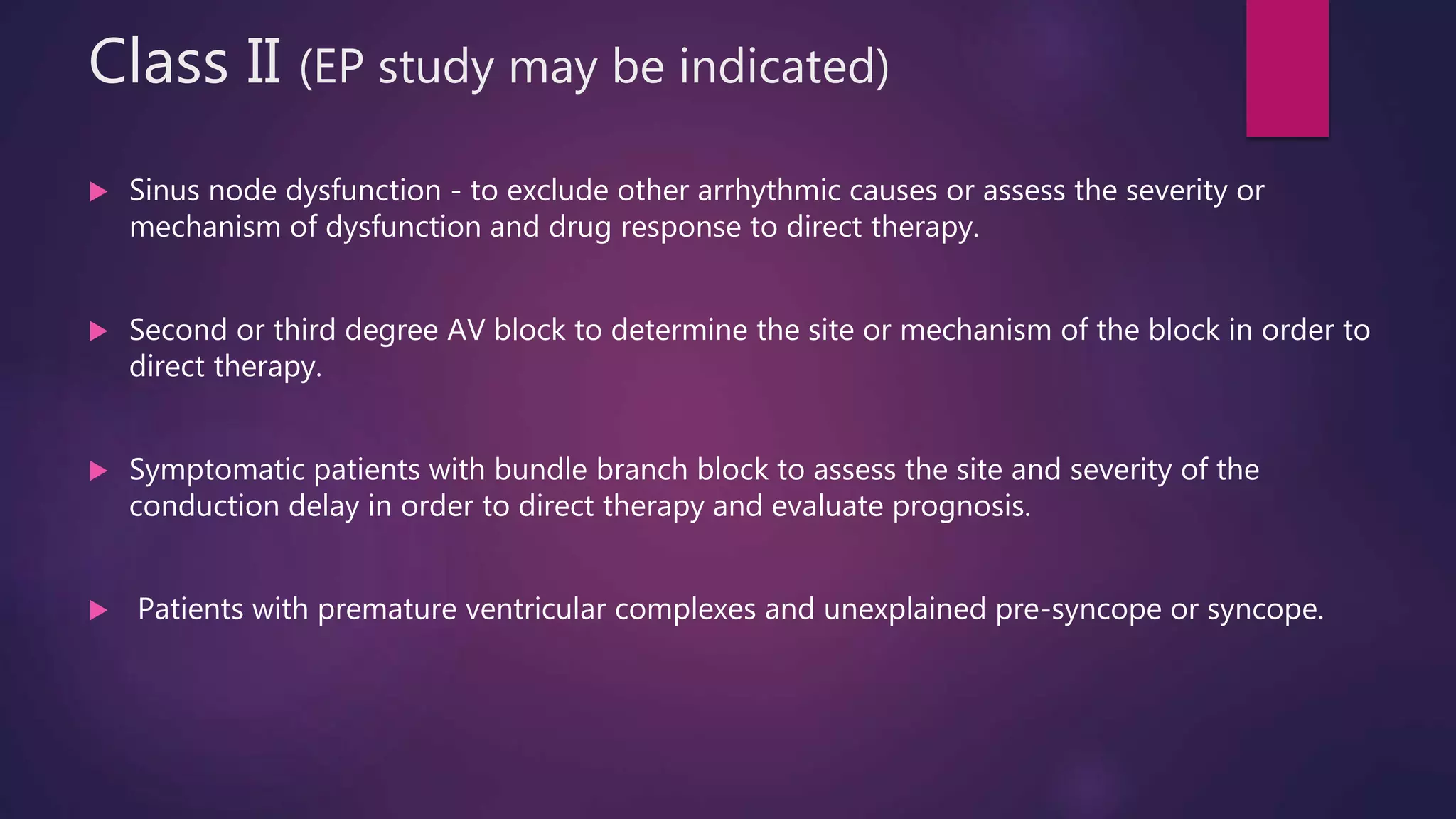
Class II (EP study may be indicated)
 Sinus node dysfunction - to exclude other arrhythmic causes or assess the severity or
mechanism of dysfunction and drug response to direct therapy.
 Second or third degree AV block to determine the site or mechanism of the block in order to
direct therapy.
 Symptomatic patients with bundle branch block to assess the site and severity of the
conduction delay in order to direct therapy and evaluate prognosis.
 Patients with premature ventricular complexes and unexplained pre-syncope or syncope.
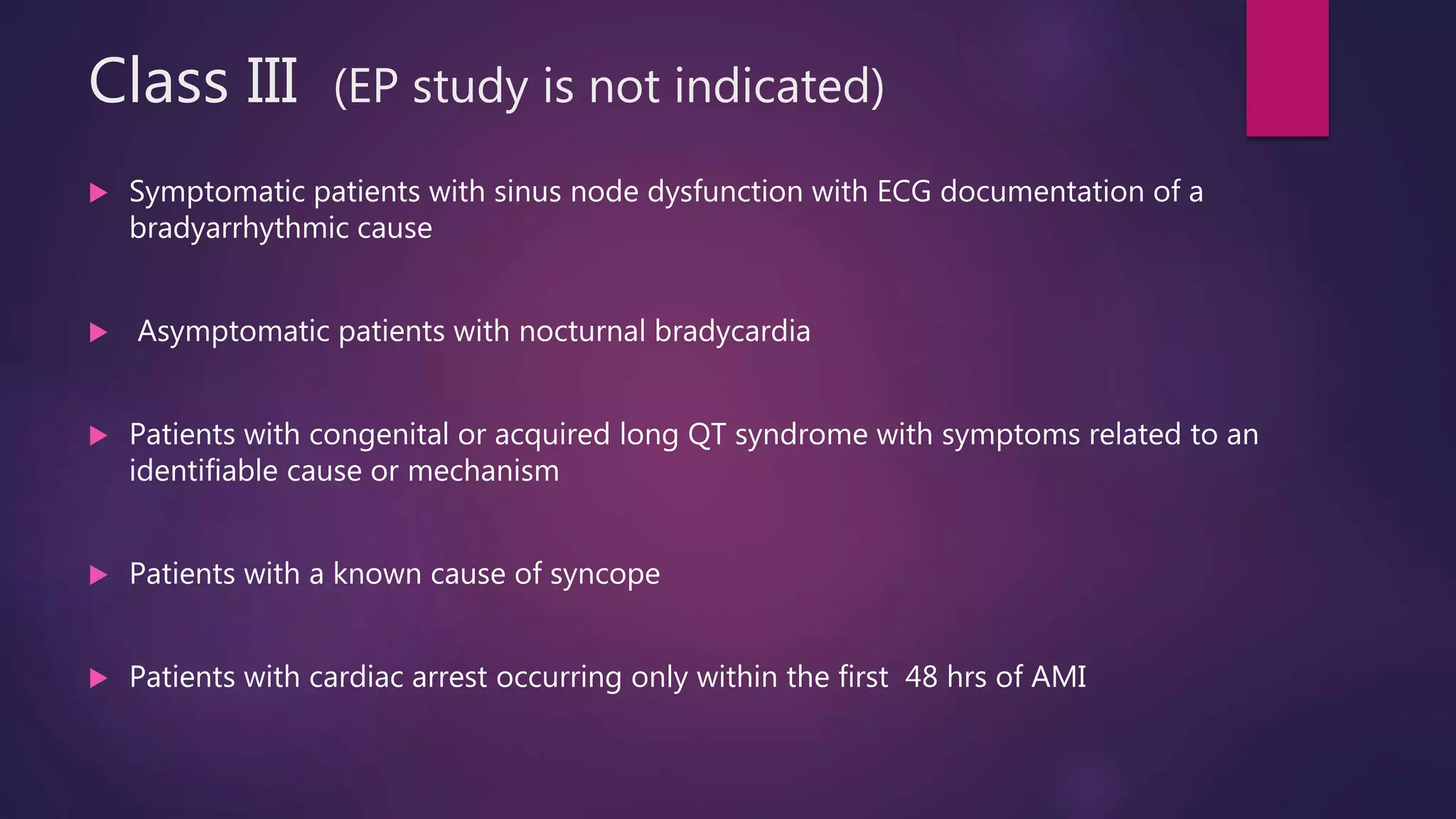
Class III (EP study is not indicated)
 Symptomatic patients with sinus node dysfunction with ECG documentation of a
bradyarrhythmic cause
 Asymptomatic patients with nocturnal bradycardia
 Patients with congenital or acquired long QT syndrome with symptoms related to an
identifiable cause or mechanism
 Patients with a known cause of syncope
 Patients with cardiac arrest occurring only within the first 48 hrs of AMI
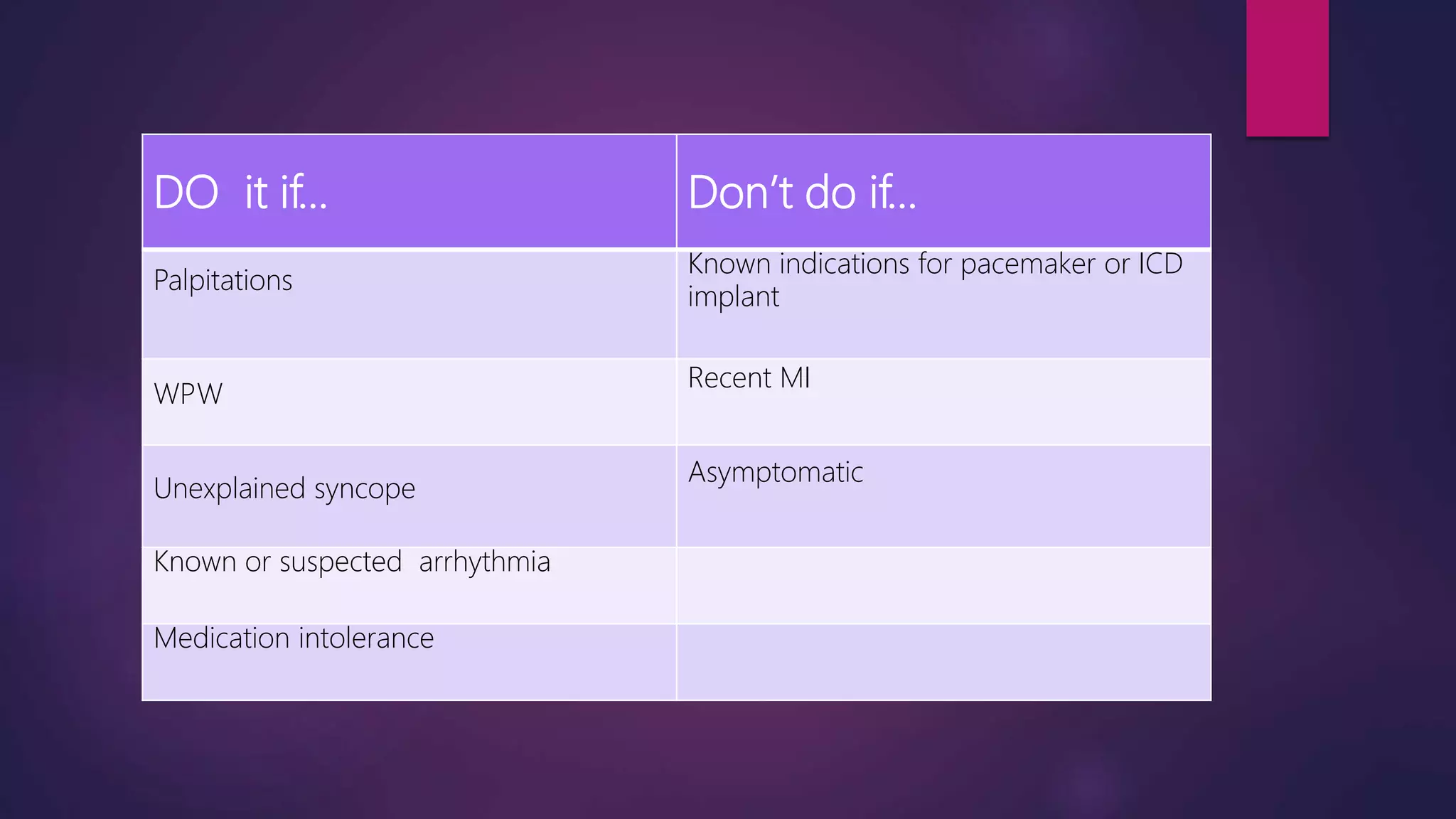
DO it if… Don’t do if…
Palpitations
Known indications for pacemaker or ICD
implant
WPW
Recent MI
Unexplained syncope
Asymptomatic
Known or suspected arrhythmia
Medication intolerance
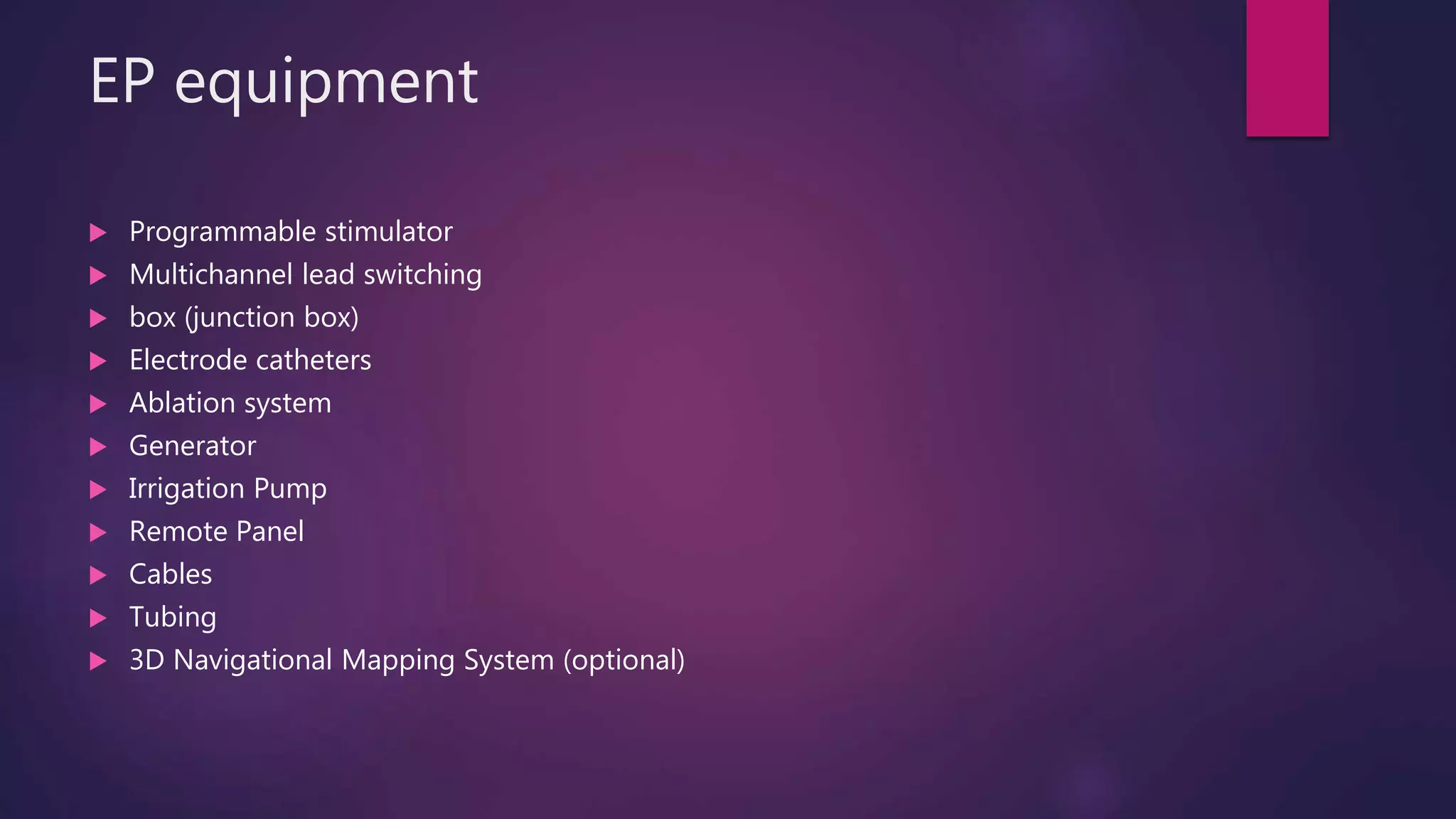
EP equipment
 Programmable stimulator
 Multichannel lead switching
 box (junction box)
 Electrode catheters
 Ablation system
 Generator
 Irrigation Pump
 Remote Panel
 Cables
 Tubing
 3D Navigational Mapping System (optional)
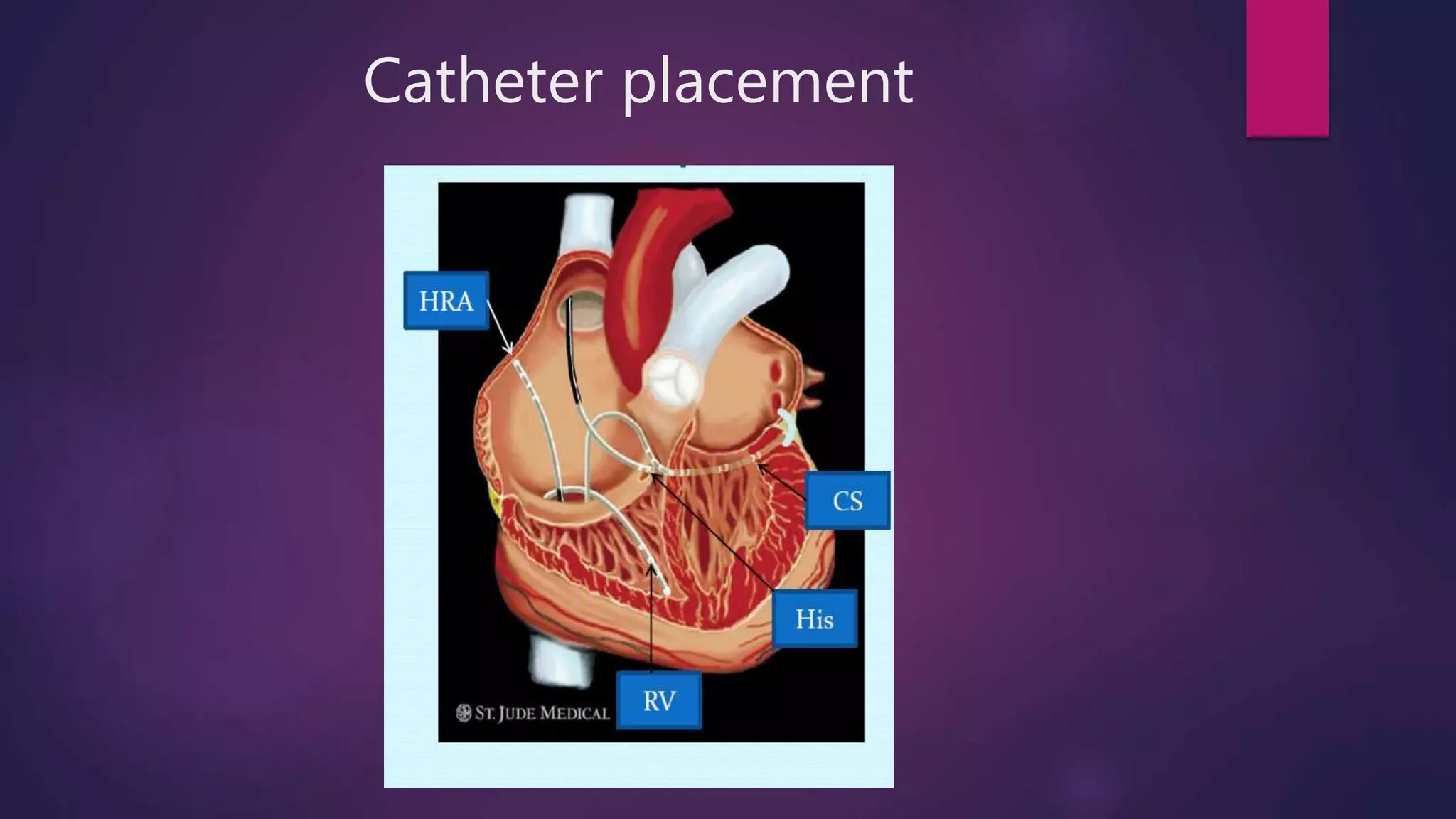
Catheter placement
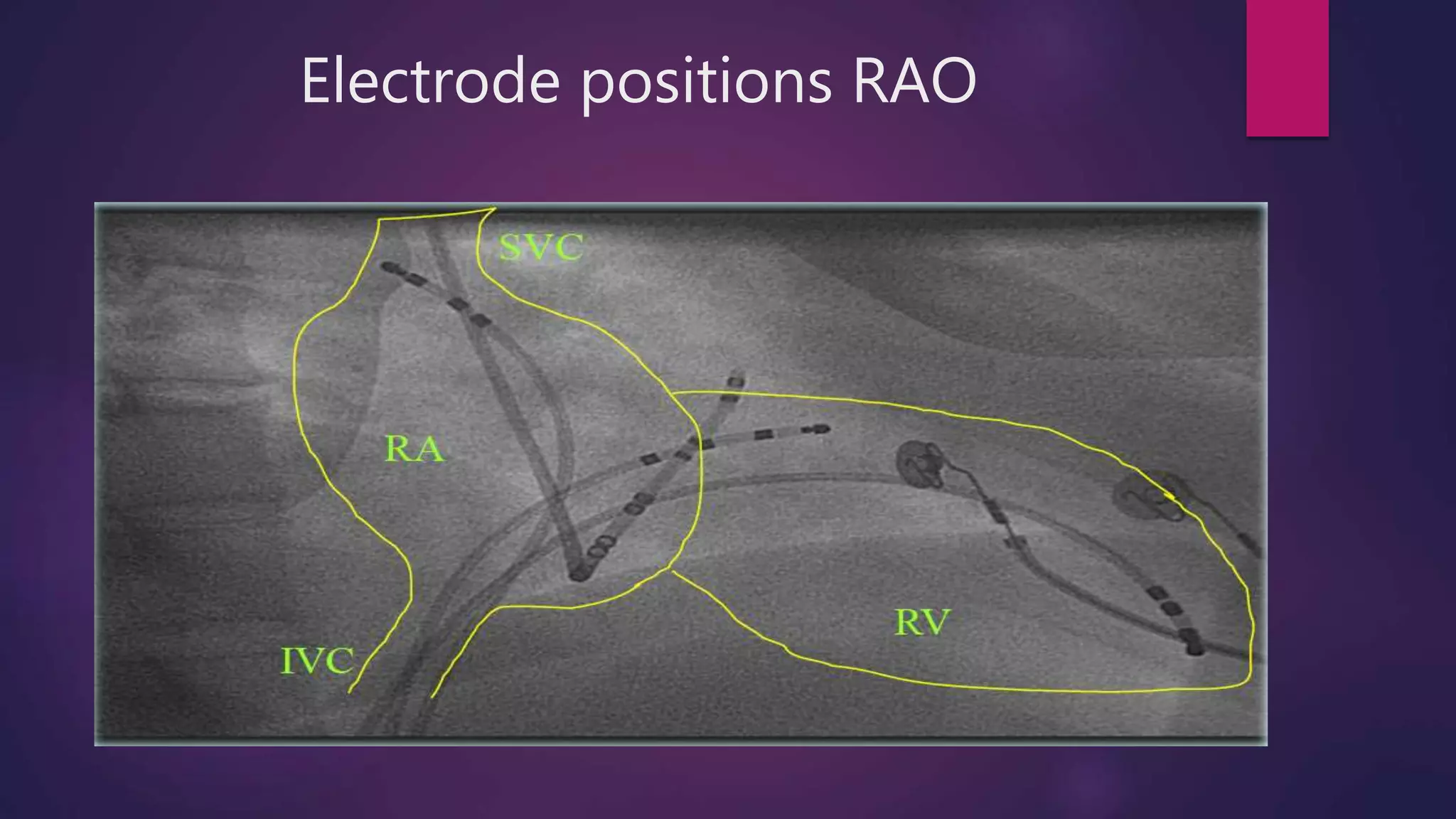
Electrode positions RAO
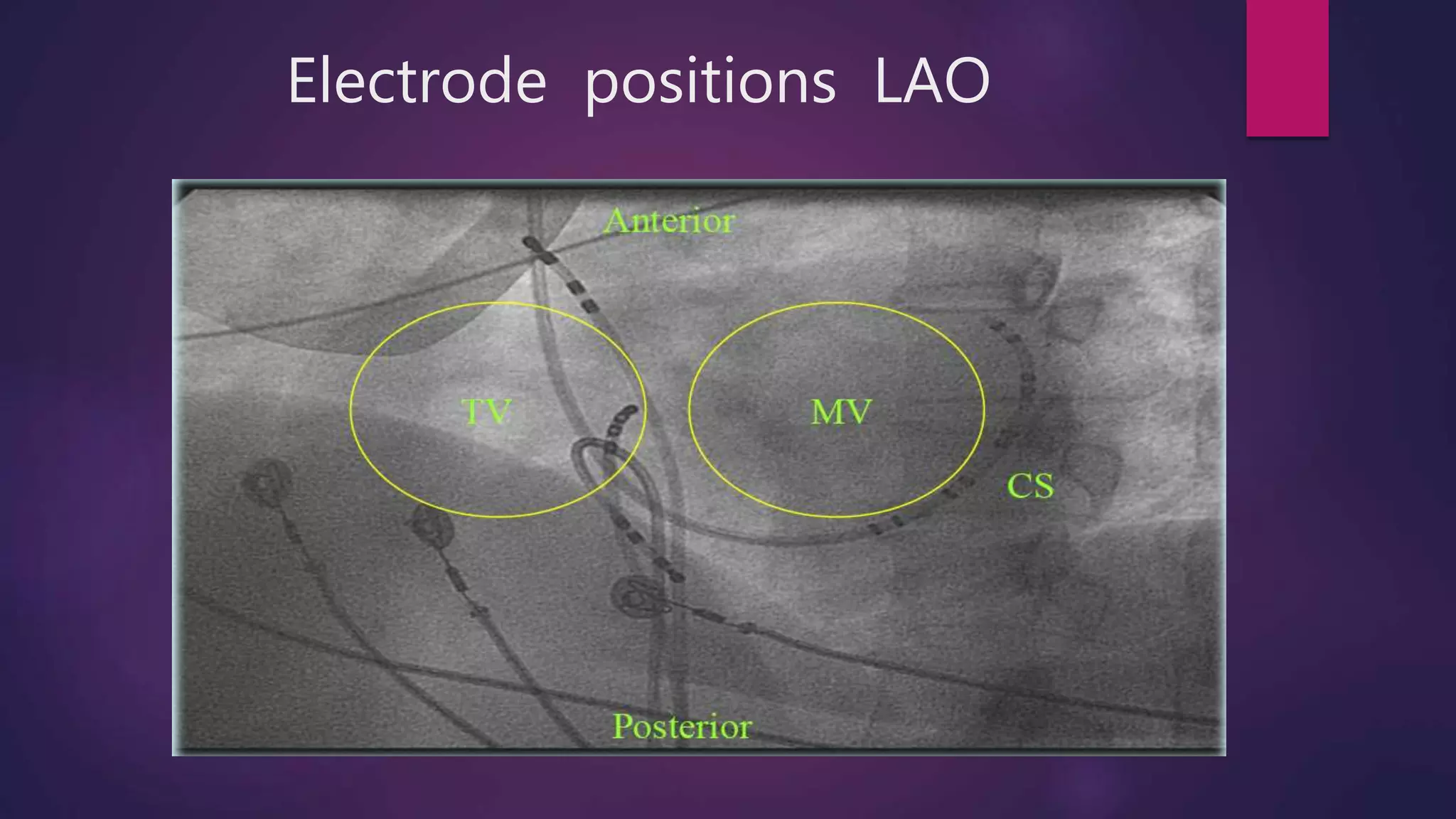
Electrode positions LAO
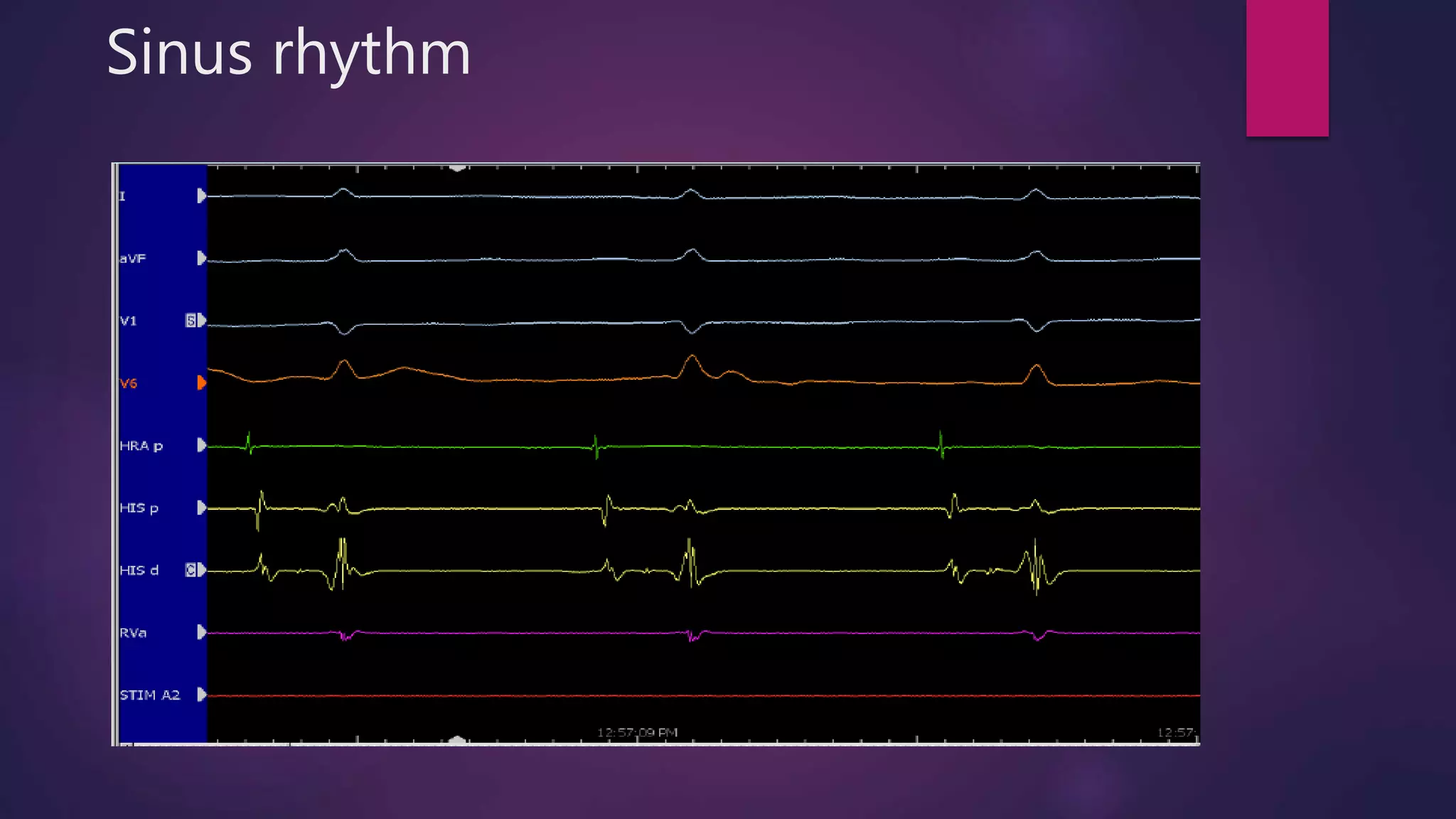
Sinus rhythm
Basic intervals
 AH interval
 Time taken to travel over the AVN
 Measured from the atrial EGM to the onset of the HIS EGM
 Normal = 55 – 125ms
 HV interval
 Time taken to travel through the His-Purkinje system
 Measured from the onset of the HIS EGM to the earliest ventricular activation in any lead
 Normal = 35 – 55ms
Pacing in EP
Programmed electrical stimulation (PES) is used:
 To assess refractory periods, conduction properties and automaticity
 To evaluate inducibility of those patients who have an indication for EPS
 To characterise arrhythmia and assist in choice of therapy
 For the purpose of mapping and ablation
 To evaluate efficacy of treatment
 To evaluate success of treatment
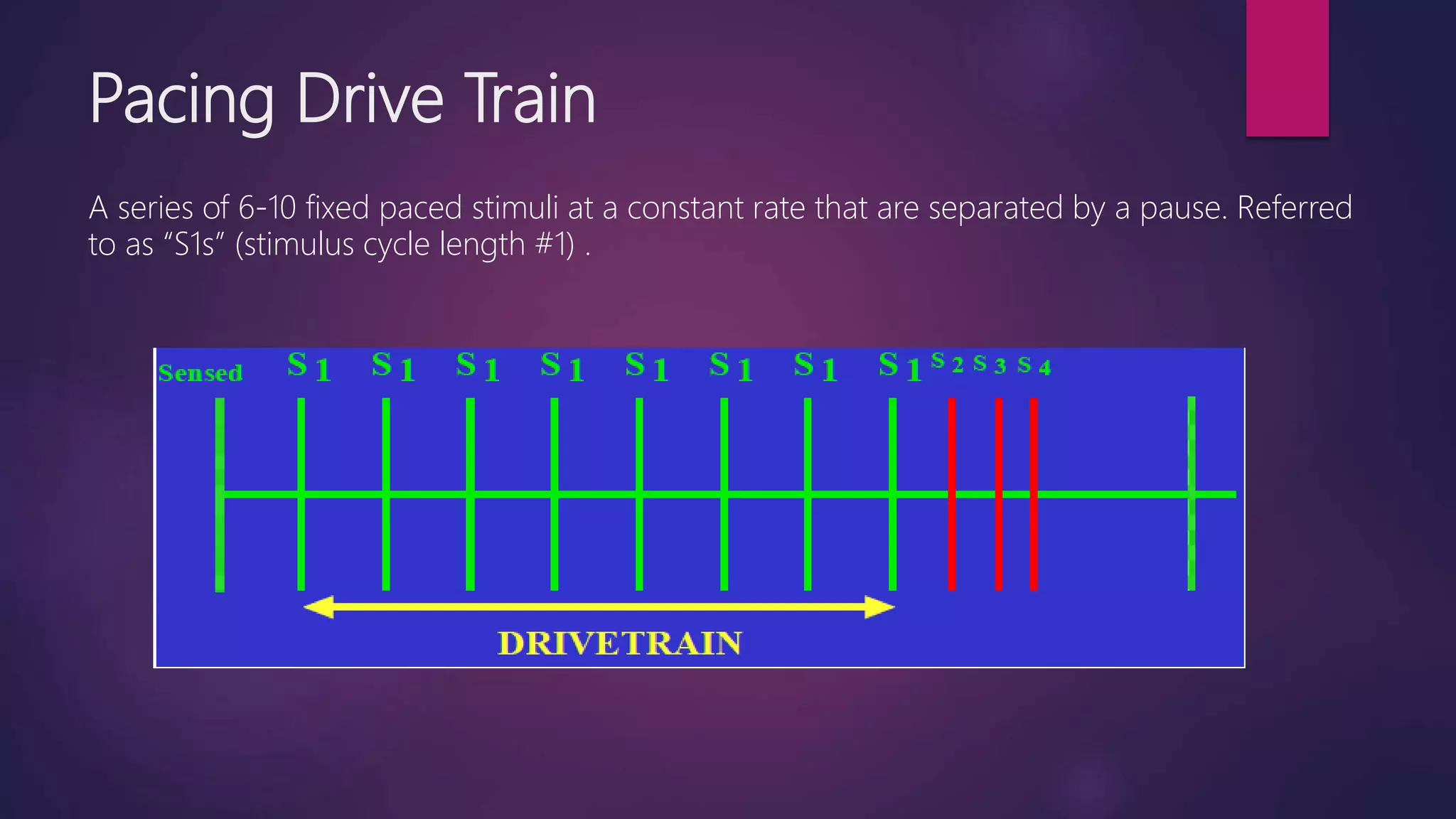
Pacing Drive Train
A series of 6-10 fixed paced stimuli at a constant rate that are separated by a pause. Referred
to as “S1s” (stimulus cycle length #1) .
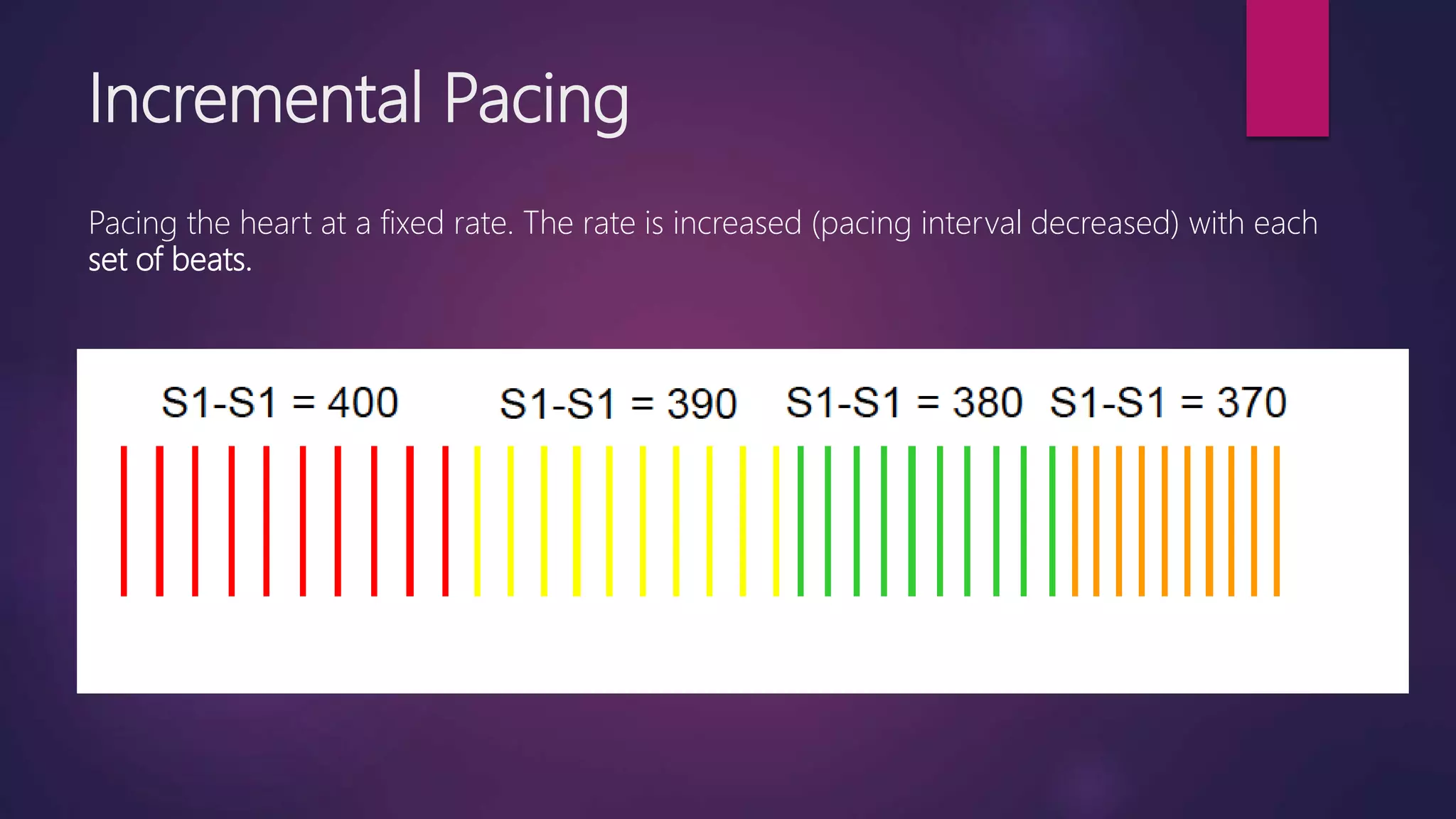
Incremental Pacing
Pacing the heart at a fixed rate. The rate is increased (pacing interval decreased) with each
set of beats.
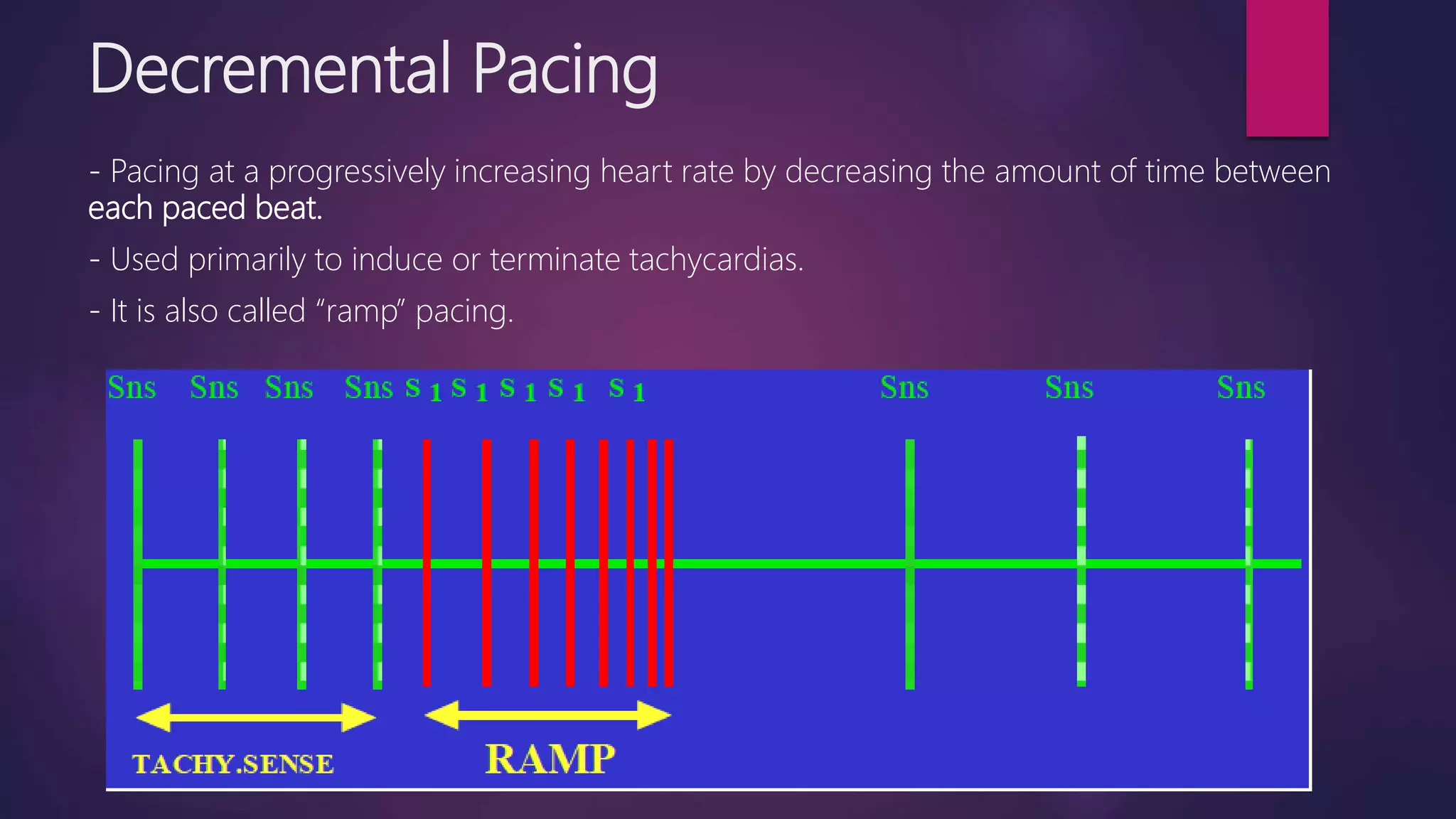
Decremental Pacing
- Pacing at a progressively increasing heart rate by decreasing the amount of time between
each paced beat.
- Used primarily to induce or terminate tachycardias.
- It is also called “ramp” pacing.
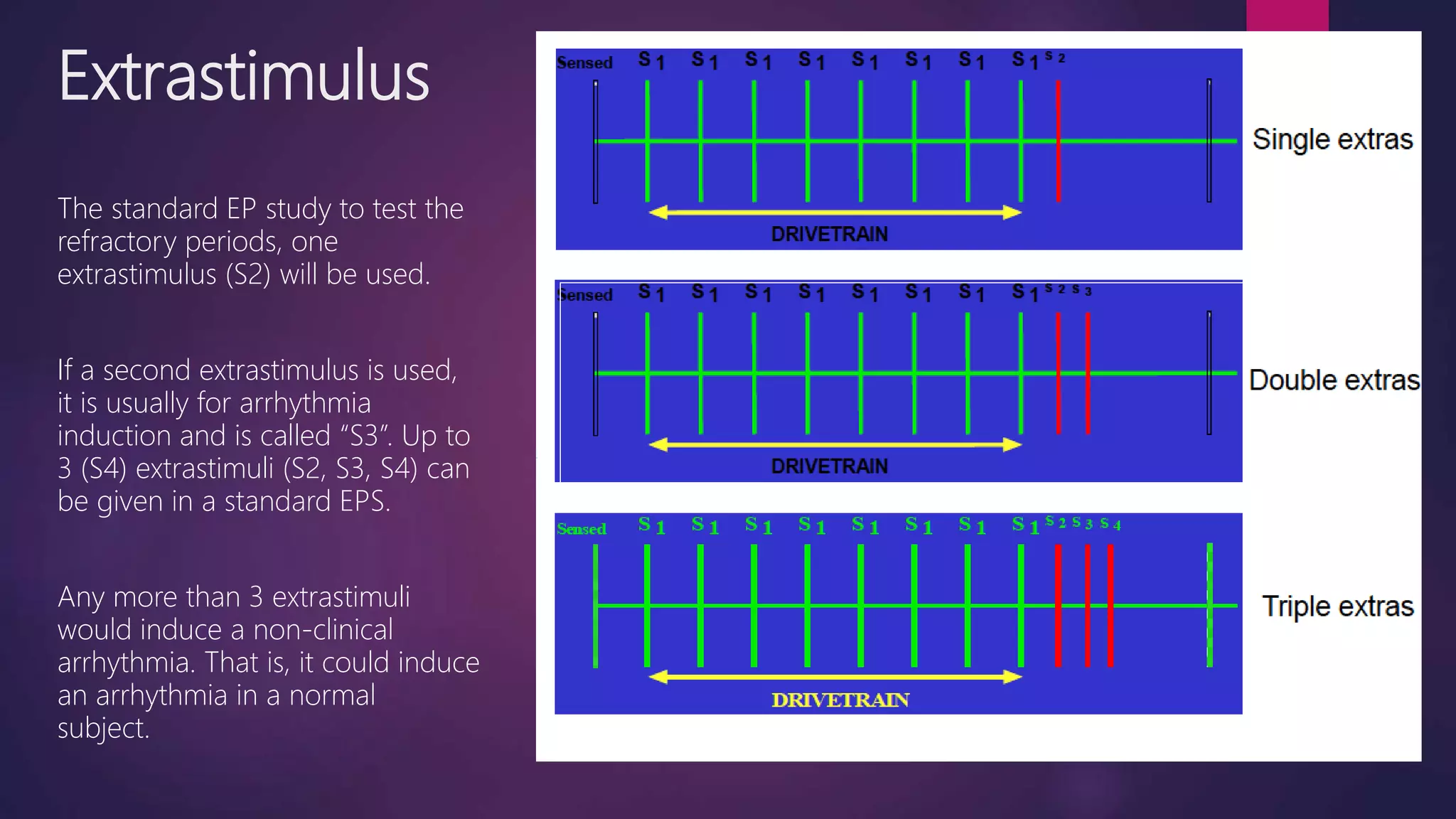
Extrastimulus
The standard EP study to test the
refractory periods, one
extrastimulus (S2) will be used.
If a second extrastimulus is used,
it is usually for arrhythmia
induction and is called “S3”. Up to
3 (S4) extrastimuli (S2, S3, S4) can
be given in a standard EPS.
Any more than 3 extrastimuli
would induce a non-clinical
arrhythmia. That is, it could induce
an arrhythmia in a normal
subject.
Typical Pacing Protocols
 Right Atrial Straight (Incremental) Pacing
 Decremental Atrial Pacing
 Programmed Atrial Stimuli with Atrial Extrastimuli
 Right Ventricular Straight (Incremental) Pacing
 Decremental Ventricular Pacing
 Programmed Ventricular Pacing with Single, Double and Triple Extrastimuli
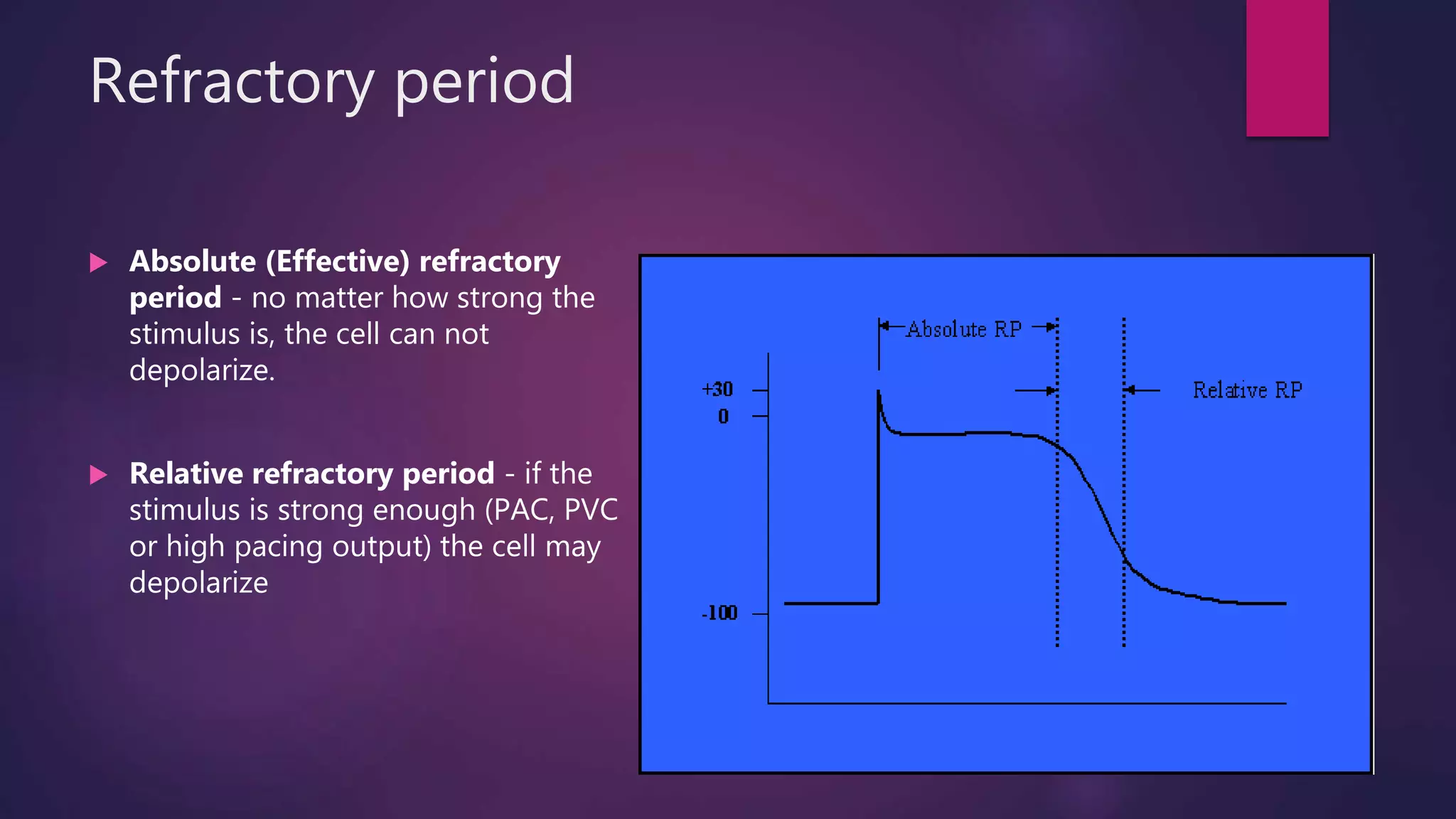
Refractory period
 Absolute (Effective) refractory
period - no matter how strong the
stimulus is, the cell can not
depolarize.
 Relative refractory period - if the
stimulus is strong enough (PAC, PVC
or high pacing output) the cell may
depolarize
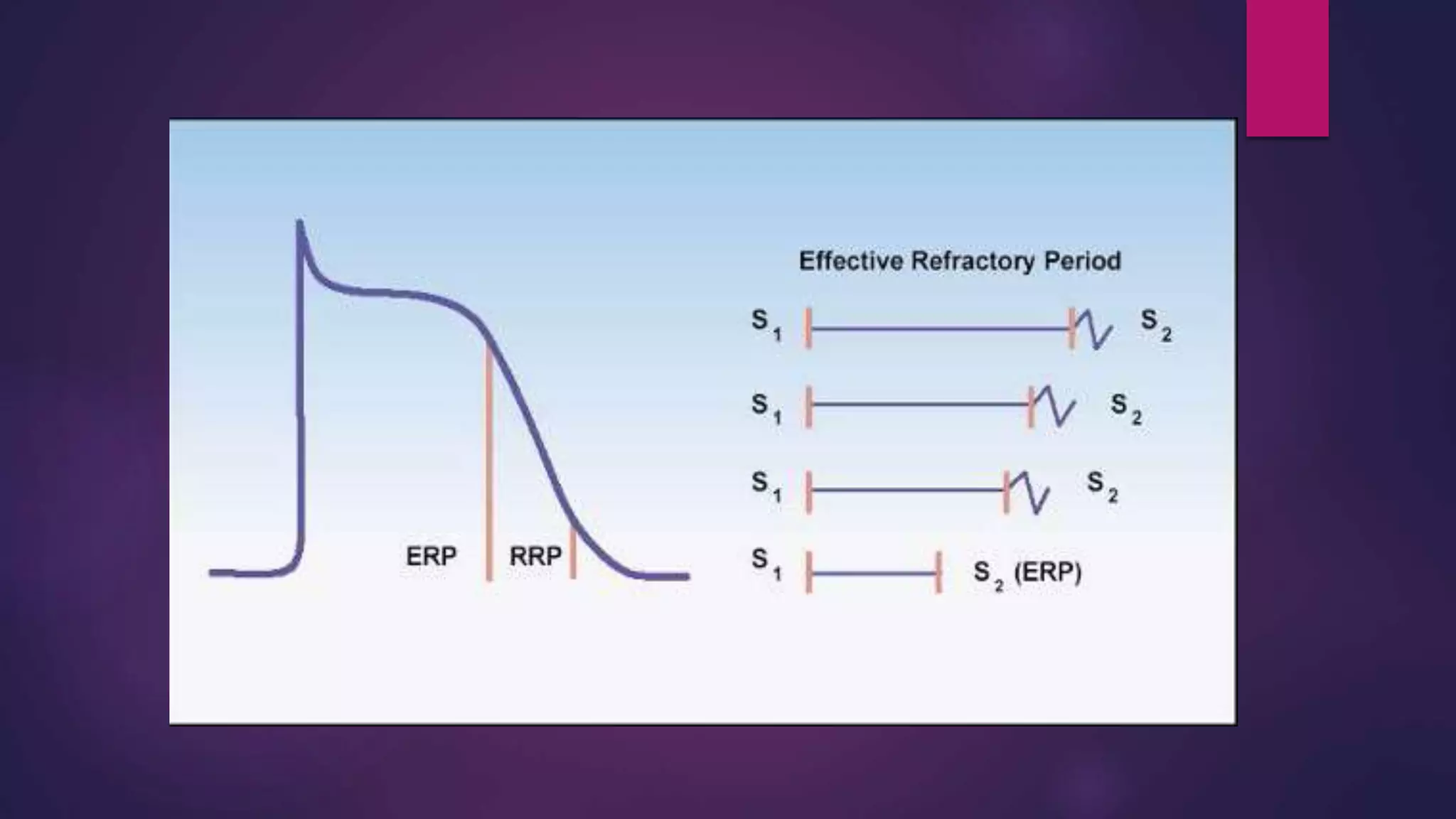
Premature impulses are used to measure refractory periods of cardiac tissue.
Effective refractory period (ERP) – Phase 2 - longest coupling interval that a premature impulse fails
to propagate through cardiac tissue = Absolute refractory period
 Cardiac cells cannot be depolarized during the ERP
 Coupling interval – time between the last paced impulse and premature impulse.
 Relative refractory period (RRP) – time from the end of the ERP to the beginning of Phase 4
(Phases 3 & 4) – longest coupling interval that a premature impulse results in slow conduction.
when cells can be depolarized again with a strong enough stimulus.
 If a cardiac cell is stimulated during the RRP, the resulting action potential has a slower Phase 0 slope and the
impulse propagates at a slower conduction velocity.
 Functional refractory period (FRP) – shortest time between 2 successive conducted impulses (time
when cells can be depolarized again - usually used to describe AV node function). The shortest
output of any given input.
AV Node Conduction (Refractory)
There are 2 main plots used to show the conduction properties obtained during programmed
stimulation:
 A1-A2 versus H1-H2 and V1-V2.
 This gives an assessment of the FRP of the AV conduction system.
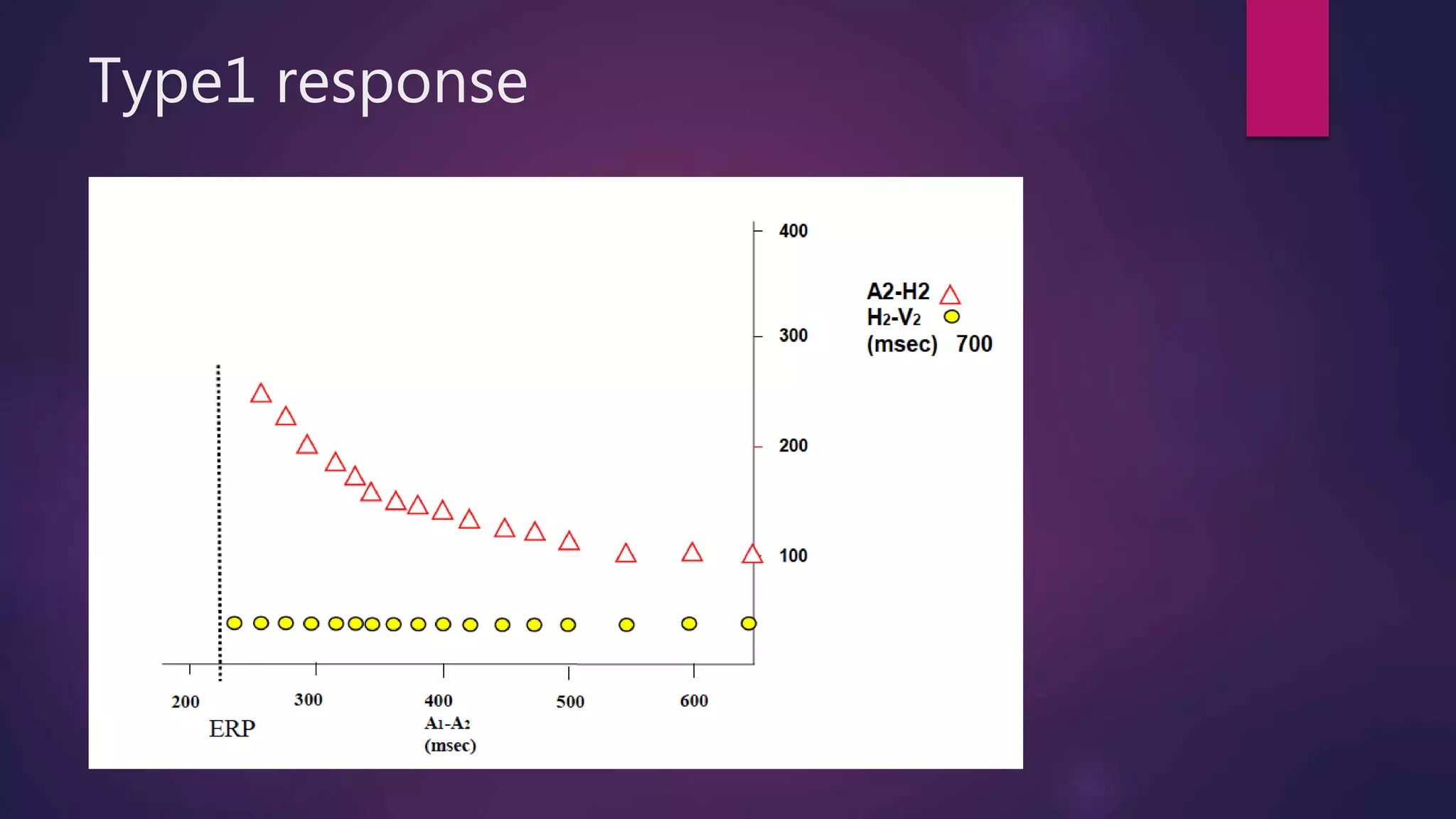
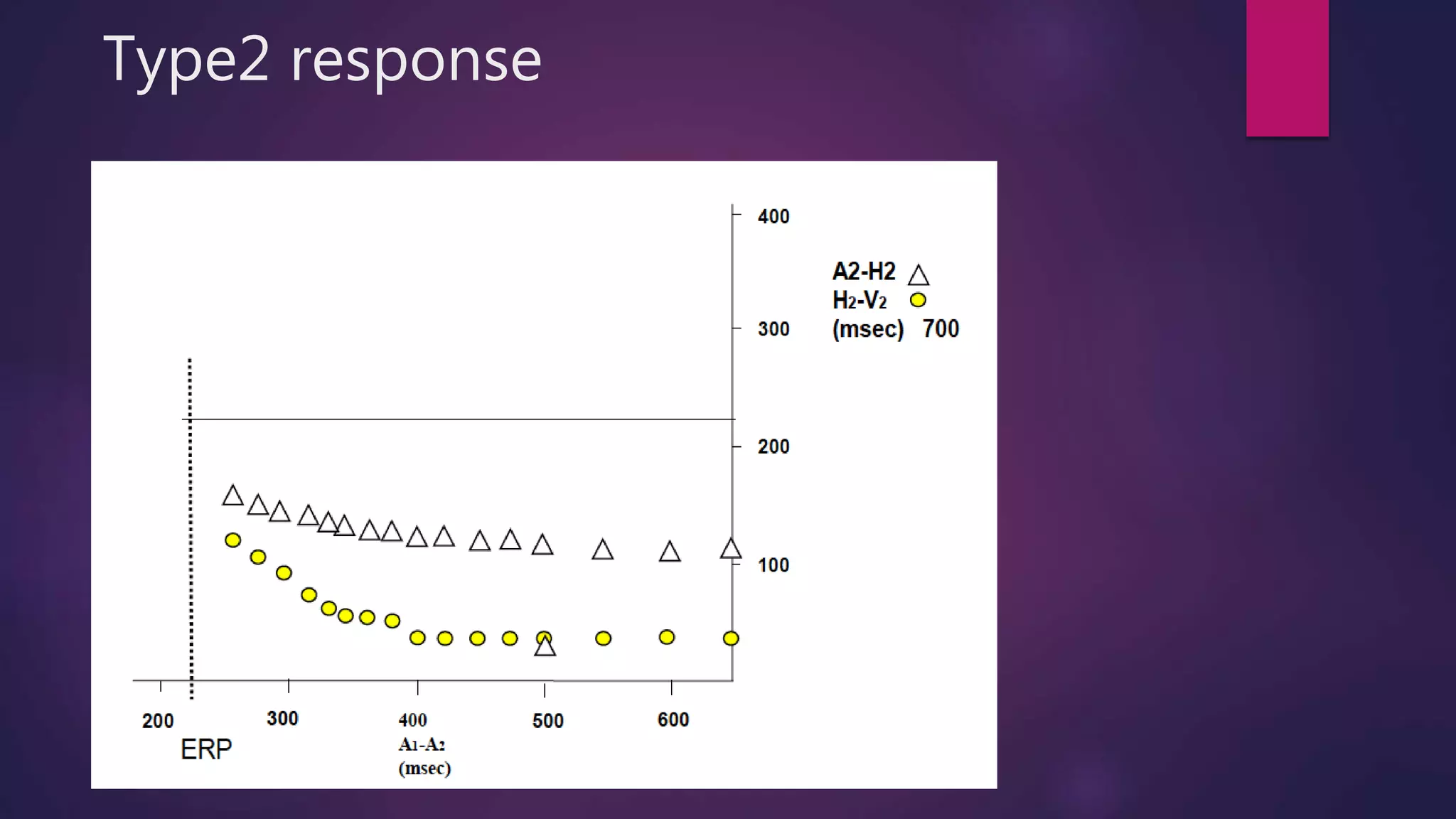
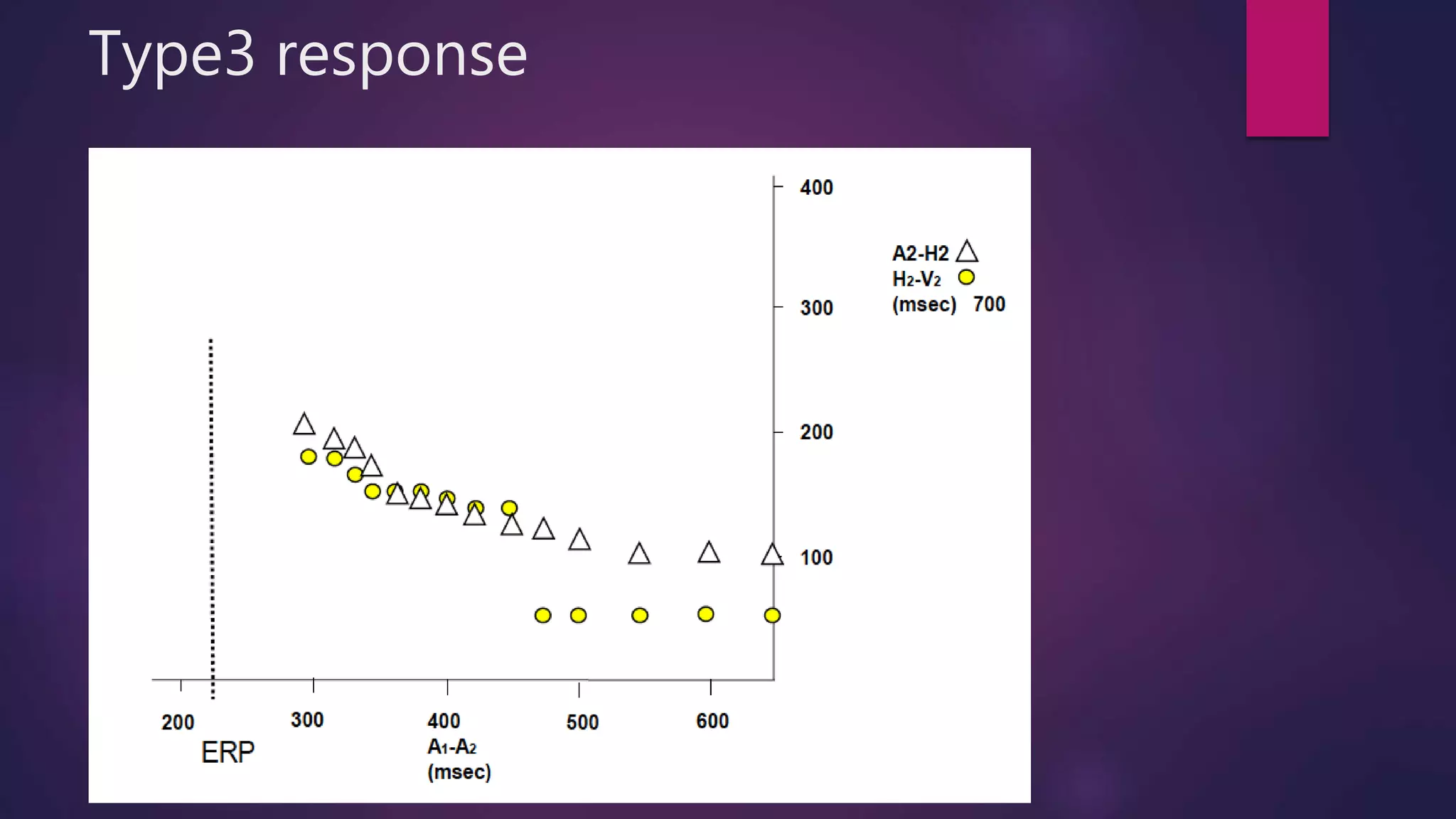
 A1-A2 versus A2-H2 and H2-V2.
 Allows to actually determine conduction times through the AV conduction system.
Response to Atrial Extrastimuli
There are 3 main patterns of the response to atrial stimuli:
Type I
– Progressively greater delay in the AV node without any change in the infranodal (His-Purkinje) conduction.
– Thus, the AH interval prolongs, but the HV interval does not. Block will occur in the AV node or the atrium.
Type II
– Delay is initially noted in the AV node, but at shorter coupling intervals (S1-S2), delay is noted in the His-
Purkinje system. However, block still usually occurs in the AV node first, but may occur in the atrium or occasionally
in the His-Purkinje system.
Type III
– Least common and initially conduction slows in the AV node, but at a critical S1-S2, a sudden and marked
prolongation occurs in the HV interval (His-Purkinje system). Block first occurs in the His-Purkinje system.
Type1 response
Type2 response
Type3 response
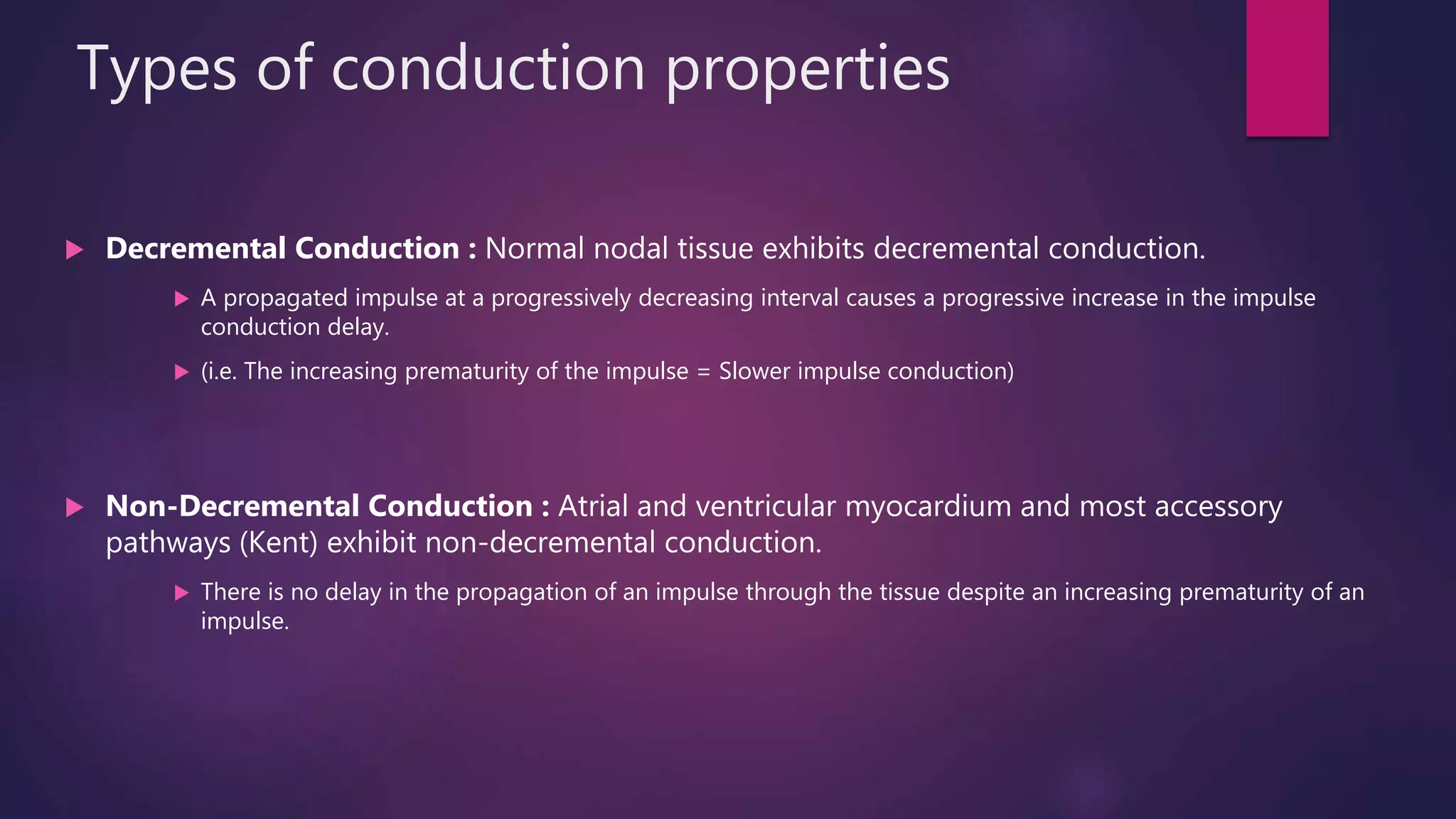
Types of conduction properties
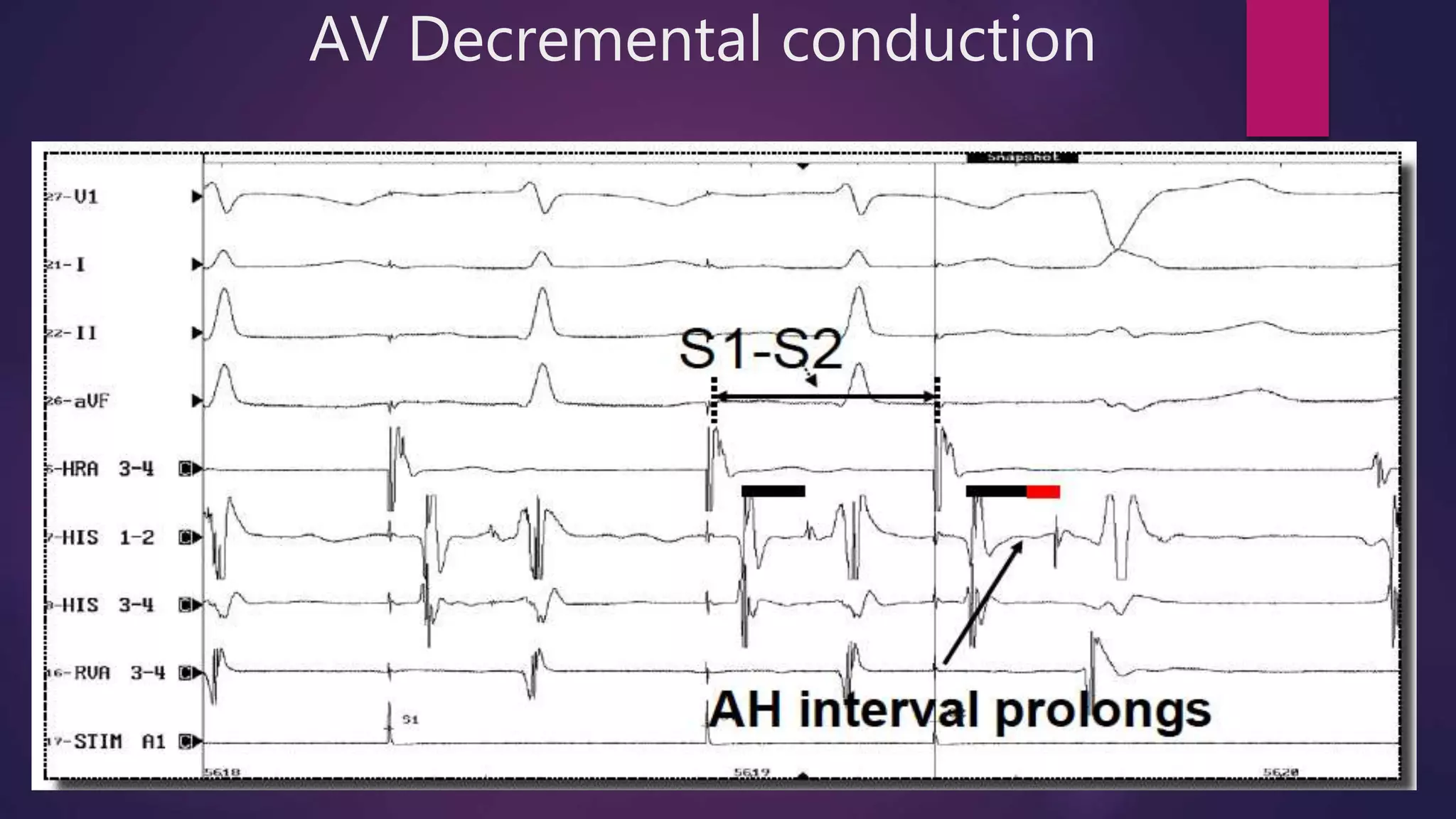
 Decremental Conduction : Normal nodal tissue exhibits decremental conduction.
 A propagated impulse at a progressively decreasing interval causes a progressive increase in the impulse
conduction delay.
 (i.e. The increasing prematurity of the impulse = Slower impulse conduction)
 Non-Decremental Conduction : Atrial and ventricular myocardium and most accessory
pathways (Kent) exhibit non-decremental conduction.
 There is no delay in the propagation of an impulse through the tissue despite an increasing prematurity of an
impulse.
AV Decremental conduction
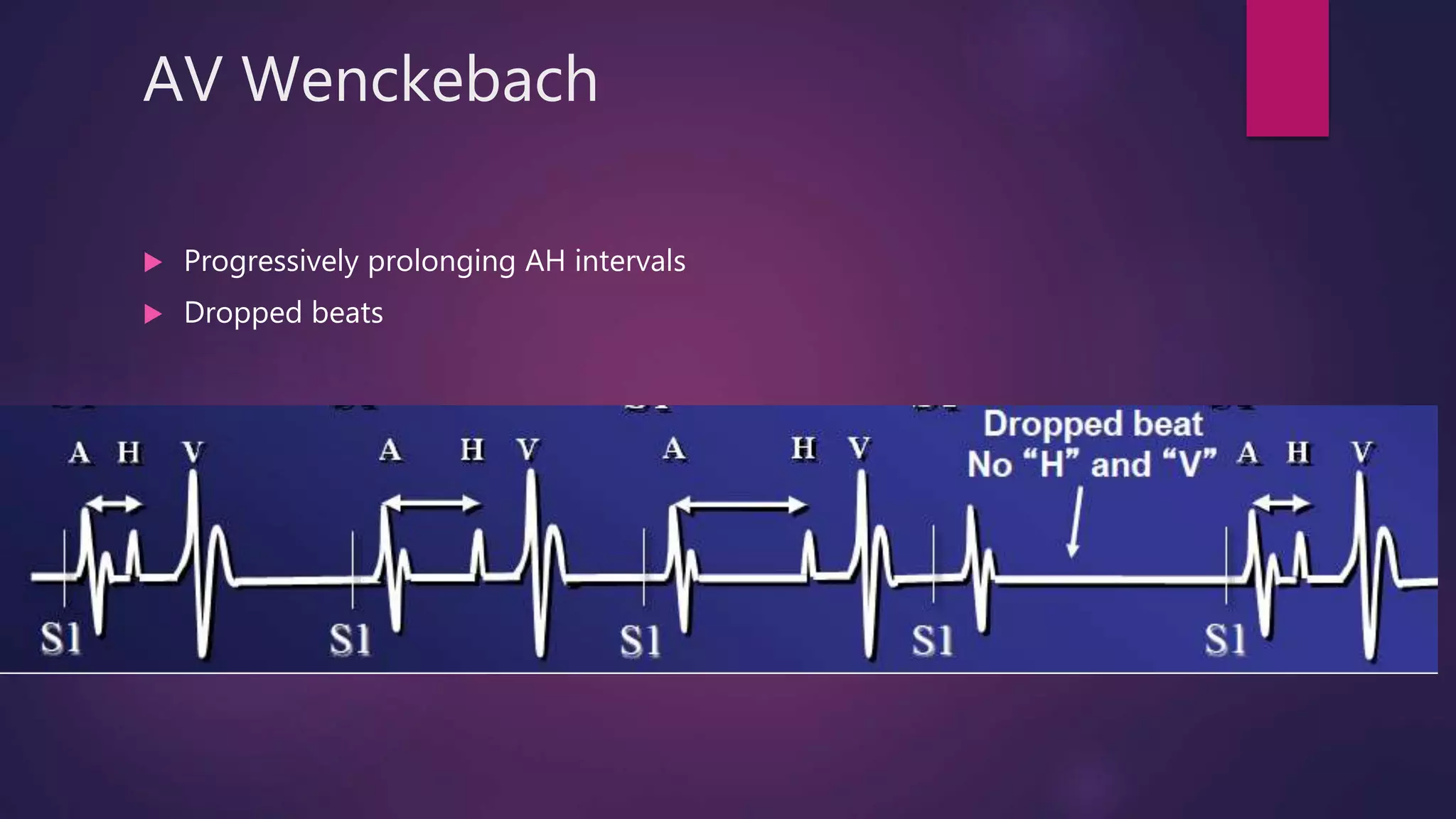
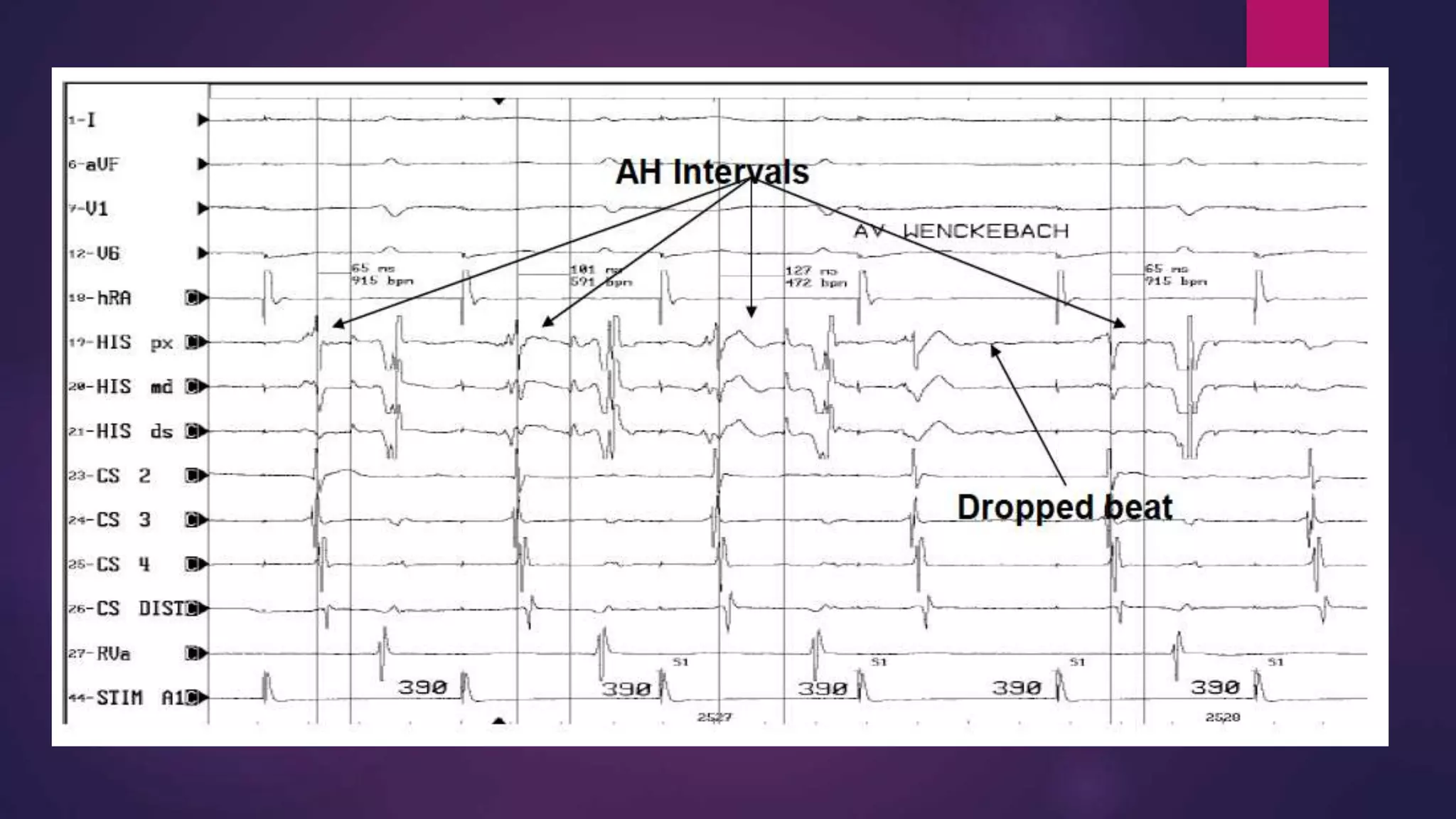
AV Wenckebach
 Progressively prolonging AH intervals
 Dropped beats
RRP
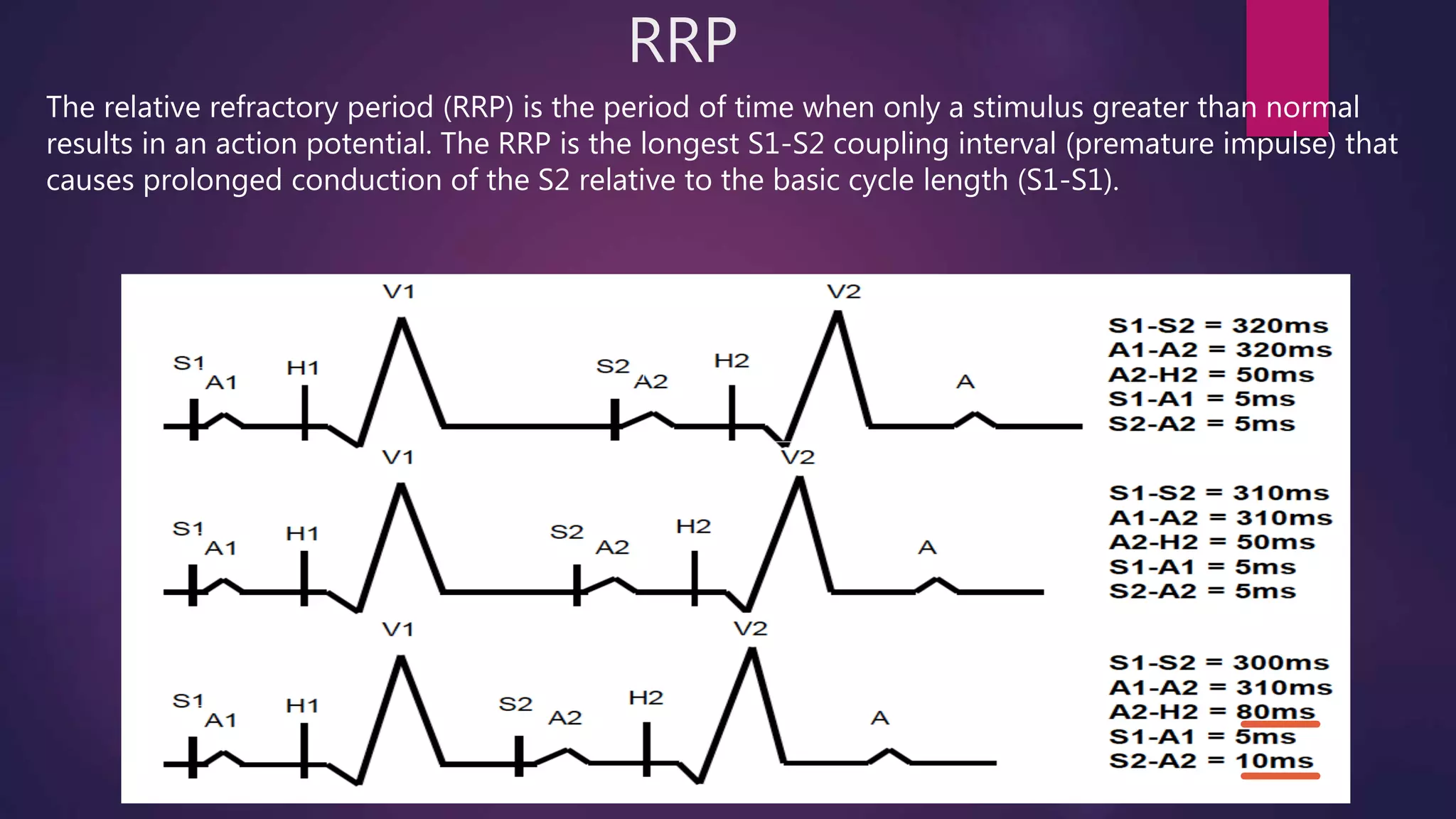
The relative refractory period (RRP) is the period of time when only a stimulus greater than normal
results in an action potential. The RRP is the longest S1-S2 coupling interval (premature impulse) that
causes prolonged conduction of the S2 relative to the basic cycle length (S1-S1).
Determination of the Relative
Refractory Period
Antegrade Relative Refractory Periods
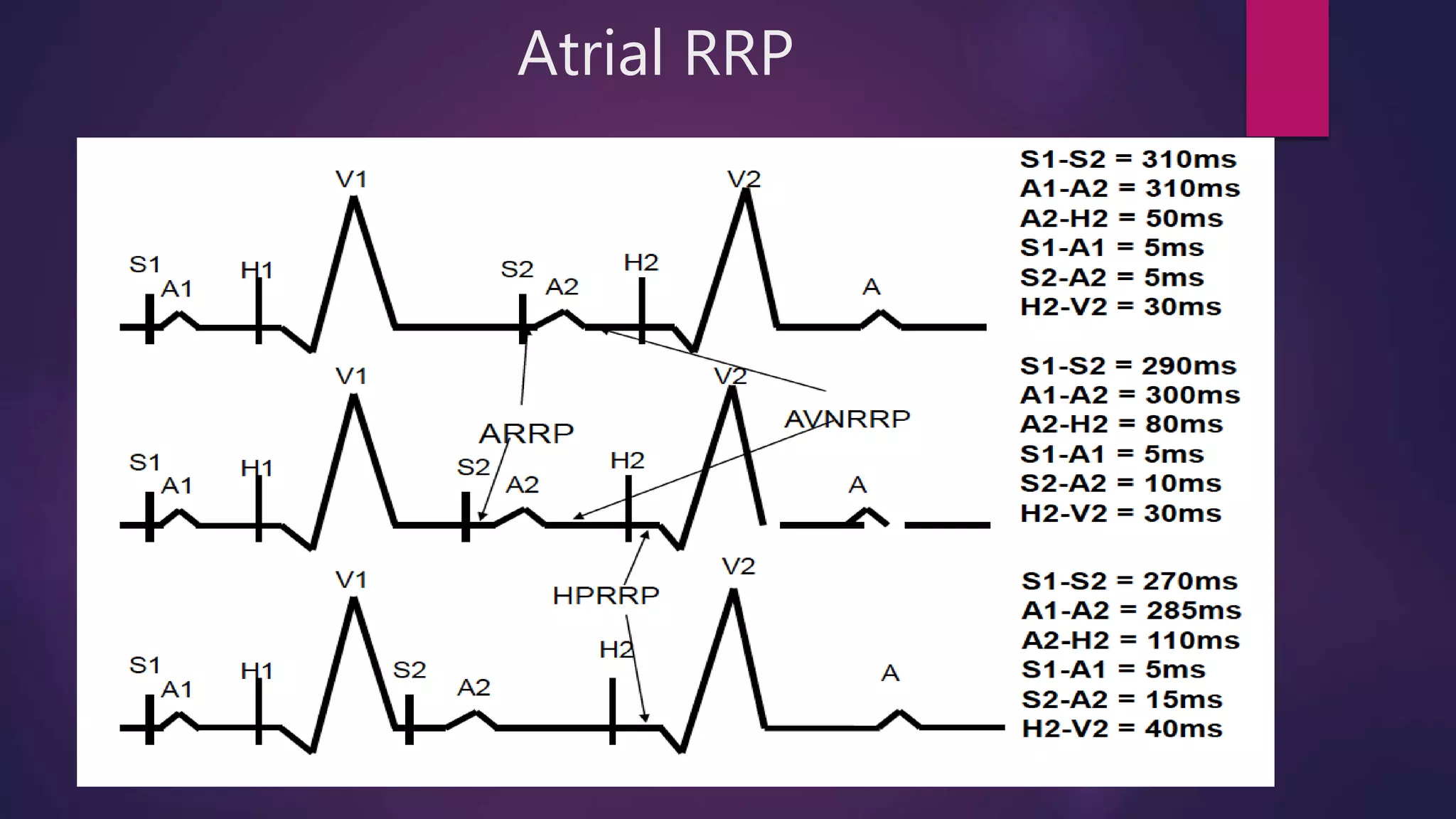
Atrial RRP or ARRP:
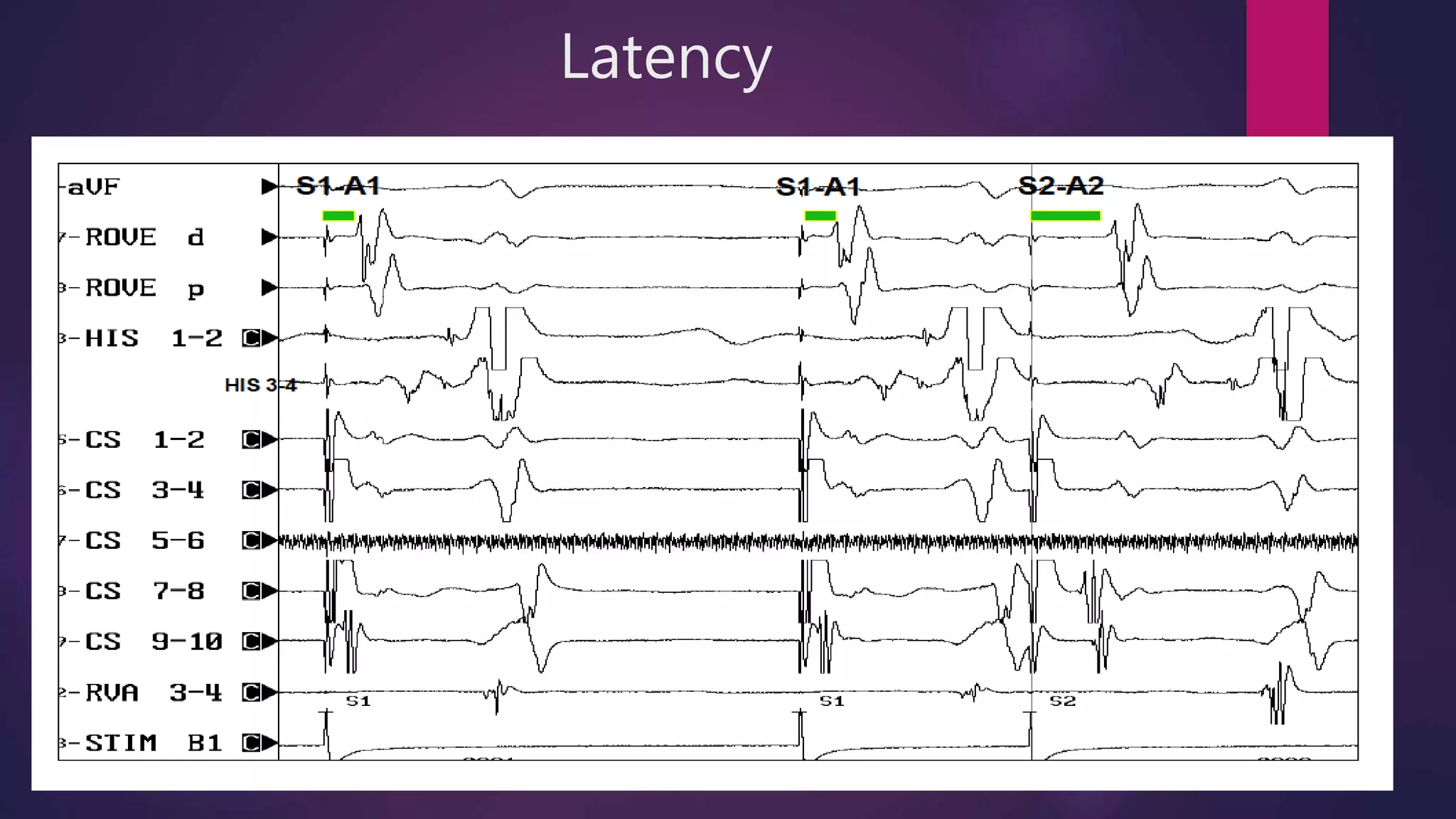
 The longest S1 - S2 interval at which the S2-A2 interval exceeds the S1-A1. This is called latency. (-
ms)
Atrioventricular Nodal RRP or AVNRRP:
 The longest A1 - A2 at which the A2-H2 interval exceeds the A1-H1. (-ms)
His Purkinje System RRP or HPRRP:
 The longest H1 - H2 at which the H2-V2 interval exceeds the H1-V1 or results in an aberrant QRS
complex. (-ms)
Atrial RRP
Latency
Retrograde Relative Refractory Periods
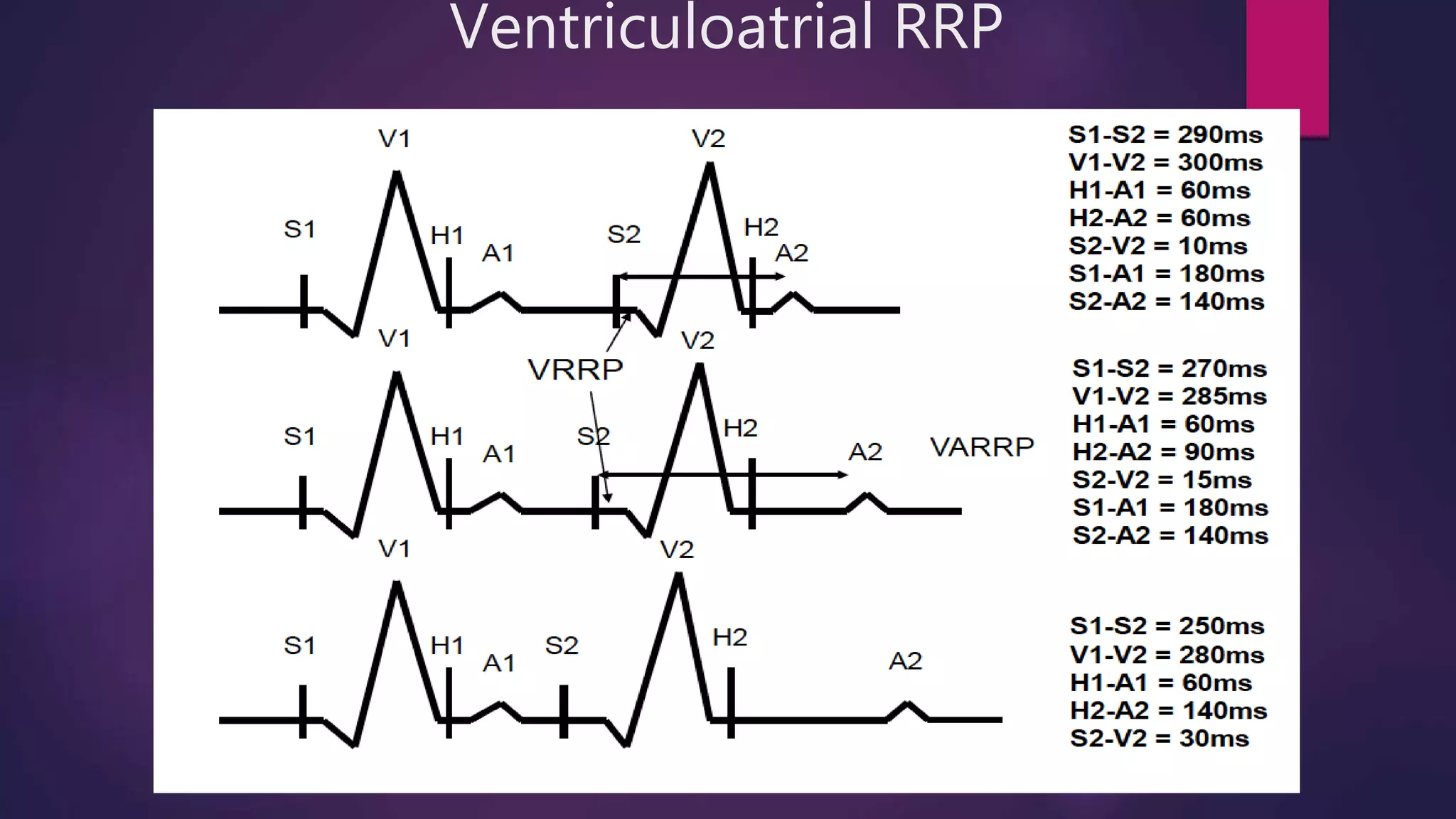
Ventricular RRP or VRRP:
 The longest S1 - S2 interval at which the S2-V2 interval exceeds the S1-V1. This is called
latency. (-ms)
Ventriculoatrial RRP or VARRP:
 The longest S1 - S2 interval at which the S2-A2 interval exceeds the S1-A1. (-ms)
Ventriculoatrial RRP
Determination of the Functional
Refractory Period
Thanks
To be continued

Basic EP study (part1)

  • 1.
    BASIC EP STUDY SAKHANSOLIDA, MD Cardiologist , ESC, EHRA and ACC member Preah Kossamak Hospital Part-1
  • 2.
    Introduction Electrophysiology...  Is thestudy of the heart’s electrical system  Assesses the function of each component of cardiac conduction  Determines the potential for a patient to have an arrhythmia  Determines the mechanism of an arrhythmia  Evaluates the need for treatment/ therapy
  • 3.
    The role ofEP study in the diagnosis and treatment of cardiac arrhythmias :  To characterise physiological and pathological properties of the atria, ventricles and the atrioventricular conduction system.  To identify accessory pathways, and determine the sites and mechanisms of arrhythmias.  To correlate patient symptoms with arrhythmias and evaluate risks for life threatening events and/or differentiate arrhythmias.  To define arrhythmia induction and termination methods for EPS  Guided interventions : i.e. Medications, anti-tachycardia pacing, antiarrhythmic, ICD’s, ablation or modification.
  • 4.
    Class I (EPstudy is indicated)  Patients not tolerating or not responding to medications  Narrow QRS tachycardia preferring ablative therapy  Sustained wide QRS complex tachycardia  An accessory pathway tachycardia that is symptomatic and may require ablative therapy  Unexplained syncope and known structural heart disease.  Palpitations and documented inappropriate rapid pulse rates without apparent cause.
  • 5.
    Class II (EPstudy may be indicated)  Sinus node dysfunction - to exclude other arrhythmic causes or assess the severity or mechanism of dysfunction and drug response to direct therapy.  Second or third degree AV block to determine the site or mechanism of the block in order to direct therapy.  Symptomatic patients with bundle branch block to assess the site and severity of the conduction delay in order to direct therapy and evaluate prognosis.  Patients with premature ventricular complexes and unexplained pre-syncope or syncope.
  • 6.
    Class III (EPstudy is not indicated)  Symptomatic patients with sinus node dysfunction with ECG documentation of a bradyarrhythmic cause  Asymptomatic patients with nocturnal bradycardia  Patients with congenital or acquired long QT syndrome with symptoms related to an identifiable cause or mechanism  Patients with a known cause of syncope  Patients with cardiac arrest occurring only within the first 48 hrs of AMI
  • 7.
    DO it if…Don’t do if… Palpitations Known indications for pacemaker or ICD implant WPW Recent MI Unexplained syncope Asymptomatic Known or suspected arrhythmia Medication intolerance
  • 8.
    EP equipment  Programmablestimulator  Multichannel lead switching  box (junction box)  Electrode catheters  Ablation system  Generator  Irrigation Pump  Remote Panel  Cables  Tubing  3D Navigational Mapping System (optional)
  • 9.
  • 10.
  • 11.
  • 12.
  • 13.
    Basic intervals  AHinterval  Time taken to travel over the AVN  Measured from the atrial EGM to the onset of the HIS EGM  Normal = 55 – 125ms  HV interval  Time taken to travel through the His-Purkinje system  Measured from the onset of the HIS EGM to the earliest ventricular activation in any lead  Normal = 35 – 55ms
  • 14.
    Pacing in EP Programmedelectrical stimulation (PES) is used:  To assess refractory periods, conduction properties and automaticity  To evaluate inducibility of those patients who have an indication for EPS  To characterise arrhythmia and assist in choice of therapy  For the purpose of mapping and ablation  To evaluate efficacy of treatment  To evaluate success of treatment
  • 15.
    Pacing Drive Train Aseries of 6-10 fixed paced stimuli at a constant rate that are separated by a pause. Referred to as “S1s” (stimulus cycle length #1) .
  • 16.
    Incremental Pacing Pacing theheart at a fixed rate. The rate is increased (pacing interval decreased) with each set of beats.
  • 17.
    Decremental Pacing - Pacingat a progressively increasing heart rate by decreasing the amount of time between each paced beat. - Used primarily to induce or terminate tachycardias. - It is also called “ramp” pacing.
  • 18.
    Extrastimulus The standard EPstudy to test the refractory periods, one extrastimulus (S2) will be used. If a second extrastimulus is used, it is usually for arrhythmia induction and is called “S3”. Up to 3 (S4) extrastimuli (S2, S3, S4) can be given in a standard EPS. Any more than 3 extrastimuli would induce a non-clinical arrhythmia. That is, it could induce an arrhythmia in a normal subject.
  • 19.
    Typical Pacing Protocols Right Atrial Straight (Incremental) Pacing  Decremental Atrial Pacing  Programmed Atrial Stimuli with Atrial Extrastimuli  Right Ventricular Straight (Incremental) Pacing  Decremental Ventricular Pacing  Programmed Ventricular Pacing with Single, Double and Triple Extrastimuli
  • 20.
    Refractory period  Absolute(Effective) refractory period - no matter how strong the stimulus is, the cell can not depolarize.  Relative refractory period - if the stimulus is strong enough (PAC, PVC or high pacing output) the cell may depolarize
  • 21.
    Premature impulses areused to measure refractory periods of cardiac tissue. Effective refractory period (ERP) – Phase 2 - longest coupling interval that a premature impulse fails to propagate through cardiac tissue = Absolute refractory period  Cardiac cells cannot be depolarized during the ERP  Coupling interval – time between the last paced impulse and premature impulse.  Relative refractory period (RRP) – time from the end of the ERP to the beginning of Phase 4 (Phases 3 & 4) – longest coupling interval that a premature impulse results in slow conduction. when cells can be depolarized again with a strong enough stimulus.  If a cardiac cell is stimulated during the RRP, the resulting action potential has a slower Phase 0 slope and the impulse propagates at a slower conduction velocity.  Functional refractory period (FRP) – shortest time between 2 successive conducted impulses (time when cells can be depolarized again - usually used to describe AV node function). The shortest output of any given input.
  • 23.
    AV Node Conduction(Refractory) There are 2 main plots used to show the conduction properties obtained during programmed stimulation:  A1-A2 versus H1-H2 and V1-V2.  This gives an assessment of the FRP of the AV conduction system.  A1-A2 versus A2-H2 and H2-V2.  Allows to actually determine conduction times through the AV conduction system.
  • 24.
    Response to AtrialExtrastimuli There are 3 main patterns of the response to atrial stimuli: Type I – Progressively greater delay in the AV node without any change in the infranodal (His-Purkinje) conduction. – Thus, the AH interval prolongs, but the HV interval does not. Block will occur in the AV node or the atrium. Type II – Delay is initially noted in the AV node, but at shorter coupling intervals (S1-S2), delay is noted in the His- Purkinje system. However, block still usually occurs in the AV node first, but may occur in the atrium or occasionally in the His-Purkinje system. Type III – Least common and initially conduction slows in the AV node, but at a critical S1-S2, a sudden and marked prolongation occurs in the HV interval (His-Purkinje system). Block first occurs in the His-Purkinje system.

  • 25.
  • 26.
  • 27.
  • 28.
    Types of conductionproperties  Decremental Conduction : Normal nodal tissue exhibits decremental conduction.  A propagated impulse at a progressively decreasing interval causes a progressive increase in the impulse conduction delay.  (i.e. The increasing prematurity of the impulse = Slower impulse conduction)  Non-Decremental Conduction : Atrial and ventricular myocardium and most accessory pathways (Kent) exhibit non-decremental conduction.  There is no delay in the propagation of an impulse through the tissue despite an increasing prematurity of an impulse.
  • 29.
  • 30.
    AV Wenckebach  Progressivelyprolonging AH intervals  Dropped beats
  • 32.
    RRP The relative refractoryperiod (RRP) is the period of time when only a stimulus greater than normal results in an action potential. The RRP is the longest S1-S2 coupling interval (premature impulse) that causes prolonged conduction of the S2 relative to the basic cycle length (S1-S1).
  • 33.
    Determination of theRelative Refractory Period
  • 34.
    Antegrade Relative RefractoryPeriods Atrial RRP or ARRP:  The longest S1 - S2 interval at which the S2-A2 interval exceeds the S1-A1. This is called latency. (- ms) Atrioventricular Nodal RRP or AVNRRP:  The longest A1 - A2 at which the A2-H2 interval exceeds the A1-H1. (-ms) His Purkinje System RRP or HPRRP:  The longest H1 - H2 at which the H2-V2 interval exceeds the H1-V1 or results in an aberrant QRS complex. (-ms)
  • 35.
  • 36.
  • 37.
    Retrograde Relative RefractoryPeriods Ventricular RRP or VRRP:  The longest S1 - S2 interval at which the S2-V2 interval exceeds the S1-V1. This is called latency. (-ms) Ventriculoatrial RRP or VARRP:  The longest S1 - S2 interval at which the S2-A2 interval exceeds the S1-A1. (-ms)
  • 38.
  • 39.
    Determination of theFunctional Refractory Period
  • 40.