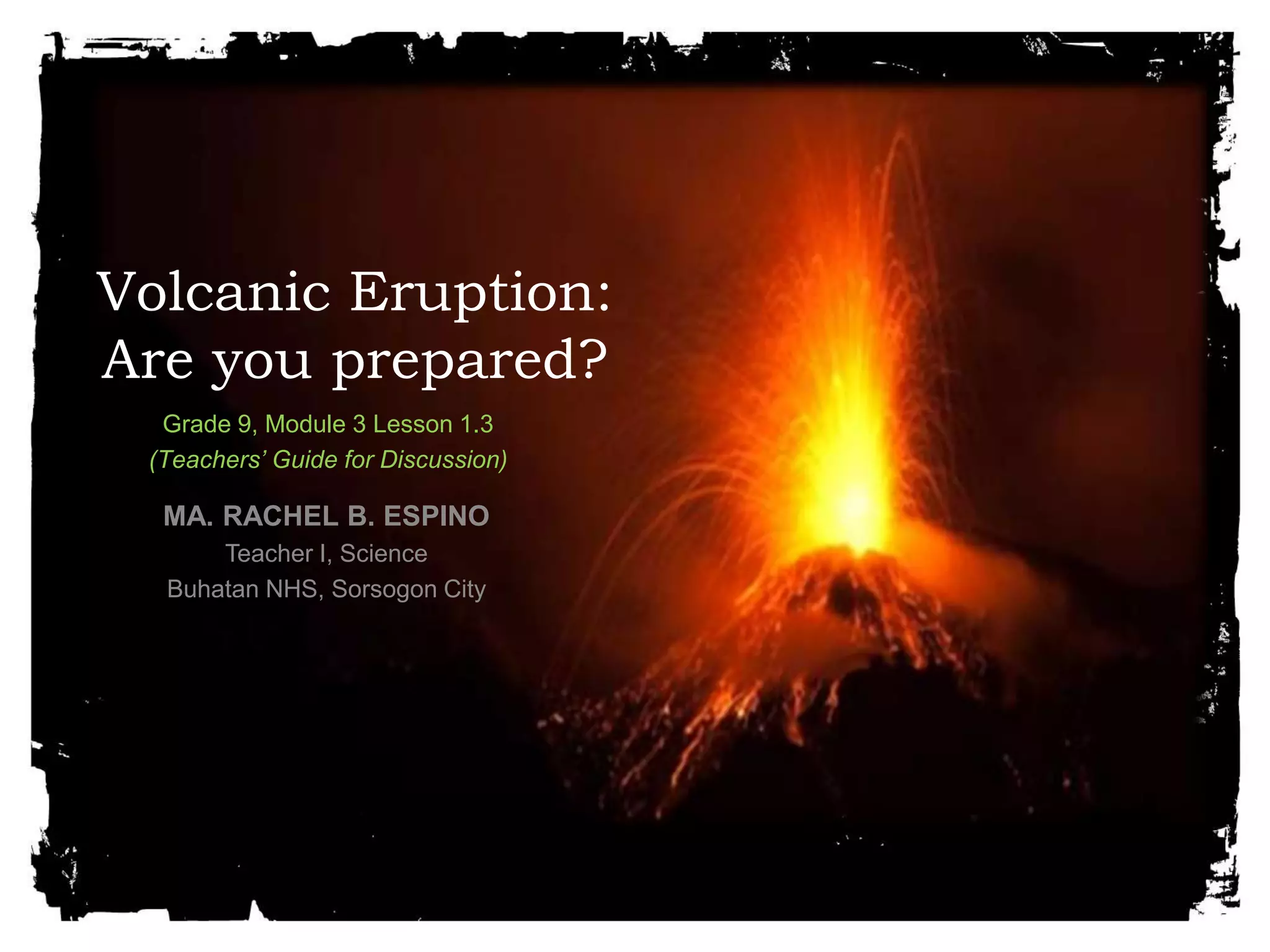
Volcanic Eruption: 
Are you prepared? 
Grade 9, Module 3 Lesson 1.3 
(Teachers’ Guide for Discussion) 
MA. RACHEL B. ESPINO 
Teacher I, Science 
Buhatan NHS, Sorsogon City
How do volcanic eruptions 
affect the society? 
Explosive volcanic eruptions pose both short-term 
and long-term hazards. Lava flows and lahars can 
wipe out the flanks of mountainsides. Volcanic ash 
can blanket the landscape for miles, and ash clouds 
can disrupt aircraft travel, such as the incident in 
2013 when a volcano in Iceland caused a shut down 
in all air flights in Europe. On longer time scales, 
eruptions can inject massive quantities of ash into the 
atmosphere, greatly reducing the solar heating of the 
Earth and potentially interrupting the global food 
supply for several years.
In 1991, Mt. Pinatubo in the Philippines erupted, and 
strong winds spread the aerosol particles from the 
plume around the globe. The result was a 
measurable cooling of the Earth's surface for a period 
of almost two years. 
Volcanoes also affect people positively. For example, 
the eruption of Mt. Pinatubo has created spectacular 
scenery. People became creative also by making 
earthenware out of the ash fall. Likewise, the eruption 
of Mt. Musuan in Bukidnon has produced very rich 
soil for farming years after its eruption in 1867.
Economic Value of Volcanoes 
1. Stream from fumaroles (fissures or hols from 
which steam and other hot gases escape) is 
harnessed to produce geothermal energy, in 
turn used to generate electricity. 
2. The gases released are 94% steam mixed 
with carbon dioxide, sulfur dioxide, 
ammonia, methane and helium. Sulfur 
dioxide is made into sulfuic acid. ammonia is 
used in fertilizers. Methane is used for fuel. 
Helium is used in smelting and in filling 
ballons and dirigibles.
Economic Value of Volcanoes 
3. Ammonium carbonate, sodium carbonate 
and boric acid are derived from steam and 
hot water. 
4. Hydrogen sulfide gas oxidizes to form water 
and sulfur which is responsible for larger 
sulfur deposits. 
5. Traprock is used to build roads. 
6. Pumice is used for grinding and polishing. 
7. Tuff is used as building stone.
Economic Value of Volcanoes 
8. Lava and volcanic ash make the soil that 
covers wide areas around a volcano fertile. 
9. Volcanoes add beauty to the landscape and 
attract tourist.
Despite the advantages that people get from volcanic 
eruption, the major concern now is how to reduce the 
negative effects of the disaster to reduce loss and 
save lives.
Signs of an Impending Volcanic Eruption: 
1. Increase in the frequency of volcanic 
quakes with rumbling sounds; 
occurrence of volcanic tremor. 
2. Increased in the frequency of volcanic 
activity; change in color of steam 
emission from white to gray due to 
entrained ash.
Signs of an Impending Volcanic Eruption: 
3. Crater glow due to presence of magma 
at or near the crater. 
4. Ground swells (or inflation), ground tilt 
and ground fissuring due to magma 
intrusion. 
5. Localized landslides and rock falls from 
the summit area which is not 
attributable to heavy rains.
Signs of an Impending Volcanic Eruption: 
6. Noticeable increase in the extent of 
drying up of vegetation around the 
volcano’s upper slopes. 
7. Increase in the temperature of hot 
springs and crater lake. 
8. Noticeable variation in the chemical 
content of springs, crater lakes within 
the vicinity of the volcano.
Signs of an Impending Volcanic Eruption: 
9. Drying up of spring well around the 
volcano 
10. Development of new thermal areas 
and/ or reactivation of old ones; 
appearance of solfatara. 
(A solfatara is a volcanic vent emitting 
only sulphurous gases and water 
vapour or sometimes hot mud.)
Key Facts About Protecting Yourself After 
a Volcanic Eruption: 
1. Pay attention to warnings, and obey 
instructions from local authorities. For 
example, stay indoors until local health 
officials tell you it is safe to go outside. 
2. Listen to local news updates for 
information about air quality, drinking 
water, and roads.
Key Facts About Protecting Yourself After 
a Volcanic Eruption: 
3. Turn off all heating and air conditioning 
units and fans, and close windows, 
doors, and fireplace and woodstove 
dampers to help keep ash and gases 
from getting into your house. Listen to 
local news updates for information 
about air quality, drinking water, and 
roads.
Key Facts About Protecting Yourself After 
a Volcanic Eruption: 
4. Exposure to ash can harm your health, 
particularly the respiratory (breathing) 
tract. To protect yourself while you are 
outdoors or while you are cleaning up 
ash that has gotten indoors, a 
disposable particulate respirator (also 
known as an “air purifying respirator”) 
may be considered.
Key Facts About Protecting Yourself After 
a Volcanic Eruption: 
5. Stay away from ashfall areas, if 
possible. Avoid contact with ash as 
much as you can. 
6. Keep your skin covered to avoid 
irritation from contact with ash. Wear 
goggles to protect your eyes from ash.
Key Facts About Protecting Yourself After 
a Volcanic Eruption: 
5. Stay away from ashfall areas, if 
possible. Avoid contact with ash as 
much as you can. 
6. Keep your skin covered to avoid 
irritation from contact with ash. Wear 
goggles to protect your eyes from ash.
Key Facts About Protecting Yourself After 
a Volcanic Eruption: 
7. Do not travel unless you have to. 
Driving in ash is hazardous to your 
health and your car. Driving will stir up 
more ash that can clog engines and 
stall vehicles. 
8. Replace disposable furnace filters or 
clean permanent furnace filters 
frequently.
Key Facts About Protecting Yourself After 
a Volcanic Eruption: 
9. If your drinking water has ash in it, use 
another source of drinking water, such 
as purchased bottled water, until your 
water can be tested. 
10. Clear roofs of ash. Ash is very heavy 
and can cause buildings to collapse.Be 
very cautious when working on a roof. 
Ash can be slippery and make it easy 
to fall.
Suggested Videos 
• Pinatubo’s Tragedy: Philippines (is a 
documentary about the effects of the 
Mt. Pinatubo eruption in 1991 and how 
Filipinos cope up with the tragedy.) 
http://youtu.be/bbSAjT12k7s
Suggested Videos 
• Mount Vesuvius : Documentary on the 
Formation and Dangers of the Vesuvius 
Volcano (is a documentary about the 
eruption of Mt. Vesuvius in Naples as shown 
by the haunting images of people who were 
“frozen” in time. It is suggested that the 
teacher guide the students in watching 
because of some poignant scenes ) 
http://youtu.be/bbSAjT12k7s
Additional References: 
• http://solidearth.jpl.nasa.gov/PAGES/v 
olc03.html 
• http://www.bt.cdc.gov/disasters/volcan 
oes/after.asp

Volcanic Eruption: Are you prepared?

  • 1.
    Volcanic Eruption: Areyou prepared? Grade 9, Module 3 Lesson 1.3 (Teachers’ Guide for Discussion) MA. RACHEL B. ESPINO Teacher I, Science Buhatan NHS, Sorsogon City
  • 2.
    How do volcaniceruptions affect the society? Explosive volcanic eruptions pose both short-term and long-term hazards. Lava flows and lahars can wipe out the flanks of mountainsides. Volcanic ash can blanket the landscape for miles, and ash clouds can disrupt aircraft travel, such as the incident in 2013 when a volcano in Iceland caused a shut down in all air flights in Europe. On longer time scales, eruptions can inject massive quantities of ash into the atmosphere, greatly reducing the solar heating of the Earth and potentially interrupting the global food supply for several years.
  • 3.
    In 1991, Mt.Pinatubo in the Philippines erupted, and strong winds spread the aerosol particles from the plume around the globe. The result was a measurable cooling of the Earth's surface for a period of almost two years. Volcanoes also affect people positively. For example, the eruption of Mt. Pinatubo has created spectacular scenery. People became creative also by making earthenware out of the ash fall. Likewise, the eruption of Mt. Musuan in Bukidnon has produced very rich soil for farming years after its eruption in 1867.
  • 4.
    Economic Value ofVolcanoes 1. Stream from fumaroles (fissures or hols from which steam and other hot gases escape) is harnessed to produce geothermal energy, in turn used to generate electricity. 2. The gases released are 94% steam mixed with carbon dioxide, sulfur dioxide, ammonia, methane and helium. Sulfur dioxide is made into sulfuic acid. ammonia is used in fertilizers. Methane is used for fuel. Helium is used in smelting and in filling ballons and dirigibles.
  • 5.
    Economic Value ofVolcanoes 3. Ammonium carbonate, sodium carbonate and boric acid are derived from steam and hot water. 4. Hydrogen sulfide gas oxidizes to form water and sulfur which is responsible for larger sulfur deposits. 5. Traprock is used to build roads. 6. Pumice is used for grinding and polishing. 7. Tuff is used as building stone.
  • 6.
    Economic Value ofVolcanoes 8. Lava and volcanic ash make the soil that covers wide areas around a volcano fertile. 9. Volcanoes add beauty to the landscape and attract tourist.
  • 7.
    Despite the advantagesthat people get from volcanic eruption, the major concern now is how to reduce the negative effects of the disaster to reduce loss and save lives.
  • 8.
    Signs of anImpending Volcanic Eruption: 1. Increase in the frequency of volcanic quakes with rumbling sounds; occurrence of volcanic tremor. 2. Increased in the frequency of volcanic activity; change in color of steam emission from white to gray due to entrained ash.
  • 9.
    Signs of anImpending Volcanic Eruption: 3. Crater glow due to presence of magma at or near the crater. 4. Ground swells (or inflation), ground tilt and ground fissuring due to magma intrusion. 5. Localized landslides and rock falls from the summit area which is not attributable to heavy rains.
  • 10.
    Signs of anImpending Volcanic Eruption: 6. Noticeable increase in the extent of drying up of vegetation around the volcano’s upper slopes. 7. Increase in the temperature of hot springs and crater lake. 8. Noticeable variation in the chemical content of springs, crater lakes within the vicinity of the volcano.
  • 11.
    Signs of anImpending Volcanic Eruption: 9. Drying up of spring well around the volcano 10. Development of new thermal areas and/ or reactivation of old ones; appearance of solfatara. (A solfatara is a volcanic vent emitting only sulphurous gases and water vapour or sometimes hot mud.)
  • 12.
    Key Facts AboutProtecting Yourself After a Volcanic Eruption: 1. Pay attention to warnings, and obey instructions from local authorities. For example, stay indoors until local health officials tell you it is safe to go outside. 2. Listen to local news updates for information about air quality, drinking water, and roads.
  • 13.
    Key Facts AboutProtecting Yourself After a Volcanic Eruption: 3. Turn off all heating and air conditioning units and fans, and close windows, doors, and fireplace and woodstove dampers to help keep ash and gases from getting into your house. Listen to local news updates for information about air quality, drinking water, and roads.
  • 14.
    Key Facts AboutProtecting Yourself After a Volcanic Eruption: 4. Exposure to ash can harm your health, particularly the respiratory (breathing) tract. To protect yourself while you are outdoors or while you are cleaning up ash that has gotten indoors, a disposable particulate respirator (also known as an “air purifying respirator”) may be considered.
  • 15.
    Key Facts AboutProtecting Yourself After a Volcanic Eruption: 5. Stay away from ashfall areas, if possible. Avoid contact with ash as much as you can. 6. Keep your skin covered to avoid irritation from contact with ash. Wear goggles to protect your eyes from ash.
  • 16.
    Key Facts AboutProtecting Yourself After a Volcanic Eruption: 5. Stay away from ashfall areas, if possible. Avoid contact with ash as much as you can. 6. Keep your skin covered to avoid irritation from contact with ash. Wear goggles to protect your eyes from ash.
  • 17.
    Key Facts AboutProtecting Yourself After a Volcanic Eruption: 7. Do not travel unless you have to. Driving in ash is hazardous to your health and your car. Driving will stir up more ash that can clog engines and stall vehicles. 8. Replace disposable furnace filters or clean permanent furnace filters frequently.
  • 18.
    Key Facts AboutProtecting Yourself After a Volcanic Eruption: 9. If your drinking water has ash in it, use another source of drinking water, such as purchased bottled water, until your water can be tested. 10. Clear roofs of ash. Ash is very heavy and can cause buildings to collapse.Be very cautious when working on a roof. Ash can be slippery and make it easy to fall.
  • 20.
    Suggested Videos •Pinatubo’s Tragedy: Philippines (is a documentary about the effects of the Mt. Pinatubo eruption in 1991 and how Filipinos cope up with the tragedy.) http://youtu.be/bbSAjT12k7s
  • 21.
    Suggested Videos •Mount Vesuvius : Documentary on the Formation and Dangers of the Vesuvius Volcano (is a documentary about the eruption of Mt. Vesuvius in Naples as shown by the haunting images of people who were “frozen” in time. It is suggested that the teacher guide the students in watching because of some poignant scenes ) http://youtu.be/bbSAjT12k7s
  • 22.
    Additional References: •http://solidearth.jpl.nasa.gov/PAGES/v olc03.html • http://www.bt.cdc.gov/disasters/volcan oes/after.asp