Simplified Explanation for Remedial Lesson in Grade 7
Science
MA. RACHEL B. ESPINO
Buhatan National High School
Purok Marcos, Buhatan, Sorsogon, City
 The GREENHOUSE EFFECT is a natural process that
warms the Earth’s surface.
To understand the greenhouse effect, we need to
understand how a real greenhouse works
HOW A GREENHOUSE WORKS
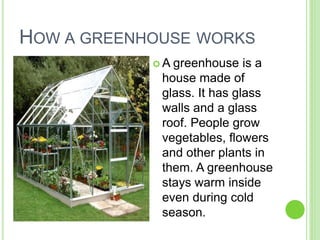
 A greenhouse is a
house made of
glass. It has glass
walls and a glass
roof. People grow
vegetables, flowers
and other plants in
them. A greenhouse
stays warm inside
even during cold
season.
In temperate
countries, a
greenhouse is
used to grow
seedlings in the
late winter and
early spring and
later, planted in
the open field
when the
weather is
warmer.
 Greenhouses also
protect plants from
weather phenomena
such as snowstorm or
duct forms. In tropical
countries like ours,
greenhouses are used
by commercial plant
growers to protect
flowering and
ornamental plants from
harsh weather
conditions and insect
attack.
HOW A GREENHOUSE WORKS
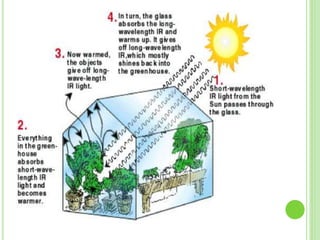
 Greenhouses allow sunlight to enter but prevent
heat from escaping. The transparent covering of the
greenhouse allows visible light to enter without
obstruction. It warms the inside of the greenhouse
as energy is absorbed by the plants, soil and other
things inside the building. Air warmed by the heat
inside is retained in the building by the roof and
walls. The transparent covering also prevents the
heat from leaving by reflecting the energy back into
the walls and preventing outside winds from
carrying it away.
Earth’s atmosphere does the same
things as the greenhouse.
Greenhouse gases in the atmosphere
do what the roof of the greenhouse
does.
 During the day, the Sun shines through the
atmosphere. The Earth’s surface warms up in the
sunlight. At night, Earth’s surface cools, releasing
the heat back into the air, but some of the heat is
trapped by the greenhouse gases in the
atmosphere, they absorb the energy coming from
the Earth’s surface, keeping the Earth’s
temperature suitable for life on Earth. This process
by which the Earth’s atmosphere warms up is
called ‘greenhouse effect’
 The greenhouse effect is a natural process and it
warms the Earth. Without the greenhouse effect,
Earth would be very cold, too cold for living things
to live.
 However, if the greenhouse effect is too strong,
Earth gets warmer and warmer. Too much carbon
dioxide and other greenhouse gases in air can
make the greenhouse effect stronger which would
result to global warming.
SOURCES OF GREENHOUSE
GASES
CARBON DIOXIDE
 CARBON DIOXIDE
(CO2) is naturally
produced when people
and animals breathe.
Plants take in and use
CO2 to produce their
own food. When food is
oxidized in the cells,
CO2 is given off as a
waste product. It is also
returned to the air as a
product of combustion
and decomposition.
METHANE
 METHANE (CH4)
is emitted by
natural sources
such as
wetlands, as well
as human
activities such as
leakage from
natural gas
systems and the
raising of
livestock.
 OZONE (O3)is created
by sunlight acting on
oxides of nitrogen and
volatile organic
compounds in the air.
There are thousands
of types of sources of
these gases. Some of
the common sources
include gasoline
vapors, chemical
solvents, combustion
products of fuels and
consumer products.
CLOROFLUOROCARBONS
 CFC’s are anthropogenic
compounds that have
been released into the
atmosphere since 1930s
in various applications
such as in air-
conditioning,
refrigeration, blowing
agents in foams,
insulations and packing
materials, propellants in
aerosol cans and as
solvents.
WATER VAPOR
 WATER VAPOR is
the gaseous phase of
water. It is one state
of water within the
hydrosphere. Water
vapor can be
produced from the
evaporation or boiling
of liquid water or from
sublimation of ice.
NITROUS OXIDE
 NITROUS OXIDES is
naturally present in the
atmosphere as part of the
nitrogen cycle and has a
variety of natural sources.
However, human activities
such as agriculture, fossil
fuel combustion, waste
water management and
industrial processes are
increasing the amount of
nitrous oxide in the
atmosphere.
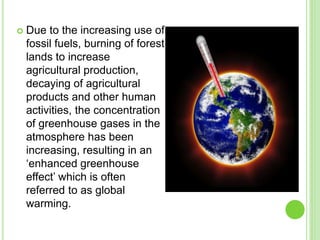
 Due to the increasing use of
fossil fuels, burning of forest
lands to increase
agricultural production,
decaying of agricultural
products and other human
activities, the concentration
of greenhouse gases in the
atmosphere has been
increasing, resulting in an
‘enhanced greenhouse
effect’ which is often
referred to as global
warming.
GLOBAL WARMING
 Global warming is the term used to describe a
gradual increase in the average temperature of the
Earth’s atmosphere and its oceans, a change that
is believed to be permanently changing the Earth’s
climate.
EFFECTS OF GLOBAL
WARMING
MELTING OF POLAR ICE CAPS
 Ice is melting worldwide especially at the Earth’s
poles. This includes mountain glaciers, ice sheets
covering West Antarctica and Greenland and Arctic
sea ice.
DECLINE OF ENDEMIC ANIMAL AND PLANT
SPECIES
Philippine
Tarsier
Tarictic Hornbill Philippine
Eagle
Philippine Spotted Deer
Mindanao
Bleeding
Heart
Nephentes
ventricosa
Waling-waling
Camia
Ilang-ilang
Basingtonia asiatica
INCREASE PRECIPITATION
 Precipitation (rain and snow fall) has increased
across the globe on average.
INCREASE POPULATION OF PESTS
DECLINE IN AGRICULTURAL HARVEST
DROUGHTS AND FLOODS BECOME COMMON
DECREASE SUPPLY OF CLEAN DRINKING
WATER
SPREAD OF DISEASES
HURRICANES AND TYPHOONS ARE STRONGER
AND MORE FREQUENT
SPECIES THAT DEPEND ON ONE ANOTHER MAY
BECOME OUT OF SYNC
 Species that depend
on one another do not
work at the same time
and speed. For
example, plants would
bloom earlier than their
pollinating insects
become active.
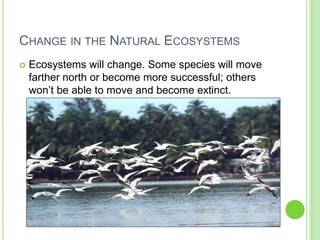
CHANGE IN THE NATURAL ECOSYSTEMS
 Ecosystems will change. Some species will move
farther north or become more successful; others
won’t be able to move and become extinct.
REFERENCES
 Science Learners Material
 Integrated Science I, DepEd, Quezon City: Vibal
Publishing House, 2009
 http://environment.nationalgeographic.com/environ
ment/global-warming/gw-effects/
 http://climatekids.nasa.gov/greenhouse-effect/
SUGGESTED VIDEOS
 Global Warming: A Way Forward: Facing Climate
Change
https://www.youtube.com/watch?v=pAA7FEqYTjA
 Six Degrees Could Change The World
https://www.youtube.com/watch?v=R_pb1G2wIoA
 LOREN LEGARDA: BUHOS, A Climate Change
Documentary
https://www.youtube.com/watch?v=ESW_S8ZHS80
 PANAHON NA! Ang Hamon sa Pinoy at Climate Change
https://www.youtube.com/watch?v=iOjyCHA_PeA

The greenhouse effect

  • 1.
    Simplified Explanation forRemedial Lesson in Grade 7 Science MA. RACHEL B. ESPINO Buhatan National High School Purok Marcos, Buhatan, Sorsogon, City
  • 2.
     The GREENHOUSEEFFECT is a natural process that warms the Earth’s surface. To understand the greenhouse effect, we need to understand how a real greenhouse works
  • 3.
    HOW A GREENHOUSEWORKS  A greenhouse is a house made of glass. It has glass walls and a glass roof. People grow vegetables, flowers and other plants in them. A greenhouse stays warm inside even during cold season.
  • 4.
    In temperate countries, a greenhouseis used to grow seedlings in the late winter and early spring and later, planted in the open field when the weather is warmer.
  • 5.
     Greenhouses also protectplants from weather phenomena such as snowstorm or duct forms. In tropical countries like ours, greenhouses are used by commercial plant growers to protect flowering and ornamental plants from harsh weather conditions and insect attack.
  • 6.
    HOW A GREENHOUSEWORKS  Greenhouses allow sunlight to enter but prevent heat from escaping. The transparent covering of the greenhouse allows visible light to enter without obstruction. It warms the inside of the greenhouse as energy is absorbed by the plants, soil and other things inside the building. Air warmed by the heat inside is retained in the building by the roof and walls. The transparent covering also prevents the heat from leaving by reflecting the energy back into the walls and preventing outside winds from carrying it away.
  • 8.
    Earth’s atmosphere doesthe same things as the greenhouse. Greenhouse gases in the atmosphere do what the roof of the greenhouse does.
  • 9.
     During theday, the Sun shines through the atmosphere. The Earth’s surface warms up in the sunlight. At night, Earth’s surface cools, releasing the heat back into the air, but some of the heat is trapped by the greenhouse gases in the atmosphere, they absorb the energy coming from the Earth’s surface, keeping the Earth’s temperature suitable for life on Earth. This process by which the Earth’s atmosphere warms up is called ‘greenhouse effect’
  • 12.
     The greenhouseeffect is a natural process and it warms the Earth. Without the greenhouse effect, Earth would be very cold, too cold for living things to live.
  • 13.
     However, ifthe greenhouse effect is too strong, Earth gets warmer and warmer. Too much carbon dioxide and other greenhouse gases in air can make the greenhouse effect stronger which would result to global warming.
  • 14.
  • 15.
    CARBON DIOXIDE  CARBONDIOXIDE (CO2) is naturally produced when people and animals breathe. Plants take in and use CO2 to produce their own food. When food is oxidized in the cells, CO2 is given off as a waste product. It is also returned to the air as a product of combustion and decomposition.
  • 16.
    METHANE  METHANE (CH4) isemitted by natural sources such as wetlands, as well as human activities such as leakage from natural gas systems and the raising of livestock.
  • 17.
     OZONE (O3)iscreated by sunlight acting on oxides of nitrogen and volatile organic compounds in the air. There are thousands of types of sources of these gases. Some of the common sources include gasoline vapors, chemical solvents, combustion products of fuels and consumer products.
  • 18.
    CLOROFLUOROCARBONS  CFC’s areanthropogenic compounds that have been released into the atmosphere since 1930s in various applications such as in air- conditioning, refrigeration, blowing agents in foams, insulations and packing materials, propellants in aerosol cans and as solvents.
  • 19.
    WATER VAPOR  WATERVAPOR is the gaseous phase of water. It is one state of water within the hydrosphere. Water vapor can be produced from the evaporation or boiling of liquid water or from sublimation of ice.
  • 20.
    NITROUS OXIDE  NITROUSOXIDES is naturally present in the atmosphere as part of the nitrogen cycle and has a variety of natural sources. However, human activities such as agriculture, fossil fuel combustion, waste water management and industrial processes are increasing the amount of nitrous oxide in the atmosphere.
  • 21.
     Due tothe increasing use of fossil fuels, burning of forest lands to increase agricultural production, decaying of agricultural products and other human activities, the concentration of greenhouse gases in the atmosphere has been increasing, resulting in an ‘enhanced greenhouse effect’ which is often referred to as global warming.
  • 22.
    GLOBAL WARMING  Globalwarming is the term used to describe a gradual increase in the average temperature of the Earth’s atmosphere and its oceans, a change that is believed to be permanently changing the Earth’s climate.
  • 23.
  • 24.
    MELTING OF POLARICE CAPS  Ice is melting worldwide especially at the Earth’s poles. This includes mountain glaciers, ice sheets covering West Antarctica and Greenland and Arctic sea ice.
  • 25.
    DECLINE OF ENDEMICANIMAL AND PLANT SPECIES Philippine Tarsier Tarictic Hornbill Philippine Eagle Philippine Spotted Deer Mindanao Bleeding Heart
  • 26.
  • 27.
    INCREASE PRECIPITATION  Precipitation(rain and snow fall) has increased across the globe on average.
  • 28.
  • 29.
  • 30.
    DROUGHTS AND FLOODSBECOME COMMON
  • 31.
    DECREASE SUPPLY OFCLEAN DRINKING WATER
  • 32.
  • 33.
    HURRICANES AND TYPHOONSARE STRONGER AND MORE FREQUENT
  • 34.
    SPECIES THAT DEPENDON ONE ANOTHER MAY BECOME OUT OF SYNC  Species that depend on one another do not work at the same time and speed. For example, plants would bloom earlier than their pollinating insects become active.
  • 35.
    CHANGE IN THENATURAL ECOSYSTEMS  Ecosystems will change. Some species will move farther north or become more successful; others won’t be able to move and become extinct.
  • 36.
    REFERENCES  Science LearnersMaterial  Integrated Science I, DepEd, Quezon City: Vibal Publishing House, 2009  http://environment.nationalgeographic.com/environ ment/global-warming/gw-effects/  http://climatekids.nasa.gov/greenhouse-effect/
  • 37.
    SUGGESTED VIDEOS  GlobalWarming: A Way Forward: Facing Climate Change https://www.youtube.com/watch?v=pAA7FEqYTjA  Six Degrees Could Change The World https://www.youtube.com/watch?v=R_pb1G2wIoA  LOREN LEGARDA: BUHOS, A Climate Change Documentary https://www.youtube.com/watch?v=ESW_S8ZHS80  PANAHON NA! Ang Hamon sa Pinoy at Climate Change https://www.youtube.com/watch?v=iOjyCHA_PeA

Editor's Notes

  • #12 For further explanation of the greenhouse effect
  • #15 Teachers could give an introduction about cellular respiration and photosynthesis so that students will be able to understand how carbon dioxide is used. To simply, the teacher can also use diagram of the carbon dioxide-oxygen cycle. The teacher may ask look into the concepts in chemistry and biology as enrichment of this concept.
  • #16 Teachers could give an introduction about cellular respiration and photosynthesis so that students will be able to understand how carbon dioxide is used. To simply, the teacher can also use diagram of the carbon dioxide-oxygen cycle. The teacher may ask look into the concepts in chemistry and biology as enrichment of this concept.
  • #19 Anthropogenic – originating from human activity