GROUP 4
MEMBERS:
1. Robles
2. Cardeno
3. Ramos
4. Quero
Learning Objective
Students will be able to:
 understand volcano formation and types
 identify key features of volcanic activity
 see images of real Volcanoes
 Explain possible human consequences of volcanic eruptions, including how volcanic
eruptions affect weather and climate change.
 Describe the layers of Earth’s atmosphere .
 Related the composition of volcanoes with structure, type, and eruption.
• Definition of Volcano
• 3 Plate tectonics
• 10 Types Of Volcanoes
• 3 Classification of Volcano
• Effects of Volcanic Eruption
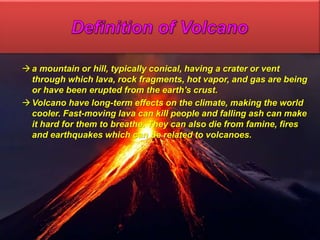
a mountain or hill, typically conical, having a crater or vent
through which lava, rock fragments, hot vapor, and gas are being
or have been erupted from the earth's crust.
Volcano have long-term effects on the climate, making the world
cooler. Fast-moving lava can kill people and falling ash can make
it hard for them to breathe. They can also die from famine, fires
and earthquakes which can be related to volcanoes.
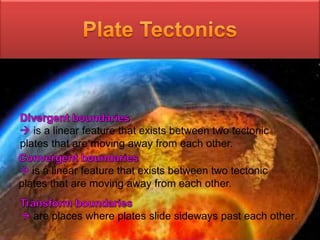
is a linear feature that exists between two tectonic
plates that are moving away from each other.
is a linear feature that exists between two tectonic
plates that are moving away from each other.
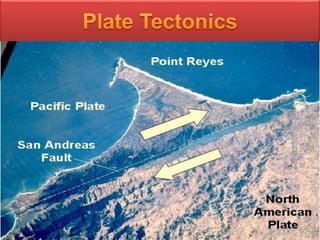
are places where plates slide sideways past each other.
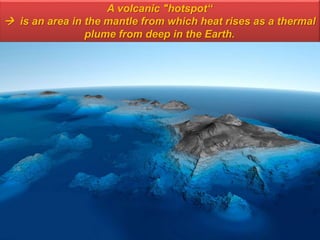
A volcanic "hotspot“
 is an area in the mantle from which heat rises as a thermal
plume from deep in the Earth.
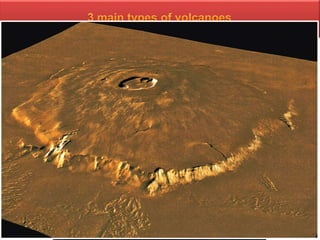
1. Shield Volcano
 is a type of volcano usually built almost entirely of fluid magma flows. They are named for
their large size and low profile, resembling a warrior's shield lying on the ground. This is caused
by the highly fluid lava they erupt, which travels farther than lava erupted from stratovolcanoes.
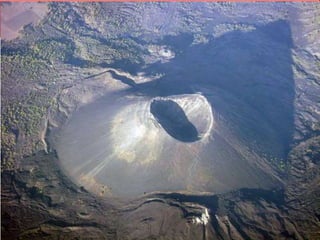
2. Cinder Volcano
 is a steep conical hill of loose pyroclastic fragments, such as either volcanic
clinkers, cinders, volcanic ash, or scoria that has been built around a volcanic vent.
3. Composite Volcano (stratovolcano)
 is a conical volcano built up by many layers (strata) of hardenedlava, tephra, pumice,
and volcanic ash.
 Stratovolcanoes are sometimes called "composite volcanoes" because of their composite
layered structure built up from sequential outpourings of eruptive materials.
Mount Pinatubo (Filipino: Bundok Pinatubo) is
anactive stratovolcano in the Cabusilan
Mountains on the island of Luzon, near the
tripoint of the Philippine provinces of Zambales,
Tarlac, and Pampanga. Before the volcanic
activities of 1991, its eruptive history was
unknown to most people.
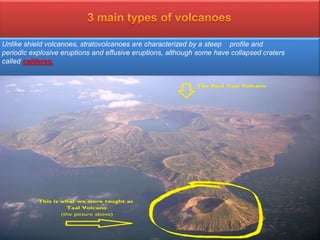
Unlike shield volcanoes, stratovolcanoes are characterized by a steep profile and
periodic explosive eruptions and effusive eruptions, although some have collapsed craters
called calderas.
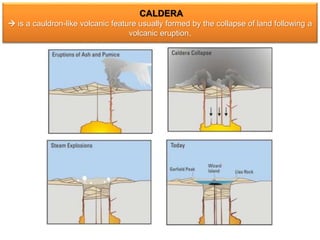
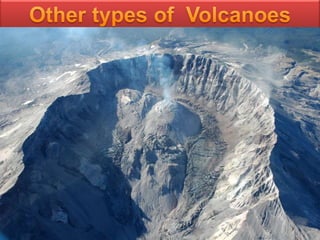
CALDERA
 is a cauldron-like volcanic feature usually formed by the collapse of land following a
volcanic eruption.
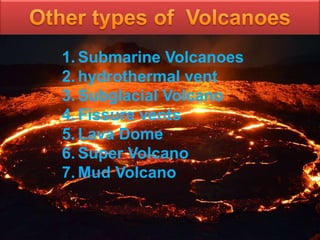
1. Submarine Volcanoes
2. hydrothermal vent
3. Subglacial Volcano
4. Fissure vents
5. Lava Dome
6. Super Volcano
7. Mud Volcano
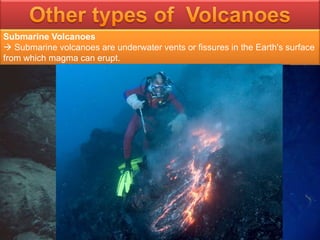
Submarine Volcanoes
 Submarine volcanoes are underwater vents or fissures in the Earth's surface
from which magma can erupt.
hydrothermal vent
 is a fissure in a planet's surface from which geothermally heated water issues.
 the hydrothermal vents are so deep, and the water surrounding them can reach
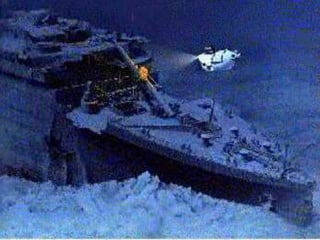
temperatures up to 250c these vents are explored using submersibles such as ALVIN.
 ALVIN, These robotic submarines allow scientists to view the vents. The submersibles allowed
scientists to discover a new type of life forms. It was believed that no life could live at the
bottom of the ocean, because of the lack of light
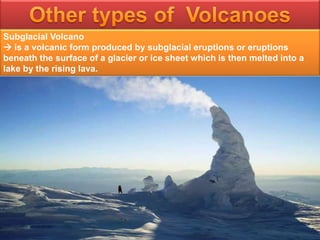
Subglacial Volcano
 is a volcanic form produced by subglacial eruptions or eruptions
beneath the surface of a glacier or ice sheet which is then melted into a
lake by the rising lava.
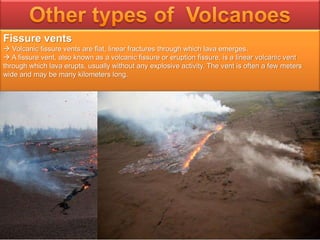
Fissure vents
 Volcanic fissure vents are flat, linear fractures through which lava emerges.
 A fissure vent, also known as a volcanic fissure or eruption fissure, is a linear volcanic vent
through which lava erupts, usually without any explosive activity. The vent is often a few meters
wide and may be many kilometers long.
Lava Dome
is a roughly circular mound-shaped protrusion resulting from the
slow extrusion of viscouslava from a volcano.
 The characteristic dome shape is attributed to high viscosity that prevents
the lava from flowing very far.
Super Volcano
 is any volcano capable of producing a volcanic eruption with an ejecta
volume greater than 1,000 cubic kilometers (240 cu mi). This is thousands of
times larger than normal volcanic eruptions.
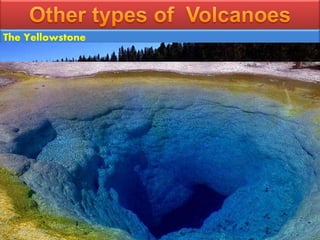
The Yellowstone
is the volcanic caldera and super volcano located in Yellowstone
National Park in the United States, sometimes referred to as the Yellowstone
Super volcano.
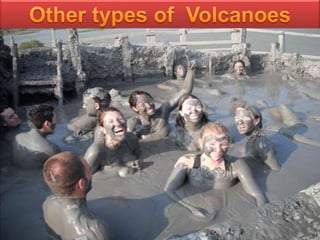
Mud Volcano
 refers to formations created by geo-exuded slurries (usually including water) and
gases. There are several geological processes that may cause the formation of mud
volcanoes.Mud volcanoes are not true (igneous) volcanoes as they produce no lava.
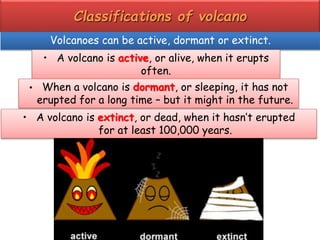
Classifications of volcano
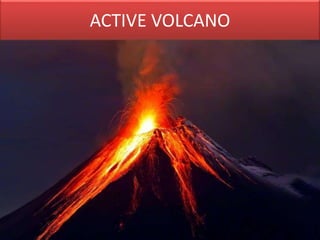
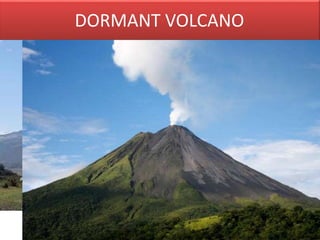
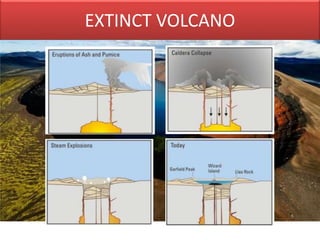
Volcanoes can be active, dormant or extinct.
• A volcano is active, or alive, when it erupts
often.
• When a volcano is dormant, or sleeping, it has not
erupted for a long time – but it might in the future.
• A volcano is extinct, or dead, when it hasn’t erupted
for at least 100,000 years.
ACTIVE VOLCANO
DORMANT VOLCANO
EXTINCT VOLCANO
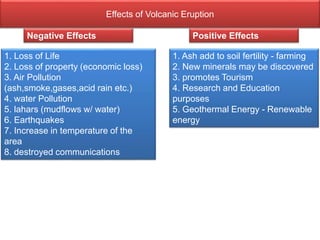
Effects of Volcanic Eruption
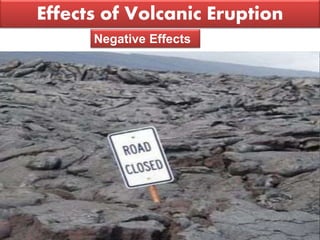
Negative Effects
1. Loss of Life
2. Loss of property (economic loss)
3. Air Pollution
(ash,smoke,gases,acid rain etc.)
4. water Pollution
5. lahars (mudflows w/ water)
6. Earthquakes
7. Increase in temperature of the
area
8. destroyed communications
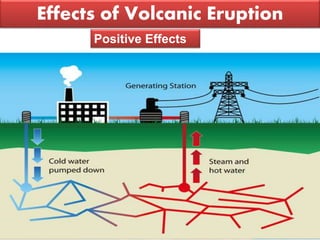
1. Ash add to soil fertility - farming
2. New minerals may be discovered
3. promotes Tourism
4. Research and Education
purposes
5. Geothermal Energy - Renewable
energy
Positive Effects
Effects of Volcanic Eruption
Negative Effects
Effects of Volcanic Eruption
Positive Effects
Protecting Yourself During a Volcanic Eruption
• If you are outdoors
1. Seek shelter indoors.
2. If caught in a rock fall, roll into a ball to protect your head.
3. If near a stream or river, be aware of rising water and
possible mudflows in low-lying areas. Move up-slope as
quickly as possible.
4. Seek care for burns right away. Immediate care can be
lifesaving.
5. If your eyes, nose, and throat become irritated from
volcanic gases and fumes, move away from the area
immediately. Your symptoms should go away when you are
no longer in contact with the Gases or fumes. If the
symptoms continue, consult your doctor.
Protecting Yourself During a Volcanic Eruption
• Protecting yourself during ash fall
1. Stay inside, if possible, with windows and doors closed.
2. Wear long-sleeved shirts and long pants.
3. Use goggles to protect your eyes.
4. If ash is continually falling, you may not be able to shelter
indoors for more than a few hours, because the weight of
the ash could collapse the roof of your building and block
air intakes into the Building. Listen to authorities for advice
on leaving the area when ash fall lasts more than a few
Hours.
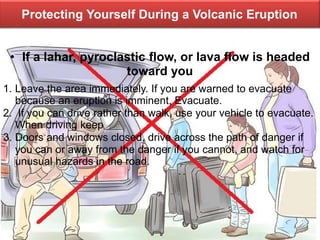
Protecting Yourself During a Volcanic Eruption
• If a lahar, pyroclastic flow, or lava flow is headed
toward you
1. Leave the area immediately. If you are warned to evacuate
because an eruption is imminent, Evacuate.
2. If you can drive rather than walk, use your vehicle to evacuate.
When driving keep
3. Doors and windows closed, drive across the path of danger if
you can or away from the danger if you cannot, and watch for
unusual hazards in the road.
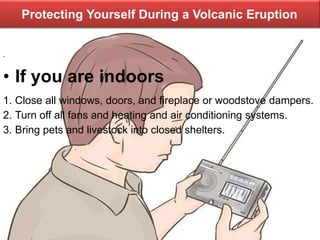
Protecting Yourself During a Volcanic Eruption
.
• If you are indoors
1. Close all windows, doors, and fireplace or woodstove dampers.
2. Turn off all fans and heating and air conditioning systems.
3. Bring pets and livestock into closed shelters.
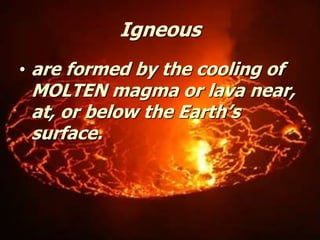
Igneous
• are formed by the cooling of
MOLTEN magma or lava near,
at, or below the Earth’s
surface.
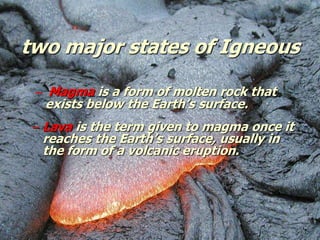
two major states of Igneous
– Magma is a form of molten rock that
exists below the Earth’s surface.
– Lava is the term given to magma once it
reaches the Earth’s surface, usually in
the form of a volcanic eruption.
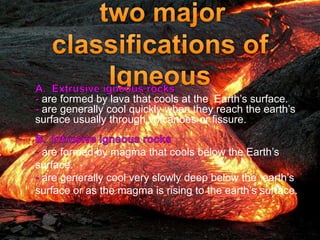
are formed by lava that cools at the Earth’s surface.
are generally cool quickly when they reach the earth’s
surface usually through volcanoes or fissure.
are formed by magma that cools below the Earth’s
surface.
are generally cool very slowly deep below the earth’s
surface or as the magma is rising to the earth’s surface.

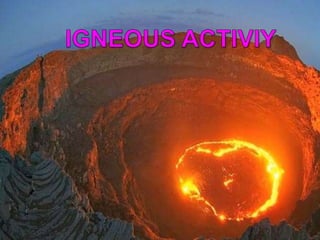
Volcanoes and other igneous activity

  • 1.
    GROUP 4 MEMBERS: 1. Robles 2.Cardeno 3. Ramos 4. Quero
  • 2.
    Learning Objective Students willbe able to:  understand volcano formation and types  identify key features of volcanic activity  see images of real Volcanoes  Explain possible human consequences of volcanic eruptions, including how volcanic eruptions affect weather and climate change.  Describe the layers of Earth’s atmosphere .  Related the composition of volcanoes with structure, type, and eruption.
  • 3.
    • Definition ofVolcano • 3 Plate tectonics • 10 Types Of Volcanoes • 3 Classification of Volcano • Effects of Volcanic Eruption
  • 4.
    a mountain orhill, typically conical, having a crater or vent through which lava, rock fragments, hot vapor, and gas are being or have been erupted from the earth's crust. Volcano have long-term effects on the climate, making the world cooler. Fast-moving lava can kill people and falling ash can make it hard for them to breathe. They can also die from famine, fires and earthquakes which can be related to volcanoes.
  • 5.
    is a linearfeature that exists between two tectonic plates that are moving away from each other. is a linear feature that exists between two tectonic plates that are moving away from each other. are places where plates slide sideways past each other.
  • 7.
    A volcanic "hotspot“ is an area in the mantle from which heat rises as a thermal plume from deep in the Earth.
  • 9.
    1. Shield Volcano is a type of volcano usually built almost entirely of fluid magma flows. They are named for their large size and low profile, resembling a warrior's shield lying on the ground. This is caused by the highly fluid lava they erupt, which travels farther than lava erupted from stratovolcanoes.
  • 10.
    2. Cinder Volcano is a steep conical hill of loose pyroclastic fragments, such as either volcanic clinkers, cinders, volcanic ash, or scoria that has been built around a volcanic vent.
  • 11.
    3. Composite Volcano(stratovolcano)  is a conical volcano built up by many layers (strata) of hardenedlava, tephra, pumice, and volcanic ash.  Stratovolcanoes are sometimes called "composite volcanoes" because of their composite layered structure built up from sequential outpourings of eruptive materials. Mount Pinatubo (Filipino: Bundok Pinatubo) is anactive stratovolcano in the Cabusilan Mountains on the island of Luzon, near the tripoint of the Philippine provinces of Zambales, Tarlac, and Pampanga. Before the volcanic activities of 1991, its eruptive history was unknown to most people. Unlike shield volcanoes, stratovolcanoes are characterized by a steep profile and periodic explosive eruptions and effusive eruptions, although some have collapsed craters called calderas.
  • 12.
    CALDERA  is acauldron-like volcanic feature usually formed by the collapse of land following a volcanic eruption.
  • 13.
    1. Submarine Volcanoes 2.hydrothermal vent 3. Subglacial Volcano 4. Fissure vents 5. Lava Dome 6. Super Volcano 7. Mud Volcano
  • 14.
    Submarine Volcanoes  Submarinevolcanoes are underwater vents or fissures in the Earth's surface from which magma can erupt.
  • 15.
    hydrothermal vent  isa fissure in a planet's surface from which geothermally heated water issues.  the hydrothermal vents are so deep, and the water surrounding them can reach temperatures up to 250c these vents are explored using submersibles such as ALVIN.  ALVIN, These robotic submarines allow scientists to view the vents. The submersibles allowed scientists to discover a new type of life forms. It was believed that no life could live at the bottom of the ocean, because of the lack of light
  • 16.
    Subglacial Volcano  isa volcanic form produced by subglacial eruptions or eruptions beneath the surface of a glacier or ice sheet which is then melted into a lake by the rising lava.
  • 17.
    Fissure vents  Volcanicfissure vents are flat, linear fractures through which lava emerges.  A fissure vent, also known as a volcanic fissure or eruption fissure, is a linear volcanic vent through which lava erupts, usually without any explosive activity. The vent is often a few meters wide and may be many kilometers long.
  • 18.
    Lava Dome is aroughly circular mound-shaped protrusion resulting from the slow extrusion of viscouslava from a volcano.  The characteristic dome shape is attributed to high viscosity that prevents the lava from flowing very far.
  • 19.
    Super Volcano  isany volcano capable of producing a volcanic eruption with an ejecta volume greater than 1,000 cubic kilometers (240 cu mi). This is thousands of times larger than normal volcanic eruptions. The Yellowstone is the volcanic caldera and super volcano located in Yellowstone National Park in the United States, sometimes referred to as the Yellowstone Super volcano.
  • 20.
    Mud Volcano  refersto formations created by geo-exuded slurries (usually including water) and gases. There are several geological processes that may cause the formation of mud volcanoes.Mud volcanoes are not true (igneous) volcanoes as they produce no lava.
  • 21.
    Classifications of volcano Volcanoescan be active, dormant or extinct. • A volcano is active, or alive, when it erupts often. • When a volcano is dormant, or sleeping, it has not erupted for a long time – but it might in the future. • A volcano is extinct, or dead, when it hasn’t erupted for at least 100,000 years.
  • 22.
  • 23.
  • 24.
  • 25.
    Effects of VolcanicEruption Negative Effects 1. Loss of Life 2. Loss of property (economic loss) 3. Air Pollution (ash,smoke,gases,acid rain etc.) 4. water Pollution 5. lahars (mudflows w/ water) 6. Earthquakes 7. Increase in temperature of the area 8. destroyed communications 1. Ash add to soil fertility - farming 2. New minerals may be discovered 3. promotes Tourism 4. Research and Education purposes 5. Geothermal Energy - Renewable energy Positive Effects
  • 26.
    Effects of VolcanicEruption Negative Effects
  • 27.
    Effects of VolcanicEruption Positive Effects
  • 28.
    Protecting Yourself Duringa Volcanic Eruption • If you are outdoors 1. Seek shelter indoors. 2. If caught in a rock fall, roll into a ball to protect your head. 3. If near a stream or river, be aware of rising water and possible mudflows in low-lying areas. Move up-slope as quickly as possible. 4. Seek care for burns right away. Immediate care can be lifesaving. 5. If your eyes, nose, and throat become irritated from volcanic gases and fumes, move away from the area immediately. Your symptoms should go away when you are no longer in contact with the Gases or fumes. If the symptoms continue, consult your doctor.
  • 29.
    Protecting Yourself Duringa Volcanic Eruption • Protecting yourself during ash fall 1. Stay inside, if possible, with windows and doors closed. 2. Wear long-sleeved shirts and long pants. 3. Use goggles to protect your eyes. 4. If ash is continually falling, you may not be able to shelter indoors for more than a few hours, because the weight of the ash could collapse the roof of your building and block air intakes into the Building. Listen to authorities for advice on leaving the area when ash fall lasts more than a few Hours.
  • 30.
    Protecting Yourself Duringa Volcanic Eruption • If a lahar, pyroclastic flow, or lava flow is headed toward you 1. Leave the area immediately. If you are warned to evacuate because an eruption is imminent, Evacuate. 2. If you can drive rather than walk, use your vehicle to evacuate. When driving keep 3. Doors and windows closed, drive across the path of danger if you can or away from the danger if you cannot, and watch for unusual hazards in the road.
  • 31.
    Protecting Yourself Duringa Volcanic Eruption . • If you are indoors 1. Close all windows, doors, and fireplace or woodstove dampers. 2. Turn off all fans and heating and air conditioning systems. 3. Bring pets and livestock into closed shelters.
  • 33.
    Igneous • are formedby the cooling of MOLTEN magma or lava near, at, or below the Earth’s surface.
  • 34.
    two major statesof Igneous – Magma is a form of molten rock that exists below the Earth’s surface. – Lava is the term given to magma once it reaches the Earth’s surface, usually in the form of a volcanic eruption.
  • 35.
    are formed bylava that cools at the Earth’s surface. are generally cool quickly when they reach the earth’s surface usually through volcanoes or fissure. are formed by magma that cools below the Earth’s surface. are generally cool very slowly deep below the earth’s surface or as the magma is rising to the earth’s surface.