Suggested Teacher’s Guide for Discussion
Grade 7 Science
MA. RACHEL B. ESPINO
Buhatan National High School
Purok Marcos, Buhatan, Sorsogon City
The Earth is enveloped in air
 The Earth is
enveloped in air
called atmosphere.
The pull of the
Earth keeps this
ocean of air close to
it.
 Without the
atmosphere, life
cannot exist on Earth,
for the atmosphere
contains oxygen – the
life-sustaining gas.
From the air, plants get
carbon dioxide needed
to manufacture food
that are in turn needed
by animals in order to
live.
The layers of air
also protects us
from intense
radiation by day
and too much
loss of heat by
night.
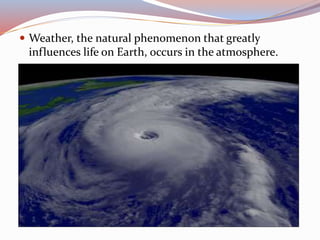
 Weather, the natural phenomenon that greatly
influences life on Earth, occurs in the atmosphere.
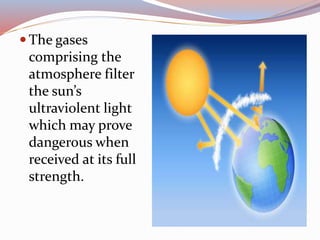
 The gases
comprising the
atmosphere filter
the sun’s
ultraviolent light
which may prove
dangerous when
received at its full
strength.
COMPOSITION OF THE EARTH’S
ATMOSPHERE
 The Earth’s atmosphere is
composed of the following
molecules: nitrogen (78%),
oxygen (21%), argon (1%),
and then trace amounts of
carbon dioxide, neon,
helium, methane, krypton,
hydrogen, nitrous oxide,
xenon, ozone, iodine,
carbon monoxide, and
ammonia. Lower altitudes
also have quantities of
water vapor.
NITRO
GEN
78%
OXYG
EN
21%
TRACE
AMOU
NTS
OF
OTHE
R
GAS…
Column1
COMPOSITION OF THE EARTH’S
ATMOSPHERE
 The Earth’s atmosphere is composed of the following
molecules: nitrogen (78%), oxygen (21%), argon (1%), and
then trace amounts of carbon dioxide, neon, helium,
methane, krypton, hydrogen, nitrous oxide, xenon, ozone,
iodine, carbon monoxide, and ammonia. Lower altitudes
also have quantities of water vapor.
 The atmosphere we have today is very different from the
Earth’s early atmosphere. When the planet first cooled
down 4.4 billion years ago, volcanos spewed out steam,
carbon dioxide and ammonia, and it was 100 times as dense
as today’s atmosphere.
ay
m
THE LAYERS OF THE ATMOSPHERE
 Temperature changes so much with altitude that one
can identify major divisions or layers of the
atmosphere based on temperature variations.
However, scientists use the average atmosphere as the
basis of dividing the atmosphere into 5 layers. This
temperature profile is an average of temperature
profiles obtained from all over the globe over a long
period of time.
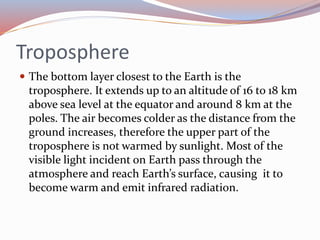
Troposphere
 The bottom layer closest to the Earth is the
troposphere. It extends up to an altitude of 16 to 18 km
above sea level at the equator and around 8 km at the
poles. The air becomes colder as the distance from the
ground increases, therefore the upper part of the
troposphere is not warmed by sunlight. Most of the
visible light incident on Earth pass through the
atmosphere and reach Earth’s surface, causing it to
become warm and emit infrared radiation.
 Gases in the air such as carbon dioxide and water vapor
absorb infrared radiation. Absorption of infrared
radiation from the surface warms the lower
atmosphere. Thus, the troposphere is not warmed from
above but from below. Earth’s surface serves as the heat
source for the decreasing temperature since this means
moving away from the heat source. This results in a
decreasing temperature profile as altitude in the
troposphere increases.
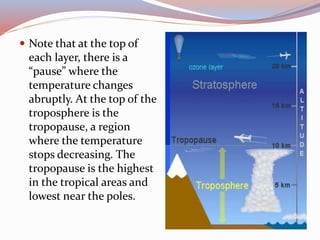
 Note that at the top of
each layer, there is a
“pause” where the
temperature changes
abruptly. At the top of the
troposphere is the
tropopause, a region
where the temperature
stops decreasing. The
tropopause is the highest
in the tropical areas and
lowest near the poles.
Stratosphere
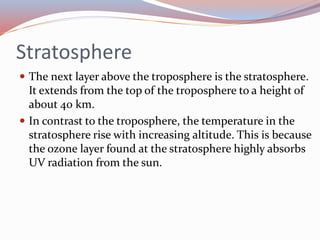
 The next layer above the troposphere is the stratosphere.
It extends from the top of the troposphere to a height of
about 40 km.
 In contrast to the troposphere, the temperature in the
stratosphere rise with increasing altitude. This is because
the ozone layer found at the stratosphere highly absorbs
UV radiation from the sun.
 Absorption of UV warms the surrounding air, leading
to an increase of temperature. UV absorption is
greatest at the uppermost level of the stratosphere,
hence air temperature is also highest in this region.
Absorption of UV at higher levels is lower, the amount
that is available at lower levels of the atmosphere
 The air is much thinner in the stratosphere and it is
clear and cloudless. This is the layer where jet planes
and manned balloons fly. The “pause” at the top of the
stratosphere is the stratopause.
Mesosphere
 Directly above the stratosphere extending from 50 to
10 km above the Earth’s surface is the mesosphere. It is
a cold layer where the temperature generally decreases
with increasing altitude. Here in the mesosphere, the
atmosphere is very rarefied, meaning it has less
oxygen. Nevertheless, it is thick enough to slow down
meteors hurtling into the atmosphere where they burn
up, leaving fiery trails in the night sky. With no gas
that absorbs sunlight in this layer, the temperature
decreases with height.
Thermosphere
 The thermosphere extends to about 87 to 100 km. In
the thermosphere, the temperature change is small. It
increases gradually from about 100 to 110 km. From 100
km to the end of the layer, the temperature steadily
increases with height.
 In the thermosphere, temperature increases with
altitude due to the absorption of high-energy radiation
from the sun.
Exosphere
 The upper limit of our
atmosphere is the
exosphere. This layer of
the atmosphere merges
into space. Satellites are
stationed in this area,
500 km to 1,000 km from
Earth.
Suggested Videos:
 The Earth’s Atmosphere
https://youtu.be/WVAZcphSz7k?list=PLXZAD5CEPE-
vkd8GpvOpVakZJK2F-v8nN
 Reveal the Earth’s Atmosphere
https://youtu.be/1YAOT92wuD8?list=PLXZAD5CEPE-
vkd8GpvOpVakZJK2F-v8nN

Atmosphere

  • 1.
    Suggested Teacher’s Guidefor Discussion Grade 7 Science MA. RACHEL B. ESPINO Buhatan National High School Purok Marcos, Buhatan, Sorsogon City
  • 2.
    The Earth isenveloped in air  The Earth is enveloped in air called atmosphere. The pull of the Earth keeps this ocean of air close to it.
  • 3.
     Without the atmosphere,life cannot exist on Earth, for the atmosphere contains oxygen – the life-sustaining gas. From the air, plants get carbon dioxide needed to manufacture food that are in turn needed by animals in order to live.
  • 4.
    The layers ofair also protects us from intense radiation by day and too much loss of heat by night.
  • 5.
     Weather, thenatural phenomenon that greatly influences life on Earth, occurs in the atmosphere.
  • 6.
     The gases comprisingthe atmosphere filter the sun’s ultraviolent light which may prove dangerous when received at its full strength.
  • 7.
    COMPOSITION OF THEEARTH’S ATMOSPHERE  The Earth’s atmosphere is composed of the following molecules: nitrogen (78%), oxygen (21%), argon (1%), and then trace amounts of carbon dioxide, neon, helium, methane, krypton, hydrogen, nitrous oxide, xenon, ozone, iodine, carbon monoxide, and ammonia. Lower altitudes also have quantities of water vapor. NITRO GEN 78% OXYG EN 21% TRACE AMOU NTS OF OTHE R GAS… Column1
  • 8.
    COMPOSITION OF THEEARTH’S ATMOSPHERE  The Earth’s atmosphere is composed of the following molecules: nitrogen (78%), oxygen (21%), argon (1%), and then trace amounts of carbon dioxide, neon, helium, methane, krypton, hydrogen, nitrous oxide, xenon, ozone, iodine, carbon monoxide, and ammonia. Lower altitudes also have quantities of water vapor.  The atmosphere we have today is very different from the Earth’s early atmosphere. When the planet first cooled down 4.4 billion years ago, volcanos spewed out steam, carbon dioxide and ammonia, and it was 100 times as dense as today’s atmosphere. ay m
  • 9.
    THE LAYERS OFTHE ATMOSPHERE  Temperature changes so much with altitude that one can identify major divisions or layers of the atmosphere based on temperature variations. However, scientists use the average atmosphere as the basis of dividing the atmosphere into 5 layers. This temperature profile is an average of temperature profiles obtained from all over the globe over a long period of time.
  • 11.
    Troposphere  The bottomlayer closest to the Earth is the troposphere. It extends up to an altitude of 16 to 18 km above sea level at the equator and around 8 km at the poles. The air becomes colder as the distance from the ground increases, therefore the upper part of the troposphere is not warmed by sunlight. Most of the visible light incident on Earth pass through the atmosphere and reach Earth’s surface, causing it to become warm and emit infrared radiation.
  • 13.
     Gases inthe air such as carbon dioxide and water vapor absorb infrared radiation. Absorption of infrared radiation from the surface warms the lower atmosphere. Thus, the troposphere is not warmed from above but from below. Earth’s surface serves as the heat source for the decreasing temperature since this means moving away from the heat source. This results in a decreasing temperature profile as altitude in the troposphere increases.
  • 15.
     Note thatat the top of each layer, there is a “pause” where the temperature changes abruptly. At the top of the troposphere is the tropopause, a region where the temperature stops decreasing. The tropopause is the highest in the tropical areas and lowest near the poles.
  • 16.
    Stratosphere  The nextlayer above the troposphere is the stratosphere. It extends from the top of the troposphere to a height of about 40 km.  In contrast to the troposphere, the temperature in the stratosphere rise with increasing altitude. This is because the ozone layer found at the stratosphere highly absorbs UV radiation from the sun.
  • 18.
     Absorption ofUV warms the surrounding air, leading to an increase of temperature. UV absorption is greatest at the uppermost level of the stratosphere, hence air temperature is also highest in this region. Absorption of UV at higher levels is lower, the amount that is available at lower levels of the atmosphere
  • 20.
     The airis much thinner in the stratosphere and it is clear and cloudless. This is the layer where jet planes and manned balloons fly. The “pause” at the top of the stratosphere is the stratopause.
  • 21.
    Mesosphere  Directly abovethe stratosphere extending from 50 to 10 km above the Earth’s surface is the mesosphere. It is a cold layer where the temperature generally decreases with increasing altitude. Here in the mesosphere, the atmosphere is very rarefied, meaning it has less oxygen. Nevertheless, it is thick enough to slow down meteors hurtling into the atmosphere where they burn up, leaving fiery trails in the night sky. With no gas that absorbs sunlight in this layer, the temperature decreases with height.
  • 24.
    Thermosphere  The thermosphereextends to about 87 to 100 km. In the thermosphere, the temperature change is small. It increases gradually from about 100 to 110 km. From 100 km to the end of the layer, the temperature steadily increases with height.  In the thermosphere, temperature increases with altitude due to the absorption of high-energy radiation from the sun.
  • 26.
    Exosphere  The upperlimit of our atmosphere is the exosphere. This layer of the atmosphere merges into space. Satellites are stationed in this area, 500 km to 1,000 km from Earth.
  • 27.
    Suggested Videos:  TheEarth’s Atmosphere https://youtu.be/WVAZcphSz7k?list=PLXZAD5CEPE- vkd8GpvOpVakZJK2F-v8nN  Reveal the Earth’s Atmosphere https://youtu.be/1YAOT92wuD8?list=PLXZAD5CEPE- vkd8GpvOpVakZJK2F-v8nN