VOLCANIC ERUPTIONS
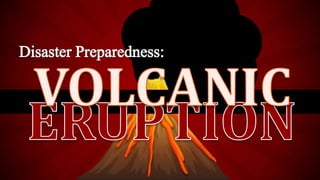
VOLCANIC ERUPTIONS
• When pressure builds up within a volcano's molten rock, it has
the potential to erupt, sending forth lava flows, poisonous gases
and flying rock and ash that can sometimes travel hundreds of
miles downwind.
• Suddenly, the top of a mountain blows off. A ball of fire goes up
into the air. Dark clouds of dust, ash, and cinders cover the sky.
Rivers of fire pour down the sides of the mountain. This is what
can happen when a volcano erupts. Erupting volcanoes have
killed thousands of people. The dust and ash have buried whole
towns.
WHAT TO DO
BEFORE
A VOLCANIC
ERUPTION
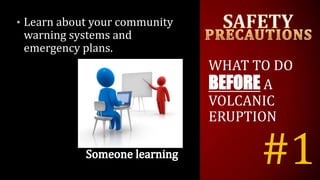
#1
• Learn about your community
warning systems and
emergency plans.
WHAT TO DO
BEFORE A
VOLCANIC
ERUPTION
#2
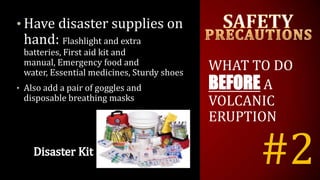
• Have disaster supplies on
hand: Flashlight and extra
batteries, First aid kit and
manual, Emergency food and
water, Essential medicines, Sturdy shoes
• Also add a pair of goggles and
disposable breathing masks
WHAT TO DO
BEFORE A
VOLCANIC
ERUPTION
#3
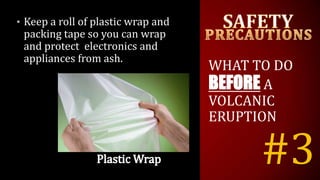
• Keep a roll of plastic wrap and
packing tape so you can wrap
and protect electronics and
appliances from ash.
WHAT TO DO
BEFORE A
VOLCANIC
ERUPTION
#4
•Be preparedfor the hazards that can accompany
volcanoes:
– Mudflows and flash floods
– Landslides and rockfalls
– Earthquakes
– Ashfall and acid rain
– Tsunamis
WHAT TO DO
BEFORE A
VOLCANIC
ERUPTION
#5
• Evaluate sites for risk of
volcanic disasters before even
putting up structures in these
sites. WHAT TO DO
BEFORE A
VOLCANIC
ERUPTION
#6
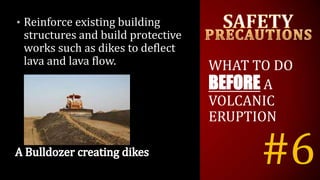
• Reinforce existing building
structures and build protective
works such as dikes to deflect
lava and lava flow. WHAT TO DO
BEFORE A
VOLCANIC
ERUPTION
#7
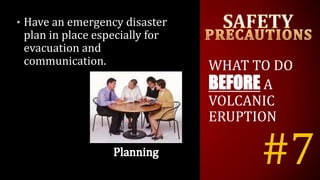
• Have an emergency disaster
plan in place especially for
evacuation and
communication. WHAT TO DO
BEFORE A
VOLCANIC
ERUPTION
WHAT TO DO
DURING
A VOLCANIC
ERUPTION
#1
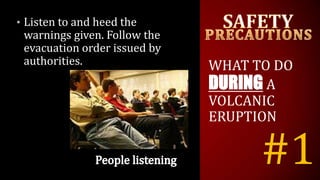
• Listen to and heed the
warnings given. Follow the
evacuation order issued by
authorities. WHAT TO DO
DURING A
VOLCANIC
ERUPTION
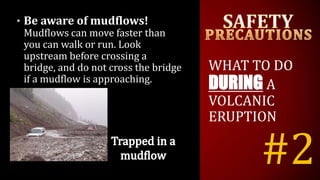
• Be aware of mudflows!
Mudflows can move faster than
you can walk or run. Look
upstream before crossing a
bridge, and do not cross the bridge
if a mudflow is approaching.
#2
WHAT TO DO
DURING A
VOLCANIC
ERUPTION
#3
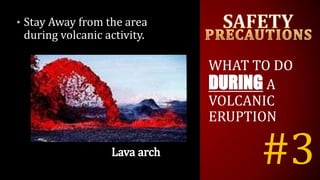
• Stay Away from the area
during volcanic activity.
WHAT TO DO
DURING A
VOLCANIC
ERUPTION
#4
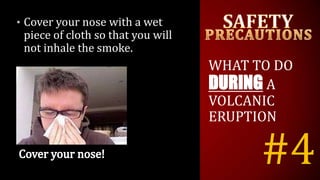
• Cover your nose with a wet
piece of cloth so that you will
not inhale the smoke.
WHAT TO DO
DURING A
VOLCANIC
ERUPTION
#5
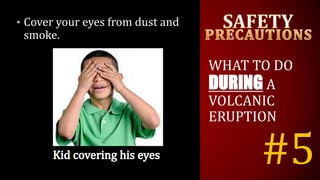
• Cover your eyes from dust and
smoke.
WHAT TO DO
DURING A
VOLCANIC
ERUPTION
#6
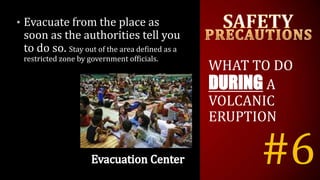
• Evacuate from the place as
soon as the authorities tell you
to do so. Stay out of the area defined as a
restricted zone by government officials.
WHAT TO DO
DURING A
VOLCANIC
ERUPTION
#7
IF INDOORS,
• close all window, doors, and dampers to
keep volcanic ash from entering.
• Put all machinery inside a garage or
barn to protect it from volcanic ash.
• Bring animals and livestock into closed
shelters to protect them from breathing
volcanic ash.
WHAT TO DO
DURING A
VOLCANIC
ERUPTION
#8
IF TRAPPED
OUTDOORS,
– Seek shelter indoors.
– If caught in a rock fall, roll into a ball
to protect your head.
– If caught near a stream, be aware of
mudflows. Move upslope, especially if
you hear the roar of a mudflow.
WHAT TO DO
DURING A
VOLCANIC
ERUPTION
#9
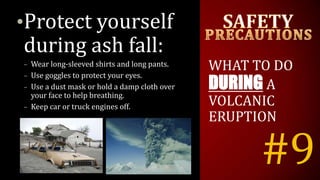
•Protect yourself
during ash fall:
– Wear long-sleeved shirts and long pants.
– Use goggles to protect your eyes.
– Use a dust mask or hold a damp cloth over
your face to help breathing.
– Keep car or truck engines off.
WHAT TO DO
DURING A
VOLCANIC
ERUPTION
WHAT TO DO
AFTER
A VOLCANIC
ERUPTION
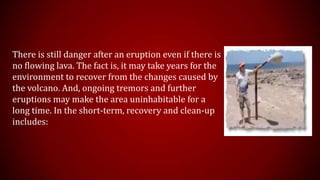
There is still danger after an eruption even if there is
no flowing lava. The fact is, it may take years for the
environment to recover from the changes caused by
the volcano. And, ongoing tremors and further
eruptions may make the area uninhabitable for a
long time. In the short-term, recovery and clean-up
includes:
#1
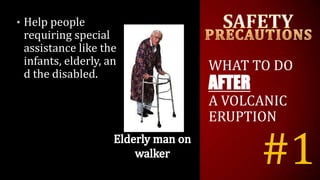
• Help people
requiring special
assistance like the
infants, elderly, an
d the disabled.
WHAT TO DO
AFTER
A VOLCANIC
ERUPTION
#2
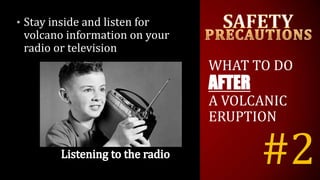
• Stay inside and listen for
volcano information on your
radio or television
WHAT TO DO
AFTER
A VOLCANIC
ERUPTION
#3
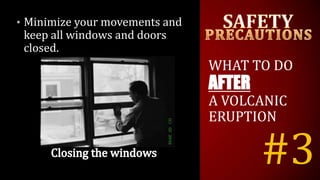
• Minimize your movements and
keep all windows and doors
closed.
WHAT TO DO
AFTER
A VOLCANIC
ERUPTION
#4
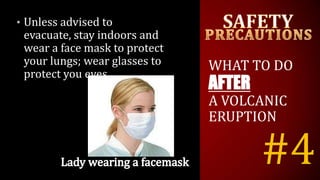
• Unless advised to
evacuate, stay indoors and
wear a face mask to protect
your lungs; wear glasses to
protect you eyes.
WHAT TO DO
AFTER
A VOLCANIC
ERUPTION
#5
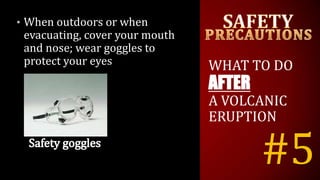
• When outdoors or when
evacuating, cover your mouth
and nose; wear goggles to
protect your eyes WHAT TO DO
AFTER
A VOLCANIC
ERUPTION
#6
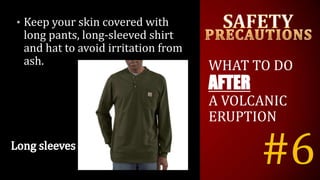
• Keep your skin covered with
long pants, long-sleeved shirt
and hat to avoid irritation from
ash. WHAT TO DO
AFTER
A VOLCANIC
ERUPTION
#7
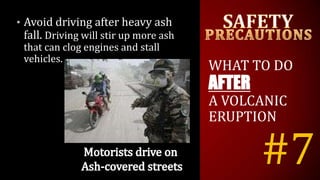
• Avoid driving after heavy ash
fall. Driving will stir up more ash
that can clog engines and stall
vehicles.
WHAT TO DO
AFTER
A VOLCANIC
ERUPTION
#8
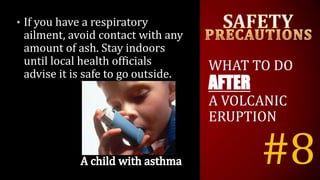
• If you have a respiratory
ailment, avoid contact with any
amount of ash. Stay indoors
until local health officials
advise it is safe to go outside.
WHAT TO DO
AFTER
A VOLCANIC
ERUPTION
#9
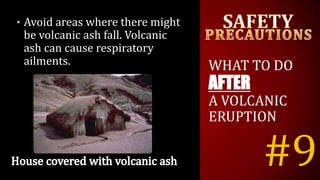
• Avoid areas where there might
be volcanic ash fall. Volcanic
ash can cause respiratory
ailments. WHAT TO DO
AFTER
A VOLCANIC
ERUPTION
#10
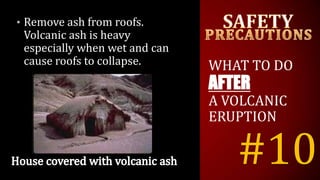
• Remove ash from roofs.
Volcanic ash is heavy
especially when wet and can
cause roofs to collapse. WHAT TO DO
AFTER
A VOLCANIC
ERUPTION
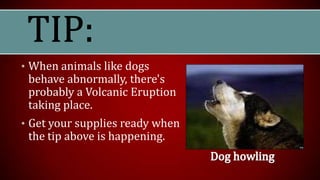
• When animals like dogs
behave abnormally, there's
probably a Volcanic Eruption
taking place.
• Get your supplies ready when
the tip above is happening.
• Materials that is given off by a
volcano is extremely hot, be
careful.
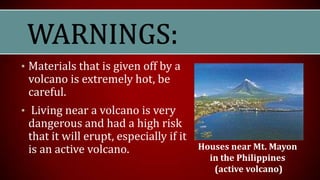
• Living near a volcano is very
dangerous and had a high risk
that it will erupt, especially if it
is an active volcano. Houses near Mt. Mayon
in the Philippines
(active volcano)
• To minimize mudflows, refrain from deforesting the slopes of
the volcano.
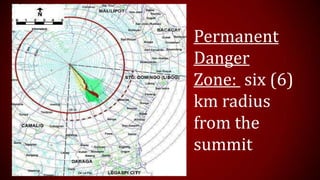
• Comply strictly with PHILVOLCS prohibition against human
settlement in Permanent Danger Zones or areas within 4-6 km
radius from the summit of active volcanoes. Also, heed
warnings and orders for evacuation issued by PHILVOLCS and
the Disaster Coordinating councils (DCCs) in times of volcanic
unrest.
• Construct earthquake-resistant structures areas near active
volcanoes.
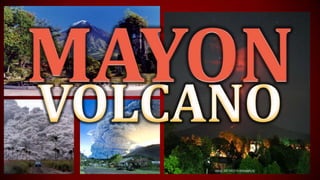
The beautifully symmetrical Mayon
Volcano is the most prominent landform
and most famous symbol of Albay and the
Bicol Region. It is located 15 kilometers
northwest of Legazpi City. Here are some
interesting facts about Mayon Volcano:
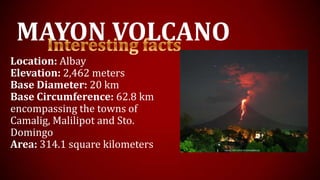
MAYON VOLCANO
Location: Albay
Elevation: 2,462 meters
Base Diameter: 20 km
Base Circumference: 62.8 km
encompassing the towns of
Camalig, Malilipot and Sto.
Domingo
Area: 314.1 square kilometers
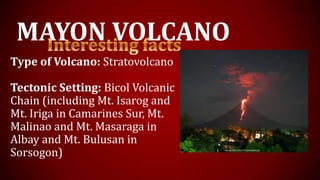
MAYON VOLCANO
Type of Volcano: Stratovolcano
Tectonic Setting: Bicol Volcanic
Chain (including Mt. Isarog and
Mt. Iriga in Camarines Sur, Mt.
Malinao and Mt. Masaraga in
Albay and Mt. Bulusan in
Sorsogon)
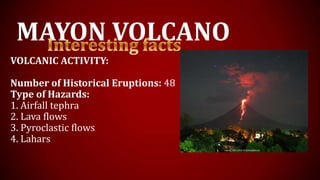
MAYON VOLCANO
VOLCANIC ACTIVITY:
Number of Historical Eruptions: 48
Type of Hazards:
1. Airfall tephra
2. Lava flows
3. Pyroclastic flows
4. Lahars
Permanent
Danger
Zone: six (6)
km radius
from the
summit
MAYON VOLCANO
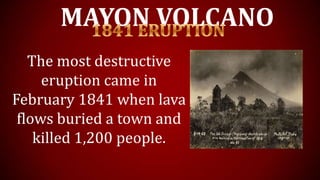
The most destructive
eruption came in
February 1841 when lava
flows buried a town and
killed 1,200 people.
MAYON VOLCANO
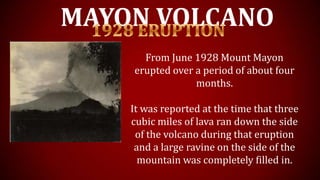
From June 1928 Mount Mayon
erupted over a period of about four
months.
It was reported at the time that three
cubic miles of lava ran down the side
of the volcano during that eruption
and a large ravine on the side of the
mountain was completely filled in.
MAYON VOLCANO
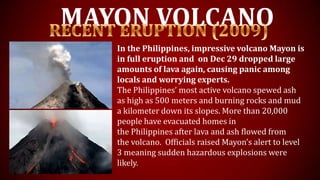
In the Philippines, impressive volcano Mayon is
in full eruption and on Dec 29 dropped large
amounts of lava again, causing panic among
locals and worrying experts.
The Philippines’ most active volcano spewed ash
as high as 500 meters and burning rocks and mud
a kilometer down its slopes. More than 20,000
people have evacuated homes in
the Philippines after lava and ash flowed from
the volcano. Officials raised Mayon’s alert to level
3 meaning sudden hazardous explosions were
likely.
SOURCES:
• http://www.wikihow.com/Be-Ready-in-a-Volcanic-
Eruption
• http://wowlegazpi.com/mayon-volcano-
interesting-facts/
• http://m24digital.com/en/2009/12/16/the-
philippines-20000-evacuees-as-mayon-volcano-
eruption-begins/
• Internet
• Google
• Youtube
Disaster Preparedness: Volcanic eruption

Disaster Preparedness: Volcanic eruption

  • 5.
  • 6.
    VOLCANIC ERUPTIONS • Whenpressure builds up within a volcano's molten rock, it has the potential to erupt, sending forth lava flows, poisonous gases and flying rock and ash that can sometimes travel hundreds of miles downwind. • Suddenly, the top of a mountain blows off. A ball of fire goes up into the air. Dark clouds of dust, ash, and cinders cover the sky. Rivers of fire pour down the sides of the mountain. This is what can happen when a volcano erupts. Erupting volcanoes have killed thousands of people. The dust and ash have buried whole towns.
  • 12.
    WHAT TO DO BEFORE AVOLCANIC ERUPTION
  • 13.
    #1 • Learn aboutyour community warning systems and emergency plans. WHAT TO DO BEFORE A VOLCANIC ERUPTION
  • 14.
    #2 • Have disastersupplies on hand: Flashlight and extra batteries, First aid kit and manual, Emergency food and water, Essential medicines, Sturdy shoes • Also add a pair of goggles and disposable breathing masks WHAT TO DO BEFORE A VOLCANIC ERUPTION
  • 15.
    #3 • Keep aroll of plastic wrap and packing tape so you can wrap and protect electronics and appliances from ash. WHAT TO DO BEFORE A VOLCANIC ERUPTION
  • 16.
    #4 •Be preparedfor thehazards that can accompany volcanoes: – Mudflows and flash floods – Landslides and rockfalls – Earthquakes – Ashfall and acid rain – Tsunamis WHAT TO DO BEFORE A VOLCANIC ERUPTION
  • 17.
    #5 • Evaluate sitesfor risk of volcanic disasters before even putting up structures in these sites. WHAT TO DO BEFORE A VOLCANIC ERUPTION
  • 18.
    #6 • Reinforce existingbuilding structures and build protective works such as dikes to deflect lava and lava flow. WHAT TO DO BEFORE A VOLCANIC ERUPTION
  • 19.
    #7 • Have anemergency disaster plan in place especially for evacuation and communication. WHAT TO DO BEFORE A VOLCANIC ERUPTION
  • 20.
    WHAT TO DO DURING AVOLCANIC ERUPTION
  • 21.
    #1 • Listen toand heed the warnings given. Follow the evacuation order issued by authorities. WHAT TO DO DURING A VOLCANIC ERUPTION
  • 22.
    • Be awareof mudflows! Mudflows can move faster than you can walk or run. Look upstream before crossing a bridge, and do not cross the bridge if a mudflow is approaching. #2 WHAT TO DO DURING A VOLCANIC ERUPTION
  • 23.
    #3 • Stay Awayfrom the area during volcanic activity. WHAT TO DO DURING A VOLCANIC ERUPTION
  • 24.
    #4 • Cover yournose with a wet piece of cloth so that you will not inhale the smoke. WHAT TO DO DURING A VOLCANIC ERUPTION
  • 25.
    #5 • Cover youreyes from dust and smoke. WHAT TO DO DURING A VOLCANIC ERUPTION
  • 26.
    #6 • Evacuate fromthe place as soon as the authorities tell you to do so. Stay out of the area defined as a restricted zone by government officials. WHAT TO DO DURING A VOLCANIC ERUPTION
  • 27.
    #7 IF INDOORS, • closeall window, doors, and dampers to keep volcanic ash from entering. • Put all machinery inside a garage or barn to protect it from volcanic ash. • Bring animals and livestock into closed shelters to protect them from breathing volcanic ash. WHAT TO DO DURING A VOLCANIC ERUPTION
  • 28.
    #8 IF TRAPPED OUTDOORS, – Seekshelter indoors. – If caught in a rock fall, roll into a ball to protect your head. – If caught near a stream, be aware of mudflows. Move upslope, especially if you hear the roar of a mudflow. WHAT TO DO DURING A VOLCANIC ERUPTION
  • 29.
    #9 •Protect yourself during ashfall: – Wear long-sleeved shirts and long pants. – Use goggles to protect your eyes. – Use a dust mask or hold a damp cloth over your face to help breathing. – Keep car or truck engines off. WHAT TO DO DURING A VOLCANIC ERUPTION
  • 30.
    WHAT TO DO AFTER AVOLCANIC ERUPTION
  • 31.
    There is stilldanger after an eruption even if there is no flowing lava. The fact is, it may take years for the environment to recover from the changes caused by the volcano. And, ongoing tremors and further eruptions may make the area uninhabitable for a long time. In the short-term, recovery and clean-up includes:
  • 32.
    #1 • Help people requiringspecial assistance like the infants, elderly, an d the disabled. WHAT TO DO AFTER A VOLCANIC ERUPTION
  • 33.
    #2 • Stay insideand listen for volcano information on your radio or television WHAT TO DO AFTER A VOLCANIC ERUPTION
  • 34.
    #3 • Minimize yourmovements and keep all windows and doors closed. WHAT TO DO AFTER A VOLCANIC ERUPTION
  • 35.
    #4 • Unless advisedto evacuate, stay indoors and wear a face mask to protect your lungs; wear glasses to protect you eyes. WHAT TO DO AFTER A VOLCANIC ERUPTION
  • 36.
    #5 • When outdoorsor when evacuating, cover your mouth and nose; wear goggles to protect your eyes WHAT TO DO AFTER A VOLCANIC ERUPTION
  • 37.
    #6 • Keep yourskin covered with long pants, long-sleeved shirt and hat to avoid irritation from ash. WHAT TO DO AFTER A VOLCANIC ERUPTION
  • 38.
    #7 • Avoid drivingafter heavy ash fall. Driving will stir up more ash that can clog engines and stall vehicles. WHAT TO DO AFTER A VOLCANIC ERUPTION
  • 39.
    #8 • If youhave a respiratory ailment, avoid contact with any amount of ash. Stay indoors until local health officials advise it is safe to go outside. WHAT TO DO AFTER A VOLCANIC ERUPTION
  • 40.
    #9 • Avoid areaswhere there might be volcanic ash fall. Volcanic ash can cause respiratory ailments. WHAT TO DO AFTER A VOLCANIC ERUPTION
  • 41.
    #10 • Remove ashfrom roofs. Volcanic ash is heavy especially when wet and can cause roofs to collapse. WHAT TO DO AFTER A VOLCANIC ERUPTION
  • 42.
    • When animalslike dogs behave abnormally, there's probably a Volcanic Eruption taking place. • Get your supplies ready when the tip above is happening.
  • 43.
    • Materials thatis given off by a volcano is extremely hot, be careful. • Living near a volcano is very dangerous and had a high risk that it will erupt, especially if it is an active volcano. Houses near Mt. Mayon in the Philippines (active volcano)
  • 44.
    • To minimizemudflows, refrain from deforesting the slopes of the volcano. • Comply strictly with PHILVOLCS prohibition against human settlement in Permanent Danger Zones or areas within 4-6 km radius from the summit of active volcanoes. Also, heed warnings and orders for evacuation issued by PHILVOLCS and the Disaster Coordinating councils (DCCs) in times of volcanic unrest. • Construct earthquake-resistant structures areas near active volcanoes.
  • 48.
    The beautifully symmetricalMayon Volcano is the most prominent landform and most famous symbol of Albay and the Bicol Region. It is located 15 kilometers northwest of Legazpi City. Here are some interesting facts about Mayon Volcano:
  • 49.
    MAYON VOLCANO Location: Albay Elevation:2,462 meters Base Diameter: 20 km Base Circumference: 62.8 km encompassing the towns of Camalig, Malilipot and Sto. Domingo Area: 314.1 square kilometers
  • 50.
    MAYON VOLCANO Type ofVolcano: Stratovolcano Tectonic Setting: Bicol Volcanic Chain (including Mt. Isarog and Mt. Iriga in Camarines Sur, Mt. Malinao and Mt. Masaraga in Albay and Mt. Bulusan in Sorsogon)
  • 51.
    MAYON VOLCANO VOLCANIC ACTIVITY: Numberof Historical Eruptions: 48 Type of Hazards: 1. Airfall tephra 2. Lava flows 3. Pyroclastic flows 4. Lahars
  • 52.
    Permanent Danger Zone: six (6) kmradius from the summit
  • 53.
    MAYON VOLCANO The mostdestructive eruption came in February 1841 when lava flows buried a town and killed 1,200 people.
  • 54.
    MAYON VOLCANO From June1928 Mount Mayon erupted over a period of about four months. It was reported at the time that three cubic miles of lava ran down the side of the volcano during that eruption and a large ravine on the side of the mountain was completely filled in.
  • 55.
    MAYON VOLCANO In thePhilippines, impressive volcano Mayon is in full eruption and on Dec 29 dropped large amounts of lava again, causing panic among locals and worrying experts. The Philippines’ most active volcano spewed ash as high as 500 meters and burning rocks and mud a kilometer down its slopes. More than 20,000 people have evacuated homes in the Philippines after lava and ash flowed from the volcano. Officials raised Mayon’s alert to level 3 meaning sudden hazardous explosions were likely.
  • 59.
    SOURCES: • http://www.wikihow.com/Be-Ready-in-a-Volcanic- Eruption • http://wowlegazpi.com/mayon-volcano- interesting-facts/ •http://m24digital.com/en/2009/12/16/the- philippines-20000-evacuees-as-mayon-volcano- eruption-begins/ • Internet • Google • Youtube