Teaching Guide for Discussion
Science Grade 7
MA. RACHEL B. ESPINO
Buhatan National High School
Sorsogon City
 Soil covers the entire Earth. Temperature,
rainfall, chemical changes and
biological action act together to
continuously form soil. Climate, expressed
as both temperature and rainfall effects, is
often considered the most powerful soil-
forming factor.
 Temperature controls how fast chemical reactions
occur. Many reactions proceed more quickly as
temperature increases. Warm-region soils are
normally more developed or more mature than cold-
region soils. Mature soils have more silt and clay on or
near the surface. Thus, soils in the tropical areas are
observed to sustain various farming activities and
account for why the primary source of livelihood in the
Philippines and other countries in the tropical region
is their fertile land.
 Climate (temperature and rainfall) is a significant
factor not only in soil formation but also in sustaining
diversity of plants and animals in the country. On the
other hand, water also directly affects the movement of
soluble soil nutrients from the top soil to deep under
the ground (leaching). These nutrients may no longer
be available to shallow rooted plants. Acidic rainwater
may also contribute to the loss of minerals in soil
resulting in low yield. So rainfall determines the kind
of vegetation in an area. In turn, the degree of
vegetation cover, especially in sloping areas,
determines how much soil is removed.
 Over million of years, the forces of weathering and
erosion, slowly but constantly have produced a layer of
broken pieces of rock all over the earth’s surface. The
size of these rock pieces varies from boulders to the
finest bits. The layer composed of pieces of rock is
called ROCK MANTLE. As the forces of wind and
water go on breaking and decomposing the rock
mantle, a layer of fine loose materials is formed. This is
referred to as SOIL. It is made up of tiny grains of
rocks and materials.
 The natural processes of weathering and
erosion bring about important changes on
the surface rock. These processes
consistently break, carry off and deposit
loose surface materials from where they are
formed to other places. The continued
action of water and wind changes the rock
pieces into finer particles, thus forming
boulders, gravel, sand and clay.
 To these surface materials are added
the decayed remains of plants and
animals called HUMUS. Organic
substances are returned into the soul
after they decompose. Because of their
finer texture, these enable the soil to
hold much water.
 The natural processes that slowly breaks rocks into
little pieces is called WEATHERING. It is a very slow
but continuous process. It wears down the surface of
the earth.
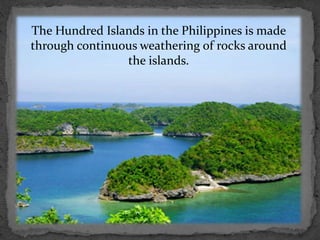
The Hundred Islands in the Philippines is made
through continuous weathering of rocks around
the islands.
 Mechanical weathering includes processes that
break rocks to pieces without changing their chemical
composition. It is brought about by severe
environmental conditions.
a) Rapid changes in temperature. During the day the rock
are heated and then expand. At night, they are cooled
and then contract. Since rocks are composed of
minerals, these minerals expand and contract too. This
alternate expansion and contraction causes the rocks
to crack, especially if the minerals expand and contract
in unequal amounts.
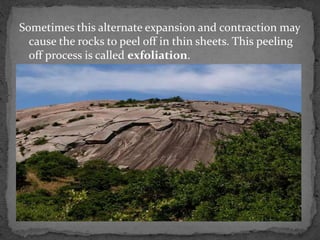
Sometimes this alternate expansion and contraction may
cause the rocks to peel off in thin sheets. This peeling
off process is called exfoliation.
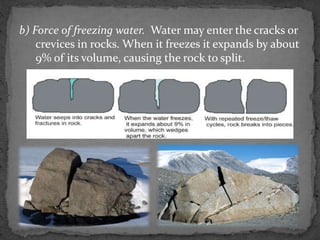
b) Force of freezing water. Water may enter the cracks or
crevices in rocks. When it freezes it expands by about
9% of its volume, causing the rock to split.
c) Roots of trees. Some seeds are accidentally thrown
into the cracks in rocks. When they grow, the roots
creep in and the force of their growing can split rocks.
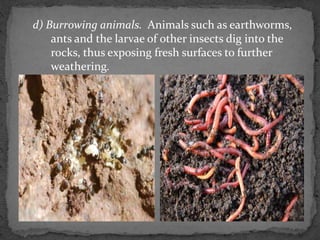
d) Burrowing animals. Animals such as earthworms,
ants and the larvae of other insects dig into the
rocks, thus exposing fresh surfaces to further
weathering.
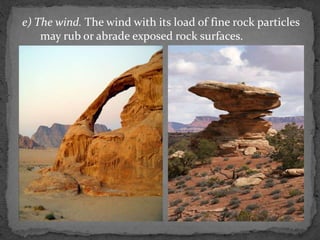
e) The wind. The wind with its load of fine rock particles
may rub or abrade exposed rock surfaces.
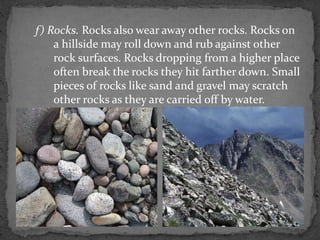
f) Rocks. Rocks also wear away other rocks. Rocks on
a hillside may roll down and rub against other
rock surfaces. Rocks dropping from a higher place
often break the rocks they hit farther down. Small
pieces of rocks like sand and gravel may scratch
other rocks as they are carried off by water.
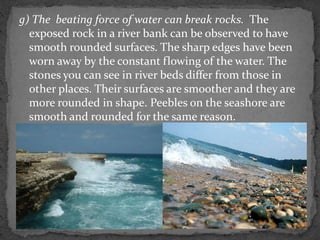
g) The beating force of water can break rocks. The
exposed rock in a river bank can be observed to have
smooth rounded surfaces. The sharp edges have been
worn away by the constant flowing of the water. The
stones you can see in river beds differ from those in
other places. Their surfaces are smoother and they are
more rounded in shape. Peebles on the seashore are
smooth and rounded for the same reason.
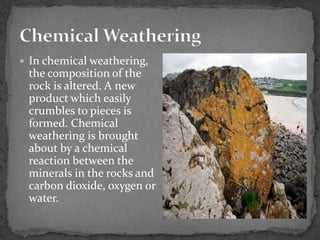
 In chemical weathering,
the composition of the
rock is altered. A new
product which easily
crumbles to pieces is
formed. Chemical
weathering is brought
about by a chemical
reaction between the
minerals in the rocks and
carbon dioxide, oxygen or
water.
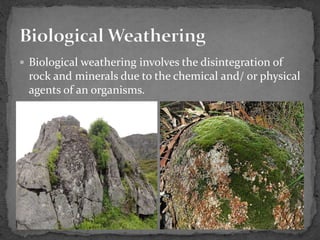
 Biological weathering involves the disintegration of
rock and minerals due to the chemical and/ or physical
agents of an organisms.
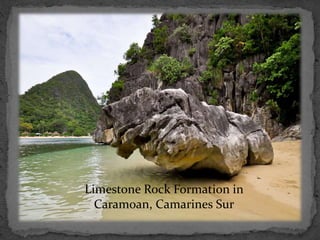
Limestone Rock Formation in
Caramoan, Camarines Sur
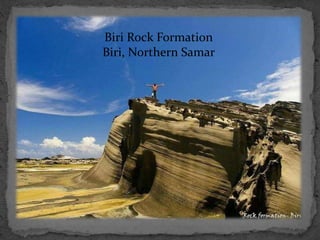
Biri Rock Formation
Biri, Northern Samar
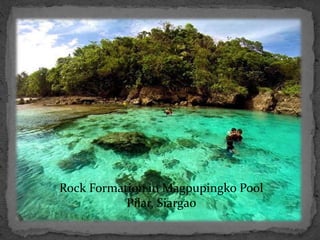
Rock Formation in Magpupingko Pool
Pilar, Siargao
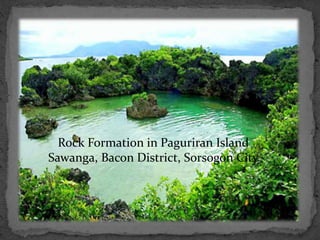
Rock Formation in Paguriran Island
Sawanga, Bacon District, Sorsogon City
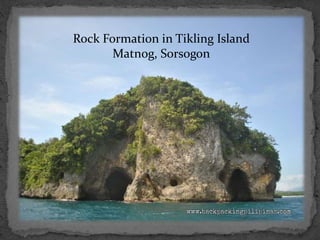
Rock Formation in Tikling Island
Matnog, Sorsogon
To sum it up, the processes of soil
formation is as follows:
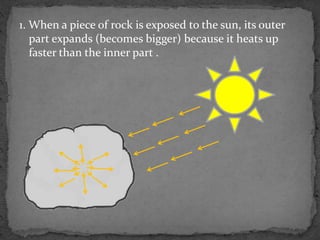
1. When a piece of rock is exposed to the sun, its outer
part expands (becomes bigger) because it heats up
faster than the inner part .
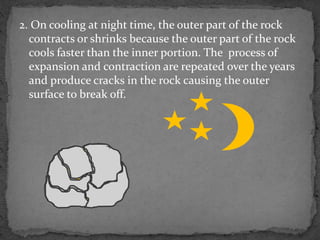
2. On cooling at night time, the outer part of the rock
contracts or shrinks because the outer part of the rock
cools faster than the inner portion. The process of
expansion and contraction are repeated over the years
and produce cracks in the rock causing the outer
surface to break off.
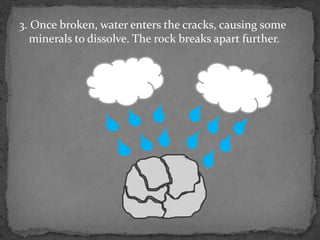
3. Once broken, water enters the cracks, causing some
minerals to dissolve. The rock breaks apart further.
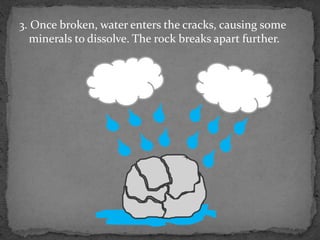
3. Once broken, water enters the cracks, causing some
minerals to dissolve. The rock breaks apart further.
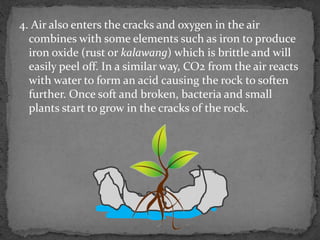
4. Air also enters the cracks and oxygen in the air
combines with some elements such as iron to produce
iron oxide (rust or kalawang) which is brittle and will
easily peel off. In a similar way, CO2 from the air reacts
with water to form an acid causing the rock to soften
further. Once soft and broken, bacteria and small
plants start to grow in the cracks of the rock.
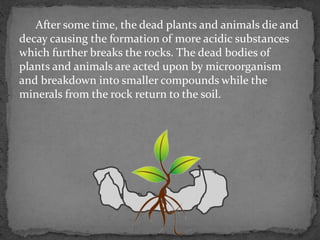
After some time, the dead plants and animals die and
decay causing the formation of more acidic substances
which further breaks the rocks. The dead bodies of
plants and animals are acted upon by microorganism
and breakdown into smaller compounds while the
minerals from the rock return to the soil.
1. Regulates the flow of water on land.
2. Sustains plant and animal life.
3. Filters potential pollutants. The minerals and
microbes in soil are responsible for filtering,
buffering, degrading, immobilizing and detoxifying
organic and inorganic materials including industrial
and municipal by-products and atmospheric
deposits.
4. Aids in cycling nutrients.
5. Supports structures of Earth.
 Science Grade 7 Learners Material (Part Two). DepEd
Philippines, 2012
 Integrated Science I. DepEd Philippines, 2009
 Salandanan, Gloria G. Earth Science. Quezon City:
Phoenix Publishing House, 1988

Soil formation

  • 1.
    Teaching Guide forDiscussion Science Grade 7 MA. RACHEL B. ESPINO Buhatan National High School Sorsogon City
  • 2.
     Soil coversthe entire Earth. Temperature, rainfall, chemical changes and biological action act together to continuously form soil. Climate, expressed as both temperature and rainfall effects, is often considered the most powerful soil- forming factor.
  • 3.
     Temperature controlshow fast chemical reactions occur. Many reactions proceed more quickly as temperature increases. Warm-region soils are normally more developed or more mature than cold- region soils. Mature soils have more silt and clay on or near the surface. Thus, soils in the tropical areas are observed to sustain various farming activities and account for why the primary source of livelihood in the Philippines and other countries in the tropical region is their fertile land.
  • 4.
     Climate (temperatureand rainfall) is a significant factor not only in soil formation but also in sustaining diversity of plants and animals in the country. On the other hand, water also directly affects the movement of soluble soil nutrients from the top soil to deep under the ground (leaching). These nutrients may no longer be available to shallow rooted plants. Acidic rainwater may also contribute to the loss of minerals in soil resulting in low yield. So rainfall determines the kind of vegetation in an area. In turn, the degree of vegetation cover, especially in sloping areas, determines how much soil is removed.
  • 5.
     Over millionof years, the forces of weathering and erosion, slowly but constantly have produced a layer of broken pieces of rock all over the earth’s surface. The size of these rock pieces varies from boulders to the finest bits. The layer composed of pieces of rock is called ROCK MANTLE. As the forces of wind and water go on breaking and decomposing the rock mantle, a layer of fine loose materials is formed. This is referred to as SOIL. It is made up of tiny grains of rocks and materials.
  • 6.
     The naturalprocesses of weathering and erosion bring about important changes on the surface rock. These processes consistently break, carry off and deposit loose surface materials from where they are formed to other places. The continued action of water and wind changes the rock pieces into finer particles, thus forming boulders, gravel, sand and clay.
  • 7.
     To thesesurface materials are added the decayed remains of plants and animals called HUMUS. Organic substances are returned into the soul after they decompose. Because of their finer texture, these enable the soil to hold much water.
  • 9.
     The naturalprocesses that slowly breaks rocks into little pieces is called WEATHERING. It is a very slow but continuous process. It wears down the surface of the earth.
  • 10.
    The Hundred Islandsin the Philippines is made through continuous weathering of rocks around the islands.
  • 11.
     Mechanical weatheringincludes processes that break rocks to pieces without changing their chemical composition. It is brought about by severe environmental conditions. a) Rapid changes in temperature. During the day the rock are heated and then expand. At night, they are cooled and then contract. Since rocks are composed of minerals, these minerals expand and contract too. This alternate expansion and contraction causes the rocks to crack, especially if the minerals expand and contract in unequal amounts.
  • 12.
    Sometimes this alternateexpansion and contraction may cause the rocks to peel off in thin sheets. This peeling off process is called exfoliation.
  • 13.
    b) Force offreezing water. Water may enter the cracks or crevices in rocks. When it freezes it expands by about 9% of its volume, causing the rock to split.
  • 14.
    c) Roots oftrees. Some seeds are accidentally thrown into the cracks in rocks. When they grow, the roots creep in and the force of their growing can split rocks.
  • 15.
    d) Burrowing animals.Animals such as earthworms, ants and the larvae of other insects dig into the rocks, thus exposing fresh surfaces to further weathering.
  • 16.
    e) The wind.The wind with its load of fine rock particles may rub or abrade exposed rock surfaces.
  • 17.
    f) Rocks. Rocksalso wear away other rocks. Rocks on a hillside may roll down and rub against other rock surfaces. Rocks dropping from a higher place often break the rocks they hit farther down. Small pieces of rocks like sand and gravel may scratch other rocks as they are carried off by water.
  • 18.
    g) The beatingforce of water can break rocks. The exposed rock in a river bank can be observed to have smooth rounded surfaces. The sharp edges have been worn away by the constant flowing of the water. The stones you can see in river beds differ from those in other places. Their surfaces are smoother and they are more rounded in shape. Peebles on the seashore are smooth and rounded for the same reason.
  • 19.
     In chemicalweathering, the composition of the rock is altered. A new product which easily crumbles to pieces is formed. Chemical weathering is brought about by a chemical reaction between the minerals in the rocks and carbon dioxide, oxygen or water.
  • 20.
     Biological weatheringinvolves the disintegration of rock and minerals due to the chemical and/ or physical agents of an organisms.
  • 21.
    Limestone Rock Formationin Caramoan, Camarines Sur
  • 23.
  • 24.
    Rock Formation inMagpupingko Pool Pilar, Siargao
  • 25.
    Rock Formation inPaguriran Island Sawanga, Bacon District, Sorsogon City
  • 26.
    Rock Formation inTikling Island Matnog, Sorsogon
  • 27.
    To sum itup, the processes of soil formation is as follows:
  • 28.
    1. When apiece of rock is exposed to the sun, its outer part expands (becomes bigger) because it heats up faster than the inner part .
  • 29.
    2. On coolingat night time, the outer part of the rock contracts or shrinks because the outer part of the rock cools faster than the inner portion. The process of expansion and contraction are repeated over the years and produce cracks in the rock causing the outer surface to break off.
  • 30.
    3. Once broken,water enters the cracks, causing some minerals to dissolve. The rock breaks apart further.
  • 31.
    3. Once broken,water enters the cracks, causing some minerals to dissolve. The rock breaks apart further.
  • 32.
    4. Air alsoenters the cracks and oxygen in the air combines with some elements such as iron to produce iron oxide (rust or kalawang) which is brittle and will easily peel off. In a similar way, CO2 from the air reacts with water to form an acid causing the rock to soften further. Once soft and broken, bacteria and small plants start to grow in the cracks of the rock.
  • 33.
    After some time,the dead plants and animals die and decay causing the formation of more acidic substances which further breaks the rocks. The dead bodies of plants and animals are acted upon by microorganism and breakdown into smaller compounds while the minerals from the rock return to the soil.
  • 34.
    1. Regulates theflow of water on land. 2. Sustains plant and animal life. 3. Filters potential pollutants. The minerals and microbes in soil are responsible for filtering, buffering, degrading, immobilizing and detoxifying organic and inorganic materials including industrial and municipal by-products and atmospheric deposits. 4. Aids in cycling nutrients. 5. Supports structures of Earth.
  • 35.
     Science Grade7 Learners Material (Part Two). DepEd Philippines, 2012  Integrated Science I. DepEd Philippines, 2009  Salandanan, Gloria G. Earth Science. Quezon City: Phoenix Publishing House, 1988

Editor's Notes

  • #28 As given in activity 4: How are soils formed from rocks...LM pp 90-91