OPTOM FASLU MUHAMMEDOPTOM FASLU MUHAMMED
CHEMISTRY OF VITAMIN A
• VITAMIN A is fat soluble vitamin
• Pro-Vitamin Beta-Carotene present in plant tissues give
rise two molecules of Vitamin A.
• All compounds with Vitamin A activity is called retinods.
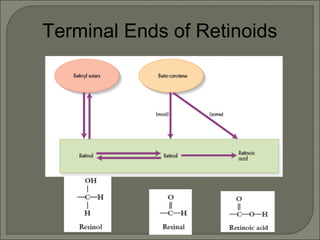
• Retinol (alcohol) Retinal (aldehyde) & Retinoic acid
(Vitamin A acid)
• Retinal on reduction gives Retinol & on oxidation
Retoinic acid.
• Vitamin A1 – all trans variety of retinal is most common
• Vitamin A2 – found in fish oils.
• Biologically important compounds is 11 Cis – Retinal.
 Intestine is the major site
 Cleavage of Beta Carotene by di-
oxygenase results in the formation of
retinal.
 Intestine retinal is reduced to retinol.
 Absorption requires fat & Bile salts.
 It is transported to the liver and stored as
retinal Palmitate.
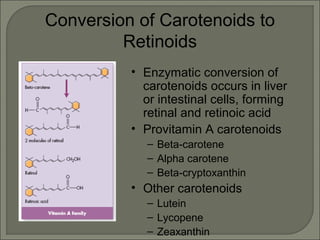
Conversion of Carotenoids to
Retinoids
• Enzymatic conversion of
carotenoids occurs in liver
or intestinal cells, forming
retinal and retinoic acid
• Provitamin A carotenoids
– Beta-carotene
– Alpha carotene
– Beta-cryptoxanthin
• Other carotenoids
– Lutein
– Lycopene
– Zeaxanthin
Absorption of Vitamin A
• Retinoids
– Retinyl esters broken down to free retinol in
small intestine - requires bile, digestive
enzymes, integration into micelles
– Once absorbed, retinyl esters reformed in
intestinal cells
– 90% of retinoids can be absorbed
• Carotenoids
– Absorbed intact, absorption rate much lower
– Intestinal cells can convert carotenoids to
retinoids
Transport and Storage of Vitamin A
• Liver stores 90% of vitamin A in the body
• Reserve is adequate for several months
• Transported via chylomicrons from intestinal
cells to the liver
• Transported from the liver to target tissue as
retinol via retinol-binding protein.
• Retinol- RBP Complex binds to specific
receptors on retina, skin,gonads & other
tissues.
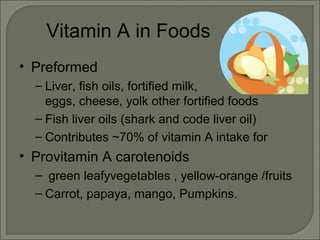
Vitamin A in Foods
• Preformed
– Liver, fish oils, fortified milk,
eggs, cheese, yolk other fortified foods
– Fish liver oils (shark and code liver oil)
– Contributes ~70% of vitamin A intake for
• Provitamin A carotenoids
– green leafyvegetables , yellow-orange /fruits
– Carrot, papaya, mango, Pumpkins.
NORMAL CONCENTRATION IN BLOOD
&
RECOMMENDED DAILY ALLOWANCE
• 0.15 to 0.6 mg/dl
• Children (400-600) microgram/day
• Men-(750-1000) microgram/day
• Women -750 microgram/day
• Pregnancy- 1000 microgram/day
• Lactation - 1200µg/day
Functions of Vitamin A: Vision
• Retinal turns visual light into nerve signals
in retina of eye
• Retinoic acid required for structural
components of eye
– Cones in the retina
• Responsible for vision under bright lights
• Translate objects to color vision
– Rods in the retina
• Responsible for vision in dim lights
• Translate objects to black and white vision
Functions of Vitamin A:
Growth and Differentiation of Cells
• Retinoic acid is necessary for cellular
differentiation
• Retinol is Important for embryo
development, gene expression.
• Retinoic acid influences production,
structure, and function of epithelial cells
that line the outside (skin) and external
passages (mucus forming cells) within the
body
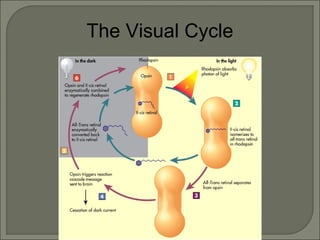
The Visual Cycle
 During Bright light Entire Rhodopsin is
found to be in bleached condition and
when the person moves in to dark area it
takes a few seconds to resynthesize the
rhodospin to activate the Rod cells to
restore vision in the Dim light.
 This time interval is called Dark
adaptation time and it is found to be high
in Vitamin A deficiency.
Functions of Vitamin A:
Immunity
• Deficiency leads to decreased resistance
to infections
• Supplementation may decrease severity of
infections in deficient person
 Vitamin A can act as antioxidant
 Due to the antioxidant property it can
exhibit anticancer activity.
 Effect of vitamin A is complementary to
VitaminE
 Beta Carotene Prevents cancer
 Retinol can act as steroid hormone
controlling the expression of genes
 Retinoic acid is found to have important
role in Glycoprotein synthesis.
Terminal Ends of Retinoids
Deficiency of Vitamin A
• Most susceptible
populations:
– Preschool children
with low F&V intake
– Urban poor
– Older adults
– Alcoholism
– Liver disease (limits
storage)
– Fat malabsorption
• Consequences:
– Night blindness
– Decreased mucus
production
– Decreased immunity
– Bacterial invasion of
the eye
– Conjunctival xerosis
– Bitot’s spots
– Xerophthalmia
– Irreversible blindness
– Follicular
hyperkeratosis
– Poor growth
 Nyctalopia;-Night Blindness
 Xeropthalmia;- conjuctiva become thick
and wrinkled. Conjuctiva become
keratinised.
 Bitot’s Spot:- Greyish Traingular spots
adherent to Conjuctiva.reversed if proper
supply of Vitamin A maintained.
 Keratomalacia;-Softening of the cornea.
 Corneal epithelium gets degenerated
and vascularised.
 Hyperkeratinisation of respiratory,
gastrointestinal tract and urinary tract.
 Epithelium atrophied, Urinary Calculi.
 Generalised infections observed in
skin.
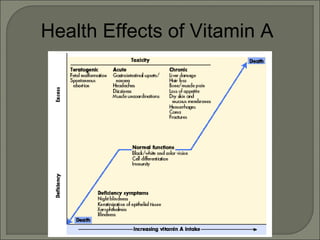
Health Effects of Vitamin A

Vitamin a

  • 1.
  • 2.
    CHEMISTRY OF VITAMINA • VITAMIN A is fat soluble vitamin • Pro-Vitamin Beta-Carotene present in plant tissues give rise two molecules of Vitamin A. • All compounds with Vitamin A activity is called retinods. • Retinol (alcohol) Retinal (aldehyde) & Retinoic acid (Vitamin A acid) • Retinal on reduction gives Retinol & on oxidation Retoinic acid. • Vitamin A1 – all trans variety of retinal is most common • Vitamin A2 – found in fish oils. • Biologically important compounds is 11 Cis – Retinal.
  • 3.
     Intestine isthe major site  Cleavage of Beta Carotene by di- oxygenase results in the formation of retinal.  Intestine retinal is reduced to retinol.  Absorption requires fat & Bile salts.  It is transported to the liver and stored as retinal Palmitate.
  • 4.
    Conversion of Carotenoidsto Retinoids • Enzymatic conversion of carotenoids occurs in liver or intestinal cells, forming retinal and retinoic acid • Provitamin A carotenoids – Beta-carotene – Alpha carotene – Beta-cryptoxanthin • Other carotenoids – Lutein – Lycopene – Zeaxanthin
  • 5.
    Absorption of VitaminA • Retinoids – Retinyl esters broken down to free retinol in small intestine - requires bile, digestive enzymes, integration into micelles – Once absorbed, retinyl esters reformed in intestinal cells – 90% of retinoids can be absorbed • Carotenoids – Absorbed intact, absorption rate much lower – Intestinal cells can convert carotenoids to retinoids
  • 6.
    Transport and Storageof Vitamin A • Liver stores 90% of vitamin A in the body • Reserve is adequate for several months • Transported via chylomicrons from intestinal cells to the liver • Transported from the liver to target tissue as retinol via retinol-binding protein. • Retinol- RBP Complex binds to specific receptors on retina, skin,gonads & other tissues.
  • 7.
    Vitamin A inFoods • Preformed – Liver, fish oils, fortified milk, eggs, cheese, yolk other fortified foods – Fish liver oils (shark and code liver oil) – Contributes ~70% of vitamin A intake for • Provitamin A carotenoids – green leafyvegetables , yellow-orange /fruits – Carrot, papaya, mango, Pumpkins.
  • 8.
    NORMAL CONCENTRATION INBLOOD & RECOMMENDED DAILY ALLOWANCE • 0.15 to 0.6 mg/dl • Children (400-600) microgram/day • Men-(750-1000) microgram/day • Women -750 microgram/day • Pregnancy- 1000 microgram/day • Lactation - 1200µg/day
  • 9.
    Functions of VitaminA: Vision • Retinal turns visual light into nerve signals in retina of eye • Retinoic acid required for structural components of eye – Cones in the retina • Responsible for vision under bright lights • Translate objects to color vision – Rods in the retina • Responsible for vision in dim lights • Translate objects to black and white vision
  • 10.
    Functions of VitaminA: Growth and Differentiation of Cells • Retinoic acid is necessary for cellular differentiation • Retinol is Important for embryo development, gene expression. • Retinoic acid influences production, structure, and function of epithelial cells that line the outside (skin) and external passages (mucus forming cells) within the body
  • 11.
  • 12.
     During Brightlight Entire Rhodopsin is found to be in bleached condition and when the person moves in to dark area it takes a few seconds to resynthesize the rhodospin to activate the Rod cells to restore vision in the Dim light.  This time interval is called Dark adaptation time and it is found to be high in Vitamin A deficiency.
  • 13.
    Functions of VitaminA: Immunity • Deficiency leads to decreased resistance to infections • Supplementation may decrease severity of infections in deficient person
  • 14.
     Vitamin Acan act as antioxidant  Due to the antioxidant property it can exhibit anticancer activity.  Effect of vitamin A is complementary to VitaminE  Beta Carotene Prevents cancer  Retinol can act as steroid hormone controlling the expression of genes  Retinoic acid is found to have important role in Glycoprotein synthesis.
  • 15.
  • 16.
    Deficiency of VitaminA • Most susceptible populations: – Preschool children with low F&V intake – Urban poor – Older adults – Alcoholism – Liver disease (limits storage) – Fat malabsorption • Consequences: – Night blindness – Decreased mucus production – Decreased immunity – Bacterial invasion of the eye – Conjunctival xerosis – Bitot’s spots – Xerophthalmia – Irreversible blindness – Follicular hyperkeratosis – Poor growth
  • 17.
     Nyctalopia;-Night Blindness Xeropthalmia;- conjuctiva become thick and wrinkled. Conjuctiva become keratinised.  Bitot’s Spot:- Greyish Traingular spots adherent to Conjuctiva.reversed if proper supply of Vitamin A maintained.  Keratomalacia;-Softening of the cornea.  Corneal epithelium gets degenerated and vascularised.
  • 18.
     Hyperkeratinisation ofrespiratory, gastrointestinal tract and urinary tract.  Epithelium atrophied, Urinary Calculi.  Generalised infections observed in skin.
  • 19.