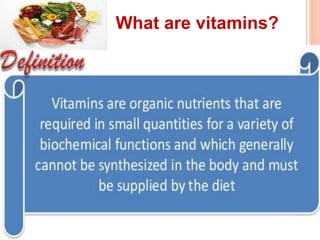
What are vitamins?
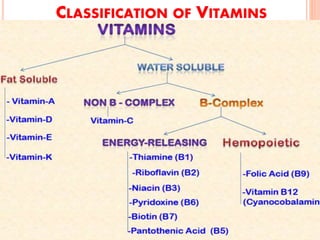
CLASSIFICATION OF VITAMINS
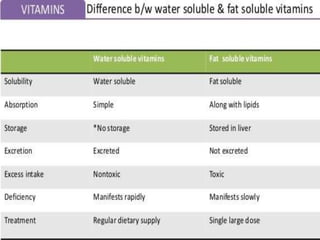
DIFFERENCE BETWEEN FAT SOLUBLE &
WATER SOLUBLE VITAMINS
VITAMIN A
CHEMISTRY
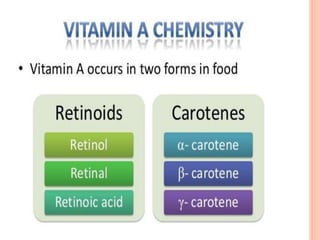
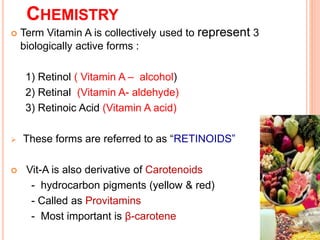
 Term Vitamin A is collectively used to represent 3
biologically active forms :
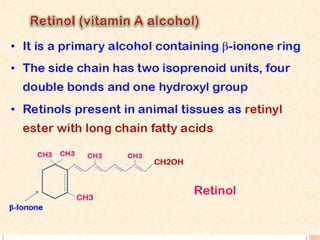
1) Retinol ( Vitamin A – alcohol)
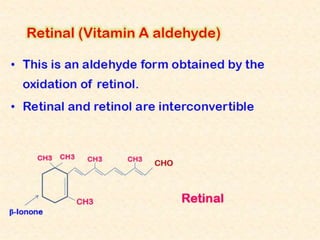
2) Retinal (Vitamin A- aldehyde)
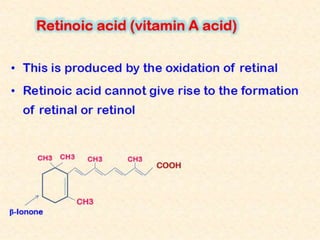
3) Retinoic Acid (Vitamin A acid)
 These forms are referred to as “RETINOIDS”
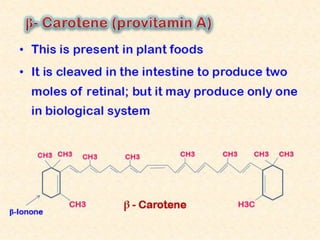
 Vit-A is also derivative of Carotenoids
- hydrocarbon pigments (yellow & red)
- Called as Provitamins
- Most important is β-carotene
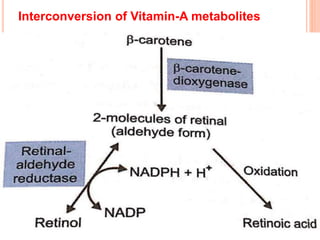
Interconversion of Vitamin-A metabolites
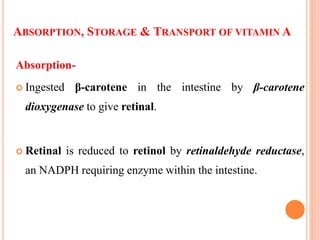
ABSORPTION, STORAGE & TRANSPORT OF VITAMIN A
Absorption-
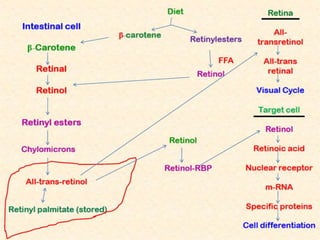
 Ingested β-carotene in the intestine by β-carotene
dioxygenase to give retinal.
 Retinal is reduced to retinol by retinaldehyde reductase,
an NADPH requiring enzyme within the intestine.
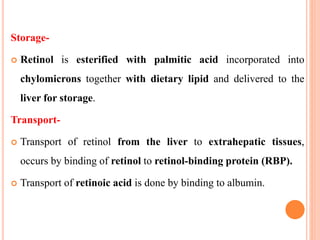
Storage-
 Retinol is esterified with palmitic acid incorporated into
chylomicrons together with dietary lipid and delivered to the
liver for storage.
Transport-
 Transport of retinol from the liver to extrahepatic tissues,
occurs by binding of retinol to retinol-binding protein (RBP).
 Transport of retinoic acid is done by binding to albumin.
FUNCTIONS OF VITAMIN A
 Different forms of Vitamin A have different functions
- Retinal & Retinol involved in vision
- Retinoic acid for growth and cellular
differentiation
- β-Carotene have an antioxidant role.
1) ROLE IN VISION
- Biochemical function of vitamin A in visual cycle was
discovered by George Wald
- Events occur in cyclic process known as “Wald’s
visual cycle”
 Retina of eyes contain 2 types of receptor cells:
- Rods – involved in dim light vision
- Cones – involved in bright light and color vision
 In retinal rod cells, light sensing protein Rhodopsin
is present
 Rhodopsin is made up of – 11-cis-retinal & protein
opsin
 11-cis retinal serves as light absorbing part.
 When light falls on Rhodopsin,a series of
photochemical isomerizations occurs, splits into
Opsin and all -trans retinal
 This trigger a nerve impulse that is transmitted by
optic nerve to the brain.
WALD’S VISUAL CYCLE
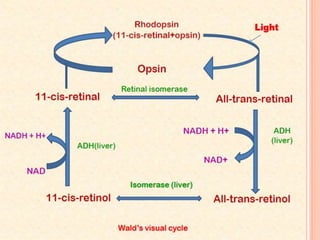
 The all-trans-retinal is immediately isomerized by
retinal isomerase to 11-cis-retinal.
 11-cis-retinal combines with opsin to regenerate
rhodopsin and complete the visual cycle.
IN LIVER-
 The conversion of all-trans-retinal to 11-cis-retinal is
incomplete.
 Remaining all-trans-retinal which is not converted to
11-cis-retinal is converted to all-trans-retinol by
alcohol dehydrogenase, gets stored in liver.
 When needed, all-trans-retinol re-enters circulation
which is taken up by retina.
 All-trans-retinol is converted back to 11-cis retinal,
which combines with Opsin & again to form Rhodopsin
 This completes- WALD’S VISUAL CYCLE.
DARK ADAPTATION TIME
 When person shifts from bright light to dark, there is
difficulty in seeing and after a few minutes the vision
improves
 During these few minutes Rhodopsin is
resynthesized and vision is improved.
 The time taken for regeneration of rhodopsin is
referred to as the Dark Adaptation Time
 Deficiency of vitamin A
Increase in dark adaptation time
 Night blindness
 Retinoic acid is important regulator of gene
expressionbinds to response elements of DNA
regulate transcription of genes.
3) Cell Growth And Differentiation
 Retinoic acid is required for cell differentiation in
spermatogenesis & epithelial cells.
2) Role In Gene Expresssion
4) Required For Maintenance Of Healthy Epithelial Cells
- Deficiency leads to keratinization of epithelial cells
5) Role In Glycoprotein & Mucopolysaccharide Synthesis
- Necessary for mucus secretion
6) Antioxidant Role-
- β carotene is an antioxidant traps free radicals in
tissues.
- Prevent the development of Cancer and cardiovascular
diseases
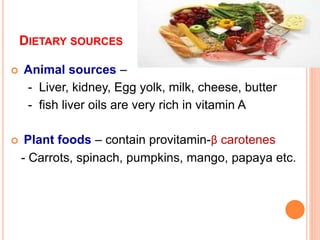
DIETARY SOURCES
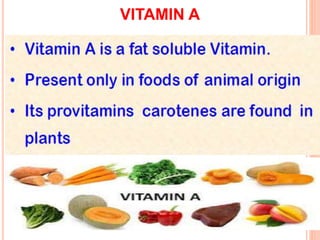
 Animal sources –
- Liver, kidney, Egg yolk, milk, cheese, butter
- fish liver oils are very rich in vitamin A
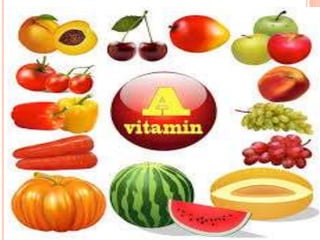
 Plant foods – contain provitamin-β carotenes
- Carrots, spinach, pumpkins, mango, papaya etc.
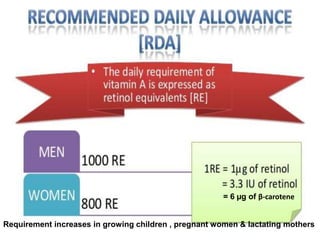
RDA

Requirement increases in growing children , pregnant women & lactating mothers
= 6 µg of β-carotene
DEFICIENCY OF VITAMIN A:
Causes-
 May be Primary or secondary
 Primary causes – Inadequate dietary intake
 Secondary causes-
- Failure to cleave β-carotene because of enzyme
defect
- Failure to synthesize chylomicrons
- Impaired storage in hepatic cells due to liver
disease
- Failure to synthesize RBP
DEFICIENCY MANIFESTATIONS
Deficiency manifestations of Eyes
 NIGHT BLINDNESS - is one of the earliest signs of vitamin A
deficiency.
- have difficulty to see in dim light since dark adaptation
time is increased.
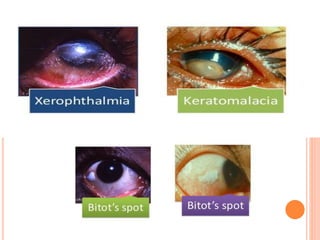
 XEROPHTHALMIA- leads to severe deficiency .
-changes occur in lacrimal glands leading to dryness of
conjunctiva & Cornea
 BITOT’S SPOTS - In conjunctiva, greyish- white triangular
plaques.
-This is due to increased thickness of conjunctiva in
certain areas.
 KERATOMALACIA- If Xerophthalmia persists for long time,
- corneal epithelium becomes keratinized, opaque and
becomes softened and ulcerated.
- ultimate result is blindness.
 Effect on growth – growth retardation due to
impairment in skeletal formation
 Effect on reproduction – degeneration of germinal
epithelium leads to sterility in males
- incidence of miscarriage and malformed
offspring
 Effect on skin – dry , rough and scaly skin.
 Effect on epithelial cells - keratinization of GIT,
Urinary tract & respiratory tract- leads to increased
bacterial infection
ASSESSMENT OF DEFICIENCY
1. Dark adaptation test
2. RBP level in serum
3. Vitamin A level in serum
 Normal blood level of vitamin A is
25 to 30 µgm/dl.
VITAMIN A TOXICITY
 Excessive intake of vitamin A produces a toxic syndrome
called hypervitaminosis A syndrome
 Symptoms are :
- dermatitis(dryness and redness of skin)
- hepatic dysfunction
- skeletal decalcification
- joint pains
- loss of weight
- loss of hair
 During pregnancy -congenital malformation of foetus.
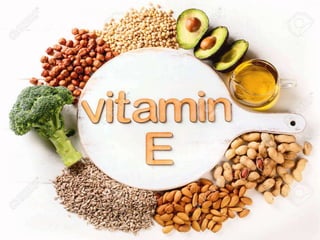
VITAMIN-E
 Vitamin-E is chemically known as Tocopherol
(tocos means childbirth).
 It plays a role in cellular respiration.
 It is an antioxidant that acts as a scavenger for
molecular oxygen and free-radicals.
 It is known as anti-sterility vitamin.
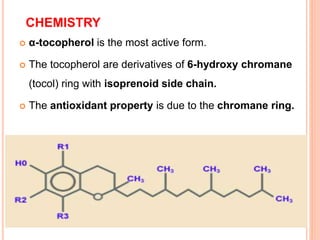
CHEMISTRY
 α-tocopherol is the most active form.
 The tocopherol are derivatives of 6-hydroxy chromane
(tocol) ring with isoprenoid side chain.
 The antioxidant property is due to the chromane ring.
ABSORPTION, TRANSPORT, & STORAGE
Absorption-
 Vitamin E is absorbed from intestine together with dietary lipid.
 It is delivered to the liver via chylomicron.
Transport-
 The liver can export vitamin E into VLDL to target cells.
 In cells, tocopherols are distributed where antioxidant activity is
required.
Storage-
 The major site of vitamin E storage is in adipose tissue.
BIOCHEMICAL FUNCTIONS
 Vitamin E act as a natural antioxidant by scavenging free radicals
and singlet molecular oxygen.
 It protects the RBCs from hemolysis by oxidizng agents(e.g H2O2)
 Vitamin E also help to prevent oxidation of LDL(oxidized LDL
promotes heart disease)
 Vitamin E is required for normal reproduction and prevent
sterility.
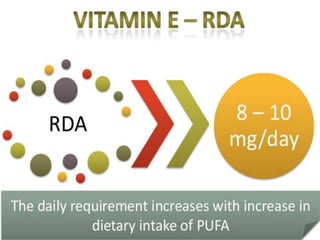
 It controls metabolism of PUFA (such as –linoleic acid , linolenic
acid)
Vitamin a e
Vitamin a e
Vitamin a e

Vitamin a e

  • 2.
  • 3.
  • 4.
    DIFFERENCE BETWEEN FATSOLUBLE & WATER SOLUBLE VITAMINS
  • 6.
  • 8.
    CHEMISTRY  Term VitaminA is collectively used to represent 3 biologically active forms : 1) Retinol ( Vitamin A – alcohol) 2) Retinal (Vitamin A- aldehyde) 3) Retinoic Acid (Vitamin A acid)  These forms are referred to as “RETINOIDS”  Vit-A is also derivative of Carotenoids - hydrocarbon pigments (yellow & red) - Called as Provitamins - Most important is β-carotene
  • 13.
  • 14.
    ABSORPTION, STORAGE &TRANSPORT OF VITAMIN A Absorption-  Ingested β-carotene in the intestine by β-carotene dioxygenase to give retinal.  Retinal is reduced to retinol by retinaldehyde reductase, an NADPH requiring enzyme within the intestine.
  • 15.
    Storage-  Retinol isesterified with palmitic acid incorporated into chylomicrons together with dietary lipid and delivered to the liver for storage. Transport-  Transport of retinol from the liver to extrahepatic tissues, occurs by binding of retinol to retinol-binding protein (RBP).  Transport of retinoic acid is done by binding to albumin.
  • 17.
    FUNCTIONS OF VITAMINA  Different forms of Vitamin A have different functions - Retinal & Retinol involved in vision - Retinoic acid for growth and cellular differentiation - β-Carotene have an antioxidant role.
  • 18.
    1) ROLE INVISION - Biochemical function of vitamin A in visual cycle was discovered by George Wald - Events occur in cyclic process known as “Wald’s visual cycle”  Retina of eyes contain 2 types of receptor cells: - Rods – involved in dim light vision - Cones – involved in bright light and color vision
  • 19.
     In retinalrod cells, light sensing protein Rhodopsin is present  Rhodopsin is made up of – 11-cis-retinal & protein opsin  11-cis retinal serves as light absorbing part.
  • 20.
     When lightfalls on Rhodopsin,a series of photochemical isomerizations occurs, splits into Opsin and all -trans retinal  This trigger a nerve impulse that is transmitted by optic nerve to the brain. WALD’S VISUAL CYCLE
  • 21.
     The all-trans-retinalis immediately isomerized by retinal isomerase to 11-cis-retinal.  11-cis-retinal combines with opsin to regenerate rhodopsin and complete the visual cycle.
  • 22.
    IN LIVER-  Theconversion of all-trans-retinal to 11-cis-retinal is incomplete.  Remaining all-trans-retinal which is not converted to 11-cis-retinal is converted to all-trans-retinol by alcohol dehydrogenase, gets stored in liver.
  • 23.
     When needed,all-trans-retinol re-enters circulation which is taken up by retina.  All-trans-retinol is converted back to 11-cis retinal, which combines with Opsin & again to form Rhodopsin  This completes- WALD’S VISUAL CYCLE.
  • 25.
    DARK ADAPTATION TIME When person shifts from bright light to dark, there is difficulty in seeing and after a few minutes the vision improves  During these few minutes Rhodopsin is resynthesized and vision is improved.
  • 26.
     The timetaken for regeneration of rhodopsin is referred to as the Dark Adaptation Time  Deficiency of vitamin A Increase in dark adaptation time  Night blindness
  • 29.
     Retinoic acidis important regulator of gene expressionbinds to response elements of DNA regulate transcription of genes. 3) Cell Growth And Differentiation  Retinoic acid is required for cell differentiation in spermatogenesis & epithelial cells. 2) Role In Gene Expresssion
  • 30.
    4) Required ForMaintenance Of Healthy Epithelial Cells - Deficiency leads to keratinization of epithelial cells 5) Role In Glycoprotein & Mucopolysaccharide Synthesis - Necessary for mucus secretion 6) Antioxidant Role- - β carotene is an antioxidant traps free radicals in tissues. - Prevent the development of Cancer and cardiovascular diseases
  • 31.
    DIETARY SOURCES  Animalsources – - Liver, kidney, Egg yolk, milk, cheese, butter - fish liver oils are very rich in vitamin A  Plant foods – contain provitamin-β carotenes - Carrots, spinach, pumpkins, mango, papaya etc.
  • 32.
    RDA  Requirement increases ingrowing children , pregnant women & lactating mothers = 6 µg of β-carotene
  • 33.
    DEFICIENCY OF VITAMINA: Causes-  May be Primary or secondary  Primary causes – Inadequate dietary intake  Secondary causes- - Failure to cleave β-carotene because of enzyme defect - Failure to synthesize chylomicrons - Impaired storage in hepatic cells due to liver disease - Failure to synthesize RBP
  • 34.
    DEFICIENCY MANIFESTATIONS Deficiency manifestationsof Eyes  NIGHT BLINDNESS - is one of the earliest signs of vitamin A deficiency. - have difficulty to see in dim light since dark adaptation time is increased.  XEROPHTHALMIA- leads to severe deficiency . -changes occur in lacrimal glands leading to dryness of conjunctiva & Cornea
  • 35.
     BITOT’S SPOTS- In conjunctiva, greyish- white triangular plaques. -This is due to increased thickness of conjunctiva in certain areas.  KERATOMALACIA- If Xerophthalmia persists for long time, - corneal epithelium becomes keratinized, opaque and becomes softened and ulcerated. - ultimate result is blindness.
  • 37.
     Effect ongrowth – growth retardation due to impairment in skeletal formation  Effect on reproduction – degeneration of germinal epithelium leads to sterility in males - incidence of miscarriage and malformed offspring  Effect on skin – dry , rough and scaly skin.  Effect on epithelial cells - keratinization of GIT, Urinary tract & respiratory tract- leads to increased bacterial infection
  • 38.
    ASSESSMENT OF DEFICIENCY 1.Dark adaptation test 2. RBP level in serum 3. Vitamin A level in serum  Normal blood level of vitamin A is 25 to 30 µgm/dl.
  • 39.
    VITAMIN A TOXICITY Excessive intake of vitamin A produces a toxic syndrome called hypervitaminosis A syndrome  Symptoms are : - dermatitis(dryness and redness of skin) - hepatic dysfunction - skeletal decalcification - joint pains - loss of weight - loss of hair  During pregnancy -congenital malformation of foetus.
  • 41.
    VITAMIN-E  Vitamin-E ischemically known as Tocopherol (tocos means childbirth).  It plays a role in cellular respiration.  It is an antioxidant that acts as a scavenger for molecular oxygen and free-radicals.  It is known as anti-sterility vitamin.
  • 42.
    CHEMISTRY  α-tocopherol isthe most active form.  The tocopherol are derivatives of 6-hydroxy chromane (tocol) ring with isoprenoid side chain.  The antioxidant property is due to the chromane ring.
  • 43.
    ABSORPTION, TRANSPORT, &STORAGE Absorption-  Vitamin E is absorbed from intestine together with dietary lipid.  It is delivered to the liver via chylomicron. Transport-  The liver can export vitamin E into VLDL to target cells.  In cells, tocopherols are distributed where antioxidant activity is required. Storage-  The major site of vitamin E storage is in adipose tissue.
  • 44.
    BIOCHEMICAL FUNCTIONS  VitaminE act as a natural antioxidant by scavenging free radicals and singlet molecular oxygen.  It protects the RBCs from hemolysis by oxidizng agents(e.g H2O2)  Vitamin E also help to prevent oxidation of LDL(oxidized LDL promotes heart disease)  Vitamin E is required for normal reproduction and prevent sterility.  It controls metabolism of PUFA (such as –linoleic acid , linolenic acid)