Vitamins
Characteristics of Vitamins
 Needed in milligrams or micrograms
 Organic compounds, human body makes a few,
rest come from food
 Work with hormones
 Needed for the metabolism of other nutrients
 Are NOT cure-alls
 Do not supply energy; do not supply building
materials for the body
 B-vitamins are necessary to convert food to
energy; need based on calorie intake
Vitamins are organic, non-caloric nutrients essential
in small quantities for growth & good health
Water-Soluble
 Thiamin (B1)
 Riboflavin (B2)
 Niacin (B3)
 Vitamin B-6
 Folate (folacin, folate
acid)
 Vitamin B-12
 Pantothenic Acid
 Biotin
 Vitamin C (ascorbic
acid)
Fat-Soluble
 Vitamin A
 Vitamin D
 Vitamin E
 Vitamin K
A,D,E,K – “Australia Does
Export Kangaroos”
Important Features of Vitamins
1. Role in body
2. Food sources
3. Main deficiency symptoms
4. Main toxicity symptoms
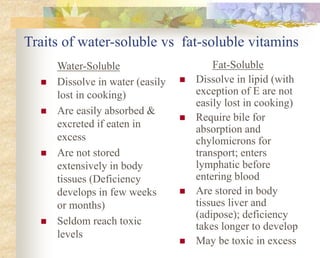
Traits of water-soluble vs fat-soluble vitamins
Water-Soluble
 Dissolve in water (easily
lost in cooking)
 Are easily absorbed &
excreted if eaten in
excess
 Are not stored
extensively in body
tissues (Deficiency
develops in few weeks
or months)
 Seldom reach toxic
levels
Fat-Soluble
 Dissolve in lipid (with
exception of E are not
easily lost in cooking)
 Require bile for
absorption and
chylomicrons for
transport; enters
lymphatic before
entering blood
 Are stored in body
tissues liver and
(adipose); deficiency
takes longer to develop
 May be toxic in excess
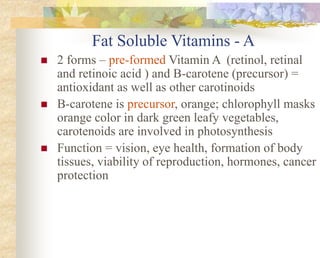
Fat Soluble Vitamins - A
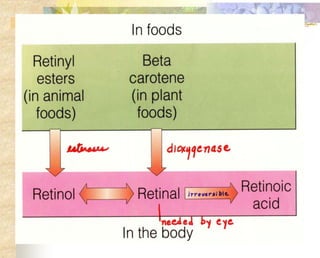
 2 forms – pre-formed Vitamin A (retinol, retinal
and retinoic acid ) and B-carotene (precursor) =
antioxidant as well as other carotinoids
 B-carotene is precursor, orange; chlorophyll masks
orange color in dark green leafy vegetables,
carotenoids are involved in photosynthesis
 Function = vision, eye health, formation of body
tissues, viability of reproduction, hormones, cancer
protection
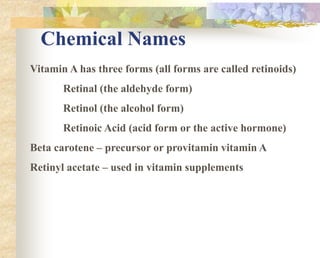
Chemical Names
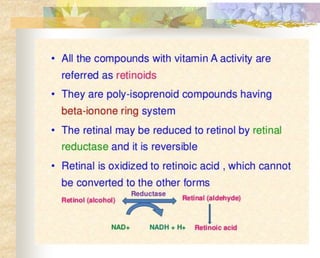
Vitamin A has three forms (all forms are called retinoids)
Retinal (the aldehyde form)
Retinol (the alcohol form)
Retinoic Acid (acid form or the active hormone)
Beta carotene – precursor or provitamin vitamin A
Retinyl acetate – used in vitamin supplements
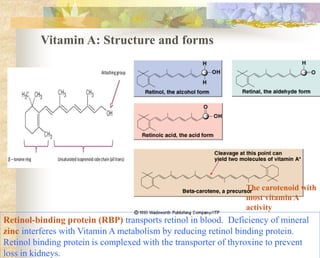
Vitamin A: Structure and forms
Retinol-binding protein (RBP) transports retinol in blood. Deficiency of mineral
zinc interferes with Vitamin A metabolism by reducing retinol binding protein.
Retinol binding protein is complexed with the transporter of thyroxine to prevent
loss in kidneys.
The carotenoid with
most vitamin A
activity
Food Sources
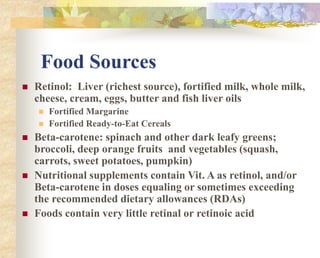
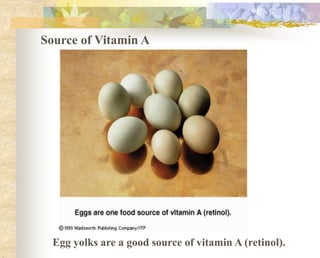
 Retinol: Liver (richest source), fortified milk, whole milk,
cheese, cream, eggs, butter and fish liver oils
 Fortified Margarine
 Fortified Ready-to-Eat Cereals
 Beta-carotene: spinach and other dark leafy greens;
broccoli, deep orange fruits and vegetables (squash,
carrots, sweet potatoes, pumpkin)
 Nutritional supplements contain Vit. A as retinol, and/or
Beta-carotene in doses equaling or sometimes exceeding
the recommended dietary allowances (RDAs)
 Foods contain very little retinal or retinoic acid
Source of Vitamin A
Egg yolks are a good source of vitamin A (retinol).
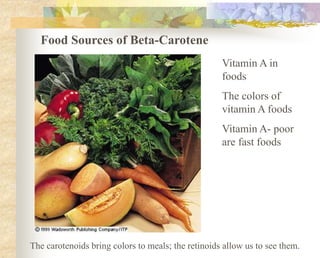
Food Sources of Beta-Carotene
The carotenoids bring colors to meals; the retinoids allow us to see them.
Vitamin A in
foods
The colors of
vitamin A foods
Vitamin A- poor
are fast foods
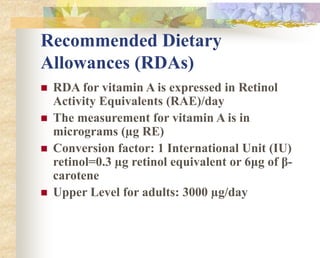
Recommended Dietary
Allowances (RDAs)
 RDA for vitamin A is expressed in Retinol
Activity Equivalents (RAE)/day
 The measurement for vitamin A is in
micrograms (µg RE)
 Conversion factor: 1 International Unit (IU)
retinol=0.3 µg retinol equivalent or 6μg of β-
carotene
 Upper Level for adults: 3000 µg/day
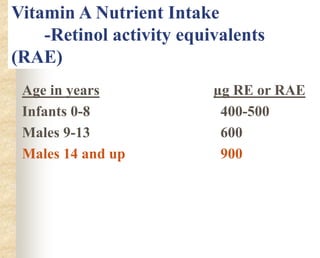
Vitamin A Nutrient Intake
-Retinol activity equivalents
(RAE)
Age in years µg RE or RAE
Infants 0-8 400-500
Males 9-13 600
Males 14 and up 900
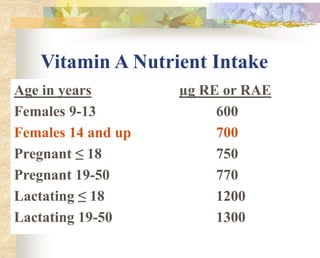
Vitamin A Nutrient Intake
Age in years µg RE or RAE
Females 9-13 600
Females 14 and up 700
Pregnant ≤ 18 750
Pregnant 19-50 770
Lactating ≤ 18 1200
Lactating 19-50 1300
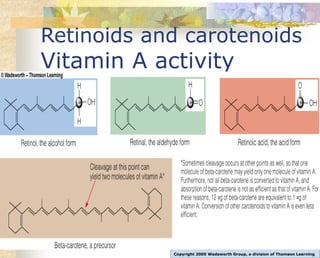
Retinoids and carotenoids
Vitamin A activity
Copyright 2005 Wadsworth Group, a division of Thomson Learning
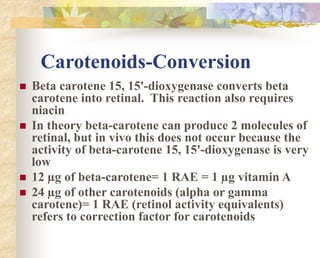
Carotenoids-Conversion
 Beta carotene 15, 15'-dioxygenase converts beta
carotene into retinal. This reaction also requires
niacin
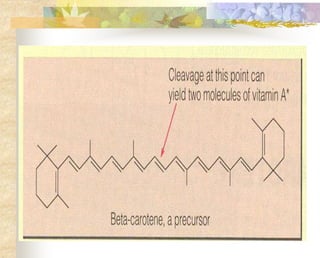
 In theory beta-carotene can produce 2 molecules of
retinal, but in vivo this does not occur because the
activity of beta-carotene 15, 15'-dioxygenase is very
low
 12 µg of beta-carotene= 1 RAE = 1 µg vitamin A
 24 µg of other carotenoids (alpha or gamma
carotene)= 1 RAE (retinol activity equivalents)
refers to correction factor for carotenoids
Carotenoids-Structures (1)
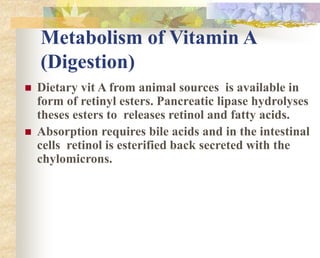
Metabolism of Vitamin A
(Digestion)
 Dietary vit A from animal sources is available in
form of retinyl esters. Pancreatic lipase hydrolyses
theses esters to releases retinol and fatty acids.
 Absorption requires bile acids and in the intestinal
cells retinol is esterified back secreted with the
chylomicrons.
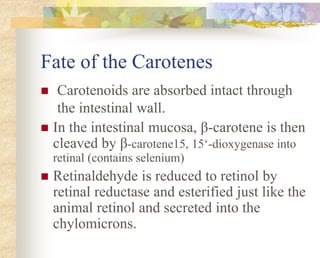
Fate of the Carotenes
 Carotenoids are absorbed intact through
the intestinal wall.
 In the intestinal mucosa, β-carotene is then
cleaved by β-carotene15, 15‘-dioxygenase into
retinal (contains selenium)
 Retinaldehyde is reduced to retinol by
retinal reductase and esterified just like the
animal retinol and secreted into the
chylomicrons.
Metabolism of Vitamin A
(Transport to Liver)
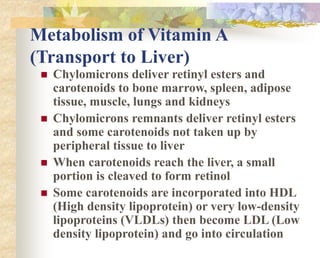
 Chylomicrons deliver retinyl esters and
carotenoids to bone marrow, spleen, adipose
tissue, muscle, lungs and kidneys
 Chylomicrons remnants deliver retinyl esters
and some carotenoids not taken up by
peripheral tissue to liver
 When carotenoids reach the liver, a small
portion is cleaved to form retinol
 Some carotenoids are incorporated into HDL
(High density lipoprotein) or very low-density
lipoproteins (VLDLs) then become LDL (Low
density lipoprotein) and go into circulation
Metabolism of Vitamin A
(Storage in Liver )
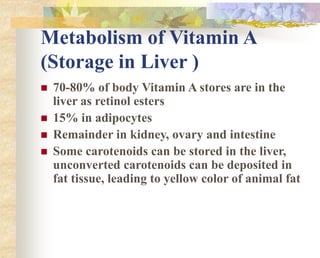
 70-80% of body Vitamin A stores are in the
liver as retinol esters
 15% in adipocytes
 Remainder in kidney, ovary and intestine
 Some carotenoids can be stored in the liver,
unconverted carotenoids can be deposited in
fat tissue, leading to yellow color of animal fat
Functions of Vitamin A
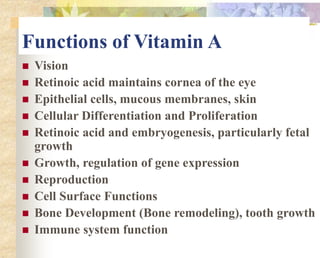
 Vision
 Retinoic acid maintains cornea of the eye
 Epithelial cells, mucous membranes, skin
 Cellular Differentiation and Proliferation
 Retinoic acid and embryogenesis, particularly fetal
growth
 Growth, regulation of gene expression
 Reproduction
 Cell Surface Functions
 Bone Development (Bone remodeling), tooth growth
 Immune system function
Vitamin A – Deficiencies
Very common in children under five years old
especially in developing countries
 Ocular- night blindness (reversible) Xerophthalmia
(complete blindness)
 Impaired Immunity - Impaired immune function-decreased
T-cells more susceptible to infections
 Growth- abnormal body growth, anorexia, narrowing of
cranial cavity and spinal cord
 Dermatological- obstruction and enlargement of hair
follicles (plugging of hair follicles with keratin, forming
white lumps called hyperkaratosis), brittle hair as well as
rough, dry skin
 Nervous system-ataxia, increased cerebrospinal fluid
causing headaches
Vitamin A (con’t)
 Toxicity = hypervitaminosis A :
 RBC’s break down (nose bleeds), rashes, dry skin
 Nausea, vomiting, vertigo
 Bone - increased activity of osteoclasts that withdraw calcium
causing reduced bone density
 Liver damage
 Brain - elevated pressure in brain (headaches) mimicking brain
tumor, neurological symptoms, irritability
 Blurred vision
 Hair loss
 High vitamin A during pregnancy can cause brain damage,
cleft palate, and other birth defects
 High dietary levels of beta carotene (Hypercarotenemia) are
not toxic but can cause (yellow palms and yellow feet)
especially in infants
Hypercarotenemia
 A condition caused by an accumulation of
carotenoids in the adipose tissue, causing
the skin of palms and soles of feet to
appear yellow-orange
Deficiencies May Develop
 Individuals with fat malabsorption disorders-
steatorrhea, pancreatic, liver, or gallbladder
disease may develop deficiency. They may
need vitamin A supplement. Aquasol A,
water-miscible form of vitamin A, can be used
 Measles infection-depletes liver stores of
vitamin A often results in blindness
 Serious infections and parasitic infections
(worms in gut), constant bleeding and
diarrhea lead to malabsorption of fat and
vitamin A
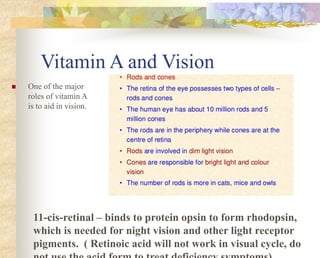
11-cis-retinal – binds to protein opsin to form rhodopsin,
which is needed for night vision and other light receptor
pigments. ( Retinoic acid will not work in visual cycle, do
Vitamin A and Vision
 One of the major
roles of vitamin A
is to aid in vision.
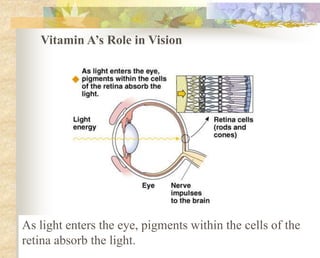
Vitamin A’s Role in Vision
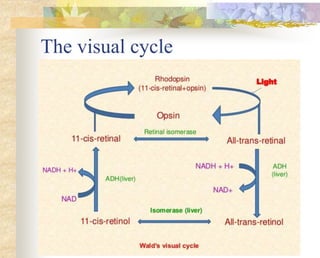
As light enters the eye, pigments within the cells of the
retina absorb the light.
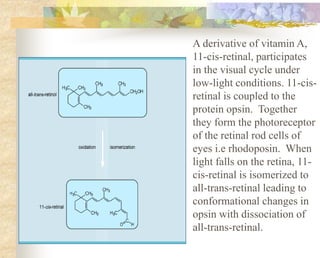
A derivative of vitamin A,
11-cis-retinal, participates
in the visual cycle under
low-light conditions. 11-cis-
retinal is coupled to the
protein opsin. Together
they form the photoreceptor
of the retinal rod cells of
eyes i.e rhodoposin. When
light falls on the retina, 11-
cis-retinal is isomerized to
all-trans-retinal leading to
conformational changes in
opsin with dissociation of
all-trans-retinal.
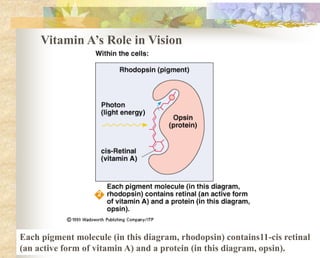
Vitamin A’s Role in Vision
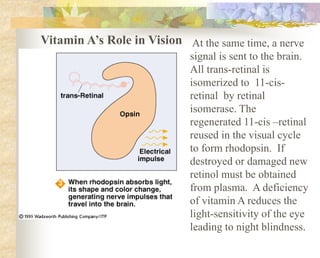
Each pigment molecule (in this diagram, rhodopsin) contains11-cis retinal
(an active form of vitamin A) and a protein (in this diagram, opsin).
Vitamin A’s Role in Vision At the same time, a nerve
signal is sent to the brain.
All trans-retinal is
isomerized to 11-cis-
retinal by retinal
isomerase. The
regenerated 11-cis –retinal
reused in the visual cycle
to form rhodopsin. If
destroyed or damaged new
retinol must be obtained
from plasma. A deficiency
of vitamin A reduces the
light-sensitivity of the eye
leading to night blindness.
The visual cycle
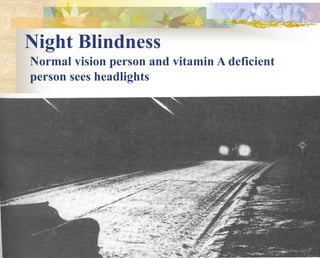
Night Blindness
Normal vision person and vitamin A deficient
person sees headlights
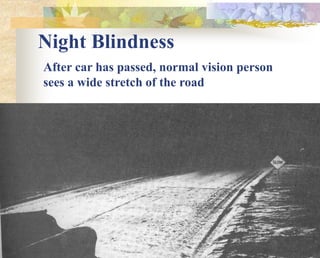
Night Blindness
After car has passed, normal vision person
sees a wide stretch of the road
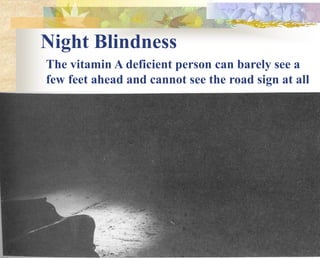
Night Blindness
The vitamin A deficient person can barely see a
few feet ahead and cannot see the road sign at all
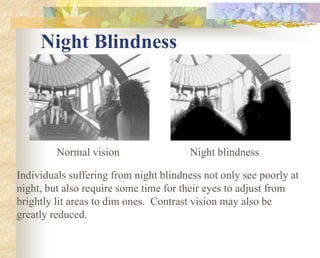
Individuals suffering from night blindness not only see poorly at
night, but also require some time for their eyes to adjust from
brightly lit areas to dim ones. Contrast vision may also be
greatly reduced.
Normal vision Night blindness
Night Blindness
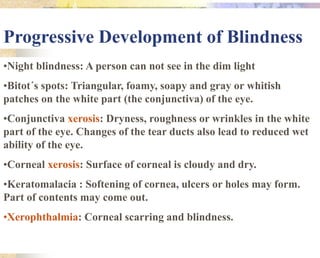
•Night blindness: A person can not see in the dim light
•Bitot´s spots: Triangular, foamy, soapy and gray or whitish
patches on the white part (the conjunctiva) of the eye.
•Conjunctiva xerosis: Dryness, roughness or wrinkles in the white
part of the eye. Changes of the tear ducts also lead to reduced wet
ability of the eye.
•Corneal xerosis: Surface of corneal is cloudy and dry.
•Keratomalacia : Softening of cornea, ulcers or holes may form.
Part of contents may come out.
•Xerophthalmia: Corneal scarring and blindness.
Progressive Development of Blindness
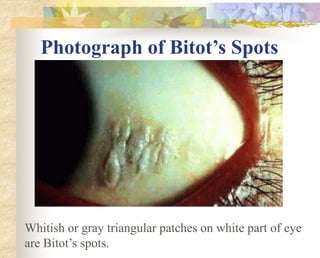
Whitish or gray triangular patches on white part of eye
are Bitot’s spots.
Photograph of Bitot’s Spots
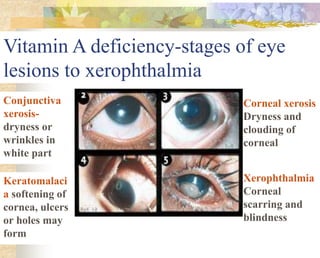
Vitamin A deficiency-stages of eye
lesions to xerophthalmia
Conjunctiva
xerosis-
dryness or
wrinkles in
white part
Corneal xerosis
Dryness and
clouding of
corneal
Keratomalaci
a softening of
cornea, ulcers
or holes may
form
Xerophthalmia
Corneal
scarring and
blindness
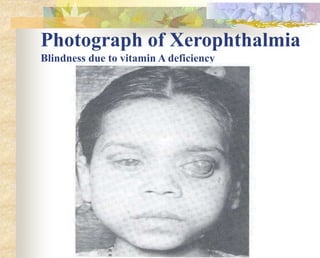
Photograph of Xerophthalmia
Blindness due to vitamin A deficiency
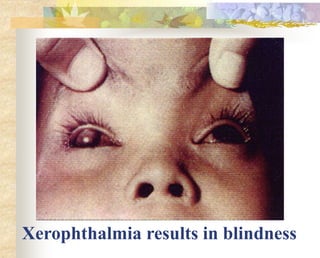
Xerophthalmia results in blindness
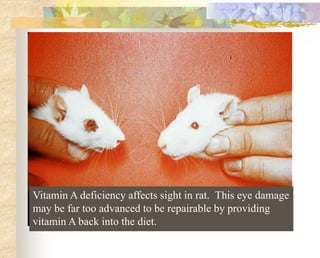
Vitamin A deficiency affects sight in rat. This eye damage
may be far too advanced to be repairable by providing
vitamin A back into the diet.
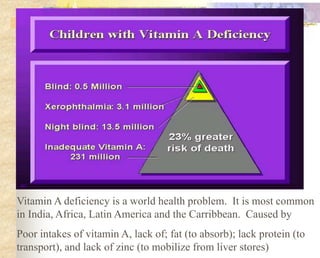
Vitamin A deficiency is a world health problem. It is most common
in India, Africa, Latin America and the Carribbean. Caused by
Poor intakes of vitamin A, lack of; fat (to absorb); lack protein (to
transport), and lack of zinc (to mobilize from liver stores)
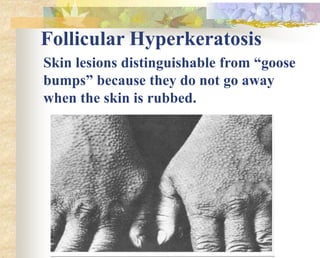
Follicular Hyperkeratosis
Skin lesions distinguishable from “goose
bumps” because they do not go away
when the skin is rubbed.
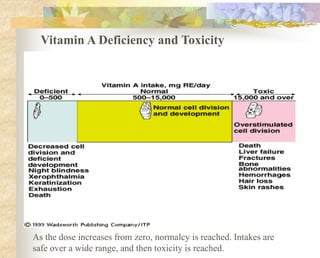
Vitamin A Deficiency and Toxicity
As the dose increases from zero, normalcy is reached. Intakes are
safe over a wide range, and then toxicity is reached.
People at risk for Vitamin A
deficiency
 Malnourished infants and young children
(males)
 People who are unable to absorb fat –
vitamin A needs to be co absorbed with
fat
 People with cirrhosis (other liver
diseases) –cannot store the vitamin
Signs of Vitamin A Toxicity
 Gingivitis
 Cheilosis
 Anorexia
 Irritability
 Fatigue
 Hepatomegaly
and abnormal
liver
function
 Ascites and portal
hypertension
 Serum vitamin A of
250-6600IU/100mL
 Bone pain and
fragility
 Hydrocephalus and
vomiting (infants
and children)
 Dry, fissured skin
 Brittle nails
 Hair loss (alopecia)
Copyright © 2000 by W. B. Saunders Company. All rights reserved.
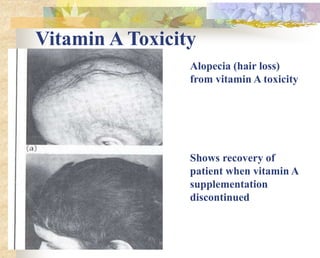
Vitamin A Toxicity
Alopecia (hair loss)
from vitamin A toxicity
Shows recovery of
patient when vitamin A
supplementation
discontinued
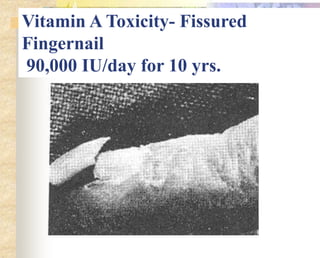
Vitamin A Toxicity- Fissured
Fingernail
90,000 IU/day for 10 yrs.
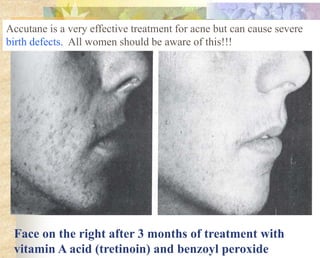
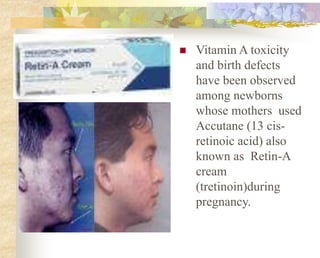
Vitamin A Toxicity – Acne (7)
Face on the right after 3 months of treatment with
vitamin A acid (tretinoin) and benzoyl peroxide
Accutane is a very effective treatment for acne but can cause severe
birth defects. All women should be aware of this!!!
 Vitamin A toxicity
and birth defects
have been observed
among newborns
whose mothers used
Accutane (13 cis-
retinoic acid) also
known as Retin-A
cream
(tretinoin)during
pregnancy.
Vitamin A – Interactions with
Other Nutrients
Iron status-the microcytic anemia of
vitamin A deficiency can be corrected when
supplied with vitamin A
Vitamin A may affect iron metabolism or
storage or differentiation of red blood cell.
Vitamin A – Interactions with
Other Nutrients (cont.)
 Vitamin E-may inhibit beta-carotene
absorption or conversion to retinol in the
intestine
 Vitamin K-interfers with vitamin A absorption
 Zinc deficiency-needed for Retinal Binding
Protein synthesis so plasma retinol
concentrations decrease and liver
concentrations increase (night blindness can
occur from zinc deficiency)
 Alcohol dehydrogenase in peripheral tissue
converts retinol to retinal is dependent on zinc
Vitamin A – Interactions with
Other Nutrients (cont.) (3,5)
 Activity of retinyl ester hydrolase which releases
retinol from its ester storage form is zinc
dependent, Zn deficiency decreases hepatic
mobilization
 Alcoholism causes low zinc levels because of
inadequate dietary intake, decreased intestinal
absorption and increased urinary excretion.
 Zinc supplements of 600 mg/day can be given to
improve night blindness but caution is necessary
because it can cause copper deficiency
 Copper deficiency is common with zinc
supplementation
In Summary
 Other names
 Retinol
 Retinal
 Retinoic acid
 Precursors are carotenoids
such as beta-carotene
 2001 RDA
 Men: 900 g RAE/day
 Women: 700 g RAE/day
Copyright 2005 Wadsworth Group, a division of Thomson Learning
In Summary
 Upper level for adults: 3000
g/day
 Chief functions in the body
 Vision
 Maintenance of cornea,
epithelial cells, mucous
membranes, skin
 Bone and tooth growth
 Reproduction
 Immunity
Copyright 2005 Wadsworth Group, a division of Thomson Learning
In Summary
 Significant sources
 Retinol: fortified milk, cheese,
cream, butter, fortified
margarine, eggs, liver
 Beta-carotene: spinach and
other dark leafy greens;
broccoli, deep orange fruits
(apricots, cantaloupe) and
vegetables (squash, carrots,
sweet potatoes, pumpkin)
Copyright 2005 Wadsworth Group, a division of Thomson Learning
In Summary
 Deficiency disease:
hypovitaminosis A
 Deficiency symptoms
 Night blindness, corneal
drying (xerosis), triangular
gray spots on eye (Bitot’s
spots), softening of the cornea
(karatomalacia), and corneal
degeneration and blindness
(xerophthalmia)
Copyright 2005 Wadsworth Group, a division of Thomson Learning
In Summary
 Deficiency symptoms
(continued)
 Impaired immunity
(infections)
 Plugging of hair follicles with
keratin, forming white lumps
(hyperkaratosis)
Copyright 2005 Wadsworth Group, a division of Thomson Learning
In Summary
 Toxicity disease:
hypervitaminosis A
 Chronic toxicity symptoms
 Increased activity of
osteoclasts causing reduced
bone density
 Liver abnormalities
 Birth defects
Copyright 2005 Wadsworth Group, a division of Thomson Learning
In Summary
 Acute toxicity symptoms
 Blurred vision
 Nausea, vomiting, vertigo
 Increase of pressure inside
skull, mimicking brain tumor
 Headaches
Copyright 2005 Wadsworth Group, a division of Thomson Learning

Vitamins ABSC.ppt

  • 1.
  • 2.
    Characteristics of Vitamins Needed in milligrams or micrograms  Organic compounds, human body makes a few, rest come from food  Work with hormones  Needed for the metabolism of other nutrients  Are NOT cure-alls  Do not supply energy; do not supply building materials for the body  B-vitamins are necessary to convert food to energy; need based on calorie intake
  • 3.
    Vitamins are organic,non-caloric nutrients essential in small quantities for growth & good health Water-Soluble  Thiamin (B1)  Riboflavin (B2)  Niacin (B3)  Vitamin B-6  Folate (folacin, folate acid)  Vitamin B-12  Pantothenic Acid  Biotin  Vitamin C (ascorbic acid) Fat-Soluble  Vitamin A  Vitamin D  Vitamin E  Vitamin K A,D,E,K – “Australia Does Export Kangaroos”
  • 4.
    Important Features ofVitamins 1. Role in body 2. Food sources 3. Main deficiency symptoms 4. Main toxicity symptoms
  • 5.
    Traits of water-solublevs fat-soluble vitamins Water-Soluble  Dissolve in water (easily lost in cooking)  Are easily absorbed & excreted if eaten in excess  Are not stored extensively in body tissues (Deficiency develops in few weeks or months)  Seldom reach toxic levels Fat-Soluble  Dissolve in lipid (with exception of E are not easily lost in cooking)  Require bile for absorption and chylomicrons for transport; enters lymphatic before entering blood  Are stored in body tissues liver and (adipose); deficiency takes longer to develop  May be toxic in excess
  • 6.
    Fat Soluble Vitamins- A  2 forms – pre-formed Vitamin A (retinol, retinal and retinoic acid ) and B-carotene (precursor) = antioxidant as well as other carotinoids  B-carotene is precursor, orange; chlorophyll masks orange color in dark green leafy vegetables, carotenoids are involved in photosynthesis  Function = vision, eye health, formation of body tissues, viability of reproduction, hormones, cancer protection
  • 7.
    Chemical Names Vitamin Ahas three forms (all forms are called retinoids) Retinal (the aldehyde form) Retinol (the alcohol form) Retinoic Acid (acid form or the active hormone) Beta carotene – precursor or provitamin vitamin A Retinyl acetate – used in vitamin supplements
  • 8.
    Vitamin A: Structureand forms Retinol-binding protein (RBP) transports retinol in blood. Deficiency of mineral zinc interferes with Vitamin A metabolism by reducing retinol binding protein. Retinol binding protein is complexed with the transporter of thyroxine to prevent loss in kidneys. The carotenoid with most vitamin A activity
  • 10.
    Food Sources  Retinol:Liver (richest source), fortified milk, whole milk, cheese, cream, eggs, butter and fish liver oils  Fortified Margarine  Fortified Ready-to-Eat Cereals  Beta-carotene: spinach and other dark leafy greens; broccoli, deep orange fruits and vegetables (squash, carrots, sweet potatoes, pumpkin)  Nutritional supplements contain Vit. A as retinol, and/or Beta-carotene in doses equaling or sometimes exceeding the recommended dietary allowances (RDAs)  Foods contain very little retinal or retinoic acid
  • 11.
    Source of VitaminA Egg yolks are a good source of vitamin A (retinol).
  • 12.
    Food Sources ofBeta-Carotene The carotenoids bring colors to meals; the retinoids allow us to see them. Vitamin A in foods The colors of vitamin A foods Vitamin A- poor are fast foods
  • 13.
    Recommended Dietary Allowances (RDAs) RDA for vitamin A is expressed in Retinol Activity Equivalents (RAE)/day  The measurement for vitamin A is in micrograms (µg RE)  Conversion factor: 1 International Unit (IU) retinol=0.3 µg retinol equivalent or 6μg of β- carotene  Upper Level for adults: 3000 µg/day
  • 14.
    Vitamin A NutrientIntake -Retinol activity equivalents (RAE) Age in years µg RE or RAE Infants 0-8 400-500 Males 9-13 600 Males 14 and up 900
  • 15.
    Vitamin A NutrientIntake Age in years µg RE or RAE Females 9-13 600 Females 14 and up 700 Pregnant ≤ 18 750 Pregnant 19-50 770 Lactating ≤ 18 1200 Lactating 19-50 1300
  • 16.
    Retinoids and carotenoids VitaminA activity Copyright 2005 Wadsworth Group, a division of Thomson Learning
  • 17.
    Carotenoids-Conversion  Beta carotene15, 15'-dioxygenase converts beta carotene into retinal. This reaction also requires niacin  In theory beta-carotene can produce 2 molecules of retinal, but in vivo this does not occur because the activity of beta-carotene 15, 15'-dioxygenase is very low  12 µg of beta-carotene= 1 RAE = 1 µg vitamin A  24 µg of other carotenoids (alpha or gamma carotene)= 1 RAE (retinol activity equivalents) refers to correction factor for carotenoids
  • 18.
  • 19.
    Metabolism of VitaminA (Digestion)  Dietary vit A from animal sources is available in form of retinyl esters. Pancreatic lipase hydrolyses theses esters to releases retinol and fatty acids.  Absorption requires bile acids and in the intestinal cells retinol is esterified back secreted with the chylomicrons.
  • 20.
    Fate of theCarotenes  Carotenoids are absorbed intact through the intestinal wall.  In the intestinal mucosa, β-carotene is then cleaved by β-carotene15, 15‘-dioxygenase into retinal (contains selenium)  Retinaldehyde is reduced to retinol by retinal reductase and esterified just like the animal retinol and secreted into the chylomicrons.
  • 22.
    Metabolism of VitaminA (Transport to Liver)  Chylomicrons deliver retinyl esters and carotenoids to bone marrow, spleen, adipose tissue, muscle, lungs and kidneys  Chylomicrons remnants deliver retinyl esters and some carotenoids not taken up by peripheral tissue to liver  When carotenoids reach the liver, a small portion is cleaved to form retinol  Some carotenoids are incorporated into HDL (High density lipoprotein) or very low-density lipoproteins (VLDLs) then become LDL (Low density lipoprotein) and go into circulation
  • 23.
    Metabolism of VitaminA (Storage in Liver )  70-80% of body Vitamin A stores are in the liver as retinol esters  15% in adipocytes  Remainder in kidney, ovary and intestine  Some carotenoids can be stored in the liver, unconverted carotenoids can be deposited in fat tissue, leading to yellow color of animal fat
  • 24.
    Functions of VitaminA  Vision  Retinoic acid maintains cornea of the eye  Epithelial cells, mucous membranes, skin  Cellular Differentiation and Proliferation  Retinoic acid and embryogenesis, particularly fetal growth  Growth, regulation of gene expression  Reproduction  Cell Surface Functions  Bone Development (Bone remodeling), tooth growth  Immune system function
  • 25.
    Vitamin A –Deficiencies Very common in children under five years old especially in developing countries  Ocular- night blindness (reversible) Xerophthalmia (complete blindness)  Impaired Immunity - Impaired immune function-decreased T-cells more susceptible to infections  Growth- abnormal body growth, anorexia, narrowing of cranial cavity and spinal cord  Dermatological- obstruction and enlargement of hair follicles (plugging of hair follicles with keratin, forming white lumps called hyperkaratosis), brittle hair as well as rough, dry skin  Nervous system-ataxia, increased cerebrospinal fluid causing headaches
  • 26.
    Vitamin A (con’t) Toxicity = hypervitaminosis A :  RBC’s break down (nose bleeds), rashes, dry skin  Nausea, vomiting, vertigo  Bone - increased activity of osteoclasts that withdraw calcium causing reduced bone density  Liver damage  Brain - elevated pressure in brain (headaches) mimicking brain tumor, neurological symptoms, irritability  Blurred vision  Hair loss  High vitamin A during pregnancy can cause brain damage, cleft palate, and other birth defects  High dietary levels of beta carotene (Hypercarotenemia) are not toxic but can cause (yellow palms and yellow feet) especially in infants
  • 27.
    Hypercarotenemia  A conditioncaused by an accumulation of carotenoids in the adipose tissue, causing the skin of palms and soles of feet to appear yellow-orange
  • 28.
    Deficiencies May Develop Individuals with fat malabsorption disorders- steatorrhea, pancreatic, liver, or gallbladder disease may develop deficiency. They may need vitamin A supplement. Aquasol A, water-miscible form of vitamin A, can be used  Measles infection-depletes liver stores of vitamin A often results in blindness  Serious infections and parasitic infections (worms in gut), constant bleeding and diarrhea lead to malabsorption of fat and vitamin A
  • 29.
    11-cis-retinal – bindsto protein opsin to form rhodopsin, which is needed for night vision and other light receptor pigments. ( Retinoic acid will not work in visual cycle, do Vitamin A and Vision  One of the major roles of vitamin A is to aid in vision.
  • 30.
    Vitamin A’s Rolein Vision As light enters the eye, pigments within the cells of the retina absorb the light.
  • 31.
    A derivative ofvitamin A, 11-cis-retinal, participates in the visual cycle under low-light conditions. 11-cis- retinal is coupled to the protein opsin. Together they form the photoreceptor of the retinal rod cells of eyes i.e rhodoposin. When light falls on the retina, 11- cis-retinal is isomerized to all-trans-retinal leading to conformational changes in opsin with dissociation of all-trans-retinal.
  • 32.
    Vitamin A’s Rolein Vision Each pigment molecule (in this diagram, rhodopsin) contains11-cis retinal (an active form of vitamin A) and a protein (in this diagram, opsin).
  • 33.
    Vitamin A’s Rolein Vision At the same time, a nerve signal is sent to the brain. All trans-retinal is isomerized to 11-cis- retinal by retinal isomerase. The regenerated 11-cis –retinal reused in the visual cycle to form rhodopsin. If destroyed or damaged new retinol must be obtained from plasma. A deficiency of vitamin A reduces the light-sensitivity of the eye leading to night blindness.
  • 34.
  • 35.
    Night Blindness Normal visionperson and vitamin A deficient person sees headlights
  • 36.
    Night Blindness After carhas passed, normal vision person sees a wide stretch of the road
  • 37.
    Night Blindness The vitaminA deficient person can barely see a few feet ahead and cannot see the road sign at all
  • 38.
    Individuals suffering fromnight blindness not only see poorly at night, but also require some time for their eyes to adjust from brightly lit areas to dim ones. Contrast vision may also be greatly reduced. Normal vision Night blindness Night Blindness
  • 39.
    •Night blindness: Aperson can not see in the dim light •Bitot´s spots: Triangular, foamy, soapy and gray or whitish patches on the white part (the conjunctiva) of the eye. •Conjunctiva xerosis: Dryness, roughness or wrinkles in the white part of the eye. Changes of the tear ducts also lead to reduced wet ability of the eye. •Corneal xerosis: Surface of corneal is cloudy and dry. •Keratomalacia : Softening of cornea, ulcers or holes may form. Part of contents may come out. •Xerophthalmia: Corneal scarring and blindness. Progressive Development of Blindness
  • 40.
    Whitish or graytriangular patches on white part of eye are Bitot’s spots. Photograph of Bitot’s Spots
  • 41.
    Vitamin A deficiency-stagesof eye lesions to xerophthalmia Conjunctiva xerosis- dryness or wrinkles in white part Corneal xerosis Dryness and clouding of corneal Keratomalaci a softening of cornea, ulcers or holes may form Xerophthalmia Corneal scarring and blindness
  • 42.
    Photograph of Xerophthalmia Blindnessdue to vitamin A deficiency
  • 43.
  • 44.
    Vitamin A deficiencyaffects sight in rat. This eye damage may be far too advanced to be repairable by providing vitamin A back into the diet.
  • 45.
    Vitamin A deficiencyis a world health problem. It is most common in India, Africa, Latin America and the Carribbean. Caused by Poor intakes of vitamin A, lack of; fat (to absorb); lack protein (to transport), and lack of zinc (to mobilize from liver stores)
  • 46.
    Follicular Hyperkeratosis Skin lesionsdistinguishable from “goose bumps” because they do not go away when the skin is rubbed.
  • 47.
    Vitamin A Deficiencyand Toxicity As the dose increases from zero, normalcy is reached. Intakes are safe over a wide range, and then toxicity is reached.
  • 48.
    People at riskfor Vitamin A deficiency  Malnourished infants and young children (males)  People who are unable to absorb fat – vitamin A needs to be co absorbed with fat  People with cirrhosis (other liver diseases) –cannot store the vitamin
  • 49.
    Signs of VitaminA Toxicity  Gingivitis  Cheilosis  Anorexia  Irritability  Fatigue  Hepatomegaly and abnormal liver function  Ascites and portal hypertension  Serum vitamin A of 250-6600IU/100mL  Bone pain and fragility  Hydrocephalus and vomiting (infants and children)  Dry, fissured skin  Brittle nails  Hair loss (alopecia) Copyright © 2000 by W. B. Saunders Company. All rights reserved.
  • 50.
    Vitamin A Toxicity Alopecia(hair loss) from vitamin A toxicity Shows recovery of patient when vitamin A supplementation discontinued
  • 51.
    Vitamin A Toxicity-Fissured Fingernail 90,000 IU/day for 10 yrs.
  • 52.
    Vitamin A Toxicity– Acne (7) Face on the right after 3 months of treatment with vitamin A acid (tretinoin) and benzoyl peroxide Accutane is a very effective treatment for acne but can cause severe birth defects. All women should be aware of this!!!
  • 53.
     Vitamin Atoxicity and birth defects have been observed among newborns whose mothers used Accutane (13 cis- retinoic acid) also known as Retin-A cream (tretinoin)during pregnancy.
  • 54.
    Vitamin A –Interactions with Other Nutrients Iron status-the microcytic anemia of vitamin A deficiency can be corrected when supplied with vitamin A Vitamin A may affect iron metabolism or storage or differentiation of red blood cell.
  • 55.
    Vitamin A –Interactions with Other Nutrients (cont.)  Vitamin E-may inhibit beta-carotene absorption or conversion to retinol in the intestine  Vitamin K-interfers with vitamin A absorption  Zinc deficiency-needed for Retinal Binding Protein synthesis so plasma retinol concentrations decrease and liver concentrations increase (night blindness can occur from zinc deficiency)  Alcohol dehydrogenase in peripheral tissue converts retinol to retinal is dependent on zinc
  • 56.
    Vitamin A –Interactions with Other Nutrients (cont.) (3,5)  Activity of retinyl ester hydrolase which releases retinol from its ester storage form is zinc dependent, Zn deficiency decreases hepatic mobilization  Alcoholism causes low zinc levels because of inadequate dietary intake, decreased intestinal absorption and increased urinary excretion.  Zinc supplements of 600 mg/day can be given to improve night blindness but caution is necessary because it can cause copper deficiency  Copper deficiency is common with zinc supplementation
  • 57.
    In Summary  Othernames  Retinol  Retinal  Retinoic acid  Precursors are carotenoids such as beta-carotene  2001 RDA  Men: 900 g RAE/day  Women: 700 g RAE/day Copyright 2005 Wadsworth Group, a division of Thomson Learning
  • 58.
    In Summary  Upperlevel for adults: 3000 g/day  Chief functions in the body  Vision  Maintenance of cornea, epithelial cells, mucous membranes, skin  Bone and tooth growth  Reproduction  Immunity Copyright 2005 Wadsworth Group, a division of Thomson Learning
  • 59.
    In Summary  Significantsources  Retinol: fortified milk, cheese, cream, butter, fortified margarine, eggs, liver  Beta-carotene: spinach and other dark leafy greens; broccoli, deep orange fruits (apricots, cantaloupe) and vegetables (squash, carrots, sweet potatoes, pumpkin) Copyright 2005 Wadsworth Group, a division of Thomson Learning
  • 60.
    In Summary  Deficiencydisease: hypovitaminosis A  Deficiency symptoms  Night blindness, corneal drying (xerosis), triangular gray spots on eye (Bitot’s spots), softening of the cornea (karatomalacia), and corneal degeneration and blindness (xerophthalmia) Copyright 2005 Wadsworth Group, a division of Thomson Learning
  • 61.
    In Summary  Deficiencysymptoms (continued)  Impaired immunity (infections)  Plugging of hair follicles with keratin, forming white lumps (hyperkaratosis) Copyright 2005 Wadsworth Group, a division of Thomson Learning
  • 62.
    In Summary  Toxicitydisease: hypervitaminosis A  Chronic toxicity symptoms  Increased activity of osteoclasts causing reduced bone density  Liver abnormalities  Birth defects Copyright 2005 Wadsworth Group, a division of Thomson Learning
  • 63.
    In Summary  Acutetoxicity symptoms  Blurred vision  Nausea, vomiting, vertigo  Increase of pressure inside skull, mimicking brain tumor  Headaches Copyright 2005 Wadsworth Group, a division of Thomson Learning