FAT SOLUBLE VITAMIN- A
Laxman I
1ST MSc BIOTECH
Vitamins
• Vitamins are the organic compounds
required in the diet in small amounts in
different natural foods
• Necessary for the growth and maintenance
of good health.
• Daily requirement depends on the age group
and increase during growth, pregnancy and
lactation.
“A Vitamin is a substance that makes
you ill if you don’t eat it”
-Albert Szent-Gyorgyi, Nobel Prize winner, 1937
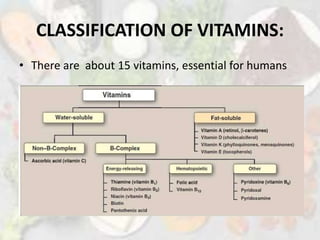
CLASSIFICATION OF VITAMINS:
• There are about 15 vitamins, essential for humans
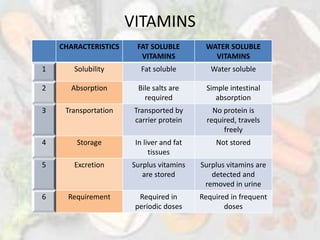
VITAMINS
CHARACTERISTICS FAT SOLUBLE
VITAMINS
WATER SOLUBLE
VITAMINS
1 Solubility Fat soluble Water soluble
2 Absorption Bile salts are
required
Simple intestinal
absorption
3 Transportation Transported by
carrier protein
No protein is
required, travels
freely
4 Storage In liver and fat
tissues
Not stored
5 Excretion Surplus vitamins
are stored
Surplus vitamins are
detected and
removed in urine
6 Requirement Required in
periodic doses
Required in frequent
doses
VITAMIN- A
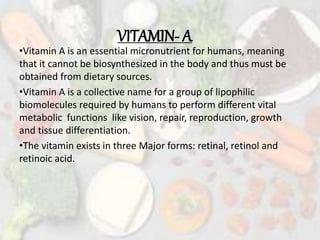
•Vitamin A is an essential micronutrient for humans, meaning
that it cannot be biosynthesized in the body and thus must be
obtained from dietary sources.
•Vitamin A is a collective name for a group of lipophilic
biomolecules required by humans to perform different vital
metabolic functions like vision, repair, reproduction, growth
and tissue differentiation.
•The vitamin exists in three Major forms: retinal, retinol and
retinoic acid.
HISTORY
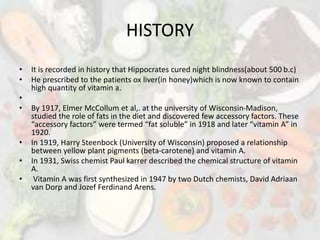
• It is recorded in history that Hippocrates cured night blindness(about 500 b.c)
• He prescribed to the patients ox liver(in honey)which is now known to contain
high quantity of vitamin a.
•
• By 1917, Elmer McCollum et al,. at the university of Wisconsin-Madison,
studied the role of fats in the diet and discovered few accessory factors. These
“accessory factors” were termed “fat soluble” in 1918 and later “vitamin A” in
1920.
• In 1919, Harry Steenbock (University of Wisconsin) proposed a relationship
between yellow plant pigments (beta-carotene) and vitamin A.
• In 1931, Swiss chemist Paul karrer described the chemical structure of vitamin
A.
• Vitamin A was first synthesized in 1947 by two Dutch chemists, David Adriaan
van Dorp and Jozef Ferdinand Arens.
Chemistry:
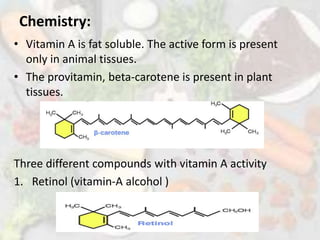
• Vitamin A is fat soluble. The active form is present
only in animal tissues.
• The provitamin, beta-carotene is present in plant
tissues.
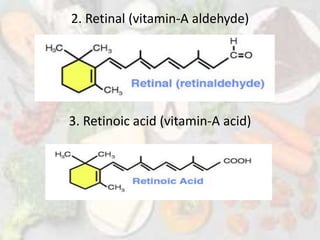
Three different compounds with vitamin A activity
1. Retinol (vitamin-A alcohol )
2. Retinal (vitamin-A aldehyde)
3. Retinoic acid (vitamin-A acid)
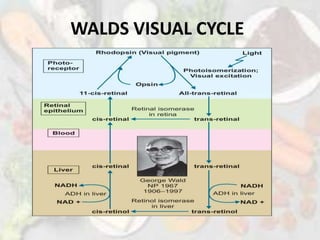
WALDS VISUAL CYCLE
• The term Visual cycle was coined by George Wald in the
mid 1900’s
• To describe the ability of eye to “re-cycle” Vitamin A for the
synthesis of visual pigments
• Wald was awarded Nobel prize in 1967 for identifying role
off Vitamin A in vision.
• Process of visual information begins in the retina with the
detection of light by photoreceptor cells.
• Photoreceptors involved in the vision are rods and cones.
• Rhodopsin (mol.wt 35,000) is a membrane protein present
in the photoreceptor rod cells of retina.
WALDS VISUAL CYCLE
BIOLOGICAL FUNCTIONS OF
VITAMIN-A
• They regulate protein synthesis.
• Function as steroid hormones.
• To maintain healthy epithelial tissue
• Involved in the cell growth
• Required to prevent keratin synthesis
• Necessary for normal reproduction
BIOLOGICAL FUNCTIONS OF
VITAMIN-A
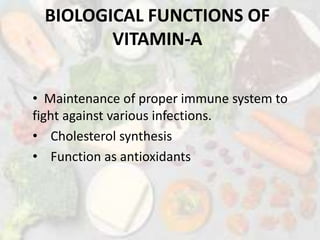
• Maintenance of proper immune system to
fight against various infections.
• Cholesterol synthesis
• Function as antioxidants
Recommended dietary
allowance (RDA)
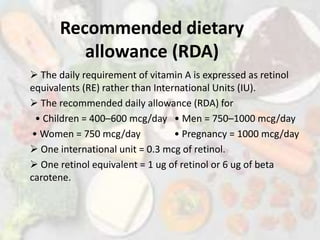
 The daily requirement of vitamin A is expressed as retinol
equivalents (RE) rather than International Units (IU).
 The recommended daily allowance (RDA) for
• Children = 400–600 mcg/day • Men = 750–1000 mcg/day
• Women = 750 mcg/day • Pregnancy = 1000 mcg/day
 One international unit = 0.3 mcg of retinol.
 One retinol equivalent = 1 ug of retinol or 6 ug of beta
carotene.
SOURCES
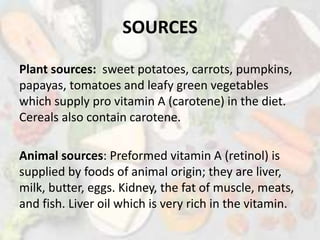
Plant sources: sweet potatoes, carrots, pumpkins,
papayas, tomatoes and leafy green vegetables
which supply pro vitamin A (carotene) in the diet.
Cereals also contain carotene.
Animal sources: Preformed vitamin A (retinol) is
supplied by foods of animal origin; they are liver,
milk, butter, eggs. Kidney, the fat of muscle, meats,
and fish. Liver oil which is very rich in the vitamin.
VITAMIN ‘A’ DEFICIENCY
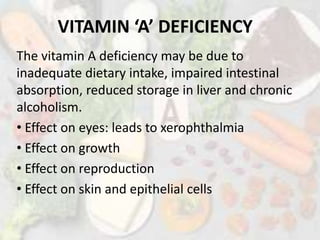
The vitamin A deficiency may be due to
inadequate dietary intake, impaired intestinal
absorption, reduced storage in liver and chronic
alcoholism.
• Effect on eyes: leads to xerophthalmia
• Effect on growth
• Effect on reproduction
• Effect on skin and epithelial cells
Hypervitaminosis A
Excessive consumption of vitamin A leads to toxicity
The symptoms of hypervitaminosis A
• Dermatitis raised intracranial tension
• Enlargement of liver
• Skeletal decalcification
• Tenderness of long bones
• Loss of weight
• Irritability
• Loss of hair
• Joint pains
References
1. Berg.J M, Tymoczko.J L, Stryer L [2007] Biochemistry. Seventh
Edition. W.H.Freemann And Company. USA. PP: 423-425
2. Deb. A C [1983] Fundamentals of Biochemistry Ninth Edition,New
Central Book of Agency . Kolkata, India. PP: 210-216
3. Delvin. T.D [2011] Textbook of Biochemistry Seventh Edition. PP:
1066-1067
4. Jain.J.L, Jain.S, Jain.N, [2005] Fundamentals of Biochemistry.
Seventh edition. S.Chand And Comapany, New Delhi. PP: 966-972
5. Kumar. P, Mina U. [2021] Life sciences Fundamentals and Practice
01, Seventh Edition, Pathfinder Publication. New Delhi, India. PP:
104-105
6. Nayak.S.B [2011] Essentials of Biochemistry. Jaypee Brothers
Medical Publishers, New Delhi. PP: 241-243
7. Nelson.D, Cox.M, Aoskins.A [2021] Lehninger Principles of
Biochemistry. Eighth Edition. W.H.Freeman And Comapany. New
Delhi. PP: 1329-1334
Fat soluble vitamin A.pptx

Fat soluble vitamin A.pptx

  • 1.
    FAT SOLUBLE VITAMIN-A Laxman I 1ST MSc BIOTECH
  • 2.
    Vitamins • Vitamins arethe organic compounds required in the diet in small amounts in different natural foods • Necessary for the growth and maintenance of good health. • Daily requirement depends on the age group and increase during growth, pregnancy and lactation.
  • 3.
    “A Vitamin isa substance that makes you ill if you don’t eat it” -Albert Szent-Gyorgyi, Nobel Prize winner, 1937
  • 4.
    CLASSIFICATION OF VITAMINS: •There are about 15 vitamins, essential for humans
  • 5.
    VITAMINS CHARACTERISTICS FAT SOLUBLE VITAMINS WATERSOLUBLE VITAMINS 1 Solubility Fat soluble Water soluble 2 Absorption Bile salts are required Simple intestinal absorption 3 Transportation Transported by carrier protein No protein is required, travels freely 4 Storage In liver and fat tissues Not stored 5 Excretion Surplus vitamins are stored Surplus vitamins are detected and removed in urine 6 Requirement Required in periodic doses Required in frequent doses
  • 6.
    VITAMIN- A •Vitamin Ais an essential micronutrient for humans, meaning that it cannot be biosynthesized in the body and thus must be obtained from dietary sources. •Vitamin A is a collective name for a group of lipophilic biomolecules required by humans to perform different vital metabolic functions like vision, repair, reproduction, growth and tissue differentiation. •The vitamin exists in three Major forms: retinal, retinol and retinoic acid.
  • 7.
    HISTORY • It isrecorded in history that Hippocrates cured night blindness(about 500 b.c) • He prescribed to the patients ox liver(in honey)which is now known to contain high quantity of vitamin a. • • By 1917, Elmer McCollum et al,. at the university of Wisconsin-Madison, studied the role of fats in the diet and discovered few accessory factors. These “accessory factors” were termed “fat soluble” in 1918 and later “vitamin A” in 1920. • In 1919, Harry Steenbock (University of Wisconsin) proposed a relationship between yellow plant pigments (beta-carotene) and vitamin A. • In 1931, Swiss chemist Paul karrer described the chemical structure of vitamin A. • Vitamin A was first synthesized in 1947 by two Dutch chemists, David Adriaan van Dorp and Jozef Ferdinand Arens.
  • 8.
    Chemistry: • Vitamin Ais fat soluble. The active form is present only in animal tissues. • The provitamin, beta-carotene is present in plant tissues. Three different compounds with vitamin A activity 1. Retinol (vitamin-A alcohol )
  • 9.
    2. Retinal (vitamin-Aaldehyde) 3. Retinoic acid (vitamin-A acid)
  • 10.
    WALDS VISUAL CYCLE •The term Visual cycle was coined by George Wald in the mid 1900’s • To describe the ability of eye to “re-cycle” Vitamin A for the synthesis of visual pigments • Wald was awarded Nobel prize in 1967 for identifying role off Vitamin A in vision. • Process of visual information begins in the retina with the detection of light by photoreceptor cells. • Photoreceptors involved in the vision are rods and cones. • Rhodopsin (mol.wt 35,000) is a membrane protein present in the photoreceptor rod cells of retina.
  • 11.
  • 12.
    BIOLOGICAL FUNCTIONS OF VITAMIN-A •They regulate protein synthesis. • Function as steroid hormones. • To maintain healthy epithelial tissue • Involved in the cell growth • Required to prevent keratin synthesis • Necessary for normal reproduction
  • 13.
    BIOLOGICAL FUNCTIONS OF VITAMIN-A •Maintenance of proper immune system to fight against various infections. • Cholesterol synthesis • Function as antioxidants
  • 14.
    Recommended dietary allowance (RDA) The daily requirement of vitamin A is expressed as retinol equivalents (RE) rather than International Units (IU).  The recommended daily allowance (RDA) for • Children = 400–600 mcg/day • Men = 750–1000 mcg/day • Women = 750 mcg/day • Pregnancy = 1000 mcg/day  One international unit = 0.3 mcg of retinol.  One retinol equivalent = 1 ug of retinol or 6 ug of beta carotene.
  • 15.
    SOURCES Plant sources: sweetpotatoes, carrots, pumpkins, papayas, tomatoes and leafy green vegetables which supply pro vitamin A (carotene) in the diet. Cereals also contain carotene. Animal sources: Preformed vitamin A (retinol) is supplied by foods of animal origin; they are liver, milk, butter, eggs. Kidney, the fat of muscle, meats, and fish. Liver oil which is very rich in the vitamin.
  • 16.
    VITAMIN ‘A’ DEFICIENCY Thevitamin A deficiency may be due to inadequate dietary intake, impaired intestinal absorption, reduced storage in liver and chronic alcoholism. • Effect on eyes: leads to xerophthalmia • Effect on growth • Effect on reproduction • Effect on skin and epithelial cells
  • 17.
    Hypervitaminosis A Excessive consumptionof vitamin A leads to toxicity The symptoms of hypervitaminosis A • Dermatitis raised intracranial tension • Enlargement of liver • Skeletal decalcification • Tenderness of long bones • Loss of weight • Irritability • Loss of hair • Joint pains
  • 18.
    References 1. Berg.J M,Tymoczko.J L, Stryer L [2007] Biochemistry. Seventh Edition. W.H.Freemann And Company. USA. PP: 423-425 2. Deb. A C [1983] Fundamentals of Biochemistry Ninth Edition,New Central Book of Agency . Kolkata, India. PP: 210-216 3. Delvin. T.D [2011] Textbook of Biochemistry Seventh Edition. PP: 1066-1067 4. Jain.J.L, Jain.S, Jain.N, [2005] Fundamentals of Biochemistry. Seventh edition. S.Chand And Comapany, New Delhi. PP: 966-972 5. Kumar. P, Mina U. [2021] Life sciences Fundamentals and Practice 01, Seventh Edition, Pathfinder Publication. New Delhi, India. PP: 104-105 6. Nayak.S.B [2011] Essentials of Biochemistry. Jaypee Brothers Medical Publishers, New Delhi. PP: 241-243 7. Nelson.D, Cox.M, Aoskins.A [2021] Lehninger Principles of Biochemistry. Eighth Edition. W.H.Freeman And Comapany. New Delhi. PP: 1329-1334