Vitamin ‘A’
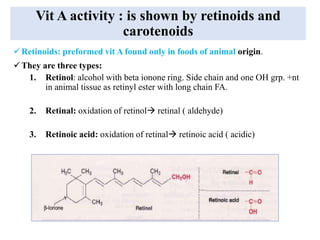
Vit A activity : is shown by retinoids and
carotenoids
Retinoids: preformed vit A found only in foods of animal origin.
They are three types:
1. Retinol: alcohol with beta ionone ring. Side chain and one OH grp. +nt
in animal tissue as retinyl ester with long chain FA.
2. Retinal: oxidation of retinol retinal ( aldehyde)
3. Retinoic acid: oxidation of retinal retinoic acid ( acidic)
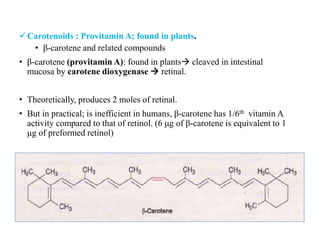
Carotenoids : Provitamin A; found in plants.
• β-carotene and related compounds
• β-carotene (provitamin A): found in plants cleaved in intestinal
mucosa by carotene dioxygenase  retinal.
• Theoretically, produces 2 moles of retinal.
• But in practical; is inefficient in humans, β-carotene has 1/6th vitamin A
activity compared to that of retinol. (6 μg of β-carotene is equivalent to 1
μg of preformed retinol)
Recommended dietary allowance
• Retinol equivalents (RE) rather than International units(IU)
• 1 RE= 1 μg retinol
• Woman= 800 RE
• Man= 1000 RE
• One IU equals = 0.3 mg of retinol
• The requirement increases in growing children, pregnant
women and lactating mothers
Dietary sources
• Animal source contain preformed vit A
• The best sources are liver, kidney, egg yolk, milk,
cheese, butter. 🧀🍼🧀
• Fish liver oils are very rich in vitamin A. 🐟🐠
• Vegetable sources contain the provitamin A-carotene
• Yellow and dark green vegetables: tomato,carrots,
spinach, pumpkins, 🧀🍅🧀
• fruits are good sources: mango, papaya etc. 🧀
👉🏻👉🏻Absorption
and
transport
of
vitamin A👍👍
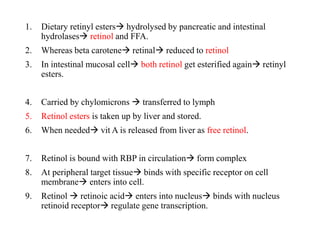
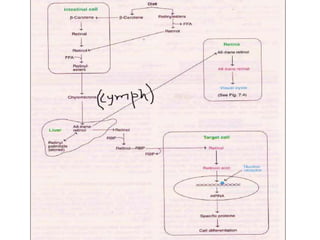
1. Dietary retinyl esters hydrolysed by pancreatic and intestinal
hydrolases retinol and FFA.
2. Whereas beta carotene retinal reduced to retinol
3. In intestinal mucosal cell both retinol get esterified again retinyl
esters.
4. Carried by chylomicrons  transferred to lymph
5. Retinol esters is taken up by liver and stored.
6. When needed vit A is released from liver as free retinol.
7. Retinol is bound with RBP in circulation form complex
8. At peripheral target tissue binds with specific receptor on cell
membrane enters into cell.
9. Retinol  retinoic acid enters into nucleus binds with nucleus
retinoid receptor regulate gene transcription.
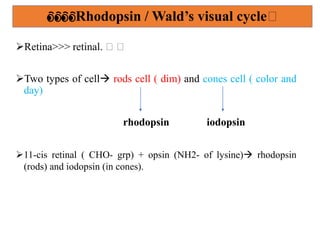
👀👀Rhodopsin / Wald’s visual cycle🏻
Retina>>> retinal. 🏻 🏻
Two types of cell rods cell ( dim) and cones cell ( color and
day)
rhodopsin iodopsin
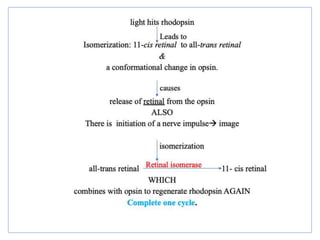
11-cis retinal ( CHO- grp) + opsin (NH2- of lysine) rhodopsin
(rods) and iodopsin (in cones).
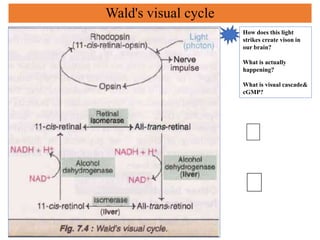
Wald's visual cycle
How does this light
strikes create vison in
our brain?
What is actually
happening?
What is visual cascade&
cGMP?
🏻
🏻
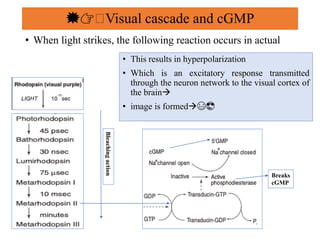
• When light strikes, the following reaction occurs in actual
💥👉🧀Visual cascade and cGMP
• This results in hyperpolarization
• Which is an excitatory response transmitted
through the neuron network to the visual cortex of
the brain
• image is formed😃😎
Breaks
cGMP
Bleachingaction
COLOR VISION
• Cones cell are specialized in bright and color vision
• Visual cycle comparable to rodes is seen in cones too.
• Governed by color sensitive pigments:
• Porphyropsin ( red)
• Iodopsin (green )
• Cyanopsin (blue)
• Splitting of these three pigments in different proportion results in
perception of different color by brain.
•👠🧀🌹🌼
Retinol ,Retinoic Acid : Regulation of Gene
Expression & Tissue Differentiation
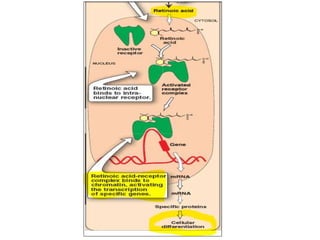
• Retinoic acid growth, development and tissue
differentiation.
• Like steroid hormone and vit D, it binds with nuclear
receptor  that binds with response element of DNA.
• And regulate transcription of different genes.
• Two nuclear receptor: Retinoid Acid Receptor ( RARs) and
Retinoid X Receptor ( RXR).
• RAR: all trans and 9-cis
• RXR: 9-cis
Other
functions of vitamin A
• Cell growth and differentiation
• Maintain healthy epithelial cells
• Synthesis of certain glycoproteins required for growth and mucus
secretion
• The synthesis of transferrin, the iron transport protein
• To maintain proper immune system( fight bacterial infection)
• Cholesterol synthesis require vit A
• Carotenoid acts as anti oxidants.( cancer and heart attack)
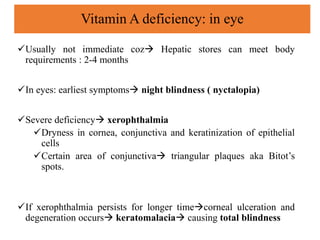
Usually not immediate coz Hepatic stores can meet body
requirements : 2-4 months
In eyes: earliest symptoms night blindness ( nyctalopia)
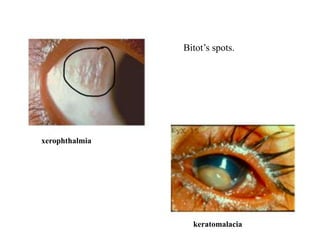
Severe deficiency xerophthalmia
Dryness in cornea, conjunctiva and keratinization of epithelial
cells
Certain area of conjunctiva triangular plaques aka Bitot’s
spots.
If xerophthalmia persists for longer timecorneal ulceration and
degeneration occurs keratomalacia causing total blindness
Vitamin A deficiency: in eye
xerophthalmia
keratomalacia
Bitot’s spots.
Other deficiency
• Effect on growth : retardation due to impairment in skeletal formation.
• Effect on reproduction: Degeneration of germinal epithelium leads to
sterility in male
• Effect on skin and epithelial cells : rough and dry skin.
• Keratinization of epithelial cells of gastro intestinal tract, urinary tract
and respiratory tract is noticed
The plasma level of retinol binding protein is decreased in vitamin A
deficiency (negative acute phase protein)
Hypervitaminosis A
• There is only a limited capacity to metabolize vitamin A, and
excessive intakes lead to toxicity.
• Dermatitis
• Hepatomegaly with hyperlipidemia
• Skeletal decalcification
• Hypercalcemia and calcification of soft tissue.
• CNS ( headache, nausea, ataxia, anorexia, ↑ CSF pressure)
• Excessive dry skin and alopecia
🙏⏰🙏

Vitamin a

  • 1.
  • 2.
    Vit A activity: is shown by retinoids and carotenoids Retinoids: preformed vit A found only in foods of animal origin. They are three types: 1. Retinol: alcohol with beta ionone ring. Side chain and one OH grp. +nt in animal tissue as retinyl ester with long chain FA. 2. Retinal: oxidation of retinol retinal ( aldehyde) 3. Retinoic acid: oxidation of retinal retinoic acid ( acidic)
  • 3.
    Carotenoids : ProvitaminA; found in plants. • β-carotene and related compounds • β-carotene (provitamin A): found in plants cleaved in intestinal mucosa by carotene dioxygenase  retinal. • Theoretically, produces 2 moles of retinal. • But in practical; is inefficient in humans, β-carotene has 1/6th vitamin A activity compared to that of retinol. (6 μg of β-carotene is equivalent to 1 μg of preformed retinol)
  • 4.
    Recommended dietary allowance •Retinol equivalents (RE) rather than International units(IU) • 1 RE= 1 μg retinol • Woman= 800 RE • Man= 1000 RE • One IU equals = 0.3 mg of retinol • The requirement increases in growing children, pregnant women and lactating mothers
  • 5.
    Dietary sources • Animalsource contain preformed vit A • The best sources are liver, kidney, egg yolk, milk, cheese, butter. 🧀🍼🧀 • Fish liver oils are very rich in vitamin A. 🐟🐠 • Vegetable sources contain the provitamin A-carotene • Yellow and dark green vegetables: tomato,carrots, spinach, pumpkins, 🧀🍅🧀 • fruits are good sources: mango, papaya etc. 🧀
  • 6.
  • 7.
    1. Dietary retinylesters hydrolysed by pancreatic and intestinal hydrolases retinol and FFA. 2. Whereas beta carotene retinal reduced to retinol 3. In intestinal mucosal cell both retinol get esterified again retinyl esters. 4. Carried by chylomicrons  transferred to lymph 5. Retinol esters is taken up by liver and stored. 6. When needed vit A is released from liver as free retinol. 7. Retinol is bound with RBP in circulation form complex 8. At peripheral target tissue binds with specific receptor on cell membrane enters into cell. 9. Retinol  retinoic acid enters into nucleus binds with nucleus retinoid receptor regulate gene transcription.
  • 9.
    👀👀Rhodopsin / Wald’svisual cycle🏻 Retina>>> retinal. 🏻 🏻 Two types of cell rods cell ( dim) and cones cell ( color and day) rhodopsin iodopsin 11-cis retinal ( CHO- grp) + opsin (NH2- of lysine) rhodopsin (rods) and iodopsin (in cones).
  • 11.
    Wald's visual cycle Howdoes this light strikes create vison in our brain? What is actually happening? What is visual cascade& cGMP? 🏻 🏻
  • 12.
    • When lightstrikes, the following reaction occurs in actual 💥👉🧀Visual cascade and cGMP • This results in hyperpolarization • Which is an excitatory response transmitted through the neuron network to the visual cortex of the brain • image is formed😃😎 Breaks cGMP Bleachingaction
  • 13.
    COLOR VISION • Conescell are specialized in bright and color vision • Visual cycle comparable to rodes is seen in cones too. • Governed by color sensitive pigments: • Porphyropsin ( red) • Iodopsin (green ) • Cyanopsin (blue) • Splitting of these three pigments in different proportion results in perception of different color by brain. •👠🧀🌹🌼
  • 14.
    Retinol ,Retinoic Acid: Regulation of Gene Expression & Tissue Differentiation • Retinoic acid growth, development and tissue differentiation. • Like steroid hormone and vit D, it binds with nuclear receptor  that binds with response element of DNA. • And regulate transcription of different genes. • Two nuclear receptor: Retinoid Acid Receptor ( RARs) and Retinoid X Receptor ( RXR). • RAR: all trans and 9-cis • RXR: 9-cis
  • 16.
    Other functions of vitaminA • Cell growth and differentiation • Maintain healthy epithelial cells • Synthesis of certain glycoproteins required for growth and mucus secretion • The synthesis of transferrin, the iron transport protein • To maintain proper immune system( fight bacterial infection) • Cholesterol synthesis require vit A • Carotenoid acts as anti oxidants.( cancer and heart attack)
  • 17.
    Usually not immediatecoz Hepatic stores can meet body requirements : 2-4 months In eyes: earliest symptoms night blindness ( nyctalopia) Severe deficiency xerophthalmia Dryness in cornea, conjunctiva and keratinization of epithelial cells Certain area of conjunctiva triangular plaques aka Bitot’s spots. If xerophthalmia persists for longer timecorneal ulceration and degeneration occurs keratomalacia causing total blindness Vitamin A deficiency: in eye
  • 18.
  • 19.
    Other deficiency • Effecton growth : retardation due to impairment in skeletal formation. • Effect on reproduction: Degeneration of germinal epithelium leads to sterility in male • Effect on skin and epithelial cells : rough and dry skin. • Keratinization of epithelial cells of gastro intestinal tract, urinary tract and respiratory tract is noticed The plasma level of retinol binding protein is decreased in vitamin A deficiency (negative acute phase protein)
  • 20.
    Hypervitaminosis A • Thereis only a limited capacity to metabolize vitamin A, and excessive intakes lead to toxicity. • Dermatitis • Hepatomegaly with hyperlipidemia • Skeletal decalcification • Hypercalcemia and calcification of soft tissue. • CNS ( headache, nausea, ataxia, anorexia, ↑ CSF pressure) • Excessive dry skin and alopecia 🙏⏰🙏

Editor's Notes

  • #3 they r interconvertible. But not retinoic acid can give back retinal or retinol The α-, β-, and γ-carotenes and cryptoxanthin are quantitatively the most important provitamin A carotenoids
  • #9 Retinyl esters present in the diet are hydrolyzed in the intestinal mucosa, releasing retinol and free fatty acids . Retinol derived from esters and from the cleavage and reduction of carotenes is re-esterified to long-chain fatty acids in the intestinal mucosa and secreted as a component of chylomicrons into the lymphatic system . Retinyl esters contained in chylomicron remnants are taken up by, and stored in, the liver.
  • #16 Like the steroid hormones and vitamin D, retinoic acid binds to nuclear receptors that bind to response elements of DNA and regulate the transcription of specific genes. There are two families of nuclear retinoid receptors: the retinoic acid receptors (RARs) bind all-trans-retinoic acid or 9-cis-retinoic acid, and the retinoid X receptors (RXRs) bind 9-cis-retinoic acid.
  • #17 Mevalonate, an intermediate in the cholesterol biosynthesis, is diverted for the synthesis of coenzyme Q in vitamin A deficiency. lt is pertinent to note that the discovery of coenzyme Q was originally made in vitamin A deficient animals. Carotenor'ds (most important p-carotene) function as antioxidants and reduce the risk of cancers initiated by free radicals and strong oxidants.p -Caroteneis found to be beneficialt o prevent heart attacks. This is also attributed to the antioxidant proper