BY
MOHAMED ABED
EGH
 The word "vitamin" comes from the Latin word
vita, means "life".
 Vitamins are chemicals found in very small
amounts in foods.
 “Vitamins have been defined as organic
compounds which are required in tiny
amounts to maintain normal health of
organisms’.
 cannot be synthesized in sufficient quantities by
an organism, and must be obtained from the diet
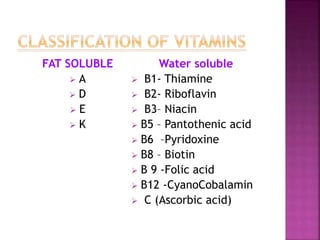
FAT SOLUBLE
 A
 D
 E
 K
Water soluble
 B1- Thiamine
 B2- Riboflavin
 B3– Niacin
 B5 – Pantothenic acid
 B6 –Pyridoxine
 B8 – Biotin
 B 9 -Folic acid
 B12 -CyanoCobalamin
 C (Ascorbic acid)
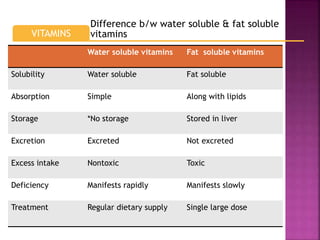
Water soluble vitamins Fat soluble vitamins
Solubility Water soluble Fat soluble
Absorption Simple Along with lipids
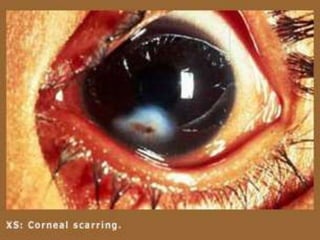
Storage *No storage Stored in liver
Excretion Excreted Not excreted
Excess intake Nontoxic Toxic
Deficiency Manifests rapidly Manifests slowly
Treatment Regular dietary supply Single large dose
Difference b/w water soluble & fat soluble
vitaminsVITAMINS
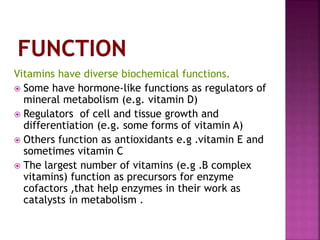
Vitamins have diverse biochemical functions.
 Some have hormone-like functions as regulators of
mineral metabolism (e.g. vitamin D)
 Regulators of cell and tissue growth and
differentiation (e.g. some forms of vitamin A)
 Others function as antioxidants e.g .vitamin E and
sometimes vitamin C
 The largest number of vitamins (e.g .B complex
vitamins) function as precursors for enzyme
cofactors ,that help enzymes in their work as
catalysts in metabolism .
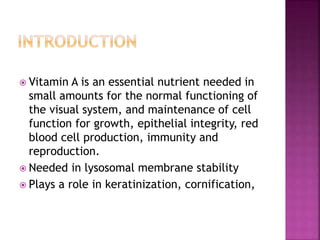
 Vitamin A is an essential nutrient needed in
small amounts for the normal functioning of
the visual system, and maintenance of cell
function for growth, epithelial integrity, red
blood cell production, immunity and
reproduction.
 Needed in lysosomal membrane stability
 Plays a role in keratinization, cornification,
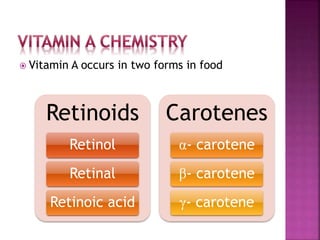
 Vitamin A occurs in two forms in food
Retinoids
Retinol
Retinal
Retinoic acid
Carotenes
α- carotene
β- carotene
γ- carotene
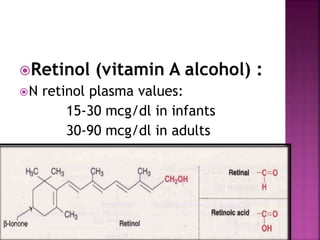
Retinol (vitamin A alcohol) :
N retinol plasma values:
15-30 mcg/dl in infants
30-90 mcg/dl in adults
 This is an aldehyde form obtained by the
oxidation of retinol.
 Retinal and retinol are inter convertible.
 produced by the oxidation of retinal.
 However, retinoic acid cannot give rise to the
formation of retinal or retinol.
 Beta-Carotene (provitamin A) :
 Found in plant foods.
 lt is cleaved in the intestine to produce two
moles of retinal
 Retinoids
 Retinyl esters broken down to free retinol in
small intestine - requires bile, digestive
enzymes, integration into micelles
 Once absorbed, retinyl esters reformed in
intestinal cells
 90% of retinoids can be absorbed
 Carotenoids
 absorption rate much lower
 Intestinal cells can convert carotenoids to
retinoids
 Liver stores 90% of vitamin A in the body in
form of Retinyl palmitate
 Reserve is adequate for several months
 Transported via chylomicrons from intestinal
cells to the liver
 Transported from the liver to target tissue as
retinol
 Free retinol is highly active but toxic &
therefore transported in blood stream in
combination with retinol binding protein
 Some lost in urine
 Kidney disease and aging increase risk of
toxicity because excretion is impaired
 Vision (night, day, colour)
 Epithelial cell integrity against infections
 Immune response
 Haematopoiesis
 Skeletal growth
 Fertility (male and female)
 Embryogenesis
 Roles in the Body
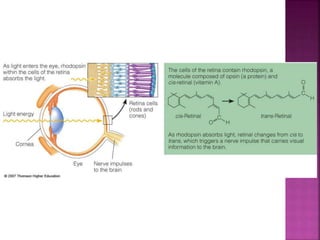
 Vitamin A in Vision
 Helps to maintain the cornea
 Conversion of light energy into nerve
impulses at the retina
 Rhodopsin is a light-sensitive pigment
of the retina that contains a protein
called opsin.
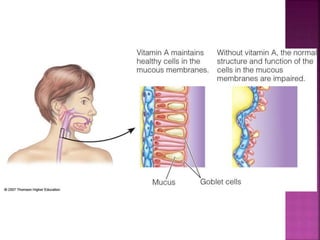
• Retinoic acid is necessary for cellular
differentiation
• Important for embryo development, gene
expression
• Retinoic acid influences production,
structure, and function of epithelial cells
that line the outside (skin) and external
passages (mucus forming cells) within the
body
 Roles in the Body
 Vitamin A in Reproduction and Growth
 Sperm development in men
 Normal fetal development in women
 Growth in children
 Remodeling of the bone involves
osteclasts, osteoblasts, and lysosomes.
 Vitamin A deficiency also diminishes the ability to
fight infections. In countries where children are not
immunized ,infectious disease like measles have
higher fatality rates.
 Even mild, subclinical deficiency can also be a
problem, as it may
 Increase children's risk of developing respiratory and
diarrheal infections
 Decrease growth rate
 Slow bone development
 Decrease probability of survival from serious illness.
 Roles in the Body
 Beta-Carotene as an Antioxidant
 Beta-carotene helps protect the body
from diseases, including cancer.(Lung,
oral, and prostate cancers)
 Prevention of cardiovascular disease
Causes Inadequate intake
Impaired absorption
Impaired storage and transport
Increased excretion [RBP]
Alcoholism
Men and women – 750-1000 μg.
Pregnancy and lactation – 1000 μg.
Infants – 350 μg.
Children – 400-600 μg.
 Vitamin A in Foods
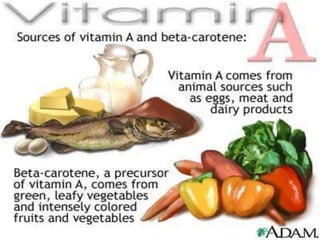
 Retinol is found in fortified milk, cheese, cream, butter,
fortified margarine, and eggs.
 Beta-carotene
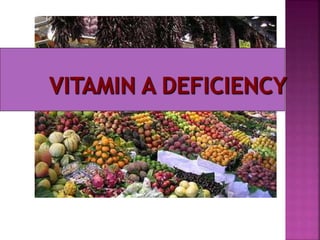
 Spinach and other dark green leafy vegetables
(chlorophyll pigment masks the color)
 Deep orange fruits
 Deep orange vegetables like squash, carrots, sweet
potatoes
 White foods are typically low in beta-carotene.
 Vitamin A is poor in fast foods and foods with the
xanthophyll pigments (beets, corn).
 Liver is rich in vitamin A.
 Vitamin A deficiency is a lack of vitamin A in humans.
Because vitamin A is stored in the body, it would take
a year or more to develop a deficiency in the
presence of inadequate intake.
 Night blindness is one of the first signs of vitamin A
deficiency .
 Night blindness is the difficulty for the eyes to adjust
to dim light. Affected individuals are unable to
distinguish images in low levels of illumination.
People with night blindness have poor vision in the
darkness, but see normally when adequate light is
present.
Ocular
 Night blindness.
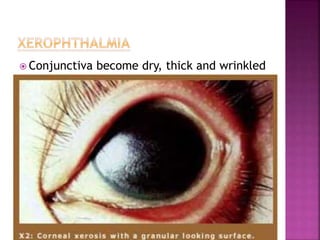
 xerophthalmia
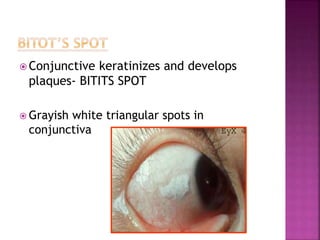
 bitot’s spot
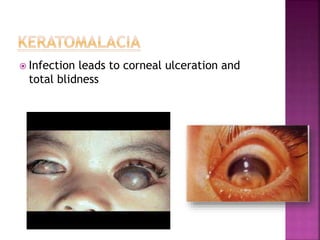
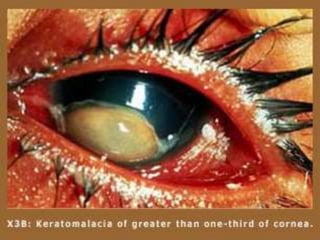
 keratomalacia
Extra ocular
 Retarded growth
 Skin disorders
 Effect on
reproductive
organs.
 Effect on bone
 Conjunctiva become dry, thick and wrinkled
 Conjunctive keratinizes and develops
plaques- BITITS SPOT
 Grayish white triangular spots in
conjunctiva
 Infection leads to corneal ulceration and
total blidness
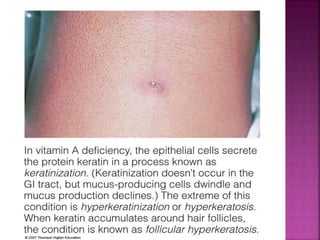
 SKIN CHANGES- Scaly, toad like
(phrynoderma)
 Squamous metaplasia of respiratory
mucosa more prone to RESPIRATORY
INFECTIONS
 Alteration in mucosa of renal pelvis and
UB formation of RENAL AND VESICAL
CALCULI
 Atrophy of germinal epithelium
© 2008 Thomson - Wadsworth
 Assessment of dietary vit.A
 Eye examination
 SERUM RETINOL level(normal level is 28 to
86 μg/dl (1 to 3 µmol/L) not an acurrate
indicator unless the deficiency is severe
and liver stores depleted
 Night vision threshold test
 For VAD syndromes, treatment includes daily oral
supplements, as follows: Children aged 3 years
or younger - 600 mcg (2000 IU)
 Children aged 4-8 years - 900 mcg (3000 IU)
 Children aged 9-13 years - 1700 mcg (5665 IU)
 Children aged 14-18 years - 2800 mcg (9335 IU)
 All adults - 3000 mcg (10,000 IU)
 Therapeutic doses for severe disease include
60,000 mcg (200,000 IU), which has been shown
to reduce child mortality rates by 35-70%
PARENTERAL WATER SOLUBLE VIT. A
DOSE- 3/4th DOSE <6 months
½ DOSE 6-12 months
INDICATION-
1. Impaired oral intake
2. Persistent vomiting
3. Severe malabsorption
6 -12 months > 1 yr
 Immediately 100,000 IU 200,000 IU
 Next day 100,000 IU 200,000 lU
 2–4 weeks later 100,000 IU 200,000 IU
 Severe Protein-Energy Malnutrition (PEM) Monthly
until PEM resolves
100,000 IU 200,000 IU
 LOCAL TREATMENT
CORNEAL ULCER-
ANTIBIOTICS DROPS/OINT. THRICE DAILY
(to prev. sec. infection)
PADDING OF EYE (to prevent dehydration and furthur
corneal exposure)
MYDRIATIC- ATROPINE DROP 1% OR OINT. ONCE
DAILY
mothers of breast-fed infants living in regions
where vitamin A deficiency is common.
2 doses of 200,000 IU (60 mg) of vitamin A are
given to the mother immediately after
delivery,
and the infant is given 3 doses of 25,000 IU
(7.5 mg) of vitamin A at 1-3 mo of age
 CONSUMPTION OF FOODS RICH IN VIT A
 LONG TERM PREVENTION STRATEGIES
1. Nutrition education and dietary diversification
2. HORTICULTURAL INTERVENTION incl. Home
gardening
3. Nutritional supplementation
4. Selective fortification for high risk and special
groups
All Infants with birth weight of ≤1 kg should receive
5000IU of Vitamin A i.m 3 times a week for first 4
weeks- slightly reduce the incidence of chronic lung
disease
Manual of neonatal care – john p cloharty, 6th ed
 Hypervitaminosis A refers to the effects of excessive
vitamin A )specifically retinoid) intake
 Hypervitaminosis A occurs when the maximum limit for
liver stores of retinoids is exceeded.
 The excess vitamin A enters the circulation causing
systemic toxicity.
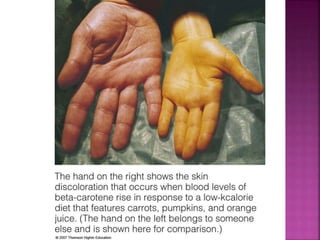
 Betacarotene (is an organic compound which is a
strongly-coloured red-orange pigment abundant in plants
and fruits. β-Carotene is also the substance in carrots
that colours them orange) a precursor of vitamin A, is
selectively converted into retinoids, so it does not cause
toxicity.
© 2008 Thomson - Wadsworth
Acute Intoxication:
 Infants: drowsiness or irritability w/signs
of increased ICP
 Adults: drowsiness, irritability, headache &
vomiting
 Serum vitamin A values = 200-1000 IU/dl
(N: 50-100 IU/dl)
 Acute – symptoms disappear when
intake stops
 GI effects
 Headaches
 Blurred vision
 Poor muscle coordination
 Results when >50,000 IU/day ingested for several
wks or more
 Signs & symptoms in infants:
 Early are anorexia, pruritus, irritability,
tender swollen bones w/motion limitation
 Alopecia, seborrhea, cheilosis & peeling of
palms & soles
 Hepatomegaly & hypercalcemia observed
 Craniotabes & hyperostosis of long bones
 Elevated serum vit A levels confirms diagnosis
 Reversible manifestations when vitamin A
discontinued
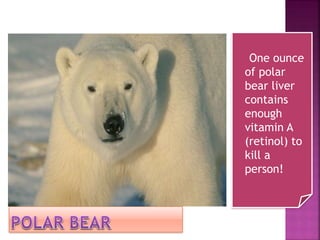
One ounce
of polar
bear liver
contains
enough
vitamin A
(retinol) to
kill a
person!
Vitamin a

Vitamin a

  • 1.
  • 2.
     The word"vitamin" comes from the Latin word vita, means "life".  Vitamins are chemicals found in very small amounts in foods.  “Vitamins have been defined as organic compounds which are required in tiny amounts to maintain normal health of organisms’.  cannot be synthesized in sufficient quantities by an organism, and must be obtained from the diet
  • 3.
    FAT SOLUBLE  A D  E  K Water soluble  B1- Thiamine  B2- Riboflavin  B3– Niacin  B5 – Pantothenic acid  B6 –Pyridoxine  B8 – Biotin  B 9 -Folic acid  B12 -CyanoCobalamin  C (Ascorbic acid)
  • 4.
    Water soluble vitaminsFat soluble vitamins Solubility Water soluble Fat soluble Absorption Simple Along with lipids Storage *No storage Stored in liver Excretion Excreted Not excreted Excess intake Nontoxic Toxic Deficiency Manifests rapidly Manifests slowly Treatment Regular dietary supply Single large dose Difference b/w water soluble & fat soluble vitaminsVITAMINS
  • 5.
    Vitamins have diversebiochemical functions.  Some have hormone-like functions as regulators of mineral metabolism (e.g. vitamin D)  Regulators of cell and tissue growth and differentiation (e.g. some forms of vitamin A)  Others function as antioxidants e.g .vitamin E and sometimes vitamin C  The largest number of vitamins (e.g .B complex vitamins) function as precursors for enzyme cofactors ,that help enzymes in their work as catalysts in metabolism .
  • 6.
     Vitamin Ais an essential nutrient needed in small amounts for the normal functioning of the visual system, and maintenance of cell function for growth, epithelial integrity, red blood cell production, immunity and reproduction.  Needed in lysosomal membrane stability  Plays a role in keratinization, cornification,
  • 7.
     Vitamin Aoccurs in two forms in food Retinoids Retinol Retinal Retinoic acid Carotenes α- carotene β- carotene γ- carotene
  • 8.
    Retinol (vitamin Aalcohol) : N retinol plasma values: 15-30 mcg/dl in infants 30-90 mcg/dl in adults
  • 9.
     This isan aldehyde form obtained by the oxidation of retinol.  Retinal and retinol are inter convertible.
  • 10.
     produced bythe oxidation of retinal.  However, retinoic acid cannot give rise to the formation of retinal or retinol.  Beta-Carotene (provitamin A) :  Found in plant foods.  lt is cleaved in the intestine to produce two moles of retinal
  • 11.
     Retinoids  Retinylesters broken down to free retinol in small intestine - requires bile, digestive enzymes, integration into micelles  Once absorbed, retinyl esters reformed in intestinal cells  90% of retinoids can be absorbed  Carotenoids  absorption rate much lower  Intestinal cells can convert carotenoids to retinoids
  • 12.
     Liver stores90% of vitamin A in the body in form of Retinyl palmitate  Reserve is adequate for several months  Transported via chylomicrons from intestinal cells to the liver  Transported from the liver to target tissue as retinol  Free retinol is highly active but toxic & therefore transported in blood stream in combination with retinol binding protein
  • 13.
     Some lostin urine  Kidney disease and aging increase risk of toxicity because excretion is impaired
  • 14.
     Vision (night,day, colour)  Epithelial cell integrity against infections  Immune response  Haematopoiesis  Skeletal growth  Fertility (male and female)  Embryogenesis
  • 15.
     Roles inthe Body  Vitamin A in Vision  Helps to maintain the cornea  Conversion of light energy into nerve impulses at the retina  Rhodopsin is a light-sensitive pigment of the retina that contains a protein called opsin.
  • 17.
    • Retinoic acidis necessary for cellular differentiation • Important for embryo development, gene expression • Retinoic acid influences production, structure, and function of epithelial cells that line the outside (skin) and external passages (mucus forming cells) within the body
  • 19.
     Roles inthe Body  Vitamin A in Reproduction and Growth  Sperm development in men  Normal fetal development in women  Growth in children  Remodeling of the bone involves osteclasts, osteoblasts, and lysosomes.
  • 20.
     Vitamin Adeficiency also diminishes the ability to fight infections. In countries where children are not immunized ,infectious disease like measles have higher fatality rates.  Even mild, subclinical deficiency can also be a problem, as it may  Increase children's risk of developing respiratory and diarrheal infections  Decrease growth rate  Slow bone development  Decrease probability of survival from serious illness.
  • 21.
     Roles inthe Body  Beta-Carotene as an Antioxidant  Beta-carotene helps protect the body from diseases, including cancer.(Lung, oral, and prostate cancers)  Prevention of cardiovascular disease
  • 23.
    Causes Inadequate intake Impairedabsorption Impaired storage and transport Increased excretion [RBP] Alcoholism
  • 24.
    Men and women– 750-1000 μg. Pregnancy and lactation – 1000 μg. Infants – 350 μg. Children – 400-600 μg.
  • 25.
     Vitamin Ain Foods  Retinol is found in fortified milk, cheese, cream, butter, fortified margarine, and eggs.  Beta-carotene  Spinach and other dark green leafy vegetables (chlorophyll pigment masks the color)  Deep orange fruits  Deep orange vegetables like squash, carrots, sweet potatoes  White foods are typically low in beta-carotene.  Vitamin A is poor in fast foods and foods with the xanthophyll pigments (beets, corn).  Liver is rich in vitamin A.
  • 27.
     Vitamin Adeficiency is a lack of vitamin A in humans. Because vitamin A is stored in the body, it would take a year or more to develop a deficiency in the presence of inadequate intake.  Night blindness is one of the first signs of vitamin A deficiency .  Night blindness is the difficulty for the eyes to adjust to dim light. Affected individuals are unable to distinguish images in low levels of illumination. People with night blindness have poor vision in the darkness, but see normally when adequate light is present.
  • 28.
    Ocular  Night blindness. xerophthalmia  bitot’s spot  keratomalacia Extra ocular  Retarded growth  Skin disorders  Effect on reproductive organs.  Effect on bone
  • 29.
     Conjunctiva becomedry, thick and wrinkled
  • 30.
     Conjunctive keratinizesand develops plaques- BITITS SPOT  Grayish white triangular spots in conjunctiva
  • 31.
     Infection leadsto corneal ulceration and total blidness
  • 34.
     SKIN CHANGES-Scaly, toad like (phrynoderma)  Squamous metaplasia of respiratory mucosa more prone to RESPIRATORY INFECTIONS  Alteration in mucosa of renal pelvis and UB formation of RENAL AND VESICAL CALCULI  Atrophy of germinal epithelium
  • 35.
    © 2008 Thomson- Wadsworth
  • 36.
     Assessment ofdietary vit.A  Eye examination  SERUM RETINOL level(normal level is 28 to 86 μg/dl (1 to 3 µmol/L) not an acurrate indicator unless the deficiency is severe and liver stores depleted  Night vision threshold test
  • 37.
     For VADsyndromes, treatment includes daily oral supplements, as follows: Children aged 3 years or younger - 600 mcg (2000 IU)  Children aged 4-8 years - 900 mcg (3000 IU)  Children aged 9-13 years - 1700 mcg (5665 IU)  Children aged 14-18 years - 2800 mcg (9335 IU)  All adults - 3000 mcg (10,000 IU)  Therapeutic doses for severe disease include 60,000 mcg (200,000 IU), which has been shown to reduce child mortality rates by 35-70%
  • 38.
    PARENTERAL WATER SOLUBLEVIT. A DOSE- 3/4th DOSE <6 months ½ DOSE 6-12 months INDICATION- 1. Impaired oral intake 2. Persistent vomiting 3. Severe malabsorption
  • 39.
    6 -12 months> 1 yr  Immediately 100,000 IU 200,000 IU  Next day 100,000 IU 200,000 lU  2–4 weeks later 100,000 IU 200,000 IU  Severe Protein-Energy Malnutrition (PEM) Monthly until PEM resolves 100,000 IU 200,000 IU
  • 40.
     LOCAL TREATMENT CORNEALULCER- ANTIBIOTICS DROPS/OINT. THRICE DAILY (to prev. sec. infection) PADDING OF EYE (to prevent dehydration and furthur corneal exposure) MYDRIATIC- ATROPINE DROP 1% OR OINT. ONCE DAILY
  • 41.
    mothers of breast-fedinfants living in regions where vitamin A deficiency is common. 2 doses of 200,000 IU (60 mg) of vitamin A are given to the mother immediately after delivery, and the infant is given 3 doses of 25,000 IU (7.5 mg) of vitamin A at 1-3 mo of age
  • 42.
     CONSUMPTION OFFOODS RICH IN VIT A  LONG TERM PREVENTION STRATEGIES 1. Nutrition education and dietary diversification 2. HORTICULTURAL INTERVENTION incl. Home gardening 3. Nutritional supplementation 4. Selective fortification for high risk and special groups
  • 43.
    All Infants withbirth weight of ≤1 kg should receive 5000IU of Vitamin A i.m 3 times a week for first 4 weeks- slightly reduce the incidence of chronic lung disease Manual of neonatal care – john p cloharty, 6th ed
  • 44.
     Hypervitaminosis Arefers to the effects of excessive vitamin A )specifically retinoid) intake  Hypervitaminosis A occurs when the maximum limit for liver stores of retinoids is exceeded.  The excess vitamin A enters the circulation causing systemic toxicity.  Betacarotene (is an organic compound which is a strongly-coloured red-orange pigment abundant in plants and fruits. β-Carotene is also the substance in carrots that colours them orange) a precursor of vitamin A, is selectively converted into retinoids, so it does not cause toxicity.
  • 45.
    © 2008 Thomson- Wadsworth
  • 46.
    Acute Intoxication:  Infants:drowsiness or irritability w/signs of increased ICP  Adults: drowsiness, irritability, headache & vomiting  Serum vitamin A values = 200-1000 IU/dl (N: 50-100 IU/dl)
  • 47.
     Acute –symptoms disappear when intake stops  GI effects  Headaches  Blurred vision  Poor muscle coordination
  • 48.
     Results when>50,000 IU/day ingested for several wks or more  Signs & symptoms in infants:  Early are anorexia, pruritus, irritability, tender swollen bones w/motion limitation  Alopecia, seborrhea, cheilosis & peeling of palms & soles  Hepatomegaly & hypercalcemia observed  Craniotabes & hyperostosis of long bones  Elevated serum vit A levels confirms diagnosis  Reversible manifestations when vitamin A discontinued
  • 49.
    One ounce of polar bearliver contains enough vitamin A (retinol) to kill a person!