The document outlines the biosynthesis and biochemical functions of thyroid hormones, including the roles of thyroxine (T4) and triiodothyronine (T3). It details the synthesis pathway, from iodide uptake to the release of hormones, emphasizing the importance of various enzymes and cellular processes. Additionally, it highlights the biological actions of these hormones, such as their effects on metabolism, growth, and energy regulation.

![Introduction
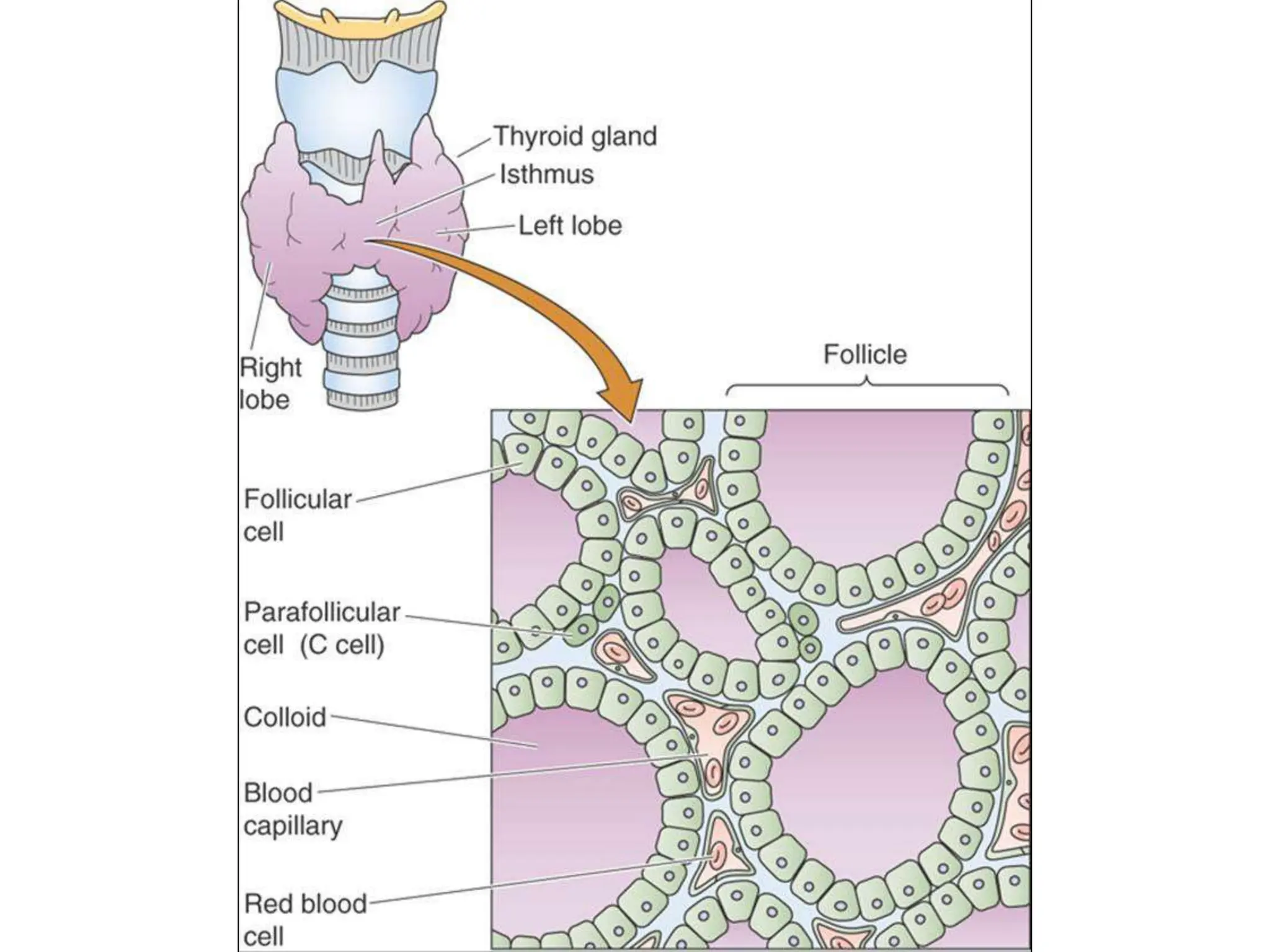
• Thyroid hormone by thyroid gland [ butterfly
shaped]
• Secretory unit is thyroid follicle
• Outer layer of epithelial cells
• Colloid [ amorphous material Thyroglobulin
and thyroalbumin]
• Also has parafollicular or ‘C’ cells calcitonin](https://image.slidesharecdn.com/biosynthesisofthhormone-240307053830-fb7d9da7/75/Thyroid-hormone-synthesis-in-our-body-mbbs-2-2048.jpg)
![Biochemistry of TH
• TWO hormones
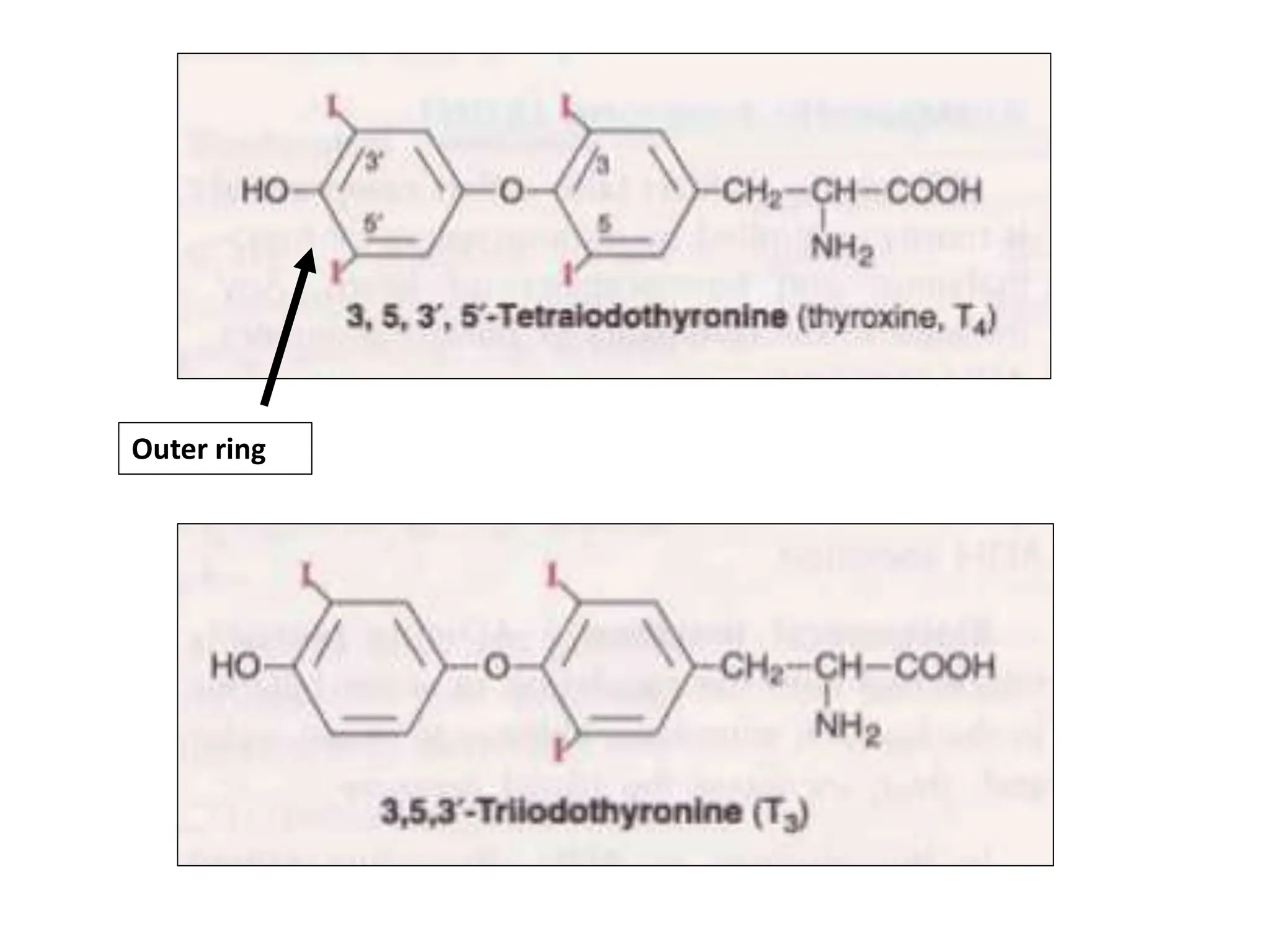
• Thyroxine [T4][ primary secretory product]
• Triiodothyronine[T3]
• In addition , small amount of
• Reverse triiodothyronine [ rT3]
• Monoiodotyrosine[MIT]
• Diiodotyrosine[DIT]
• rT3 is biologically inactive](https://image.slidesharecdn.com/biosynthesisofthhormone-240307053830-fb7d9da7/75/Thyroid-hormone-synthesis-in-our-body-mbbs-4-2048.jpg)

![Further info..
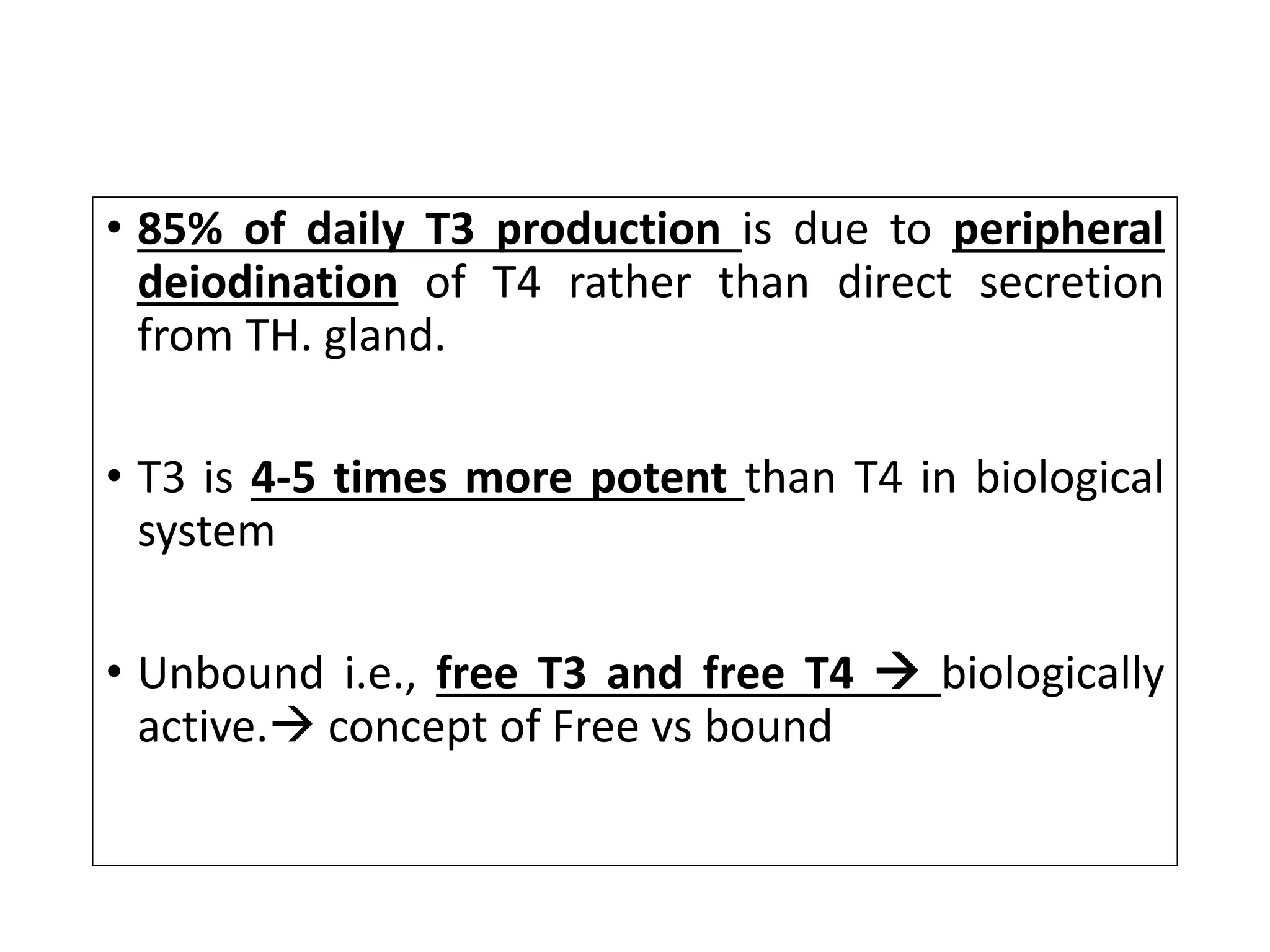
• Half life of T4 [ 4-7 days] and T3 is about 1 day.
Out of total T4 secreted
↓
Deiodinase enz.[se] in peripheral tissue
↓
40%T3 and 45%rT3
• T3: peripheral deiodination of outer ring of T4.
• rT3: peripheral deiodination of inner ring of T4.](https://image.slidesharecdn.com/biosynthesisofthhormone-240307053830-fb7d9da7/75/Thyroid-hormone-synthesis-in-our-body-mbbs-7-2048.jpg)
![concept of Free vs bound
• Both T3 & T4 are bound reversibly and almost
completely to carrier protein
• Thyroxine binding globulin [TBG] [ Predominant]
• Thyroxine binding prealbumin[TBPA]
• Albumin
• In collectively, 99.97% of T4 & 99.7% of T3 is bound
• So, fT4 [0.03%] & FT3 [0.3%] free thyroid
hormone actual biological function.](https://image.slidesharecdn.com/biosynthesisofthhormone-240307053830-fb7d9da7/75/Thyroid-hormone-synthesis-in-our-body-mbbs-9-2048.jpg)
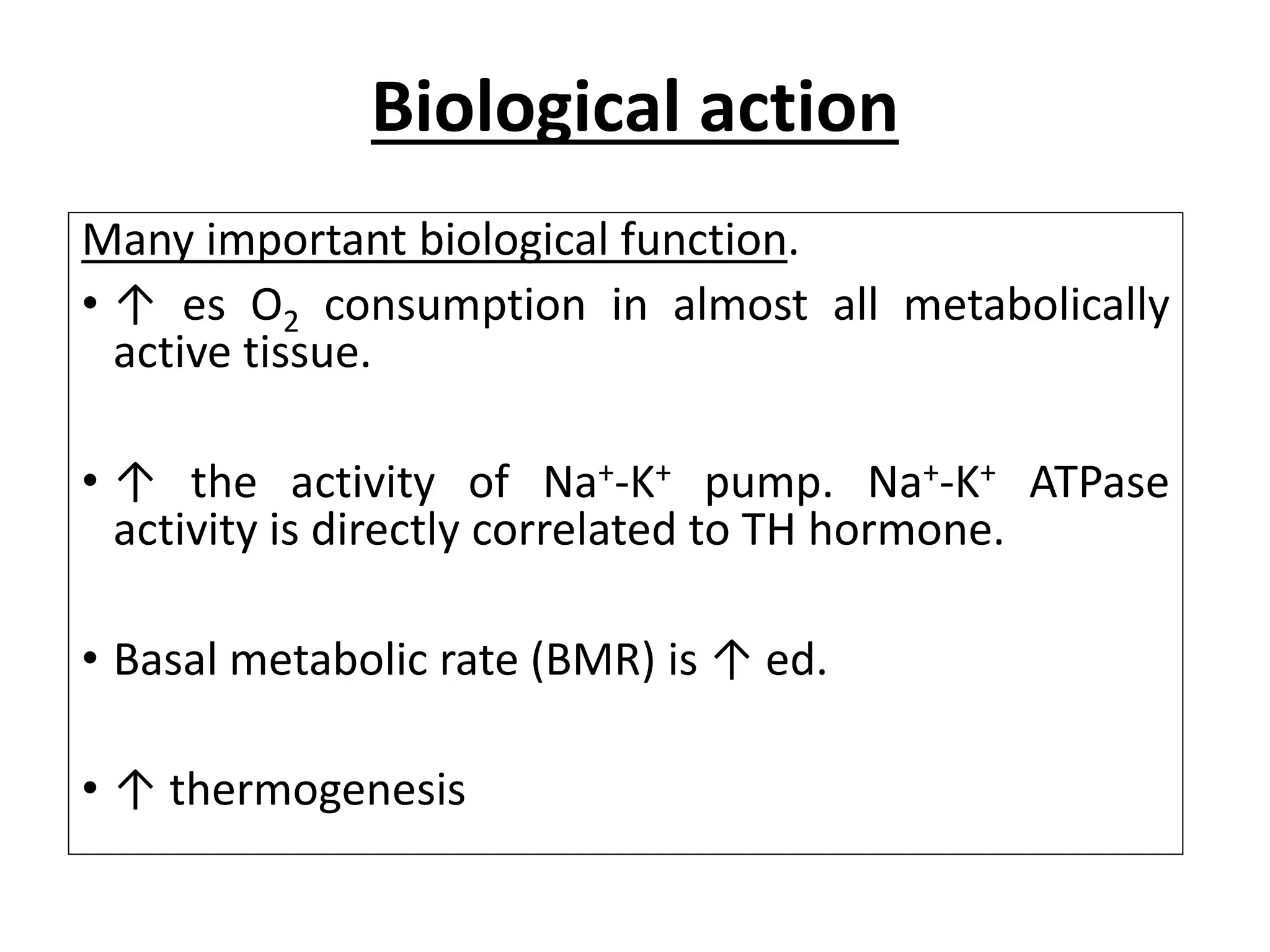
![• ↑es mitochondrial metabolism[ mito. Respiration
and ox. Phosphorylation]
• ↑ es the sensitivity of adrenergic receptors to
catecholamines.
• Stimulate adrenergic activity with ↑ ed heart rate
and myocardial contractility
• Stimulation of RNA synthesis and consequent
protein synthesis acts like steroid hormone](https://image.slidesharecdn.com/biosynthesisofthhormone-240307053830-fb7d9da7/75/Thyroid-hormone-synthesis-in-our-body-mbbs-11-2048.jpg)

![Biosynthesis[pathway]
of
Thyroid hormones](https://image.slidesharecdn.com/biosynthesisofthhormone-240307053830-fb7d9da7/75/Thyroid-hormone-synthesis-in-our-body-mbbs-13-2048.jpg)

![Steps of synthesis
• Normally iodide [I-] is trapped from
circulating plasma.
• Follicular cell concentrate iodide to 30-40
times plasma conc by iodine pump[Na/I
sym].
• Rate limiting step: Iodide transport to follicle
is 1st and R.L step.](https://image.slidesharecdn.com/biosynthesisofthhormone-240307053830-fb7d9da7/75/Thyroid-hormone-synthesis-in-our-body-mbbs-15-2048.jpg)
![1.Uptake of iodine
• Thyroid gland takes up and concentrates
iodine by Na/I symporter
• Energy requiring process [ Na+-k+ ATPase
pump]
• Anti thyroid agent such as thiocyanate
perchlorate and pertechnetate inhibit iodine
transport inhibit iodide transport](https://image.slidesharecdn.com/biosynthesisofthhormone-240307053830-fb7d9da7/75/Thyroid-hormone-synthesis-in-our-body-mbbs-16-2048.jpg)

![2.Oxidation of Iodine [ Active iodine]
• The thyroid is the only organ which can
perform this oxidation step.
• by the enzyme thyroperoxidase [ TPO]](https://image.slidesharecdn.com/biosynthesisofthhormone-240307053830-fb7d9da7/75/Thyroid-hormone-synthesis-in-our-body-mbbs-18-2048.jpg)
![3.Iodination of Tg [ Tyrosine residue]
• Tg[ 660Kda] contains tyrosine residue.
• Active Iodine will bind to tyrosine residue of Tg
organification MIT and DIT
• by thyroperoxidase [ TPO]](https://image.slidesharecdn.com/biosynthesisofthhormone-240307053830-fb7d9da7/75/Thyroid-hormone-synthesis-in-our-body-mbbs-19-2048.jpg)
![4. Coupling
• Coupling or condensation is also done by TPO.
• DIT+DIT T4
• DIT+MITT3
• Occurs at follicular cell-colloid interface and also
with in colloid.
• Formed TH hormones are stored in colloid [
approx. 3 months]](https://image.slidesharecdn.com/biosynthesisofthhormone-240307053830-fb7d9da7/75/Thyroid-hormone-synthesis-in-our-body-mbbs-20-2048.jpg)

![5.Release
TSH
Globules [colloid] endocytosed by follicular cells
Lysosomal protease breaks down peptide bond
of Tg
T3 and T4 circulation
MIT&DIT deiodinated by dehalogenase
Free iodides are then reutilized
↓
↓
↓
↓](https://image.slidesharecdn.com/biosynthesisofthhormone-240307053830-fb7d9da7/75/Thyroid-hormone-synthesis-in-our-body-mbbs-22-2048.jpg)

![Metabolic fate of T3&T4
• Conjugates with glucuronic acid or sulphate in liver
• Excrete through bile
• Also, deamination to produce
• tetraiodothyroacetic acid[T4]
• triiodothyroacetic acid[T3]
• Undergo conjugation and excretion.](https://image.slidesharecdn.com/biosynthesisofthhormone-240307053830-fb7d9da7/75/Thyroid-hormone-synthesis-in-our-body-mbbs-25-2048.jpg)


