Lung surfactant system
Binaya Tamang
UCMS
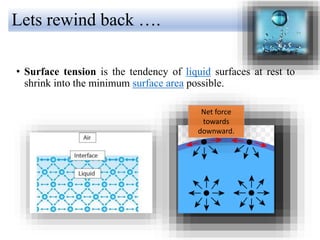
Lets rewind back ….
• Surface tension is the tendency of liquid surfaces at rest to
shrink into the minimum surface area possible.
Net force
towards
downward.
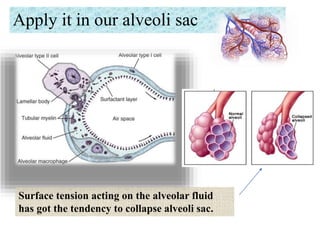
Apply it in our alveoli sac
Surface tension acting on the alveolar fluid
has got the tendency to collapse alveoli sac.
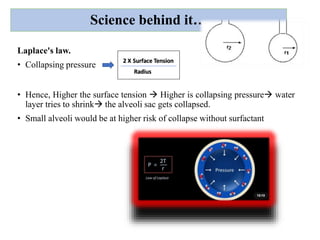
Science behind it…
Laplace's law.
• Collapsing pressure
• Hence, Higher the surface tension  Higher is collapsing pressure water
layer tries to shrink the alveoli sac gets collapsed.
• Small alveoli would be at higher risk of collapse without surfactant
Safeguard role by…
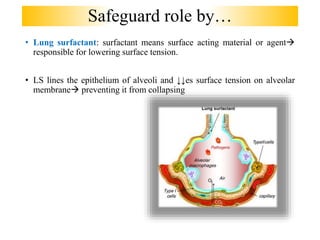
• Lung surfactant: surfactant means surface acting material or agent
responsible for lowering surface tension.
• LS lines the epithelium of alveoli and ↓↓es surface tension on alveolar
membrane preventing it from collapsing
Source and composition of LS
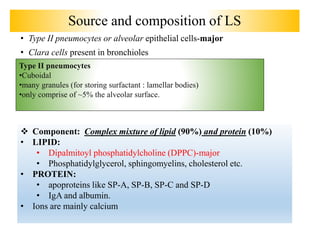
• Type II pneumocytes or alveolar epithelial cells-major
• Clara cells present in bronchioles
Type II pneumocytes
•Cuboidal
•many granules (for storing surfactant : lamellar bodies)
•only comprise of ~5% the alveolar surface.
 Component: Complex mixture of lipid (90%) and protein (10%)
• LIPID:
• Dipalmitoyl phosphatidylcholine (DPPC)-major
• Phosphatidylglycerol, sphingomyelins, cholesterol etc.
• PROTEIN:
• apoproteins like SP-A, SP-B, SP-C and SP-D
• IgA and albumin.
• Ions are mainly calcium
Functions
• Preventing lung collapse ↓surface tension
• Defense mechanism IgA
• SP-A and D helps in opsonization and facilitate phagocytosis
• SP-B and C helps surfactant to spread on surface
• Cleans alveoli surface
• Essential in gas exchange
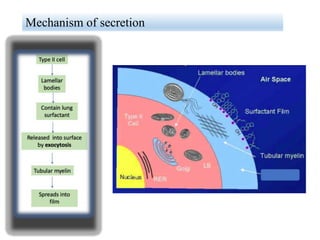
Mechanism of secretion
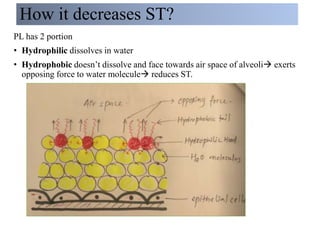
How it decreases ST?
PL has 2 portion
• Hydrophilic dissolves in water
• Hydrophobic doesn’t dissolve and face towards air space of alveoli exerts
opposing force to water molecule reduces ST.
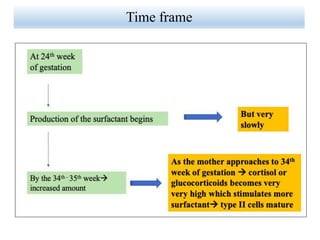
Time frame
At 24th week
of gestation
Production of the surfactant begins
But very
slowly
By the 34th - 35th week
increased amount
As the mother approaches to 34th
week of gestation  cortisol or
glucocorticoids becomes very
very high which stimulates more
surfactant type II cells mature
Clinical
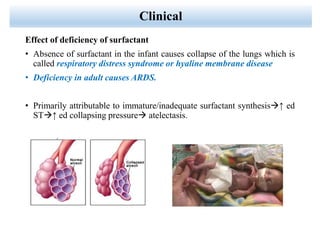
Effect of deficiency of surfactant
• Absence of surfactant in the infant causes collapse of the lungs which is
called respiratory distress syndrome or hyaline membrane disease
• Deficiency in adult causes ARDS.
• Primarily attributable to immature/inadequate surfactant synthesis↑ ed
ST↑ ed collapsing pressure atelectasis.
Lab diagnosis
• During fetal life: lungs synthesizes sphingomyelin before 28th week of
gestation
• BUT as fetus matures, more lecithin is synthesized
• SO, L/S ratio of amniotic fluid is an index of fetal maturity
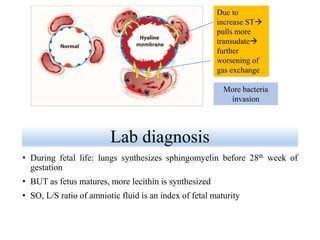
Due to
increase ST
pulls more
transudate
further
worsening of
gas exchange
More bacteria
invasion
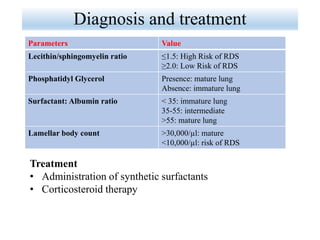
Diagnosis and treatment
Parameters Value
Lecithin/sphingomyelin ratio ≤1.5: High Risk of RDS
≥2.0: Low Risk of RDS
Phosphatidyl Glycerol Presence: mature lung
Absence: immature lung
Surfactant: Albumin ratio < 35: immature lung
35-55: intermediate
>55: mature lung
Lamellar body count >30,000/µl: mature
<10,000/µl: risk of RDS
Treatment
• Administration of synthetic surfactants
• Corticosteroid therapy
THANK
YOU

Lung surfactant system

  • 1.
  • 2.
    Lets rewind back…. • Surface tension is the tendency of liquid surfaces at rest to shrink into the minimum surface area possible. Net force towards downward.
  • 3.
    Apply it inour alveoli sac Surface tension acting on the alveolar fluid has got the tendency to collapse alveoli sac.
  • 4.
    Science behind it… Laplace'slaw. • Collapsing pressure • Hence, Higher the surface tension  Higher is collapsing pressure water layer tries to shrink the alveoli sac gets collapsed. • Small alveoli would be at higher risk of collapse without surfactant
  • 5.
    Safeguard role by… •Lung surfactant: surfactant means surface acting material or agent responsible for lowering surface tension. • LS lines the epithelium of alveoli and ↓↓es surface tension on alveolar membrane preventing it from collapsing
  • 6.
    Source and compositionof LS • Type II pneumocytes or alveolar epithelial cells-major • Clara cells present in bronchioles Type II pneumocytes •Cuboidal •many granules (for storing surfactant : lamellar bodies) •only comprise of ~5% the alveolar surface.  Component: Complex mixture of lipid (90%) and protein (10%) • LIPID: • Dipalmitoyl phosphatidylcholine (DPPC)-major • Phosphatidylglycerol, sphingomyelins, cholesterol etc. • PROTEIN: • apoproteins like SP-A, SP-B, SP-C and SP-D • IgA and albumin. • Ions are mainly calcium
  • 7.
    Functions • Preventing lungcollapse ↓surface tension • Defense mechanism IgA • SP-A and D helps in opsonization and facilitate phagocytosis • SP-B and C helps surfactant to spread on surface • Cleans alveoli surface • Essential in gas exchange
  • 8.
  • 9.
    How it decreasesST? PL has 2 portion • Hydrophilic dissolves in water • Hydrophobic doesn’t dissolve and face towards air space of alveoli exerts opposing force to water molecule reduces ST.
  • 10.
    Time frame At 24thweek of gestation Production of the surfactant begins But very slowly By the 34th - 35th week increased amount As the mother approaches to 34th week of gestation  cortisol or glucocorticoids becomes very very high which stimulates more surfactant type II cells mature
  • 11.
    Clinical Effect of deficiencyof surfactant • Absence of surfactant in the infant causes collapse of the lungs which is called respiratory distress syndrome or hyaline membrane disease • Deficiency in adult causes ARDS. • Primarily attributable to immature/inadequate surfactant synthesis↑ ed ST↑ ed collapsing pressure atelectasis.
  • 12.
    Lab diagnosis • Duringfetal life: lungs synthesizes sphingomyelin before 28th week of gestation • BUT as fetus matures, more lecithin is synthesized • SO, L/S ratio of amniotic fluid is an index of fetal maturity Due to increase ST pulls more transudate further worsening of gas exchange More bacteria invasion
  • 13.
    Diagnosis and treatment ParametersValue Lecithin/sphingomyelin ratio ≤1.5: High Risk of RDS ≥2.0: Low Risk of RDS Phosphatidyl Glycerol Presence: mature lung Absence: immature lung Surfactant: Albumin ratio < 35: immature lung 35-55: intermediate >55: mature lung Lamellar body count >30,000/µl: mature <10,000/µl: risk of RDS Treatment • Administration of synthetic surfactants • Corticosteroid therapy
  • 14.

Editor's Notes

  • #7 Called as specific surfactant proteins
  • #12 meconium aspiration, pneumothorax pnemonia
  • #14 Sig and symp occurs after 4hrs of birth Sternal retraction Intercostal and subcostal recession Expiratory grunt Tachypnea. RR< 60/min Ground glass appearance on chest X ray