VITAMIN
‘K’
Introduction
üWater soluble vit has many coenzyme fxn, BUT Vit Kà only fat soluble
vit with coenzyme.
üHas role in coagulation process.
üExist in 3 different form:
• Vit. K1( phylloquinone): plant, green veg.
• Vit K2( menaquinone): intestinal bacteria & animal.
• Vit K3( menadione): is a synthetic formà can be metabolized to
phylloquinone.
Further……….
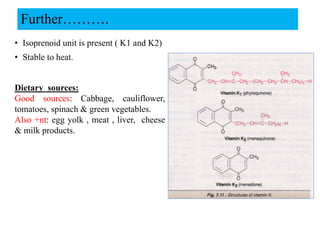
• Isoprenoid unit is present ( K1 and K2)
• Stable to heat.
Dietary sources:
Good sources: Cabbage, cauliflower,
tomatoes, spinach & green vegetables.
Also +nt: egg yolk , meat , liver, cheese
& milk products.
Absorption, transport and storage
• Diet or intestinal bacteriaà vit K
• Absorption is taken place in +nce of chylomicrons & bile salts.
• Transported along with LDL & stored in liver.
• Little in other tissue.
RDA: Strictly speaking à no RDA, since it can be synthesized in GUT
by flora.
However, recommended ( ½ by diet & ½ by bacterial flora)
Accordinglyà suggested à RDA: 70-140 𝜇g/day.
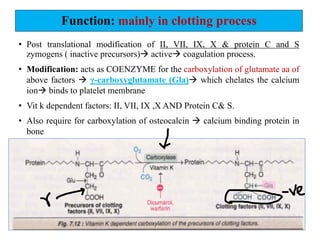
Function: mainly in clotting process
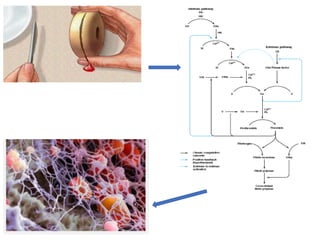
• Post translational modification of II, VII, IX, X & protein C and S
zymogens ( inactive precursors)à activeà coagulation process.
• Modification: acts as COENZYME for the carboxylation of glutamate aa of
above factors à γ-carboxyglutamate (Gla)à which chelates the calcium
ionà binds to platelet membrane
• Vit k dependent factors: II, VII, IX ,X AND Protein C& S.
• Also require for carboxylation of osteocalcin à calcium binding protein in
bone
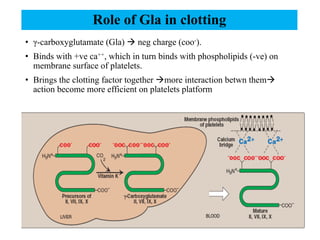
Role of Gla in clotting
• γ-carboxyglutamate (Gla) à neg charge (coo-).
• Binds with +ve ca++, which in turn binds with phospholipids (-ve) on
membrane surface of platelets.
• Brings the clotting factor together àmore interaction betwn themà
action become more efficient on platelets platform
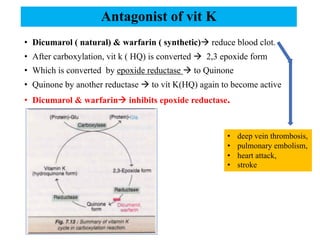
• Dicumarol ( natural) & warfarin ( synthetic)à reduce blood clot.
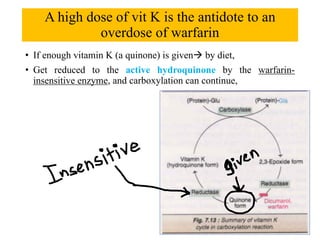
• After carboxylation, vit k ( HQ) is converted à 2,3 epoxide form
• Which is converted by epoxide reductase à to Quinone
• Quinone by another reductase à to vit K(HQ) again to become active
• Dicumarol & warfarinà inhibits epoxide reductase.
Antagonist of vit K
• deep vein thrombosis,
• pulmonary embolism,
• heart attack,
• stroke
A high dose of vit K is the antidote to an
overdose of warfarin
• If enough vitamin K (a quinone) is givenà by diet,
• Get reduced to the active hydroquinone by the warfarin-
insensitive enzyme, and carboxylation can continue,
Deficiency symptoms
üCauses
• Fat malabsorption
• ↑↑ broad-spectrum antibiotics ( killing of gut flora)
• Loss of vit. K in feces (diarrhea)
üLeads to ( ↓↓ active prothrombin)
• Bleeding disordersà profusely bleeds even for minor injury.
üHypervitaminosis: ↑↑ RBC destructionà
anemia & jaundice
•🙏🙏🌝🌞

Vit k

  • 1.
  • 2.
    Introduction üWater soluble vithas many coenzyme fxn, BUT Vit Kà only fat soluble vit with coenzyme. üHas role in coagulation process. üExist in 3 different form: • Vit. K1( phylloquinone): plant, green veg. • Vit K2( menaquinone): intestinal bacteria & animal. • Vit K3( menadione): is a synthetic formà can be metabolized to phylloquinone.
  • 3.
    Further………. • Isoprenoid unitis present ( K1 and K2) • Stable to heat. Dietary sources: Good sources: Cabbage, cauliflower, tomatoes, spinach & green vegetables. Also +nt: egg yolk , meat , liver, cheese & milk products.
  • 4.
    Absorption, transport andstorage • Diet or intestinal bacteriaà vit K • Absorption is taken place in +nce of chylomicrons & bile salts. • Transported along with LDL & stored in liver. • Little in other tissue. RDA: Strictly speaking à no RDA, since it can be synthesized in GUT by flora. However, recommended ( ½ by diet & ½ by bacterial flora) Accordinglyà suggested à RDA: 70-140 𝜇g/day.
  • 5.
    Function: mainly inclotting process • Post translational modification of II, VII, IX, X & protein C and S zymogens ( inactive precursors)à activeà coagulation process. • Modification: acts as COENZYME for the carboxylation of glutamate aa of above factors à γ-carboxyglutamate (Gla)à which chelates the calcium ionà binds to platelet membrane • Vit k dependent factors: II, VII, IX ,X AND Protein C& S. • Also require for carboxylation of osteocalcin à calcium binding protein in bone
  • 6.
    Role of Glain clotting • γ-carboxyglutamate (Gla) à neg charge (coo-). • Binds with +ve ca++, which in turn binds with phospholipids (-ve) on membrane surface of platelets. • Brings the clotting factor together àmore interaction betwn themà action become more efficient on platelets platform
  • 8.
    • Dicumarol (natural) & warfarin ( synthetic)à reduce blood clot. • After carboxylation, vit k ( HQ) is converted à 2,3 epoxide form • Which is converted by epoxide reductase à to Quinone • Quinone by another reductase à to vit K(HQ) again to become active • Dicumarol & warfarinà inhibits epoxide reductase. Antagonist of vit K • deep vein thrombosis, • pulmonary embolism, • heart attack, • stroke
  • 9.
    A high doseof vit K is the antidote to an overdose of warfarin • If enough vitamin K (a quinone) is givenà by diet, • Get reduced to the active hydroquinone by the warfarin- insensitive enzyme, and carboxylation can continue,
  • 10.
    Deficiency symptoms üCauses • Fatmalabsorption • ↑↑ broad-spectrum antibiotics ( killing of gut flora) • Loss of vit. K in feces (diarrhea) üLeads to ( ↓↓ active prothrombin) • Bleeding disordersà profusely bleeds even for minor injury. üHypervitaminosis: ↑↑ RBC destructionà anemia & jaundice
  • 11.