Iris: The number one hit by Goo Goo Dolls in 1998. Also the colourful part of 
the eye. 
The eye: Structure 
and function 
Csilla Egri, KIN 306, Spring 2012
Outline 
 Functional anatomy of the eye 
 Optical 
 Neural 
 Photoreceptors 
 Rods 
 Cones 
 Phototransduction 
 Mechanism 
 Termination 
 Light adaptation 
 Colour Vision 
2
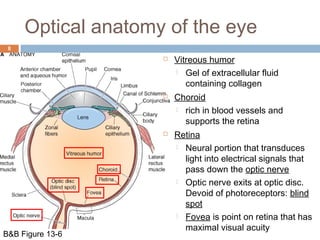
Optical anatomy of the eye 
3 
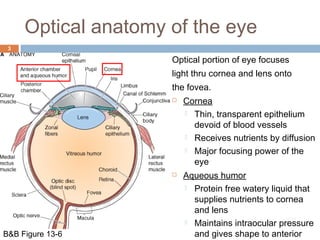
Optical portion of eye focuses 
light thru cornea and lens onto 
the fovea. 
 Cornea 
 Thin, transparent epithelium 
devoid of blood vessels 
 Receives nutrients by diffusion 
 Major focusing power of the 
eye 
 Aqueous humor 
 Protein free watery liquid that 
supplies nutrients to cornea 
and lens 
 Maintains intraocular pressure 
and gives shape to anterior 
portion of eye 
B&B Figure 13-6
Optical anatomy of the eye 
4 
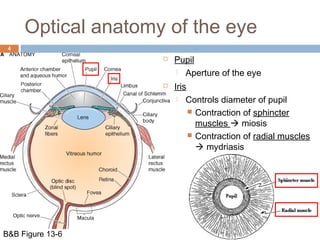
 Pupil 
 Aperture of the eye 
 Iris 
 Controls diameter of pupil 
 Contraction of sphincter 
muscles  miosis 
 Contraction of radial muscles 
 mydriasis 
B&B Figure 13-6
Optical anatomy of the eye 
5 
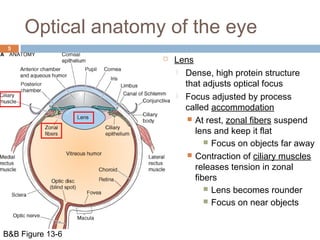
 Lens 
 Dense, high protein structure 
that adjusts optical focus 
 Focus adjusted by process 
called accommodation 
 At rest, zonal fibers suspend 
lens and keep it flat 
 Focus on objects far away 
 Contraction of ciliary muscles 
releases tension in zonal 
fibers 
 Lens becomes rounder 
 Focus on near objects 
B&B Figure 13-6
Accommodation and associated 
disorders 6 
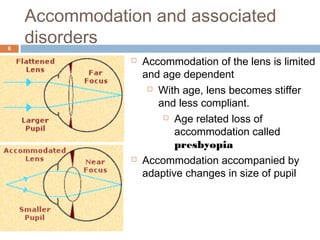
 Accommodation of the lens is limited 
and age dependent 
 With age, lens becomes stiffer 
and less compliant. 
 Age related loss of 
accommodation called 
presbyopia 
 Accommodation accompanied by 
adaptive changes in size of pupil
Accommodation and associated 
disorders 7 
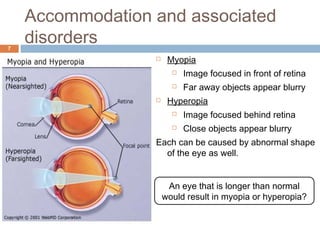
 Myopia 
 Image focused in front of retina 
 Far away objects appear blurry 
 Hyperopia 
 Image focused behind retina 
 Close objects appear blurry 
Each can be caused by abnormal shape 
of the eye as well. 
An eye that is longer than normal 
would result in myopia or hyperopia?
Optical anatomy of the eye 
8 
 Vitreous humor 
 Gel of extracellular fluid 
containing collagen 
 Choroid 
 rich in blood vessels and 
supports the retina 
 Retina 
 Neural portion that transduces 
light into electrical signals that 
pass down the optic nerve 
 Optic nerve exits at optic disc. 
Devoid of photoreceptors: blind 
spot 
 Fovea is point on retina that has 
maximal visual acuity 
B&B Figure 13-6
Neural 
anatomy 9 
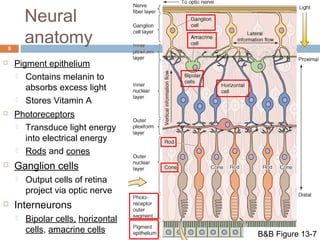
 Pigment epithelium 
 Contains melanin to 
absorbs excess light 
 Stores Vitamin A 
 Photoreceptors 
 Transduce light energy 
into electrical energy 
 Rods and cones 
 Ganglion cells 
 Output cells of retina 
project via optic nerve 
 Interneurons 
 Bipolar cells, horizontal 
cells, amacrine cells B&B Figure 13-7
Neural anatomy 
10 
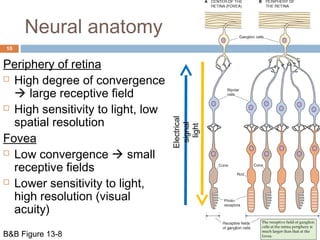
Periphery of retina 
 High degree of convergence 
 large receptive field 
 High sensitivity to light, low 
spatial resolution 
Fovea 
 Low convergence  small 
receptive fields 
 Lower sensitivity to light, 
high resolution (visual 
acuity) 
B&B Figure 13-8 
Electrical 
signal 
light
Neural anatomy: Fovea 
11 
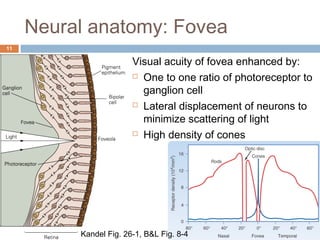
Visual acuity of fovea enhanced by: 
 One to one ratio of photoreceptor to 
ganglion cell 
 Lateral displacement of neurons to 
minimize scattering of light 
 High density of cones 
Kandel Fig. 26-1, B&L Fig. 8-4
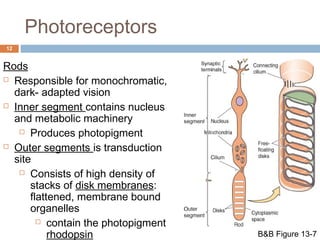
Photoreceptors 
12 
Rods 
 Responsible for monochromatic, 
dark- adapted vision 
 Inner segment contains nucleus 
and metabolic machinery 
 Produces photopigment 
 Outer segments is transduction 
site 
 Consists of high density of 
stacks of disk membranes: 
flattened, membrane bound 
organelles 
 contain the photopigment 
rhodopsin 
v 
v 
B&B Figure 13-7
Photoreceptors 
13 
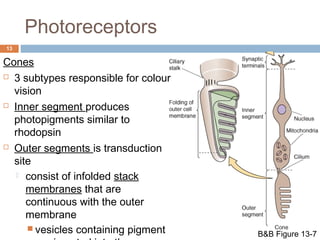
Cones 
 3 subtypes responsible for colour 
vision 
 Inner segment produces 
photopigments similar to 
rhodopsin 
 Outer segments is transduction 
site 
 consist of infolded stack 
membranes that are 
continuous with the outer 
membrane 
 vesicles containing pigment 
are inserted into the 
B&B Figure 13-7
Phototransduction: Dark current 
14 
 Partially active guanylyl cyclase 
keeps cytoplasmic [cGMP] high in the 
dark 
 Outer segment contains cGMP-gated 
cation channels 
 Influx of Na+ and Ca2+ 
 Inner segment contains non-gated K+ 
selective channels 
 K+ efflux 
 Resting, or dark Vm is -40 mV 
 concentration gradients maintained 
by Na+/K+ pump and NCX 
Kandel Figure 26-5A
Phototransduction 
15 
Photoreceptors hyperpolarize in response to light and release less 
neurotransmitter 
 In darkness, the Vm of -40 mV keeps CaV channels in the 
synaptic terminal open 
 photoreceptors continuously release neurotransmitter 
glutamate 
 absorption of light by photopigment ’s [cGMP] 
 cation channels close 
 K+ efflux predominates, hyperpolarizes cell (-70mV) 
 CaV channels close, decreased release of glutamate
Phototransduction: mechanism 
16 
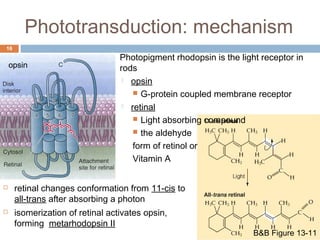
 Photopigment rhodopsin is the light receptor in 
rods 
 opsin 
 G-protein coupled membrane receptor 
 retinal 
 Light absorbing compound 
 the aldehyde 
form of retinol or 
Vitamin A 
B&B Figure 13-11 
opsin 
 retinal changes conformation from 11-cis to 
all-trans after absorbing a photon 
 isomerization of retinal activates opsin, 
forming metarhodopsin II
Phototransduction: mechanism 
17 
light 
1. Absorption of a photon isomerizes retinal 
a) Converts opsin to metarhodopsin II 
2. Metarodophsin II activates the G-protein transducin 
a) Activates cGMP phosphodiesterase (PDE) 
3. PDE hydrolyzes cGMP to GMP 
a) Decreased [cGMP] closes cGMP gated cation channels 
b) Photoreceptor hyperpolarizes, less glutamate released Kandel Figure 26-4
Phototransduction: termination 
18 
 Activated rhodopsin is a target for 
phosphorylation by rhodopsin kinase 
 Phosphorylated rhodopsin inactivated by cytosolic 
protein arrestin 
 All-trans retinal transported to the pigment 
epithelium where it is converted back to 11-cis 
retinal, and recycled back to the rod 
 Activated transducin inactivates itself by 
hydrolyzing GTP to GDP
Phototransduction: light 
adaptation 19 
Eyes adapt to increased light intensity and 
remain sensitive to further changes in light 
 Optic adaptation: 
 Constriction of pupils to allow in less light 
 Photoreceptor adaptation: 
 The closure of cGMP gated channel reduces 
inward flux of Ca2+ decreased [Ca2+]i 
 Ca2+ induced inhibition of guanylyl cyclase 
removed 
More cGMP made  reopening of some cGMP gated 
channels  influx of cations  slight depolarization 
Photoreceptor can once again be stimulated 
(hyperpolarized) by photons
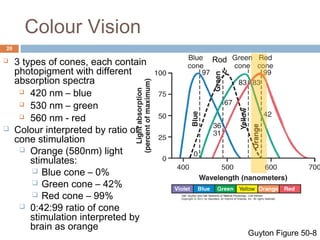
Colour Vision 
20 
 3 types of cones, each contain 
photopigment with different 
absorption spectra 
 420 nm – blue 
 530 nm – green 
 560 nm - red 
 Colour interpreted by ratio of 
cone stimulation 
 Orange (580nm) light 
stimulates: 
 Blue cone – 0% 
 Green cone – 42% 
 Red cone – 99% 
Rod 
 0:42:99 ratio of cone 
stimulation interpreted by 
brain as orange Guyton Figure 50-8
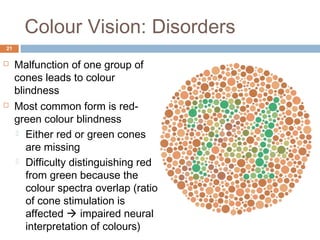
Colour Vision: Disorders 
21 
 Malfunction of one group of 
cones leads to colour 
blindness 
 Most common form is red-green 
colour blindness 
 Either red or green cones 
are missing 
 Difficulty distinguishing red 
from green because the 
colour spectra overlap (ratio 
of cone stimulation is 
affected  impaired neural 
interpretation of colours)
Objectives 
After this lecture you should be able to: 
 Outline the functional anatomy of the optical and neural 
components of the eye 
 Compare and contrast the structure and function of rods 
vs. cones 
 Describe the mechanism of phototransduction, including 
the dark current, termination of light signal, and 
adaptation 
 Relate the absorptive spectra of cones to colour vision 
and colour blindness 
22
23 
Test your knowledge 
1. Individuals with presbyopia have difficulty focusing on 
objects near or far? 
2. What is the only light dependent step in vision? 
3. Using the figure from slide 20, predict the ratio of cone 
stimulation for yellow and blue light. 
4. A monitor of the amount of neurotransmitters released 
from photoreceptors shows a constant release of 
glutamate. This implies that the person is: 
a) Reading 
b) In a dark room 
c) Outside in the sunlight 
d) Focusing on a distant object

Visual System Structure and Function

  • 1.
    Iris: The numberone hit by Goo Goo Dolls in 1998. Also the colourful part of the eye. The eye: Structure and function Csilla Egri, KIN 306, Spring 2012
  • 2.
    Outline  Functionalanatomy of the eye  Optical  Neural  Photoreceptors  Rods  Cones  Phototransduction  Mechanism  Termination  Light adaptation  Colour Vision 2
  • 3.
    Optical anatomy ofthe eye 3 Optical portion of eye focuses light thru cornea and lens onto the fovea.  Cornea  Thin, transparent epithelium devoid of blood vessels  Receives nutrients by diffusion  Major focusing power of the eye  Aqueous humor  Protein free watery liquid that supplies nutrients to cornea and lens  Maintains intraocular pressure and gives shape to anterior portion of eye B&B Figure 13-6
  • 4.
    Optical anatomy ofthe eye 4  Pupil  Aperture of the eye  Iris  Controls diameter of pupil  Contraction of sphincter muscles  miosis  Contraction of radial muscles  mydriasis B&B Figure 13-6
  • 5.
    Optical anatomy ofthe eye 5  Lens  Dense, high protein structure that adjusts optical focus  Focus adjusted by process called accommodation  At rest, zonal fibers suspend lens and keep it flat  Focus on objects far away  Contraction of ciliary muscles releases tension in zonal fibers  Lens becomes rounder  Focus on near objects B&B Figure 13-6
  • 6.
    Accommodation and associated disorders 6  Accommodation of the lens is limited and age dependent  With age, lens becomes stiffer and less compliant.  Age related loss of accommodation called presbyopia  Accommodation accompanied by adaptive changes in size of pupil
  • 7.
    Accommodation and associated disorders 7  Myopia  Image focused in front of retina  Far away objects appear blurry  Hyperopia  Image focused behind retina  Close objects appear blurry Each can be caused by abnormal shape of the eye as well. An eye that is longer than normal would result in myopia or hyperopia?
  • 8.
    Optical anatomy ofthe eye 8  Vitreous humor  Gel of extracellular fluid containing collagen  Choroid  rich in blood vessels and supports the retina  Retina  Neural portion that transduces light into electrical signals that pass down the optic nerve  Optic nerve exits at optic disc. Devoid of photoreceptors: blind spot  Fovea is point on retina that has maximal visual acuity B&B Figure 13-6
  • 9.
    Neural anatomy 9  Pigment epithelium  Contains melanin to absorbs excess light  Stores Vitamin A  Photoreceptors  Transduce light energy into electrical energy  Rods and cones  Ganglion cells  Output cells of retina project via optic nerve  Interneurons  Bipolar cells, horizontal cells, amacrine cells B&B Figure 13-7
  • 10.
    Neural anatomy 10 Periphery of retina  High degree of convergence  large receptive field  High sensitivity to light, low spatial resolution Fovea  Low convergence  small receptive fields  Lower sensitivity to light, high resolution (visual acuity) B&B Figure 13-8 Electrical signal light
  • 11.
    Neural anatomy: Fovea 11 Visual acuity of fovea enhanced by:  One to one ratio of photoreceptor to ganglion cell  Lateral displacement of neurons to minimize scattering of light  High density of cones Kandel Fig. 26-1, B&L Fig. 8-4
  • 12.
    Photoreceptors 12 Rods  Responsible for monochromatic, dark- adapted vision  Inner segment contains nucleus and metabolic machinery  Produces photopigment  Outer segments is transduction site  Consists of high density of stacks of disk membranes: flattened, membrane bound organelles  contain the photopigment rhodopsin v v B&B Figure 13-7
  • 13.
    Photoreceptors 13 Cones  3 subtypes responsible for colour vision  Inner segment produces photopigments similar to rhodopsin  Outer segments is transduction site  consist of infolded stack membranes that are continuous with the outer membrane  vesicles containing pigment are inserted into the B&B Figure 13-7
  • 14.
    Phototransduction: Dark current 14  Partially active guanylyl cyclase keeps cytoplasmic [cGMP] high in the dark  Outer segment contains cGMP-gated cation channels  Influx of Na+ and Ca2+  Inner segment contains non-gated K+ selective channels  K+ efflux  Resting, or dark Vm is -40 mV  concentration gradients maintained by Na+/K+ pump and NCX Kandel Figure 26-5A
  • 15.
    Phototransduction 15 Photoreceptorshyperpolarize in response to light and release less neurotransmitter  In darkness, the Vm of -40 mV keeps CaV channels in the synaptic terminal open  photoreceptors continuously release neurotransmitter glutamate  absorption of light by photopigment ’s [cGMP]  cation channels close  K+ efflux predominates, hyperpolarizes cell (-70mV)  CaV channels close, decreased release of glutamate
  • 16.
    Phototransduction: mechanism 16  Photopigment rhodopsin is the light receptor in rods  opsin  G-protein coupled membrane receptor  retinal  Light absorbing compound  the aldehyde form of retinol or Vitamin A B&B Figure 13-11 opsin  retinal changes conformation from 11-cis to all-trans after absorbing a photon  isomerization of retinal activates opsin, forming metarhodopsin II
  • 17.
    Phototransduction: mechanism 17 light 1. Absorption of a photon isomerizes retinal a) Converts opsin to metarhodopsin II 2. Metarodophsin II activates the G-protein transducin a) Activates cGMP phosphodiesterase (PDE) 3. PDE hydrolyzes cGMP to GMP a) Decreased [cGMP] closes cGMP gated cation channels b) Photoreceptor hyperpolarizes, less glutamate released Kandel Figure 26-4
  • 18.
    Phototransduction: termination 18  Activated rhodopsin is a target for phosphorylation by rhodopsin kinase  Phosphorylated rhodopsin inactivated by cytosolic protein arrestin  All-trans retinal transported to the pigment epithelium where it is converted back to 11-cis retinal, and recycled back to the rod  Activated transducin inactivates itself by hydrolyzing GTP to GDP
  • 19.
    Phototransduction: light adaptation19 Eyes adapt to increased light intensity and remain sensitive to further changes in light  Optic adaptation:  Constriction of pupils to allow in less light  Photoreceptor adaptation:  The closure of cGMP gated channel reduces inward flux of Ca2+ decreased [Ca2+]i  Ca2+ induced inhibition of guanylyl cyclase removed More cGMP made  reopening of some cGMP gated channels  influx of cations  slight depolarization Photoreceptor can once again be stimulated (hyperpolarized) by photons
  • 20.
    Colour Vision 20  3 types of cones, each contain photopigment with different absorption spectra  420 nm – blue  530 nm – green  560 nm - red  Colour interpreted by ratio of cone stimulation  Orange (580nm) light stimulates:  Blue cone – 0%  Green cone – 42%  Red cone – 99% Rod  0:42:99 ratio of cone stimulation interpreted by brain as orange Guyton Figure 50-8
  • 21.
    Colour Vision: Disorders 21  Malfunction of one group of cones leads to colour blindness  Most common form is red-green colour blindness  Either red or green cones are missing  Difficulty distinguishing red from green because the colour spectra overlap (ratio of cone stimulation is affected  impaired neural interpretation of colours)
  • 22.
    Objectives After thislecture you should be able to:  Outline the functional anatomy of the optical and neural components of the eye  Compare and contrast the structure and function of rods vs. cones  Describe the mechanism of phototransduction, including the dark current, termination of light signal, and adaptation  Relate the absorptive spectra of cones to colour vision and colour blindness 22
  • 23.
    23 Test yourknowledge 1. Individuals with presbyopia have difficulty focusing on objects near or far? 2. What is the only light dependent step in vision? 3. Using the figure from slide 20, predict the ratio of cone stimulation for yellow and blue light. 4. A monitor of the amount of neurotransmitters released from photoreceptors shows a constant release of glutamate. This implies that the person is: a) Reading b) In a dark room c) Outside in the sunlight d) Focusing on a distant object

Editor's Notes

  • #2 Readings B&B: Chapter 13, pages 331 - 343 BLKS: Chapter 8
  • #3 The auditory system is one of the engineering masterpieces of the human body. At the heart of the system is an array of miniature acoustical detectors packed into a space no larger than a pea. These detectors can faithfully transduce vibrations as small as the diameter of an atom, and they can respond a thousand times faster than visual photoreceptors. Such rapid auditory responses to acoustical cues facilitate the initial orientation of the head and body to novel stimuli, especially those that are not initially within the field of view. Although humans are highly visual creatures, much human communication is mediated by the auditory system; indeed, loss of hearing can be more socially debilitating than blindness. From a cultural perspective, the auditory system is essential not only to language, but also to music, one of the most aesthetically sophisticated forms of human expression. For these and other reasons, audition represents a fascinating and especially important aspect of sensation, and more generally of brain function.
  • #4 Cornea: major refractory portion of the eye (fixed refractory index). Has unmyelinated nerve endings sensitive to touch and pressure. Receives nutrients thru diffusion from tear fluid. Laser eye surgery reshapes the cornea to reduce the need for corrective lenses. Aqueous humor: produced by ciliary epithelial cells. High rate of turnover. Gluacoma increases pressure in eye due to increased production or decreased drainage. Canals of Schlemm drain the aqeuous humor. The eye is a fluid-filled sphere enclosed by three layers of tissue (Figure 11.1). Most of the outer layer is composed of a tough white fibrous tissue, the sclera. At the front of the eye, however, this opaque outer layer is transformed into the cornea, a specialized transparent tissue that permits light rays to enter the eye. The middle layer of tissue includes three distinct but continuous structures: the iris, the ciliary body, and the choroid. The iris is the colored portion of the eye that can be seen through the cornea. It contains two sets of muscles with opposing actions, which allow the size of the pupil (the opening in its center) to be adjusted under neural control. The ciliary body is a ring of tissue that encircles the lens and includes a muscular component that is important for adjusting the refractive power of the lens, and a vascular component (the so-called ciliary processes) that produces the fluid that fills the front of the eye. The choroid is composed of a rich capillary bed that serves as the main source of blood supply for the photoreceptors of the retina. Only the innermost layer of the eye, the retina, contains neurons that are sensitive to light and are capable of transmitting visual signals to central targets. En route to the retina, light passes through the cornea, the lens, and two distinct fluid environments. The anterior chamber, the space between the lens and the cornea, is filled with aqueous humor, a clear, watery liquid that supplies nutrients to these structures as well as to the lens. Aqueous humor is produced by the ciliary processes in the posterior chamber (the region between the lens and the iris) and flows into the anterior chamber through the pupil. A specialized meshwork of cells that lies at the junction of the iris and the cornea is responsible for its uptake. Under normal conditions, the rates of aqueous humor production and uptake are in equilibrium, ensuring a constant intraocular pressure. Abnormally high levels of intraocular pressure, which occur in glaucoma, can reduce the blood supply to the eye and eventually damage retinal neurons. The space between the back of the lens and the surface of the retina is filled with a thick, gelatinous substance called the vitreous humor, which accounts for about 80% of the volume of the eye. In addition to maintaining the shape of the eye, the vitreous humor contains phagocytic cells that remove blood and other debris that might otherwise interfere with light transmission. The housekeeping abilities of the vitreous humor are limited, however, as a large number of middle-aged and elderly individuals with vitreal “floaters” will attest. Floaters are collections of debris too large for phagocytic consumption that therefore remain to cast annoying shadows on the retina; they typically arise when the aging vitreous membrane pulls away from the overly long eyeball of myopic individuals.
  • #5 The eye is a fluid-filled sphere enclosed by three layers of tissue (Figure 11.1). Most of the outer layer is composed of a tough white fibrous tissue, the sclera. At the front of the eye, however, this opaque outer layer is transformed into the cornea, a specialized transparent tissue that permits light rays to enter the eye. The middle layer of tissue includes three distinct but continuous structures: the iris, the ciliary body, and the choroid. The iris is the colored portion of the eye that can be seen through the cornea. It contains two sets of muscles with opposing actions, which allow the size of the pupil (the opening in its center) to be adjusted under neural control. The ciliary body is a ring of tissue that encircles the lens and includes a muscular component that is important for adjusting the refractive power of the lens, and a vascular component (the so-called ciliary processes) that produces the fluid that fills the front of the eye. The choroid is composed of a rich capillary bed that serves as the main source of blood supply for the photoreceptors of the retina. Only the innermost layer of the eye, the retina, contains neurons that are sensitive to light and are capable of transmitting visual signals to central targets. En route to the retina, light passes through the cornea, the lens, and two distinct fluid environments. The anterior chamber, the space between the lens and the cornea, is filled with aqueous humor, a clear, watery liquid that supplies nutrients to these structures as well as to the lens. Aqueous humor is produced by the ciliary processes in the posterior chamber (the region between the lens and the iris) and flows into the anterior chamber through the pupil. A specialized meshwork of cells that lies at the junction of the iris and the cornea is responsible for its uptake. Under normal conditions, the rates of aqueous humor production and uptake are in equilibrium, ensuring a constant intraocular pressure. Abnormally high levels of intraocular pressure, which occur in glaucoma, can reduce the blood supply to the eye and eventually damage retinal neurons. The space between the back of the lens and the surface of the retina is filled with a thick, gelatinous substance called the vitreous humor, which accounts for about 80% of the volume of the eye. In addition to maintaining the shape of the eye, the vitreous humor contains phagocytic cells that remove blood and other debris that might otherwise interfere with light transmission. The housekeeping abilities of the vitreous humor are limited, however, as a large number of middle-aged and elderly individuals with vitreal “floaters” will attest. Floaters are collections of debris too large for phagocytic consumption that therefore remain to cast annoying shadows on the retina; they typically arise when the aging vitreous membrane pulls away from the overly long eyeball of myopic individuals.
  • #6 The eye is a fluid-filled sphere enclosed by three layers of tissue (Figure 11.1). Most of the outer layer is composed of a tough white fibrous tissue, the sclera. At the front of the eye, however, this opaque outer layer is transformed into the cornea, a specialized transparent tissue that permits light rays to enter the eye. The middle layer of tissue includes three distinct but continuous structures: the iris, the ciliary body, and the choroid. The iris is the colored portion of the eye that can be seen through the cornea. It contains two sets of muscles with opposing actions, which allow the size of the pupil (the opening in its center) to be adjusted under neural control. The ciliary body is a ring of tissue that encircles the lens and includes a muscular component that is important for adjusting the refractive power of the lens, and a vascular component (the so-called ciliary processes) that produces the fluid that fills the front of the eye. The choroid is composed of a rich capillary bed that serves as the main source of blood supply for the photoreceptors of the retina. Only the innermost layer of the eye, the retina, contains neurons that are sensitive to light and are capable of transmitting visual signals to central targets. En route to the retina, light passes through the cornea, the lens, and two distinct fluid environments. The anterior chamber, the space between the lens and the cornea, is filled with aqueous humor, a clear, watery liquid that supplies nutrients to these structures as well as to the lens. Aqueous humor is produced by the ciliary processes in the posterior chamber (the region between the lens and the iris) and flows into the anterior chamber through the pupil. A specialized meshwork of cells that lies at the junction of the iris and the cornea is responsible for its uptake. Under normal conditions, the rates of aqueous humor production and uptake are in equilibrium, ensuring a constant intraocular pressure. Abnormally high levels of intraocular pressure, which occur in glaucoma, can reduce the blood supply to the eye and eventually damage retinal neurons. The space between the back of the lens and the surface of the retina is filled with a thick, gelatinous substance called the vitreous humor, which accounts for about 80% of the volume of the eye. In addition to maintaining the shape of the eye, the vitreous humor contains phagocytic cells that remove blood and other debris that might otherwise interfere with light transmission. The housekeeping abilities of the vitreous humor are limited, however, as a large number of middle-aged and elderly individuals with vitreal “floaters” will attest. Floaters are collections of debris too large for phagocytic consumption that therefore remain to cast annoying shadows on the retina; they typically arise when the aging vitreous membrane pulls away from the overly long eyeball of myopic individuals.
  • #8 Myopia: lens is too round Hyperopia: lens is too flat Astigmatism is abnormal curvature of cornea, images are blurry both near and far. Myopia and hyperopia can be caused by abnormal shape of eyeball as well. Eye that is longer than normal results in myopia, corrected with a concave lens (focuses images at longer distance)
  • #9 Retina is part of the CNS derived from diencephalon Macula is yellow region at back of eye on retina. Contains fovea is broader region responsible for central vision
  • #10 Despite its peripheral location, the retina or neural portion of the eye, is actually part of the central nervous system. There are five types of neurons in the retina: photoreceptors, bipolar cells, ganglion cells, horizontal cells, and amacrine cells. Absorption of light by the photopigment in the outer segment of the photoreceptors initiates a cascade of events that changes the membrane potential of the receptor, and therefore the amount of neurotransmitter released by the photoreceptor synapses onto the cells they contact. At first glance, the spatial arrangement of retinal layers seems counterintuitive, since light rays must pass through the non-light-sensitive elements of the retina (and retinal vasculature!) before reaching the outer segments of the photoreceptors, where photons are absorbed. The reason for this curious feature of retinal organization lies in the special relationship that exists between the outer segments of the photoreceptors and the pigment epithelium. The outer segments contain membranous disks that house the light-sensitive photopigment and other proteins involved in the transduction process. These disks are formed near the inner segment of the photoreceptor and move toward the tip of the outer segment, where they are shed. The pigment epithelium plays an essential role in removing the expended receptor disks; this is no small task, since all the disks in the outer segments are replaced every 12 days. In addition, the pigment epithelium contains the biochemical machinery that is required to regenerate photopigment molecules after they have been exposed to light. It is presumably the demands of the photoreceptor disk life cycle and photopigment recycling that explain why rods and cones are found in the outermost rather than the innermost layer of the retina. Disruptions in the normal relationships between pigment epithelium and retinal photoreceptors such as those that occur in retinitis pigmentosa have severe consequences for vision
  • #11 At the periphery of the retina there is convergence of synaptic input from many photoreceptors onto bipolar and ganglion cells, reducing spatial resolution because receptive fields are larger, but increasing sensitivity because more photoreceptors collect light Outside fovea density of cones drops and density of rods rises; there are no photoreceptors at optic disc where ganglion cell axons leave retina (blind spot). Fovea is region 300-700 m in diameter located in center of retina and contains the highest density of cones Over most of retina, light must travel through several layers to reach photoreceptors; at fovea layers of neurons are shifted aside, reducing distortion due to light scatter Most photoreceptors in fovea synapse on only one bipolar cell which in turn synapses on only one ganglion cell, resulting in smallest receptive fields and greatest resolution
  • #12 Cones are narrower and can pack more densley
  • #13 Photoreceptors consist of synaptic terminal connected by short axon to inner segment (contains nucleus and metabolic machinery) and outer segment. Outer segments of rods consist of stacks of membrane discs rich in photopigment rhodopsin. Inner segment synthesizes photopigments and inserts them into membrane of vesicles which move from inner to outer segment. In rods vesicles become incorporated into new discs, which move up the stack until they reach apex where they are shed and recycled by pigment epithelium.
  • #14 Photopigments contain same retinal, just different forms of opsin Outer segments of cones consist of folded, stacked membrane containing other photopigments (opsins) but in lower concentration than rods therefore less sensitive to light. As with rods, the inner segment synthesizes photopigments and inserts them into membrane of vesicles which move from inner to outer segment. However, in cones the vesicles are inserted into membrane folds of outer segment
  • #15 Guanylyl cyclase synthesizes cGMP from GTP Outer segment membrane has cation channels which remain open in the dark whereas inner segment has K+ channels that are not regulated by light. Na+ (90%) and Ca++(10%) enter through cation channels in outer segment and K+ leaves inner segment, resulting in hyperpolarization (resting membrane potential of rods is ~ – 40 mV ) and ionic current called dark current. Na-K pump removes Na+ from inner segment and Na-Ca exchanger removes Ca++ from outer segment to maintain concentration gradients.
  • #16 Depolarized state of membrane keeps voltage-gated Ca++ channels open in synaptic terminals, resulting in constant release of neurotransmitter (glutamate)
  • #17 Aldehyde is r-c=o Retinol contains only an C-OH Trans form is more stable
  • #18 transducin exchanges GDP for GTP activated transducin (G protein) → activates cGMP phosphodiesterase → hydrolyzes cGMP to GMP (5’-guanylate monophosphate)→ ↓ [cGMP]i → closes cGMP-gated cation channels → hyperpolarization → ↓ neurotransmitter release all-trans retinal separates from opsin (bleaching) converts to retinol translocates to the pigment epithelium where it is converted back to 11-cis retinal returns to the outer segment and recombines with opsin recycling process takes several minutes
  • #19 Ca++ entry through cation channels inhibits guanylyl cyclase, which synthesizes cGMP, and stimulates phosphodiesterase to regulate [cGMP]I closure of cGMP-gated channels → ↓ [Ca++]i, reducing inhibition of guanylyl cyclase and inhibiting phosphodiesterase to increase [cGMP]i
  • #20 Ca++ entry through cation channels inhibits guanylyl cyclase, which synthesizes cGMP, and stimulates phosphodiesterase to regulate [cGMP]I closure of cGMP-gated channels → ↓ [Ca++]i, reducing inhibition of guanylyl cyclase and inhibiting phosphodiesterase to increase [cGMP]i
  • #21 Cones actually respond to violet, yellow-green, and yellow-red but called blue green red by convention Rod peak wavelength at 500nm Red green colour blindness: red or green cones missing, therefore cannot distinguish red from green because the colour spectra overlap.
  • #22 The spots are arranged so that a normal vision person sees a 74, whereas a red-green colour blind person sees a 21
  • #24 Age related loss of accommodation called presbyopia trouble focusing on objects near, lens shape unable to bulge Isomerization of 11-cis retinal to all-trans retinal 0:83:83, 97:0:0 In a dark room