• T wo or three types of cone photoreceptor
  and a single type of rod photoreceptor are
  present in the norm al m am m alian retina.
  Som e non-m am m alian retinas have even
  m ore cone types
I . LIght mIcroscopy and
uL structure of rods a
   tra                   nd
cones.
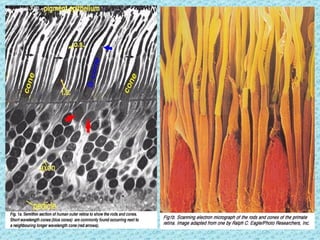
• In vertical sections of retina prepared for
light microscopy with the rods and cones
nicely aligned, the rods and cones can be
distinguished rather easily.
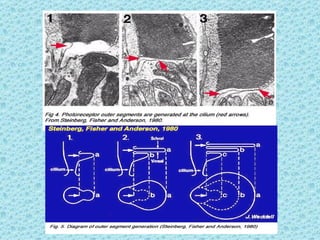
2. o uter segment
genera tIon.
•It is from the base of the cilium that membrane
evaginations and invaginations occur to produce
the outer segment or the important visual
pigment-bearing portion of the photoreceptor.
Outer segments of both the rods and cones arises
from outpouching of the photoreceptor cell
plasma membrane at this point.
3. VIsua pIgments and VIsuaL
        L
transductIon.
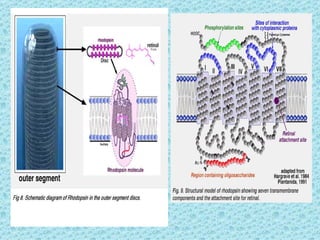
•Vertebrate photoreceptors can respond to li ght by virtue of
their containing a vi sual pigm ent em bed ded in the bilipid
m em branous di scs that m ake up the outer segm ent. The
vi sual pigm ent consists of a protein called opsi n and a
chrom ophore d erived from vitam in A known as retinal.
The vitam in A i s m anufactured from beta-carotene in the
food we eat, and the protein is m anufactured in the
photoreceptor cell. T he opsin and the chrom ophore are
bound together and lie buried in the m em branes of the
outer segm ent discs.
4. phagocytosIs of outer segments by
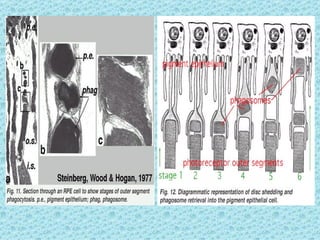
pIgment epItheLIum.

• T he s ta c ks o f d is cs co nt a in in g
v is ua l p ig me n t mo le c ul es in t he ou te r
s eg me nt s o f t he p ho t or ec e pt or s a re
c on st an t ly r e ne we d. Ne w d is cs a r e
a dd ed a t t he ba se o f t he ou te r
s eg me nt at t h e ci li u m as di sc us s ed
a bo ve . A t th e s am e t im e o ld d is c s ar e
d is pl ac e d up th e ou t er s e gm en t a nd
a re p in c he d o ff a t t he t i ps a nd
e ng ul fe d b y t he a pi c al p r oc es se s o f
t he p ig m en t ep it he l iu m.
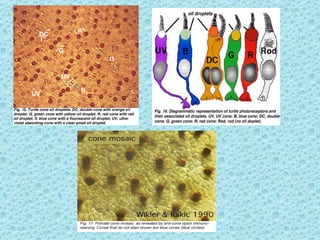
5. Different types of cone photorec eptor.
    •As we have seen from the morphological appearances
    described above, two basic types of photoreceptor, rods and
    cones, exist in the vertebrate retina. The rods are
    photoreceptors that contain the visual pigment - rhodopsin
    and are sensitive to blue-green light with a peak sensitivity
    around 500 nm wavelength of light. Rods are highly
    sensitive photoreceptors and are used for vision under dark-
    dim conditions at night. Cones contain cone opsins as their
    visual pigments and, depending on the exact structure of the
    opsin molecule, are maximally sensitive to either long
    wavelengths of light (red light), medium wavelengths of
    light (green light) or short wavelengths of light (blue light).
    Cones of different wavelength sensitivity and the
    consequent pathways of connectivity to the brain are, of
    course, the basis of color perception in our visual image.
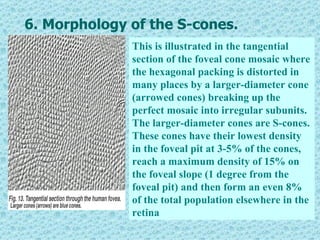
6. Morphology of the S-cones.
              This is illustrated in the tangential
              section of the foveal cone mosaic where
              the hexagonal packing is distorted in
              many places by a larger-diameter cone
              (arrowed cones) breaking up the
              perfect mosaic into irregular subunits.
              The larger-diameter cones are S-cones.
              These cones have their lowest density
              in the foveal pit at 3-5% of the cones,
              reach a maximum density of 15% on
              the foveal slope (1 degree from the
              foveal pit) and then form an even 8%
              of the total population elsewhere in the
              retina
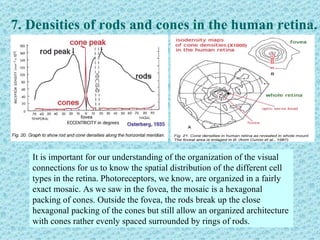
7. Densities of rods and cones in the human retina.


   It is important for our understanding of the organization of the visual
   connections for us to know the spatial distribution of the different cell
   types in the retina. Photoreceptors, we know, are organized in a fairly
   exact mosaic. As we saw in the fovea, the mosaic is a hexagonal
   packing of cones. Outside the fovea, the rods break up the close
   hexagonal packing of the cones but still allow an organized architecture
   with cones rather evenly spaced surrounded by rings of rods.
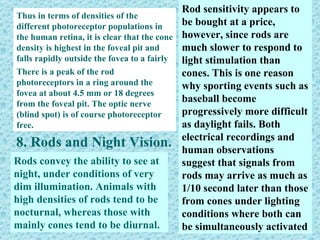
Rod sensitivity appears to
Thus in terms of densities of the
different photoreceptor populations in      be bought at a price,
the human retina, it is clear that the cone however, since rods are
density is highest in the foveal pit and    much slower to respond to
falls rapidly outside the fovea to a fairly light stimulation than
even density into the peripheral retina.
There is a peak of the rod                  cones. This is one reason
photoreceptors in a ring around the         why sporting events such as
fovea at about 4.5 mm or 18 degrees
from the foveal pit. The optic nerve
                                            baseball become
(blind spot) is of course photoreceptor     progressively more difficult
free.                                       as daylight fails. Both
                                            electrical recordings and
8. Rods and Night Vision. human observations
Rods convey the ability to see at           suggest that signals from
night, under conditions of very             rods may arrive as much as
dim illumination. Animals with              1/10 second later than those
high densities of rods tend to be           from cones under lighting
nocturnal, whereas those with               conditions where both can
mainly cones tend to be diurnal.            be simultaneously activated
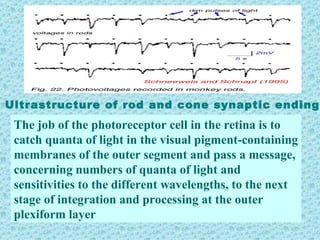
Ultrastructure of rod and cone synaptic endings
 The job of the photoreceptor cell in the retina is to
 catch quanta of light in the visual pigment-containing
 membranes of the outer segment and pass a message,
 concerning numbers of quanta of light and
 sensitivities to the different wavelengths, to the next
 stage of integration and processing at the outer
 plexiform layer
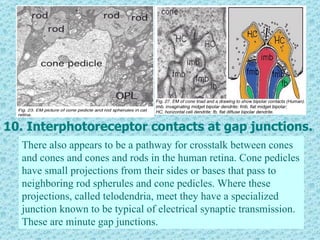
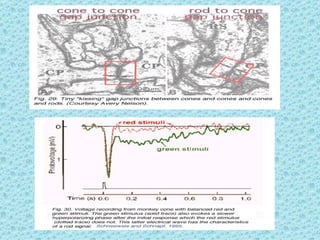
10. Interphotoreceptor contacts at gap junctions.
  There also appears to be a pathway for crosstalk between cones
  and cones and cones and rods in the human retina. Cone pedicles
  have small projections from their sides or bases that pass to
  neighboring rod spherules and cone pedicles. Where these
  projections, called telodendria, meet they have a specialized
  junction known to be typical of electrical synaptic transmission.
  These are minute gap junctions.
Photoreceptors

Photoreceptors

  • 1.
    • T woor three types of cone photoreceptor and a single type of rod photoreceptor are present in the norm al m am m alian retina. Som e non-m am m alian retinas have even m ore cone types
  • 2.
    I . LIghtmIcroscopy and uL structure of rods a tra nd cones. • In vertical sections of retina prepared for light microscopy with the rods and cones nicely aligned, the rods and cones can be distinguished rather easily.
  • 4.
    2. o utersegment genera tIon. •It is from the base of the cilium that membrane evaginations and invaginations occur to produce the outer segment or the important visual pigment-bearing portion of the photoreceptor. Outer segments of both the rods and cones arises from outpouching of the photoreceptor cell plasma membrane at this point.
  • 6.
    3. VIsua pIgmentsand VIsuaL L transductIon. •Vertebrate photoreceptors can respond to li ght by virtue of their containing a vi sual pigm ent em bed ded in the bilipid m em branous di scs that m ake up the outer segm ent. The vi sual pigm ent consists of a protein called opsi n and a chrom ophore d erived from vitam in A known as retinal. The vitam in A i s m anufactured from beta-carotene in the food we eat, and the protein is m anufactured in the photoreceptor cell. T he opsin and the chrom ophore are bound together and lie buried in the m em branes of the outer segm ent discs.
  • 8.
    4. phagocytosIs ofouter segments by pIgment epItheLIum. • T he s ta c ks o f d is cs co nt a in in g v is ua l p ig me n t mo le c ul es in t he ou te r s eg me nt s o f t he p ho t or ec e pt or s a re c on st an t ly r e ne we d. Ne w d is cs a r e a dd ed a t t he ba se o f t he ou te r s eg me nt at t h e ci li u m as di sc us s ed a bo ve . A t th e s am e t im e o ld d is c s ar e d is pl ac e d up th e ou t er s e gm en t a nd a re p in c he d o ff a t t he t i ps a nd e ng ul fe d b y t he a pi c al p r oc es se s o f t he p ig m en t ep it he l iu m.
  • 10.
    5. Different typesof cone photorec eptor. •As we have seen from the morphological appearances described above, two basic types of photoreceptor, rods and cones, exist in the vertebrate retina. The rods are photoreceptors that contain the visual pigment - rhodopsin and are sensitive to blue-green light with a peak sensitivity around 500 nm wavelength of light. Rods are highly sensitive photoreceptors and are used for vision under dark- dim conditions at night. Cones contain cone opsins as their visual pigments and, depending on the exact structure of the opsin molecule, are maximally sensitive to either long wavelengths of light (red light), medium wavelengths of light (green light) or short wavelengths of light (blue light). Cones of different wavelength sensitivity and the consequent pathways of connectivity to the brain are, of course, the basis of color perception in our visual image.
  • 12.
    6. Morphology ofthe S-cones. This is illustrated in the tangential section of the foveal cone mosaic where the hexagonal packing is distorted in many places by a larger-diameter cone (arrowed cones) breaking up the perfect mosaic into irregular subunits. The larger-diameter cones are S-cones. These cones have their lowest density in the foveal pit at 3-5% of the cones, reach a maximum density of 15% on the foveal slope (1 degree from the foveal pit) and then form an even 8% of the total population elsewhere in the retina
  • 13.
    7. Densities ofrods and cones in the human retina. It is important for our understanding of the organization of the visual connections for us to know the spatial distribution of the different cell types in the retina. Photoreceptors, we know, are organized in a fairly exact mosaic. As we saw in the fovea, the mosaic is a hexagonal packing of cones. Outside the fovea, the rods break up the close hexagonal packing of the cones but still allow an organized architecture with cones rather evenly spaced surrounded by rings of rods.
  • 14.
    Rod sensitivity appearsto Thus in terms of densities of the different photoreceptor populations in be bought at a price, the human retina, it is clear that the cone however, since rods are density is highest in the foveal pit and much slower to respond to falls rapidly outside the fovea to a fairly light stimulation than even density into the peripheral retina. There is a peak of the rod cones. This is one reason photoreceptors in a ring around the why sporting events such as fovea at about 4.5 mm or 18 degrees from the foveal pit. The optic nerve baseball become (blind spot) is of course photoreceptor progressively more difficult free. as daylight fails. Both electrical recordings and 8. Rods and Night Vision. human observations Rods convey the ability to see at suggest that signals from night, under conditions of very rods may arrive as much as dim illumination. Animals with 1/10 second later than those high densities of rods tend to be from cones under lighting nocturnal, whereas those with conditions where both can mainly cones tend to be diurnal. be simultaneously activated
  • 15.
    Ultrastructure of rodand cone synaptic endings The job of the photoreceptor cell in the retina is to catch quanta of light in the visual pigment-containing membranes of the outer segment and pass a message, concerning numbers of quanta of light and sensitivities to the different wavelengths, to the next stage of integration and processing at the outer plexiform layer
  • 16.
    10. Interphotoreceptor contactsat gap junctions. There also appears to be a pathway for crosstalk between cones and cones and cones and rods in the human retina. Cone pedicles have small projections from their sides or bases that pass to neighboring rod spherules and cone pedicles. Where these projections, called telodendria, meet they have a specialized junction known to be typical of electrical synaptic transmission. These are minute gap junctions.