The Auditory System
The Nature of Sound   Sound is a longitudinal wave  Vibrations cause  compressions & rarefactions Medium is usually air, but sound travels in any elastic medium All waves have basic characteristics: Amplitude Frequency Wavelength These properties have particular names with reference to sound Amplitude = loudness or volume Frequency = pitch
Properties of Waves
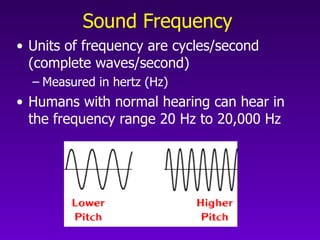
Sound Frequency   Units of frequency are cycles/second (complete waves/second) Measured in hertz (Hz) Humans with normal hearing can hear in the frequency range 20 Hz to 20,000 Hz
Path of Sound Sound waves enter the outer ear  They pass along the ear canal to the eardrum Sound waves bounce off the eardrum, making it vibrate.  The eardrum is connected to 3 tiny bones, the ossicles The vibrations pass along these bones.  The 3 rd  of these bones, the stapes, presses against the oval window in the cochlea.  The vibrations pass into the fluid inside the cochlea.  Here, they shake thousands of tiny hairs that stick into the fluid from hair cells.  As the hairs vibrate, the hair cells generate nerve signals The nerve signals travel along the auditory nerve to the hearing center of the brain.
A Diagrammatic Representation
Structure of the Ear The ear is divided into three parts: The outer ear  The middle ear amplifies the sound and transfers it to the inner ear The inner ear converts the sound waves into action potentials and transmits them to the brain.
Divisions of the Ear
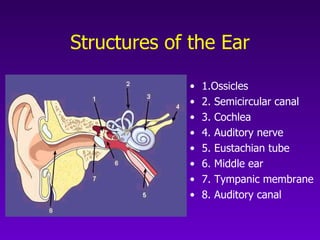
Structures of the Ear 1.Ossicles 2. Semicircular canal  3. Cochlea  4. Auditory nerve  5. Eustachian tube 6. Middle ear  7. Tympanic membrane  8. Auditory canal
The Outer Ear The  pinna  –  the visible part of the ear directs sound waves into the middle ear involved in localizing sounds in vertical plane Auditory canal  –  The tube connecting the center of the pinna with the tympanic membrane channels sound into the middle ear  can be analyzed (to first approximation) as a open-closed pipe.  Both the pinna and auditory canal impose filtering characteristics based on unique shapes.
The Middle Ear Tympanic Membrane  – Ear drum: cone-shaped membrane that converts sound to mechanical vibration  Ossicles  -  three serial bones that conduct sound vibrations from the tympanic membrane to the cochlea  Eustachian Tube  – connects the middle ear and throat  equalizes pressure on either side of tympanic membrane
The Ossicles Three small bones conduct sound vibrations from the tympanic membrane to the oval window of the cochlea  The malleus – attached to the tympanic membrane The incus – connects the malleus to the stapes,  The stapes – the foot of the stapes is attached to the oval window Also known as the hammer, anvil, & stirrup Ossicles act as a mechanical transformer, converting pressure on the eardrum to pressure on the oval window Amplifies signal 20 – 30x.
Picturing the Ossicles
Attenuation The acoustic reflex Loud noise triggers two sets of muscles: Stapedius muscle  Tensor tympani One tightens the eardrum The other pulls the stirrup away from the oval window.  Change sound conduction from the tympanic membrane to the cochlea
The Inner Ear Semicircular canals   control balance The cochlea   A double-walled, fluid-filled tube, curled into a snail shell shape with 2 ½ turns  transforms pressure variations to neural impulses.  Organ of Corti   Inside the cochlea Contains actual receptors,  hair cells Bone conduction to inner ear is also significant .
The Middle & Inner Ear
The Cochlea   Two major chambers  scala tympani  &  scala vestibuli Stapes footplate sits on the oval window  opens onto the  scala vestibuli  at the base of the cochlea At the apex, the  scala vestibuli  communicates with the  scala tympani  via a hole, the  helicotrema   At the base, the  scala vestibuli  ends at the  round window  which is covered by a membrane
Picturing the Cochlea
The Cochlea in Cross-section This section shows the coiling of the cochlear duct (1) which contains endolymph, and the scala vestibuli (2) and scala tympani (3) which contain perilymph. The red arrow is from the oval window, the blue arrow points to the round window. Within the modiolus, the spiral ganglion (4) and auditory nerve fibres (5) are seen.
A Single Turn
Frequency Processing Occurs in the cochlea The base of cochlea processes high frequencies The apex processes low frequencies From the base to the apex of the cochlea the frequency that produces a maximal deformation of the basilar membrane decreases Auditory nerve fibers are ``tuned'' to different center frequencies.
Picturing Frequency Processing
Cochlear Fluids Scala tympani  &  scala vestibuli   are filled with  perilymph Inner chamber,  scala media , is filled with  endolymph   Inwardmovement of the stapes footplate causes bulging of the round window membrane because the fluid in the cochlea is incompressible  The  stria vascularis  secretes  endolymph   Perilymph  is like CSF, high Na + , low K +   Endolymph  is very unusual, high K + , low Na +   There is a voltage in the  scala media , the  endocochlear potential  of about +80mV
Organ of Corti   Part of the cochlea A helical band between the outer wall of the bony cochlea and the inner bony covering of the  modiolus  (central axis of the helix) Contains the receptors of hearing:  hair cells Layers: Basilar membrane   Hair cells rest on the basilar membrane Reticular lamina –   top rigid surface that supports the  stereocilia  of the hair cells Tectorial membrane  – gelatinous mass with internal fibers that sits on top of stereocilia
Picturing the Organ of Corti
Hair Cells The Organ of Corti contains 16,000 - 20,000 hair cells along its 37 millimeter length.  Each hair cell has many cilia which bend with the vibrations of the basilar membrane.
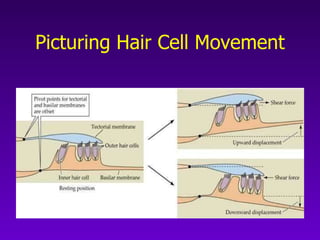
Transduction   Sound input causes a traveling wave in the basilar membrane and the organ of Corti  Upward movement of organ of Corti deflects stereocilia away from the modiolus Downward movement of organ of Corti deflects them toward the modiolus This deflection is reflected in the receptor potential of the inner hair cells
Inner Hair Cells Cell body below the reticular lamina sits in normal extracellular fluid  high Na + , low K + Top surface, bearing stereocilia sits in endolymph high K + , low Na + In silence, mechanically gated potassium   channels at tips of the stereocilia are partly open Resting potential is about -70mV E K , the potassium equilibrium potential is 0mV because of the high concentration of potassium both inside the cell and in the endolymph
Transduction of Inner Hair Cells Deflection of the stereocilia either fully opens or fully closes the potassium channels  The mechanism is the mechanical springs (filaments) connecting the stereocilia When open, depolarization results  inward rushing potassium tends to move the membrane potential toward 0mV = E K   When closed, hyperpolarization results  Depolarization opens voltage-gated calcium channels  Calcium mediates release of synaptic vesicles containing glutamate onto auditory nerve neurites Each IHC is innervated by about 10 auditory nerve fibers
Outer Hair Cells - The Cochlear Amplifier   Main purpose of OHCs is not to stimulate auditory nerve fibers, but to change the mechanical properties of the organ of Corti  affects transduction in IHCs Stimulation of OHC causes inward movement of potassium  This contracts  motor   proteins  in the cell wall and shortens the cell  pulls reticular lamina closer to basilar membrane and causes the stereocilia of the IHCs to bend more - Thus a cochlear amplifier
Modifying Outer Hair Cell Response Blocking the action of the OHC motor proteins by drugs or sound damage reduces the sensitivity of the cochlea The actions of the OHCs can be modified by efferent nerve fibers from the brain  the brain can modulate the sensitivity of the cochlea Ototoxic effects of antibiotics occur because they damage the OHCs and reduce the sensitivity of the cochlea.   IHCs are not affected directly by antibiotics.
Picturing Hair Cell Movement
Processing Auditory Signals in the Brain Two major pathways:  the dorsal pathway  the ventral pathway  Pathways are complex and connections not well understood. Ventral Auditory Pathway:  begins in the ventral cochlear nucleus, travels through the Superior olive to the inferior colliculus and MGN to the auditory cortex.
Major Structures of the Ventral Auditory Pathway Spiral ganglion  - spiral band of auditory nerve cell bodies in wall of modiolus  Auditory nerve  - fibers enter modiolus and exit toward the brainstem  Ventral cochlear nucleus  - brainstem nucleus - ipsilateral innervation, monaural response properties Superior olive  - each side is innervated from both ventral cochlear nuclei - binaural response properties Medial geniculate nucleus  - next to LGN, auditory thalamic relay nucleus
Other Important Structures Acoustic radiation  - fibers from MGN to A1 - auditory cortex  Auditory cortex  - A1, Brodmann area 41, superior surface of temporal lobe  Secondary auditory cortices - e.g. Wernicke's area, etc.
 
Tonotopic Maps   Frequency sensitivity is caused by properties of the Basilar Membrane. The map of sound frequency from the basilar membrane in cochlea is preserved  like the retinotopic map of visual system  When neurons synapse, they do so in an organized pattern based on characteristic frequency. Systematic organization of characteristic frequency is called  tonotopy There are tonotopic maps on the basilar membrane, the MGN, the auditory cortex, and  within each of the nerve relay nuclei. Tonotopy allows for the location of the impulse to indicate frequency.
Sound Intensity Louder sounds cause the basilar membrane to vibrate with greater amplitude More intense stimuli produce movements of the basilar membrane over a greater distance, which leads to the activation of more hair cells More action potentials occur because of the greater movement of the basilar membrane
Coding Sound Intensity   Two ways to code sound intensity Number of active neurons and firing rates of neurons Population code  as sound intensity increases, the deflections of the basilar membrane stimulating IHCs broaden  more and more IHCs are activated  Rate code  as sound intensity increases, the receptor potential in IHCs grows larger  the auditory nerve fibers fire faster  Together they tell the brain the value of sound intensity  This produces the sensation of loudness
Coding of Sound Frequency   Place code –  according to the tonotopic map, different frequency sounds cause deflections of the basilar membrane at different places in the cochlea –  which IHCs are activated indicates what the sound frequency is  Phase locking –  for sound frequencies below 4,000 Hz, the timing of action potentials in the auditory nerve is locked to the cycle of compression &  rarefaction in the sound wave timing of action potentials codes for sound frequency  Together these two codes produce the sensation of pitch
Frequency Variation For very low frequencies (below 200 Hz), only phase locking codes frequency  This is because there aren't dedicated fibers  For medium frequencies (200-4000 Hz), both place code and phase locking code frequency  For high frequencies (4000-20,000 Hz), only place code indicates sound frequency  phase locking stops
Localizing Sound in the Horizontal Plane   Time differences between ears For frequencies 20-2000 Hz, the phase locking in firing patterns from the two ears are compared  The difference in timing between them specifies the location of the sound source Intensity differences   between ears                 For frequencies above 2000 Hz, the head produces a significant shadow on the sound waves  The differences in intensity between the two ears are compared to localize the sound
Localizing Sound in the Vertical Plane   Works as well with one ear as with two ears  Covering up the pinna eliminates this capability Comparison of direct and secondary reflected sound paths from the wrinkles on the pinna enables us localize vertically
The Auditory Cortex   Layers similar to visual cortex  6 of them   A1 has a tonotopic map with low frequencies represented anteriorly and high frequencies represented posteriorly  Most A1 neurons are sharply tuned for frequency All are binaural  Some are excited by both left and right ears (EE) Some are excited by one ear and inhibited by the other ear (EI)
Cortical Modules in the Auditory Cortex   Each vertical column has cells sensitive to the same frequency  Adjacent columns in anterior-posterior direction change frequencies in order - tonotopy  Adjacent columns in lateral-medial direction change from EE to EI to EE  like ocular dominance columns  Analogous to cortical modules in Area 17
Cortical Damage   Unlike the visual system, damage to auditory cortex often has little effect on basic hearing  More often ability to understand speech or some other complex ability is lost  Damage to cochlea, auditory nerve, or cochlear nuclei are more typically causes of deafness
Auditory Disorders   Conduction deafness  blockage in sound conduction: wax in ear, disarticulated ossicles, stiffening of insertion of stapes footplate into oval window.   Usually correctable with surgery  Nerve deafness  damage to hair cells or auditory nerve fibers from tumors, ototoxic drugs, loud sounds, etc.   No treatment for nerve deafness, but partial loss can be compensated for by various hearing aids.   Prevention is important.
Tinnitus   Ringing in the ears  A common phenomenon Caused by hyperactivity of cochlear amplifier The sounds of tinnitus are actually occurring in the cochlea and one is simply hearing them  they originate in cochlea and mask incoming external sounds  May indicate sound damage, cochlear disease or vascular abnormalities  Tinnitus after rock concerts is very common (and not healthy)!
Auditory Perception Like vision, auditory sensations are organized and interpreted in the brain to create auditory perceptions Like visual perception, auditory perception is relative  Brain also makes “assumptions” Basis of auditory illusions: Shephard Tones Tri-tone illusion McGurk Effect
Shepard's Tones   Circularity of judgment of relative pitch  These tones eliminate all relative pitch discrimination information.  As a result, when played in sequence, each tone sounds higher than all tones preceding it and lower than all tones following it (and vice versa when the sequence is played in the opposite order). Since there are only twelve tones in the sequence, played in a continuous loop, every tone sounds both higher and lower than every other at some point in the sequence.
The Tritone Effect   Although pitch discrimination cues have been removed from Shepard's Tones, proximity information remains.  2 consecutive tones are always separated by a single semitone.  Although you can't determine which is higher based on the tones alone, your choice is that the second tone is either one semitone higher or eleven semitones lower in pitch than the first.  It is natural for the smaller distance to be selected.  What if the proximity cue was removed?  If the second tone played is either half an octave higher or half an octave lower than the first Result is the tri-tone effect (The midpoint of the octave is called the  tritone )
The Risset Scale This is actually a single octave of twelve notes!  Each note, however, is actually a chord. Each chord is comprised of six individual notes from six different octaves.  The notes of each chord have the same pitch (6 C's, 6 D's) - but they are played at 6 different volumes.  This creates ambiguous information for the listener. The Risset Scale blends each tone from this special octave into the next tone, over and over again.  This blending, combined with the complex and ambiguous tonal information of each note, creates the illusion of an endlessly rising or descending tone.
McGurk Effect What am I saying?  Alternate between looking at the talking head while listening, and listening with your eyes shut. Most adults (98%) think they are hearing "DA"  a so called "fused response"  the "D" is a result of an audio-visual illusion  In reality you are hearing the sound "BA", while you are seeing the lip movements "GA".
 
The Scale Illusion A scale with successive tones alternating from ear to ear The scale is played simultaneously in ascending and descending form When a tone from the ascending scale is in the right ear, a tone from the descending scale is in the left ear, and vice versa When heard through earphones produce a number of illusions
A Variant Scale Illusion When listening to this pattern through loudspeakers, notice that when each channel is played separately, it appears to shift dramatically in pitch, but when both channels are played together, two smooth melodies are heard.  The brain creates order out of chaos.
Name That Tune Knowledge of a piece of music influences what we hear All of the notes of a well known tune are correct, but the tones are distributed randomly across three octaves In the second clip, the notes are the same, but now they are all in one octave

Auditory System

  • 1.
  • 2.
    The Nature ofSound Sound is a longitudinal wave Vibrations cause compressions & rarefactions Medium is usually air, but sound travels in any elastic medium All waves have basic characteristics: Amplitude Frequency Wavelength These properties have particular names with reference to sound Amplitude = loudness or volume Frequency = pitch
  • 3.
  • 4.
    Sound Frequency Units of frequency are cycles/second (complete waves/second) Measured in hertz (Hz) Humans with normal hearing can hear in the frequency range 20 Hz to 20,000 Hz
  • 5.
    Path of SoundSound waves enter the outer ear They pass along the ear canal to the eardrum Sound waves bounce off the eardrum, making it vibrate. The eardrum is connected to 3 tiny bones, the ossicles The vibrations pass along these bones. The 3 rd of these bones, the stapes, presses against the oval window in the cochlea. The vibrations pass into the fluid inside the cochlea. Here, they shake thousands of tiny hairs that stick into the fluid from hair cells. As the hairs vibrate, the hair cells generate nerve signals The nerve signals travel along the auditory nerve to the hearing center of the brain.
  • 6.
  • 7.
    Structure of theEar The ear is divided into three parts: The outer ear The middle ear amplifies the sound and transfers it to the inner ear The inner ear converts the sound waves into action potentials and transmits them to the brain.
  • 8.
  • 9.
    Structures of theEar 1.Ossicles 2. Semicircular canal 3. Cochlea 4. Auditory nerve 5. Eustachian tube 6. Middle ear 7. Tympanic membrane 8. Auditory canal
  • 10.
    The Outer EarThe pinna – the visible part of the ear directs sound waves into the middle ear involved in localizing sounds in vertical plane Auditory canal – The tube connecting the center of the pinna with the tympanic membrane channels sound into the middle ear can be analyzed (to first approximation) as a open-closed pipe. Both the pinna and auditory canal impose filtering characteristics based on unique shapes.
  • 11.
    The Middle EarTympanic Membrane – Ear drum: cone-shaped membrane that converts sound to mechanical vibration Ossicles - three serial bones that conduct sound vibrations from the tympanic membrane to the cochlea Eustachian Tube – connects the middle ear and throat equalizes pressure on either side of tympanic membrane
  • 12.
    The Ossicles Threesmall bones conduct sound vibrations from the tympanic membrane to the oval window of the cochlea The malleus – attached to the tympanic membrane The incus – connects the malleus to the stapes, The stapes – the foot of the stapes is attached to the oval window Also known as the hammer, anvil, & stirrup Ossicles act as a mechanical transformer, converting pressure on the eardrum to pressure on the oval window Amplifies signal 20 – 30x.
  • 13.
  • 14.
    Attenuation The acousticreflex Loud noise triggers two sets of muscles: Stapedius muscle Tensor tympani One tightens the eardrum The other pulls the stirrup away from the oval window. Change sound conduction from the tympanic membrane to the cochlea
  • 15.
    The Inner EarSemicircular canals control balance The cochlea A double-walled, fluid-filled tube, curled into a snail shell shape with 2 ½ turns transforms pressure variations to neural impulses. Organ of Corti Inside the cochlea Contains actual receptors, hair cells Bone conduction to inner ear is also significant .
  • 16.
    The Middle &Inner Ear
  • 17.
    The Cochlea Two major chambers scala tympani & scala vestibuli Stapes footplate sits on the oval window opens onto the scala vestibuli at the base of the cochlea At the apex, the scala vestibuli communicates with the scala tympani via a hole, the helicotrema At the base, the scala vestibuli ends at the round window which is covered by a membrane
  • 18.
  • 19.
    The Cochlea inCross-section This section shows the coiling of the cochlear duct (1) which contains endolymph, and the scala vestibuli (2) and scala tympani (3) which contain perilymph. The red arrow is from the oval window, the blue arrow points to the round window. Within the modiolus, the spiral ganglion (4) and auditory nerve fibres (5) are seen.
  • 20.
  • 21.
    Frequency Processing Occursin the cochlea The base of cochlea processes high frequencies The apex processes low frequencies From the base to the apex of the cochlea the frequency that produces a maximal deformation of the basilar membrane decreases Auditory nerve fibers are ``tuned'' to different center frequencies.
  • 22.
  • 23.
    Cochlear Fluids Scalatympani & scala vestibuli are filled with perilymph Inner chamber, scala media , is filled with endolymph Inwardmovement of the stapes footplate causes bulging of the round window membrane because the fluid in the cochlea is incompressible The stria vascularis secretes endolymph Perilymph is like CSF, high Na + , low K + Endolymph is very unusual, high K + , low Na + There is a voltage in the scala media , the endocochlear potential of about +80mV
  • 24.
    Organ of Corti Part of the cochlea A helical band between the outer wall of the bony cochlea and the inner bony covering of the modiolus (central axis of the helix) Contains the receptors of hearing: hair cells Layers: Basilar membrane Hair cells rest on the basilar membrane Reticular lamina – top rigid surface that supports the stereocilia of the hair cells Tectorial membrane – gelatinous mass with internal fibers that sits on top of stereocilia
  • 25.
  • 26.
    Hair Cells TheOrgan of Corti contains 16,000 - 20,000 hair cells along its 37 millimeter length. Each hair cell has many cilia which bend with the vibrations of the basilar membrane.
  • 27.
    Transduction Sound input causes a traveling wave in the basilar membrane and the organ of Corti Upward movement of organ of Corti deflects stereocilia away from the modiolus Downward movement of organ of Corti deflects them toward the modiolus This deflection is reflected in the receptor potential of the inner hair cells
  • 28.
    Inner Hair CellsCell body below the reticular lamina sits in normal extracellular fluid high Na + , low K + Top surface, bearing stereocilia sits in endolymph high K + , low Na + In silence, mechanically gated potassium channels at tips of the stereocilia are partly open Resting potential is about -70mV E K , the potassium equilibrium potential is 0mV because of the high concentration of potassium both inside the cell and in the endolymph
  • 29.
    Transduction of InnerHair Cells Deflection of the stereocilia either fully opens or fully closes the potassium channels The mechanism is the mechanical springs (filaments) connecting the stereocilia When open, depolarization results inward rushing potassium tends to move the membrane potential toward 0mV = E K When closed, hyperpolarization results Depolarization opens voltage-gated calcium channels Calcium mediates release of synaptic vesicles containing glutamate onto auditory nerve neurites Each IHC is innervated by about 10 auditory nerve fibers
  • 30.
    Outer Hair Cells- The Cochlear Amplifier Main purpose of OHCs is not to stimulate auditory nerve fibers, but to change the mechanical properties of the organ of Corti affects transduction in IHCs Stimulation of OHC causes inward movement of potassium This contracts motor proteins in the cell wall and shortens the cell pulls reticular lamina closer to basilar membrane and causes the stereocilia of the IHCs to bend more - Thus a cochlear amplifier
  • 31.
    Modifying Outer HairCell Response Blocking the action of the OHC motor proteins by drugs or sound damage reduces the sensitivity of the cochlea The actions of the OHCs can be modified by efferent nerve fibers from the brain the brain can modulate the sensitivity of the cochlea Ototoxic effects of antibiotics occur because they damage the OHCs and reduce the sensitivity of the cochlea.  IHCs are not affected directly by antibiotics.
  • 32.
  • 33.
    Processing Auditory Signalsin the Brain Two major pathways: the dorsal pathway the ventral pathway Pathways are complex and connections not well understood. Ventral Auditory Pathway: begins in the ventral cochlear nucleus, travels through the Superior olive to the inferior colliculus and MGN to the auditory cortex.
  • 34.
    Major Structures ofthe Ventral Auditory Pathway Spiral ganglion - spiral band of auditory nerve cell bodies in wall of modiolus Auditory nerve - fibers enter modiolus and exit toward the brainstem Ventral cochlear nucleus - brainstem nucleus - ipsilateral innervation, monaural response properties Superior olive - each side is innervated from both ventral cochlear nuclei - binaural response properties Medial geniculate nucleus - next to LGN, auditory thalamic relay nucleus
  • 35.
    Other Important StructuresAcoustic radiation - fibers from MGN to A1 - auditory cortex Auditory cortex - A1, Brodmann area 41, superior surface of temporal lobe Secondary auditory cortices - e.g. Wernicke's area, etc.
  • 36.
  • 37.
    Tonotopic Maps Frequency sensitivity is caused by properties of the Basilar Membrane. The map of sound frequency from the basilar membrane in cochlea is preserved like the retinotopic map of visual system When neurons synapse, they do so in an organized pattern based on characteristic frequency. Systematic organization of characteristic frequency is called tonotopy There are tonotopic maps on the basilar membrane, the MGN, the auditory cortex, and within each of the nerve relay nuclei. Tonotopy allows for the location of the impulse to indicate frequency.
  • 38.
    Sound Intensity Loudersounds cause the basilar membrane to vibrate with greater amplitude More intense stimuli produce movements of the basilar membrane over a greater distance, which leads to the activation of more hair cells More action potentials occur because of the greater movement of the basilar membrane
  • 39.
    Coding Sound Intensity Two ways to code sound intensity Number of active neurons and firing rates of neurons Population code as sound intensity increases, the deflections of the basilar membrane stimulating IHCs broaden more and more IHCs are activated Rate code as sound intensity increases, the receptor potential in IHCs grows larger the auditory nerve fibers fire faster Together they tell the brain the value of sound intensity This produces the sensation of loudness
  • 40.
    Coding of SoundFrequency Place code – according to the tonotopic map, different frequency sounds cause deflections of the basilar membrane at different places in the cochlea – which IHCs are activated indicates what the sound frequency is Phase locking – for sound frequencies below 4,000 Hz, the timing of action potentials in the auditory nerve is locked to the cycle of compression & rarefaction in the sound wave timing of action potentials codes for sound frequency Together these two codes produce the sensation of pitch
  • 41.
    Frequency Variation Forvery low frequencies (below 200 Hz), only phase locking codes frequency This is because there aren't dedicated fibers For medium frequencies (200-4000 Hz), both place code and phase locking code frequency For high frequencies (4000-20,000 Hz), only place code indicates sound frequency phase locking stops
  • 42.
    Localizing Sound inthe Horizontal Plane Time differences between ears For frequencies 20-2000 Hz, the phase locking in firing patterns from the two ears are compared The difference in timing between them specifies the location of the sound source Intensity differences between ears                 For frequencies above 2000 Hz, the head produces a significant shadow on the sound waves The differences in intensity between the two ears are compared to localize the sound
  • 43.
    Localizing Sound inthe Vertical Plane Works as well with one ear as with two ears Covering up the pinna eliminates this capability Comparison of direct and secondary reflected sound paths from the wrinkles on the pinna enables us localize vertically
  • 44.
    The Auditory Cortex Layers similar to visual cortex 6 of them A1 has a tonotopic map with low frequencies represented anteriorly and high frequencies represented posteriorly Most A1 neurons are sharply tuned for frequency All are binaural Some are excited by both left and right ears (EE) Some are excited by one ear and inhibited by the other ear (EI)
  • 45.
    Cortical Modules inthe Auditory Cortex Each vertical column has cells sensitive to the same frequency Adjacent columns in anterior-posterior direction change frequencies in order - tonotopy Adjacent columns in lateral-medial direction change from EE to EI to EE like ocular dominance columns Analogous to cortical modules in Area 17
  • 46.
    Cortical Damage Unlike the visual system, damage to auditory cortex often has little effect on basic hearing More often ability to understand speech or some other complex ability is lost Damage to cochlea, auditory nerve, or cochlear nuclei are more typically causes of deafness
  • 47.
    Auditory Disorders Conduction deafness blockage in sound conduction: wax in ear, disarticulated ossicles, stiffening of insertion of stapes footplate into oval window.  Usually correctable with surgery Nerve deafness damage to hair cells or auditory nerve fibers from tumors, ototoxic drugs, loud sounds, etc.  No treatment for nerve deafness, but partial loss can be compensated for by various hearing aids.  Prevention is important.
  • 48.
    Tinnitus Ringing in the ears A common phenomenon Caused by hyperactivity of cochlear amplifier The sounds of tinnitus are actually occurring in the cochlea and one is simply hearing them they originate in cochlea and mask incoming external sounds May indicate sound damage, cochlear disease or vascular abnormalities Tinnitus after rock concerts is very common (and not healthy)!
  • 49.
    Auditory Perception Likevision, auditory sensations are organized and interpreted in the brain to create auditory perceptions Like visual perception, auditory perception is relative Brain also makes “assumptions” Basis of auditory illusions: Shephard Tones Tri-tone illusion McGurk Effect
  • 50.
    Shepard's Tones Circularity of judgment of relative pitch These tones eliminate all relative pitch discrimination information. As a result, when played in sequence, each tone sounds higher than all tones preceding it and lower than all tones following it (and vice versa when the sequence is played in the opposite order). Since there are only twelve tones in the sequence, played in a continuous loop, every tone sounds both higher and lower than every other at some point in the sequence.
  • 51.
    The Tritone Effect Although pitch discrimination cues have been removed from Shepard's Tones, proximity information remains. 2 consecutive tones are always separated by a single semitone. Although you can't determine which is higher based on the tones alone, your choice is that the second tone is either one semitone higher or eleven semitones lower in pitch than the first. It is natural for the smaller distance to be selected. What if the proximity cue was removed? If the second tone played is either half an octave higher or half an octave lower than the first Result is the tri-tone effect (The midpoint of the octave is called the tritone )
  • 52.
    The Risset ScaleThis is actually a single octave of twelve notes! Each note, however, is actually a chord. Each chord is comprised of six individual notes from six different octaves. The notes of each chord have the same pitch (6 C's, 6 D's) - but they are played at 6 different volumes. This creates ambiguous information for the listener. The Risset Scale blends each tone from this special octave into the next tone, over and over again. This blending, combined with the complex and ambiguous tonal information of each note, creates the illusion of an endlessly rising or descending tone.
  • 53.
    McGurk Effect Whatam I saying? Alternate between looking at the talking head while listening, and listening with your eyes shut. Most adults (98%) think they are hearing "DA" a so called "fused response" the "D" is a result of an audio-visual illusion In reality you are hearing the sound "BA", while you are seeing the lip movements "GA".
  • 54.
  • 55.
    The Scale IllusionA scale with successive tones alternating from ear to ear The scale is played simultaneously in ascending and descending form When a tone from the ascending scale is in the right ear, a tone from the descending scale is in the left ear, and vice versa When heard through earphones produce a number of illusions
  • 56.
    A Variant ScaleIllusion When listening to this pattern through loudspeakers, notice that when each channel is played separately, it appears to shift dramatically in pitch, but when both channels are played together, two smooth melodies are heard. The brain creates order out of chaos.
  • 57.
    Name That TuneKnowledge of a piece of music influences what we hear All of the notes of a well known tune are correct, but the tones are distributed randomly across three octaves In the second clip, the notes are the same, but now they are all in one octave