
The Auditory System
Csilla Egri, KIN 306 Spring 2012
The system that allows you to hear the most annoying sound in the world
Outline
 Anatomy of the ear
 Sensory transduction
 Cochlea
 Organ of Corti
 Frequency tuning
 Auditory pathways
 Localization of sound
 Auditory disorders
2
Anatomy of the Ear
3
B&B Figure 13-6
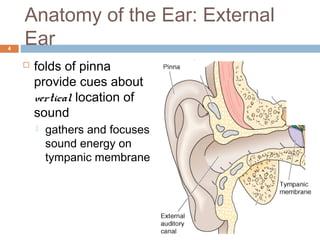
Anatomy of the Ear: External
Ear4
 folds of pinna
provide cues about
vertical location of
sound
 gathers and focuses
sound energy on
tympanic membrane
Anatomy of the Ear: Middle Ear
5
 amplifies vibrations of
tympanic membrane to oval
window
 matches low acoustic
impedance of air to high
acoustic impedance of
fluid of the inner ear
Eustachian tube
Anatomy of the Ear: Inner Ear
6
 connected to the middle ear
via two openings:
 oval window (entrance)
& round window (exit)
 contains the cochlea
 a coiled tube separated
into three fluid filled
partitions
 location of the Organ of
Corti, the sensory organ
responsible for sound
transduction
perilymph
endolymph
B&L Figure 8-17Eustachian tube
Cochlea – partially unravelled
Helicotrema or apex
Perilymph ≈ CSF
What is the composition of
CSF compared to plasma?
Sensory Transduction:
Overview7
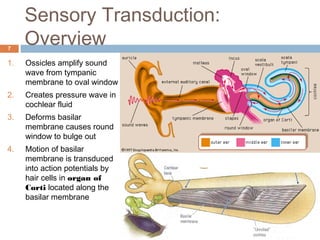
1. Ossicles amplify sound
wave from tympanic
membrane to oval window
2. Creates pressure wave in
cochlear fluid
3. Deforms basilar
membrane causes round
window to bulge out
4. Motion of basilar
membrane is transduced
into action potentials by
hair cells in organ of
Corti located along the
basilar membrane
Cochlea:
cross-section8
 Reissner’s membrane
 separates scala media
from scala vestibuli
 Basilar membrane
 separates scala media
from scala tympani
 Tectorial membrane
 attached along one edge
of the wall to scala media
 Organ of Corti
 Located in scala media
on top of basilar
membrane
B&B Figure 13-9
Cochlea: Organ of Corti
9
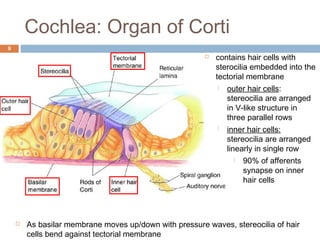
 contains hair cells with
sterocilia embedded into the
tectorial membrane
 outer hair cells:
stereocilia are arranged
in V-like structure in
three parallel rows
 inner hair cells:
stereocilia are arranged
linearly in single row
 90% of afferents
synapse on inner
hair cells
 As basilar membrane moves up/down with pressure waves, stereocilia of hair
cells bend against tectorial membrane
Sensory Transduction:
Hair cells10
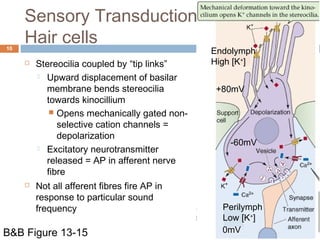
 Stereocilia coupled by “tip links”
 Upward displacement of basilar
membrane bends stereocilia
towards kinocillium
 Opens mechanically gated non-
selective cation channels =
depolarization
 Excitatory neurotransmitter
released = AP in afferent nerve
fibre
 Not all afferent fibres fire AP in
response to particular sound
frequency
B&B Figure 13-15
Endolymph
High [K+
]
Perilymph
Low [K+
]
+80mV
-60mV
0mV
Frequency Tuning of Basilar
Membrane11
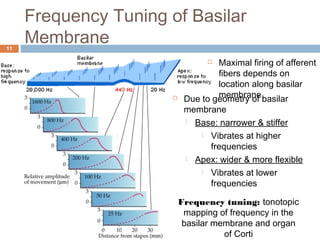
 Due to geometry of basilar
membrane
 Base: narrower & stiffer
 Vibrates at higher
frequencies
 Apex: wider & more flexible
 Vibrates at lower
frequencies
 Maximal firing of afferent
fibers depends on
location along basilar
membrane
Frequency tuning: tonotopic
mapping of frequency in the
basilar membrane and organ
of Corti
Auditory Pathways
12
 Cochlear afferents synapse on cochlear nuclei in the medulla on the same side
 Most second order neurons cross over and synapse in the superior olivary nucleus
 Receives input from both ears (binaural)
 Medial and lateral superior olive (MSO and LSO) important in computing location
of sound
Auditory Pathways
13
 Ascend via the lateral meniscus tract on ipsilateral side to the inferior colliculus in the
midbrain
 Fourth order neurons travel to the medial geniculate nucleus (MGN) in the thalamus
 Terminate in the primary auditory cortex in the temporal lobe
 Tonotopic organization maintained from cochlear nuclei to auditory cortex
Sound Localization
14
 two strategies to localize the horizontal position of sound sources,
depending on the frequency
 frequencies above 3 kHz use interaural intensity differences
 computed by neural circuitry in the lateral superior olive (LSO) and
the medial nucleus of the trapezoid body (MNTB)
 frequencies below 3 kHz use interaural time differences
 computed by neural circuitry in the medial superior olive (MSO)
B&B Figure 14-15
Interaural Intensity Differences:
LSO and MNTB15
 cochlear nucleus on same side as
location of sound directly excites
LSO
 LSO excites inhibitory
interneurons in contralateral
MNTB
 Contralateral LSO inhibited
 Excitation/inhibition arrangement
sends maximal signal to auditory
cortex on same side as sound

Interaural Time Differences:
MSO16
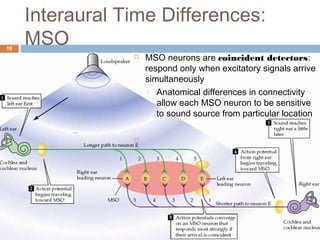
 MSO neurons are coincident detectors:
respond only when excitatory signals arrive
simultaneously
 Anatomical differences in connectivity
allow each MSO neuron to be sensitive
to sound source from particular location

Auditory Cortex
17
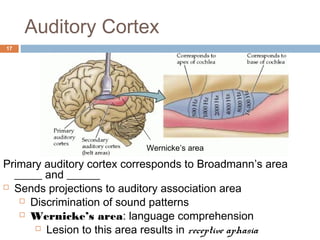
Primary auditory cortex corresponds to Broadmann’s area
_____ and ______
 Sends projections to auditory association area
 Discrimination of sound patterns
 Wernicke’s area: language comprehension
 Lesion to this area results in receptive aphasia
Wernicke’s area
Auditory Disorders
18
 Sensorineural hearing loss
 Dysfunctions of the inner ear, vestibulocochlear nerve or
auditory cortex
 Most common cause is damage to hair cells. Two
examples include:
 Noise induced hearing loss
 Caused by auditory trauma or long term exposure to loud
sounds
 Leads to structural damage or complete degeneration and
loss of hair cells
 Sensory presbycusis
 Age related hearing loss
 Hair cell damage caused by factors other than auditory
trauma
 Often occurs in both ears
WebCT readings: Sensorineural Hearing Loss
Objectives
After this lecture you should be able to:
 Describe the structure and function of the outer, middle,
and inner ear
 Relate the anatomical organization of the cochlea and
associated structures to sensory transduction of sound
 Explain how damage to these structures can cause hearing
loss
 Differentiate between the mechanisms for localization of
horizontal sound above and below 3kHz
 Outline the neuronal pathway from the cochlea to the
auditory cortex
19
20
1. What is the first location in the auditory pathway that
receives input from both ears?
2. What does tonotopic organization mean?
3. Endolymph closely resembles the ionic composition of
intra or extracellular fluid of a typical neuron?
Test your knowledge