ACCOMODATION
By
Prof.Dr.Nusrat Tariq
M.Islam Medical &Dental College
ACCOMMODATION
or
NEAR RESPONSE
„
DEFINITION:
Accommodation is the adjustment
of eye to see near objects clearly. It is
the process by which light rays from
near objects are brought to a focus
on retina
Mechanism Of
Accommodation:
It is achieved by various
adjustments made in
the eyeball
Adjustments Made In The Eyeballs
When a person looks at a near object after
seeing a far object, three adjustments are
made in the eyeballs:
1. Convergence of the eyeballs
2. Constriction of the pupil
3. Increase in the anterior curvature of
the lens (lens becomes more spherical)
1. Convergence of the eyeballs due
to contraction of the medial recti.
2. Constriction of the pupil due to
the contraction of
constrictor/sphincter pupillae of
iris.
3. Increase in the anterior
curvature of the lens due to
contraction of the ciliary muscle.
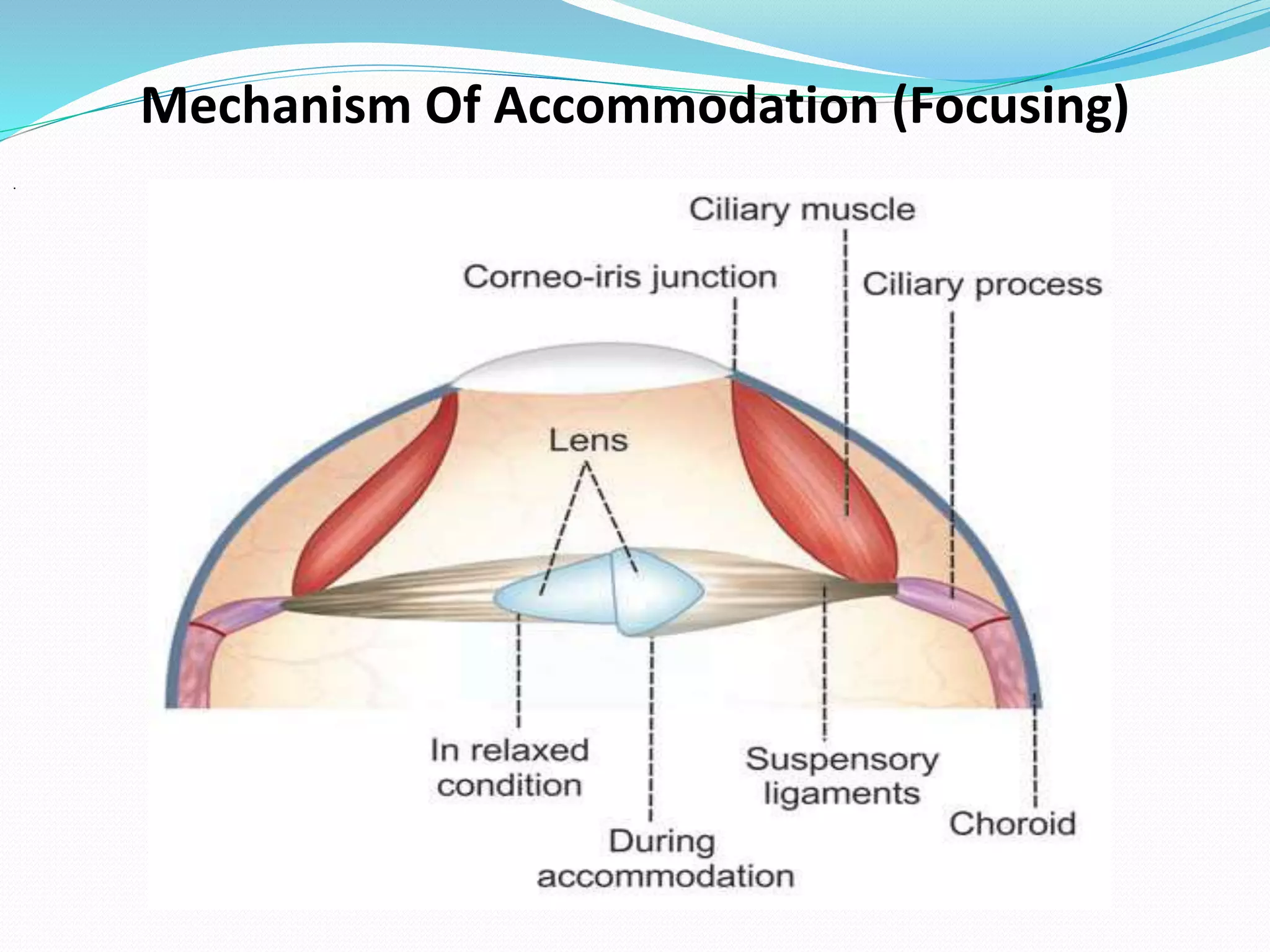
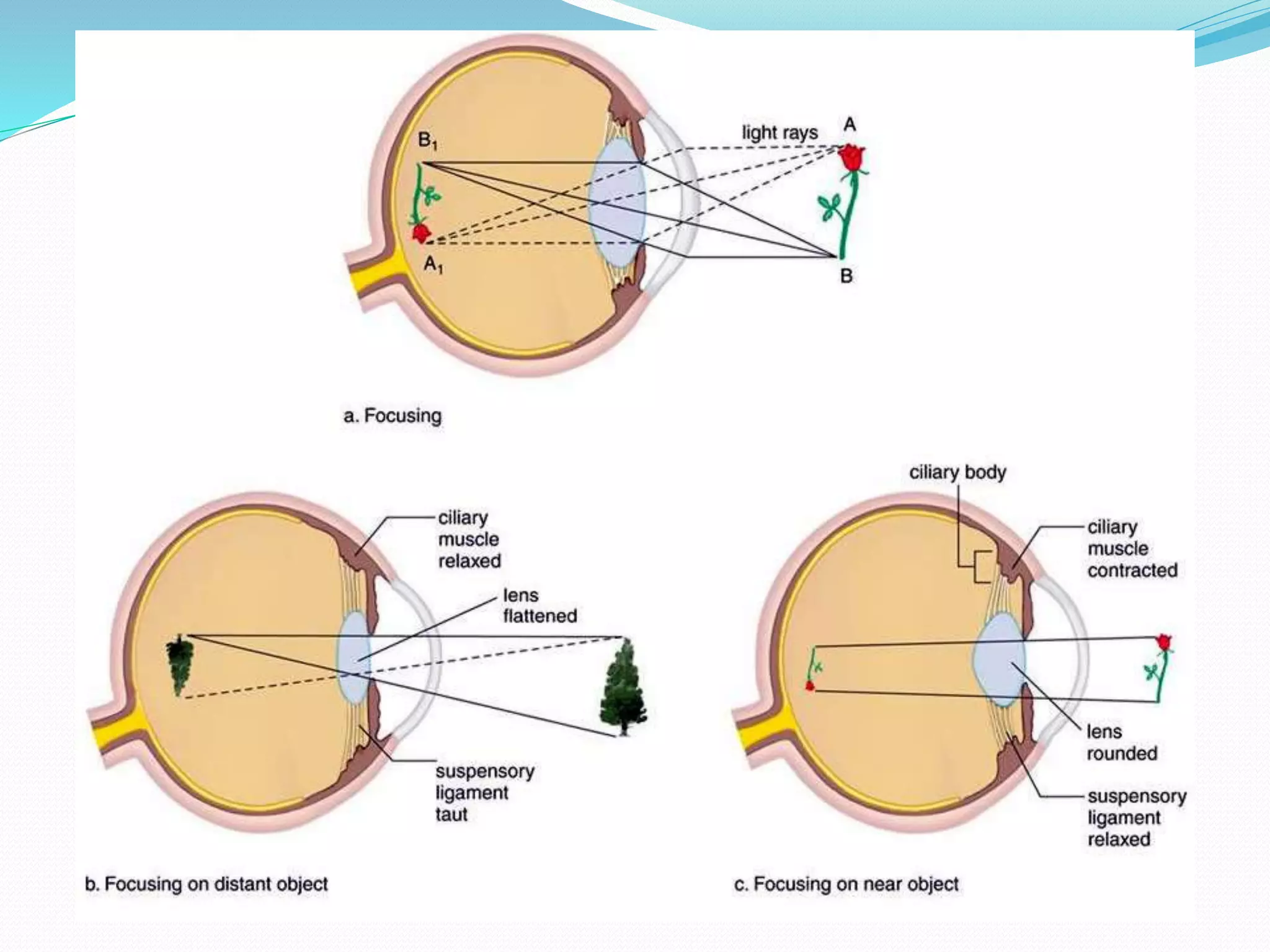
Mechanism Of Accommodation (Focusing)
.
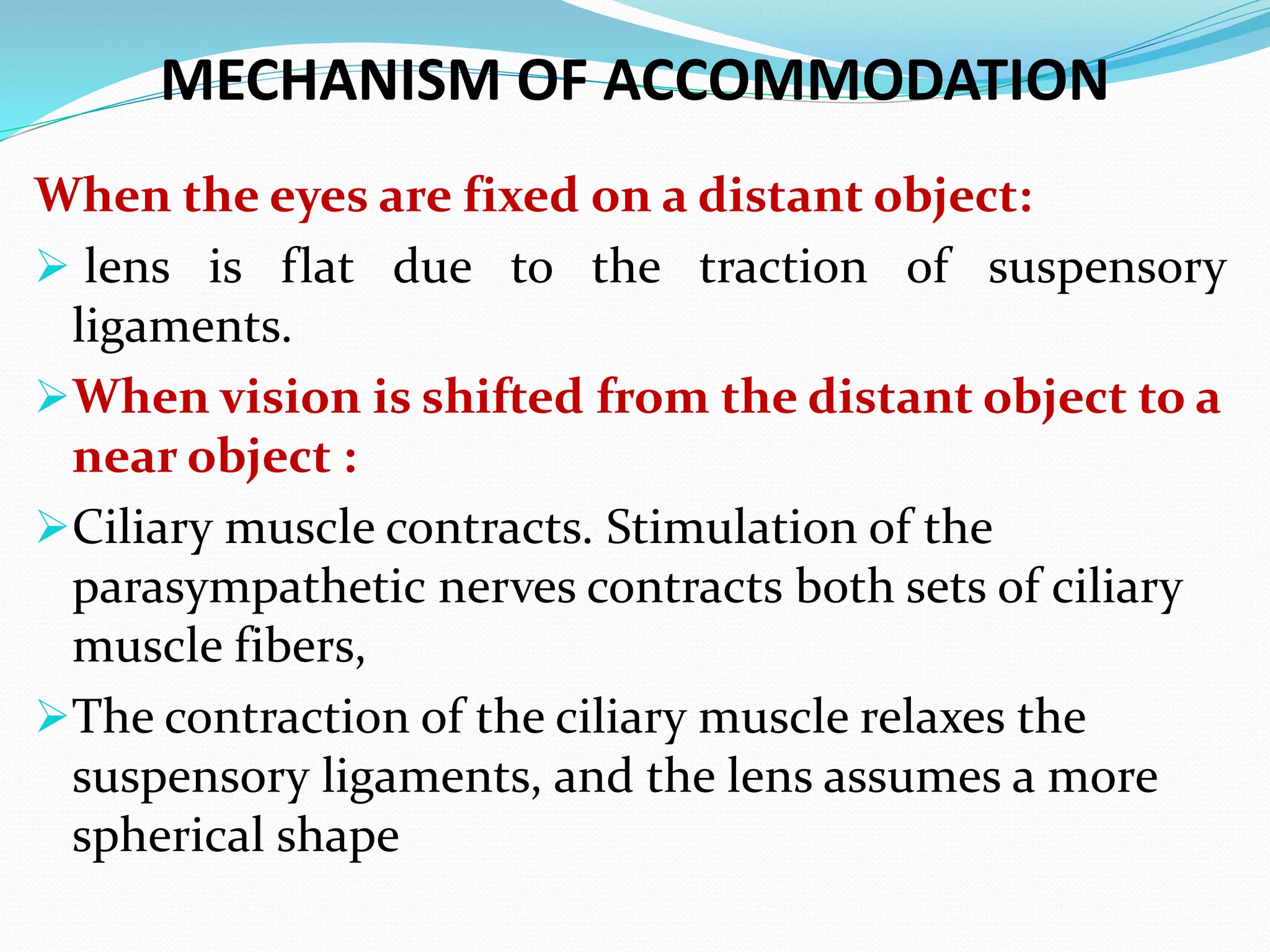
MECHANISM OF ACCOMMODATION
When the eyes are fixed on a distant object:
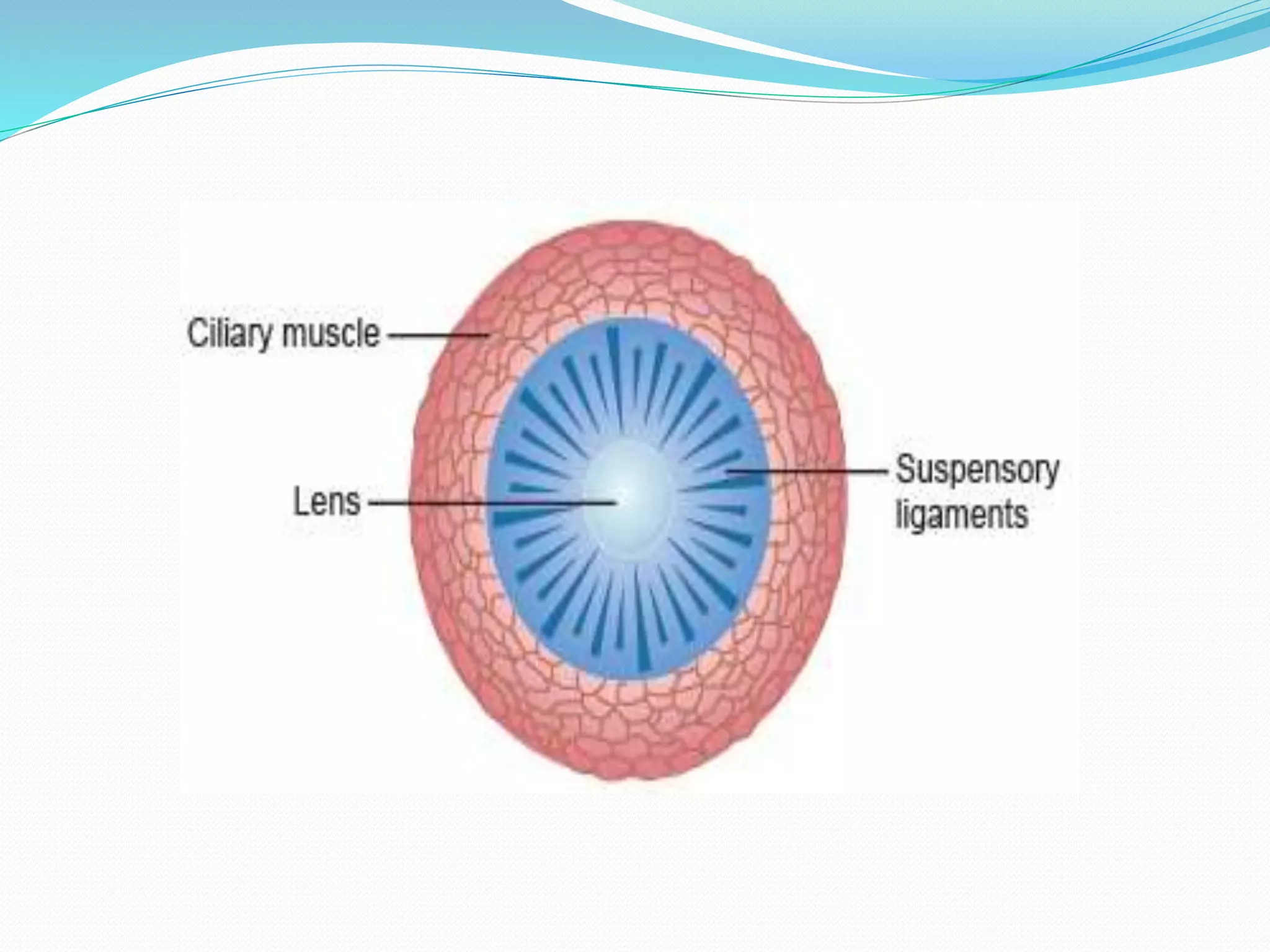
 lens is flat due to the traction of suspensory
ligaments.
When vision is shifted from the distant object to a
near object :
Ciliary muscle contracts. Stimulation of the
parasympathetic nerves contracts both sets of ciliary
muscle fibers,
The contraction of the ciliary muscle relaxes the
suspensory ligaments, and the lens assumes a more
spherical shape
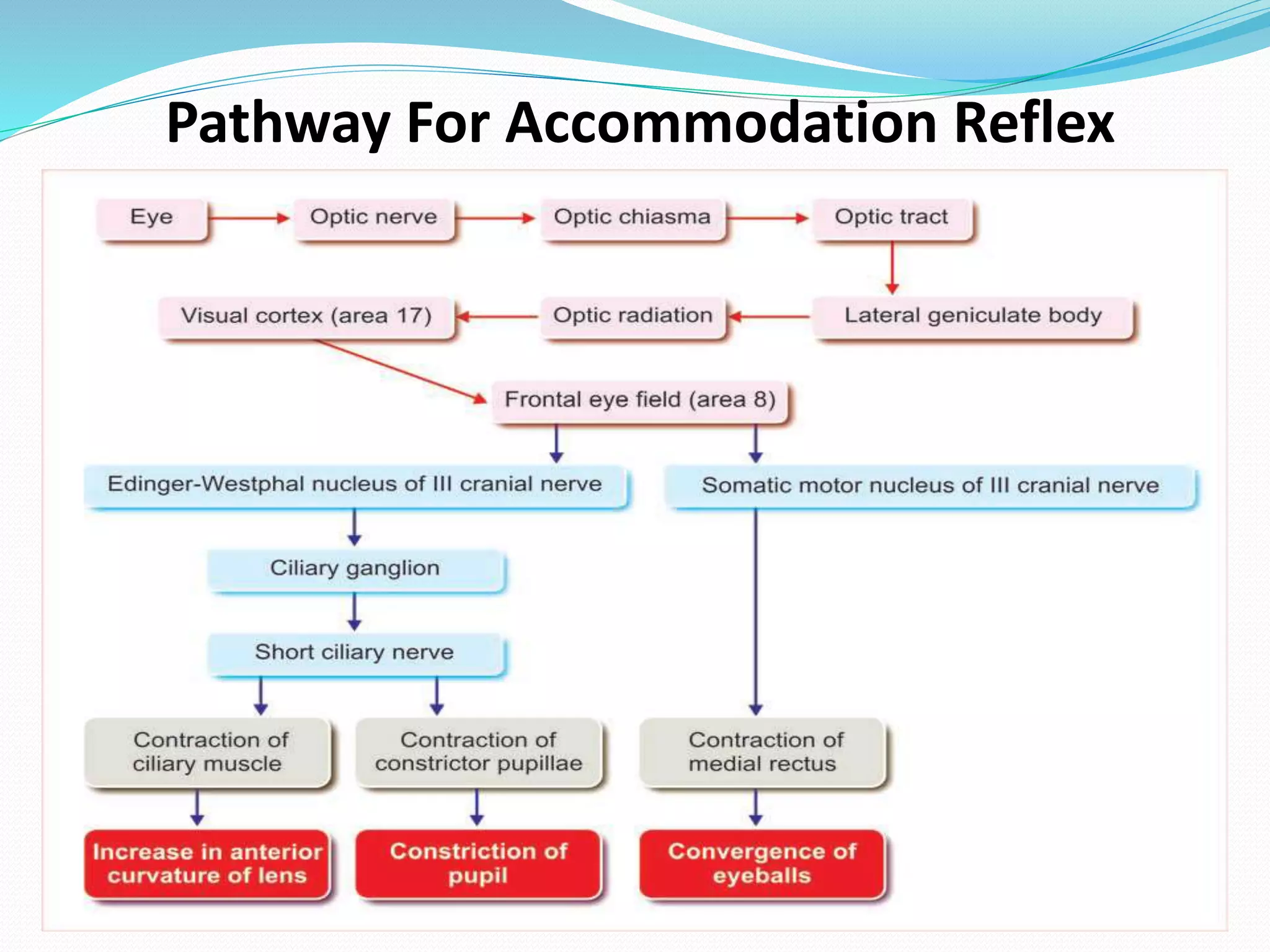
PATHWAY FOR
ACCOMMODATION REFLEX
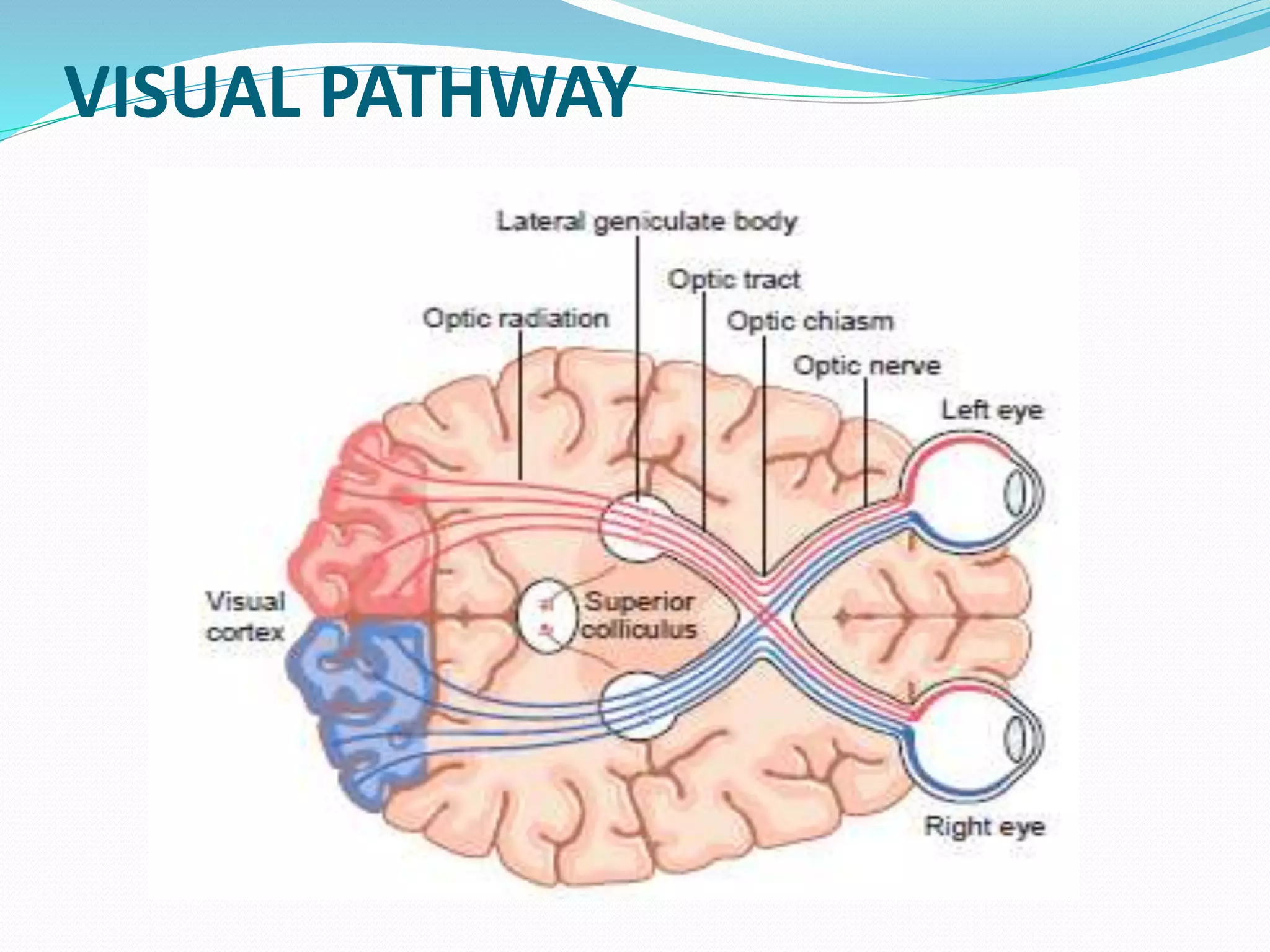
VISUAL PATHWAY
Pathway For Accommodation Reflex
ACCOMMODATION REFLEX
Receptors: ?
Receptors:
Rods and Cones
ACCOMMODATION REFLEX
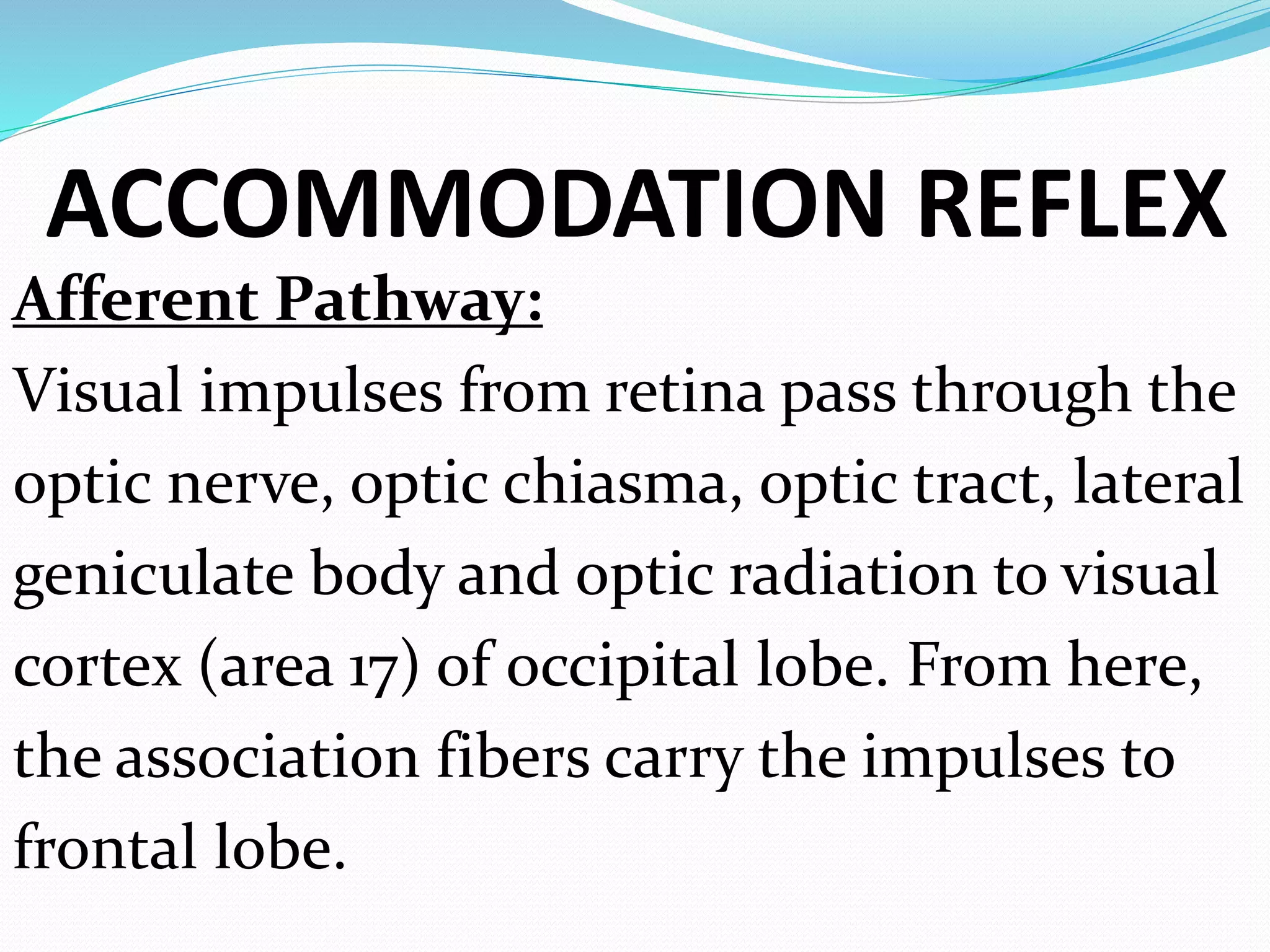
Afferent Pathway:
Visual impulses from retina pass through the
optic nerve, optic chiasma, optic tract, lateral
geniculate body and optic radiation to visual
cortex (area 17) of occipital lobe. From here,
the association fibers carry the impulses to
frontal lobe.
ACCOMMODATION REFLEX
Center
The center for accommodation lies in:
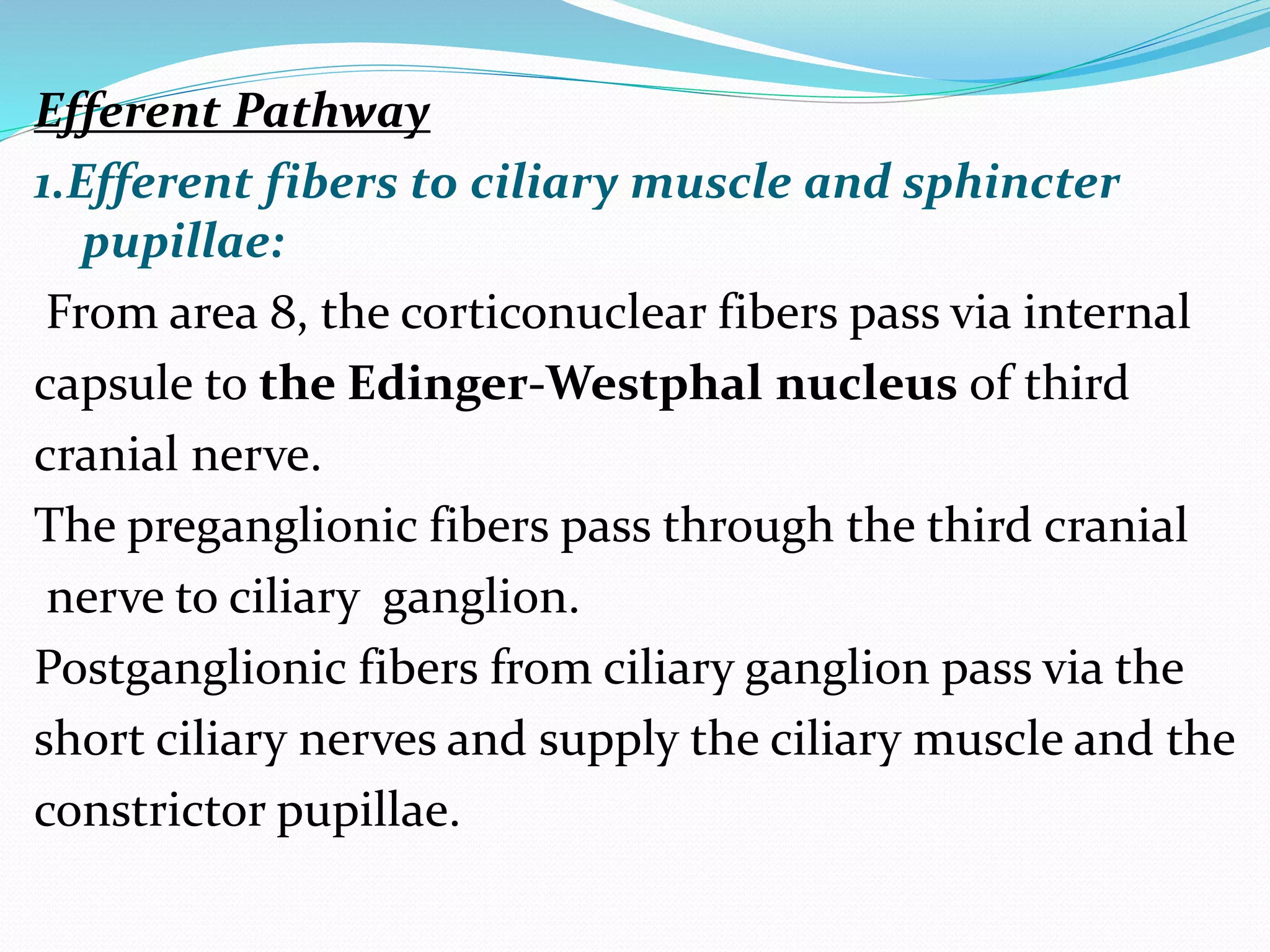
frontal eye field (area 8) that is
situated in the frontal lobe of
cerebral cortex.
Efferent Pathway
1.Efferent fibers to ciliary muscle and sphincter
pupillae:
From area 8, the corticonuclear fibers pass via internal
capsule to the Edinger-Westphal nucleus of third
cranial nerve.
The preganglionic fibers pass through the third cranial
nerve to ciliary ganglion.
Postganglionic fibers from ciliary ganglion pass via the
short ciliary nerves and supply the ciliary muscle and the
constrictor pupillae.
2. Efferent fibers to medial rectus:
Some of the fibers from frontal eye
field terminate in the somatic motor
nucleus of oculomotor nerve. The
fibers from motor nucleus supply
medial rectus.
Effectors:
???
Effectors:
The ciliary muscle and the
constrictor pupillae.
Medial rectus
Pathway For Accommodation Reflex
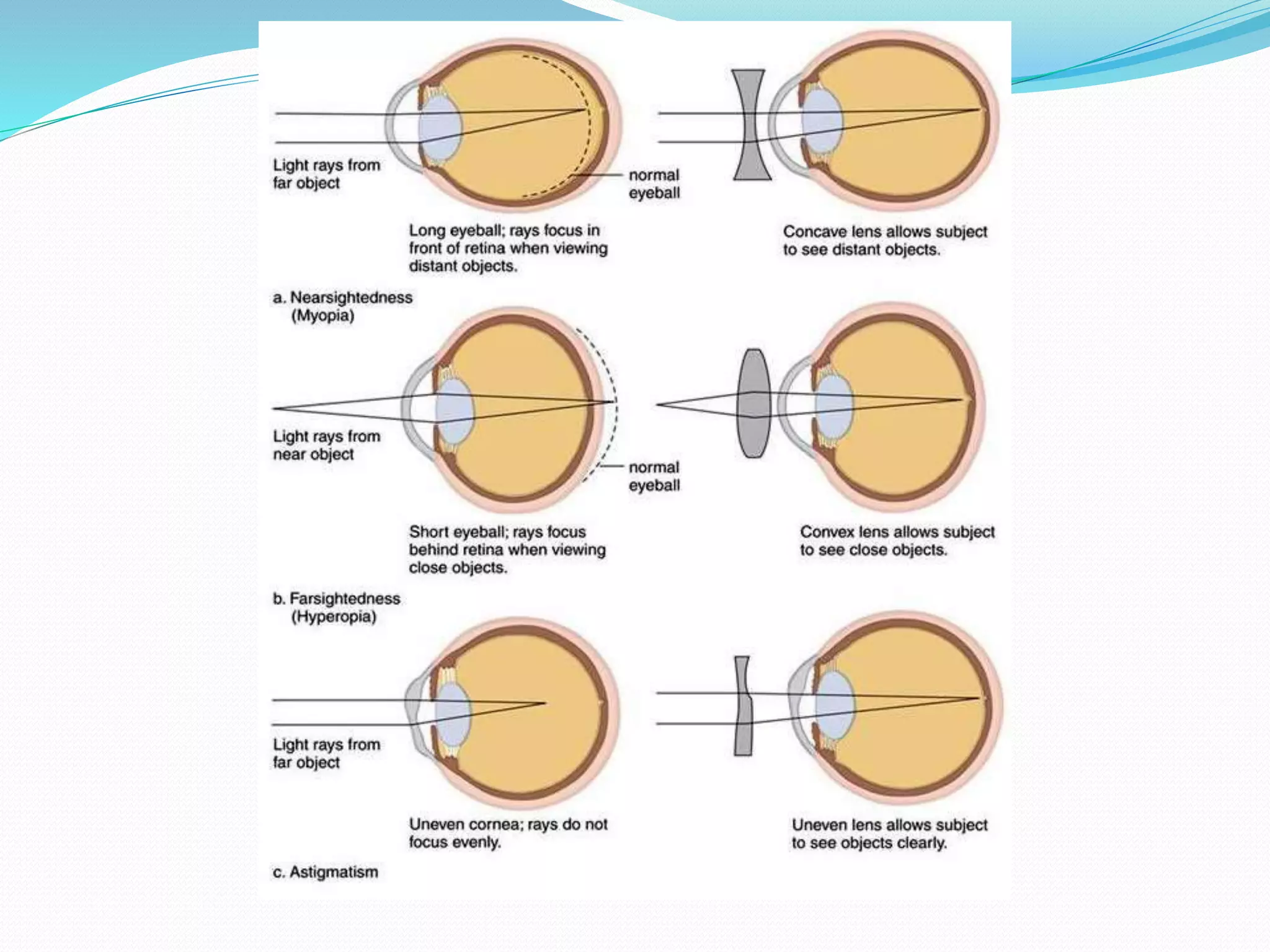
Presbyopia: Loss of Accommodation by the
Lens.
Presbyopia :
Failure of accommodation to near objects due to gradual
diminution of lens elasticity with advancing age is called
Presbiopia.
 The power of accommodation decreases from 14 diopters in a
child to less than 2diopters at age 70 years.Thereafter, the
lens remains almost totally non accommodating (presbiopic).
 In presbyopia the eyes can no longer accommodate for both
near and far vision. To see clearly both in the distance and
nearby, an older person must wear bifocal glasses, with the
upper segment focused for far-seeing and the lower segment
focused for near-seeing (e.g., for reading).
Causes OF Presbyopia
It is due to:
1. loss of elasticity the lens grows larger and
thicker and becomes far less elastic.
(denaturation of the lens proteins).
2. sclerosis of lens capsule or suspensory
ligaments .
3. weakness of the ciliary muscles.
Advantages of Pupillary constriction
 Spherical abberation.
(The constriction of pupil allows the light to pass
through the centre of the lens with least bending )
 Chromatic abberation
 No Image distortion
 Depth of focus
Accomodation reflex
Accomodation reflex
Accomodation reflex
Accomodation reflex

Accomodation reflex

  • 1.
  • 3.
  • 4.
    „ DEFINITION: Accommodation is theadjustment of eye to see near objects clearly. It is the process by which light rays from near objects are brought to a focus on retina
  • 5.
    Mechanism Of Accommodation: It isachieved by various adjustments made in the eyeball
  • 6.
    Adjustments Made InThe Eyeballs When a person looks at a near object after seeing a far object, three adjustments are made in the eyeballs: 1. Convergence of the eyeballs 2. Constriction of the pupil 3. Increase in the anterior curvature of the lens (lens becomes more spherical)
  • 7.
    1. Convergence ofthe eyeballs due to contraction of the medial recti. 2. Constriction of the pupil due to the contraction of constrictor/sphincter pupillae of iris. 3. Increase in the anterior curvature of the lens due to contraction of the ciliary muscle.
  • 11.
  • 12.
    MECHANISM OF ACCOMMODATION Whenthe eyes are fixed on a distant object:  lens is flat due to the traction of suspensory ligaments. When vision is shifted from the distant object to a near object : Ciliary muscle contracts. Stimulation of the parasympathetic nerves contracts both sets of ciliary muscle fibers, The contraction of the ciliary muscle relaxes the suspensory ligaments, and the lens assumes a more spherical shape
  • 13.
  • 14.
  • 22.
  • 23.
  • 24.
  • 25.
    ACCOMMODATION REFLEX Afferent Pathway: Visualimpulses from retina pass through the optic nerve, optic chiasma, optic tract, lateral geniculate body and optic radiation to visual cortex (area 17) of occipital lobe. From here, the association fibers carry the impulses to frontal lobe.
  • 26.
    ACCOMMODATION REFLEX Center The centerfor accommodation lies in: frontal eye field (area 8) that is situated in the frontal lobe of cerebral cortex.
  • 27.
    Efferent Pathway 1.Efferent fibersto ciliary muscle and sphincter pupillae: From area 8, the corticonuclear fibers pass via internal capsule to the Edinger-Westphal nucleus of third cranial nerve. The preganglionic fibers pass through the third cranial nerve to ciliary ganglion. Postganglionic fibers from ciliary ganglion pass via the short ciliary nerves and supply the ciliary muscle and the constrictor pupillae.
  • 28.
    2. Efferent fibersto medial rectus: Some of the fibers from frontal eye field terminate in the somatic motor nucleus of oculomotor nerve. The fibers from motor nucleus supply medial rectus.
  • 29.
  • 30.
    Effectors: The ciliary muscleand the constrictor pupillae. Medial rectus
  • 31.
  • 33.
    Presbyopia: Loss ofAccommodation by the Lens. Presbyopia : Failure of accommodation to near objects due to gradual diminution of lens elasticity with advancing age is called Presbiopia.  The power of accommodation decreases from 14 diopters in a child to less than 2diopters at age 70 years.Thereafter, the lens remains almost totally non accommodating (presbiopic).  In presbyopia the eyes can no longer accommodate for both near and far vision. To see clearly both in the distance and nearby, an older person must wear bifocal glasses, with the upper segment focused for far-seeing and the lower segment focused for near-seeing (e.g., for reading).
  • 34.
    Causes OF Presbyopia Itis due to: 1. loss of elasticity the lens grows larger and thicker and becomes far less elastic. (denaturation of the lens proteins). 2. sclerosis of lens capsule or suspensory ligaments . 3. weakness of the ciliary muscles.
  • 35.
    Advantages of Pupillaryconstriction  Spherical abberation. (The constriction of pupil allows the light to pass through the centre of the lens with least bending )  Chromatic abberation  No Image distortion  Depth of focus

Editor's Notes

  • #5 It is achieved by various adjustments made in the eyeball. It is the process by which light rays from near distant objects are brought to a focus on retina.
  • #8 In children, the refractive power of the lens of the eye can be increased voluntarily from 20 diopters to about 34 diopters, which is an “accommodation” of 14 diopters..
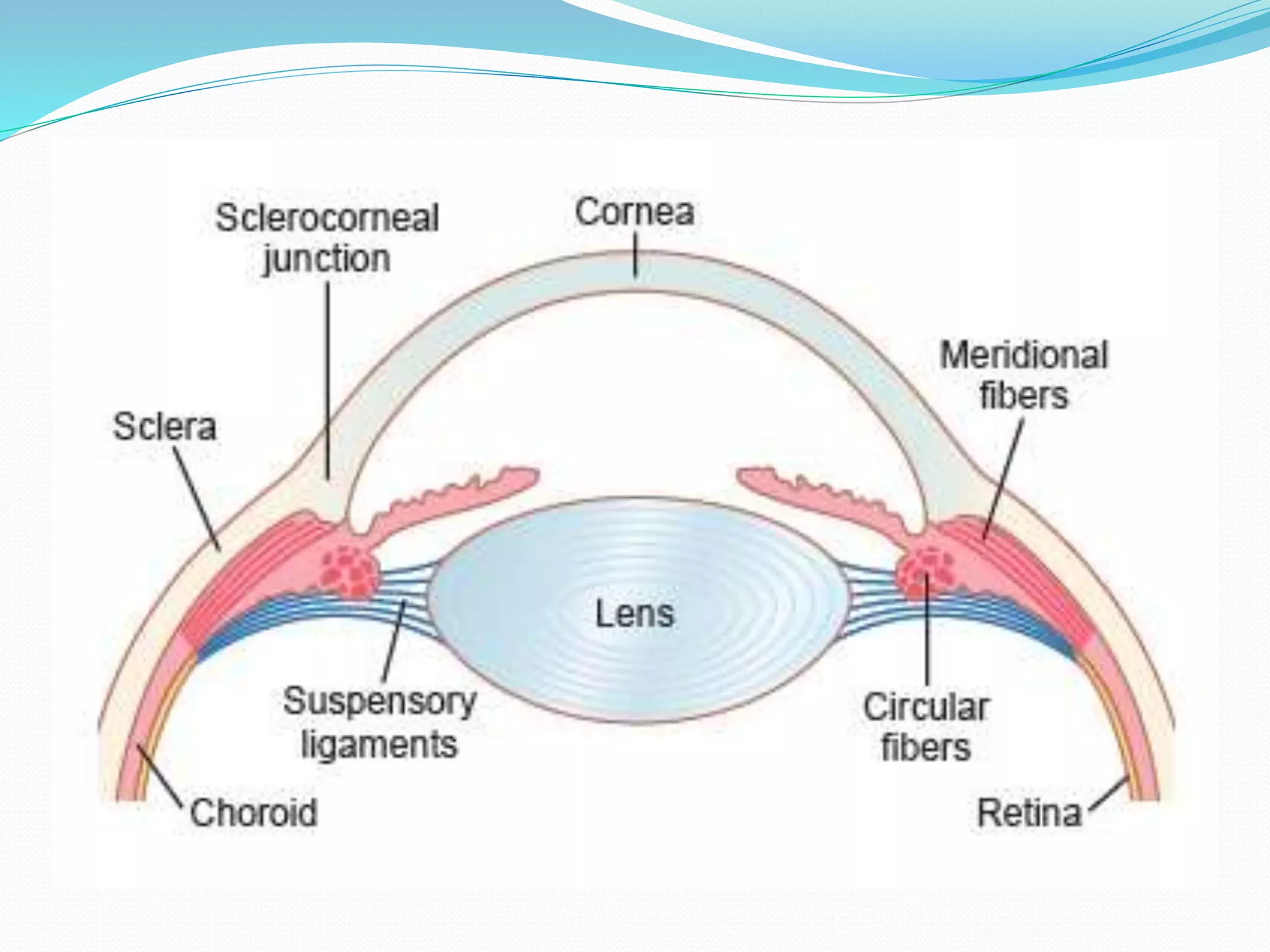
  • #12 suspensory ligaments extend from the capsule of lens and are attached to ciliary processes. Ciliary processes are attached to choroid through the ciliary muscle
  • #13 About 70 suspensory ligaments attach radially around the lens, pulling the lens edges toward the outer circle of the eyeball. These ligaments are constantly tensed by their attachments at the anterior border of the choroid and retina. The tension on the ligaments causes the lens to remain relatively flat under normal conditions of the eye The meridoneal fibers:When these muscle fibers contract, the peripheral insertions of the lens ligaments are pulled medially toward the edges of the cornea, thereby releasing the ligaments’ tension on the lens.The circular fibers:when they contract, a sphincter-like action occurs, decreasing the diameter of the circle of ligament attachments allowing the ligaments to pull less on the lens capsule