Vision:The Eye
Contents
• ANATOMIC CONSIDERATIONS
• THE IMAGE-FORMING MECHANISM
• THE PHOTORECEPTOR MECHANISM
• RESPONSES IN THE VISUAL PATHWAYS & CORTEX
• COLOR VISION
• OTHER ASPECTS OF VISUAL FUNCTION
• EYE MOVEMENTS
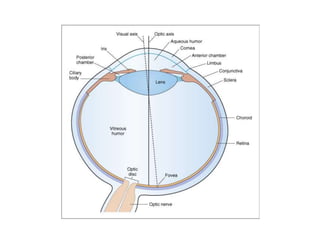
PARTS OF EYE
• A layer of receptors within protective
case
• A lens system focuses light
• Nerve fibers transmit impulses to brain
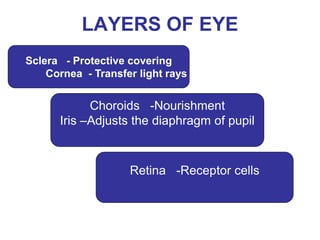
LAYERS OF EYE
Sclera - Protective covering
Cornea - Transfer light rays
Choroids -Nourishment
Iris –Adjusts the diaphragm of pupil
Retina -Receptor cells
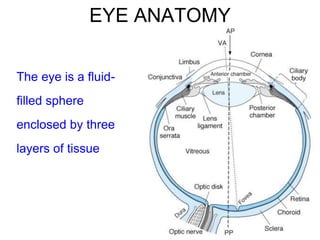
EYE ANATOMY
The eye is a fluid-
filled sphere
enclosed by three
layers of tissue
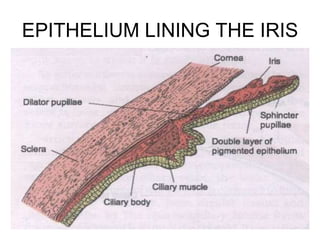
EPITHELIUM LINING THE IRIS
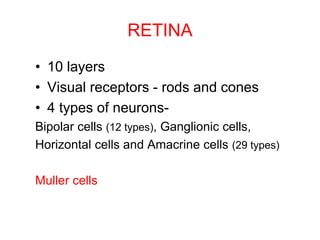
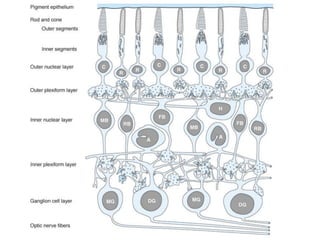
RETINA
• 10 layers
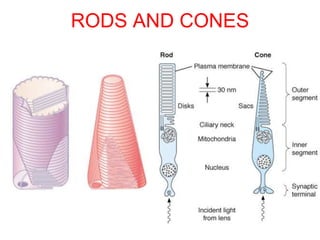
• Visual receptors - rods and cones
• 4 types of neurons-
Bipolar cells (12 types), Ganglionic cells,
Horizontal cells and Amacrine cells (29 types)
Muller cells
RODS AND CONES
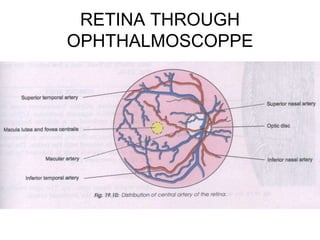
RETINA THROUGH
OPHTHALMOSCOPPE
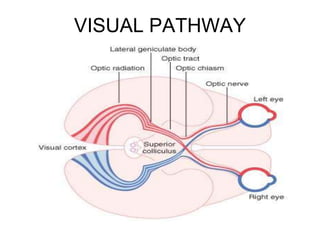
VISUAL PATHWAY
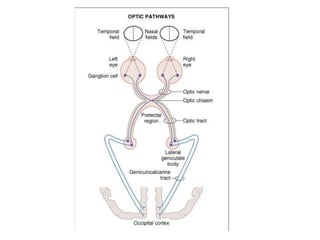
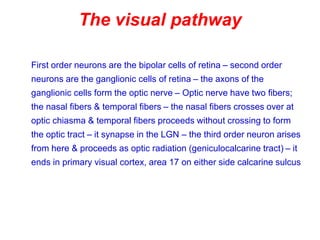
The visual pathway
First order neurons are the bipolar cells of retina – second order
neurons are the ganglionic cells of retina – the axons of the
ganglionic cells form the optic nerve – Optic nerve have two fibers;
the nasal fibers & temporal fibers – the nasal fibers crosses over at
optic chiasma & temporal fibers proceeds without crossing to form
the optic tract – it synapse in the LGN – the third order neuron arises
from here & proceeds as optic radiation (geniculocalcarine tract) – it
ends in primary visual cortex, area 17 on either side calcarine sulcus
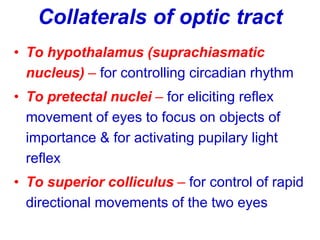
Collaterals of optic tract
• To hypothalamus (suprachiasmatic
nucleus) – for controlling circadian rhythm
• To pretectal nuclei – for eliciting reflex
movement of eyes to focus on objects of
importance & for activating pupilary light
reflex
• To superior colliculus – for control of rapid
directional movements of the two eyes
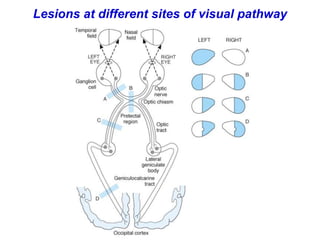
Lesions at different sites of visual pathway
• Anopia : Blindness
• Hemianopia : partial blindness
• Lesion of optic nerve :
• Lesion of optic chiasma : Bitemporal
hemianopia
• Lesion of outer margins optic chiasma :
Binasal hemianopia
• Lesion of optic chiasma & its outer
margins : blindness in rt eye with temporal
hemianopia in left eye
• Lesion of optic tract : homonymous
hemianopia
• Lesion of LGB /optic radiation :
Homonymous hemianopia with pupillary
reaction to light
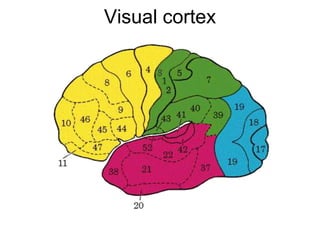
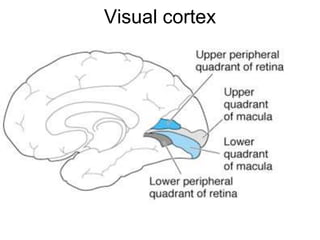
• Lesion of occipital cortex : discrete
quadrantic visual field defects
Visual cortex
Visual cortex
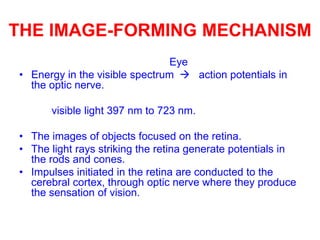
THE IMAGE-FORMING MECHANISM
Eye
• Energy in the visible spectrum  action potentials in
the optic nerve.
visible light 397 nm to 723 nm.
• The images of objects focused on the retina.
• The light rays striking the retina generate potentials in
the rods and cones.
• Impulses initiated in the retina are conducted to the
cerebral cortex, through optic nerve where they produce
the sensation of vision.
• Principles of Optics
• Accommodation
• Near Point
• The Near Response
• Other Pupillary Reflexes
• Retinal Image
• Common Defects of the Image-Forming Mechanism
Contents
Principles of Optics
• Refraction
• Principal focus
• Nodal point
• Principal axis
• Principal focal distance
• The refractive power of human eye -
60 diopters
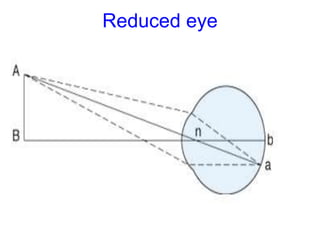
Reduced eye
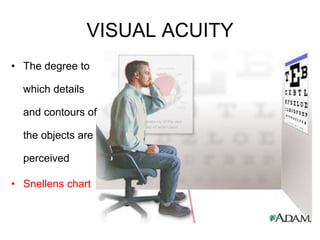
VISUAL ACUITY
• The degree to
which details
and contours of
the objects are
perceived
• Snellens chart
Accommodation
• Accommodation is the ability of eye to
focus an object at varying distance.
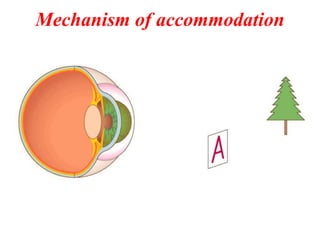
Mechanism of accommodation
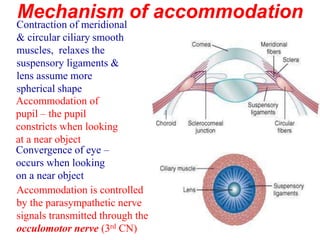
Contraction of meridional
& circular ciliary smooth
muscles, relaxes the
suspensory ligaments &
lens assume more
spherical shape
Accommodation is controlled
by the parasympathetic nerve
signals transmitted through the
occulomotor nerve (3rd CN)
Accommodation of
pupil – the pupil
constricts when looking
at a near object
Convergence of eye –
occurs when looking
on a near object
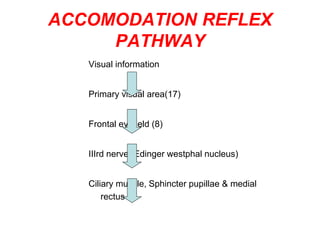
ACCOMODATION REFLEX
PATHWAY
Visual information
Primary visual area(17)
Frontal eyefield (8)
IIIrd nerve (Edinger westphal nucleus)
Ciliary muscle, Sphincter pupillae & medial
rectus
• The extra amount of refractive power
required to focus the images of near
objects on retina.
• It is the difference in refractive power
required to focus the images of near
objects on retina.
AMPLITUDE OF ACCOMODATION
Applied aspect
• Argyll Robertson pupil (pupillary reflex
absent, while accommodation reflex present)
• Reverse Argyll Robertson pupil
(pupillary reflex present, while
accommodation reflex absent)
Near point of vision
• The nearest point to the eye at which an object
can be brought into clear focus by
accommodation is called the near point of
vision.
• 10 years - 9 cm
• 60 years - 83 cm
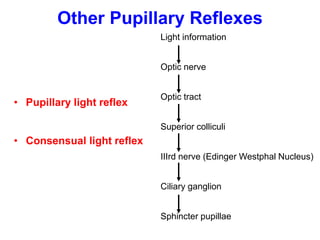
Other Pupillary Reflexes
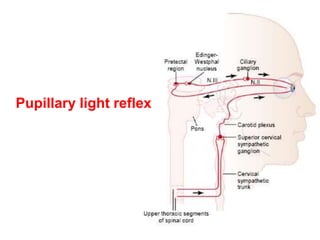
• Pupillary light reflex
• Consensual light reflex
Light information
Optic nerve
Optic tract
Superior colliculi
IIIrd nerve (Edinger Westphal Nucleus)
Ciliary ganglion
Sphincter pupillae
Pupillary light reflex
Common Defects of the Image –
Forming Mechanism
• Hyperopia
• Myopia
• Astigmatism
• Presbyopia
• Optical Aberration
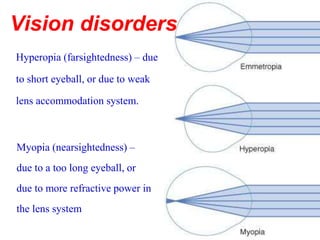
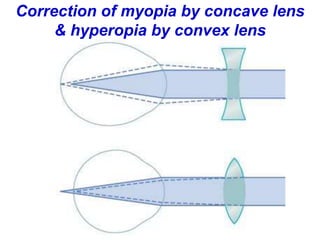
Hyperopia (farsightedness) – due
to short eyeball, or due to weak
lens accommodation system.
Myopia (nearsightedness) –
due to a too long eyeball, or
due to more refractive power in
the lens system
Vision disorders
Correction of myopia by concave lens
& hyperopia by convex lens
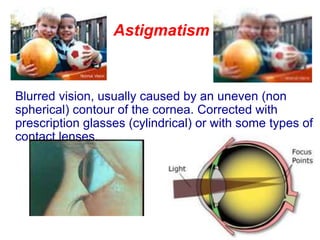
Astigmatism
Blurred vision, usually caused by an uneven (non
spherical) contour of the cornea. Corrected with
prescription glasses (cylindrical) or with some types of
contact lenses.
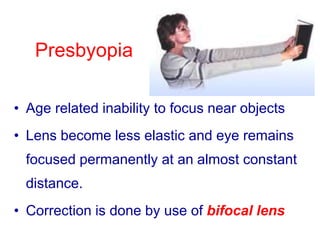
Presbyopia
• Age related inability to focus near objects
• Lens become less elastic and eye remains
focused permanently at an almost constant
distance.
• Correction is done by use of bifocal lens
Dark Adaptation
• When entering to dim light , the decrease
in visual threshold or increase in visual
sensitivity of eye to light is called Dark
adaptation.
1.Fast Response: The first drop in visual
threshold is rapid, but small in magnitude.
This is due to dark adaptation of cones.
(paradoxical adaptation) , occurs over a
period of 4-5 mts
2. Slow Response: A further drop in visual
threshold occurs slowly over a period of 25
mts, due to adaptation of rods in peripheral
portion of retina
Changes occur during dark adaptation are
a) Mydriasis
b) Change over photoreceptor function from
cones to rods
c) Resynthesis of Rhodopsin
• Significance : Radiologists wear Red
goggles
• Wavelength of red coloured light
stimulates rods only to a slight degree &
simultaneously allowing cones to function
Light Adaptation
• When person suddenly moves from dim
lighted area to bright light, blurring of
vision for about 5 mts. Pupil constricts to
reduce the amount of light entering into
eye. There is neural adaptation &
Chemical adaptation
THE PHOTORECEPTOR MECHANISM
• Genesis of Electrical Responses
• Ionic Basis of Photoreceptor Potentials
• Photosensitive Compounds
Rhodopsin, Cone Pigments
• Resynthesis of Cyclic GMP
• Synaptic Mediators in the Retina
• Image Formation
• Electroretinogram
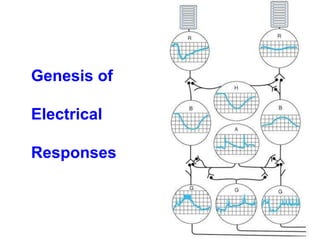
Genesis of
Electrical
Responses
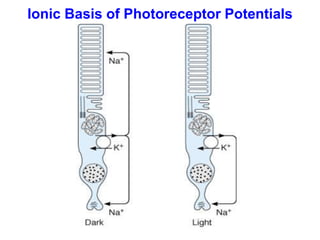
Ionic Basis of Photoreceptor Potentials
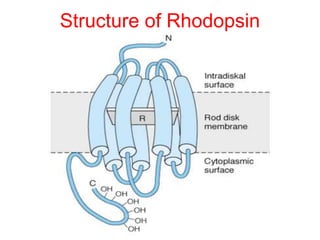
Structure of Rhodopsin
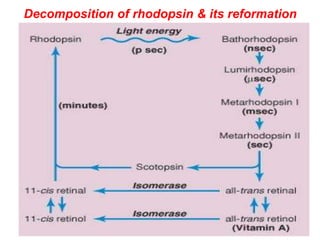
Decomposition of rhodopsin & its reformation
Importance of vitamin A
Vitamin A helps in the reformation of rhodopsin.
Night Blindness occurs in severe vit.A deficiency
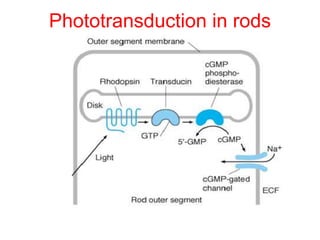
Phototransduction in rods
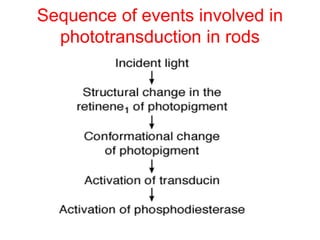
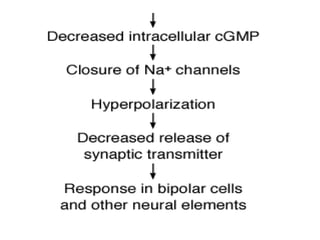
Sequence of events involved in
phototransduction in rods
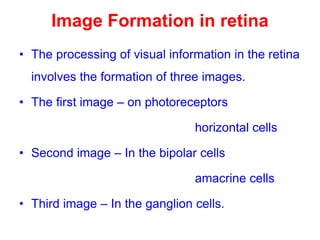
Image Formation in retina
• The processing of visual information in the retina
involves the formation of three images.
• The first image – on photoreceptors
horizontal cells
• Second image – In the bipolar cells
amacrine cells
• Third image – In the ganglion cells.
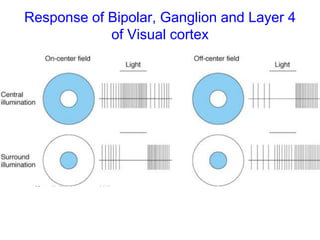
Response of Bipolar, Ganglion and Layer 4
of Visual cortex
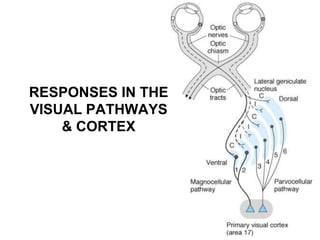
RESPONSES IN THE
VISUAL PATHWAYS
& CORTEX
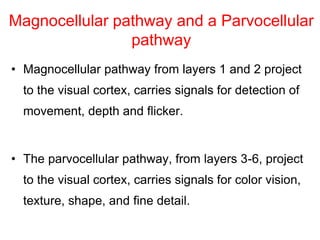
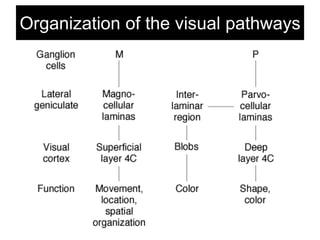
Magnocellular pathway and a Parvocellular
pathway
• Magnocellular pathway from layers 1 and 2 project
to the visual cortex, carries signals for detection of
movement, depth and flicker.
• The parvocellular pathway, from layers 3-6, project
to the visual cortex, carries signals for color vision,
texture, shape, and fine detail.
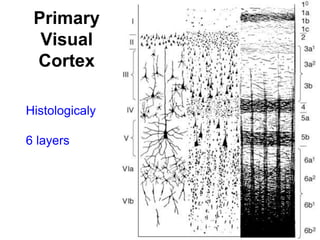
Primary
Visual
Cortex
Histologicaly
6 layers
Functions of Primary Visual Cortex
• The primary visual cortex segregates
information about color from that concerned with
form and movement, combines the input from
the two eyes, and converts the visual world into
short line segments of various orientations.
Geniculocalcarine tract
• Lateral geniculate body projects point-for-point representation
on the primary visual cortex
• The axons from the lateral geniculate nucleus that form the
magnocellular pathway end in layer 4, specifically in its
deepest part, layer 4C.
• Many of the axons that form the parvocellular pathway also
end in layer 4C.
• The axons from the interlaminar region end in layers 2 and 3.
BLOBS
• Layers 2 and 3 of the cortex contain clusters of cells about
0.2 mm in diameter contain a high concentration of the
mitochondrial enzyme cytochrome oxidase.
• They are arranged in a mosaic in the visual cortex and are
concerned with color vision.
• However, the parvocellular pathway also carries color
opponent data to the deep part of layer 4
Organization of the visual pathways
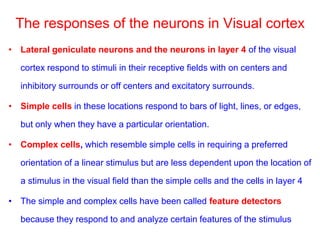
The responses of the neurons in Visual cortex
• Lateral geniculate neurons and the neurons in layer 4 of the visual
cortex respond to stimuli in their receptive fields with on centers and
inhibitory surrounds or off centers and excitatory surrounds.
• Simple cells in these locations respond to bars of light, lines, or edges,
but only when they have a particular orientation.
• Complex cells, which resemble simple cells in requiring a preferred
orientation of a linear stimulus but are less dependent upon the location of
a stimulus in the visual field than the simple cells and the cells in layer 4
• The simple and complex cells have been called feature detectors
because they respond to and analyze certain features of the stimulus
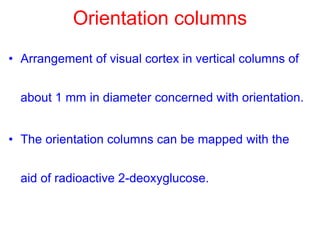
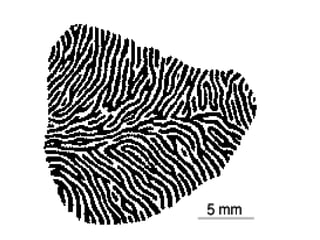
Orientation columns
• Arrangement of visual cortex in vertical columns of
about 1 mm in diameter concerned with orientation.
• The orientation columns can be mapped with the
aid of radioactive 2-deoxyglucose.
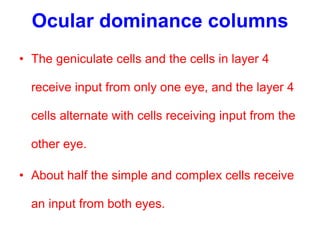
Ocular dominance columns
• The geniculate cells and the cells in layer 4
receive input from only one eye, and the layer 4
cells alternate with cells receiving input from the
other eye.
• About half the simple and complex cells receive
an input from both eyes.
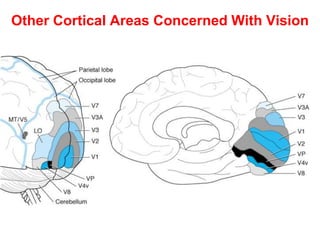
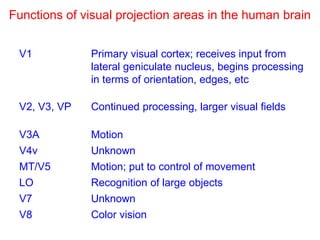
Other Cortical Areas Concerned With Vision
V1 Primary visual cortex; receives input from
lateral geniculate nucleus, begins processing
in terms of orientation, edges, etc
V2, V3, VP Continued processing, larger visual fields
V3A Motion
V4v Unknown
MT/V5 Motion; put to control of movement
LO Recognition of large objects
V7 Unknown
V8 Color vision
Functions of visual projection areas in the human brain
• Dorsal or parietal pathway - concerned primarily
with motion
• Ventral or temporal pathway, concerned with
shape and recognition of forms and faces.
• In addition, connections to the sensory areas are
important.
COLOR VISION
• Colors have three attributes: hue, intensity, and saturation
• Complementary color
• Primary colors : red (wavelength 723-647 nm), green (575-
492 nm), and blue (492-450 nm).
• Color perceived depends in part on the color of other objects
in the visual field.
Retinal Mechanisms
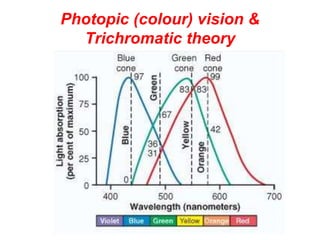
• Young-Helmholtz theory - There are three types of cones,
each get stimulated to maximum by different wave length of
light. But one wave length of light itself will stimulate different
types of cone differentially, forming the basis for colour
vision.
• Rayleigh match -It has been known for some time that
responses to the, the amounts of red and green light that a
subject mixes to match a monochromatic orange, are
bimodal.
Photopic (colour) vision &
Trichromatic theory
NEURAL MECHANISM OF COLOR VISION
• Color is mediated by ganglion cells
• Processing in the ganglion cells and the lateral
geniculate nucleus produces impulses that pass along
three types of neural pathways that project to V1:
• A red-green pathway that signals differences between L-
and M-cone responses;
• A blue-yellow pathway that signals differences between
S-cone and the sum of L- and M-cone responses;
• A luminance pathway that signals the sum of L- and M-
cone responses.
• These pathways project to the blobs and the deep
portion of layer 4C of V1.
• From the blobs and layer 4, color information is projected
to V8.
Colour blindness
• Insensitive to colours .Inability on part of
an individual to recognise certain colours
is colour blindness
• Total loss of color vision achrommatopsia.
• Monochromats : 1 cone system
• Dichromats : 2 cone system
• Trichromats : 3 cone system one weak
Colour blindness
Trichromats
Dichromats
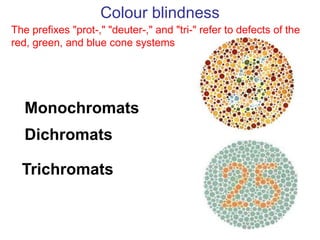
Monochromats
The prefixes "prot-," "deuter-," and "tri-" refer to defects of the
red, green, and blue cone systems
• Deteronomaly
• Deteronopia
• Protonopia
• Protonomaly
• Tritanomaly
Tests for Colour blindness
• Yarn test
• Ishihara charts
• Edridge Green Lantern
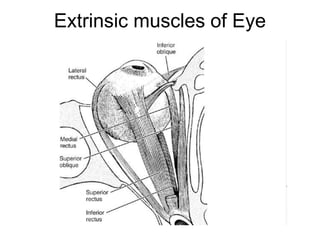
Extrinsic muscles of Eye
Movements of eye
• Saccadic movement : Rapid jerky movements
that occur, when the gaze shifts from one object
to other. Function is to keep new object in focus.
• Smooth pursuit movements : Tracking
movements as they follow moving objects
• Vergence : movements occur when objects
comes near or move far away from that
• Vestibular movements:When the head moves, to
keep the object in focus, the eyeballs moves in
response to stimuli arriving from semicircular
canals
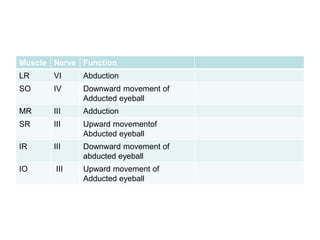
Muscle Nerve Function
LR VI Abduction
SO IV Downward movement of
Adducted eyeball
MR III Adduction
SR III Upward movementof
Abducted eyeball
IR III Downward movement of
abducted eyeball
IO III Upward movement of
Adducted eyeball

EYE PRESENTATION Dr Sheeba.ppt

  • 1.
  • 2.
    Contents • ANATOMIC CONSIDERATIONS •THE IMAGE-FORMING MECHANISM • THE PHOTORECEPTOR MECHANISM • RESPONSES IN THE VISUAL PATHWAYS & CORTEX • COLOR VISION • OTHER ASPECTS OF VISUAL FUNCTION • EYE MOVEMENTS
  • 3.
    PARTS OF EYE •A layer of receptors within protective case • A lens system focuses light • Nerve fibers transmit impulses to brain
  • 5.
    LAYERS OF EYE Sclera- Protective covering Cornea - Transfer light rays Choroids -Nourishment Iris –Adjusts the diaphragm of pupil Retina -Receptor cells
  • 6.
    EYE ANATOMY The eyeis a fluid- filled sphere enclosed by three layers of tissue
  • 7.
  • 8.
    RETINA • 10 layers •Visual receptors - rods and cones • 4 types of neurons- Bipolar cells (12 types), Ganglionic cells, Horizontal cells and Amacrine cells (29 types) Muller cells
  • 10.
  • 11.
  • 13.
  • 14.
    The visual pathway Firstorder neurons are the bipolar cells of retina – second order neurons are the ganglionic cells of retina – the axons of the ganglionic cells form the optic nerve – Optic nerve have two fibers; the nasal fibers & temporal fibers – the nasal fibers crosses over at optic chiasma & temporal fibers proceeds without crossing to form the optic tract – it synapse in the LGN – the third order neuron arises from here & proceeds as optic radiation (geniculocalcarine tract) – it ends in primary visual cortex, area 17 on either side calcarine sulcus
  • 15.
    Collaterals of optictract • To hypothalamus (suprachiasmatic nucleus) – for controlling circadian rhythm • To pretectal nuclei – for eliciting reflex movement of eyes to focus on objects of importance & for activating pupilary light reflex • To superior colliculus – for control of rapid directional movements of the two eyes
  • 16.
    Lesions at differentsites of visual pathway
  • 17.
    • Anopia :Blindness • Hemianopia : partial blindness • Lesion of optic nerve : • Lesion of optic chiasma : Bitemporal hemianopia • Lesion of outer margins optic chiasma : Binasal hemianopia • Lesion of optic chiasma & its outer margins : blindness in rt eye with temporal hemianopia in left eye
  • 18.
    • Lesion ofoptic tract : homonymous hemianopia • Lesion of LGB /optic radiation : Homonymous hemianopia with pupillary reaction to light • Lesion of occipital cortex : discrete quadrantic visual field defects
  • 19.
  • 20.
  • 21.
    THE IMAGE-FORMING MECHANISM Eye •Energy in the visible spectrum  action potentials in the optic nerve. visible light 397 nm to 723 nm. • The images of objects focused on the retina. • The light rays striking the retina generate potentials in the rods and cones. • Impulses initiated in the retina are conducted to the cerebral cortex, through optic nerve where they produce the sensation of vision.
  • 22.
    • Principles ofOptics • Accommodation • Near Point • The Near Response • Other Pupillary Reflexes • Retinal Image • Common Defects of the Image-Forming Mechanism Contents
  • 23.
    Principles of Optics •Refraction • Principal focus • Nodal point • Principal axis • Principal focal distance • The refractive power of human eye - 60 diopters
  • 24.
  • 25.
    VISUAL ACUITY • Thedegree to which details and contours of the objects are perceived • Snellens chart
  • 26.
    Accommodation • Accommodation isthe ability of eye to focus an object at varying distance.
  • 27.
  • 28.
    Mechanism of accommodation Contractionof meridional & circular ciliary smooth muscles, relaxes the suspensory ligaments & lens assume more spherical shape Accommodation is controlled by the parasympathetic nerve signals transmitted through the occulomotor nerve (3rd CN) Accommodation of pupil – the pupil constricts when looking at a near object Convergence of eye – occurs when looking on a near object
  • 29.
    ACCOMODATION REFLEX PATHWAY Visual information Primaryvisual area(17) Frontal eyefield (8) IIIrd nerve (Edinger westphal nucleus) Ciliary muscle, Sphincter pupillae & medial rectus
  • 30.
    • The extraamount of refractive power required to focus the images of near objects on retina. • It is the difference in refractive power required to focus the images of near objects on retina. AMPLITUDE OF ACCOMODATION
  • 31.
    Applied aspect • ArgyllRobertson pupil (pupillary reflex absent, while accommodation reflex present) • Reverse Argyll Robertson pupil (pupillary reflex present, while accommodation reflex absent)
  • 32.
    Near point ofvision • The nearest point to the eye at which an object can be brought into clear focus by accommodation is called the near point of vision. • 10 years - 9 cm • 60 years - 83 cm
  • 33.
    Other Pupillary Reflexes •Pupillary light reflex • Consensual light reflex Light information Optic nerve Optic tract Superior colliculi IIIrd nerve (Edinger Westphal Nucleus) Ciliary ganglion Sphincter pupillae
  • 34.
  • 35.
    Common Defects ofthe Image – Forming Mechanism • Hyperopia • Myopia • Astigmatism • Presbyopia • Optical Aberration
  • 36.
    Hyperopia (farsightedness) –due to short eyeball, or due to weak lens accommodation system. Myopia (nearsightedness) – due to a too long eyeball, or due to more refractive power in the lens system Vision disorders
  • 37.
    Correction of myopiaby concave lens & hyperopia by convex lens
  • 38.
    Astigmatism Blurred vision, usuallycaused by an uneven (non spherical) contour of the cornea. Corrected with prescription glasses (cylindrical) or with some types of contact lenses.
  • 39.
    Presbyopia • Age relatedinability to focus near objects • Lens become less elastic and eye remains focused permanently at an almost constant distance. • Correction is done by use of bifocal lens
  • 40.
    Dark Adaptation • Whenentering to dim light , the decrease in visual threshold or increase in visual sensitivity of eye to light is called Dark adaptation. 1.Fast Response: The first drop in visual threshold is rapid, but small in magnitude. This is due to dark adaptation of cones. (paradoxical adaptation) , occurs over a period of 4-5 mts
  • 41.
    2. Slow Response:A further drop in visual threshold occurs slowly over a period of 25 mts, due to adaptation of rods in peripheral portion of retina Changes occur during dark adaptation are a) Mydriasis b) Change over photoreceptor function from cones to rods c) Resynthesis of Rhodopsin
  • 42.
    • Significance :Radiologists wear Red goggles • Wavelength of red coloured light stimulates rods only to a slight degree & simultaneously allowing cones to function
  • 43.
    Light Adaptation • Whenperson suddenly moves from dim lighted area to bright light, blurring of vision for about 5 mts. Pupil constricts to reduce the amount of light entering into eye. There is neural adaptation & Chemical adaptation
  • 44.
    THE PHOTORECEPTOR MECHANISM •Genesis of Electrical Responses • Ionic Basis of Photoreceptor Potentials • Photosensitive Compounds Rhodopsin, Cone Pigments • Resynthesis of Cyclic GMP • Synaptic Mediators in the Retina • Image Formation • Electroretinogram
  • 45.
  • 46.
    Ionic Basis ofPhotoreceptor Potentials
  • 47.
  • 48.
    Decomposition of rhodopsin& its reformation
  • 49.
    Importance of vitaminA Vitamin A helps in the reformation of rhodopsin. Night Blindness occurs in severe vit.A deficiency
  • 50.
  • 51.
    Sequence of eventsinvolved in phototransduction in rods
  • 53.
    Image Formation inretina • The processing of visual information in the retina involves the formation of three images. • The first image – on photoreceptors horizontal cells • Second image – In the bipolar cells amacrine cells • Third image – In the ganglion cells.
  • 54.
    Response of Bipolar,Ganglion and Layer 4 of Visual cortex
  • 55.
    RESPONSES IN THE VISUALPATHWAYS & CORTEX
  • 56.
    Magnocellular pathway anda Parvocellular pathway • Magnocellular pathway from layers 1 and 2 project to the visual cortex, carries signals for detection of movement, depth and flicker. • The parvocellular pathway, from layers 3-6, project to the visual cortex, carries signals for color vision, texture, shape, and fine detail.
  • 57.
  • 58.
    Functions of PrimaryVisual Cortex • The primary visual cortex segregates information about color from that concerned with form and movement, combines the input from the two eyes, and converts the visual world into short line segments of various orientations.
  • 59.
    Geniculocalcarine tract • Lateralgeniculate body projects point-for-point representation on the primary visual cortex • The axons from the lateral geniculate nucleus that form the magnocellular pathway end in layer 4, specifically in its deepest part, layer 4C. • Many of the axons that form the parvocellular pathway also end in layer 4C. • The axons from the interlaminar region end in layers 2 and 3.
  • 60.
    BLOBS • Layers 2and 3 of the cortex contain clusters of cells about 0.2 mm in diameter contain a high concentration of the mitochondrial enzyme cytochrome oxidase. • They are arranged in a mosaic in the visual cortex and are concerned with color vision. • However, the parvocellular pathway also carries color opponent data to the deep part of layer 4
  • 61.
    Organization of thevisual pathways
  • 62.
    The responses ofthe neurons in Visual cortex • Lateral geniculate neurons and the neurons in layer 4 of the visual cortex respond to stimuli in their receptive fields with on centers and inhibitory surrounds or off centers and excitatory surrounds. • Simple cells in these locations respond to bars of light, lines, or edges, but only when they have a particular orientation. • Complex cells, which resemble simple cells in requiring a preferred orientation of a linear stimulus but are less dependent upon the location of a stimulus in the visual field than the simple cells and the cells in layer 4 • The simple and complex cells have been called feature detectors because they respond to and analyze certain features of the stimulus
  • 63.
    Orientation columns • Arrangementof visual cortex in vertical columns of about 1 mm in diameter concerned with orientation. • The orientation columns can be mapped with the aid of radioactive 2-deoxyglucose.
  • 64.
    Ocular dominance columns •The geniculate cells and the cells in layer 4 receive input from only one eye, and the layer 4 cells alternate with cells receiving input from the other eye. • About half the simple and complex cells receive an input from both eyes.
  • 66.
    Other Cortical AreasConcerned With Vision
  • 67.
    V1 Primary visualcortex; receives input from lateral geniculate nucleus, begins processing in terms of orientation, edges, etc V2, V3, VP Continued processing, larger visual fields V3A Motion V4v Unknown MT/V5 Motion; put to control of movement LO Recognition of large objects V7 Unknown V8 Color vision Functions of visual projection areas in the human brain
  • 68.
    • Dorsal orparietal pathway - concerned primarily with motion • Ventral or temporal pathway, concerned with shape and recognition of forms and faces. • In addition, connections to the sensory areas are important.
  • 69.
    COLOR VISION • Colorshave three attributes: hue, intensity, and saturation • Complementary color • Primary colors : red (wavelength 723-647 nm), green (575- 492 nm), and blue (492-450 nm). • Color perceived depends in part on the color of other objects in the visual field.
  • 70.
    Retinal Mechanisms • Young-Helmholtztheory - There are three types of cones, each get stimulated to maximum by different wave length of light. But one wave length of light itself will stimulate different types of cone differentially, forming the basis for colour vision. • Rayleigh match -It has been known for some time that responses to the, the amounts of red and green light that a subject mixes to match a monochromatic orange, are bimodal.
  • 71.
    Photopic (colour) vision& Trichromatic theory
  • 72.
    NEURAL MECHANISM OFCOLOR VISION • Color is mediated by ganglion cells • Processing in the ganglion cells and the lateral geniculate nucleus produces impulses that pass along three types of neural pathways that project to V1: • A red-green pathway that signals differences between L- and M-cone responses; • A blue-yellow pathway that signals differences between S-cone and the sum of L- and M-cone responses; • A luminance pathway that signals the sum of L- and M- cone responses. • These pathways project to the blobs and the deep portion of layer 4C of V1. • From the blobs and layer 4, color information is projected to V8.
  • 73.
    Colour blindness • Insensitiveto colours .Inability on part of an individual to recognise certain colours is colour blindness • Total loss of color vision achrommatopsia. • Monochromats : 1 cone system • Dichromats : 2 cone system • Trichromats : 3 cone system one weak
  • 74.
    Colour blindness Trichromats Dichromats Monochromats The prefixes"prot-," "deuter-," and "tri-" refer to defects of the red, green, and blue cone systems
  • 75.
    • Deteronomaly • Deteronopia •Protonopia • Protonomaly • Tritanomaly
  • 76.
    Tests for Colourblindness • Yarn test • Ishihara charts • Edridge Green Lantern
  • 77.
  • 78.
    Movements of eye •Saccadic movement : Rapid jerky movements that occur, when the gaze shifts from one object to other. Function is to keep new object in focus. • Smooth pursuit movements : Tracking movements as they follow moving objects • Vergence : movements occur when objects comes near or move far away from that • Vestibular movements:When the head moves, to keep the object in focus, the eyeballs moves in response to stimuli arriving from semicircular canals
  • 79.
    Muscle Nerve Function LRVI Abduction SO IV Downward movement of Adducted eyeball MR III Adduction SR III Upward movementof Abducted eyeball IR III Downward movement of abducted eyeball IO III Upward movement of Adducted eyeball