Awang Ismawi Bin Awang Ismail
Wan Muhammad Hakimi Bin Wan Zakaria
 Gram  negative bacteria
 Three members pathogenic to human, other
  species are pathogenic for animal and insects
 Lead a commensal existance in numerous
  hosts or occur as saprophytes, particularly in
  water
 Found  in fresh and brackish (slighly salt)
  water, shellfish and other seafood
 Man is the major reservoir for V.cholerae
 Factor of transmission – inadequate
  sanitation, lack of person and food hygiene,
  use a polluted water to prepare food,
  inadequate cooked shellfish etc
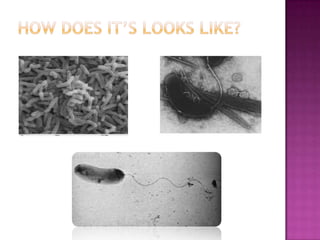
 Curved  rods with rounded ends
 3 x 0.5µm
 Gram negative – pink stained
 Actively motile with single polar flagellum.
  To- and fro- movement (dark-field
  micsroscopy)
 Non-capsulated, Non-sporing
 Some strain is lateral flagellum
   Produce enterotoxin (exotoxin) that activates
    enzyme adenylcyclase
   Causing watery diarrhoea producing ‘rice
    water’ stool containing vibrios, epithelial
    cells and mucus
   Adherence factor – motility and extracellular
    enzymes such as proteases
   Acute cholera – rapid loss of fluid and
    electrolytes in stool, vomit leads to muscular
    cramps and severe dehydration (fatal),
    acidosis, blood urea increase, urine increase
    in albumin
   Aerobic
   Wide temperature. Optimum 37oC
   Grow in ordinary media but sensitive to acid pH
    (alkaline; 8.2)
   2-3 mm in size after 18 – 24 hr incubation in
    optimum temp.
   Low convex with an entire edge, whitish and
    translucent
   Older colonies develop a light ochre tinta tube of
    peptone water with a flake of mucus from stool and
    incubating for only 6 – 8 hrs
 Ferment   glucose, sucrose, mannitol and
  maltose without gas production
 Does not utilise lactose or dulcitol
 Positive in indole and nitrites test
 Non-hemolytic in sheep blood agar (Greig
  test)
 Can be tested in H2SO4
Vibrio Cholerae

Vibrio Cholerae

  • 1.
    Awang Ismawi BinAwang Ismail Wan Muhammad Hakimi Bin Wan Zakaria
  • 2.
     Gram negative bacteria  Three members pathogenic to human, other species are pathogenic for animal and insects  Lead a commensal existance in numerous hosts or occur as saprophytes, particularly in water
  • 3.
     Found in fresh and brackish (slighly salt) water, shellfish and other seafood  Man is the major reservoir for V.cholerae  Factor of transmission – inadequate sanitation, lack of person and food hygiene, use a polluted water to prepare food, inadequate cooked shellfish etc
  • 5.
     Curved rods with rounded ends  3 x 0.5µm  Gram negative – pink stained  Actively motile with single polar flagellum. To- and fro- movement (dark-field micsroscopy)  Non-capsulated, Non-sporing  Some strain is lateral flagellum
  • 6.
    Produce enterotoxin (exotoxin) that activates enzyme adenylcyclase  Causing watery diarrhoea producing ‘rice water’ stool containing vibrios, epithelial cells and mucus  Adherence factor – motility and extracellular enzymes such as proteases  Acute cholera – rapid loss of fluid and electrolytes in stool, vomit leads to muscular cramps and severe dehydration (fatal), acidosis, blood urea increase, urine increase in albumin
  • 7.
    Aerobic  Wide temperature. Optimum 37oC  Grow in ordinary media but sensitive to acid pH (alkaline; 8.2)  2-3 mm in size after 18 – 24 hr incubation in optimum temp.  Low convex with an entire edge, whitish and translucent  Older colonies develop a light ochre tinta tube of peptone water with a flake of mucus from stool and incubating for only 6 – 8 hrs
  • 8.
     Ferment glucose, sucrose, mannitol and maltose without gas production  Does not utilise lactose or dulcitol  Positive in indole and nitrites test  Non-hemolytic in sheep blood agar (Greig test)  Can be tested in H2SO4