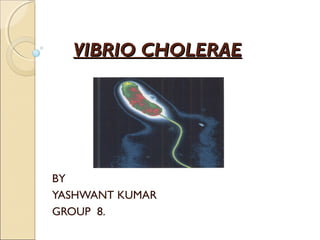
VIBRIO CHOLERAE


BY
YASHWANT KUMAR
GROUP 8.
History
First pandemic spreads from India to
 South, Central Asia, Middle East and
 Russia
Second pandemic reaches England
Pandemics in 1800’s deadly
All pandemics reach Africa
First pandemic reaches Latin America in
 1991
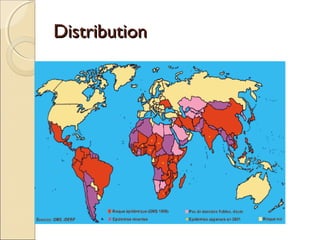
Distribution
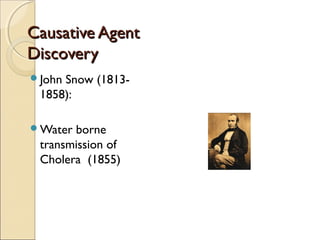
Causative Agent
Discovery
JohnSnow (1813-
 1858):

Water borne
 transmission of
 Cholera (1855)
Discovery
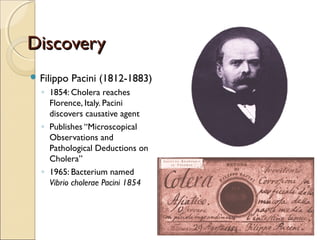
 Filippo   Pacini (1812-1883)
  ◦ 1854: Cholera reaches
    Florence, Italy. Pacini
    discovers causative agent
  ◦ Publishes “Microscopical
    Observations and
    Pathological Deductions on
    Cholera”
  ◦ 1965: Bacterium named
    Vibrio cholerae Pacini 1854
Discovery
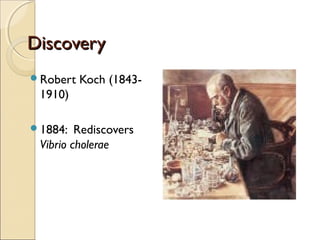
Robert   Koch (1843-
 1910)

1884:   Rediscovers
 Vibrio cholerae
Vibrio cholerae
Morphology
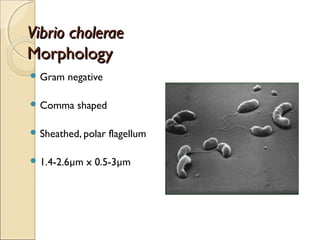
 Gram   negative

 Comma    shaped

 Sheathed, polar   flagellum

 1.4-2.6µm   x 0.5-3µm
Physiology
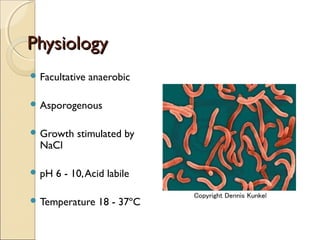
 Facultative   anaerobic

 Asporogenous


 Growth    stimulated by
  NaCl

 pH   6 - 10, Acid labile

 Temperature     18 - 37ºC
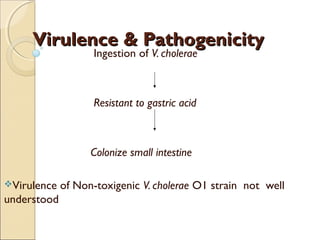
Virulence & Pathogenicity
                    Ingestion of V. cholerae


                    Resistant to gastric acid


                   Colonize small intestine

Virulence   of Non-toxigenic V. cholerae O1 strain not well
understood
ANTIGENIC STRUCTURE
Heat-labile flagellar H antigen.
O-lipopolysaccharides has 140
 serogroups.
Serogroup O1 and O139-classic cholera.
Others cause cholera like diseases.
Serotypes (inaba,ogawa,hikojima) and
 biotypes(classical,el tor)
El tor- hemolysin.
Serogroup O139- polysaccharide capsule.
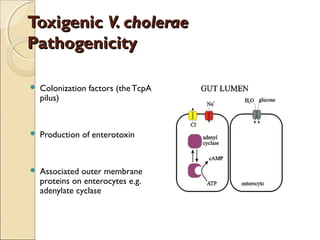
Toxigenic V. cholerae
Pathogenicity

   Colonization factors (the TcpA
    pilus)


   Production of enterotoxin


   Associated outer membrane
    proteins on enterocytes e.g.
    adenylate cyclase
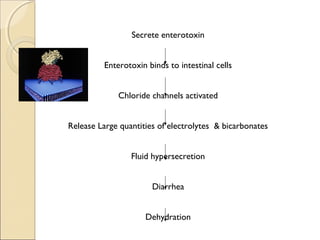
Secrete enterotoxin


         Enterotoxin binds to intestinal cells


             Chloride channels activated


Release Large quantities of electrolytes & bicarbonates


                 Fluid hypersecretion


                       Diarrhea


                     Dehydration
Transmission
Fecal-oral   route

Entry   = oral

Discharge    = fecal
Transmission
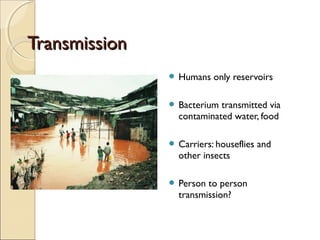
                Humans   only reservoirs

                Bacterium transmitted via
                 contaminated water, food

                Carriers: houseflies   and
                 other insects

                Person to person
                 transmission?
Symptoms
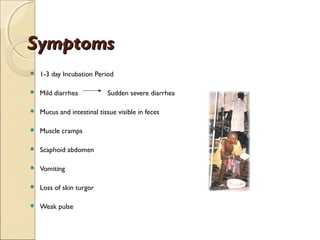
   1-3 day Incubation Period

   Mild diarrhea           Sudden severe diarrhea

   Mucus and intestinal tissue visible in feces

   Muscle cramps

   Scaphoid abdomen

   Vomiting

   Loss of skin turgor

   Weak pulse
Diagnosis
 Clinical   symptoms

 Isolation of V. cholerae from stool
  ◦ Live V. cholerae in stool (ca. 1.0 x 10⁸ cells per ml)
  ◦ Identification via dark-field microscopy

 Measurement   of serum antibodies using ELISA
  ◦ Antibacterial antibodies: vibriocidal assays
  ◦ Antitoxin antibodies
Methods of Cure
Chemotherapeutic

Antibiotics   (tetracycline)

Immunological

Local mucosal immune response       to V. cholerae
Serological antivibrio antibodies
Antitoxin antibodies


To Ease Symptoms

Oral Rehydration
Intraveneous Rehydration
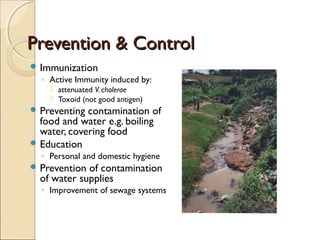
Prevention & Control
 Immunization
  ◦ Active Immunity induced by:
     attenuated V. cholerae
     Toxoid (not good antigen)
 Preventing contamination of
  food and water e.g. boiling
  water, covering food
 Education
  ◦ Personal and domestic hygiene
 Prevention of contamination
  of water supplies
  ◦ Improvement of sewage systems
Vibrio cholerae

Vibrio cholerae

  • 1.
  • 2.
    History First pandemic spreadsfrom India to South, Central Asia, Middle East and Russia Second pandemic reaches England Pandemics in 1800’s deadly All pandemics reach Africa First pandemic reaches Latin America in 1991
  • 3.
  • 4.
    Causative Agent Discovery JohnSnow (1813- 1858): Water borne transmission of Cholera (1855)
  • 5.
    Discovery  Filippo Pacini (1812-1883) ◦ 1854: Cholera reaches Florence, Italy. Pacini discovers causative agent ◦ Publishes “Microscopical Observations and Pathological Deductions on Cholera” ◦ 1965: Bacterium named Vibrio cholerae Pacini 1854
  • 6.
    Discovery Robert Koch (1843- 1910) 1884: Rediscovers Vibrio cholerae
  • 7.
    Vibrio cholerae Morphology  Gram negative  Comma shaped  Sheathed, polar flagellum  1.4-2.6µm x 0.5-3µm
  • 8.
    Physiology  Facultative anaerobic  Asporogenous  Growth stimulated by NaCl  pH 6 - 10, Acid labile  Temperature 18 - 37ºC
  • 9.
    Virulence & Pathogenicity Ingestion of V. cholerae Resistant to gastric acid Colonize small intestine Virulence of Non-toxigenic V. cholerae O1 strain not well understood
  • 10.
    ANTIGENIC STRUCTURE Heat-labile flagellarH antigen. O-lipopolysaccharides has 140 serogroups. Serogroup O1 and O139-classic cholera. Others cause cholera like diseases. Serotypes (inaba,ogawa,hikojima) and biotypes(classical,el tor) El tor- hemolysin. Serogroup O139- polysaccharide capsule.
  • 11.
    Toxigenic V. cholerae Pathogenicity  Colonization factors (the TcpA pilus)  Production of enterotoxin  Associated outer membrane proteins on enterocytes e.g. adenylate cyclase
  • 12.
    Secrete enterotoxin Enterotoxin binds to intestinal cells Chloride channels activated Release Large quantities of electrolytes & bicarbonates Fluid hypersecretion Diarrhea Dehydration
  • 13.
    Transmission Fecal-oral route Entry = oral Discharge = fecal
  • 14.
    Transmission  Humans only reservoirs  Bacterium transmitted via contaminated water, food  Carriers: houseflies and other insects  Person to person transmission?
  • 15.
    Symptoms  1-3 day Incubation Period  Mild diarrhea Sudden severe diarrhea  Mucus and intestinal tissue visible in feces  Muscle cramps  Scaphoid abdomen  Vomiting  Loss of skin turgor  Weak pulse
  • 16.
    Diagnosis  Clinical symptoms  Isolation of V. cholerae from stool ◦ Live V. cholerae in stool (ca. 1.0 x 10⁸ cells per ml) ◦ Identification via dark-field microscopy  Measurement of serum antibodies using ELISA ◦ Antibacterial antibodies: vibriocidal assays ◦ Antitoxin antibodies
  • 17.
    Methods of Cure Chemotherapeutic Antibiotics (tetracycline) Immunological Local mucosal immune response to V. cholerae Serological antivibrio antibodies Antitoxin antibodies To Ease Symptoms Oral Rehydration Intraveneous Rehydration
  • 18.
    Prevention & Control Immunization ◦ Active Immunity induced by:  attenuated V. cholerae  Toxoid (not good antigen)  Preventing contamination of food and water e.g. boiling water, covering food  Education ◦ Personal and domestic hygiene  Prevention of contamination of water supplies ◦ Improvement of sewage systems