CHOLERA
Fatima Al-Awadh
LEARNING OBJECTIVES


• Define cholera.
• State epidemiology of cholera.
• Describe the causative organism.
• Explain the pathophysiology of cholera.
• Mention the sign & symptom, complication, risk
  factors, causes, diagnosis, treatment, prevention,
  & prognosis of cholera.
• Describe the ways of controlling the spread of
  cholera.
CHOLERA

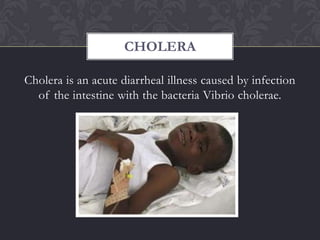
Cholera is an acute diarrheal illness caused by infection
  of the intestine with the bacteria Vibrio cholerae.
EPIDEMIOLOGY

• Cholera was prevalent in the 1800s, but due to
 proper treatment of sewage and drinking water,
    has become rare in developed countries.
  • Cholera is a fecal disease, meaning that it
  spreads when the feces of an infected person
      come into contact with food or water.
     • Incidence: 1 in 100,000 worldwide.
   • Over 1 million cases and nearly 10,000
                     fatalities.
VIBRIO CHOLERAE

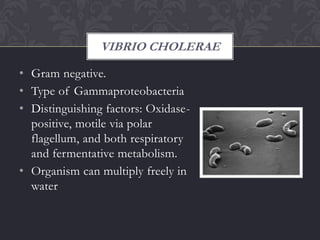
• Gram negative.
• Type of Gammaproteobacteria
• Distinguishing factors: Oxidase-
  positive, motile via polar
  flagellum, and both respiratory
  and fermentative metabolism.
• Organism can multiply freely in
  water
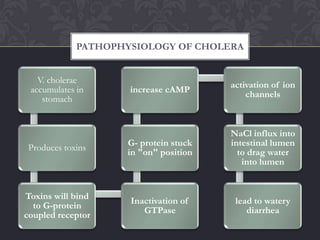
PATHOPHYSIOLOGY OF CHOLERA


   V. cholerae
                                       activation of ion
 accumulates in      increase cAMP
                                           channels
    stomach


                                       NaCl influx into
                    G- protein stuck   intestinal lumen
 Produces toxins
                    in "on" position     to drag water
                                          into lumen


Toxins will bind
                     Inactivation of    lead to watery
  to G-protein
                        GTPase             diarrhea
coupled receptor
SIGNS & SYMPTOMS

Most people remain asymptomatic. The symptoms of
                 cholera include :


   profuse, watery        stomach       leg cramps      Mild fever
      diarrhea              pains


   Vomiting          Sunken eyes    Dry mucous         Decreased
                      and cheeks    membranes        urinary output
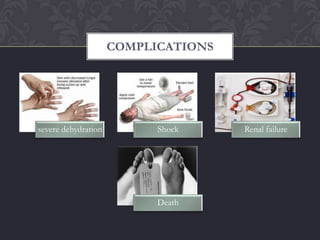
COMPLICATIONS


severe dehydration         Shock     Renal failure


                           Death
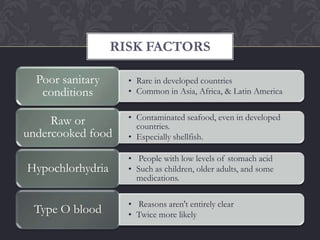
RISK FACTORS

  Poor sanitary     • Rare in developed countries
   conditions       • Common in Asia, Africa, & Latin America


     Raw or         • Contaminated seafood, even in developed
                      countries.
undercooked food    • Especially shellfish.

                    • People with low levels of stomach acid
Hypochlorhydria     • Such as children, older adults, and some
                      medications.

                    • Reasons aren't entirely clear
 Type O blood       • Twice more likely
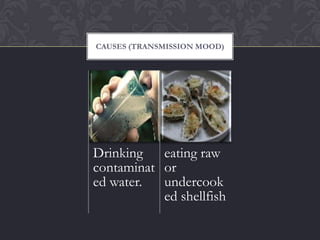
CAUSES (TRANSMISSION MOOD)


Drinking   eating raw
contaminat or
ed water.  undercook
           ed shellfish
DIAGNOSIS

Clinical diagnosis                  Differential diagnosis

  Cholera should be considered             Enterotoxigenic e. Coli
  in all cases with severe watery
      diarrhea and vomiting.

                                          Bacterial food poisoning
  Traveling to affected areas and
          eating shellfish
                                            Viral gastroenteritis


    No distinguishing clinical
    manifestations for cholera.
LABORATORY DIAGNOSIS


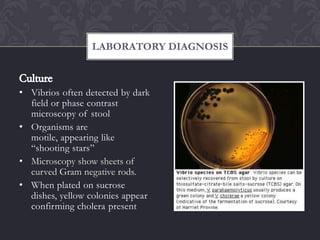
• Vibrios often detected by dark
  field or phase contrast
  microscopy of stool
• Organisms are motile,
  appearing like “shooting stars”
• Microscopy show sheets of
  curved Gram negative rods.
• When plated on sucrose
  dishes, yellow colonies appear
  confirming cholera present
LABORATORY DIAGNOSIS


Additional methods of detection include
PCR and monoclonal antibody-based
              stool tests.
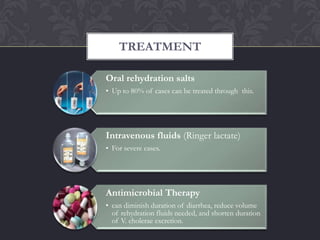
TREATMENT

Oral rehydration salts
• Up to 80% of cases can be treated through this.


Intravenous fluids (Ringer lactate)
• For severe cases.


Antimicrobial Therapy
• can diminish duration of diarrhea, reduce volume
  of rehydration fluids needed, and shorten duration
  of V. cholerae excretion.
PREVENTION

  • Basic health education and hygiene
       • Mass chemoprophylaxis
• Provision of safe water and sanitation
   • Comprehensive Multidisciplinary
  Approach: water, sanitation, education,
           and communication
VACCINES

Parenteral Vaccine :
 • 2 doses administered 2 weeks apart
 • Efficacy of approximately 50% and hardly exceeds 6 months
 • Not recommended
Killed WC/rBS Vaccine :
 •   Killed whole-cell V.cholerae in combination with a recombinant B-subunit of cholera toxin
 •   Safe in pregnancy and breastfeeding
 •   Efficacy of approximately 50% after 3 years
 •   Only mild side-effects
Live, attenuated CVD 103-HgR Vaccine :
 • Protection as early as 1 week after vaccination, with >90%
 • Unknown efficacy for children under 2
 • No adverse side-effects
PROGNOSIS

The prognosis of cholera can range depending
on the severity of the dehydration and how
 quickly the patient is given and responds to
                  treatments.
Death (mortality) rates in untreated cholera can
be as high as 50%-60% during large outbreaks
 but can be reduced to about 1% if treatment
     protocols are rapidly put into action.
CONTROLLING CHOLERA

Treatment
centers         Set up treatment centers for prompt
                treatment.
Sanitary
measures.       food safety and animal health measures


Comprehensive
surveillance    (adapt to each situation) for a
data            comprehensive multidisciplinary approach.
REFERENCES


• http://www.mayoclinic.com/health/cholera/DS00579/DSECTION=risk-
                                     factors
• http://www.safewater.org/PDFS/resourcesknowthefacts/Cholera.pdf ?nof
                                      rame
 • http://tropicaldisease.files.wordpress.com/2008/01/cholera-rose-ricardo-
                                 compatible-v.ppt
      • http://cti.itc.virginia.edu/~whg2n/biom204/ppt/cholera.ppt
• http://www.socgastro.org.pe/biblioteca/presentacion/archivos/diarrea/20
                                  07Cholera3.ppt
THANK YOU

Cholera

  • 1.
  • 2.
    LEARNING OBJECTIVES • Definecholera. • State epidemiology of cholera. • Describe the causative organism. • Explain the pathophysiology of cholera. • Mention the sign & symptom, complication, risk factors, causes, diagnosis, treatment, prevention, & prognosis of cholera. • Describe the ways of controlling the spread of cholera.
  • 3.
    CHOLERA Cholera is anacute diarrheal illness caused by infection of the intestine with the bacteria Vibrio cholerae.
  • 4.
    EPIDEMIOLOGY • Cholera wasprevalent in the 1800s, but due to proper treatment of sewage and drinking water, has become rare in developed countries. • Cholera is a fecal disease, meaning that it spreads when the feces of an infected person come into contact with food or water. • Incidence: 1 in 100,000 worldwide. • Over 1 million cases and nearly 10,000 fatalities.
  • 5.
    VIBRIO CHOLERAE • Gramnegative. • Type of Gammaproteobacteria • Distinguishing factors: Oxidase- positive, motile via polar flagellum, and both respiratory and fermentative metabolism. • Organism can multiply freely in water
  • 6.
    PATHOPHYSIOLOGY OF CHOLERA V. cholerae activation of ion accumulates in increase cAMP channels stomach NaCl influx into G- protein stuck intestinal lumen Produces toxins in "on" position to drag water into lumen Toxins will bind Inactivation of lead to watery to G-protein GTPase diarrhea coupled receptor
  • 7.
    SIGNS & SYMPTOMS Mostpeople remain asymptomatic. The symptoms of cholera include : profuse, watery stomach leg cramps Mild fever diarrhea pains Vomiting Sunken eyes Dry mucous Decreased and cheeks membranes urinary output
  • 8.
    COMPLICATIONS severe dehydration Shock Renal failure Death
  • 9.
    RISK FACTORS Poor sanitary • Rare in developed countries conditions • Common in Asia, Africa, & Latin America Raw or • Contaminated seafood, even in developed countries. undercooked food • Especially shellfish. • People with low levels of stomach acid Hypochlorhydria • Such as children, older adults, and some medications. • Reasons aren't entirely clear Type O blood • Twice more likely
  • 10.
    CAUSES (TRANSMISSION MOOD) Drinking eating raw contaminat or ed water. undercook ed shellfish
  • 11.
    DIAGNOSIS Clinical diagnosis Differential diagnosis Cholera should be considered Enterotoxigenic e. Coli in all cases with severe watery diarrhea and vomiting. Bacterial food poisoning Traveling to affected areas and eating shellfish Viral gastroenteritis No distinguishing clinical manifestations for cholera.
  • 12.
    LABORATORY DIAGNOSIS • Vibriosoften detected by dark field or phase contrast microscopy of stool • Organisms are motile, appearing like “shooting stars” • Microscopy show sheets of curved Gram negative rods. • When plated on sucrose dishes, yellow colonies appear confirming cholera present
  • 13.
    LABORATORY DIAGNOSIS Additional methodsof detection include PCR and monoclonal antibody-based stool tests.
  • 14.
    TREATMENT Oral rehydration salts •Up to 80% of cases can be treated through this. Intravenous fluids (Ringer lactate) • For severe cases. Antimicrobial Therapy • can diminish duration of diarrhea, reduce volume of rehydration fluids needed, and shorten duration of V. cholerae excretion.
  • 15.
    PREVENTION •Basic health education and hygiene • Mass chemoprophylaxis • Provision of safe water and sanitation • Comprehensive Multidisciplinary Approach: water, sanitation, education, and communication
  • 16.
    VACCINES Parenteral Vaccine : • 2 doses administered 2 weeks apart • Efficacy of approximately 50% and hardly exceeds 6 months • Not recommended Killed WC/rBS Vaccine : • Killed whole-cell V.cholerae in combination with a recombinant B-subunit of cholera toxin • Safe in pregnancy and breastfeeding • Efficacy of approximately 50% after 3 years • Only mild side-effects Live, attenuated CVD 103-HgR Vaccine : • Protection as early as 1 week after vaccination, with >90% • Unknown efficacy for children under 2 • No adverse side-effects
  • 17.
    PROGNOSIS The prognosis ofcholera can range depending on the severity of the dehydration and how quickly the patient is given and responds to treatments. Death (mortality) rates in untreated cholera can be as high as 50%-60% during large outbreaks but can be reduced to about 1% if treatment protocols are rapidly put into action.
  • 18.
    CONTROLLING CHOLERA Treatment centers Set up treatment centers for prompt treatment. Sanitary measures. food safety and animal health measures Comprehensive surveillance (adapt to each situation) for a data comprehensive multidisciplinary approach.
  • 19.
    REFERENCES • http://www.mayoclinic.com/health/cholera/DS00579/DSECTION=risk- factors • http://www.safewater.org/PDFS/resourcesknowthefacts/Cholera.pdf ?nof rame • http://tropicaldisease.files.wordpress.com/2008/01/cholera-rose-ricardo- compatible-v.ppt • http://cti.itc.virginia.edu/~whg2n/biom204/ppt/cholera.ppt • http://www.socgastro.org.pe/biblioteca/presentacion/archivos/diarrea/20 07Cholera3.ppt
  • 20.