Organic photovoltaics
thin-flm processing considerations
Dr Max Reinhardt
Ossila Ltd.
11/03/2015 1
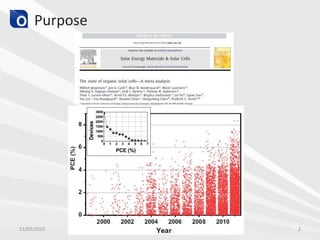
Purpose
11/03/2015 2
Content
• General OPV considerations and requirements
• Practical fabrication issues
– Cleaning and processing conditions
• Spin coating considerations
11/03/2015 3
General OPV considerations
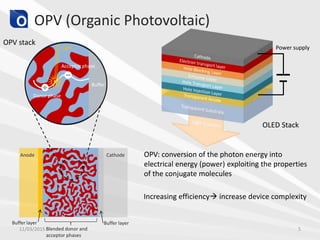
OPV (Organic Photovoltaic)
Buffer
Acceptor phase
Donor phase
Light
Buffer layer
Anode Cathode
Buffer layer
Blended donor and
acceptor phases
Power supply
OLED Stack
OPV stack
OPV: conversion of the photon energy into
electrical energy (power) exploiting the properties
of the conjugate molecules
Increasing efficiency increase device complexity
11/03/2015 5
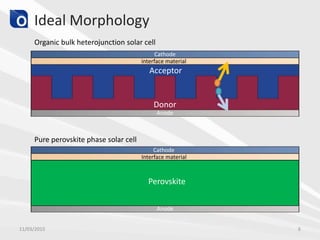
Ideal Morphology
Donor
Acceptor
Anode
Cathode
interface material
Perovskite
Cathode
Interface material
Anode
11/03/2015 6
Organic bulk heterojunction solar cell
Pure perovskite phase solar cell
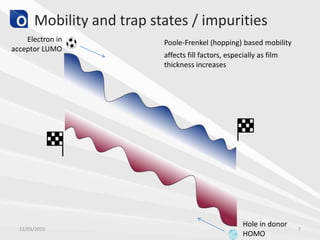
Mobility and trap states / impurities
Electron in
acceptor LUMO
Hole in donor
HOMO
affects fill factors, especially as film
thickness increases
Poole-Frenkel (hopping) based mobility
11/03/2015 7
Morphology
E
v
Ev  
v: velocity of the carrier,
E=VDS/L: electrical field across the OSC
μ: Carrier mobility; [μ] =cm2/(V·s)
11/03/2015 8
- Long-Chain Polymeric OSC
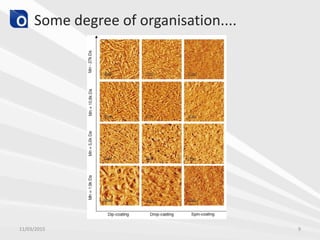
Some degree of organisation....
11/03/2015 9
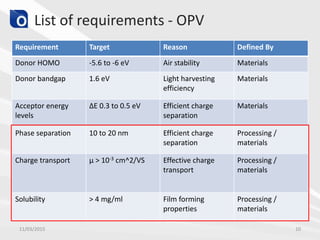
List of requirements - OPV
Requirement Target Reason Defined By
Donor HOMO -5.6 to -6 eV Air stability Materials
Donor bandgap 1.6 eV Light harvesting
efficiency
Materials
Acceptor energy
levels
∆E 0.3 to 0.5 eV Efficient charge
separation
Materials
Phase separation 10 to 20 nm Efficient charge
separation
Processing /
materials
Charge transport µ > 10-3 cm^2/VS Effective charge
transport
Processing /
materials
Solubility > 4 mg/ml Film forming
properties
Processing /
materials
11/03/2015 10
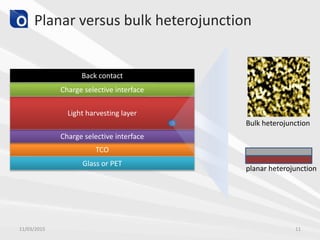
Planar versus bulk heterojunction
TCO
Glass or PET
Charge selective interface
Light harvesting layer
Charge selective interface
Back contact
Bulk heterojunction
planar heterojunction
11/03/2015 11
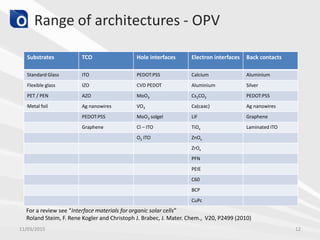
Range of architectures - OPV
Substrates TCO Hole interfaces Electron interfaces Back contacts
Standard Glass ITO PEDOT:PSS Calcium Aluminium
Flexible glass IZO CVD PEDOT Aluminium Silver
PET / PEN AZO MoO3 Cs2CO3 PEDOT:PSS
Metal foil Ag nanowires VO3 Ca(caac) Ag nanowires
PEDOT:PSS MoO3 solgel LiF Graphene
Graphene Cl – ITO TiOx Laminated ITO
O2 ITO ZnOx
ZrOx
PFN
PEIE
C60
BCP
CuPc
For a review see “Interface materials for organic solar cells”
Roland Steim, F. Rene Kogler and Christoph J. Brabec, J. Mater. Chem., V20, P2499 (2010)
11/03/2015 12
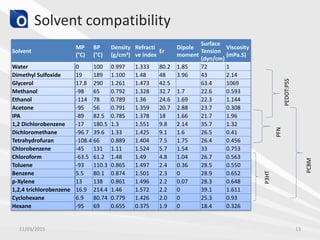
Solvent compatibility
Solvent
MP
(°C)
BP
(°C)
Density
(g/cm3)
Refracti
ve index
Er
Dipole
moment
Surface
Tension
(dyn/cm)
Viscosity
(mPa.S)
Water 0 100 0.997 1.333 80.2 1.85 72 1
Dimethyl Sulfoxide 19 189 1.100 1.48 48 3.96 43 2.14
Glycerol 17.8 290 1.261 1.473 42.5 63.4 1069
Methanol -98 65 0.792 1.328 32.7 1.7 22.6 0.593
Ethanol -114 78 0.789 1.36 24.6 1.69 22.3 1.144
Acetone -95 56 0.791 1.359 20.7 2.88 23.7 0.308
IPA -89 82.5 0.785 1.378 18 1.66 21.7 1.96
1,2 Dichlorobenzene -17 180.5 1.3 1.551 9.8 2.14 35.7 1.32
Dichloromethane -96.7 39.6 1.33 1.425 9.1 1.6 26.5 0.41
Tetrahydrofuran -108.4 66 0.889 1.404 7.5 1.75 26.4 0.456
Chlorobenzene -45 131 1.11 1.524 5.7 1.54 33 0.753
Chloroform -63.5 61.2 1.48 1.49 4.8 1.04 26.7 0.563
Toluene -93 110.3 0.865 1.497 2.4 0.36 28.5 0.550
Benzene 5.5 80.1 0.874 1.501 2.3 0 28.9 0.652
p-Xylene 13 138 0.861 1.496 2.2 0.07 28.3 0.648
1,2,4 trichlorobenzene 16.9 214.4 1.46 1.572 2.2 0 39.1 1.611
Cyclohexane 6.9 80.74 0.779 1.426 2.0 0 25.3 0.93
Hexane -95 69 0.655 0.375 1.9 0 18.4 0.326
P3HT
PEDOT:PSS
PFN
PCBM
11/03/2015 13
Perovskite
ETL
TCO
HTL
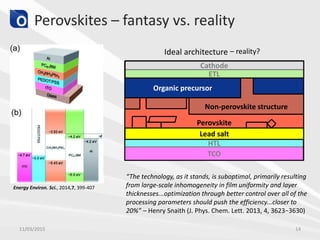
Perovskites – fantasy vs. reality
Cathode
11/03/2015 14
Ideal architecture
Energy Environ. Sci., 2014,7, 399-407
– reality?
Non-perovskite structure
Organic precursor
Lead salt
“The technology, as it stands, is suboptimal, primarily resulting
from large-scale inhomogeneity in film uniformity and layer
thicknesses...optimization through better control over all of the
processing parameters should push the efficiency...closer to
20%” – Henry Snaith (J. Phys. Chem. Lett. 2013, 4, 3623−3630)
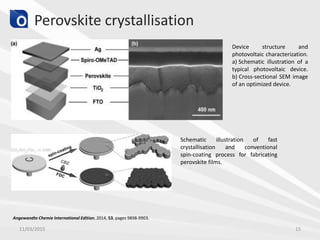
Perovskite crystallisation
11/03/2015 15
Angewandte Chemie International Edition, 2014, 53, pages 9898-9903.
Device structure and
photovoltaic characterization.
a) Schematic illustration of a
typical photovoltaic device.
b) Cross‐sectional SEM image
of an optimized device.
Schematic illustration of fast
crystallisation and conventional
spin‐coating process for fabricating
perovskite films.
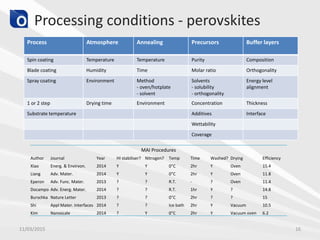
Processing conditions - perovskites
11/03/2015 16
Process Atmosphere Annealing Precursors Buffer layers
Spin coating Temperature Temperature Purity Composition
Blade coating Humidity Time Molar ratio Orthogonality
Spray coating Environment Method
- oven/hotplate
- solvent
Solvents
- solubility
- orthogonality
Energy level
alignment
1 or 2 step Drying time Environment Concentration Thickness
Substrate temperature Additives Interface
Wettability
Coverage
MAI Procedures
Author Journal Year HI stabiliser? Nitrogen? Temp Time Washed? Drying Efficiency
Xiao Energ. & Envirvon. 2014 Y Y 0°C 2hr Y Oven 15.4
Liang Adv. Mater. 2014 Y Y 0°C 2hr Y Oven 11.8
Eperon Adv. Func. Mater. 2013 ? ? R.T. - ? Oven 11.4
Docampo Adv. Energ. Mater. 2014 ? ? R.T. 1hr Y ? 14.8
Burschka Nature Letter 2013 ? ? 0°C 2hr ? ? 15
Shi Appl Mater. Interfaces 2014 ? ? Ice bath 2hr Y Vacuum 10.5
Kim Nanoscale 2014 ? Y 0°C 2hr Y Vacuum oven 6.2
Practical fabrication issues
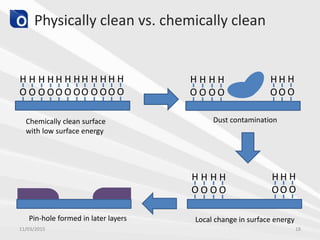
Physically clean vs. chemically clean
H
O
H
O
H
O
H
O
H
O
H
O
H
O
H
O
H
O
H
O
H
O
H
O
H
O
H
O
H
O
H
O
H
O
H
O
H
O
H
O
H
O
H
O
H
O
H
O
H
O
H
O
Chemically clean surface
with low surface energy
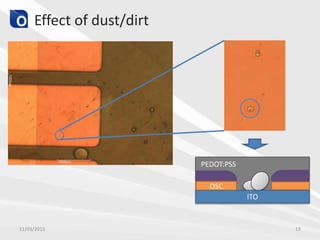
Dust contamination
Local change in surface energyPin-hole formed in later layers
11/03/2015 18
Effect of dust/dirt
PEDOT:PSS
OSC
ITO
11/03/2015 19
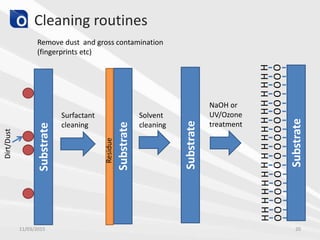
Cleaning routines
Remove dust and gross contamination
(fingerprints etc)
Substrate
Dirt/Dust
Surfactant
cleaning Substrate
Residue
Solvent
cleaning
Substrate
Substrate
H
O
H
O
H
O
H
O
H
O
H
O
H
O
H
O
H
O
H
O
H
O
H
O
H
O
H
O
H
O
H
O
H
O
H
O
NaOH or
UV/Ozone
treatment
11/03/2015 20
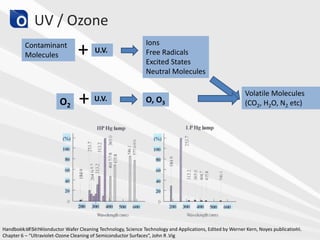
UV / Ozone
Handbook of Semiconductor Wafer Cleaning Technology, Science Technology and Applications, Edited by Werner Kern, Noyes publications.
Chapter 6 – “Ultraviolet-Ozone Cleaning of Semiconductor Surfaces”, John R .Vig
Contaminant
Molecules
U.V.
Ions
Free Radicals
Excited States
Neutral Molecules
Volatile Molecules
(CO2, H2O, N2 etc)
U.V.O2
O, O3
+
+
11/03/2015 21
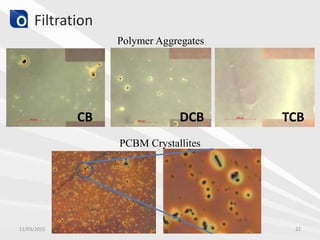
Filtration
Polymer Aggregates
CB DCB TCB
PCBM Crystallites
11/03/2015 22
Syringe filters
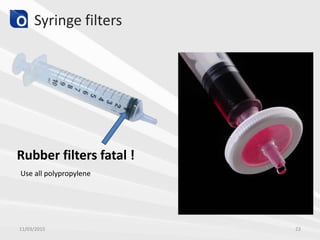
Rubber filters fatal !
Use all polypropylene
11/03/2015 23
Vials / Septa’s
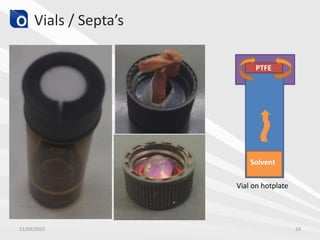
PTFE
Solvent
Vial on hotplate
11/03/2015 24
Effect of residues / impurities
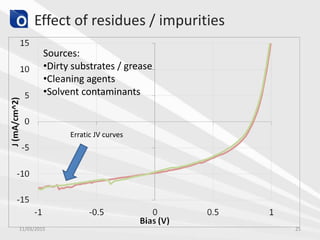
Erratic JV curves
Sources:
•Dirty substrates / grease
•Cleaning agents
•Solvent contaminants
11/03/2015 25
Statistics - practise factor
Substrate #
Efficiency
1 2 3 4 5
Substrate #
Efficiency
1 2 3 4 5
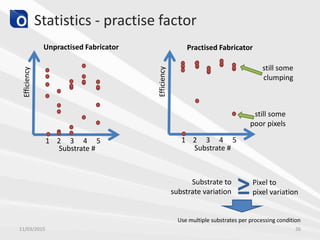
Unpractised Fabricator Practised Fabricator
still some
clumping
still some
poor pixels
≥
Use multiple substrates per processing condition
Substrate to
substrate variation
Pixel to
pixel variation
11/03/2015 26
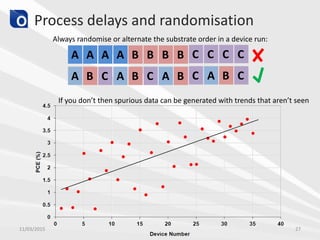
Process delays and randomisation
A A A A B B B B C C C C
A B C A B C A B C A B C
Always randomise or alternate the substrate order in a device run:
If you don’t then spurious data can be generated with trends that aren’t seen
11/03/2015 27
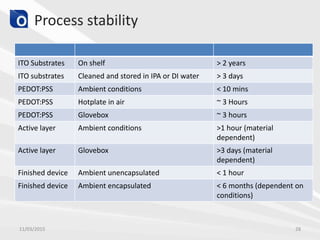
Process stability
ITO Substrates On shelf > 2 years
ITO substrates Cleaned and stored in IPA or DI water > 3 days
PEDOT:PSS Ambient conditions < 10 mins
PEDOT:PSS Hotplate in air ~ 3 Hours
PEDOT:PSS Glovebox ~ 3 hours
Active layer Ambient conditions >1 hour (material
dependent)
Active layer Glovebox >3 days (material
dependent)
Finished device Ambient unencapsulated < 1 hour
Finished device Ambient encapsulated < 6 months (dependent on
conditions)
11/03/2015 28
Spin coating considerations
Digital Signal
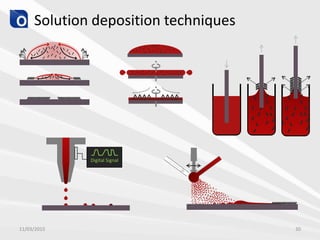
Solution deposition techniques
11/03/2015 30
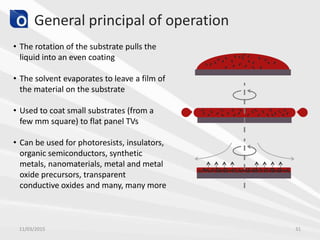
General principal of operation
11/03/2015 31
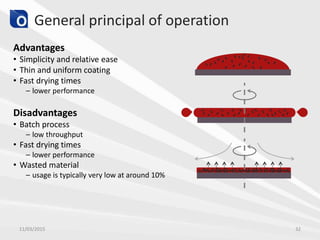
• The rotation of the substrate pulls the
liquid into an even coating
• The solvent evaporates to leave a film of
the material on the substrate
• Used to coat small substrates (from a
few mm square) to flat panel TVs
• Can be used for photoresists, insulators,
organic semiconductors, synthetic
metals, nanomaterials, metal and metal
oxide precursors, transparent
conductive oxides and many, many more
General principal of operation
11/03/2015 32
Advantages
• Simplicity and relative ease
• Thin and uniform coating
• Fast drying times
– lower performance
Disadvantages
• Batch process
– low throughput
• Fast drying times
– lower performance
• Wasted material
– usage is typically very low at around 10%
Drying time
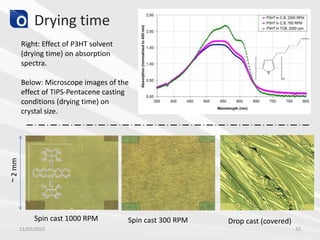
Spin cast 1000 RPM Spin cast 300 RPM Drop cast (covered)
~2mm
Right: Effect of P3HT solvent
(drying time) on absorption
spectra.
Below: Microscope images of the
effect of TIPS-Pentacene casting
conditions (drying time) on
crystal size.
11/03/2015 33
Film thickness
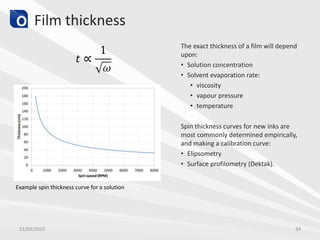
The exact thickness of a film will depend
upon:
• Solution concentration
• Solvent evaporation rate:
• viscosity
• vapour pressure
• temperature
Spin thickness curves for new inks are
most commonly determined empirically,
and making a calibration curve:
• Elipsometry
• Surface profilometry (Dektak).
11/03/2015 34
Example spin thickness curve for a solution
Wetting
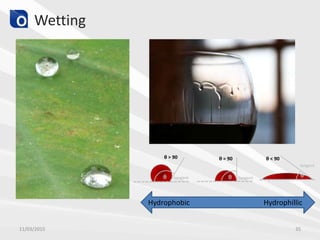
θ > 90
θ tangent θ tangent
θ = 90 θ < 90
θ
tangent
Hydrophobic Hydrophillic
11/03/2015 35
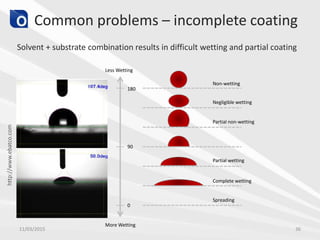
Common problems – incomplete coating
Solvent + substrate combination results in difficult wetting and partial coating
11/03/2015 36
Non-wetting
Negligible wetting
Partial non-wetting
Partial wetting
Complete wetting
Spreading
0
90
180
More Wetting
Less Wetting
http://www.ebatco.com
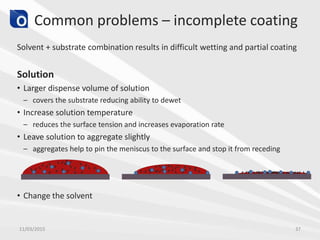
Common problems – incomplete coating
Solvent + substrate combination results in difficult wetting and partial coating
Solution
• Larger dispense volume of solution
– covers the substrate reducing ability to dewet
• Increase solution temperature
– reduces the surface tension and increases evaporation rate
• Leave solution to aggregate slightly
– aggregates help to pin the meniscus to the surface and stop it from receding
• Change the solvent
11/03/2015 37
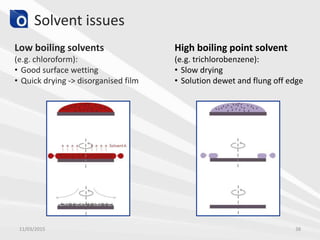
Solvent issues
11/03/2015 38
Low boiling solvents
(e.g. chloroform):
• Good surface wetting
• Quick drying -> disorganised film
High boiling point solvent
(e.g. trichlorobenzene):
• Slow drying
• Solution dewet and flung off edge
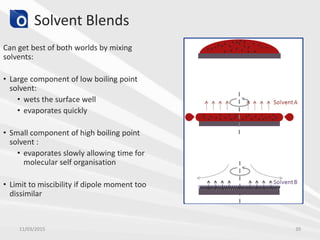
Solvent Blends
Can get best of both worlds by mixing
solvents:
• Large component of low boiling point
solvent:
• wets the surface well
• evaporates quickly
• Small component of high boiling point
solvent :
• evaporates slowly allowing time for
molecular self organisation
• Limit to miscibility if dipole moment too
dissimilar
11/03/2015 39
www.Ossila.com
11/03/2015 40
Spin coating guide Perovskite materials
Fabrication routines Videos
Support

Organic Photovoltaics Thin-Film Processing Considerations

  • 1.
    Organic photovoltaics thin-flm processingconsiderations Dr Max Reinhardt Ossila Ltd. 11/03/2015 1
  • 2.
  • 3.
    Content • General OPVconsiderations and requirements • Practical fabrication issues – Cleaning and processing conditions • Spin coating considerations 11/03/2015 3
  • 4.
  • 5.
    OPV (Organic Photovoltaic) Buffer Acceptorphase Donor phase Light Buffer layer Anode Cathode Buffer layer Blended donor and acceptor phases Power supply OLED Stack OPV stack OPV: conversion of the photon energy into electrical energy (power) exploiting the properties of the conjugate molecules Increasing efficiency increase device complexity 11/03/2015 5
  • 6.
    Ideal Morphology Donor Acceptor Anode Cathode interface material Perovskite Cathode Interfacematerial Anode 11/03/2015 6 Organic bulk heterojunction solar cell Pure perovskite phase solar cell
  • 7.
    Mobility and trapstates / impurities Electron in acceptor LUMO Hole in donor HOMO affects fill factors, especially as film thickness increases Poole-Frenkel (hopping) based mobility 11/03/2015 7
  • 8.
    Morphology E v Ev   v:velocity of the carrier, E=VDS/L: electrical field across the OSC μ: Carrier mobility; [μ] =cm2/(V·s) 11/03/2015 8 - Long-Chain Polymeric OSC
  • 9.
    Some degree oforganisation.... 11/03/2015 9
  • 10.
    List of requirements- OPV Requirement Target Reason Defined By Donor HOMO -5.6 to -6 eV Air stability Materials Donor bandgap 1.6 eV Light harvesting efficiency Materials Acceptor energy levels ∆E 0.3 to 0.5 eV Efficient charge separation Materials Phase separation 10 to 20 nm Efficient charge separation Processing / materials Charge transport µ > 10-3 cm^2/VS Effective charge transport Processing / materials Solubility > 4 mg/ml Film forming properties Processing / materials 11/03/2015 10
  • 11.
    Planar versus bulkheterojunction TCO Glass or PET Charge selective interface Light harvesting layer Charge selective interface Back contact Bulk heterojunction planar heterojunction 11/03/2015 11
  • 12.
    Range of architectures- OPV Substrates TCO Hole interfaces Electron interfaces Back contacts Standard Glass ITO PEDOT:PSS Calcium Aluminium Flexible glass IZO CVD PEDOT Aluminium Silver PET / PEN AZO MoO3 Cs2CO3 PEDOT:PSS Metal foil Ag nanowires VO3 Ca(caac) Ag nanowires PEDOT:PSS MoO3 solgel LiF Graphene Graphene Cl – ITO TiOx Laminated ITO O2 ITO ZnOx ZrOx PFN PEIE C60 BCP CuPc For a review see “Interface materials for organic solar cells” Roland Steim, F. Rene Kogler and Christoph J. Brabec, J. Mater. Chem., V20, P2499 (2010) 11/03/2015 12
  • 13.
    Solvent compatibility Solvent MP (°C) BP (°C) Density (g/cm3) Refracti ve index Er Dipole moment Surface Tension (dyn/cm) Viscosity (mPa.S) Water0 100 0.997 1.333 80.2 1.85 72 1 Dimethyl Sulfoxide 19 189 1.100 1.48 48 3.96 43 2.14 Glycerol 17.8 290 1.261 1.473 42.5 63.4 1069 Methanol -98 65 0.792 1.328 32.7 1.7 22.6 0.593 Ethanol -114 78 0.789 1.36 24.6 1.69 22.3 1.144 Acetone -95 56 0.791 1.359 20.7 2.88 23.7 0.308 IPA -89 82.5 0.785 1.378 18 1.66 21.7 1.96 1,2 Dichlorobenzene -17 180.5 1.3 1.551 9.8 2.14 35.7 1.32 Dichloromethane -96.7 39.6 1.33 1.425 9.1 1.6 26.5 0.41 Tetrahydrofuran -108.4 66 0.889 1.404 7.5 1.75 26.4 0.456 Chlorobenzene -45 131 1.11 1.524 5.7 1.54 33 0.753 Chloroform -63.5 61.2 1.48 1.49 4.8 1.04 26.7 0.563 Toluene -93 110.3 0.865 1.497 2.4 0.36 28.5 0.550 Benzene 5.5 80.1 0.874 1.501 2.3 0 28.9 0.652 p-Xylene 13 138 0.861 1.496 2.2 0.07 28.3 0.648 1,2,4 trichlorobenzene 16.9 214.4 1.46 1.572 2.2 0 39.1 1.611 Cyclohexane 6.9 80.74 0.779 1.426 2.0 0 25.3 0.93 Hexane -95 69 0.655 0.375 1.9 0 18.4 0.326 P3HT PEDOT:PSS PFN PCBM 11/03/2015 13
  • 14.
    Perovskite ETL TCO HTL Perovskites – fantasyvs. reality Cathode 11/03/2015 14 Ideal architecture Energy Environ. Sci., 2014,7, 399-407 – reality? Non-perovskite structure Organic precursor Lead salt “The technology, as it stands, is suboptimal, primarily resulting from large-scale inhomogeneity in film uniformity and layer thicknesses...optimization through better control over all of the processing parameters should push the efficiency...closer to 20%” – Henry Snaith (J. Phys. Chem. Lett. 2013, 4, 3623−3630)
  • 15.
    Perovskite crystallisation 11/03/2015 15 AngewandteChemie International Edition, 2014, 53, pages 9898-9903. Device structure and photovoltaic characterization. a) Schematic illustration of a typical photovoltaic device. b) Cross‐sectional SEM image of an optimized device. Schematic illustration of fast crystallisation and conventional spin‐coating process for fabricating perovskite films.
  • 16.
    Processing conditions -perovskites 11/03/2015 16 Process Atmosphere Annealing Precursors Buffer layers Spin coating Temperature Temperature Purity Composition Blade coating Humidity Time Molar ratio Orthogonality Spray coating Environment Method - oven/hotplate - solvent Solvents - solubility - orthogonality Energy level alignment 1 or 2 step Drying time Environment Concentration Thickness Substrate temperature Additives Interface Wettability Coverage MAI Procedures Author Journal Year HI stabiliser? Nitrogen? Temp Time Washed? Drying Efficiency Xiao Energ. & Envirvon. 2014 Y Y 0°C 2hr Y Oven 15.4 Liang Adv. Mater. 2014 Y Y 0°C 2hr Y Oven 11.8 Eperon Adv. Func. Mater. 2013 ? ? R.T. - ? Oven 11.4 Docampo Adv. Energ. Mater. 2014 ? ? R.T. 1hr Y ? 14.8 Burschka Nature Letter 2013 ? ? 0°C 2hr ? ? 15 Shi Appl Mater. Interfaces 2014 ? ? Ice bath 2hr Y Vacuum 10.5 Kim Nanoscale 2014 ? Y 0°C 2hr Y Vacuum oven 6.2
  • 17.
  • 18.
    Physically clean vs.chemically clean H O H O H O H O H O H O H O H O H O H O H O H O H O H O H O H O H O H O H O H O H O H O H O H O H O H O Chemically clean surface with low surface energy Dust contamination Local change in surface energyPin-hole formed in later layers 11/03/2015 18
  • 19.
  • 20.
    Cleaning routines Remove dustand gross contamination (fingerprints etc) Substrate Dirt/Dust Surfactant cleaning Substrate Residue Solvent cleaning Substrate Substrate H O H O H O H O H O H O H O H O H O H O H O H O H O H O H O H O H O H O NaOH or UV/Ozone treatment 11/03/2015 20
  • 21.
    UV / Ozone Handbookof Semiconductor Wafer Cleaning Technology, Science Technology and Applications, Edited by Werner Kern, Noyes publications. Chapter 6 – “Ultraviolet-Ozone Cleaning of Semiconductor Surfaces”, John R .Vig Contaminant Molecules U.V. Ions Free Radicals Excited States Neutral Molecules Volatile Molecules (CO2, H2O, N2 etc) U.V.O2 O, O3 + + 11/03/2015 21
  • 22.
    Filtration Polymer Aggregates CB DCBTCB PCBM Crystallites 11/03/2015 22
  • 23.
    Syringe filters Rubber filtersfatal ! Use all polypropylene 11/03/2015 23
  • 24.
    Vials / Septa’s PTFE Solvent Vialon hotplate 11/03/2015 24
  • 25.
    Effect of residues/ impurities Erratic JV curves Sources: •Dirty substrates / grease •Cleaning agents •Solvent contaminants 11/03/2015 25
  • 26.
    Statistics - practisefactor Substrate # Efficiency 1 2 3 4 5 Substrate # Efficiency 1 2 3 4 5 Unpractised Fabricator Practised Fabricator still some clumping still some poor pixels ≥ Use multiple substrates per processing condition Substrate to substrate variation Pixel to pixel variation 11/03/2015 26
  • 27.
    Process delays andrandomisation A A A A B B B B C C C C A B C A B C A B C A B C Always randomise or alternate the substrate order in a device run: If you don’t then spurious data can be generated with trends that aren’t seen 11/03/2015 27
  • 28.
    Process stability ITO SubstratesOn shelf > 2 years ITO substrates Cleaned and stored in IPA or DI water > 3 days PEDOT:PSS Ambient conditions < 10 mins PEDOT:PSS Hotplate in air ~ 3 Hours PEDOT:PSS Glovebox ~ 3 hours Active layer Ambient conditions >1 hour (material dependent) Active layer Glovebox >3 days (material dependent) Finished device Ambient unencapsulated < 1 hour Finished device Ambient encapsulated < 6 months (dependent on conditions) 11/03/2015 28
  • 29.
  • 30.
    Digital Signal Solution depositiontechniques 11/03/2015 30
  • 31.
    General principal ofoperation 11/03/2015 31 • The rotation of the substrate pulls the liquid into an even coating • The solvent evaporates to leave a film of the material on the substrate • Used to coat small substrates (from a few mm square) to flat panel TVs • Can be used for photoresists, insulators, organic semiconductors, synthetic metals, nanomaterials, metal and metal oxide precursors, transparent conductive oxides and many, many more
  • 32.
    General principal ofoperation 11/03/2015 32 Advantages • Simplicity and relative ease • Thin and uniform coating • Fast drying times – lower performance Disadvantages • Batch process – low throughput • Fast drying times – lower performance • Wasted material – usage is typically very low at around 10%
  • 33.
    Drying time Spin cast1000 RPM Spin cast 300 RPM Drop cast (covered) ~2mm Right: Effect of P3HT solvent (drying time) on absorption spectra. Below: Microscope images of the effect of TIPS-Pentacene casting conditions (drying time) on crystal size. 11/03/2015 33
  • 34.
    Film thickness The exactthickness of a film will depend upon: • Solution concentration • Solvent evaporation rate: • viscosity • vapour pressure • temperature Spin thickness curves for new inks are most commonly determined empirically, and making a calibration curve: • Elipsometry • Surface profilometry (Dektak). 11/03/2015 34 Example spin thickness curve for a solution
  • 35.
    Wetting θ > 90 θtangent θ tangent θ = 90 θ < 90 θ tangent Hydrophobic Hydrophillic 11/03/2015 35
  • 36.
    Common problems –incomplete coating Solvent + substrate combination results in difficult wetting and partial coating 11/03/2015 36 Non-wetting Negligible wetting Partial non-wetting Partial wetting Complete wetting Spreading 0 90 180 More Wetting Less Wetting http://www.ebatco.com
  • 37.
    Common problems –incomplete coating Solvent + substrate combination results in difficult wetting and partial coating Solution • Larger dispense volume of solution – covers the substrate reducing ability to dewet • Increase solution temperature – reduces the surface tension and increases evaporation rate • Leave solution to aggregate slightly – aggregates help to pin the meniscus to the surface and stop it from receding • Change the solvent 11/03/2015 37
  • 38.
    Solvent issues 11/03/2015 38 Lowboiling solvents (e.g. chloroform): • Good surface wetting • Quick drying -> disorganised film High boiling point solvent (e.g. trichlorobenzene): • Slow drying • Solution dewet and flung off edge
  • 39.
    Solvent Blends Can getbest of both worlds by mixing solvents: • Large component of low boiling point solvent: • wets the surface well • evaporates quickly • Small component of high boiling point solvent : • evaporates slowly allowing time for molecular self organisation • Limit to miscibility if dipole moment too dissimilar 11/03/2015 39
  • 40.
    www.Ossila.com 11/03/2015 40 Spin coatingguide Perovskite materials Fabrication routines Videos Support

Editor's Notes

  • #3 A recent meta analysis of the state of organic photovoltaics in the literature showed that the modal efficiency of devices tended towards zero! There are relatively few high efficiency devices but a lot of low efficiency devices. We all know that headline metrics and quality of science shouldn’t be linked but we all know that in practise they are. Science is competitive and the aim of this course is to raise efficiencies and give people scientific competitive advantage.
  • #4 The purpose of this training course is to transfer practical know-how in OPV fabrication and testing so that people can re-produce the results in their own labs. We intend to cover a range of the “standard” architectures such that delegates will be familiar and comfortable with their fabrication routines. In general all of the devices that we work on will be R&D focussed where the emphasis is on overall functionality and versatility rather than scale-up or flexibility. We also aim to cover a number of the common mistakes and problems to help people avoid them. The course is not intended as a general introduction to organic electronics and/or OPVs and so although we will be reviewing the general concepts to ensure we have a consistent language, we will be covering this at relative speed and refer people to review papers and text-books for a more in-depth study.
  • #9 Long polymer may look like a spaghetti bowl: messy, with entangled polymer chain. Alkyl side chains are very effective in preventing spaghetti-like OSC. In general the degree of self organisation may change over the same sample: region of highly (or semi!)-organised polymers are surrounded by amorphous material: this make any theoretical study (or even simple comparison of transistor performance fabricated with the same OSC) quite complicated. In other words: are we studying/measuring the intrinsic OSC performance or the effect of the growth and self-organisation of the OSC layer?
  • #11 A look at the key requirements for efficient solar cells shows that many of the properties are defined by the materials being used and it is these that will limit the possible performance. For this reason it is materials development that has the largest effect on the progress of the field. However, by fully optimising the processing conditions the maximum performance can be gained from any individual materials set.
  • #19 Dust is insulating and won’t kill a OE device in itself as it will just produce a small dead spot which will only reduce the overall performance very slightly as this is an average over the whole area. However, dust can usually be blown off and the surface properties where dust has been changes. This can lead to pin-holes in later layers and cause device failure even after removal. However, this effect depends upon which layers are being put down next – i.e if pin-holes will cause critical failure (such as for top-gate dielectrics).
  • #24 Rubber filters fatal as dissolved by acids (PEDOT:PSS) or chlorinated solvents
  • #34 In this presentation we’ll be referring regularly to two proto-typical materials – P3HT as an example of a polymeric semiconductor and TIPS-Pentacene as an example small molecule. In the case of P3HT the crystallinity of a film can be seen by eye as a colour change due to a vibronic absorption shoulder appearing at around 620 nm in the absorption spectra. In the case of TIPS-pentacene we can see the crystals easily under a microscope. In both cases higher crystallinity means higher performance but requires longer drying time. Unfortunately, the longer the drying time the larger the opportunity for dewetting.
  • #36 We’re relatively familiar with contact angles and wetting from everyday life... Beads of water on a “furry” leaf such as a lotus leaf lead to droplets forming that simply roll off. Meanwhile the “legs” (sometimes also called “tears”) on a glass of wine are a sign of a high alcohol increasing the wettability of the wine on the glass. Good wetting is essential for device fabrication and becomes even more critical for high throughput fabrication techniques. In general if a contact angle is less than 90 degrees we would consider the surface to be “wettable.”
  • #40 Solvent blends can also help significantly for solutions that are close to the wetting envelope. Using a low boiling point solvent at high spin speed will enable wetting as the solvent will evaporate quickly leaving insufficient time to dewet. However, on it’s own this would give poor performance as there is not time for the molecules to organise themselves. However, by adding a small amount of a high-boiling point solvent the film remains slightly wet but in a gelatinous state that is less likely to dewet but still gives the molecules time to organise themselves.