INFRARED SPECTROSCOPY
Ravish Yadav
VIBRATIONAL ROTATIONAL SPECTROSCOPY
• MOLECULAR ABSORPTION SPECTROSCOPY
• MATTER : MOLECULE
• EMR: INFRA RED RADIATION
• TYPE OF INTERACTION: ABSORPTION OF RADIATION
• EFFECT ON THE MOLECULE: AS A RESULT OF ABSORPTION OF
INFRARED RADIA TION THE VIBRATIONAL AND ROTATIONAL ENERGY
OF THE MOLECULE INCREASES. MOLECULE BECOMES VIBRATIONALLY
EXCITED.
MH + IR ʎ MH* (VIBRATIONALLY EXCITED MOLECULE)
•HENCE IR SPECTROSCOPY IS ALSO KNOWN AS VIBRATIONAL –
ROTATIONAL SPECTROSCOPY
FEATURES
FEATURES
• APPLICATION: QUALITATIVE.
• HEPLS IN DETERMINATION OF STRUCTURE OF A MOLECULE.
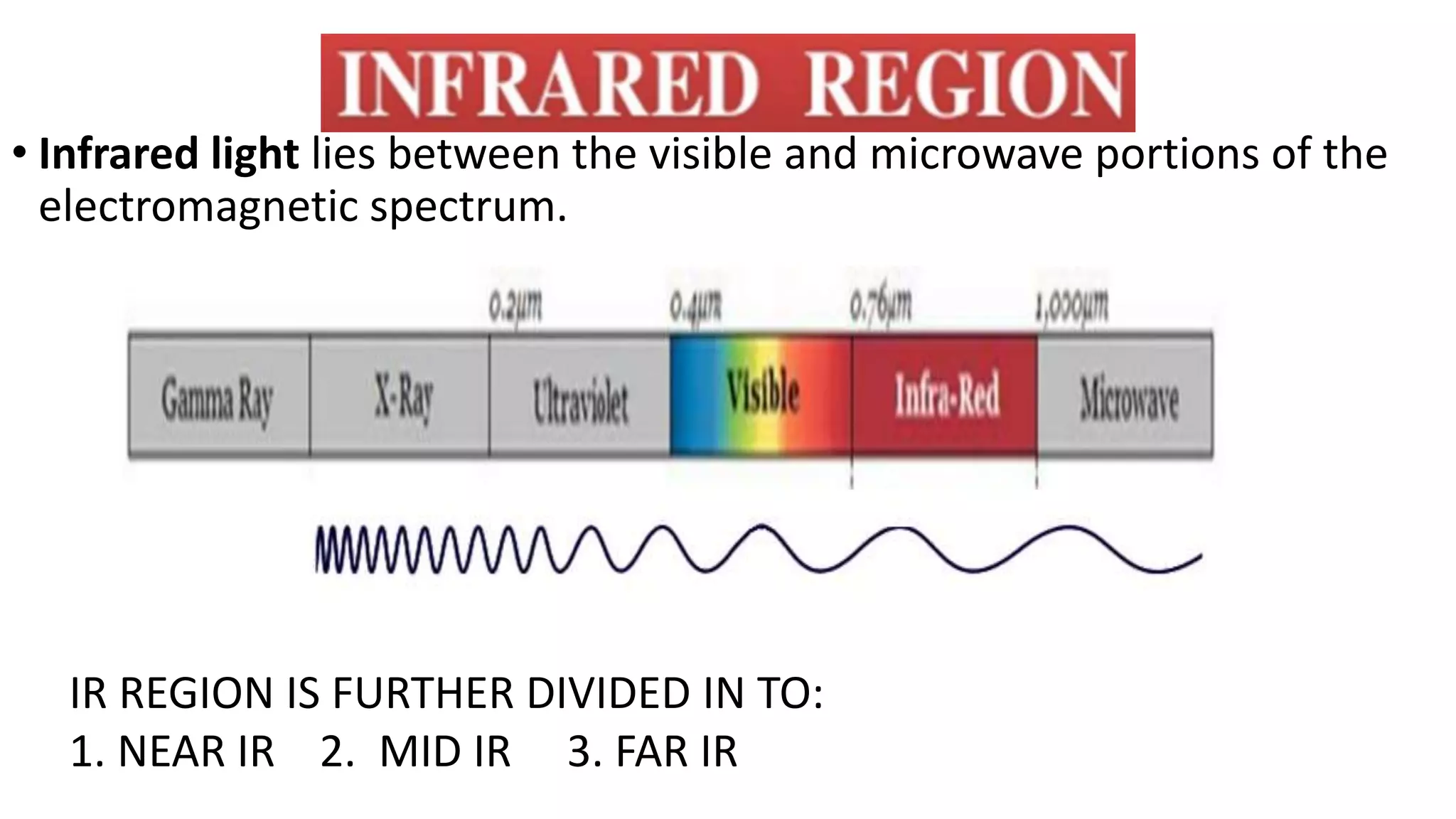
• Infrared light lies between the visible and microwave portions of the
electromagnetic spectrum.
IR REGION IS FURTHER DIVIDED IN TO:
1. NEAR IR 2. MID IR 3. FAR IR
OVERTONE REGION
VIBRATIONAL REGION
THERMAL WAVES
IR REGION IS FURTHER DIVIDED IN TO:
MID IR
RANGE: 4000-667 CM-1
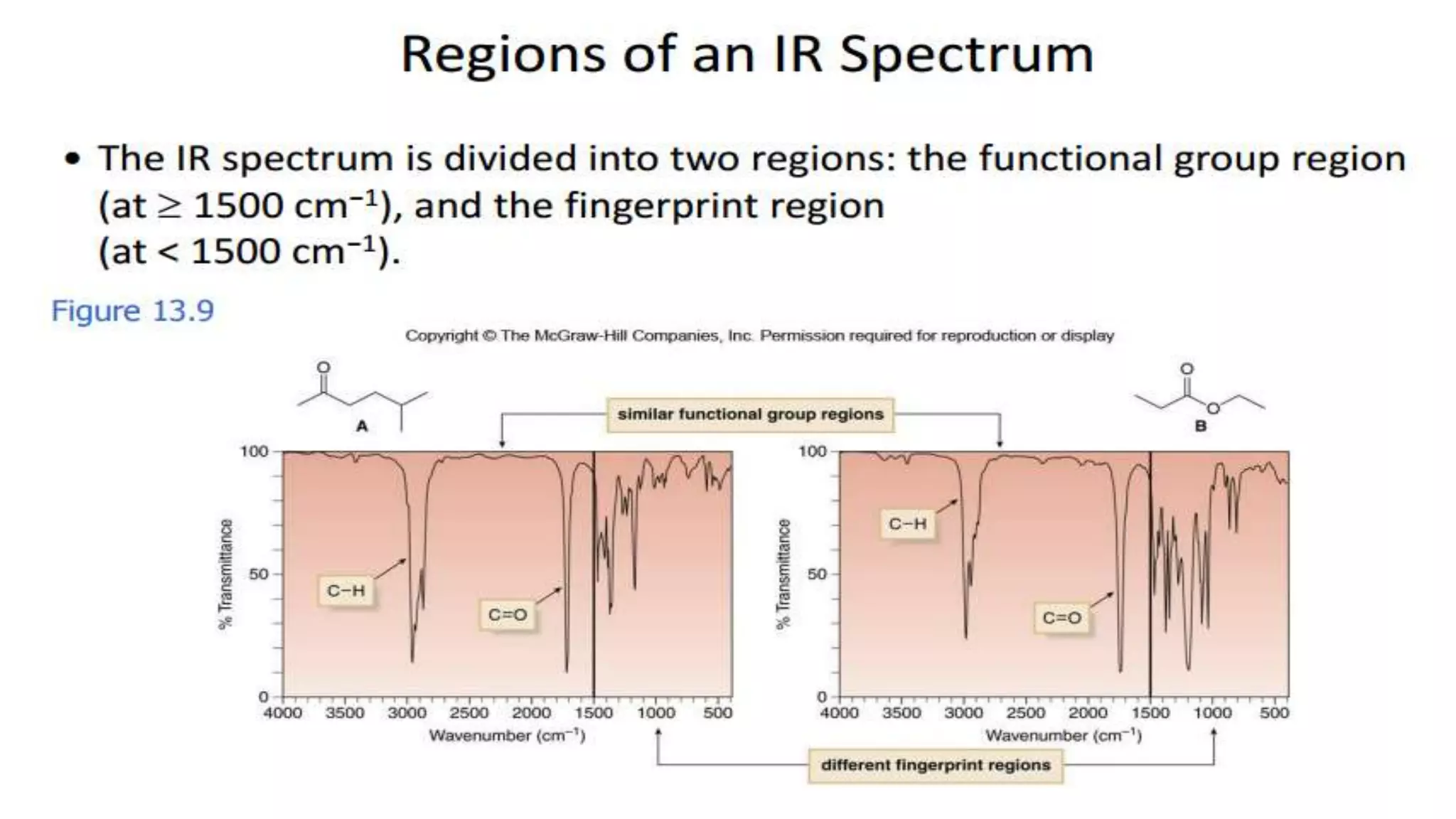
FUNCTIONAL
GROUP REGION
RANGE: 4000-1400 CM-1
HELPS IN DETECTION OF
SPECIFIC FUNCTIONAL
GROUPS IN THE MOLECULE
e.g –OH,C=O , double
bonds, triple bonds etc
FINGER PRINT &
SINGLE BOND
REGION
RANGE: 1400 - 667 CM-1
IR SPECTRUM OF A MOLECULE
= CHEMICAL FINGERPRINT OF
MOLECULE. BANDS IN THIS
REGION IS UNIQUE TO A
MOLECULE. HENCE THIS
REGION IS USED FOR
IDENTIFICATION OF
MOLECULE
THEORY & PRINCIPLE OF IR
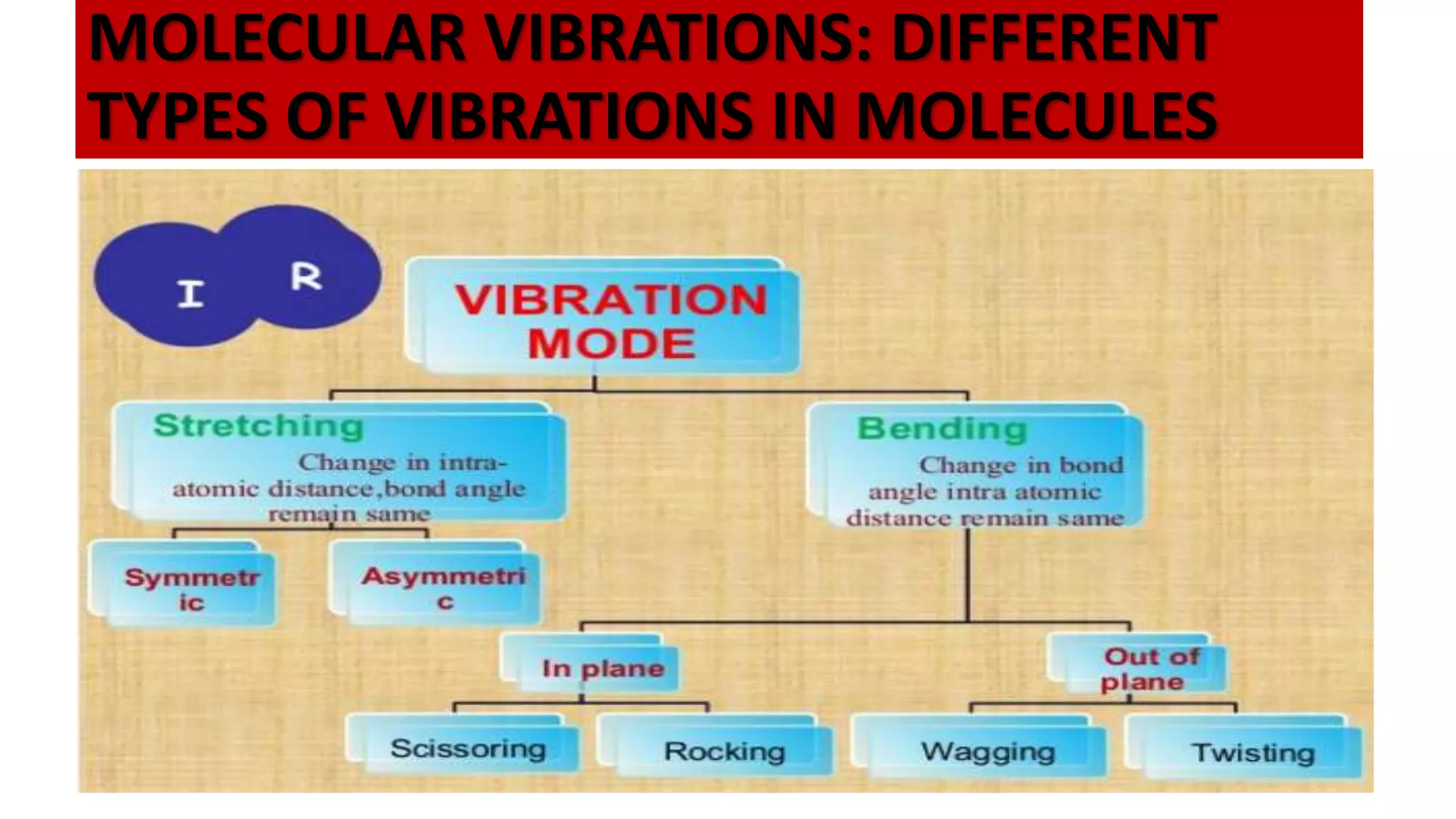
MOLECULAR VIBRATIONS: DIFFERENT
TYPES OF VIBRATIONS IN MOLECULES
Stretching: SYMMETRIC STRECTING
Stretching: ASYMMETRIC STRECTING
BENDING (INPLANE): SCISSORING
BENDING (INPLANE): ROCKING
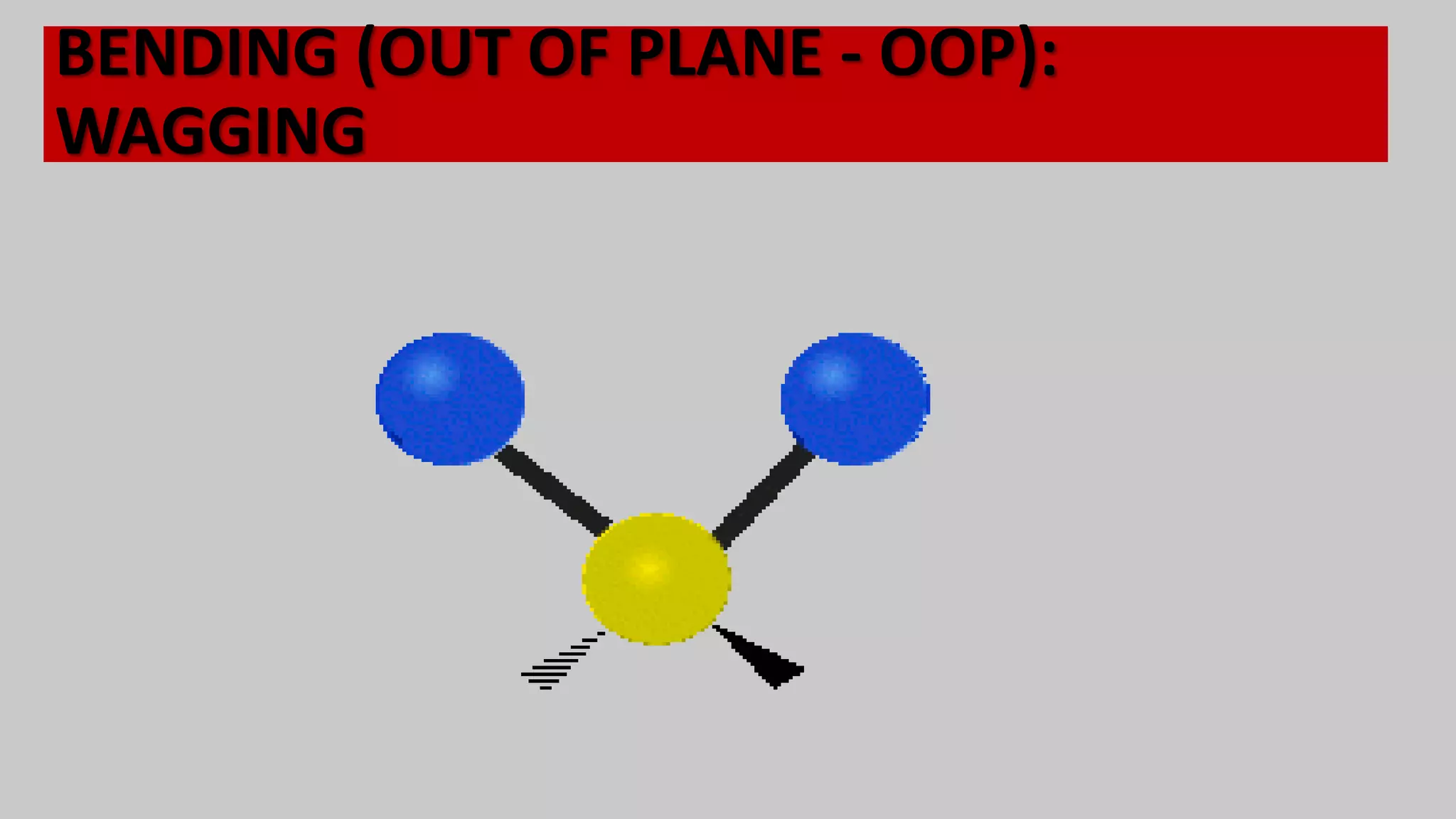
BENDING (OUT OF PLANE - OOP):
WAGGING
BENDING (OUT OF PLANE - OOP):
TWISTING
PRINCIPLE OF IR
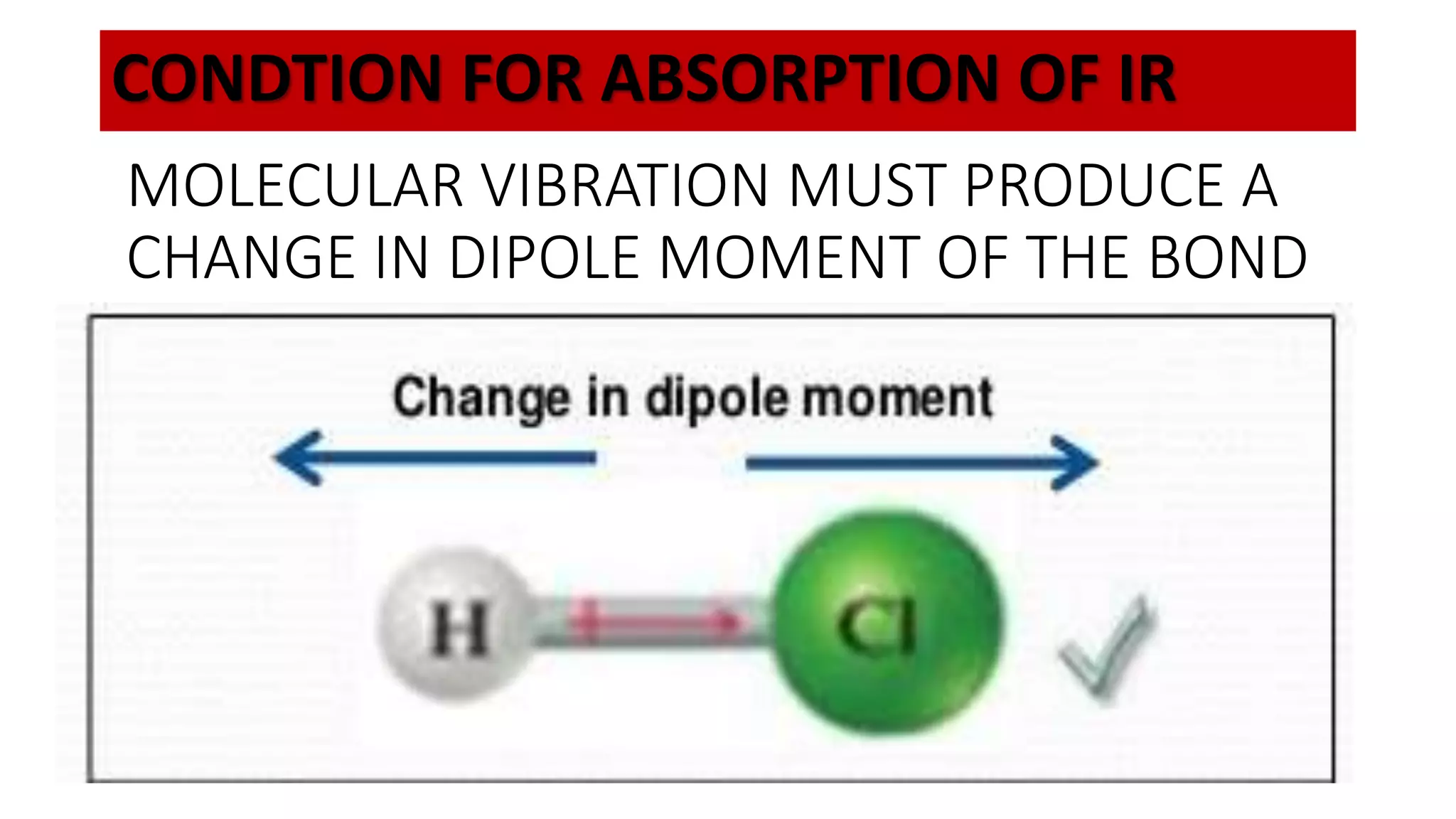
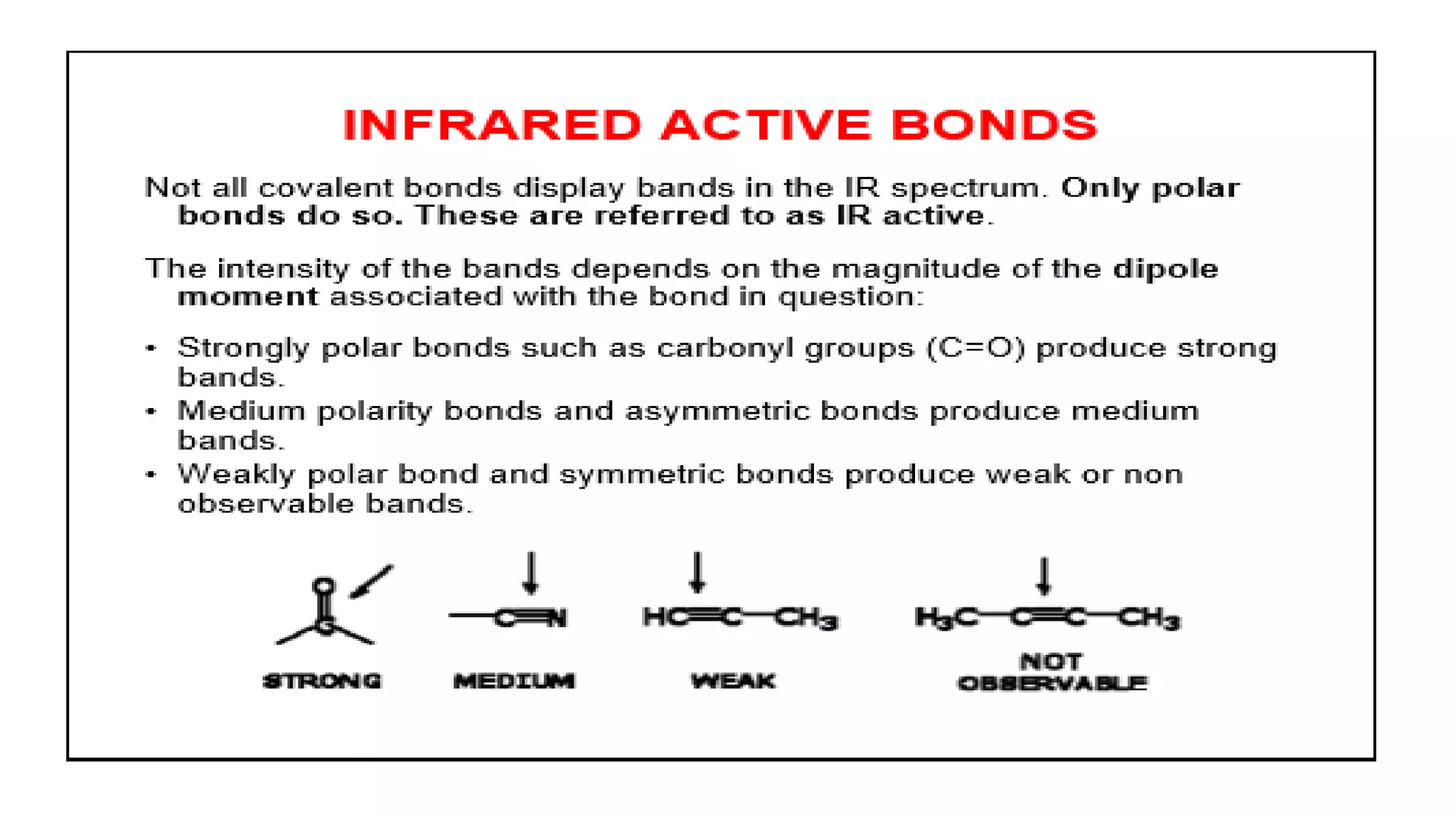
IR ACTIVE VIBRATIONS:
CONDITION FOR
ABSORPTION OF IR by
BONDS
Molecular vibrations
must produce a
change in dipole
moment of bond
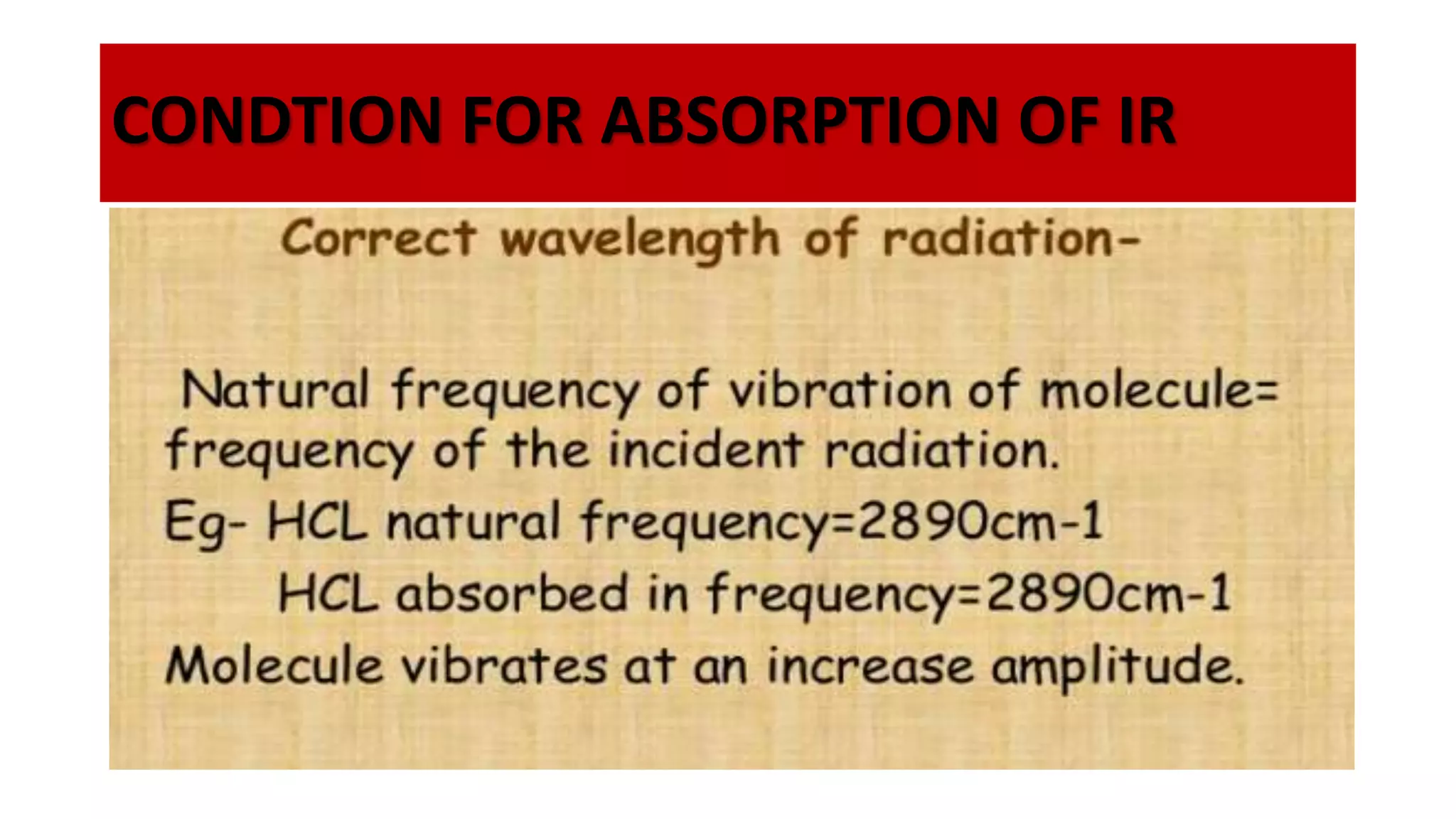
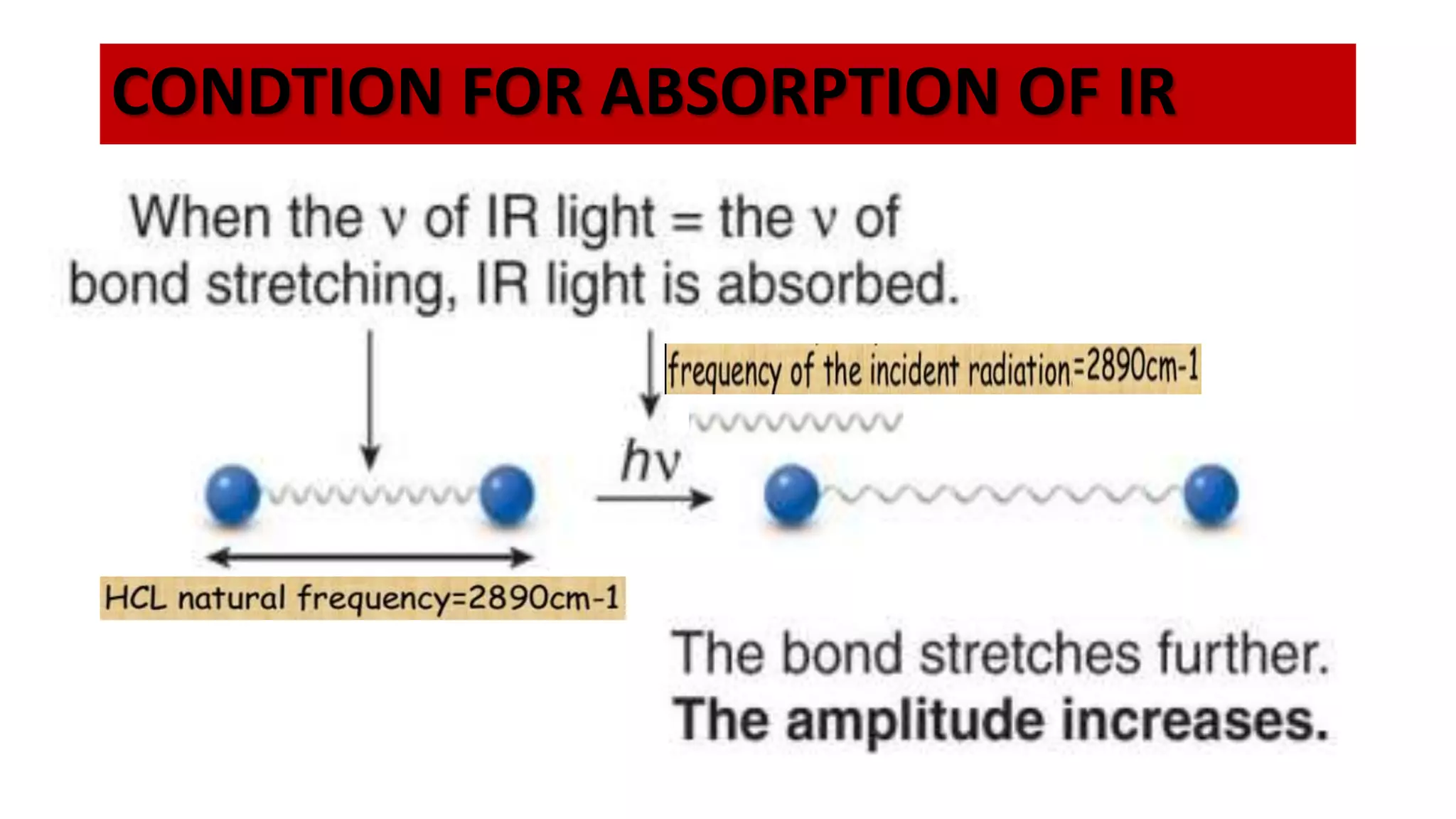
The frequency of IR
radiation = Frequency
of bond vibration
CONDTION FOR A MOLECULAR VIBRATION
(BOND) TO ABSORB IR RADIATION
CONDTION FOR ABSORPTION OF IR
MOLECULAR VIBRATION MUST PRODUCE A
CHANGE IN DIPOLE MOMENT OF THE BOND
CONDTION FOR ABSORPTION OF IR
H2 I2
MM =2 g/mole
MM =254 g/mole
RECORDING IR SPECTRUM OF A COMPD
IR ABSROPTION ENERGY LEVEL & TYPES OF
PEAKS OBTAINED IN IR SPECTRUM
POTENTIAL ENERGY LEVEL DIAGRAM
In the case of the anharmonic
oscillator, the vibrational
transitions no longer only
obey the selection rule n =
1. This type of vibrational
transition is called
fundamental vibration.
Vibrational transitions with n
= 2, 3, ... are also possible,
and are termed overtones.
Called first, second, and so
on, overtones.
Fundamentals and Overtones
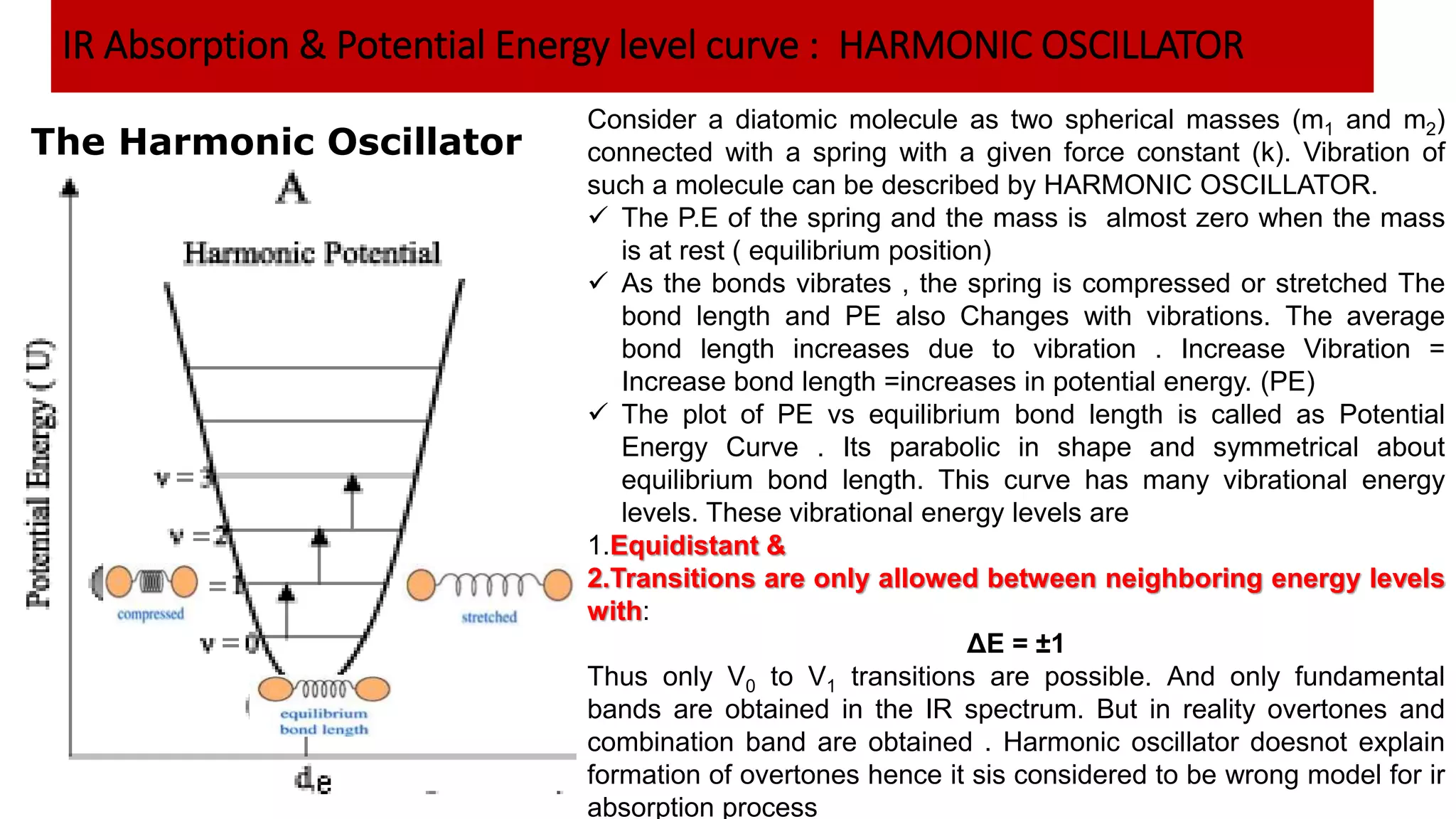
The Harmonic Oscillator
Consider a diatomic molecule as two spherical masses (m1 and m2)
connected with a spring with a given force constant (k). Vibration of
such a molecule can be described by HARMONIC OSCILLATOR.
 The P.E of the spring and the mass is almost zero when the mass
is at rest ( equilibrium position)
 As the bonds vibrates , the spring is compressed or stretched The
bond length and PE also Changes with vibrations. The average
bond length increases due to vibration . Increase Vibration =
Increase bond length =increases in potential energy. (PE)
 The plot of PE vs equilibrium bond length is called as Potential
Energy Curve . Its parabolic in shape and symmetrical about
equilibrium bond length. This curve has many vibrational energy
levels. These vibrational energy levels are
1.Equidistant &
2.Transitions are only allowed between neighboring energy levels
with:
ΔE = ±1
Thus only V0 to V1 transitions are possible. And only fundamental
bands are obtained in the IR spectrum. But in reality overtones and
combination band are obtained . Harmonic oscillator doesnot explain
formation of overtones hence it sis considered to be wrong model for ir
absorption process
IR Absorption & Potential Energy level curve : HARMONIC OSCILLATOR
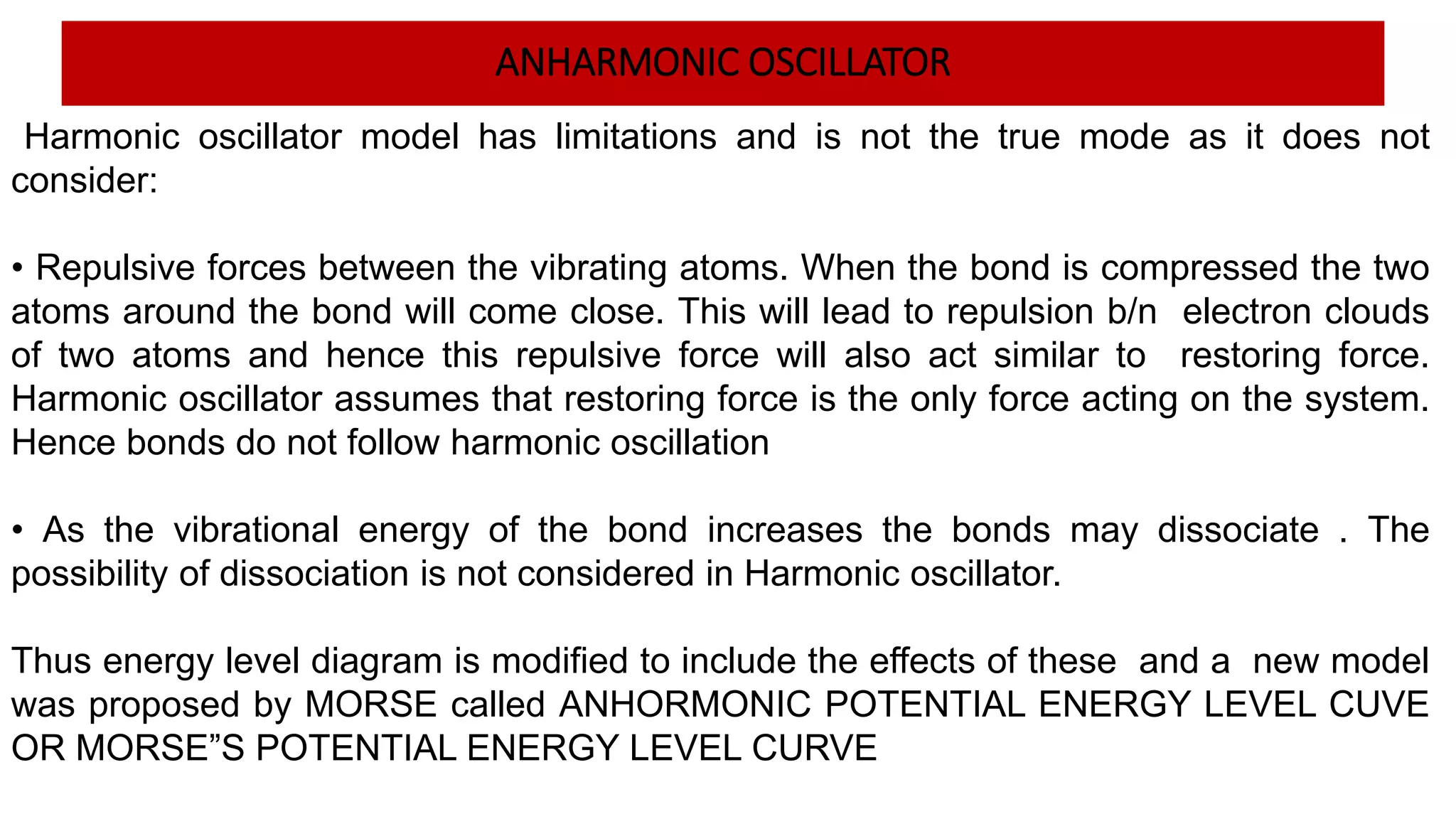
Harmonic oscillator model has limitations and is not the true mode as it does not
consider:
• Repulsive forces between the vibrating atoms. When the bond is compressed the two
atoms around the bond will come close. This will lead to repulsion b/n electron clouds
of two atoms and hence this repulsive force will also act similar to restoring force.
Harmonic oscillator assumes that restoring force is the only force acting on the system.
Hence bonds do not follow harmonic oscillation
• As the vibrational energy of the bond increases the bonds may dissociate . The
possibility of dissociation is not considered in Harmonic oscillator.
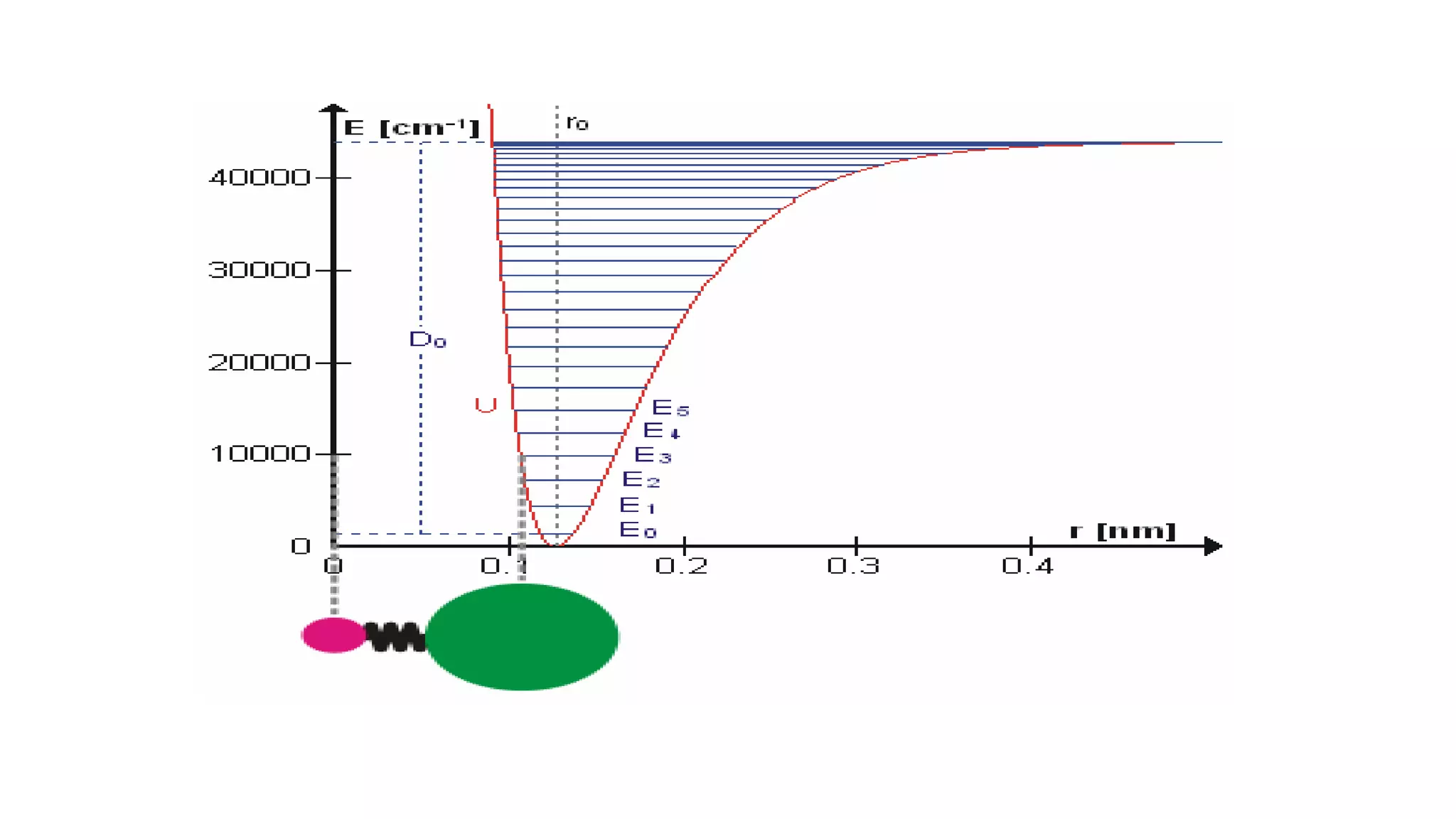
Thus energy level diagram is modified to include the effects of these and a new model
was proposed by MORSE called ANHORMONIC POTENTIAL ENERGY LEVEL CUVE
OR MORSE”S POTENTIAL ENERGY LEVEL CURVE
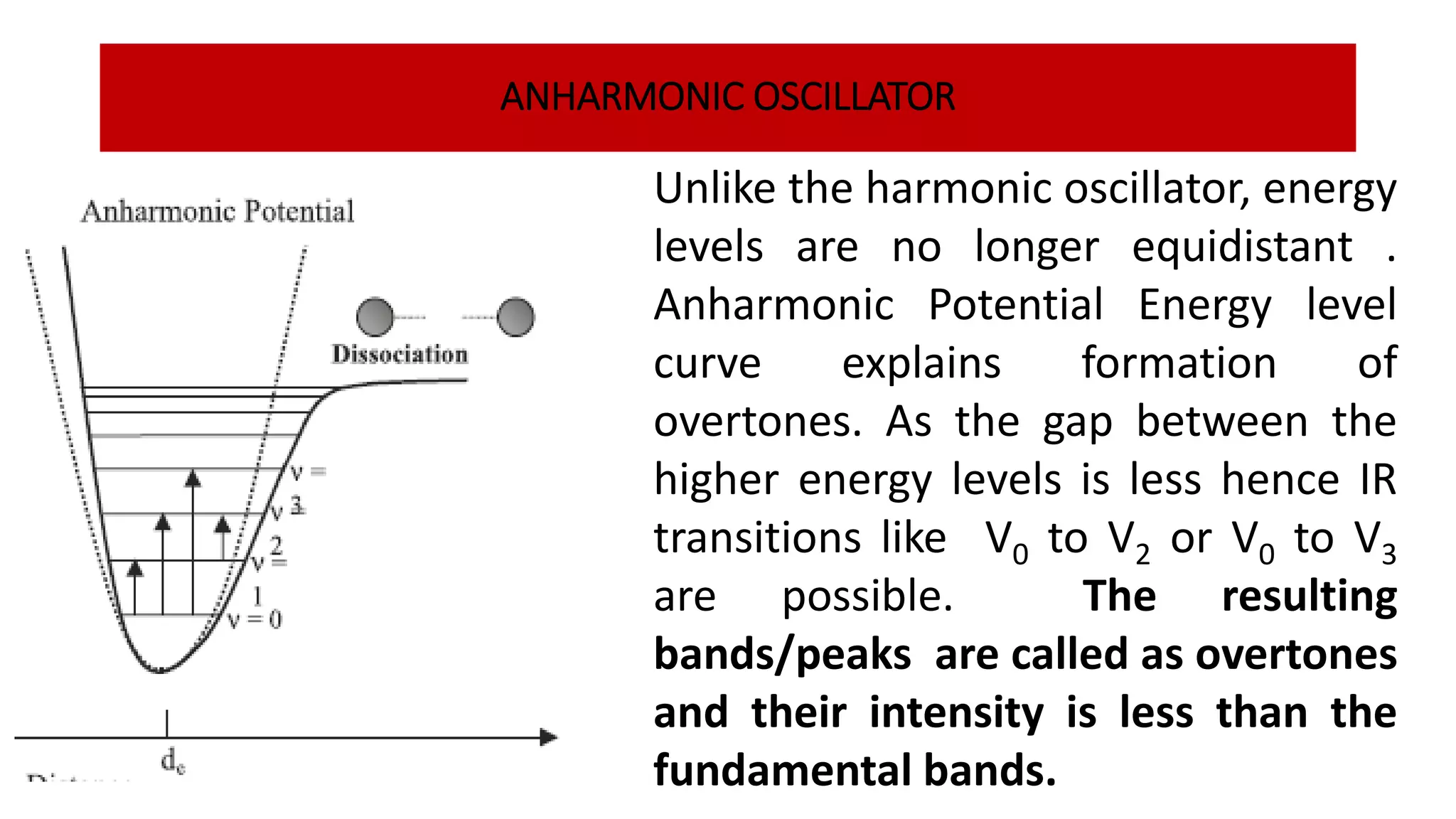
ANHARMONIC OSCILLATOR
Unlike the harmonic oscillator, energy
levels are no longer equidistant .
Anharmonic Potential Energy level
curve explains formation of
overtones. As the gap between the
higher energy levels is less hence IR
transitions like V0 to V2 or V0 to V3
are possible. The resulting
bands/peaks are called as overtones
and their intensity is less than the
fundamental bands.
Anharmonicity leads to deviations of two kinds:
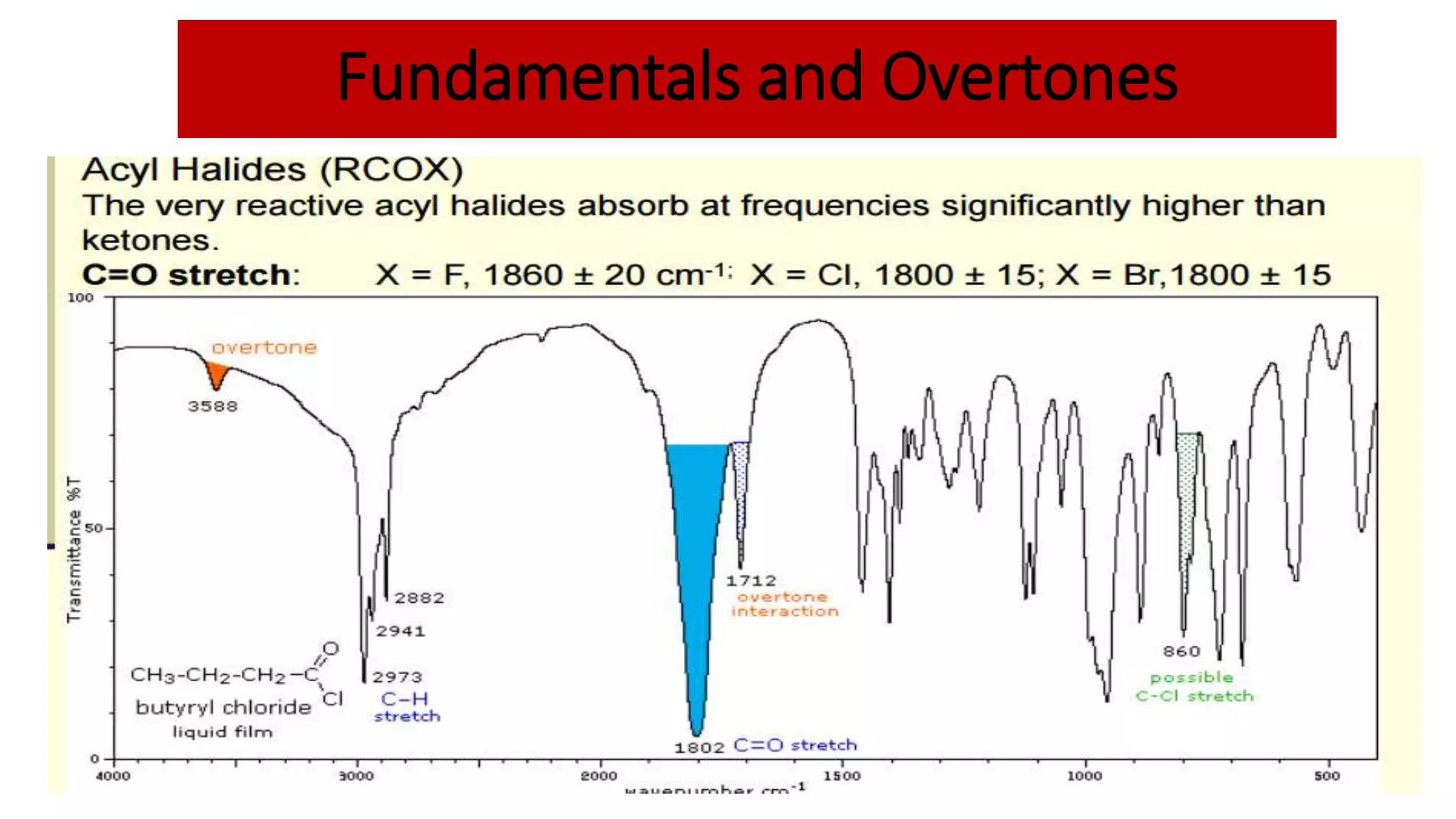
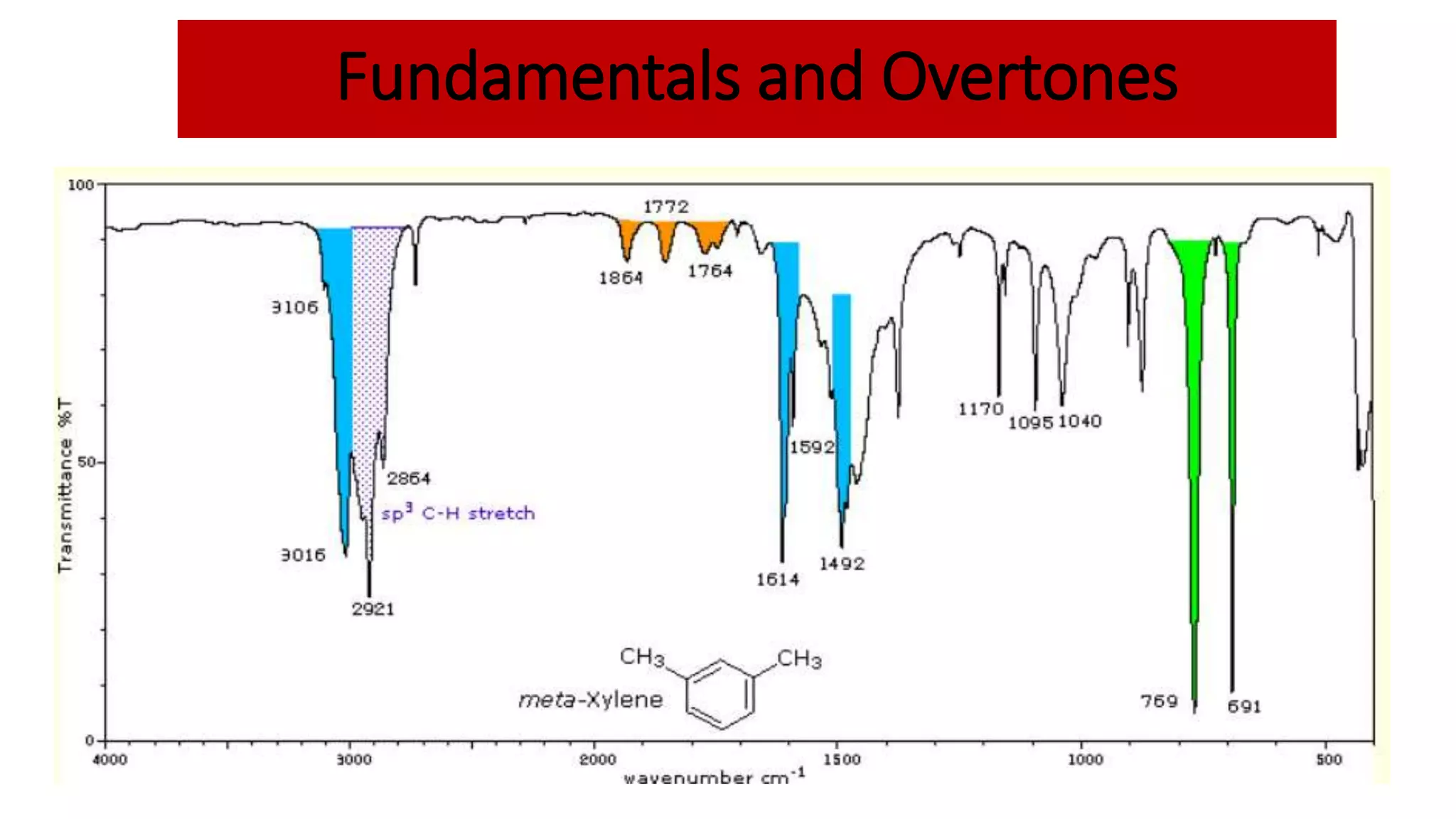
1) OVERTONE BANDS: At higher energy levels, E becomes smaller and the
selection rule is not followed. Higher energy levels are closely placed. As a
result, weaker transitions called overtones are sometimes observed. These
transitions correspond to  =  2 or  3.
• The frequencies of such overtone transitions are approximately two or three
times that of the fundamental frequency
• The intensities are lower than that of the fundamental frequency.
2) COMBINATION BANDS: Different vibrations in a molecule can interact to give
absorption peaks with frequencies that are approximately sums or differences
of their fundamental frequencies (combination frequencies)
• The Intensities of overtone, combination and difference peaks are lower than
that of the fundamental frequency.
ANHARMOINIC OSCILLATOR
Fundamentals and Overtones
1864/2=932
 The frequency of a combination is approx. the sum of the frequencies of the individual
bands.
 Combinations of fundamentals with overtones are possible as well as well as
fundamentals involving two or more vibrations.
 The vibrations must involve the same functional group and have the same symmetry.
Combination bands for water speciation in
hydrated Na2O·6SiO2 (NS6) glasses
Shigeru Yamashita, Harald Behrens, Burkhard C. Schmidt, Ray
Dupree. Water speciation in sodium silicate glasses based on NIR
and NMR spectroscopy. Chemical Geology 256 (2008) 231–241.
COMBINATION BANDS
COMBINATION BANDS
FERMI RESONANCE

Infrared spectroscopy (vibrational rotational spectroscopy)

  • 1.
  • 2.
    • MOLECULAR ABSORPTIONSPECTROSCOPY • MATTER : MOLECULE • EMR: INFRA RED RADIATION • TYPE OF INTERACTION: ABSORPTION OF RADIATION • EFFECT ON THE MOLECULE: AS A RESULT OF ABSORPTION OF INFRARED RADIA TION THE VIBRATIONAL AND ROTATIONAL ENERGY OF THE MOLECULE INCREASES. MOLECULE BECOMES VIBRATIONALLY EXCITED. MH + IR ʎ MH* (VIBRATIONALLY EXCITED MOLECULE) •HENCE IR SPECTROSCOPY IS ALSO KNOWN AS VIBRATIONAL – ROTATIONAL SPECTROSCOPY FEATURES
  • 3.
    FEATURES • APPLICATION: QUALITATIVE. •HEPLS IN DETERMINATION OF STRUCTURE OF A MOLECULE.
  • 4.
    • Infrared lightlies between the visible and microwave portions of the electromagnetic spectrum. IR REGION IS FURTHER DIVIDED IN TO: 1. NEAR IR 2. MID IR 3. FAR IR
  • 5.
    OVERTONE REGION VIBRATIONAL REGION THERMALWAVES IR REGION IS FURTHER DIVIDED IN TO:
  • 6.
    MID IR RANGE: 4000-667CM-1 FUNCTIONAL GROUP REGION RANGE: 4000-1400 CM-1 HELPS IN DETECTION OF SPECIFIC FUNCTIONAL GROUPS IN THE MOLECULE e.g –OH,C=O , double bonds, triple bonds etc FINGER PRINT & SINGLE BOND REGION RANGE: 1400 - 667 CM-1 IR SPECTRUM OF A MOLECULE = CHEMICAL FINGERPRINT OF MOLECULE. BANDS IN THIS REGION IS UNIQUE TO A MOLECULE. HENCE THIS REGION IS USED FOR IDENTIFICATION OF MOLECULE
  • 8.
  • 10.
    MOLECULAR VIBRATIONS: DIFFERENT TYPESOF VIBRATIONS IN MOLECULES
  • 11.
  • 12.
  • 13.
  • 14.
  • 15.
    BENDING (OUT OFPLANE - OOP): WAGGING
  • 16.
    BENDING (OUT OFPLANE - OOP): TWISTING
  • 17.
  • 18.
  • 19.
  • 20.
    CONDITION FOR ABSORPTION OFIR by BONDS Molecular vibrations must produce a change in dipole moment of bond The frequency of IR radiation = Frequency of bond vibration CONDTION FOR A MOLECULAR VIBRATION (BOND) TO ABSORB IR RADIATION
  • 21.
  • 22.
    MOLECULAR VIBRATION MUSTPRODUCE A CHANGE IN DIPOLE MOMENT OF THE BOND CONDTION FOR ABSORPTION OF IR
  • 23.
  • 24.
  • 25.
    H2 I2 MM =2g/mole MM =254 g/mole
  • 26.
  • 35.
    IR ABSROPTION ENERGYLEVEL & TYPES OF PEAKS OBTAINED IN IR SPECTRUM
  • 36.
  • 37.
    In the caseof the anharmonic oscillator, the vibrational transitions no longer only obey the selection rule n = 1. This type of vibrational transition is called fundamental vibration. Vibrational transitions with n = 2, 3, ... are also possible, and are termed overtones. Called first, second, and so on, overtones. Fundamentals and Overtones
  • 38.
    The Harmonic Oscillator Considera diatomic molecule as two spherical masses (m1 and m2) connected with a spring with a given force constant (k). Vibration of such a molecule can be described by HARMONIC OSCILLATOR.  The P.E of the spring and the mass is almost zero when the mass is at rest ( equilibrium position)  As the bonds vibrates , the spring is compressed or stretched The bond length and PE also Changes with vibrations. The average bond length increases due to vibration . Increase Vibration = Increase bond length =increases in potential energy. (PE)  The plot of PE vs equilibrium bond length is called as Potential Energy Curve . Its parabolic in shape and symmetrical about equilibrium bond length. This curve has many vibrational energy levels. These vibrational energy levels are 1.Equidistant & 2.Transitions are only allowed between neighboring energy levels with: ΔE = ±1 Thus only V0 to V1 transitions are possible. And only fundamental bands are obtained in the IR spectrum. But in reality overtones and combination band are obtained . Harmonic oscillator doesnot explain formation of overtones hence it sis considered to be wrong model for ir absorption process IR Absorption & Potential Energy level curve : HARMONIC OSCILLATOR
  • 40.
    Harmonic oscillator modelhas limitations and is not the true mode as it does not consider: • Repulsive forces between the vibrating atoms. When the bond is compressed the two atoms around the bond will come close. This will lead to repulsion b/n electron clouds of two atoms and hence this repulsive force will also act similar to restoring force. Harmonic oscillator assumes that restoring force is the only force acting on the system. Hence bonds do not follow harmonic oscillation • As the vibrational energy of the bond increases the bonds may dissociate . The possibility of dissociation is not considered in Harmonic oscillator. Thus energy level diagram is modified to include the effects of these and a new model was proposed by MORSE called ANHORMONIC POTENTIAL ENERGY LEVEL CUVE OR MORSE”S POTENTIAL ENERGY LEVEL CURVE ANHARMONIC OSCILLATOR
  • 41.
    ANHARMONIC OSCILLATOR Unlike theharmonic oscillator, energy levels are no longer equidistant . Anharmonic Potential Energy level curve explains formation of overtones. As the gap between the higher energy levels is less hence IR transitions like V0 to V2 or V0 to V3 are possible. The resulting bands/peaks are called as overtones and their intensity is less than the fundamental bands.
  • 42.
    Anharmonicity leads todeviations of two kinds: 1) OVERTONE BANDS: At higher energy levels, E becomes smaller and the selection rule is not followed. Higher energy levels are closely placed. As a result, weaker transitions called overtones are sometimes observed. These transitions correspond to  =  2 or  3. • The frequencies of such overtone transitions are approximately two or three times that of the fundamental frequency • The intensities are lower than that of the fundamental frequency. 2) COMBINATION BANDS: Different vibrations in a molecule can interact to give absorption peaks with frequencies that are approximately sums or differences of their fundamental frequencies (combination frequencies) • The Intensities of overtone, combination and difference peaks are lower than that of the fundamental frequency. ANHARMOINIC OSCILLATOR
  • 43.
  • 44.
  • 45.
  • 46.
  • 47.
     The frequencyof a combination is approx. the sum of the frequencies of the individual bands.  Combinations of fundamentals with overtones are possible as well as well as fundamentals involving two or more vibrations.  The vibrations must involve the same functional group and have the same symmetry. Combination bands for water speciation in hydrated Na2O·6SiO2 (NS6) glasses Shigeru Yamashita, Harald Behrens, Burkhard C. Schmidt, Ray Dupree. Water speciation in sodium silicate glasses based on NIR and NMR spectroscopy. Chemical Geology 256 (2008) 231–241. COMBINATION BANDS
  • 48.
  • 49.

Editor's Notes

  • #3 IMP: Molecule is not electronically exicted. Absorbtion of ir radiation can not cause electronic tranisition in the molecule. This is because the energy required for electronic tranistion is very high and ir radiations are less energetic than uv and visible. Hence incaplable of causing electronic excitation.
  • #5 FAR INFRARED : These waves are thermal. We experience this type of infrared radiation every day in the form of heat! The heat that we feel from sunlight, a fire, a radiator or a warm sidewalk is infrared. MID INFRARED: NEAR INFRARED :waves are not hot . These shorter wavelengths are the ones used by TV's remote control.  
  • #8 IR BANDS IN THE FUNCTIONAL GROUP REGION SIMILAR FOR ETHANOL AND PROPANOL BUT THE PATTERN IN THE FINGER PRINT REGION IS VERY DIFFERENT. HENCE NO TWO MOLECULES HAVE SAME IR SPECTRUM EVEN IF THEY ARE STRUCTURALLY SIMILAR. HENCE IR SPECTRUM CAN BE USED FOR IDENTIFICATION OF MOLECULES BY COMPARING THE IR SPECTRUM OF SAMPLE WITH IR SPECTRUM OF STANDARD COMPOUND. ALL PHARMACEOPOIEAS FOLLOW THIS METHOD FOR IDENTIFICATION OF BULK DRUG.
  • #11 PLS REFER DIAGRAMS OF VIBRATIONAL MODES FROM SKOOG OR YR SHARMA.
  • #22 NO CHANGE IN DIPOLE MOMENT NO ABSORPTION OF IR RADIATION
  • #37 Energy level of IR is described by PE level diagram. Each absorption results in a peak or band in the IR spectrum. There are two types of peaks obtained in the ir spectrum fundamental and overtone
  • #39 NOTES: In classical mechanics, a harmonic oscillator is a system that, when displaced from its equilibrium position, experiences a restoring force, F, proportional to the displacement, x: If F is the only force acting on the system, the system is called a simple harmonic oscillator, and it undergoes simple harmonic motion: sinusoidal oscillations about the equilibrium point, with a constant amplitude and a constant frequency (which does not depend on the amplitude) Mechanical examples include pendulums (with small angles of displacement), masses connected to springs
  • #41 ..
  • #43 Single photon causesthis.
  • #44 5920 is in NIR region. Hence many overtones are obtained in NIR. Hence NIR spectrum consists of Overtones and Combination bands.
  • #48 After describing the NIR and explaining its advantages and disadvantages, the students have to learn about the origin of bands in NIR. At this time, it is important that the professor explains that the bands in NIR are overbands or combination bands. In this explanation, it is important to clearly state how the overtones can be obtained, and where do they come from.
  • #50 Acid Chlorides Saturated acid chlorides have a strong band at 1790-1815 cm-1 (see spectrum of ethanoyl chloride, below), but when the carbonyl group is conjugated to an aromatic system a second (usually less intense) band appears at ca. 1730 cm-1. This is due to Fermi resonance involving the C=O stretching fundamental (~1790 cm-1) and the first overtone of an intense Ar-C bending mode at ca. 900 cm-1 (see benzoyl chloride below) Refer class notes .