Spectroscopy and AAS
Dr. Aparna khandelwal
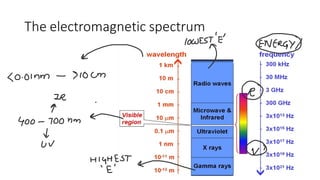
The electromagnetic spectrum
The photon is the elementary particle
responsible for electromagnetic phenomena
• As a particle, it interacts with matter by transferring its energy E:
• E= hν = hc/λ
• h - Planck constant (h = 6.63 x 1034 Js)
• ν - frequency of the radiation (no. of wave cycle pass through a
point in one sec.
• c – speed of light
Types of spectroscopy
• When radiation meets matter,the radiation is either
Scattered
emitted
or absorbed
• This gives rise to three principle branches of spectroscopy
• After absorption of light molecule from excited statecan return to ground
stateby means of radioactive transition, energy is reemitted in the form
of luminescence.
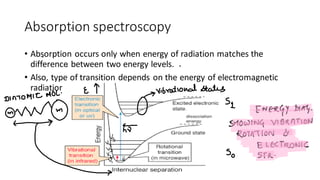
Absorption spectroscopy
• Absorption occurs only when energy of radiation matches the
difference between two energy levels.
• Also, type of transition depends on the energy of electromagnetic
radiation.
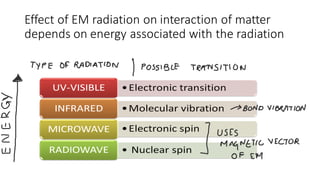
Effect of EM radiation on interaction of matter
depends on energy associated with the radiation
Molecular orbitals
• Different orbitals combine to yield molecular orbitals that generally fall into
one of the five different classes
• s orbitals combine to form------ binding s and the antibinding s* orbitals.
• Some p orbitals combine to form----- binding p and the anti-binding
p*orbitals.
• Other p orbitals combine to form ------non-binding n orbitals.
• The population of binding orbitals strengthens a chemical bond, and, vice
versa, the population of anti-binding orbitals weakens a chemical bond
Energy scheme for molecular orbitals
Arrows indicate possible electronic transitions.
The length of the arrows indicates the energy required to be put into the system in
order to enable the transition.
Spin and multiplicity
• For paired electrons in one orbital,
normally have antiparallel spin
• S= +½ + -½ = 0
• The multiplicity is thus
M=2 x 0 + 1 = 1.
Such a state is thus called a singlet state
and denotated as ‘S’.
The ground state of a molecule is a
singlet state, S0
Excited singlet statesare S1, S2 etc
• The total spin S is calculated from the
individual electron spins.
• S = spin(electron 1)+ spin(electron 2)
• The multiplicity M is obtained by​
M= 2xS+1
• In case the spins of both electrons
are oriented in a parallel fashion
• S=+½ + +½=1
• The multiplicity is thus
M=2 x 1 + 1 = 3.
Such a stateis thus called a
Triplet stateand denotated as ‘T’.
This stateis one of the excited state
only
Jablonski diagram
For UV-Visible region
In order to absorb EM radiationin this range,
Moleculemust contain
Such molecules known
as chromophores
In protein there are 3 types of chromophores
• Peptide bonds
• certain amino acid side chains( tyrosine and tryptphan mainly)
• Certain prosthetic groups and coenzymes( e.g.porphyrine groups such
as in haem)
Beer Lambert law
• Lambert's law states that when monochromatic light passes through a
transparent medium,
Beer Lambert law
• Beer's law states that intensity of transmitted monochromatic light
decreases exponentially as the concentration of absorbing substance
increases
Mathematical expression of lambert Beer's
law
Deviation
According to the Beer–Lambert law
1. This might not be the case any more in samples with high
absorbance. chromophores might dimerise at high concentrations
2. Every spectrophotometer has a certain amount of stray light, which
is light received at the detector but not anticipated in the spectral band
isolated by the monochromator.
• In order to obtain reasonable signal-to-noise ratios, the intensity of
light at the chosen wavelength should be 10 times higher than the
intensity of the stray light.
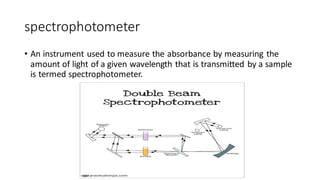
spectrophotometer
• An instrument used to measure the absorbance by measuring the
amount of light of a given wavelength that is transmitted by a sample
is termed spectrophotometer.
• Light source
• Hydrogen and deuterium lamp
• Xenon discharge lamps
• Mercury arc
• Tungsten filament
• Lasers
Laser
• LIGHT AMPLIFICATION BY STIMULATED EMMISION OF RADIATION
obviates any problems of variation in light intensity, as both referenceand
sample would be affected equally
one detector to measures the incoming and the
transmitted intensity alternately is better, so that it
eliminate the differencein the potential variations .
series of engraved fine lines.
The distance between the lines decides
the magnitude of wavelength diffracted
By varying the distance between the
lines, different wavelengths are selected
DIFFERACTION GRATING
borosilicate glass and normal
plastics absorbUV light
such cuvettes can only be used
for applications in the visible
range of the spectrum (up to
350 nm).
For UV measurements, quartz
cuvettes are used.
However, disposable plastic
cuvettes have been developed
that allow for measurements
over the entire range of the
UV/Vis spectrum
Photodetectors
• Converts light into electric signal
• Most commonly used PD in UV-Visible range is PMT
• PMT contains
• A cathode
• A light sensetive metal
• A series of dynodes
No. Of photons striking to
its photosensitivesurface
Characteristic of PMT
• Have rapid response times
• Very sensetive
• Slow to fatigue
• Should be carefully shielded from all stray light
• It may burn out if exposed to room light with voltage applied
• When voltage is applied to a PMT in the absence of any incident light
some current is usually produced k/a DARK CURRENT
• It is desirable to have dark current of a PMT at its lowest level
because this current appear as background noise
Signal to noise ratio Measure of the power of desired signal relativeto the
background signal
• Expressed in decibles.
• Should be higher than 1:1 or 0 db
• Greater the SNR better the resolution
Atomic absorption spectrophotometry
• We discussed the general theory of electronic transitions and said
that molecules give rise to band spectra, but atoms yield clearly
defined line spectra.
• In atomic emission spectroscopy these lines can be observed as light
of a particular wavelength (colour).
• Conversely, black lines can be observed against a bright background in
atomic absorption
Principle
• In a spectrum of an element, the absorption or emission
wavelengths are associated with transitions that require a minimum
of energy change.
(‘D-line’) due to the transitionof an electron
from the 3s to the 3p orbital and return
AAS vs AES
AAS
Hollow cathode lamp
Cathode made up of
metal of intrest
Filled with inert gas
On applying voltage its atom
ionises & strike to cathode
and excite the atoms of
cathode
Sample droplet
vaporises and absorb
energy and gets excited
Atomic emission spectroscopy
AES
• The energy absorbed or emitted is proportional to the number of
atoms in the optical path.
• Concentration determination with AES or AAS is carried out by
comparison with calibration standards
AAS vs AES
AAS
• More accurate
• More sensitive
• Quantitative assesment
• Intensity of light absorbed
AES
• Faster
• Qualitative assesment
• Intensity of light emitted is
studied

spectroscopy, Atomic absorption & Atomic emission

  • 1.
    Spectroscopy and AAS Dr.Aparna khandelwal
  • 4.
  • 5.
    The photon isthe elementary particle responsible for electromagnetic phenomena • As a particle, it interacts with matter by transferring its energy E: • E= hν = hc/λ • h - Planck constant (h = 6.63 x 1034 Js) • ν - frequency of the radiation (no. of wave cycle pass through a point in one sec. • c – speed of light
  • 6.
    Types of spectroscopy •When radiation meets matter,the radiation is either Scattered emitted or absorbed • This gives rise to three principle branches of spectroscopy • After absorption of light molecule from excited statecan return to ground stateby means of radioactive transition, energy is reemitted in the form of luminescence.
  • 7.
    Absorption spectroscopy • Absorptionoccurs only when energy of radiation matches the difference between two energy levels. • Also, type of transition depends on the energy of electromagnetic radiation.
  • 8.
    Effect of EMradiation on interaction of matter depends on energy associated with the radiation
  • 9.
    Molecular orbitals • Differentorbitals combine to yield molecular orbitals that generally fall into one of the five different classes • s orbitals combine to form------ binding s and the antibinding s* orbitals. • Some p orbitals combine to form----- binding p and the anti-binding p*orbitals. • Other p orbitals combine to form ------non-binding n orbitals. • The population of binding orbitals strengthens a chemical bond, and, vice versa, the population of anti-binding orbitals weakens a chemical bond
  • 10.
    Energy scheme formolecular orbitals Arrows indicate possible electronic transitions. The length of the arrows indicates the energy required to be put into the system in order to enable the transition.
  • 11.
    Spin and multiplicity •For paired electrons in one orbital, normally have antiparallel spin • S= +½ + -½ = 0 • The multiplicity is thus M=2 x 0 + 1 = 1. Such a state is thus called a singlet state and denotated as ‘S’. The ground state of a molecule is a singlet state, S0 Excited singlet statesare S1, S2 etc • The total spin S is calculated from the individual electron spins. • S = spin(electron 1)+ spin(electron 2) • The multiplicity M is obtained by​ M= 2xS+1 • In case the spins of both electrons are oriented in a parallel fashion • S=+½ + +½=1 • The multiplicity is thus M=2 x 1 + 1 = 3. Such a stateis thus called a Triplet stateand denotated as ‘T’. This stateis one of the excited state only
  • 12.
  • 13.
    For UV-Visible region Inorder to absorb EM radiationin this range, Moleculemust contain Such molecules known as chromophores
  • 14.
    In protein thereare 3 types of chromophores • Peptide bonds • certain amino acid side chains( tyrosine and tryptphan mainly) • Certain prosthetic groups and coenzymes( e.g.porphyrine groups such as in haem)
  • 15.
    Beer Lambert law •Lambert's law states that when monochromatic light passes through a transparent medium,
  • 16.
    Beer Lambert law •Beer's law states that intensity of transmitted monochromatic light decreases exponentially as the concentration of absorbing substance increases
  • 17.
    Mathematical expression oflambert Beer's law
  • 18.
    Deviation According to theBeer–Lambert law 1. This might not be the case any more in samples with high absorbance. chromophores might dimerise at high concentrations 2. Every spectrophotometer has a certain amount of stray light, which is light received at the detector but not anticipated in the spectral band isolated by the monochromator. • In order to obtain reasonable signal-to-noise ratios, the intensity of light at the chosen wavelength should be 10 times higher than the intensity of the stray light.
  • 19.
    spectrophotometer • An instrumentused to measure the absorbance by measuring the amount of light of a given wavelength that is transmitted by a sample is termed spectrophotometer.
  • 20.
    • Light source •Hydrogen and deuterium lamp • Xenon discharge lamps • Mercury arc • Tungsten filament • Lasers
  • 21.
    Laser • LIGHT AMPLIFICATIONBY STIMULATED EMMISION OF RADIATION
  • 22.
    obviates any problemsof variation in light intensity, as both referenceand sample would be affected equally one detector to measures the incoming and the transmitted intensity alternately is better, so that it eliminate the differencein the potential variations . series of engraved fine lines. The distance between the lines decides the magnitude of wavelength diffracted By varying the distance between the lines, different wavelengths are selected
  • 23.
  • 24.
    borosilicate glass andnormal plastics absorbUV light such cuvettes can only be used for applications in the visible range of the spectrum (up to 350 nm). For UV measurements, quartz cuvettes are used. However, disposable plastic cuvettes have been developed that allow for measurements over the entire range of the UV/Vis spectrum
  • 25.
    Photodetectors • Converts lightinto electric signal • Most commonly used PD in UV-Visible range is PMT • PMT contains • A cathode • A light sensetive metal • A series of dynodes No. Of photons striking to its photosensitivesurface
  • 26.
    Characteristic of PMT •Have rapid response times • Very sensetive • Slow to fatigue • Should be carefully shielded from all stray light • It may burn out if exposed to room light with voltage applied • When voltage is applied to a PMT in the absence of any incident light some current is usually produced k/a DARK CURRENT • It is desirable to have dark current of a PMT at its lowest level because this current appear as background noise
  • 27.
    Signal to noiseratio Measure of the power of desired signal relativeto the background signal • Expressed in decibles. • Should be higher than 1:1 or 0 db • Greater the SNR better the resolution
  • 28.
    Atomic absorption spectrophotometry •We discussed the general theory of electronic transitions and said that molecules give rise to band spectra, but atoms yield clearly defined line spectra. • In atomic emission spectroscopy these lines can be observed as light of a particular wavelength (colour). • Conversely, black lines can be observed against a bright background in atomic absorption
  • 29.
    Principle • In aspectrum of an element, the absorption or emission wavelengths are associated with transitions that require a minimum of energy change. (‘D-line’) due to the transitionof an electron from the 3s to the 3p orbital and return
  • 30.
  • 31.
    AAS Hollow cathode lamp Cathodemade up of metal of intrest Filled with inert gas On applying voltage its atom ionises & strike to cathode and excite the atoms of cathode Sample droplet vaporises and absorb energy and gets excited
  • 32.
  • 33.
  • 34.
    • The energyabsorbed or emitted is proportional to the number of atoms in the optical path. • Concentration determination with AES or AAS is carried out by comparison with calibration standards
  • 35.
    AAS vs AES AAS •More accurate • More sensitive • Quantitative assesment • Intensity of light absorbed AES • Faster • Qualitative assesment • Intensity of light emitted is studied