Rigid Rotator
Fatima Syed
Rigid Rotators
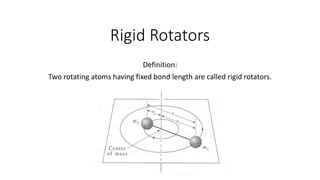
Definition:
Two rotating atoms having fixed bond length are called rigid rotators.
Why we study rigid rotator:
 Rigid rotator is studied because it is a model for the diatomic
molecule.
 It helps us to calculate rotational energy of diatomic molecule.
Classical treatment;
Let us consider two atoms having masses m1 and m2 and fixed bond
length r.
The center of gravity is fixed.
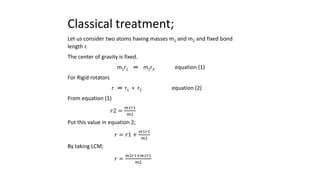
m1r1 ═ m2r2 equation (1)
For Rigid rotators
r ═ r1 + r2 equation (2)
From equation (1)
𝑟2 =
𝑚1𝑟1
𝑚2
Put this value in equation 2;
𝑟 = 𝑟1 +
𝑚1𝑟1
𝑚2
By taking LCM;
𝑟 =
𝑚2𝑟1+𝑚1𝑟1
𝑚2
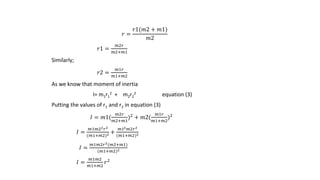
𝑟 =
𝑟1(𝑚2 + 𝑚1)
𝑚2
𝑟1 =
𝑚2𝑟
𝑚2+𝑚1
Similarly;
𝑟2 =
𝑚1𝑟
𝑚1+𝑚2
As we know that moment of inertia
I= m1r1
2 + m2r2
2 equation (3)
Putting the values of r1 and r2 in equation (3)
𝐼 = 𝑚1(
𝑚2𝑟
𝑚2+𝑚1
)2
+ 𝑚2(
𝑚1𝑟
𝑚1+𝑚2
)2
𝐼 =
𝑚1𝑚22 𝑟2
(𝑚1+𝑚2)2 +
𝑚12 𝑚2𝑟2
(𝑚1+𝑚2)2
𝐼 =
𝑚1𝑚2𝑟2(𝑚2+𝑚1)
(𝑚1+𝑚2)2
𝐼 =
𝑚1𝑚2
𝑚1+𝑚2
𝑟2
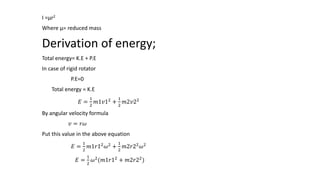
I =µr2
Where µ= reduced mass
Derivation of energy;
Total energy= K.E + P.E
In case of rigid rotator
P.E=0
Total energy = K.E
𝐸 =
1
2
𝑚1𝑣12 +
1
2
𝑚2𝑣22
By angular velocity formula
𝑣 = 𝑟𝜔
Put this value in the above equation
𝐸 =
1
2
𝑚1𝑟12 𝜔2 +
1
2
𝑚2𝑟22 𝜔2
𝐸 =
1
2
𝜔2
(𝑚1𝑟12
+ 𝑚2𝑟22
)
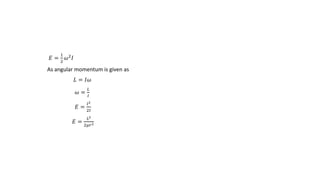
𝐸 =
1
2
𝜔2
𝐼
As angular momentum is given as
𝐿 = 𝐼𝜔
𝜔 =
𝐿
𝐼
𝐸 =
𝑙2
2𝐼
𝐸 =
𝐿2
2µ𝑟2
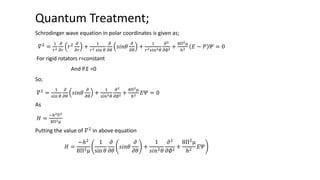
Quantum Treatment;
Schrodinger wave equation in polar coordinates is given as;
𝛻2
=
1
𝑟2
𝜕
𝜕𝑟
𝑟2 𝜕
𝜕𝑟
+
1
𝑟2 sin 𝜃
𝜕
𝜕𝜃
𝑠𝑖𝑛𝜃
𝜕
𝜕𝜃
+
1
𝑟2 𝑠𝑖𝑛2 𝜃
𝜕2
𝜕∅2 +
8П2µ
ℎ2 𝐸 − 𝑃 𝛹 = 0
For rigid rotators r=constant
And P.E =0
So;
𝛻2
=
1
sin 𝜃
𝜕
𝜕𝜃
𝑠𝑖𝑛𝜃
𝜕
𝜕𝜃
+
1
𝑠𝑖𝑛2 𝜃
𝜕2
𝜕∅2 +
8П2µ
ℎ2 𝐸𝛹 = 0
As
𝐻 =
−ℎ2 𝛻2
8П2µ
Putting the value of 𝛻2 in above equation
𝐻 =
−ℎ2
8П2µ
1
sin 𝜃
𝜕
𝜕𝜃
𝑠𝑖𝑛𝜃
𝜕
𝜕𝜃
+
1
𝑠𝑖𝑛2 𝜃
𝜕2
𝜕∅2 +
8П2µ
ℎ2 𝐸𝛹
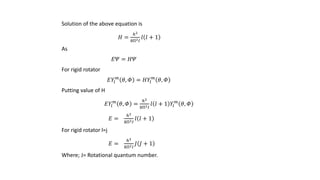
Solution of the above equation is
𝐻 =
ℎ2
8П2 𝐼
𝑙 𝑙 + 1
As
𝐸𝛹 = 𝐻𝛹
For rigid rotator
𝐸𝑌𝑙
𝑚
𝜃, 𝛷 = 𝐻𝑌𝑙
𝑚
𝜃, 𝛷
Putting value of H
𝐸𝑌𝑙
𝑚
𝜃, 𝛷 =
ℎ2
8П2 𝐼
𝑙 𝑙 + 1 𝑌𝑙
𝑚
𝜃, 𝛷
𝐸 =
ℎ2
8П2 𝐼
𝑙 𝑙 + 1
For rigid rotator l=j
𝐸 =
ℎ2
8П2 𝐼
𝐽 𝐽 + 1
Where; J= Rotational quantum number.
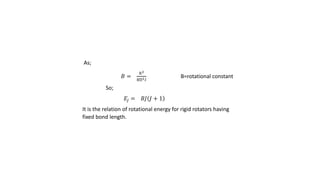
As;
𝐵 =
ℎ2
8П2 𝐼
B=rotational constant
So;
𝐸𝑗 = 𝐵𝐽 𝐽 + 1
It is the relation of rotational energy for rigid rotators having
fixed bond length.
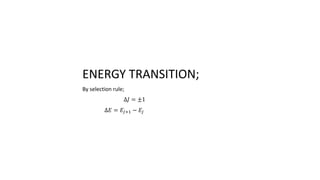
ENERGY TRANSITION;
By selection rule;
∆𝐽 = ±1
∆𝐸 = 𝐸𝐽+1 − 𝐸𝐽
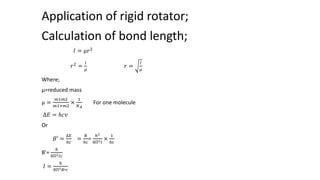
Application of rigid rotator;
Calculation of bond length;
𝐼 = µ𝑟2
𝑟2 =
𝐼
µ
𝑟 =
𝐼
µ
Where;
µ=reduced mass
µ =
𝑚1𝑚2
𝑚1+𝑚2
×
1
𝑁 𝐴
For one molecule
∆𝐸 = ℎ𝑐𝑣
Or
𝐵′ =
∆𝐸
ℎ𝑐
=
𝐵
ℎ𝑐
=
ℎ2
8П2 𝐼
×
1
ℎ𝑐
B’=
ℎ
8П2 𝐼𝑐
𝐼 =
ℎ
8П2 𝐵′𝑐

Rigid rotators

  • 1.
  • 2.
    Rigid Rotators Definition: Two rotatingatoms having fixed bond length are called rigid rotators.
  • 3.
    Why we studyrigid rotator:  Rigid rotator is studied because it is a model for the diatomic molecule.  It helps us to calculate rotational energy of diatomic molecule.
  • 4.
    Classical treatment; Let usconsider two atoms having masses m1 and m2 and fixed bond length r. The center of gravity is fixed. m1r1 ═ m2r2 equation (1) For Rigid rotators r ═ r1 + r2 equation (2) From equation (1) 𝑟2 = 𝑚1𝑟1 𝑚2 Put this value in equation 2; 𝑟 = 𝑟1 + 𝑚1𝑟1 𝑚2 By taking LCM; 𝑟 = 𝑚2𝑟1+𝑚1𝑟1 𝑚2
  • 5.
    𝑟 = 𝑟1(𝑚2 +𝑚1) 𝑚2 𝑟1 = 𝑚2𝑟 𝑚2+𝑚1 Similarly; 𝑟2 = 𝑚1𝑟 𝑚1+𝑚2 As we know that moment of inertia I= m1r1 2 + m2r2 2 equation (3) Putting the values of r1 and r2 in equation (3) 𝐼 = 𝑚1( 𝑚2𝑟 𝑚2+𝑚1 )2 + 𝑚2( 𝑚1𝑟 𝑚1+𝑚2 )2 𝐼 = 𝑚1𝑚22 𝑟2 (𝑚1+𝑚2)2 + 𝑚12 𝑚2𝑟2 (𝑚1+𝑚2)2 𝐼 = 𝑚1𝑚2𝑟2(𝑚2+𝑚1) (𝑚1+𝑚2)2 𝐼 = 𝑚1𝑚2 𝑚1+𝑚2 𝑟2
  • 6.
    I =µr2 Where µ=reduced mass Derivation of energy; Total energy= K.E + P.E In case of rigid rotator P.E=0 Total energy = K.E 𝐸 = 1 2 𝑚1𝑣12 + 1 2 𝑚2𝑣22 By angular velocity formula 𝑣 = 𝑟𝜔 Put this value in the above equation 𝐸 = 1 2 𝑚1𝑟12 𝜔2 + 1 2 𝑚2𝑟22 𝜔2 𝐸 = 1 2 𝜔2 (𝑚1𝑟12 + 𝑚2𝑟22 )
  • 7.
    𝐸 = 1 2 𝜔2 𝐼 As angularmomentum is given as 𝐿 = 𝐼𝜔 𝜔 = 𝐿 𝐼 𝐸 = 𝑙2 2𝐼 𝐸 = 𝐿2 2µ𝑟2
  • 8.
    Quantum Treatment; Schrodinger waveequation in polar coordinates is given as; 𝛻2 = 1 𝑟2 𝜕 𝜕𝑟 𝑟2 𝜕 𝜕𝑟 + 1 𝑟2 sin 𝜃 𝜕 𝜕𝜃 𝑠𝑖𝑛𝜃 𝜕 𝜕𝜃 + 1 𝑟2 𝑠𝑖𝑛2 𝜃 𝜕2 𝜕∅2 + 8П2µ ℎ2 𝐸 − 𝑃 𝛹 = 0 For rigid rotators r=constant And P.E =0 So; 𝛻2 = 1 sin 𝜃 𝜕 𝜕𝜃 𝑠𝑖𝑛𝜃 𝜕 𝜕𝜃 + 1 𝑠𝑖𝑛2 𝜃 𝜕2 𝜕∅2 + 8П2µ ℎ2 𝐸𝛹 = 0 As 𝐻 = −ℎ2 𝛻2 8П2µ Putting the value of 𝛻2 in above equation 𝐻 = −ℎ2 8П2µ 1 sin 𝜃 𝜕 𝜕𝜃 𝑠𝑖𝑛𝜃 𝜕 𝜕𝜃 + 1 𝑠𝑖𝑛2 𝜃 𝜕2 𝜕∅2 + 8П2µ ℎ2 𝐸𝛹
  • 9.
    Solution of theabove equation is 𝐻 = ℎ2 8П2 𝐼 𝑙 𝑙 + 1 As 𝐸𝛹 = 𝐻𝛹 For rigid rotator 𝐸𝑌𝑙 𝑚 𝜃, 𝛷 = 𝐻𝑌𝑙 𝑚 𝜃, 𝛷 Putting value of H 𝐸𝑌𝑙 𝑚 𝜃, 𝛷 = ℎ2 8П2 𝐼 𝑙 𝑙 + 1 𝑌𝑙 𝑚 𝜃, 𝛷 𝐸 = ℎ2 8П2 𝐼 𝑙 𝑙 + 1 For rigid rotator l=j 𝐸 = ℎ2 8П2 𝐼 𝐽 𝐽 + 1 Where; J= Rotational quantum number.
  • 10.
    As; 𝐵 = ℎ2 8П2 𝐼 B=rotationalconstant So; 𝐸𝑗 = 𝐵𝐽 𝐽 + 1 It is the relation of rotational energy for rigid rotators having fixed bond length.
  • 11.
    ENERGY TRANSITION; By selectionrule; ∆𝐽 = ±1 ∆𝐸 = 𝐸𝐽+1 − 𝐸𝐽
  • 12.
    Application of rigidrotator; Calculation of bond length; 𝐼 = µ𝑟2 𝑟2 = 𝐼 µ 𝑟 = 𝐼 µ Where; µ=reduced mass µ = 𝑚1𝑚2 𝑚1+𝑚2 × 1 𝑁 𝐴 For one molecule ∆𝐸 = ℎ𝑐𝑣 Or 𝐵′ = ∆𝐸 ℎ𝑐 = 𝐵 ℎ𝑐 = ℎ2 8П2 𝐼 × 1 ℎ𝑐 B’= ℎ 8П2 𝐼𝑐 𝐼 = ℎ 8П2 𝐵′𝑐