Cardiac Resynchronization
Therapy And ICDs
Presented by
Ahmed Mahmood
cardiac resynchronization therapy (CRT)
• An implanted cardiac resynchronization device is a medical device
used in cardiac resynchronization therapy (CRT).
• It resynchronizes the contractions of the heart’s ventricles by sending
tiny electrical impulses to the heart muscle, which can help the heart
pump blood throughout the body more efficiently.
• CRT defibrillators (CRT-D) also incorporate the additional function of
an implantable cardioverter-defibrillator, to quickly terminate an
abnormally fast, life-threatening heart rhythm.
• CRT and CRT-D have become increasingly important therapeutic
options for patients with moderate and severe heart failure.
Desynchrony or Asynchrony
• refers to “ventricular electromechanical delay,”
• identified by multiple imaging techniques, including
echocardiography.
• Prolongation of the QRS complex is seen in approximately one-third
of patients with advanced heart failure
• QRS prolongation may be associated with varying degrees of
“dyssynchrony.”
• Modifications in this delay are often seen with CRT pacing.
Different Mechanisms of Asynchrony
• Interatrial asynchrony: is defined as a delay between left and right
atrial contraction.
• Delayed left atrial contraction and premature left ventricular
contraction reflected as a dip in the atrial filling curve
• Atrioventricular asynchrony: the main reason is AV block and a
prolongation of the LV isovolumetric contraction time. As a result the
diastolic LV filling is impaired and the mitral valve closure is
premature leading to a diastolic mitral insufficiency.
Mechanisms of Asynchrony
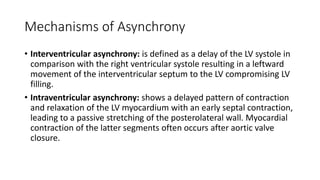
• Interventricular asynchrony: is defined as a delay of the LV systole in
comparison with the right ventricular systole resulting in a leftward
movement of the interventricular septum to the LV compromising LV
filling.
• Intraventricular asynchrony: shows a delayed pattern of contraction
and relaxation of the LV myocardium with an early septal contraction,
leading to a passive stretching of the posterolateral wall. Myocardial
contraction of the latter segments often occurs after aortic valve
closure.
QRS prolongation
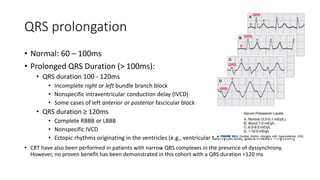
• Normal: 60 – 100ms
• Prolonged QRS Duration (> 100ms):
• QRS duration 100 - 120ms
• Incomplete right or left bundle branch block
• Nonspecific intraventricular conduction delay (IVCD)
• Some cases of left anterior or posterior fascicular block
• QRS duration ≥ 120ms
• Complete RBBB or LBBB
• Nonspecific IVCD
• Ectopic rhythms originating in the ventricles (e.g., ventricular tachycardia, pacemaker rhythm)
• CRT have also been performed in patients with narrow QRS complexes in the presence of dyssynchrony.
However, no proven benefit has been demonstrated in this cohort with a QRS duration <120 ms
CRT and ICD
• (CRT) is also known as biventricular pacing or multisite ventricular
pacing, involves simultaneous pacing of the right ventricle (RV) and
the left ventricle (LV). To this end, a coronary sinus lead is placed for
LV pacing in addition to a conventional RV endocardial lead (with or
without a right atrial [RA] lead).
• ICDs “implantable cardioverterdefibrillators” have revolutionized the
treatment of patients at risk for sudden cardiac death due to
ventricular tachyarrhythmias.
CRT-D
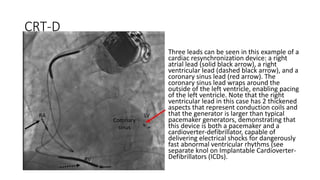
Three leads can be seen in this example of a
cardiac resynchronization device: a right
atrial lead (solid black arrow), a right
ventricular lead (dashed black arrow), and a
coronary sinus lead (red arrow). The
coronary sinus lead wraps around the
outside of the left ventricle, enabling pacing
of the left ventricle. Note that the right
ventricular lead in this case has 2 thickened
aspects that represent conduction coils and
that the generator is larger than typical
pacemaker generators, demonstrating that
this device is both a pacemaker and a
cardioverter-defibrillator, capable of
delivering electrical shocks for dangerously
fast abnormal ventricular rhythms (see
separate knol on Implantable Cardioverter-
Defibrillators (ICDs).
RA
RV
LV
Coronary
sinus
CRT and ICD Benifits
Randomized clinical trials have confirmed the effectiveness of CRT for
the following purposes:
• Improving cardiac hemodynamics and symptoms, reduced
remodeling (reduction in LV chamber size and measures of mitral
regurgitation)
• Preventing hospitalization
• Improving mortality as compared with conventional therapy in
patients with advanced heart failure symptoms and severe left
ventricular dysfunction
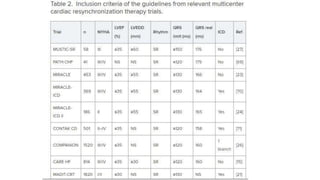
CRT indications criteria
• From the current clinical practice guidelines, there is 369 indications
• There is no single criterion such as QRS width or mechanical
desynchrony assessed by any echocardiographic measure should be
chosen for the prediction of CRT outcome on its own.
• Most of the benefits appear to be associated with the presence of left
bundle branch block (LBBB) on electrocardiography (ECG); the longer
the QRS duration (particularly >150ms), the more beneficial CRT is
likely to be.
• In patients with other forms of conduction disturbance (e.g. right
bundle branch block [RBBB] or RV pacing), CRT is of questionable
utility and therefore cannot be recommended at this time
CRT indications criteria
• secondary prophylaxis against sudden cardiac death and primary prophylaxis.
1. Sinus rhythm, EF less than or equal to 35%, NYHA functional class III/IV and
QRS duration of 120 ms or greater: IA recommendation in the German
guideline only with QRS greater than 150 ms and left bundle branch block
(LBBB);
2. Frequent right ventricular stimulation, EF less than or equal to 35%, and NYHA
functional status III/IV: IIa C recommendation; in the German guideline IIb C;
3. Atrial fibrillation, EF less than or equal to 35%, and NYHA functional status III/IV
IIa B recommendation; in the German guideline IIa C.
4. NYHA functional class II, Sinus rhythm, EF less than or equal to 35%: IIb C
recommendation (without any QRS criterion but frequent RV stimulation); in
the German guideline with QRS duration >150 ms and LBBB: IIb B.
NB. References are available upon request
Thank You
Ahmed Mahmood

Cardiac Resynchronization Therapy and ICDs

  • 1.
    Cardiac Resynchronization Therapy AndICDs Presented by Ahmed Mahmood
  • 2.
    cardiac resynchronization therapy(CRT) • An implanted cardiac resynchronization device is a medical device used in cardiac resynchronization therapy (CRT). • It resynchronizes the contractions of the heart’s ventricles by sending tiny electrical impulses to the heart muscle, which can help the heart pump blood throughout the body more efficiently. • CRT defibrillators (CRT-D) also incorporate the additional function of an implantable cardioverter-defibrillator, to quickly terminate an abnormally fast, life-threatening heart rhythm. • CRT and CRT-D have become increasingly important therapeutic options for patients with moderate and severe heart failure.
  • 3.
    Desynchrony or Asynchrony •refers to “ventricular electromechanical delay,” • identified by multiple imaging techniques, including echocardiography. • Prolongation of the QRS complex is seen in approximately one-third of patients with advanced heart failure • QRS prolongation may be associated with varying degrees of “dyssynchrony.” • Modifications in this delay are often seen with CRT pacing.
  • 4.
    Different Mechanisms ofAsynchrony • Interatrial asynchrony: is defined as a delay between left and right atrial contraction. • Delayed left atrial contraction and premature left ventricular contraction reflected as a dip in the atrial filling curve • Atrioventricular asynchrony: the main reason is AV block and a prolongation of the LV isovolumetric contraction time. As a result the diastolic LV filling is impaired and the mitral valve closure is premature leading to a diastolic mitral insufficiency.
  • 5.
    Mechanisms of Asynchrony •Interventricular asynchrony: is defined as a delay of the LV systole in comparison with the right ventricular systole resulting in a leftward movement of the interventricular septum to the LV compromising LV filling. • Intraventricular asynchrony: shows a delayed pattern of contraction and relaxation of the LV myocardium with an early septal contraction, leading to a passive stretching of the posterolateral wall. Myocardial contraction of the latter segments often occurs after aortic valve closure.
  • 6.
    QRS prolongation • Normal:60 – 100ms • Prolonged QRS Duration (> 100ms): • QRS duration 100 - 120ms • Incomplete right or left bundle branch block • Nonspecific intraventricular conduction delay (IVCD) • Some cases of left anterior or posterior fascicular block • QRS duration ≥ 120ms • Complete RBBB or LBBB • Nonspecific IVCD • Ectopic rhythms originating in the ventricles (e.g., ventricular tachycardia, pacemaker rhythm) • CRT have also been performed in patients with narrow QRS complexes in the presence of dyssynchrony. However, no proven benefit has been demonstrated in this cohort with a QRS duration <120 ms
  • 7.
    CRT and ICD •(CRT) is also known as biventricular pacing or multisite ventricular pacing, involves simultaneous pacing of the right ventricle (RV) and the left ventricle (LV). To this end, a coronary sinus lead is placed for LV pacing in addition to a conventional RV endocardial lead (with or without a right atrial [RA] lead). • ICDs “implantable cardioverterdefibrillators” have revolutionized the treatment of patients at risk for sudden cardiac death due to ventricular tachyarrhythmias.
  • 8.
    CRT-D Three leads canbe seen in this example of a cardiac resynchronization device: a right atrial lead (solid black arrow), a right ventricular lead (dashed black arrow), and a coronary sinus lead (red arrow). The coronary sinus lead wraps around the outside of the left ventricle, enabling pacing of the left ventricle. Note that the right ventricular lead in this case has 2 thickened aspects that represent conduction coils and that the generator is larger than typical pacemaker generators, demonstrating that this device is both a pacemaker and a cardioverter-defibrillator, capable of delivering electrical shocks for dangerously fast abnormal ventricular rhythms (see separate knol on Implantable Cardioverter- Defibrillators (ICDs). RA RV LV Coronary sinus
  • 9.
    CRT and ICDBenifits Randomized clinical trials have confirmed the effectiveness of CRT for the following purposes: • Improving cardiac hemodynamics and symptoms, reduced remodeling (reduction in LV chamber size and measures of mitral regurgitation) • Preventing hospitalization • Improving mortality as compared with conventional therapy in patients with advanced heart failure symptoms and severe left ventricular dysfunction
  • 10.
    CRT indications criteria •From the current clinical practice guidelines, there is 369 indications • There is no single criterion such as QRS width or mechanical desynchrony assessed by any echocardiographic measure should be chosen for the prediction of CRT outcome on its own. • Most of the benefits appear to be associated with the presence of left bundle branch block (LBBB) on electrocardiography (ECG); the longer the QRS duration (particularly >150ms), the more beneficial CRT is likely to be. • In patients with other forms of conduction disturbance (e.g. right bundle branch block [RBBB] or RV pacing), CRT is of questionable utility and therefore cannot be recommended at this time
  • 11.
    CRT indications criteria •secondary prophylaxis against sudden cardiac death and primary prophylaxis. 1. Sinus rhythm, EF less than or equal to 35%, NYHA functional class III/IV and QRS duration of 120 ms or greater: IA recommendation in the German guideline only with QRS greater than 150 ms and left bundle branch block (LBBB); 2. Frequent right ventricular stimulation, EF less than or equal to 35%, and NYHA functional status III/IV: IIa C recommendation; in the German guideline IIb C; 3. Atrial fibrillation, EF less than or equal to 35%, and NYHA functional status III/IV IIa B recommendation; in the German guideline IIa C. 4. NYHA functional class II, Sinus rhythm, EF less than or equal to 35%: IIb C recommendation (without any QRS criterion but frequent RV stimulation); in the German guideline with QRS duration >150 ms and LBBB: IIb B.
  • 13.
    NB. References areavailable upon request Thank You Ahmed Mahmood