TOPIC OUTLINE
 Introduction
 Clinical features
 Mechanism
 Types
 ECG recognition
 D/D
HISTORY
It was first recognized as an electrocardiographic entity in 1979
by Zipes et al.
n 1981, Belhassen et al. were the first to demonstrate the
sensitivity of the tachycardia to verapamil .
In 1988, Ohe et al. reported another type of this tachycardia,
with RBBB and a right-axis deviation.
 Fascicular tachycardia usually presents in patients between 15
and 40 years of age.
 60 %to 80 % are males.
 Fascicular ventricular Tachycardia can be incessant and may
cause reversible tachycardia-related cardiomyopathy.
 SCD is not usually associated with this form of ventricular
tachycardia.
CLINICAL FEATURES
 the natural history is relatively benign
 Occurs in young (15-40YRS)
 Common in males
 Symptoms include palpitations,fatigue,dyspnea,dizziness and
presyncope
 Hemodynamically stable
 Narrow QRS (Narrow because the VT does not travel by cell to
cell instead run through the normal conducting system for
most part in the circuit)
 Most of the episodes occur at rest
 Can be triggered by exercise and emotional stress
 Verapamil sensitive
 Degeneration into VF is rare and hence SCD is
rare
 Tachycardic induced cardiomyopathy can occur
 Spontaneous remission may occur with time .
 Induction with atrial pacing,
 Right bundle branch block (RBBB) and left-axis
configuration and
 Manifestation in patients without structural heart
disease
Theories for origin of VT
 Zipes et al
 origin of the tachycardia was localized to a small region
located in the posteroinferior left ventricle, close to the
posterior fascicle of the left bundle branch.
 Response to verapamil suggested a role for the slow inward
calcium channel in the genesis of the arrhythmia.
 Endocardial mapping during tachycardia revealed the
earliest activation at the ventricular apex and mid septum .
 The tachycardia can be entrained by ventricular and atrial
pacing.
 Entrainment by atrial pacing suggests easy access over the
conduction system into the reentry circuit and hence a role
for the fascicles in the reentrant circuit .
 Lau suggested the origin as reentry circuits involving
the lower septum or posterior part of the left ventricle
close to the endocardial surface in view of the response
to radiofrequency ablation in these sites .
 Purkinje potential recorded in the diastolic phase
during VT at the mid-anterior left ventricular septum
in cases with RBBB pattern and right axis deviation
suggested origin near left anterior fascicle in those
cases .
Anatomic Substrate
 Endocardial mapping during VT initially identified the earliest
site of activation in the region of the infero posterior LV
septum.
 Tachycardia's characteristic QRS morphology during VT and
short retrograde VH interval ,suggested a left-posterior
fascicular origin
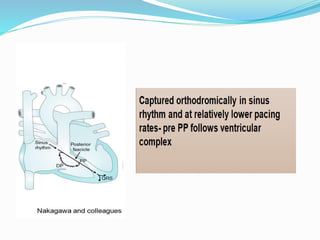
 Nakagawa and colleagues recorded high-frequency
potentials preceding the site of earliest ventricular
activation during the VT and sinus rhythm.
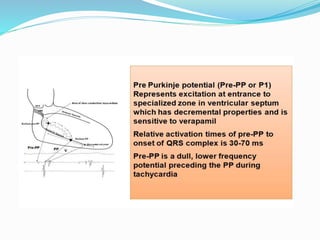
 P potentials (PP) :These potentials are thought to
represent activation of Purkinje fibers and are
recorded from the posterior one third of the left
ventricular septum. Also called as diastolic potentials.
 Successful RF ablation is achieved at sites where the
purkinje potential is recorded 30 to 40 ms before the
VT QRS complex.
Role of false tendon in origin of VT
 tachycardia may originate from a false tendon or
fibro- muscular band that extends from the
posteroinferior left ventricle to the basal septum .
 Histological examination of false tendon disclosed
abundant Purkinje fibers.
 Surgical excision of false tendons eliminates VT.
 false tendon either constitutes part of the tachycardia
circuit, or that the tendon elicits stretch on Purkinje
fibers in the LV septum and there by initiates
tachycardia.
Role of purkinje fibres in genesis of VT
 The AV node is not a anatomically distinct and
discrete structure .
 Instead it is made up of thousands of specialized cells located
in AV junctional area .
 These cells ramify both superiorly and inferiorly
 Hence AV Nodal properties extend downward into the IVS for
some distance.
 In some individuals clusters of cells with slow
conducting property (which is a hall mark of AV nodal
tissue) may invade deep into the IVS .
 The interface of these slow conducting tissue with that of fast
septal purkinje fibres , make it a perfect platform for the
potential slow-fast reentry within IVS.
 This forms the basis of fascicular VT.
 many of the VTs shared the characteristics of SVT especially
when it arises from the high septum.
Mechanism of fascicular VT
 Fascicular VT is due to reentrant mechanism, because it can
be induced, entrained, and terminated by ventricle or atrial
stimulation
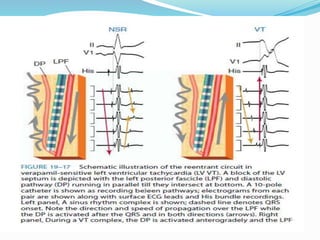
 Tachycardia circuit may comprise a macroreentrant circuit,
with the posterior fascicle serving as one limb and abnormal
decremental Purkinje tissue serving as the other limb
 Anterograde limb is composed of abnormal Purkinje tissue,
which exhibits slow, decremental conduction.
 The retrograde limb consists of Purkinje system tissue from
the left posterior fascicle .
 The entrance site to the slow conduction zone is
thought to be located closer to the base of the LV
septum.
 The exit site (site of earliest ventricular activation) is
located in the inferoposterior aspect of the LV septum
(the region of the LPF) closer to the apex.
 The retrograde limb consists of Purkinje tissue from or
contiguous to the LPF, which gives rise to the Purkinje
potentials.
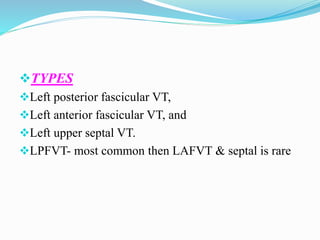
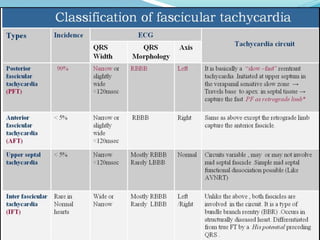
TYPES
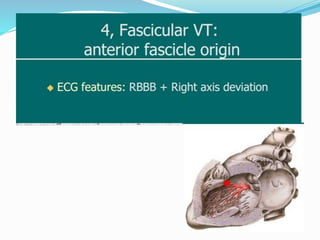
Left posterior fascicular VT,
Left anterior fascicular VT, and
Left upper septal VT.
LPFVT- most common then LAFVT & septal is rare
ECG
ECG During Normal Sinus Rhythm.
 The resting ECG is usually normal.
 Symmetrical, inferolateral T wave inversion can be
present after termination of the VT.
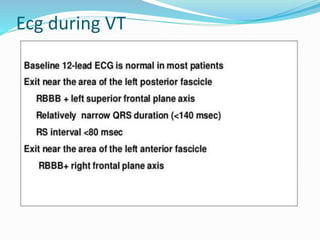
ECG features during VT
 Monomorphic ventricular tachycardia eg. fusion
complexes, AV dissociation, capture beats.
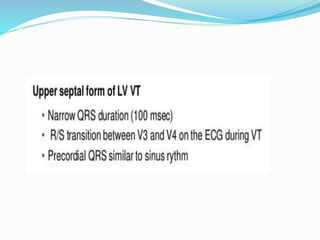
 QRS duration 100 – 140 ms — this is narrower than
other forms of VT.
 Short RS interval (onset of R to nadir of S wave) of 60-
80 ms — the RS interval is usually > 100 ms in other
types of VT.
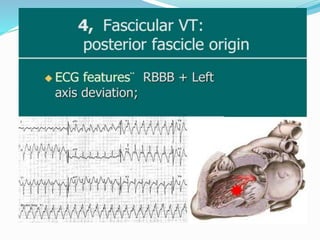
 RBBB Pattern.
 Axis deviation depending on anatomical site of re-
entry circuit
Ecg during VT
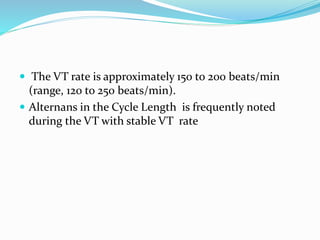
 The VT rate is approximately 150 to 200 beats/min
(range, 120 to 250 beats/min).
 Alternans in the Cycle Length is frequently noted
during the VT with stable VT rate
.
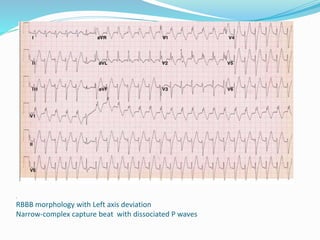
RBBB morphology with Left axis deviation
Narrow-complex capture beat with dissociated P waves
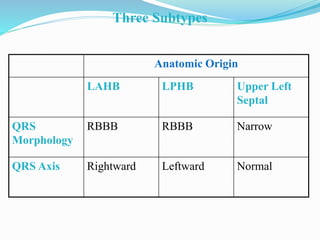
Three Subtypes
Anatomic Origin
LAHB LPHB Upper Left
Septal
QRS
Morphology
RBBB RBBB Narrow
QRS Axis Rightward Leftward Normal
 Fascicular reentrant tachycardia has a characteristic
electropharmacologicprofile.
 Like other forms of idiopathic VT, it is responsive to verapamil
but in contrast to VT originating from the RVOT, adenosine
and Valsalva maneuvers usually have no effect on this form of
VT.
FASCICULAR VT vs. SVT with aberrancy
 The QRS duration in fascicular VT varies from 120 ms to 140
ms and the duration from the beginning of the QRS onset to the
nadir of the S-wave in the precordial leads is 60 to 80 ms.
 This makes it difficult to differentiate this tachycardia from
SVT with aberrancy using the criteria based on QRS
morphology and RS interval.
 Careful analysis of the surface ECG can demonstrate VA
dissociation and rapid atrial pacing during tachycardia can
demonstrate AV dissociation and favors the diagnosis of
fascicular VT
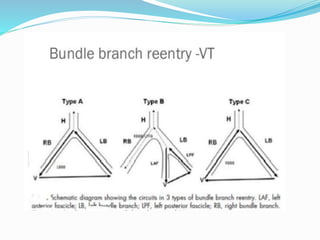
Interfascicular VT
 It is a type of bundle branch reentrant VT
 RBBB morphology and left or right axis deviation during
VT mimicking fascicular VT.
 most commonly seen in patients with an anterior
infarction and either left anterior or posterior hemi
fascicular block.
 During EP study, the ventricular depolarization is
preceded by His bundle depolarization in interfascicular
VT which is not seen in fascicular VT
 Idiopathic mitral annulus VT
RBBB morphology with right axis deviation of the
frontal QRS vector
Focal Purkinje VT
 from the left ventricle can present with an RBBB
configuration and either a left- or right-axis deviation
depending on the origin of VT.
 It is difficult to distinguish this VT from re-entrant
fascicular VT by 12-lead ECG.
 VT can be induced by exercise and catecholamines (e.g.
isoproterenol and phenyrlephline)
 it cannot be induced or terminated by programmed
ventricular stimulation.
 VT is responsive to lidocaine and beta-blockers, it is
usually not responsive to verapamil.
Thank u

FASCICULAR VENTRICULAR TACHYCARDIA( VT)

  • 2.
    TOPIC OUTLINE  Introduction Clinical features  Mechanism  Types  ECG recognition  D/D
  • 3.
    HISTORY It was firstrecognized as an electrocardiographic entity in 1979 by Zipes et al. n 1981, Belhassen et al. were the first to demonstrate the sensitivity of the tachycardia to verapamil . In 1988, Ohe et al. reported another type of this tachycardia, with RBBB and a right-axis deviation.
  • 4.
     Fascicular tachycardiausually presents in patients between 15 and 40 years of age.  60 %to 80 % are males.  Fascicular ventricular Tachycardia can be incessant and may cause reversible tachycardia-related cardiomyopathy.  SCD is not usually associated with this form of ventricular tachycardia.
  • 7.
    CLINICAL FEATURES  thenatural history is relatively benign  Occurs in young (15-40YRS)  Common in males  Symptoms include palpitations,fatigue,dyspnea,dizziness and presyncope  Hemodynamically stable  Narrow QRS (Narrow because the VT does not travel by cell to cell instead run through the normal conducting system for most part in the circuit)
  • 8.
     Most ofthe episodes occur at rest  Can be triggered by exercise and emotional stress  Verapamil sensitive  Degeneration into VF is rare and hence SCD is rare  Tachycardic induced cardiomyopathy can occur  Spontaneous remission may occur with time .
  • 9.
     Induction withatrial pacing,  Right bundle branch block (RBBB) and left-axis configuration and  Manifestation in patients without structural heart disease
  • 11.
    Theories for originof VT  Zipes et al  origin of the tachycardia was localized to a small region located in the posteroinferior left ventricle, close to the posterior fascicle of the left bundle branch.  Response to verapamil suggested a role for the slow inward calcium channel in the genesis of the arrhythmia.  Endocardial mapping during tachycardia revealed the earliest activation at the ventricular apex and mid septum .  The tachycardia can be entrained by ventricular and atrial pacing.  Entrainment by atrial pacing suggests easy access over the conduction system into the reentry circuit and hence a role for the fascicles in the reentrant circuit .
  • 12.
     Lau suggestedthe origin as reentry circuits involving the lower septum or posterior part of the left ventricle close to the endocardial surface in view of the response to radiofrequency ablation in these sites .  Purkinje potential recorded in the diastolic phase during VT at the mid-anterior left ventricular septum in cases with RBBB pattern and right axis deviation suggested origin near left anterior fascicle in those cases .
  • 13.
    Anatomic Substrate  Endocardialmapping during VT initially identified the earliest site of activation in the region of the infero posterior LV septum.  Tachycardia's characteristic QRS morphology during VT and short retrograde VH interval ,suggested a left-posterior fascicular origin
  • 14.
     Nakagawa andcolleagues recorded high-frequency potentials preceding the site of earliest ventricular activation during the VT and sinus rhythm.  P potentials (PP) :These potentials are thought to represent activation of Purkinje fibers and are recorded from the posterior one third of the left ventricular septum. Also called as diastolic potentials.  Successful RF ablation is achieved at sites where the purkinje potential is recorded 30 to 40 ms before the VT QRS complex.
  • 15.
    Role of falsetendon in origin of VT  tachycardia may originate from a false tendon or fibro- muscular band that extends from the posteroinferior left ventricle to the basal septum .  Histological examination of false tendon disclosed abundant Purkinje fibers.  Surgical excision of false tendons eliminates VT.  false tendon either constitutes part of the tachycardia circuit, or that the tendon elicits stretch on Purkinje fibers in the LV septum and there by initiates tachycardia.
  • 16.
    Role of purkinjefibres in genesis of VT  The AV node is not a anatomically distinct and discrete structure .  Instead it is made up of thousands of specialized cells located in AV junctional area .  These cells ramify both superiorly and inferiorly  Hence AV Nodal properties extend downward into the IVS for some distance.
  • 17.
     In someindividuals clusters of cells with slow conducting property (which is a hall mark of AV nodal tissue) may invade deep into the IVS .  The interface of these slow conducting tissue with that of fast septal purkinje fibres , make it a perfect platform for the potential slow-fast reentry within IVS.  This forms the basis of fascicular VT.  many of the VTs shared the characteristics of SVT especially when it arises from the high septum.
  • 18.
    Mechanism of fascicularVT  Fascicular VT is due to reentrant mechanism, because it can be induced, entrained, and terminated by ventricle or atrial stimulation  Tachycardia circuit may comprise a macroreentrant circuit, with the posterior fascicle serving as one limb and abnormal decremental Purkinje tissue serving as the other limb  Anterograde limb is composed of abnormal Purkinje tissue, which exhibits slow, decremental conduction.  The retrograde limb consists of Purkinje system tissue from the left posterior fascicle .
  • 19.
     The entrancesite to the slow conduction zone is thought to be located closer to the base of the LV septum.  The exit site (site of earliest ventricular activation) is located in the inferoposterior aspect of the LV septum (the region of the LPF) closer to the apex.  The retrograde limb consists of Purkinje tissue from or contiguous to the LPF, which gives rise to the Purkinje potentials.
  • 25.
    TYPES Left posterior fascicularVT, Left anterior fascicular VT, and Left upper septal VT. LPFVT- most common then LAFVT & septal is rare
  • 26.
    ECG ECG During NormalSinus Rhythm.  The resting ECG is usually normal.  Symmetrical, inferolateral T wave inversion can be present after termination of the VT.
  • 27.
    ECG features duringVT  Monomorphic ventricular tachycardia eg. fusion complexes, AV dissociation, capture beats.  QRS duration 100 – 140 ms — this is narrower than other forms of VT.  Short RS interval (onset of R to nadir of S wave) of 60- 80 ms — the RS interval is usually > 100 ms in other types of VT.  RBBB Pattern.  Axis deviation depending on anatomical site of re- entry circuit
  • 28.
  • 30.
     The VTrate is approximately 150 to 200 beats/min (range, 120 to 250 beats/min).  Alternans in the Cycle Length is frequently noted during the VT with stable VT rate
  • 32.
    . RBBB morphology withLeft axis deviation Narrow-complex capture beat with dissociated P waves
  • 35.
    Three Subtypes Anatomic Origin LAHBLPHB Upper Left Septal QRS Morphology RBBB RBBB Narrow QRS Axis Rightward Leftward Normal
  • 37.
     Fascicular reentranttachycardia has a characteristic electropharmacologicprofile.  Like other forms of idiopathic VT, it is responsive to verapamil but in contrast to VT originating from the RVOT, adenosine and Valsalva maneuvers usually have no effect on this form of VT.
  • 38.
    FASCICULAR VT vs.SVT with aberrancy  The QRS duration in fascicular VT varies from 120 ms to 140 ms and the duration from the beginning of the QRS onset to the nadir of the S-wave in the precordial leads is 60 to 80 ms.  This makes it difficult to differentiate this tachycardia from SVT with aberrancy using the criteria based on QRS morphology and RS interval.  Careful analysis of the surface ECG can demonstrate VA dissociation and rapid atrial pacing during tachycardia can demonstrate AV dissociation and favors the diagnosis of fascicular VT
  • 39.
    Interfascicular VT  Itis a type of bundle branch reentrant VT  RBBB morphology and left or right axis deviation during VT mimicking fascicular VT.  most commonly seen in patients with an anterior infarction and either left anterior or posterior hemi fascicular block.  During EP study, the ventricular depolarization is preceded by His bundle depolarization in interfascicular VT which is not seen in fascicular VT
  • 41.
     Idiopathic mitralannulus VT RBBB morphology with right axis deviation of the frontal QRS vector
  • 42.
    Focal Purkinje VT from the left ventricle can present with an RBBB configuration and either a left- or right-axis deviation depending on the origin of VT.  It is difficult to distinguish this VT from re-entrant fascicular VT by 12-lead ECG.  VT can be induced by exercise and catecholamines (e.g. isoproterenol and phenyrlephline)  it cannot be induced or terminated by programmed ventricular stimulation.  VT is responsive to lidocaine and beta-blockers, it is usually not responsive to verapamil.
  • 44.