Ventricular Tachycardia
                林彥璋 醫師,
    Lin Yenn-Jiang MD. Chen Shih-Ann MD.
                   April 24, 2011
           Advanced EP training, THRS
             St. Jude Medical, Taipei
Division of Cardiology, Taipei Veterans General Hospital
   and National Yang-Ming University, Taipei, Taiwan
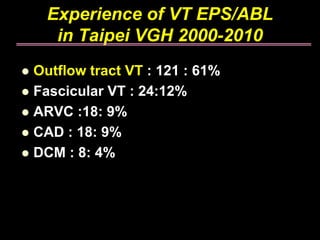
Experience of VT EPS/ABL
   in Taipei VGH 2000-2010
Outflow tract VT : 121 : 61%
Fascicular VT : 24:12%
ARVC :18: 9%
CAD : 18: 9%
DCM : 8: 4%
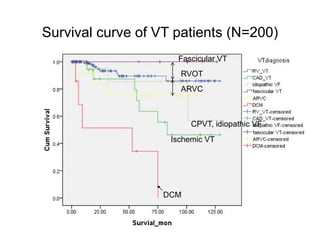
P=0.007
Survival curve of VT patients (N=200)
                     Fascicular VT
                      RVOT
                      ARVC


                         CPVT, idiopathic VF
                    Ischemic VT


                   DCM
How to Map VT

Mapping
 Basic electrophysiologic study
 Pace mapping
 Activation mapping
 Electroanatomic mapping
Ablation: RV, LV, and Epicardium
Outlines


Outflow tract VT
ARVC
Fascicular VT
Substrate VT
Outflow Tract Ventricular
     Tachycardia (OT-VT)
VT arises from the right ventricular outflow
tract (RVOT-VT, left ventricular outflow
tract (LVOT-VT), aortic cusps (Cusp VT),
and from the pulmonary artery (PA VT)
OT-VT tend to occur in the absence of
structural heart disease and are focal in
origin, the 12-lead ECG recorded during
VT is a precise localizing tool.
Clinical Features of RVOT-VT
RVOT VT constitutes 75% of all patients
with outflow tract VT
RVOT VT is more common in females 30-
50 years old.
Symptoms include palpitations, dizziness,
atypical chest pain, and syncope.
Exercise testing reproduces the patient’s
clinical VT 25 to 50% of the time.
Mechanism of RVOT-VT
Most forms of RVOT VT are sensitive to
adenosine
Most likely mechanism is catecholamine
mediated DAD and triggered activity.
Mediated by the activation of cyclic AMP.
Can be induced in the EP lab with
isoproterenol, aminophylline, atropine, and
rapid burst pacing but rarely with
programmed ventricular extrastimuli.
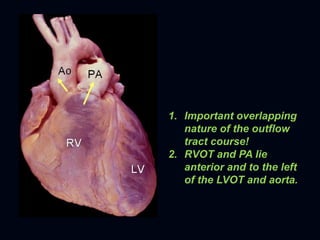
1. Important overlapping
   nature of the outflow
   tract course!
2. RVOT and PA lie
   anterior and to the left
   of the LVOT and aorta.
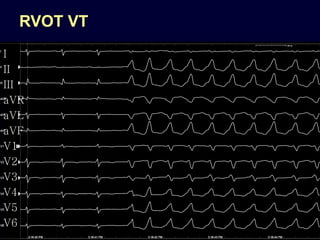
RVOT VT
I
II
III
aVR
aVL
aVF
V1
V2
V3
V4
V5
V6
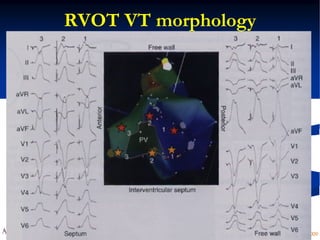
RVOT VT morphology
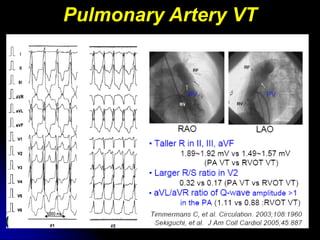
Pulmonary Artery VT
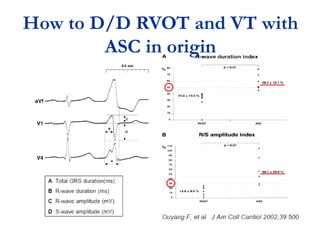
How to D/D RVOT and VT with
        ASC in origin
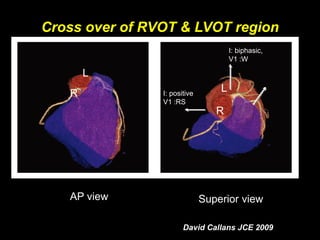
Cross over of RVOT & LVOT region
                                      I: biphasic,
                                      V1 :W

       L
   R            I: positive
                                  L
                V1 :RS
                                 R


   AP view                    Superior view

                       David Callans JCE 2009
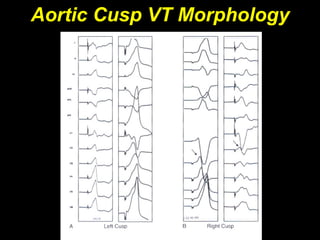
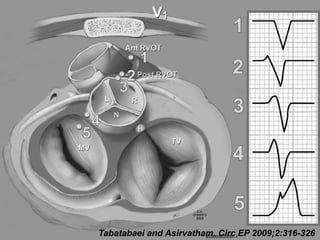
Aortic Cusp VT Morphology
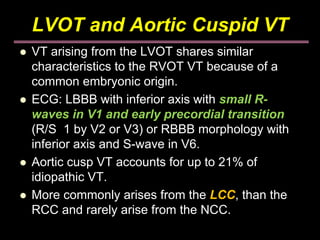
LVOT and Aortic Cuspid VT
VT arising from the LVOT shares similar
characteristics to the RVOT VT because of a
common embryonic origin.
ECG: LBBB with inferior axis with small R-
waves in V1 and early precordial transition
(R/S 1 by V2 or V3) or RBBB morphology with
inferior axis and S-wave in V6.
Aortic cusp VT accounts for up to 21% of
idiopathic VT.
More commonly arises from the LCC, than the
RCC and rarely arise from the NCC.
Tabatabaei and Asirvatham. Circ EP 2009;2:316-326
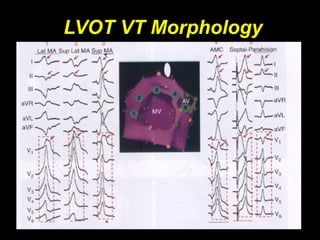
LVOT VT Morphology
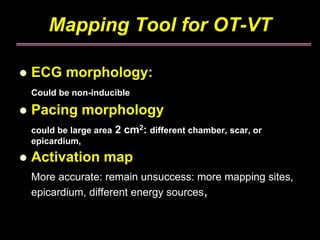
Mapping Tool for OT-VT

ECG morphology:
Could be non-inducible

Pacing morphology
could be large area   2 cm2: different chamber, scar, or
epicardium,
Activation map
More accurate: remain unsuccess: more mapping sites,
epicardium, different energy sources,
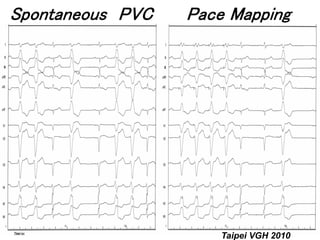
Spontaneous PVC   Pace Mapping


                      Taipei VGH 2010
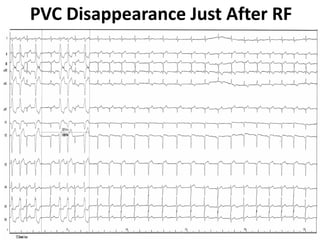
PVC Disappearance Just After RF 
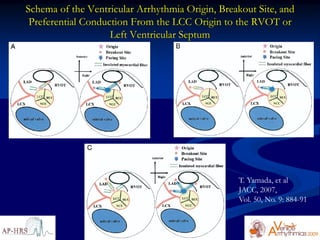
Schema of the Ventricular Arrhythmia Origin, Breakout Site, and
 Preferential Conduction From the LCC Origin to the RVOT or
                    Left Ventricular Septum


                                                 T. Yamada, et al
                                                 JACC, 2007,
                                                 Vol. 50, No. 9: 884-91
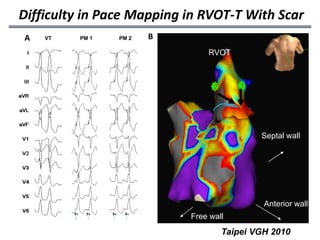
Difficulty in Pace Mapping in RVOT‐T With Scar
A   VT   PM 1   PM 2   B
                               RVOT


                                 2       1


                                             Septal wall


                                              Anterior wall
                           Free wall
                                     Taipei VGH 2010
Requirement of NCM
        for VT mapping
Pacing mapping may not sensitive to
locate the sites of foci in certain patients
with focal VT, in the presence of large
scar area.
VT could be non-sustained and unstable.
It is difficult to map the entire chamber
One beat analysis of dynamic substrate by
NCM may be useful to treat these patients.
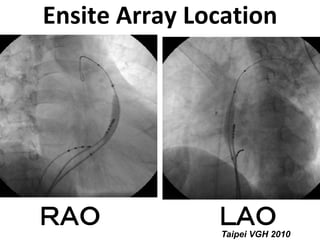
Ensite Array Location


RAO            LAO
               Taipei VGH 2010
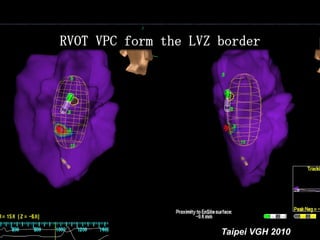
RVOT VPC form the LVZ border


(Higa S: University of the Ryukyus, Okinawa, Japan) 2010
                                         Taipei VGH
Conclusions
 Carefully ECG interpretation and EP study to
 localize the optimum ablation site for VT.
 Usually not life threatening, and could be treated
 conservatively.
 3D mapping system can be helpful (activation
 map or substrate map), but correct chamber, far-
 field sensing, preferential conduction need to be
 considered.
Outlines

Outflow tract VT
RV related VT and ARVC
Fascicular VT
Substrate VT
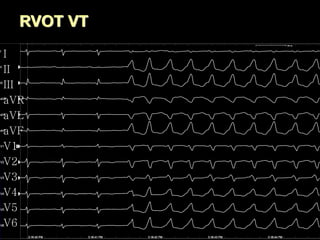
RVOT VT
I
II
III
aVR
aVL
aVF
V1
V2
V3
V4
V5
V6
Idiopathic RVOT-T
Right ventricular outflow tract tachycardia
(RVOT-T) represents up to 10% of all ventricular
tachycardias (VTs), and is considered as a
benign disease.
Symptoms: Ranging from none to palpitations,
lightheadedness, dyspnea, or syncope.
Arrhythmias: Frequent isolated PVCs, bursts of
nonsustained VT, or sustained tachycardia often
facilitated by catecholamines or exercise.
Ablation: Acute success rate of focal ablation of
RVOT-T is 65–97% with rare complications.
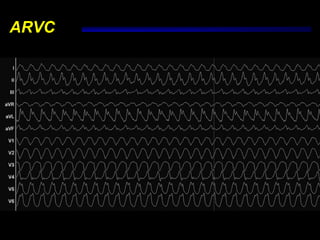
ARVC
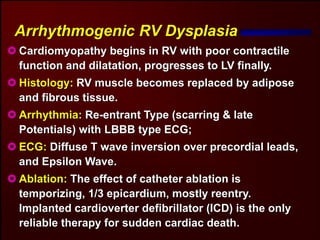
Arrhythmogenic RV Dysplasia
Cardiomyopathy begins in RV with poor contractile
function and dilatation, progresses to LV finally.
Histology: RV muscle becomes replaced by adipose
and fibrous tissue.
Arrhythmia: Re-entrant Type (scarring & late
Potentials) with LBBB type ECG;
ECG: Diffuse T wave inversion over precordial leads,
and Epsilon Wave.
Ablation: The effect of catheter ablation is
temporizing, 1/3 epicardium, mostly reentry.
Implanted cardioverter defibrillator (ICD) is the only
reliable therapy for sudden cardiac death.
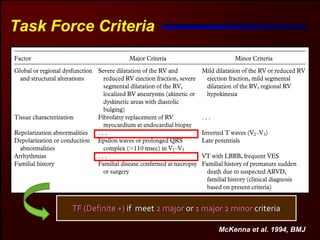
Task Force Criteria


        TF (Definite +) if  meet 2 major or 1 major 2 minor criteria

                                                  McKenna et al. 1994, BMJ
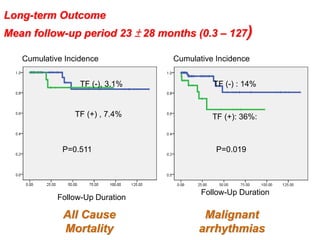
Long-term Outcome
Mean follow-up period 23 ± 28 months (0.3 – 127)

   Cumulative Incidence          Cumulative Incidence


                  TF (-), 3.1%             TF (-) : 14%


                TF (+) , 7.4%              TF (+): 36%:


             P=0.511                        P=0.019


                                        Follow-Up Duration
            Follow-Up Duration

             All Cause                  Malignant
             Mortality                 arrhythmias
Conclusions
 Positive TF criteria is important to diagnose
 ARVC/D and is specific to detect the future
 VF/ICD implantation/ CV mortality
 Malignant ventricular arrhythmia and late
 recurrences may occur in patients with mild
 or atypical form of arrhythmogenic RV
 cardiomyopathy.
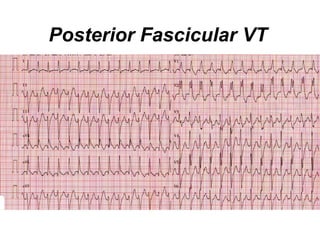
Posterior Fascicular VT
Outlines

Outflow tract VT
ARVC
Fascicular VT
Substrate VT
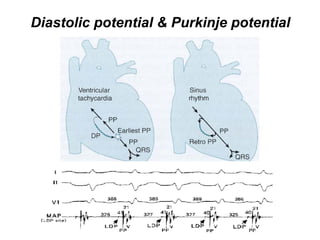
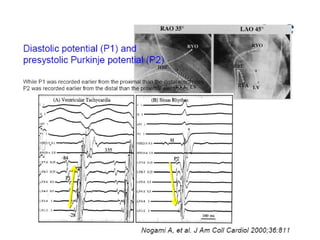
Diastolic potential & Purkinje potential
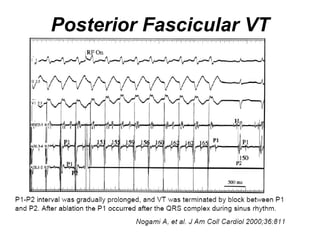
Posterior Fascicular VT
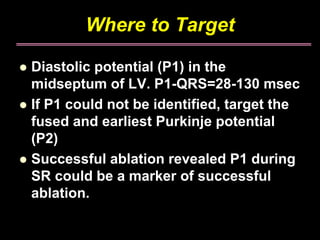
Where to Target

Diastolic potential (P1) in the
midseptum of LV. P1-QRS=28-130 msec
If P1 could not be identified, target the
fused and earliest Purkinje potential
(P2)
Successful ablation revealed P1 during
SR could be a marker of successful
ablation.
Outlines

Outflow tract VT
ARVC
Fascicular VT
Substrate VT
Structure heart related VT
• BBRT
• Ischemic heart disease (most common):
  mostly Endocardium
• ARVC: Epi/Endo
• Non-ischemic cardiomyopathy: Epi/Edno
• Tetralogy of Fallot and other post
  operation patients: Endo
Substrate VT

Identification of the critical ventricle
to be targeted (voltage mapping).
Identify the location of the scar
(bipolar voltage <0.5 mV, unipolar
PNV < 30%).
Conventional entrainment
techniques remain important.
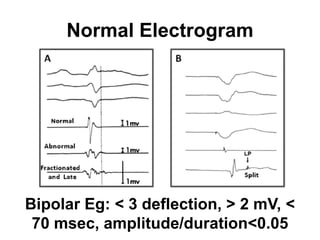
Normal Electrogram


Bipolar Eg: < 3 deflection, > 2 mV, <
 70 msec, amplitude/duration<0.05
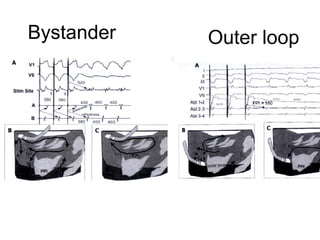
Bystander   Outer loop
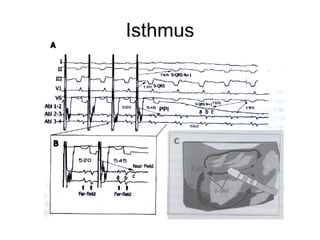
Isthmus
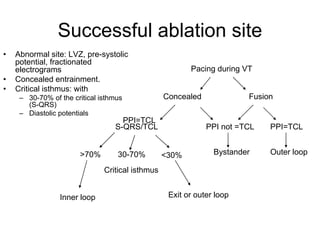
Successful ablation site
•   Abnormal site: LVZ, pre-systolic
    potential, fractionated
    electrograms                                         Pacing during VT
•   Concealed entrainment.
•   Critical isthmus: with
     – 30-70% of the critical isthmus             Concealed             Fusion
       (S-QRS)
     – Diastolic potentials
                                    PPI=TCL
                                  S-QRS/TCL                   PPI not =TCL   PPI=TCL


                       >70%        30-70%         <30%          Bystander    Outer loop

                               Critical isthmus


                 Inner loop                        Exit or outer loop
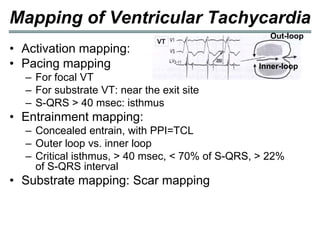
Mapping of Ventricular Tachycardia
                                                   Out-loop
• Activation mapping:
• Pacing mapping                                Inner-loop
  – For focal VT
  – For substrate VT: near the exit site
  – S-QRS > 40 msec: isthmus
• Entrainment mapping:
  – Concealed entrain, with PPI=TCL
  – Outer loop vs. inner loop
  – Critical isthmus, > 40 msec, < 70% of S-QRS, > 22%
    of S-QRS interval
• Substrate mapping: Scar mapping
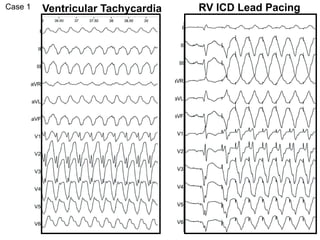
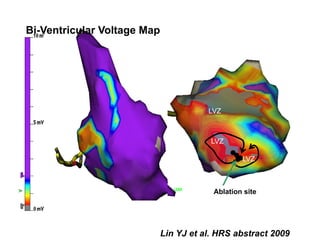
Case 1   Ventricular Tachycardia   RV ICD Lead Pacing
Bi-Ventricular Voltage Map


                                        LVZ


                                         LVZ

                                                 LVZ


                                         Ablation site


                             Lin YJ et al. HRS abstract 2009
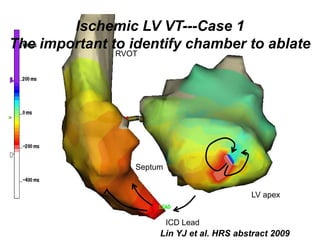
Ischemic LV VT---Case 1
The important to identify chamber to ablate
               RVOT


                  Septum


                                            LV apex


                           ICD Lead
                       Lin YJ et al. HRS abstract 2009
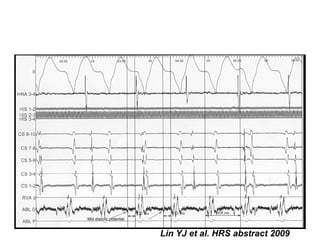
Lin YJ et al. HRS abstract 2009
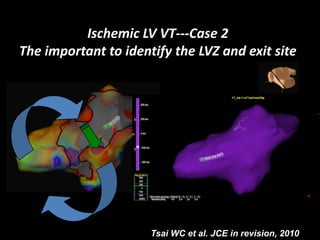
Ischemic LV VT‐‐‐Case 2
The important to identify the LVZ and exit site


                      Tsai WC et al. JCE in revision, 2010
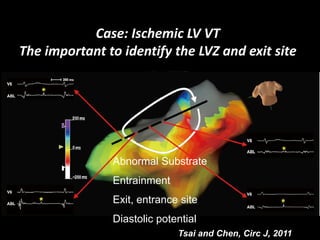
Case: Ischemic LV VT 
The important to identify the LVZ and exit site


               Abnormal Substrate
               Entrainment
               Exit, entrance site
               Diastolic potential
                             Tsai and Chen, Circ J, 2011
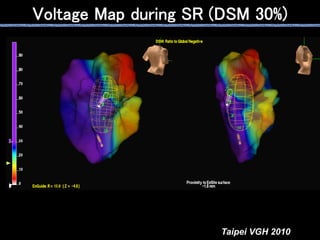
Voltage Map during SR (DSM 30%)


                      Taipei VGH 2010
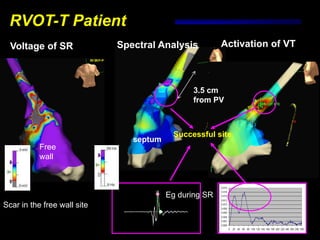
RVOT-T Patient
  Voltage of SR              Spectral Analysis          Activation of VT


                                                3.5 cm
                                                from PV


                                          Successful site
                                septum
           Free
           wall


                                         Eg during SR
Scar in the free wall site
Conclusions
Outflow tract VT is the commonest form of
idiopathic VT.
ECG morphology is important for localization of
focal VT and exit site of substrate VT before 3 D
mapping.
Pacing mapping may not sensitive to locate the
sites of foci in certain patients with focal VT, in
the presence of large scar area.
Substrate mapping and entrainment mapping
are important for the substrate VT.

Ventricular tachycardia_lecture

  • 1.
    Ventricular Tachycardia 林彥璋 醫師, Lin Yenn-Jiang MD. Chen Shih-Ann MD. April 24, 2011 Advanced EP training, THRS St. Jude Medical, Taipei Division of Cardiology, Taipei Veterans General Hospital and National Yang-Ming University, Taipei, Taiwan
  • 2.
    Experience of VTEPS/ABL in Taipei VGH 2000-2010 Outflow tract VT : 121 : 61% Fascicular VT : 24:12% ARVC :18: 9% CAD : 18: 9% DCM : 8: 4%
  • 3.
    P=0.007 Survival curve ofVT patients (N=200) Fascicular VT RVOT ARVC CPVT, idiopathic VF Ischemic VT DCM
  • 4.
    How to MapVT Mapping Basic electrophysiologic study Pace mapping Activation mapping Electroanatomic mapping Ablation: RV, LV, and Epicardium
  • 5.
  • 6.
    Outflow Tract Ventricular Tachycardia (OT-VT) VT arises from the right ventricular outflow tract (RVOT-VT, left ventricular outflow tract (LVOT-VT), aortic cusps (Cusp VT), and from the pulmonary artery (PA VT) OT-VT tend to occur in the absence of structural heart disease and are focal in origin, the 12-lead ECG recorded during VT is a precise localizing tool.
  • 7.
    Clinical Features ofRVOT-VT RVOT VT constitutes 75% of all patients with outflow tract VT RVOT VT is more common in females 30- 50 years old. Symptoms include palpitations, dizziness, atypical chest pain, and syncope. Exercise testing reproduces the patient’s clinical VT 25 to 50% of the time.
  • 8.
    Mechanism of RVOT-VT Mostforms of RVOT VT are sensitive to adenosine Most likely mechanism is catecholamine mediated DAD and triggered activity. Mediated by the activation of cyclic AMP. Can be induced in the EP lab with isoproterenol, aminophylline, atropine, and rapid burst pacing but rarely with programmed ventricular extrastimuli.
  • 9.
    1. Important overlapping nature of the outflow tract course! 2. RVOT and PA lie anterior and to the left of the LVOT and aorta.
  • 10.
  • 11.
  • 12.
  • 13.
    How to D/DRVOT and VT with ASC in origin
  • 14.
    Cross over ofRVOT & LVOT region I: biphasic, V1 :W L R I: positive L V1 :RS R AP view Superior view David Callans JCE 2009
  • 15.
    Aortic Cusp VTMorphology
  • 16.
    LVOT and AorticCuspid VT VT arising from the LVOT shares similar characteristics to the RVOT VT because of a common embryonic origin. ECG: LBBB with inferior axis with small R- waves in V1 and early precordial transition (R/S 1 by V2 or V3) or RBBB morphology with inferior axis and S-wave in V6. Aortic cusp VT accounts for up to 21% of idiopathic VT. More commonly arises from the LCC, than the RCC and rarely arise from the NCC.
  • 17.
    Tabatabaei and Asirvatham.Circ EP 2009;2:316-326
  • 18.
  • 19.
    Mapping Tool forOT-VT ECG morphology: Could be non-inducible Pacing morphology could be large area 2 cm2: different chamber, scar, or epicardium, Activation map More accurate: remain unsuccess: more mapping sites, epicardium, different energy sources,
  • 20.
    Spontaneous PVC Pace Mapping Taipei VGH 2010
  • 21.
  • 22.
    Schema of theVentricular Arrhythmia Origin, Breakout Site, and Preferential Conduction From the LCC Origin to the RVOT or Left Ventricular Septum T. Yamada, et al JACC, 2007, Vol. 50, No. 9: 884-91
  • 23.
    Difficulty in Pace Mapping in RVOT‐T With Scar A VT PM 1 PM 2 B RVOT 2 1 Septal wall Anterior wall Free wall Taipei VGH 2010
  • 24.
    Requirement of NCM for VT mapping Pacing mapping may not sensitive to locate the sites of foci in certain patients with focal VT, in the presence of large scar area. VT could be non-sustained and unstable. It is difficult to map the entire chamber One beat analysis of dynamic substrate by NCM may be useful to treat these patients.
  • 25.
    Ensite Array Location RAO LAO Taipei VGH 2010
  • 26.
    RVOT VPC formthe LVZ border (Higa S: University of the Ryukyus, Okinawa, Japan) 2010 Taipei VGH
  • 27.
    Conclusions Carefully ECGinterpretation and EP study to localize the optimum ablation site for VT. Usually not life threatening, and could be treated conservatively. 3D mapping system can be helpful (activation map or substrate map), but correct chamber, far- field sensing, preferential conduction need to be considered.
  • 28.
    Outlines Outflow tract VT RVrelated VT and ARVC Fascicular VT Substrate VT
  • 29.
  • 30.
    Idiopathic RVOT-T Right ventricularoutflow tract tachycardia (RVOT-T) represents up to 10% of all ventricular tachycardias (VTs), and is considered as a benign disease. Symptoms: Ranging from none to palpitations, lightheadedness, dyspnea, or syncope. Arrhythmias: Frequent isolated PVCs, bursts of nonsustained VT, or sustained tachycardia often facilitated by catecholamines or exercise. Ablation: Acute success rate of focal ablation of RVOT-T is 65–97% with rare complications.
  • 32.
  • 33.
    Arrhythmogenic RV Dysplasia Cardiomyopathybegins in RV with poor contractile function and dilatation, progresses to LV finally. Histology: RV muscle becomes replaced by adipose and fibrous tissue. Arrhythmia: Re-entrant Type (scarring & late Potentials) with LBBB type ECG; ECG: Diffuse T wave inversion over precordial leads, and Epsilon Wave. Ablation: The effect of catheter ablation is temporizing, 1/3 epicardium, mostly reentry. Implanted cardioverter defibrillator (ICD) is the only reliable therapy for sudden cardiac death.
  • 34.
    Task Force Criteria TF (Definite +) if  meet 2 major or 1 major 2 minor criteria McKenna et al. 1994, BMJ
  • 35.
    Long-term Outcome Mean follow-upperiod 23 ± 28 months (0.3 – 127) Cumulative Incidence Cumulative Incidence TF (-), 3.1% TF (-) : 14% TF (+) , 7.4% TF (+): 36%: P=0.511 P=0.019 Follow-Up Duration Follow-Up Duration All Cause Malignant Mortality arrhythmias
  • 36.
    Conclusions Positive TFcriteria is important to diagnose ARVC/D and is specific to detect the future VF/ICD implantation/ CV mortality Malignant ventricular arrhythmia and late recurrences may occur in patients with mild or atypical form of arrhythmogenic RV cardiomyopathy.
  • 37.
  • 38.
  • 39.
    Diastolic potential &Purkinje potential
  • 41.
  • 42.
    Where to Target Diastolicpotential (P1) in the midseptum of LV. P1-QRS=28-130 msec If P1 could not be identified, target the fused and earliest Purkinje potential (P2) Successful ablation revealed P1 during SR could be a marker of successful ablation.
  • 43.
  • 44.
    Structure heart relatedVT • BBRT • Ischemic heart disease (most common): mostly Endocardium • ARVC: Epi/Endo • Non-ischemic cardiomyopathy: Epi/Edno • Tetralogy of Fallot and other post operation patients: Endo
  • 45.
    Substrate VT Identification ofthe critical ventricle to be targeted (voltage mapping). Identify the location of the scar (bipolar voltage <0.5 mV, unipolar PNV < 30%). Conventional entrainment techniques remain important.
  • 46.
    Normal Electrogram Bipolar Eg:< 3 deflection, > 2 mV, < 70 msec, amplitude/duration<0.05
  • 47.
    Bystander Outer loop
  • 48.
  • 49.
    Successful ablation site • Abnormal site: LVZ, pre-systolic potential, fractionated electrograms Pacing during VT • Concealed entrainment. • Critical isthmus: with – 30-70% of the critical isthmus Concealed Fusion (S-QRS) – Diastolic potentials PPI=TCL S-QRS/TCL PPI not =TCL PPI=TCL >70% 30-70% <30% Bystander Outer loop Critical isthmus Inner loop Exit or outer loop
  • 50.
    Mapping of VentricularTachycardia Out-loop • Activation mapping: • Pacing mapping Inner-loop – For focal VT – For substrate VT: near the exit site – S-QRS > 40 msec: isthmus • Entrainment mapping: – Concealed entrain, with PPI=TCL – Outer loop vs. inner loop – Critical isthmus, > 40 msec, < 70% of S-QRS, > 22% of S-QRS interval • Substrate mapping: Scar mapping
  • 51.
    Case 1 Ventricular Tachycardia RV ICD Lead Pacing
  • 52.
    Bi-Ventricular Voltage Map LVZ LVZ LVZ Ablation site Lin YJ et al. HRS abstract 2009
  • 53.
    Ischemic LV VT---Case1 The important to identify chamber to ablate RVOT Septum LV apex ICD Lead Lin YJ et al. HRS abstract 2009
  • 54.
    Lin YJ etal. HRS abstract 2009
  • 55.
  • 56.
    Case: Ischemic LV VT  The important to identify the LVZ and exit site Abnormal Substrate Entrainment Exit, entrance site Diastolic potential Tsai and Chen, Circ J, 2011
  • 57.
    Voltage Map duringSR (DSM 30%) Taipei VGH 2010
  • 58.
    RVOT-T Patient Voltage of SR Spectral Analysis Activation of VT 3.5 cm from PV Successful site septum Free wall Eg during SR Scar in the free wall site
  • 59.
    Conclusions Outflow tract VTis the commonest form of idiopathic VT. ECG morphology is important for localization of focal VT and exit site of substrate VT before 3 D mapping. Pacing mapping may not sensitive to locate the sites of foci in certain patients with focal VT, in the presence of large scar area. Substrate mapping and entrainment mapping are important for the substrate VT.