THEBASICSOF
VENTILATOR SETTINGS
SERIES2
DR. C. KANNAN
POST GRADUATE
PEDIATRICS
MGMCRI
REVISION OF PART 1
TIDAL VOLUME (VT)
• Volume of gas that flows in and out of the chest during quiet breathing .
• Normal tidal volume in children – 6-12ml/kg
MINUTE VENTILATION (MV)
• Product of tidal volume and ventilator rate.
PEAK INSPIRATORY PRESSURE (PIP)
• Highest that can be met during the inspiratory period
POSITIVE END EXPIRATORY PRESSURE (PEEP)
• PEEP is the baseline positive pressure in the airway during expiration.
• It is designed to keep alveoli from collapsing at the end of expiration.
• PEEP prevents derecruitment of alveoli and it has protective effect in
prevention of ventilator associated lung injury.
• Normal PEEP 3-5cmH2O
INSPIRATORY TIME AND I:E RATIOS
• Normal I:E ratio is usually 1:1.5 to 1:2
• Altered by adjusting the inspiratory time.
DICUSSION
• Anatomy of the ventilator
• Modes in ventilator
• How to start a ventilator ?
• Disease based strategy
ANATOMY
• Purified compressed air & oxygen
• Either inbuilt cylinders or from wall outlet
• Sophisticated software
• Ensures the pattern of breath delivery
• As set by the caregiver
• Humidifier / Heat & Moist exchanger (HME)
Contd.,
• Ventilator hardware
• Monitors
• Pressure gauges / Flow & Volume sensors / Alarms / Graphics
• Circuits – Reusable / Disposable
• Two limbs – Inspiratory / expiratory
• Heated wire present in both limbs - Prevents condensation
• Water traps in dependent position in both limbs
MODES
DETERMINANTS OF MODES
• BREATH TYPE
• Mandatory
• Spontaneous
• Assisted
• CONTROL VARIABLE
• Pressure control
• Volume control
• Dual control
• TIME OF BREATH DELIVERY
• CMV
• Spontaneous
• Assisted
MODES/ACTION BY TRIGGERING LIMITING CYCLING
MANDATORY Ventilator ventilator ventilator
ASSISTED Patient / venti Patient / venti Patient / venti
SPONTANEOUS Patient Venti / patient Patient
1. BREATH TYPE
2. CONTROL VARIABLE
A. PRESSURE CONTROLLED BREATHS
• Pressure is set by clinician (Independent variable)
• PIP / PEEP / Rate / Inspiratory time (Ti)
• Volume (VT) can change (Dependent variable)
• Determined by
• Delta P (PIP – PEEP)
• Compliance / Airway resistance / Circuit / Patient effort
• Flow waveform is decelerating ( Pressure gradient )
PRESSURE CONTROL FLOW CHART
• Advantages
• Risk of barotrauma is less
• Improves gas distribution in heterogeneous lung mechanics
• Satisfy patient demands in spontaneous breaths
• Where airway is not fully sealed
• Uncuffed tracheal tubes
• Bronchopleural fistulas
• Airleak syndromes
• Disadvantages
• PC does not guarantee minute volume
• Tidal volume changes depends upon compliance
• If lung is stiff - TV reduces
• If lung compliance improves - TV increases - Volutrauma
• Hence close clinical monitoring is essential
• To prevent hypo / hyperventilation
B. VOLUME CONTROLLED BREATHS
• Used in older children
• Part of mandatory controlled mode (CMV / SIMV)
• Tidal volume is set by clinician (Independent variable)
• Pressure can change (Dependant variable)
• Cycling mechanism is controlled by
• Pre-set time (Ti) / Pre-set Volume
• Flow wave form is constant
VC – FLOW CHART
• Advantages
• Minute ventilation is guaranteed
• Important in airway diseases ( B. Asthma / Bronchiolitis)
• Disadvantages
• High risk of barotrauma (Pressure fluctuates)
• Flow is constant
• Hence cant satisfy patient demand in spontaneous breaths
• Smaller tidal volume will not be accurately delivered
• In case of altered lung mechanics
• Divided B/W circuit / Airways / Lungs
• Disadvantages
• If the patient worsens by
• Eg., Takes more tidal volume by increased WOB
• Ventilator senses high exhaled TV and reduces pressure
• Reduced pressure support, further worsens WOB
3. TIMING OF BREATH DELIVERY
A. CONTROLLED MANDATORY / MECHANICAL VENTILATION (CMV)
• CMV may utilise pressure / Volume / Dual control
• Breaths initiated, limited and cycled by ventilator
• Patient has no active role
• Used in
• Insufficient / Absent respiratory drive
• Completely sedated patients
B. ASSISTED MODES
• Used, when patient is making some effort
• Breath may be triggered by patient / pre-set time
• Whichever comes first
• Rest of the breath completed by ventilator
• Two types of assisted modes
• Intermittent mandatory ventilation
• Synchronised Intermittent Mandatory Ventilation
• Intermittent mandatory ventilation(IMV)
• Gives partial ventilator support
• Gradually increases patient’s WOB
• Thereby strengthens respiratory muscles
• Concurrently IMV breaths delivered to prevent fatigue
• IMV breaths are delivered at set intervals
• IMV breaths gradually reduced to CPAP, if patient improves
• Disadvantages
• Breath stacking
• Ventilator & Patient breaths at same time
• Leads to high airway pressure
• Breathing against the ETT – Burden for injured lungs
• Synchronised Intermittent Mandatory Ventilation (SIMV)
• Allows mechanical breaths to be given on patient demand
• Breath stacking solved by inbuilt sensor, which
• Synchronises patient’s spontaneous breaths to set rate
• SIMV along with pressure or volume support is widely used
• SIMV+PS / SIMV+VS
C. SPONTANEOUS MODES (CPAP / PSV / VS)
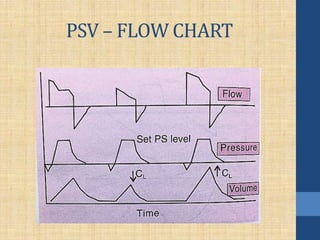
Pressure Support Ventilation (PSV)
• Used for patients with reliable and stable respiratory drive
• To set PIP / PEEP / FiO2
• Setting VT / Ti / Rate is not required
• Patient initiates breaths, F/B ventilator completes
• Patient triggered / pressure limited / flow cycled
• VT can be changed depending on compliance / resistance
• If patient effort improves, pre-set PS may be reduced
• Hence monitor RR / VTe / Patient effort
PSV – FLOW CHART
• CPAP
• Elevation of baseline pressure during spontaneous breathing
• PEEP is elevation of baseline pressure during mech. Ventilation
• Open ups the collapsed alveoli
CPAP – FLOW CHART
HOW TO START A
VENTILATOR ?
BEFORE CONNECTING TO VENTILATOR
• System self check with circuit and test lung
• Calculates the compressible volume
• Thereby determines the VT
• Pressure controlled ventilators are preferred in weight < 8kg
• Ensure functioning humidifier / HME
• Set an average PIP ( 10 – 12 cmH2O)
• Optimal PIP will be determined by
• Adequate chest rise
• Good oxygenation
• Hemodynamic stability
• Blood gas
PROVISION OF ALVEOLAR VENTILATION
• Ventilator rate - According to age / Disease
• VC
• VT – 6-8 ml/kg
• Further adjusted acc. to chest rise / air entry / bld. gases
• PC
• PIP – 10 to 20 cmH2O / Above PEEP
• Should produce adequate chest rise
• VT will be generated from PIP – PEEP
• I:E ratio - 1:2
• In obstructive disease
• Keep prolonged expiratory time
• Reduced rate
MAINTANANCE OF ADEQUATE OXYGENATION
• FiO2
• In hypoxemic patients - Set initial FiO2 to 0.6 – 1.0
• Once improves reduce to non-toxic levels (< 0.5)
• PEEP
• 5 cmH2O or higher as needed
• Optimal PEEP
• Recruits collapsed alveoli / Maintains hemodynamics
• Heterogeneous lung disease = 7-10 cmH2O
• Diffuse lung disease = 10-15 cmH2O
• Target SaO2 90% with FiO2 0.5 – 0.6
SETTING APPROPRIATE ALARM SETTINGS
• Set alarm after final settings are made
• Too narrow range - Frequent alarms / Ignored by care givers
• Too wide range - Life threatening events will be missed
• High pressure alarm
• Set 8-10 cmH2O above the PIP
• Once alarm rings
• Inspiratory flow stopped / Gases vented out
• New onset high pressure alarm indicates
• Worsening of lung mechanics
• Increase in resistance / decrease in compliance
• ETT issues – secretions / patient biting the tube
• Low pressure alarms
• Set 5-10 cmH2O below PIP
• Common causes
• Tube leaks / ventilator disconnections
DISEASE BASED STRATEGY
SETTINGS IN NORMAL LUNG
CNS PATHOLOGY (POOR RESPIRATORY DRIVE)
• Ideal mode – SIMV – PC (Depends upon the patient’s effort)
• PIP: 10-12 cmH2O
• PEEP: 4-6 cmH2O
• FiO2: 0.2-0.3
• PS: 10-12 cmH20
• I:E Ratio – 1:2
PARENCHYMAL LUNG DISEASES
• ARDS / Pneumonia / Aspiration
• Heterogeneous pathology
• Atelectatic segment interspersed normal segments
• CV > FRC / VQ Mismatch / Intrapulmonary shunting
• Goals
• Lung protective strategy
• Reduce pressure / VT / Toxic oxygen levels
• Settings
• Low VT - 6 ml/kg to maintain plateau pressure <30 cmH20
• Optimal PEEP, which gives
• Saturation 86-90 % with FiO2 <0.6
• Optimal compliance with least over-inflation
• Least hemodynamic instability
• How to determine optimal PEEP ?
• Gradually increase the PEEP with fixed Delta P
• Monitor – Compliance (VTe) / O2 Saturation / Hemodynamics
• After maximum recruitment (opening alveoli)
• Oxygenation becomes static / Hemodynamics start worsens
• Optimal PEEP achieved – Maintain PEEP slightly above this point
• Same time risk of over inflation should be monitored
• Ideal PEEP 7-10 in heterogeneous lung disease
• 10-15 cmH2O in non pulmonary ARDS
AIRWAY DISEASES
UPPER AIRWAY OBSTRUCTION
• Epiglottitis / Croup / Post Extubation stridor / Burns
• Use ETT size less than for age
• Remove ETT when there is adequate peritubal leak
LOWER AIRWAY OBSTRUCTION
• Bronchiolitis
• CPAP is better option with PEEP 6-10 cmH2O
• If deteriorates after CPAP support
• Go for mechanical ventilation
• Bronchial asthma
• Goals
• Relieve respiratory muscle fatigue
• Reverse hypoxemia
• Avoid worsening hyperinflation
• Improve hemodynamic function
• Settings
• Use low tidal volumes (5-7 ml/kg)
• To reduce plateau pressure <30-35cmH2O
• PIP can be high
• Accept high PCO2 / if Ph >7.2
• PRVC mode is appropriate
• Set upper limit pressures / Reduced rate
• Long exhalation time to prevent air trapping
• Avoid reduction in inspiratory time < 0.5-0.6 sec
• Set PEEP of two third of auto PEEP ( not >7-8 cmH2O)
• Measured by expiration hold
• Deep sedation / avoid suctions / pharmacotherapy
• Early weaning and extubation is wise
• While recovering tube may activate wheeze
THANK YOU

Ventilator

  • 1.
    THEBASICSOF VENTILATOR SETTINGS SERIES2 DR. C.KANNAN POST GRADUATE PEDIATRICS MGMCRI
  • 2.
    REVISION OF PART1 TIDAL VOLUME (VT) • Volume of gas that flows in and out of the chest during quiet breathing . • Normal tidal volume in children – 6-12ml/kg MINUTE VENTILATION (MV) • Product of tidal volume and ventilator rate. PEAK INSPIRATORY PRESSURE (PIP) • Highest that can be met during the inspiratory period
  • 3.
    POSITIVE END EXPIRATORYPRESSURE (PEEP) • PEEP is the baseline positive pressure in the airway during expiration. • It is designed to keep alveoli from collapsing at the end of expiration. • PEEP prevents derecruitment of alveoli and it has protective effect in prevention of ventilator associated lung injury. • Normal PEEP 3-5cmH2O INSPIRATORY TIME AND I:E RATIOS • Normal I:E ratio is usually 1:1.5 to 1:2 • Altered by adjusting the inspiratory time.
  • 4.
    DICUSSION • Anatomy ofthe ventilator • Modes in ventilator • How to start a ventilator ? • Disease based strategy
  • 5.
    ANATOMY • Purified compressedair & oxygen • Either inbuilt cylinders or from wall outlet • Sophisticated software • Ensures the pattern of breath delivery • As set by the caregiver • Humidifier / Heat & Moist exchanger (HME)
  • 6.
    Contd., • Ventilator hardware •Monitors • Pressure gauges / Flow & Volume sensors / Alarms / Graphics • Circuits – Reusable / Disposable • Two limbs – Inspiratory / expiratory • Heated wire present in both limbs - Prevents condensation • Water traps in dependent position in both limbs
  • 8.
  • 9.
    DETERMINANTS OF MODES •BREATH TYPE • Mandatory • Spontaneous • Assisted • CONTROL VARIABLE • Pressure control • Volume control • Dual control • TIME OF BREATH DELIVERY • CMV • Spontaneous • Assisted
  • 10.
    MODES/ACTION BY TRIGGERINGLIMITING CYCLING MANDATORY Ventilator ventilator ventilator ASSISTED Patient / venti Patient / venti Patient / venti SPONTANEOUS Patient Venti / patient Patient 1. BREATH TYPE
  • 11.
    2. CONTROL VARIABLE A.PRESSURE CONTROLLED BREATHS • Pressure is set by clinician (Independent variable) • PIP / PEEP / Rate / Inspiratory time (Ti) • Volume (VT) can change (Dependent variable) • Determined by • Delta P (PIP – PEEP) • Compliance / Airway resistance / Circuit / Patient effort • Flow waveform is decelerating ( Pressure gradient )
  • 12.
  • 13.
    • Advantages • Riskof barotrauma is less • Improves gas distribution in heterogeneous lung mechanics • Satisfy patient demands in spontaneous breaths • Where airway is not fully sealed • Uncuffed tracheal tubes • Bronchopleural fistulas • Airleak syndromes
  • 14.
    • Disadvantages • PCdoes not guarantee minute volume • Tidal volume changes depends upon compliance • If lung is stiff - TV reduces • If lung compliance improves - TV increases - Volutrauma • Hence close clinical monitoring is essential • To prevent hypo / hyperventilation
  • 15.
    B. VOLUME CONTROLLEDBREATHS • Used in older children • Part of mandatory controlled mode (CMV / SIMV) • Tidal volume is set by clinician (Independent variable) • Pressure can change (Dependant variable) • Cycling mechanism is controlled by • Pre-set time (Ti) / Pre-set Volume • Flow wave form is constant
  • 16.
  • 17.
    • Advantages • Minuteventilation is guaranteed • Important in airway diseases ( B. Asthma / Bronchiolitis) • Disadvantages • High risk of barotrauma (Pressure fluctuates) • Flow is constant • Hence cant satisfy patient demand in spontaneous breaths • Smaller tidal volume will not be accurately delivered • In case of altered lung mechanics • Divided B/W circuit / Airways / Lungs
  • 18.
    • Disadvantages • Ifthe patient worsens by • Eg., Takes more tidal volume by increased WOB • Ventilator senses high exhaled TV and reduces pressure • Reduced pressure support, further worsens WOB
  • 19.
    3. TIMING OFBREATH DELIVERY A. CONTROLLED MANDATORY / MECHANICAL VENTILATION (CMV) • CMV may utilise pressure / Volume / Dual control • Breaths initiated, limited and cycled by ventilator • Patient has no active role • Used in • Insufficient / Absent respiratory drive • Completely sedated patients
  • 20.
    B. ASSISTED MODES •Used, when patient is making some effort • Breath may be triggered by patient / pre-set time • Whichever comes first • Rest of the breath completed by ventilator • Two types of assisted modes • Intermittent mandatory ventilation • Synchronised Intermittent Mandatory Ventilation
  • 21.
    • Intermittent mandatoryventilation(IMV) • Gives partial ventilator support • Gradually increases patient’s WOB • Thereby strengthens respiratory muscles • Concurrently IMV breaths delivered to prevent fatigue • IMV breaths are delivered at set intervals • IMV breaths gradually reduced to CPAP, if patient improves
  • 22.
    • Disadvantages • Breathstacking • Ventilator & Patient breaths at same time • Leads to high airway pressure • Breathing against the ETT – Burden for injured lungs
  • 23.
    • Synchronised IntermittentMandatory Ventilation (SIMV) • Allows mechanical breaths to be given on patient demand • Breath stacking solved by inbuilt sensor, which • Synchronises patient’s spontaneous breaths to set rate • SIMV along with pressure or volume support is widely used • SIMV+PS / SIMV+VS
  • 24.
    C. SPONTANEOUS MODES(CPAP / PSV / VS) Pressure Support Ventilation (PSV) • Used for patients with reliable and stable respiratory drive • To set PIP / PEEP / FiO2 • Setting VT / Ti / Rate is not required • Patient initiates breaths, F/B ventilator completes • Patient triggered / pressure limited / flow cycled • VT can be changed depending on compliance / resistance • If patient effort improves, pre-set PS may be reduced • Hence monitor RR / VTe / Patient effort
  • 25.
  • 26.
    • CPAP • Elevationof baseline pressure during spontaneous breathing • PEEP is elevation of baseline pressure during mech. Ventilation • Open ups the collapsed alveoli
  • 27.
  • 28.
    HOW TO STARTA VENTILATOR ?
  • 29.
    BEFORE CONNECTING TOVENTILATOR • System self check with circuit and test lung • Calculates the compressible volume • Thereby determines the VT • Pressure controlled ventilators are preferred in weight < 8kg • Ensure functioning humidifier / HME • Set an average PIP ( 10 – 12 cmH2O)
  • 30.
    • Optimal PIPwill be determined by • Adequate chest rise • Good oxygenation • Hemodynamic stability • Blood gas PROVISION OF ALVEOLAR VENTILATION • Ventilator rate - According to age / Disease • VC • VT – 6-8 ml/kg • Further adjusted acc. to chest rise / air entry / bld. gases
  • 31.
    • PC • PIP– 10 to 20 cmH2O / Above PEEP • Should produce adequate chest rise • VT will be generated from PIP – PEEP • I:E ratio - 1:2 • In obstructive disease • Keep prolonged expiratory time • Reduced rate
  • 32.
    MAINTANANCE OF ADEQUATEOXYGENATION • FiO2 • In hypoxemic patients - Set initial FiO2 to 0.6 – 1.0 • Once improves reduce to non-toxic levels (< 0.5) • PEEP • 5 cmH2O or higher as needed • Optimal PEEP • Recruits collapsed alveoli / Maintains hemodynamics • Heterogeneous lung disease = 7-10 cmH2O • Diffuse lung disease = 10-15 cmH2O • Target SaO2 90% with FiO2 0.5 – 0.6
  • 33.
    SETTING APPROPRIATE ALARMSETTINGS • Set alarm after final settings are made • Too narrow range - Frequent alarms / Ignored by care givers • Too wide range - Life threatening events will be missed • High pressure alarm • Set 8-10 cmH2O above the PIP • Once alarm rings • Inspiratory flow stopped / Gases vented out
  • 34.
    • New onsethigh pressure alarm indicates • Worsening of lung mechanics • Increase in resistance / decrease in compliance • ETT issues – secretions / patient biting the tube • Low pressure alarms • Set 5-10 cmH2O below PIP • Common causes • Tube leaks / ventilator disconnections
  • 35.
  • 36.
    SETTINGS IN NORMALLUNG CNS PATHOLOGY (POOR RESPIRATORY DRIVE) • Ideal mode – SIMV – PC (Depends upon the patient’s effort) • PIP: 10-12 cmH2O • PEEP: 4-6 cmH2O • FiO2: 0.2-0.3 • PS: 10-12 cmH20 • I:E Ratio – 1:2
  • 37.
    PARENCHYMAL LUNG DISEASES •ARDS / Pneumonia / Aspiration • Heterogeneous pathology • Atelectatic segment interspersed normal segments • CV > FRC / VQ Mismatch / Intrapulmonary shunting • Goals • Lung protective strategy • Reduce pressure / VT / Toxic oxygen levels
  • 38.
    • Settings • LowVT - 6 ml/kg to maintain plateau pressure <30 cmH20 • Optimal PEEP, which gives • Saturation 86-90 % with FiO2 <0.6 • Optimal compliance with least over-inflation • Least hemodynamic instability
  • 39.
    • How todetermine optimal PEEP ? • Gradually increase the PEEP with fixed Delta P • Monitor – Compliance (VTe) / O2 Saturation / Hemodynamics • After maximum recruitment (opening alveoli) • Oxygenation becomes static / Hemodynamics start worsens • Optimal PEEP achieved – Maintain PEEP slightly above this point • Same time risk of over inflation should be monitored • Ideal PEEP 7-10 in heterogeneous lung disease • 10-15 cmH2O in non pulmonary ARDS
  • 40.
    AIRWAY DISEASES UPPER AIRWAYOBSTRUCTION • Epiglottitis / Croup / Post Extubation stridor / Burns • Use ETT size less than for age • Remove ETT when there is adequate peritubal leak LOWER AIRWAY OBSTRUCTION • Bronchiolitis • CPAP is better option with PEEP 6-10 cmH2O • If deteriorates after CPAP support • Go for mechanical ventilation
  • 41.
    • Bronchial asthma •Goals • Relieve respiratory muscle fatigue • Reverse hypoxemia • Avoid worsening hyperinflation • Improve hemodynamic function • Settings • Use low tidal volumes (5-7 ml/kg) • To reduce plateau pressure <30-35cmH2O • PIP can be high • Accept high PCO2 / if Ph >7.2
  • 42.
    • PRVC modeis appropriate • Set upper limit pressures / Reduced rate • Long exhalation time to prevent air trapping • Avoid reduction in inspiratory time < 0.5-0.6 sec • Set PEEP of two third of auto PEEP ( not >7-8 cmH2O) • Measured by expiration hold • Deep sedation / avoid suctions / pharmacotherapy • Early weaning and extubation is wise • While recovering tube may activate wheeze
  • 43.