Management of septic shock
By
Dr. C. Kannan
1st year post graduate
Department of pediatrics
MGMCRI
OBJECTIVES
What is septic shock?
Basic pathophysiology
Recognition of septic shock
Fluid resuscitation and therapeutic
goals
Choosing antibiotics
SHOCK
Shock is a syndrome that results from
• Inadequate oxygen delivery to meet metabolic demands
• Oxygen supply is less than Oxygen demand
• If untreated this leads to
Metabolic acidosis
Organ dysfunction
Death
SEPTIC SHOCK
• Form of distributive shock
• Invasion of microorganisms
• Exaggerated by
Immune response to infection
Release and activation of immune mediators
• Typical changes are
Vasodilation
Capillary permeability
PATHOPHYSIOLOGY OF SEPTIC SHOCK
PATTERN-RECOGNITION RECEPTORS
Four main classes
• Toll-like receptors
• C-type lectin receptors
• Retinoic acid inducible gene 1–like receptors
• Nucleotide-binding oligomerization domain–like receptor
SEPTIC SHOCK
• SIRS
Systemic inflammatory Response Syndrome
Seen in early stages of septic shock
Criteria
Temperature changes (>38°C or <36°C)
Tachycardia (>160/min in infants, >150/min in children)
Tachypnea (>60/min in infants, >50/min in children)
Leucocytosis/ leucopenia
• Sepsis
SIRS with suspected or proven sepsis
SEPTIC SHOCK
• Severe sepsis
Sepsis + CVS dysfunction/ARDS or
Sepsis with 2 or more organ failures
• Septic shock
Sepsis + CVS dysfunction despite >40ml/hr isotonic fluid in 1 hour
• CVS dysfunction
SBP < 5th centile/required vasoactive medication
CFT > 5 sec
Oliguria < 0.5 ml/kg/hr
Base deficit > 5
Lactate twice the normal
SEPTIC SHOCK
Warm shock
• Early compensated
• Warm peripheries
• Bounding pulses
• Increased CO
• Decreased SVR
• Widened pulse pressure
• Hypocarbia
• Hyperglycaemia
• Metabolic acidosis
Cold shock
• Late hypotensive
• Cold and clammy
• Weak thready pulses
• Decreased CO
• Increased SVR
• Narrow pulse pressure
• Hypoxia
• Hypoglycaemia
• Metabolic acidosis
• Capillary leak & Oliguria
RISK FACTORS
Extremes of age
Immunocompromised
Malnutrition
Asplenia
Chronic antibiotics use
Any insult (shock, trauma, burns and pancreatitis)
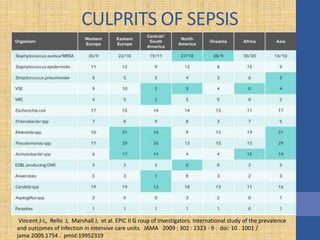
CULPRITS OF SEPSIS
Vincent J-L, Rello J, Marshall J, et al. EPIC II G roup of Investigators. International study of the prevalence
and outcomes of infection in intensive care units. JAMA 2009 ; 302 : 2323 - 9 . doi: 10 . 1001 /
jama.2009.1754 . pmid:19952319
EARLY RECOGNITION
• Septic shock is a clinical diagnosis
• High index of suspicion is warranted
• Altered mental status with fever
Altered alertness Lethargy
Poor eye contact Somnolence
Inconsolable cry
• Clinical triad of impending septic shock
Hyper/hypothermia Altered mental status
Peripheral vasodilation
• Any fever + irritability/ lethargy + decreased urine output- look for
tachycardia out of proportion with fever- Septic shock
PRIMARY RESUSCITATION
• Initial assessment of ABC
• 100% oxygen via NRM
• Early administration of broad spectrum antibiotics
• Securing minimum 2 IV lines/ intraosseous line
• Collect briefly the past history to R/O underlying cause
• Initial investigations
• ABG
• Blood sugar
• RFT and Electrolytes
• CBC
• PT/PTT
• Type and cross match
• Cultures
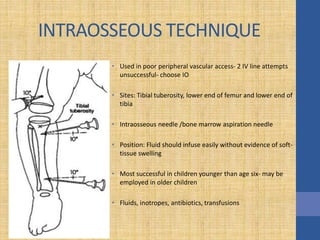
INTRAOSSEOUS TECHNIQUE
• Used in poor peripheral vascular access- 2 IV line attempts
unsuccessful- choose IO
• Sites: Tibial tuberosity, lower end of femur and lower end of
tibia
• Intraosseous needle /bone marrow aspiration needle
• Position: Fluid should infuse easily without evidence of soft-
tissue swelling
• Most successful in children younger than age six- may be
employed in older children
• Fluids, inotropes, antibiotics, transfusions
ANTIMICROBIALS
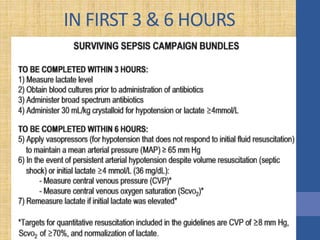
IN FIRST 3 & 6 HOURS
FLUID RESUCITATION
• Compensated shock
NS/RL 20 ml/kg over 1 hour
Assess the vitals and titrate the fluids accordingly
• Hypotensive shock (uncompensated shock)
Rapid boluses of NS/RL - 20 ml/kg
Until SBP/MAP normal for age
Can reach upto 60 ml/kg in 1 hour
FLUID RESUCITATION
General concerns in fluid therapy in any kind of shock
• Assess the vitals and CCF features
• At the end of each boluses/aliquots
• In cardiac patients start at 10-20 ml/kg over 1 hour
• Once shock is revived wean the fluid and
• Maintain according to the requirement
QUESTION
• Why the amount of bolus is 20 ml/kg?
• Magic number??
FLUID INTOLERANCE
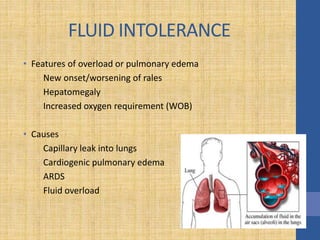
• Features of overload or pulmonary edema
New onset/worsening of rales
Hepatomegaly
Increased oxygen requirement (WOB)
• Causes
Capillary leak into lungs
Cardiogenic pulmonary edema
ARDS
Fluid overload
FLUID INTOLERANCE
• Pathophysiology
Capillary leak
Uncorrected hypovolemia
Loss of crystalloids and colloids
• Management
Slow down the fluid rate
Consider colloids
Consider inotrope/pressor depending upon BP
Positive pressure ventilation( CPAP/Invasive ventilation)
THERAPEUTIC GOALS
• HR for age
• SBP/MAP for age
• Urine O/P > 1 ml/kg/hr
• Warm peripheries with CFT <3 sec
• Normal mental status
• Improving metabolic acidosis/reducing lactate
INTUBATION AND VENTILATION
• Indications
Increased work of breathing
Pulmonary edema
Hypoventilation
Altered mental status(GCS <8)
Refractory shock
Severe hypoxemia +/- hypercapnia and
Moribund state
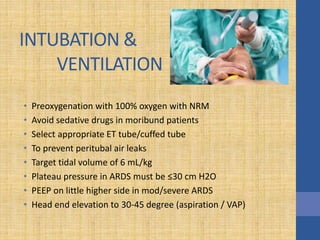
INTUBATION &
VENTILATION
• Preoxygenation with 100% oxygen with NRM
• Avoid sedative drugs in moribund patients
• Select appropriate ET tube/cuffed tube
• To prevent peritubal air leaks
• Target tidal volume of 6 mL/kg
• Plateau pressure in ARDS must be ≤30 cm H2O
• PEEP on little higher side in mod/severe ARDS
• Head end elevation to 30-45 degree (aspiration / VAP)
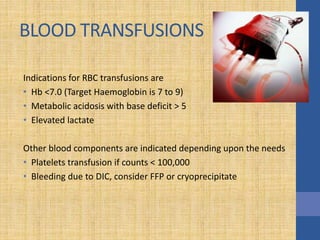
BLOOD TRANSFUSIONS
Indications for RBC transfusions are
• Hb <7.0 (Target Haemoglobin is 7 to 9)
• Metabolic acidosis with base deficit > 5
• Elevated lactate
Other blood components are indicated depending upon the needs
• Platelets transfusion if counts < 100,000
• Bleeding due to DIC, consider FFP or cryoprecipitate
STEROIDS
Timely hydrocortisone therapy in children with
• Fluid refractory
• Catecholamine resistant shock and
• Suspected or proven absolute (classic) adrenal insufficiency
• 1-2 mg/kg of hydrocortisone bolus followed by 1mg/kg Q6-8H.
ACID BASE/SUGAR/ELECTROLYTES
• Hypo/hyperglycaemia both are common in SS
Periodic monitoring is warranted
In persistent hypoglycaemia consider early steroids and 10%D
Insulin infusion in persistent hyperglycaemia
• Electrolytes and RFT should be monitored
• Wide anion gap acidosis common in SS due to lactate
Bicarbonate correction is not required
Adequate fluid correction is enough
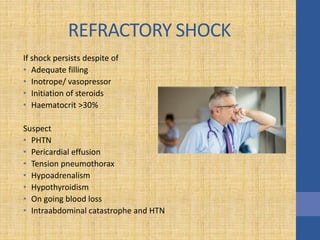
REFRACTORY SHOCK
If shock persists despite of
• Adequate filling
• Inotrope/ vasopressor
• Initiation of steroids
• Haematocrit >30%
Suspect
• PHTN
• Pericardial effusion
• Tension pneumothorax
• Hypoadrenalism
• Hypothyroidism
• On going blood loss
• Intraabdominal catastrophe and HTN
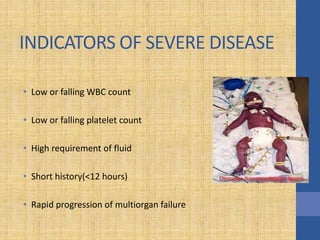
INDICATORS OF SEVERE DISEASE
• Low or falling WBC count
• Low or falling platelet count
• High requirement of fluid
• Short history(<12 hours)
• Rapid progression of multiorgan failure
SYMPATHETIC RECEPTORS
ALPHA
• Alpha -1 (vasoconstriction)
1-a prostatic urethra
1-b blood vessels
• Alpha -2
Presynaptic
Brake to sym system
Post synaptic
Blood vessels & brain
BETA
• Beta-1
Heart & GJ cells
• Beta-2 (vasodilation)
Bronchus, GIT, Bladder
Uterus, Liver, Skeletal muscle
Blood vessels
• Beta-3
Adipose tissue
Coronary vessels
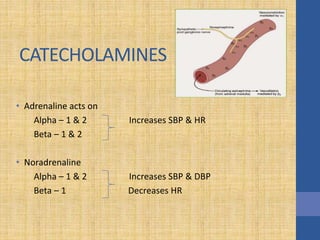
CATECHOLAMINES
• Adrenaline acts on
Alpha – 1 & 2 Increases SBP & HR
Beta – 1 & 2
• Noradrenaline
Alpha – 1 & 2 Increases SBP & DBP
Beta – 1 Decreases HR
CATECHOLAMINES
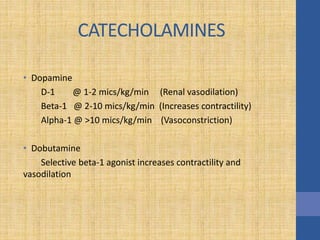
• Dopamine
D-1 @ 1-2 mics/kg/min (Renal vasodilation)
Beta-1 @ 2-10 mics/kg/min (Increases contractility)
Alpha-1 @ >10 mics/kg/min (Vasoconstriction)
• Dobutamine
Selective beta-1 agonist increases contractility and
vasodilation
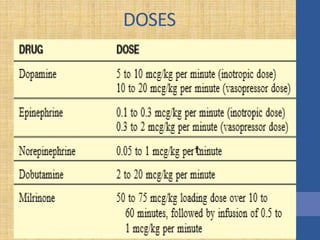
DOSES
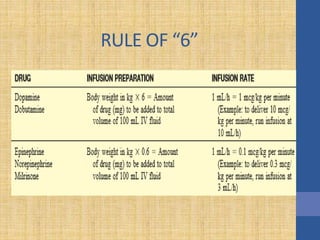
RULE OF “6”
Question
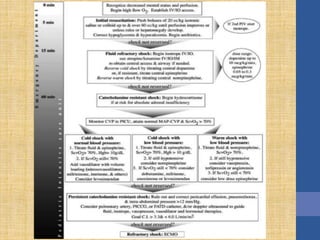
• Write Dopamine orders for a 10 kg child with fluid refractory
septic shock
TAKE HOME MESSAGE
Septic shock is a clinical diagnosis, needs high suspicion
Early recognition and resuscitation of septic shock
Early fluid resuscitation
Early initiation/Choosing/Narrowing of antibiotics
Timely initiation of inotropes/vasopressors, if needed
Therapeutic goals in 3 & 6 hours
THANK YOU !!
CASE DEFINITION
SUSPECTED CASE
Acute febrile respiratory illness (fever ≥ 38 C)
• Within 7 days of close contact with a confirmed case or
• Within 7 days of travel to pandemic areas or
• Resides in a pandemic community.
Contd.,
PROBABLE CASE
Acute febrile respiratory illness who is
• Positive for influenza A
But unsubtypable for H1 and H3 by influenza RT-PCT or
• Positive for influenza A
Influenza rapid test or IFA + suspected case or
• Who died of an unexplained acute respiratory
Illness is epidemiologically linked to a probable or confirmed case.
Contd.,
CONFIRMED CASE
Acute febrile respiratory illness
• Found to be positive in any of following method
• Real Time PCR
• Viral culture
• Four-fold rise in H1N1 virus specific neutralizing antibodies
• Through any of WHO approved laboratory
• Give examples of distributive shock
Anaphylactic/Neurogenic/Septic shock
Important receptors of immune cells implicated in
pathophysiology of septic shock
• Toll-like receptors
• C-type lectin receptors
• Retinoic acid inducible gene 1–like receptors and
• Nucleotide-binding oligomerization domain–like receptors.
What is SIRS ? Criteria for SIRS ?
• Systemic inflammatory Response Syndrome
Seen in early stages of septic shock
Criteria
Temperature changes (>38°C or <36°C)
Tachycardia (>160/min in infants, >150/min in children)
Tachypnea (>60/min in infants, >50/min in children)
Leucocytosis/ leucopenia
• Most common organisms involved in sepsis ?
• Pseudomonas
• Klebsiella
• Acenetobacter
• E coli
• Staph aureus
Most common site of Intraosseous route ?
Successful upto which ?
• Lower 1/3rd of femur
• Upper 1/3rd of tibia
• Lower 1/3rd of tibia
• Age upto 6
Clinical features of fluid overload ? Causes ?
• Features of overload or pulmonary edema
New onset/worsening of rales
Hepatomegaly
Increased oxygen requirement (WOB)
• Causes
Capillary leak into lungs
Cardiogenic pulmonary edema
ARDS
Fluid overload
Therapeutic goals of septic shock ? Should achieved within ?
• All must be achieved within first 6 hours
• HR for age
• SBP/MAP for age
• Urine O/P > 1 ml/kg/hr
• Warm peripheries with CFT >3 sec
• Normal mental status
• Improving metabolic acidosis/reducing lactate
Role of alpha 1 and beta 2 receptors in blood vessels ?
• Alpha -1 (vasoconstriction)
• Beta-2 (vasodilation)
What is mixed venous oxygen saturation (called SvO2) ?
Clinical role ?
• Percentage of oxygen bound to haemoglobin in blood
returning to the right side of the heart.

• Reflects
The amount of oxygen "left over" after the tissues usage
Amount of oxygen extracted by tissues
• Helps to determine whether the cardiac output and oxygen
delivery is high enough to meet a patient's needs
• A true mixed venous sample is drawn from the tip of the
pulmonary artery catheter
• Normal SvO2 60-80%.
Parameters catecholamines
MAP increased by Dopamine/Adrenaline
Both CO & SVR are increased by Dopamine
Both increasing CO & decreasing SVR by Dobutamine
Most potent vasopressor Noradrenaline
DBP increased by Adre/Noradre
http://www.who.int/childgrowth/standards/weight_for_age/en/

Septic shock management

  • 1.
    Management of septicshock By Dr. C. Kannan 1st year post graduate Department of pediatrics MGMCRI
  • 2.
    OBJECTIVES What is septicshock? Basic pathophysiology Recognition of septic shock Fluid resuscitation and therapeutic goals Choosing antibiotics
  • 3.
    SHOCK Shock is asyndrome that results from • Inadequate oxygen delivery to meet metabolic demands • Oxygen supply is less than Oxygen demand • If untreated this leads to Metabolic acidosis Organ dysfunction Death
  • 4.
    SEPTIC SHOCK • Formof distributive shock • Invasion of microorganisms • Exaggerated by Immune response to infection Release and activation of immune mediators • Typical changes are Vasodilation Capillary permeability
  • 5.
  • 6.
    PATTERN-RECOGNITION RECEPTORS Four mainclasses • Toll-like receptors • C-type lectin receptors • Retinoic acid inducible gene 1–like receptors • Nucleotide-binding oligomerization domain–like receptor
  • 7.
    SEPTIC SHOCK • SIRS Systemicinflammatory Response Syndrome Seen in early stages of septic shock Criteria Temperature changes (>38°C or <36°C) Tachycardia (>160/min in infants, >150/min in children) Tachypnea (>60/min in infants, >50/min in children) Leucocytosis/ leucopenia • Sepsis SIRS with suspected or proven sepsis
  • 8.
    SEPTIC SHOCK • Severesepsis Sepsis + CVS dysfunction/ARDS or Sepsis with 2 or more organ failures • Septic shock Sepsis + CVS dysfunction despite >40ml/hr isotonic fluid in 1 hour • CVS dysfunction SBP < 5th centile/required vasoactive medication CFT > 5 sec Oliguria < 0.5 ml/kg/hr Base deficit > 5 Lactate twice the normal
  • 9.
    SEPTIC SHOCK Warm shock •Early compensated • Warm peripheries • Bounding pulses • Increased CO • Decreased SVR • Widened pulse pressure • Hypocarbia • Hyperglycaemia • Metabolic acidosis Cold shock • Late hypotensive • Cold and clammy • Weak thready pulses • Decreased CO • Increased SVR • Narrow pulse pressure • Hypoxia • Hypoglycaemia • Metabolic acidosis • Capillary leak & Oliguria
  • 10.
    RISK FACTORS Extremes ofage Immunocompromised Malnutrition Asplenia Chronic antibiotics use Any insult (shock, trauma, burns and pancreatitis)
  • 11.
    CULPRITS OF SEPSIS VincentJ-L, Rello J, Marshall J, et al. EPIC II G roup of Investigators. International study of the prevalence and outcomes of infection in intensive care units. JAMA 2009 ; 302 : 2323 - 9 . doi: 10 . 1001 / jama.2009.1754 . pmid:19952319
  • 12.
    EARLY RECOGNITION • Septicshock is a clinical diagnosis • High index of suspicion is warranted • Altered mental status with fever Altered alertness Lethargy Poor eye contact Somnolence Inconsolable cry • Clinical triad of impending septic shock Hyper/hypothermia Altered mental status Peripheral vasodilation • Any fever + irritability/ lethargy + decreased urine output- look for tachycardia out of proportion with fever- Septic shock
  • 13.
    PRIMARY RESUSCITATION • Initialassessment of ABC • 100% oxygen via NRM • Early administration of broad spectrum antibiotics • Securing minimum 2 IV lines/ intraosseous line • Collect briefly the past history to R/O underlying cause • Initial investigations • ABG • Blood sugar • RFT and Electrolytes • CBC • PT/PTT • Type and cross match • Cultures
  • 14.
    INTRAOSSEOUS TECHNIQUE • Usedin poor peripheral vascular access- 2 IV line attempts unsuccessful- choose IO • Sites: Tibial tuberosity, lower end of femur and lower end of tibia • Intraosseous needle /bone marrow aspiration needle • Position: Fluid should infuse easily without evidence of soft- tissue swelling • Most successful in children younger than age six- may be employed in older children • Fluids, inotropes, antibiotics, transfusions
  • 15.
  • 16.
    IN FIRST 3& 6 HOURS
  • 17.
    FLUID RESUCITATION • Compensatedshock NS/RL 20 ml/kg over 1 hour Assess the vitals and titrate the fluids accordingly • Hypotensive shock (uncompensated shock) Rapid boluses of NS/RL - 20 ml/kg Until SBP/MAP normal for age Can reach upto 60 ml/kg in 1 hour
  • 18.
    FLUID RESUCITATION General concernsin fluid therapy in any kind of shock • Assess the vitals and CCF features • At the end of each boluses/aliquots • In cardiac patients start at 10-20 ml/kg over 1 hour • Once shock is revived wean the fluid and • Maintain according to the requirement
  • 19.
    QUESTION • Why theamount of bolus is 20 ml/kg? • Magic number??
  • 20.
    FLUID INTOLERANCE • Featuresof overload or pulmonary edema New onset/worsening of rales Hepatomegaly Increased oxygen requirement (WOB) • Causes Capillary leak into lungs Cardiogenic pulmonary edema ARDS Fluid overload
  • 21.
    FLUID INTOLERANCE • Pathophysiology Capillaryleak Uncorrected hypovolemia Loss of crystalloids and colloids • Management Slow down the fluid rate Consider colloids Consider inotrope/pressor depending upon BP Positive pressure ventilation( CPAP/Invasive ventilation)
  • 22.
    THERAPEUTIC GOALS • HRfor age • SBP/MAP for age • Urine O/P > 1 ml/kg/hr • Warm peripheries with CFT <3 sec • Normal mental status • Improving metabolic acidosis/reducing lactate
  • 23.
    INTUBATION AND VENTILATION •Indications Increased work of breathing Pulmonary edema Hypoventilation Altered mental status(GCS <8) Refractory shock Severe hypoxemia +/- hypercapnia and Moribund state
  • 24.
    INTUBATION & VENTILATION • Preoxygenationwith 100% oxygen with NRM • Avoid sedative drugs in moribund patients • Select appropriate ET tube/cuffed tube • To prevent peritubal air leaks • Target tidal volume of 6 mL/kg • Plateau pressure in ARDS must be ≤30 cm H2O • PEEP on little higher side in mod/severe ARDS • Head end elevation to 30-45 degree (aspiration / VAP)
  • 25.
    BLOOD TRANSFUSIONS Indications forRBC transfusions are • Hb <7.0 (Target Haemoglobin is 7 to 9) • Metabolic acidosis with base deficit > 5 • Elevated lactate Other blood components are indicated depending upon the needs • Platelets transfusion if counts < 100,000 • Bleeding due to DIC, consider FFP or cryoprecipitate
  • 26.
    STEROIDS Timely hydrocortisone therapyin children with • Fluid refractory • Catecholamine resistant shock and • Suspected or proven absolute (classic) adrenal insufficiency • 1-2 mg/kg of hydrocortisone bolus followed by 1mg/kg Q6-8H.
  • 27.
    ACID BASE/SUGAR/ELECTROLYTES • Hypo/hyperglycaemiaboth are common in SS Periodic monitoring is warranted In persistent hypoglycaemia consider early steroids and 10%D Insulin infusion in persistent hyperglycaemia • Electrolytes and RFT should be monitored • Wide anion gap acidosis common in SS due to lactate Bicarbonate correction is not required Adequate fluid correction is enough
  • 28.
    REFRACTORY SHOCK If shockpersists despite of • Adequate filling • Inotrope/ vasopressor • Initiation of steroids • Haematocrit >30% Suspect • PHTN • Pericardial effusion • Tension pneumothorax • Hypoadrenalism • Hypothyroidism • On going blood loss • Intraabdominal catastrophe and HTN
  • 29.
    INDICATORS OF SEVEREDISEASE • Low or falling WBC count • Low or falling platelet count • High requirement of fluid • Short history(<12 hours) • Rapid progression of multiorgan failure
  • 30.
    SYMPATHETIC RECEPTORS ALPHA • Alpha-1 (vasoconstriction) 1-a prostatic urethra 1-b blood vessels • Alpha -2 Presynaptic Brake to sym system Post synaptic Blood vessels & brain BETA • Beta-1 Heart & GJ cells • Beta-2 (vasodilation) Bronchus, GIT, Bladder Uterus, Liver, Skeletal muscle Blood vessels • Beta-3 Adipose tissue Coronary vessels
  • 31.
    CATECHOLAMINES • Adrenaline actson Alpha – 1 & 2 Increases SBP & HR Beta – 1 & 2 • Noradrenaline Alpha – 1 & 2 Increases SBP & DBP Beta – 1 Decreases HR
  • 32.
    CATECHOLAMINES • Dopamine D-1 @1-2 mics/kg/min (Renal vasodilation) Beta-1 @ 2-10 mics/kg/min (Increases contractility) Alpha-1 @ >10 mics/kg/min (Vasoconstriction) • Dobutamine Selective beta-1 agonist increases contractility and vasodilation
  • 33.
  • 34.
  • 35.
    Question • Write Dopamineorders for a 10 kg child with fluid refractory septic shock
  • 37.
    TAKE HOME MESSAGE Septicshock is a clinical diagnosis, needs high suspicion Early recognition and resuscitation of septic shock Early fluid resuscitation Early initiation/Choosing/Narrowing of antibiotics Timely initiation of inotropes/vasopressors, if needed Therapeutic goals in 3 & 6 hours
  • 38.
  • 39.
    CASE DEFINITION SUSPECTED CASE Acutefebrile respiratory illness (fever ≥ 38 C) • Within 7 days of close contact with a confirmed case or • Within 7 days of travel to pandemic areas or • Resides in a pandemic community.
  • 40.
    Contd., PROBABLE CASE Acute febrilerespiratory illness who is • Positive for influenza A But unsubtypable for H1 and H3 by influenza RT-PCT or • Positive for influenza A Influenza rapid test or IFA + suspected case or • Who died of an unexplained acute respiratory Illness is epidemiologically linked to a probable or confirmed case.
  • 41.
    Contd., CONFIRMED CASE Acute febrilerespiratory illness • Found to be positive in any of following method • Real Time PCR • Viral culture • Four-fold rise in H1N1 virus specific neutralizing antibodies • Through any of WHO approved laboratory
  • 42.
    • Give examplesof distributive shock Anaphylactic/Neurogenic/Septic shock
  • 43.
    Important receptors ofimmune cells implicated in pathophysiology of septic shock • Toll-like receptors • C-type lectin receptors • Retinoic acid inducible gene 1–like receptors and • Nucleotide-binding oligomerization domain–like receptors.
  • 44.
    What is SIRS? Criteria for SIRS ? • Systemic inflammatory Response Syndrome Seen in early stages of septic shock Criteria Temperature changes (>38°C or <36°C) Tachycardia (>160/min in infants, >150/min in children) Tachypnea (>60/min in infants, >50/min in children) Leucocytosis/ leucopenia
  • 45.
    • Most commonorganisms involved in sepsis ? • Pseudomonas • Klebsiella • Acenetobacter • E coli • Staph aureus
  • 46.
    Most common siteof Intraosseous route ? Successful upto which ? • Lower 1/3rd of femur • Upper 1/3rd of tibia • Lower 1/3rd of tibia • Age upto 6
  • 47.
    Clinical features offluid overload ? Causes ? • Features of overload or pulmonary edema New onset/worsening of rales Hepatomegaly Increased oxygen requirement (WOB) • Causes Capillary leak into lungs Cardiogenic pulmonary edema ARDS Fluid overload
  • 48.
    Therapeutic goals ofseptic shock ? Should achieved within ? • All must be achieved within first 6 hours • HR for age • SBP/MAP for age • Urine O/P > 1 ml/kg/hr • Warm peripheries with CFT >3 sec • Normal mental status • Improving metabolic acidosis/reducing lactate
  • 49.
    Role of alpha1 and beta 2 receptors in blood vessels ? • Alpha -1 (vasoconstriction) • Beta-2 (vasodilation)
  • 50.
    What is mixedvenous oxygen saturation (called SvO2) ? Clinical role ? • Percentage of oxygen bound to haemoglobin in blood returning to the right side of the heart. • Reflects The amount of oxygen "left over" after the tissues usage Amount of oxygen extracted by tissues • Helps to determine whether the cardiac output and oxygen delivery is high enough to meet a patient's needs • A true mixed venous sample is drawn from the tip of the pulmonary artery catheter • Normal SvO2 60-80%.
  • 51.
    Parameters catecholamines MAP increasedby Dopamine/Adrenaline Both CO & SVR are increased by Dopamine Both increasing CO & decreasing SVR by Dobutamine Most potent vasopressor Noradrenaline DBP increased by Adre/Noradre http://www.who.int/childgrowth/standards/weight_for_age/en/