Basic Modes of
Mechanical
Ventilation
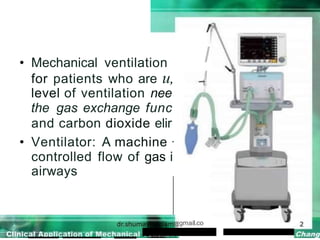
• Mechanical ventilation
for patients who are u,
level of ventilation nee
the gas exchange func
and carbon dioxide elir
• Ventilator: A machine ·
controlled flow of gas i
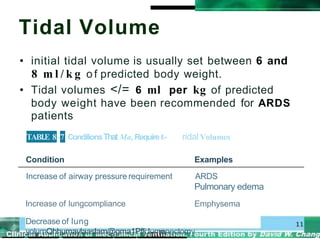
airways
I
gmail.co
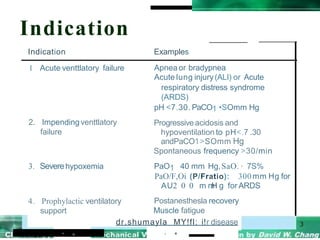
Indication
Indication Examples
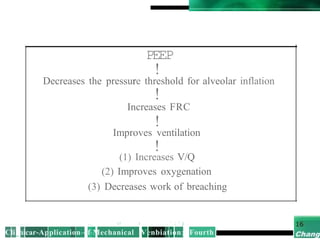
1 Acute venttlatory failure
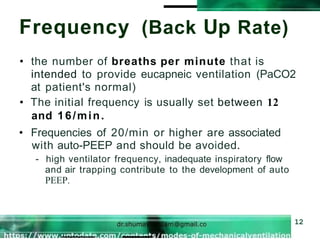
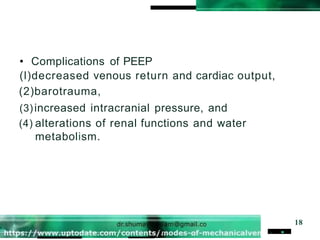
2. Impendingventtlatory
failure
3. Severehypoxemia
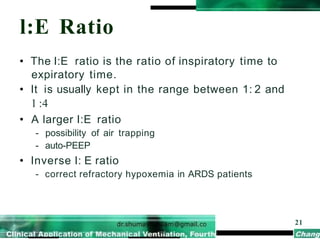
4. Prophylactic ventilatory
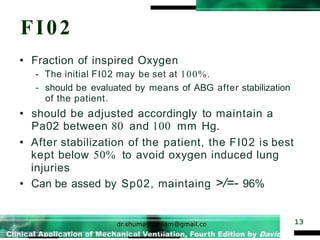
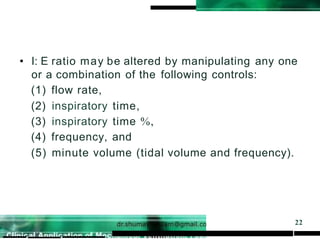
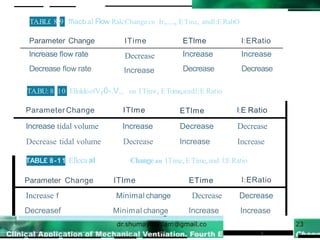
support
Apneaor bradypnea
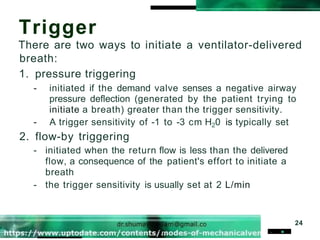
Acute lung injury(ALI) or Acute
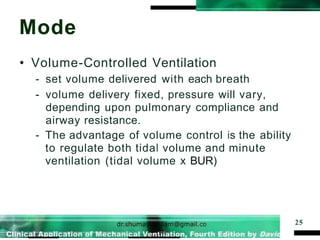
respiratory distress syndrome
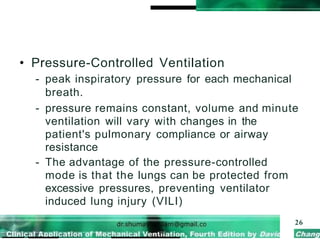
(ARDS)
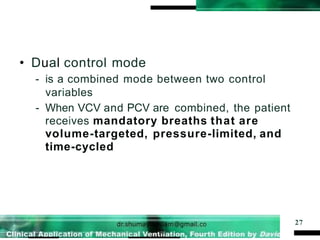
pH <7.30. PaCO1 •SOmm Hg
Progressiveacidosis and
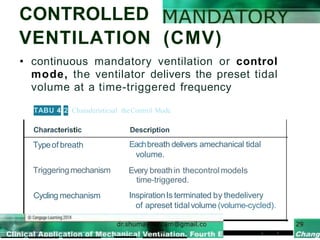
hypoventilation to pH<.7
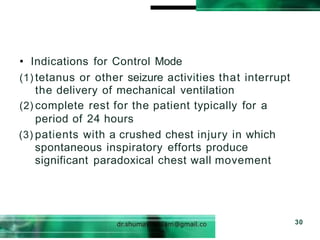
. .30
andPaCO1>SOmm Hg
Spontaneous frequency >30/min
PaO1 40 mm Hg,SaO. · 7S%
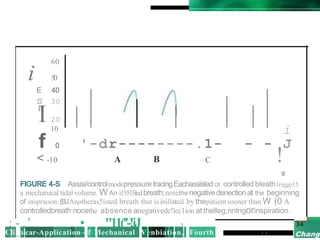
PaO/F,Oi (P/Fratio): 300mm Hg for
AU2
. 0 0 m m
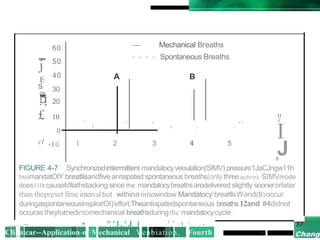
H g for ARDS
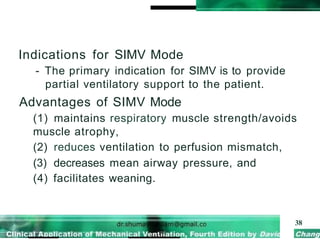
Postanesthesla recovery
Muscle fatigue
dr.shumayla MY!fl: i!r disease
- . . .
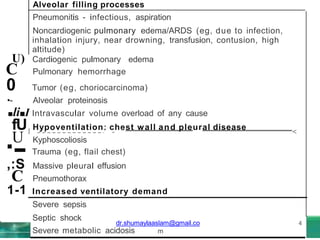
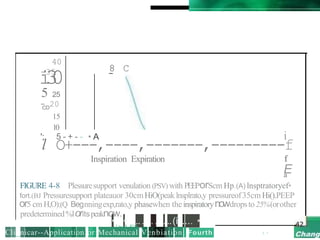
Alveolar filling processes
Pneumonitis - infectious, aspiration
Noncardiogenic pulmonary edema/ARDS (eg, due to infection,
inhalation injury, near drowning, transfusion, contusion, high
altitude)
U) Cardiogenic pulmonary edema
C Pulmonary hemorrhage
0 Tumor (eg, choriocarcinoma)
•- Alveolar proteinosis
■li■I Intravascular volume overload of any cause
fU Hypoventilation: chest wall and pleural disease
U
I ' - ' <
Kyphoscoliosis
·-Trauma (eg, flail chest)
,:S Massive pleural effusion
C Pneumothorax
1-1 Increased ventilatory demand
Severe sepsis
Septic shock
dr.shumaylaaslam@gmail.co
Severe metabolic acidosis m
4
U)
C
·
..
0
-
.,
ra
u
·-
,:,
C
1-t
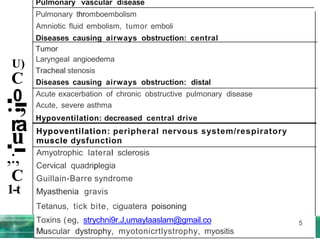
Pulmonary vascular disease
Pulmonary thromboembolism
Amniotic fluid embolism, tumor emboli
Diseases causing airways obstruction: central
Tumor
Laryngeal angioedema
Tracheal stenosis
Diseases causing airways obstruction: distal
Acute exacerbation of chronic obstructive pulmonary disease
Acute, severe asthma
Hypoventilation: decreased central drive
Hypoventilation: peripheral nervous system/respiratory
muscle dysfunction
Amyotrophic lateral sclerosis
Cervical quadriplegia
Guillain-Barre syndrome
Myasthenia gravis
Tetanus, tick bite, ciguatera poisoning
Toxins (eg, strychni9r.J,umaylaaslam@gmail.co
Muscular dystrophy, myotonicrtlystrophy, myositis
5
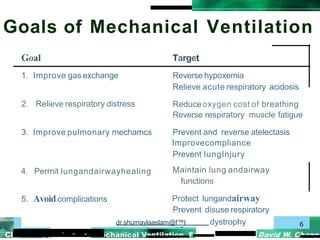
Goals of Mechanical Ventilation
Goal Target
1. Improve gas exchange
2. Relieve respiratory distress
3. Improve pulmonary mechamcs
4. Permit lungandairwayhealing
Reverse hypoxemia
Relieve acute respiratory acidosis
Reduceoxygen cost of breathing
Reverse respiratory muscle fatigue
Prevent and reverse atelectasis
Improvecompliance
Prevent lungInjury
Maintain lung andairway
functions
Protect lungandairway
Prevent disuse respiratory
5. Avoidcomplications
dr.shumaylaaslam@f™I dystrophy
- . .
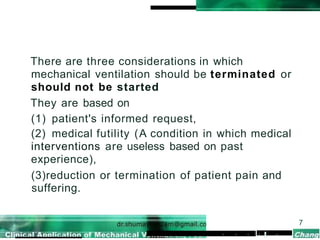
There are three considerations in which
mechanical ventilation should be terminated or
should not be started
They are based on
(1) patient's informed request,
(2) medical futility (A condition in which medical
interventions are useless based on past
experience),
(3)reduction or termination of patient pain and
suffering.
7
• • • I • •
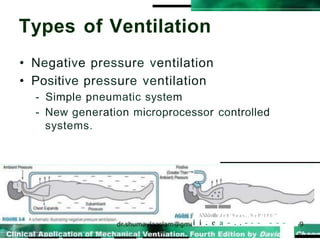
Types of Ventilation
• Negative pressure ventilation
• Positive pressure ventilation
- Simple pneumatic system
- New generation microprocessor controlled
systems.
--
AGUti 7 AXh!mlile J r 8 ' 9 o a s . . N e P ' l 5 U "
i i . e a - . . - - - - - -
Basic Ventilator Parameters
• Mode
• Tidal volume
• Frequency or back up rate
• Fi02
• PEEP
• Flow rate
• I: E Ratio
• Triggers
10
• • • I • •
Tidal Volume
• initial tidal volume is usually set between 6 and
8 m l / k g o f predicted body weight.
• Tidal volumes </= 6 ml per kg of predicted
body weight have been recommended for ARDS
patients
TABI.E 8-7 CondilionsThat Ma, Requiret- ridalVolumes
Condition Examples
Increase of airway pressure requirement ARDS
Pulmonary edema
Emphysema
Increase of lungcompliance
Decrease of lung
volumQhhumaylaaslam@gma1Pflj:!umonectomy
Frequency (Back Up Rate)
12
• the number of breaths per minute that is
intended to provide eucapneic ventilation (PaCO2
at patient's normal)
• The initial frequency is usually set between 12
and 16/min.
• Frequencies of 20/min or higher are associated
with auto-PEEP and should be avoided.
- high ventilator frequency, inadequate inspiratory flow
and air trapping contribute to the development of auto
PEEP.
FI02
13
• Fraction of inspired Oxygen
- The initial FI02 may be set at 100%.
- should be evaluated by means of ABG after stabilization
of the patient.
• should be adjusted accordingly to maintain a
Pa02 between 80 and 100 mm Hg.
• After stabilization of the patient, the FI02 is best
kept below 50% to avoid oxygen induced lung
injuries
• Can be assed by Sp02, maintaing >/=- 96%
Desired Fi02
14
If Age< 60, PO2 =104-age x 0.43
If Age >60, PO2 =80-(age-60)
Pao2 = (713 x Fio2)- Pco2/0.8
A2a2= PAo2/Pao2
Desired Fio2=
[(pO2/A2a2+pCO2/0.8)/713]x100%
PEEP
15
• Positive end-expiratory pressure (PEEP)
- PEEP reinflates collapsed alveoli and supports
and maintains alveolar inflation during
exhalation.
• increases the functional residual capacity
• useful to treat refractory hypoxemia.
- The initial PEEP level may be set at 5 cm H20
- Auto-PEEP is present when the end-expiratory
pressure does not return to baseline pressure
at the end of expiration.
PEEP
!
Decreases the pressure threshold for alveolar inflation
!
Increases FRC
!
Improves ventilation
!
(1) Increases V/Q
(2) Improves oxygenation
(3) Decreases work of breaching
. , . . . . , , _ , - .,.._ 1.7 I . ' ; ' j .
Cli_nicar-Application-of-Mechanical Venbiation; Fourth
• Complications of PEEP
(l)decreased venous return and cardiac output,
(2)barotrauma,
(3)increased intracranial pressure, and
(4) alterations of renal functions and water
metabolism.
. . 18
Flow rate
. . 19
• The peak flow rate is the maximum flow delivered
by the ventilator during inspiration.
• The inspiratory flow needs to be sufficient to
overcome pulmonary and ventilator impedance
otherwise the work of breathing is increased.
• Peak flow rates of 60 L per minute may be
sufficient,
• higher rates are frequently necessary in patients
with bronchoconstriction.
• An insufficient peak flow rate is
characterized by
- dyspnea,
- spuriously low peak inspiratory pressures,
- scalloping of the inspiratory pressure tracing
20
l:E Ratio
21
• The I:E ratio is the ratio of inspiratory time to
expiratory time.
• It is usually kept in the range between 1: 2 and
1 :4
• A larger I:E ratio
- possibility of air trapping
- auto-PEEP
• Inverse I: E ratio
- correct refractory hypoxemia in ARDS patients
• I: E ratio may be altered by manipulating any one
or a combination of the following controls:
(1) flow rate,
(2) inspiratory time,
(3) inspiratory time %,
(4) frequency, and
(5) minute volume (tidal volume and frequency).
22
TA.BL£ 8-9 ffiacb al Flow RalcChange cn Ir,,.,.,, E Tme, andl:ERabO
Parameter Change ITime ETlme l:ERatio
Increase flow rate
Decrease flow rate
Decrease
Increase
Increase
Decrease
Increase
Decrease
TA.BU: 8·10 ElloldoofV10-.V,, on ITinw, ETome,andl:E Ratio
ParameterChange ITlme ETlme l:E Ratio
Increase tidal volume
Decrease tidal volume
Increase Decrease
Decrease Increase
Decrease
Increase
TABL£ 8-11 Ellecaal Changean ITime, ETime, and l:E Ratio
Parameter Change ITlme ETime l:ERatio
Increase f Minimal change Decrease Decrease
Decreasef Minimal change Increase Increase
I,
Trigger
There are two ways to initiate a ventilator-delivered
breath:
1. pressure triggering
- initiated if the demand valve senses a negative airway
pressure deflection (generated by the patient trying to
initiate a breath) greater than the trigger sensitivity.
- A trigger sensitivity of -1 to -3 cm H20 is typically set
2. flow-by triggering
- initiated when the return flow is less than the delivered
flow, a consequence of the patient's effort to initiate a
breath
- the trigger sensitivity is usually set at 2 L/min
24
. .
Mode
25
• Volume-Controlled Ventilation
- set volume delivered with each breath
- volume delivery fixed, pressure will vary,
depending upon pulmonary compliance and
airway resistance.
- The advantage of volume control is the ability
to regulate both tidal volume and minute
ventilation (tidal volume x BUR)
• Pressure-Controlled Ventilation
- peak inspiratory pressure for each mechanical
breath.
- pressure remains constant, volume and minute
ventilation will vary with changes in the
patient's pulmonary compliance or airway
resistance
- The advantage of the pressure-controlled
mode is that the lungs can be protected from
excessive pressures, preventing ventilator
induced lung injury (VILI)
26
• Dual control mode
- is a combined mode between two control
variables
- When VCV and PCV are combined, the patient
receives mandatory breaths that are
volume-targeted, pressure-limited, and
time-cycled
27
Pressure Support
28
• used to augment a patient's breathing effort by
reducing the airflow resistance during
spontaneous breathing (the artificial airway,
ventilator circuit, and secretions)
• Pressure support is available in modes of
ventilation that allows spontaneous breathing
(e.g., SIMV, PSV).
• PS level must be adjusted on an as-needed basis
depending on the changing conditions that alter
the PIP and Pplat
CONTROLLED
VENTILATION (CMV)
• continuous mandatory ventilation or control
mode, the ventilator delivers the preset tidal
volume at a time-triggered frequency
TABU 4·2 Charaderisticsal theControl Mode
Characteristic Description
Typeof breath
Triggeringmechanism
Cycling mechanism
Eachbreath delivers amechanical tidal
volume.
Every breathin thecontrolmodeIs
time-triggered.
InspirationIs terminated by thedelivery
of apreset tidalvolume (volume-cycled).
I, •
• Indications for Control Mode
(1) tetanus or other seizure activities that interrupt
the delivery of mechanical ventilation
(2) complete rest for the patient typically for a
period of 24 hours
(3) patients with a crushed chest injury in which
spontaneous inspiratory efforts produce
significant paradoxical chest wall movement
30
• Complication of CMV
- In a sedated or apneic patient, potential for
apnea and hypoxia if the patient should
become disconnected from the ventilator or
the ventilator should fail to operate.
- rapid disuse atrophy of diaphragm fibers
- prolonged mechanical ventilation leads to
diaphragmatic oxidative injury, elevated
proteolysis, and reduced function of the
diaphragm
31
How to set (Inputs)
32
• Mode: CMV
• TV: 360ml
- Given weight: 60kg
• BUR: 16 breaths/ min
• Minute ventilation: TV x BUR
• Peak flow: 60
• Fi02: 100% initially
ASSIST/CONTROL (AC)
33
• The mandatory mechanical breaths may be either
patient-triggered by the patient's spontaneous
inspiratory efforts (assist) or time-triggered by a
preset frequency
• Inspiration in the AC mode is terminated by
volume cycling. When the preset tidal volume is
delivered, the ventilator is cycled to expiration.
• provide full ventilatory support for patients when
they are first placed on mechanical ventilation
60
i 50
E 40
s 30
I!!
i
I 20
10
f 0 '-dr--------.1- - - J
< -10 A B C !
g
FIGURE 4-S Assisi/controlmodepressuretracing.EachassistedOf controlled bleath1rigge15
a mecharucal tidal volume. WAn i1551Stedbreath;notethe negativedenectionat the beginning
of inspraoon.(BJAnotheras5isted breath that is inillated by thepatientsooner than W (0 A
controlledbreath:nocethe absence anegativede!lec1ion at thelleg,nnlngorinspiration.
; - ,' • "11(''-!iJ 'l .
Cli_nicar-Application-of·Mechanical Venbiation, Fourth I •
Indications for AC Mode
• patients with stable respiratory drive and can
therefore trigger the ventilator into inspiration.
Advantages of AC Mode
• patient's work of breathing requirement is very
small
• allows the patient to control the frequency and
therefore the minute volume required to
normalize the patient's PaC02
Complications of AC Mode
• alveolar hyperventilation (respiratory alkalosis).
35
SYNCHRONIZED INTERMITTENT
MANDATORY VENTILATION (SIMV)
36
• ventilator delivers either assisted breaths to the
patient at the beginning of a spontaneous breath
or time-triggered mandatory breaths
• mandatory breaths are synchronized with the
patient's spontaneous breathing efforts so as to
avoid breath stacking
• Spontaneous frequency and tidal volume taken
by the patient in the SIMV mode are totally
dependent on the patient's breathing effort.
-
j
E
s
CD
-
60
50
40
30
.D
,l 20
£ 10
0
I'
'-
cl -10 1
A
--- Mechanical Breaths
- - - - Spontaneous Breaths
B
"
2
' , ,,
I
' I I
I
,
2 3 4 5
J
0
FIGURE 4-7 Synchronizedintermittent mandatocyveoulation(SIMV) pressure1JaCJngw11h
twomandatOIY breatllsandfive anriapated spontaneous breaths(only threeactive). SIMVmode
does110tcauseb!llathstacking since the mandatocybreathsaredelivered slightly soonerorlater
than thepreset llmeintervalbut withina timewindow.Mandatocy breatllsWand(B)occur
duringaspontaneousinsplra!OI)'effort.Theantiapatedspontaneous breaths12and #4didnot
occurastheyturnedintomechanical breathsduring the mandatocycycle.
,,,...,-- • " ' l . ' J i ' ' 'l '· •
Cli_nicar--Application-of·Mechanical Venbiation, Fourth I •
Indications for SIMV Mode
- The primary indication for SIMV is to provide
partial ventilatory support to the patient.
Advantages of SIMV Mode
(1) maintains respiratory muscle strength/avoids
muscle atrophy,
(2) reduces ventilation to perfusion mismatch,
(3) decreases mean airway pressure, and
(4) facilitates weaning.
38
Complications of SIMV Mode
- The desire to wean the patient too rapidly,
leading first to a high work of spontaneous
breathing and ultimately to muscle fatigue and
weaning failure
39
. .
PRESSURE SUPP OR I
VENTILATION (PSV)
40
• lower the work of spontaneous breathing and
augment a patient's spontaneous tidal volume
• patient-triggered, pressure-limited, and flow
cycled.
• PSV + SIMV, significantly lowers the oxygen
consumption requirement presumably due to the
reduced work of breathing
(1) increases the patient's spontaneous tidal volume,
(2) decreases the patient's spontaneous frequency
• Pressure-supported breaths are considered
spontaneous because
(1) they are patient-triggered,
(2)the tidal volume varies with the patient's
inspiratory flow demand,
(3) inspiration lasts only for as long as the patient
actively inspires, and
(4) inspiration is terminated when the patient's
inspiratory flow demand decreases to a preset
minimal value.
41
40
i
-3
3
5
0
5 25
-
CD
20
15
10
';. 5 - + - - • A i
l O+---,----,-------,---------f
Inspiration Expiration f
E
a
FIGURE 4-8 Plessuresupport venulation (PSV) with PEEPorScm Hp.(A) lnsptratoryef•
fort.(BJ Pressuresupport plateauor 30cmHiO(peaklnsplrato,y pressureof35cm Hi().PEEP
or5 cm H,O);(Q Begnningexp,rato,y phasewhen theinspiratorynowdropsto25%(orother
predetermined%loritspeaknow.
8 C
- ' > r l f'9.
Cli_nicar--Application·or·Mechanical Venbiation, Fourth
• • ... .. ...(i'i.... •
I •
Indication for PSV
43
• weaning from mechanical ventilation
Disadvantages
• Each breath must be initiated by the patient.
Central apnea may occur if the respiratory drive
is depressed due to sedatives, critical illness, or
hypocapnia due to excessive ventilation
• PSV is associated with poorer sleep than AC
• Relatively high levels of pressure support (>20
cm H20) are required to prevent alveolar collapse
(which can lead to cyclic atelectasis and
ventilator-associated lung injury)
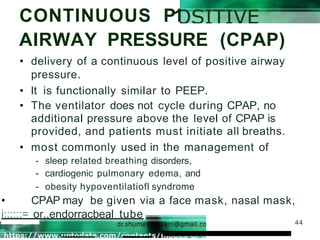
CONTINUOUS P1
AIRWAY PRESSURE (CPAP)
44
• delivery of a continuous level of positive airway
pressure.
• It is functionally similar to PEEP.
• The ventilator does not cycle during CPAP, no
additional pressure above the level of CPAP is
provided, and patients must initiate all breaths.
• most commonly used in the management of
- sleep related breathing disorders,
- cardiogenic pulmonary edema, and
- obesity hypoventilatiofl syndrome
• CPAP may be given via a face mask, nasal mask,
i::;:::= or..endorracbeal tube
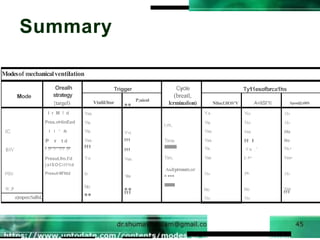
Modesof mechanicalventilation
Mode
Orealh
strategy
{targel)
Trigger Cycle
(breatl,
lcrminalion)
Ty11esofbrca1hs
Vtnlil/ltor P;uienl
.. Nllncf.llOS'Y A<liSl'1l Sponljl,t00$
l r M ! d Yes
Y<i
"'
"'
Yes
.
Y
.
es
"'
-
r,m,
Time
Tim,
.A
.o
.J
.t
,pressure,or
-
Y,s No Ho
Pres.vt•linEed Yts Yts No Ho
IC. l i ' N Yts Yes Yes Ho
IHV
,P
,,..,r
...,.t
,.d
,,.
Presut.fm.t'd
Yes
"'
Y,s
Yes
Ye,
Yes
"
Y e', '
y,s•
No
Ye,•
Yes•
(alSOCill!td
PSV
W,P
Presut•M'lttd lb
.N
.
o
No
No
ye,
No
Ho
Yes
a)mpen:Salfol, No No "'
Summary
Be the change you wish to s e e i n this world
- Mahatma Gandhi
Thank you
46

5f292b2c1f71d3ed58db0d85befc65dc.pptx

  • 1.
  • 2.
    • Mechanical ventilation forpatients who are u, level of ventilation nee the gas exchange func and carbon dioxide elir • Ventilator: A machine · controlled flow of gas i airways I gmail.co
  • 3.
    Indication Indication Examples 1 Acuteventtlatory failure 2. Impendingventtlatory failure 3. Severehypoxemia 4. Prophylactic ventilatory support Apneaor bradypnea Acute lung injury(ALI) or Acute respiratory distress syndrome (ARDS) pH <7.30. PaCO1 •SOmm Hg Progressiveacidosis and hypoventilation to pH<.7 . .30 andPaCO1>SOmm Hg Spontaneous frequency >30/min PaO1 40 mm Hg,SaO. · 7S% PaO/F,Oi (P/Fratio): 300mm Hg for AU2 . 0 0 m m H g for ARDS Postanesthesla recovery Muscle fatigue dr.shumayla MY!fl: i!r disease - . . .
  • 4.
    Alveolar filling processes Pneumonitis- infectious, aspiration Noncardiogenic pulmonary edema/ARDS (eg, due to infection, inhalation injury, near drowning, transfusion, contusion, high altitude) U) Cardiogenic pulmonary edema C Pulmonary hemorrhage 0 Tumor (eg, choriocarcinoma) •- Alveolar proteinosis ■li■I Intravascular volume overload of any cause fU Hypoventilation: chest wall and pleural disease U I ' - ' < Kyphoscoliosis ·-Trauma (eg, flail chest) ,:S Massive pleural effusion C Pneumothorax 1-1 Increased ventilatory demand Severe sepsis Septic shock dr.shumaylaaslam@gmail.co Severe metabolic acidosis m 4
  • 5.
    U) C · .. 0 - ., ra u ·- ,:, C 1-t Pulmonary vascular disease Pulmonarythromboembolism Amniotic fluid embolism, tumor emboli Diseases causing airways obstruction: central Tumor Laryngeal angioedema Tracheal stenosis Diseases causing airways obstruction: distal Acute exacerbation of chronic obstructive pulmonary disease Acute, severe asthma Hypoventilation: decreased central drive Hypoventilation: peripheral nervous system/respiratory muscle dysfunction Amyotrophic lateral sclerosis Cervical quadriplegia Guillain-Barre syndrome Myasthenia gravis Tetanus, tick bite, ciguatera poisoning Toxins (eg, strychni9r.J,umaylaaslam@gmail.co Muscular dystrophy, myotonicrtlystrophy, myositis 5
  • 6.
    Goals of MechanicalVentilation Goal Target 1. Improve gas exchange 2. Relieve respiratory distress 3. Improve pulmonary mechamcs 4. Permit lungandairwayhealing Reverse hypoxemia Relieve acute respiratory acidosis Reduceoxygen cost of breathing Reverse respiratory muscle fatigue Prevent and reverse atelectasis Improvecompliance Prevent lungInjury Maintain lung andairway functions Protect lungandairway Prevent disuse respiratory 5. Avoidcomplications dr.shumaylaaslam@f™I dystrophy - . .
  • 7.
    There are threeconsiderations in which mechanical ventilation should be terminated or should not be started They are based on (1) patient's informed request, (2) medical futility (A condition in which medical interventions are useless based on past experience), (3)reduction or termination of patient pain and suffering. 7 • • • I • •
  • 8.
    Types of Ventilation •Negative pressure ventilation • Positive pressure ventilation - Simple pneumatic system - New generation microprocessor controlled systems. -- AGUti 7 AXh!mlile J r 8 ' 9 o a s . . N e P ' l 5 U " i i . e a - . . - - - - - -
  • 9.
    Basic Ventilator Parameters •Mode • Tidal volume • Frequency or back up rate • Fi02 • PEEP • Flow rate • I: E Ratio • Triggers 10 • • • I • •
  • 10.
    Tidal Volume • initialtidal volume is usually set between 6 and 8 m l / k g o f predicted body weight. • Tidal volumes </= 6 ml per kg of predicted body weight have been recommended for ARDS patients TABI.E 8-7 CondilionsThat Ma, Requiret- ridalVolumes Condition Examples Increase of airway pressure requirement ARDS Pulmonary edema Emphysema Increase of lungcompliance Decrease of lung volumQhhumaylaaslam@gma1Pflj:!umonectomy
  • 11.
    Frequency (Back UpRate) 12 • the number of breaths per minute that is intended to provide eucapneic ventilation (PaCO2 at patient's normal) • The initial frequency is usually set between 12 and 16/min. • Frequencies of 20/min or higher are associated with auto-PEEP and should be avoided. - high ventilator frequency, inadequate inspiratory flow and air trapping contribute to the development of auto PEEP.
  • 12.
    FI02 13 • Fraction ofinspired Oxygen - The initial FI02 may be set at 100%. - should be evaluated by means of ABG after stabilization of the patient. • should be adjusted accordingly to maintain a Pa02 between 80 and 100 mm Hg. • After stabilization of the patient, the FI02 is best kept below 50% to avoid oxygen induced lung injuries • Can be assed by Sp02, maintaing >/=- 96%
  • 13.
    Desired Fi02 14 If Age<60, PO2 =104-age x 0.43 If Age >60, PO2 =80-(age-60) Pao2 = (713 x Fio2)- Pco2/0.8 A2a2= PAo2/Pao2 Desired Fio2= [(pO2/A2a2+pCO2/0.8)/713]x100%
  • 14.
    PEEP 15 • Positive end-expiratorypressure (PEEP) - PEEP reinflates collapsed alveoli and supports and maintains alveolar inflation during exhalation. • increases the functional residual capacity • useful to treat refractory hypoxemia. - The initial PEEP level may be set at 5 cm H20 - Auto-PEEP is present when the end-expiratory pressure does not return to baseline pressure at the end of expiration.
  • 15.
    PEEP ! Decreases the pressurethreshold for alveolar inflation ! Increases FRC ! Improves ventilation ! (1) Increases V/Q (2) Improves oxygenation (3) Decreases work of breaching . , . . . . , , _ , - .,.._ 1.7 I . ' ; ' j . Cli_nicar-Application-of-Mechanical Venbiation; Fourth
  • 16.
    • Complications ofPEEP (l)decreased venous return and cardiac output, (2)barotrauma, (3)increased intracranial pressure, and (4) alterations of renal functions and water metabolism. . . 18
  • 17.
    Flow rate . .19 • The peak flow rate is the maximum flow delivered by the ventilator during inspiration. • The inspiratory flow needs to be sufficient to overcome pulmonary and ventilator impedance otherwise the work of breathing is increased. • Peak flow rates of 60 L per minute may be sufficient, • higher rates are frequently necessary in patients with bronchoconstriction.
  • 18.
    • An insufficientpeak flow rate is characterized by - dyspnea, - spuriously low peak inspiratory pressures, - scalloping of the inspiratory pressure tracing 20
  • 19.
    l:E Ratio 21 • TheI:E ratio is the ratio of inspiratory time to expiratory time. • It is usually kept in the range between 1: 2 and 1 :4 • A larger I:E ratio - possibility of air trapping - auto-PEEP • Inverse I: E ratio - correct refractory hypoxemia in ARDS patients
  • 20.
    • I: Eratio may be altered by manipulating any one or a combination of the following controls: (1) flow rate, (2) inspiratory time, (3) inspiratory time %, (4) frequency, and (5) minute volume (tidal volume and frequency). 22
  • 21.
    TA.BL£ 8-9 ffiacbal Flow RalcChange cn Ir,,.,.,, E Tme, andl:ERabO Parameter Change ITime ETlme l:ERatio Increase flow rate Decrease flow rate Decrease Increase Increase Decrease Increase Decrease TA.BU: 8·10 ElloldoofV10-.V,, on ITinw, ETome,andl:E Ratio ParameterChange ITlme ETlme l:E Ratio Increase tidal volume Decrease tidal volume Increase Decrease Decrease Increase Decrease Increase TABL£ 8-11 Ellecaal Changean ITime, ETime, and l:E Ratio Parameter Change ITlme ETime l:ERatio Increase f Minimal change Decrease Decrease Decreasef Minimal change Increase Increase I,
  • 22.
    Trigger There are twoways to initiate a ventilator-delivered breath: 1. pressure triggering - initiated if the demand valve senses a negative airway pressure deflection (generated by the patient trying to initiate a breath) greater than the trigger sensitivity. - A trigger sensitivity of -1 to -3 cm H20 is typically set 2. flow-by triggering - initiated when the return flow is less than the delivered flow, a consequence of the patient's effort to initiate a breath - the trigger sensitivity is usually set at 2 L/min 24 . .
  • 23.
    Mode 25 • Volume-Controlled Ventilation -set volume delivered with each breath - volume delivery fixed, pressure will vary, depending upon pulmonary compliance and airway resistance. - The advantage of volume control is the ability to regulate both tidal volume and minute ventilation (tidal volume x BUR)
  • 24.
    • Pressure-Controlled Ventilation -peak inspiratory pressure for each mechanical breath. - pressure remains constant, volume and minute ventilation will vary with changes in the patient's pulmonary compliance or airway resistance - The advantage of the pressure-controlled mode is that the lungs can be protected from excessive pressures, preventing ventilator induced lung injury (VILI) 26
  • 25.
    • Dual controlmode - is a combined mode between two control variables - When VCV and PCV are combined, the patient receives mandatory breaths that are volume-targeted, pressure-limited, and time-cycled 27
  • 26.
    Pressure Support 28 • usedto augment a patient's breathing effort by reducing the airflow resistance during spontaneous breathing (the artificial airway, ventilator circuit, and secretions) • Pressure support is available in modes of ventilation that allows spontaneous breathing (e.g., SIMV, PSV). • PS level must be adjusted on an as-needed basis depending on the changing conditions that alter the PIP and Pplat
  • 27.
    CONTROLLED VENTILATION (CMV) • continuousmandatory ventilation or control mode, the ventilator delivers the preset tidal volume at a time-triggered frequency TABU 4·2 Charaderisticsal theControl Mode Characteristic Description Typeof breath Triggeringmechanism Cycling mechanism Eachbreath delivers amechanical tidal volume. Every breathin thecontrolmodeIs time-triggered. InspirationIs terminated by thedelivery of apreset tidalvolume (volume-cycled). I, •
  • 28.
    • Indications forControl Mode (1) tetanus or other seizure activities that interrupt the delivery of mechanical ventilation (2) complete rest for the patient typically for a period of 24 hours (3) patients with a crushed chest injury in which spontaneous inspiratory efforts produce significant paradoxical chest wall movement 30
  • 29.
    • Complication ofCMV - In a sedated or apneic patient, potential for apnea and hypoxia if the patient should become disconnected from the ventilator or the ventilator should fail to operate. - rapid disuse atrophy of diaphragm fibers - prolonged mechanical ventilation leads to diaphragmatic oxidative injury, elevated proteolysis, and reduced function of the diaphragm 31
  • 30.
    How to set(Inputs) 32 • Mode: CMV • TV: 360ml - Given weight: 60kg • BUR: 16 breaths/ min • Minute ventilation: TV x BUR • Peak flow: 60 • Fi02: 100% initially
  • 31.
    ASSIST/CONTROL (AC) 33 • Themandatory mechanical breaths may be either patient-triggered by the patient's spontaneous inspiratory efforts (assist) or time-triggered by a preset frequency • Inspiration in the AC mode is terminated by volume cycling. When the preset tidal volume is delivered, the ventilator is cycled to expiration. • provide full ventilatory support for patients when they are first placed on mechanical ventilation
  • 32.
    60 i 50 E 40 s30 I!! i I 20 10 f 0 '-dr--------.1- - - J < -10 A B C ! g FIGURE 4-S Assisi/controlmodepressuretracing.EachassistedOf controlled bleath1rigge15 a mecharucal tidal volume. WAn i1551Stedbreath;notethe negativedenectionat the beginning of inspraoon.(BJAnotheras5isted breath that is inillated by thepatientsooner than W (0 A controlledbreath:nocethe absence anegativede!lec1ion at thelleg,nnlngorinspiration. ; - ,' • "11(''-!iJ 'l . Cli_nicar-Application-of·Mechanical Venbiation, Fourth I •
  • 33.
    Indications for ACMode • patients with stable respiratory drive and can therefore trigger the ventilator into inspiration. Advantages of AC Mode • patient's work of breathing requirement is very small • allows the patient to control the frequency and therefore the minute volume required to normalize the patient's PaC02 Complications of AC Mode • alveolar hyperventilation (respiratory alkalosis). 35
  • 34.
    SYNCHRONIZED INTERMITTENT MANDATORY VENTILATION(SIMV) 36 • ventilator delivers either assisted breaths to the patient at the beginning of a spontaneous breath or time-triggered mandatory breaths • mandatory breaths are synchronized with the patient's spontaneous breathing efforts so as to avoid breath stacking • Spontaneous frequency and tidal volume taken by the patient in the SIMV mode are totally dependent on the patient's breathing effort.
  • 35.
    - j E s CD - 60 50 40 30 .D ,l 20 £ 10 0 I' '- cl-10 1 A --- Mechanical Breaths - - - - Spontaneous Breaths B " 2 ' , ,, I ' I I I , 2 3 4 5 J 0 FIGURE 4-7 Synchronizedintermittent mandatocyveoulation(SIMV) pressure1JaCJngw11h twomandatOIY breatllsandfive anriapated spontaneous breaths(only threeactive). SIMVmode does110tcauseb!llathstacking since the mandatocybreathsaredelivered slightly soonerorlater than thepreset llmeintervalbut withina timewindow.Mandatocy breatllsWand(B)occur duringaspontaneousinsplra!OI)'effort.Theantiapatedspontaneous breaths12and #4didnot occurastheyturnedintomechanical breathsduring the mandatocycycle. ,,,...,-- • " ' l . ' J i ' ' 'l '· • Cli_nicar--Application-of·Mechanical Venbiation, Fourth I •
  • 36.
    Indications for SIMVMode - The primary indication for SIMV is to provide partial ventilatory support to the patient. Advantages of SIMV Mode (1) maintains respiratory muscle strength/avoids muscle atrophy, (2) reduces ventilation to perfusion mismatch, (3) decreases mean airway pressure, and (4) facilitates weaning. 38
  • 37.
    Complications of SIMVMode - The desire to wean the patient too rapidly, leading first to a high work of spontaneous breathing and ultimately to muscle fatigue and weaning failure 39 . .
  • 38.
    PRESSURE SUPP ORI VENTILATION (PSV) 40 • lower the work of spontaneous breathing and augment a patient's spontaneous tidal volume • patient-triggered, pressure-limited, and flow cycled. • PSV + SIMV, significantly lowers the oxygen consumption requirement presumably due to the reduced work of breathing (1) increases the patient's spontaneous tidal volume, (2) decreases the patient's spontaneous frequency
  • 39.
    • Pressure-supported breathsare considered spontaneous because (1) they are patient-triggered, (2)the tidal volume varies with the patient's inspiratory flow demand, (3) inspiration lasts only for as long as the patient actively inspires, and (4) inspiration is terminated when the patient's inspiratory flow demand decreases to a preset minimal value. 41
  • 40.
    40 i -3 3 5 0 5 25 - CD 20 15 10 ';. 5- + - - • A i l O+---,----,-------,---------f Inspiration Expiration f E a FIGURE 4-8 Plessuresupport venulation (PSV) with PEEPorScm Hp.(A) lnsptratoryef• fort.(BJ Pressuresupport plateauor 30cmHiO(peaklnsplrato,y pressureof35cm Hi().PEEP or5 cm H,O);(Q Begnningexp,rato,y phasewhen theinspiratorynowdropsto25%(orother predetermined%loritspeaknow. 8 C - ' > r l f'9. Cli_nicar--Application·or·Mechanical Venbiation, Fourth • • ... .. ...(i'i.... • I •
  • 41.
    Indication for PSV 43 •weaning from mechanical ventilation Disadvantages • Each breath must be initiated by the patient. Central apnea may occur if the respiratory drive is depressed due to sedatives, critical illness, or hypocapnia due to excessive ventilation • PSV is associated with poorer sleep than AC • Relatively high levels of pressure support (>20 cm H20) are required to prevent alveolar collapse (which can lead to cyclic atelectasis and ventilator-associated lung injury)
  • 42.
    CONTINUOUS P1 AIRWAY PRESSURE(CPAP) 44 • delivery of a continuous level of positive airway pressure. • It is functionally similar to PEEP. • The ventilator does not cycle during CPAP, no additional pressure above the level of CPAP is provided, and patients must initiate all breaths. • most commonly used in the management of - sleep related breathing disorders, - cardiogenic pulmonary edema, and - obesity hypoventilatiofl syndrome • CPAP may be given via a face mask, nasal mask, i::;:::= or..endorracbeal tube
  • 43.
    Modesof mechanicalventilation Mode Orealh strategy {targel) Trigger Cycle (breatl, lcrminalion) Ty11esofbrca1hs Vtnlil/ltorP;uienl .. Nllncf.llOS'Y A<liSl'1l Sponljl,t00$ l r M ! d Yes Y<i "' "' Yes . Y . es "' - r,m, Time Tim, .A .o .J .t ,pressure,or - Y,s No Ho Pres.vt•linEed Yts Yts No Ho IC. l i ' N Yts Yes Yes Ho IHV ,P ,,..,r ...,.t ,.d ,,. Presut.fm.t'd Yes "' Y,s Yes Ye, Yes " Y e', ' y,s• No Ye,• Yes• (alSOCill!td PSV W,P Presut•M'lttd lb .N . o No No ye, No Ho Yes a)mpen:Salfol, No No "' Summary
  • 44.
    Be the changeyou wish to s e e i n this world - Mahatma Gandhi Thank you 46