INTRODUCTION TO
BASIC MECHANICAL
VENTILATION
NOHA EL-ANWAR
ASSISTANT LECTURER OF PEDIATRICS AND CRITICAL CARE
 MV is the INTERACTION between the patient and ventilator to
achieve the objectives.
 You cannot be focusing on the ventilator and neglecting the patient.
 Patients change and so should the way of support.
 MV is supposed to be temporary; treat the underlying cause and aim
to get your patient off as soon as possible, the proper time to
consider this is AS SOON AS YOU VENTILATE THE PATIENT.
OBJECTIVES:
To achieve appropriate:
 Ventilation
 Oxygenation
 Work of breathing
 Lung protection
Ventilation is the gas exchange between alveolar and surrounding gas.
Minute volume is the volume exchange per minute, tidal volume is per
breath.
 Minute volume = tidal volume x respiratory rate
 High pCO2 denotes inadequate minute volume (hypoventilation)
 Note that part of the volume delivered is to dead space so minute
volume increases more by increasing an inadequate tidal volume
increases than by increasing rate
 Excessive tidal volume is the main cause of ventilator associated lung
injury
Oxygenation at the level of arterial pO2 depends on ventilation and other factors:
 Inspired pO2: barometric pressure and FiO2 (= % oxygen in inhaled gas mixture)
 Mean airway pressure
 Pulmonary gas exchange; affected by:
- Effective gas exchange area (amount of functioning= recruited lung)
- Ventilation-perfusion match (=perfused non-ventilated alveoli)
- Diffusion
 Note that at the level of tissues it also depends on hemoglobin, cardiac output,
blood flow and tissue oxygen utilization
 Excessive or non-synchronized work of breathing is a problem;
however, totally eliminating patient efforts is usually NOT the goal.
 The patient is receiving the TOTAL of his effort and the ventilator
effort. The total should provide the required minute volume. The
relation between total effort and minute volume depends on airway
resistance (needs more effort) and lung compliance (higher
compliance needs less effort)
MV can cause lung injury in different ways:
 Volutrauma (=overdistension)
 Barotrauma (=high ΔP; i.e. difference between PIP and PEEP)
 Atelectrauma (=repeated collapse and reopening of alveoli each
breath)
 Oxygen toxicity (depends on FiO2 and time)
 Infection (eg VAP= ventilator associated pneumonia)
 Others as aspiration, hypoxic events, etc
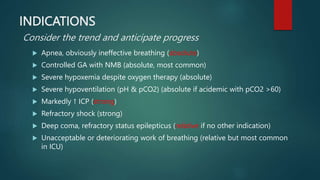
INDICATIONS
Consider the trend and anticipate progress
 Apnea, obviously ineffective breathing (absolute)
 Controlled GA with NMB (absolute, most common)
 Severe hypoxemia despite oxygen therapy (absolute)
 Severe hypoventilation (pH & pCO2) (absolute if acidemic with pCO2 >60)
 Markedly ↑ ICP (strong)
 Refractory shock (strong)
 Deep coma, refractory status epilepticus (relative if no other indication)
 Unacceptable or deteriorating work of breathing (relative but most common
in ICU)
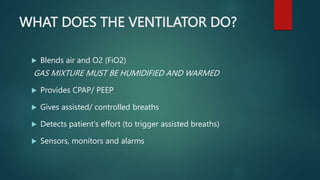
WHAT DOES THE VENTILATOR DO?
 Blends air and O2 (FiO2)
GAS MIXTURE MUST BE HUMIDIFIED AND WARMED
 Provides CPAP/ PEEP
 Gives assisted/ controlled breaths
 Detects patient’s effort (to trigger assisted breaths)
 Sensors, monitors and alarms
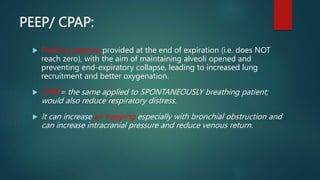
PEEP/ CPAP:
 Positive pressure provided at the end of expiration (i.e. does NOT
reach zero), with the aim of maintaining alveoli opened and
preventing end-expiratory collapse, leading to increased lung
recruitment and better oxygenation.
 CPAP= the same applied to SPONTANEOUSLY breathing patient;
would also reduce respiratory distress.
 It can increase air trapping especially with bronchial obstruction and
can increase intracranial pressure and reduce venous return.
RESPIRATORY CYCLES:
 Cycle = breath = inspiration and expiration
 Expiration is generally passive; Cycling = end of inspiration
and beginning of expiration
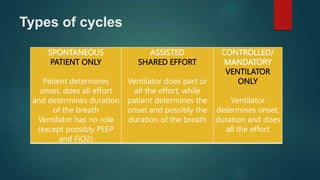
Types of cycles
SPONTANEOUS
PATIENT ONLY
Patient determines
onset, does all effort
and determines duration
of the breath
Ventilator has no role
(except possibly PEEP
and FiO2)
ASSISTED
SHARED EFFORT
Ventilator does part or
all the effort, while
patient determines the
onset and possibly the
duration of the breath
CONTROLLED/
MANDATORY
VENTILATOR
ONLY
Ventilator
determines onset,
duration and does
all the effort
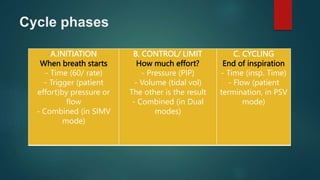
Cycle phases
A.INITIATION
When breath starts
- Time (60/ rate)
- Trigger (patient
effort)by pressure or
flow
- Combined (in SIMV
mode)
B. CONTROL/ LIMIT
How much effort?
- Pressure (PIP)
- Volume (tidal vol)
The other is the result
- Combined (in Dual
modes)
C. CYCLING
End of inspiration
- Time (insp. Time)
- Flow (patient
termination, in PSV
mode)
BASIC MODES
CMV
Continuous (controlled)
mandatory ventilation
- All cycles controlled at set rate, all effort by ventilator, NO
patient contribution
- May be pressure or volume controlled
SIMV
Synchronized intermittent
mandatory ventilation
The set rate is given
- As assisted cycles at the time initiated (triggered) by
patient; or
- As controlled cycles if patient did not trigger
Patients’ efforts EXCEEDING the set rate remain spontaneous
May be pressure or volume controlled
AC/ PTV/ SIPPV
Assist-control
ALL PATIENT EFFORTS trigger assisted cycles
(ventilator rate = patient rate)
Set rate is a BACKUP; will be given as controlled cycles if
patient did not trigger
May be pressure or volume controlled
PSV
Pressure Support
Patient efforts trigger assisted cycles (as AC); but
Inspiratory time is determined by the patient
Always pressure; may be alone or with SIMV
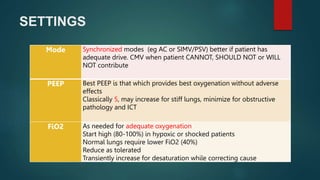
SETTINGS
Mode Synchronized modes (eg AC or SIMV/PSV) better if patient has
adequate drive. CMV when patient CANNOT, SHOULD NOT or WILL
NOT contribute
PEEP Best PEEP is that which provides best oxygenation without adverse
effects
Classically 5, may increase for stiff lungs, minimize for obstructive
pathology and ICT
FiO2 As needed for adequate oxygenation
Start high (80-100%) in hypoxic or shocked patients
Normal lungs require lower FiO2 (40%)
Reduce as tolerated
Transiently increase for desaturation while correcting cause
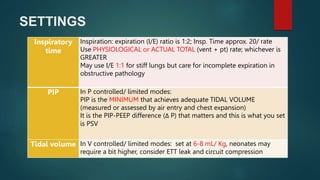
SETTINGS
Inspiratory
time
Inspiration: expiration (I/E) ratio is 1:2; Insp. Time approx. 20/ rate
Use PHYSIOLOGICAL or ACTUAL TOTAL (vent + pt) rate; whichever is
GREATER
May use I/E 1:1 for stiff lungs but care for incomplete expiration in
obstructive pathology
PIP In P controlled/ limited modes:
PIP is the MINIMUM that achieves adequate TIDAL VOLUME
(measured or assessed by air entry and chest expansion)
It is the PIP-PEEP difference (Δ P) that matters and this is what you set
is PSV
Tidal volume In V controlled/ limited modes: set at 6-8 mL/ Kg, neonates may
require a bit higher, consider ETT leak and circuit compression
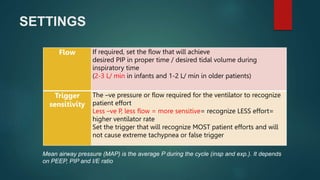
SETTINGS
Flow If required, set the flow that will achieve
desired PIP in proper time / desired tidal volume during
inspiratory time
(2-3 L/ min in infants and 1-2 L/ min in older patients)
Trigger
sensitivity
The –ve pressure or flow required for the ventilator to recognize
patient effort
Less –ve P, less flow = more sensitive= recognize LESS effort=
higher ventilator rate
Set the trigger that will recognize MOST patient efforts and will
not cause extreme tachypnea or false trigger
Mean airway pressure (MAP) is the average P during the cycle (insp and exp.). It depends
on PEEP, PIP and I/E ratio
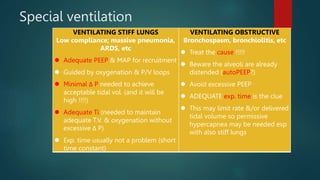
Special ventilation
VENTILATING STIFF LUNGS
Low compliance; massive pneumonia,
ARDS, etc
 Adequate PEEP & MAP for recruitment
 Guided by oxygenation & P/V loops
 Minimal Δ P needed to achieve
acceptable tidal vol. (and it will be
high !!!!)
 Adequate Ti (needed to maintain
adequate T.V. & oxygenation without
excessive Δ P)
 Exp. time usually not a problem (short
time constant)
VENTILATING OBSTRUCTIVE
Bronchospasm, bronchiolitis, etc
 Treat the cause !!!!!
 Beware the alveoli are already
distended (autoPEEP?)
 Avoid excessive PEEP
 ADEQUATE exp. time is the clue
 This may limit rate &/or delivered
tidal volume so permissive
hypercapnea may be needed esp
with also stiff lungs
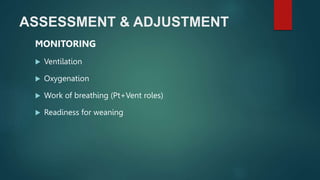
ASSESSMENT & ADJUSTMENT
MONITORING
 Ventilation
 Oxygenation
 Work of breathing (Pt+Vent roles)
 Readiness for weaning
ASSESSMENT & ADJUSTMENT
Inadequate
 Ensure adequate
Tidal volume; then
 Increase rate
Care of I/E ratio
Inadequate oxygenation
 Ensure adequate
ventilation
 Increase FiO2
 Recruitment
 MAP (mainly PEEP, also
MAP by I/E ratio or PIP)
Care of excessive O2/
pressures
↑ or ↓ patient
 Question sometimes
difficult
 If you can lower
support and the
patient can make up
the difference
 Commonly trial and
adjustment
ADJUSTMENT
ACUTE DETERIORATION
Classically DOPE
 Displacement
 Obstruction
 Pneumothorax
 Equipment failure
 There are others (some less acute) eg asynchrony, derecruitment, loss
of pt role after sedation/ NMB, bronchospasm, original pathology,
VAP, …
Deterioration on M.V.
PATIENT
Asynchrony
Barotrauma
Bronchospasm
Collapse
VAP
TECHNIQUE
Inlet pressure
Machine failure
Settings
Circuit block/ leak
Accidental extubation
Obstructed tube
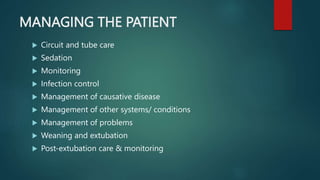
MANAGING THE PATIENT
 Circuit and tube care
 Sedation
 Monitoring
 Infection control
 Management of causative disease
 Management of other systems/ conditions
 Management of problems
 Weaning and extubation
 Post-extubation care & monitoring
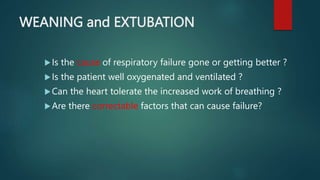
WEANING and EXTUBATION
Is the cause of respiratory failure gone or getting better ?
Is the patient well oxygenated and ventilated ?
Can the heart tolerate the increased work of breathing ?
Are there correctable factors that can cause failure?
Extubation
Control of airway reflexes
Patent upper airway (air leak around tube?)
Minimal oxygen requirement
Minimal rate
Minimize pressure support (0-10)
“Awake ” patient

INTRODUCTION TO basic MECHANICAL VENTILATION 2.pptx

  • 1.
    INTRODUCTION TO BASIC MECHANICAL VENTILATION NOHAEL-ANWAR ASSISTANT LECTURER OF PEDIATRICS AND CRITICAL CARE
  • 2.
     MV isthe INTERACTION between the patient and ventilator to achieve the objectives.  You cannot be focusing on the ventilator and neglecting the patient.  Patients change and so should the way of support.  MV is supposed to be temporary; treat the underlying cause and aim to get your patient off as soon as possible, the proper time to consider this is AS SOON AS YOU VENTILATE THE PATIENT.
  • 3.
    OBJECTIVES: To achieve appropriate: Ventilation  Oxygenation  Work of breathing  Lung protection
  • 4.
    Ventilation is thegas exchange between alveolar and surrounding gas. Minute volume is the volume exchange per minute, tidal volume is per breath.  Minute volume = tidal volume x respiratory rate  High pCO2 denotes inadequate minute volume (hypoventilation)  Note that part of the volume delivered is to dead space so minute volume increases more by increasing an inadequate tidal volume increases than by increasing rate  Excessive tidal volume is the main cause of ventilator associated lung injury
  • 5.
    Oxygenation at thelevel of arterial pO2 depends on ventilation and other factors:  Inspired pO2: barometric pressure and FiO2 (= % oxygen in inhaled gas mixture)  Mean airway pressure  Pulmonary gas exchange; affected by: - Effective gas exchange area (amount of functioning= recruited lung) - Ventilation-perfusion match (=perfused non-ventilated alveoli) - Diffusion  Note that at the level of tissues it also depends on hemoglobin, cardiac output, blood flow and tissue oxygen utilization
  • 6.
     Excessive ornon-synchronized work of breathing is a problem; however, totally eliminating patient efforts is usually NOT the goal.  The patient is receiving the TOTAL of his effort and the ventilator effort. The total should provide the required minute volume. The relation between total effort and minute volume depends on airway resistance (needs more effort) and lung compliance (higher compliance needs less effort)
  • 7.
    MV can causelung injury in different ways:  Volutrauma (=overdistension)  Barotrauma (=high ΔP; i.e. difference between PIP and PEEP)  Atelectrauma (=repeated collapse and reopening of alveoli each breath)  Oxygen toxicity (depends on FiO2 and time)  Infection (eg VAP= ventilator associated pneumonia)  Others as aspiration, hypoxic events, etc
  • 8.
    INDICATIONS Consider the trendand anticipate progress  Apnea, obviously ineffective breathing (absolute)  Controlled GA with NMB (absolute, most common)  Severe hypoxemia despite oxygen therapy (absolute)  Severe hypoventilation (pH & pCO2) (absolute if acidemic with pCO2 >60)  Markedly ↑ ICP (strong)  Refractory shock (strong)  Deep coma, refractory status epilepticus (relative if no other indication)  Unacceptable or deteriorating work of breathing (relative but most common in ICU)
  • 9.
    WHAT DOES THEVENTILATOR DO?  Blends air and O2 (FiO2) GAS MIXTURE MUST BE HUMIDIFIED AND WARMED  Provides CPAP/ PEEP  Gives assisted/ controlled breaths  Detects patient’s effort (to trigger assisted breaths)  Sensors, monitors and alarms
  • 10.
    PEEP/ CPAP:  Positivepressure provided at the end of expiration (i.e. does NOT reach zero), with the aim of maintaining alveoli opened and preventing end-expiratory collapse, leading to increased lung recruitment and better oxygenation.  CPAP= the same applied to SPONTANEOUSLY breathing patient; would also reduce respiratory distress.  It can increase air trapping especially with bronchial obstruction and can increase intracranial pressure and reduce venous return.
  • 11.
    RESPIRATORY CYCLES:  Cycle= breath = inspiration and expiration  Expiration is generally passive; Cycling = end of inspiration and beginning of expiration
  • 12.
    Types of cycles SPONTANEOUS PATIENTONLY Patient determines onset, does all effort and determines duration of the breath Ventilator has no role (except possibly PEEP and FiO2) ASSISTED SHARED EFFORT Ventilator does part or all the effort, while patient determines the onset and possibly the duration of the breath CONTROLLED/ MANDATORY VENTILATOR ONLY Ventilator determines onset, duration and does all the effort
  • 13.
    Cycle phases A.INITIATION When breathstarts - Time (60/ rate) - Trigger (patient effort)by pressure or flow - Combined (in SIMV mode) B. CONTROL/ LIMIT How much effort? - Pressure (PIP) - Volume (tidal vol) The other is the result - Combined (in Dual modes) C. CYCLING End of inspiration - Time (insp. Time) - Flow (patient termination, in PSV mode)
  • 14.
    BASIC MODES CMV Continuous (controlled) mandatoryventilation - All cycles controlled at set rate, all effort by ventilator, NO patient contribution - May be pressure or volume controlled SIMV Synchronized intermittent mandatory ventilation The set rate is given - As assisted cycles at the time initiated (triggered) by patient; or - As controlled cycles if patient did not trigger Patients’ efforts EXCEEDING the set rate remain spontaneous May be pressure or volume controlled AC/ PTV/ SIPPV Assist-control ALL PATIENT EFFORTS trigger assisted cycles (ventilator rate = patient rate) Set rate is a BACKUP; will be given as controlled cycles if patient did not trigger May be pressure or volume controlled PSV Pressure Support Patient efforts trigger assisted cycles (as AC); but Inspiratory time is determined by the patient Always pressure; may be alone or with SIMV
  • 15.
    SETTINGS Mode Synchronized modes(eg AC or SIMV/PSV) better if patient has adequate drive. CMV when patient CANNOT, SHOULD NOT or WILL NOT contribute PEEP Best PEEP is that which provides best oxygenation without adverse effects Classically 5, may increase for stiff lungs, minimize for obstructive pathology and ICT FiO2 As needed for adequate oxygenation Start high (80-100%) in hypoxic or shocked patients Normal lungs require lower FiO2 (40%) Reduce as tolerated Transiently increase for desaturation while correcting cause
  • 16.
    SETTINGS Inspiratory time Inspiration: expiration (I/E)ratio is 1:2; Insp. Time approx. 20/ rate Use PHYSIOLOGICAL or ACTUAL TOTAL (vent + pt) rate; whichever is GREATER May use I/E 1:1 for stiff lungs but care for incomplete expiration in obstructive pathology PIP In P controlled/ limited modes: PIP is the MINIMUM that achieves adequate TIDAL VOLUME (measured or assessed by air entry and chest expansion) It is the PIP-PEEP difference (Δ P) that matters and this is what you set is PSV Tidal volume In V controlled/ limited modes: set at 6-8 mL/ Kg, neonates may require a bit higher, consider ETT leak and circuit compression
  • 17.
    SETTINGS Flow If required,set the flow that will achieve desired PIP in proper time / desired tidal volume during inspiratory time (2-3 L/ min in infants and 1-2 L/ min in older patients) Trigger sensitivity The –ve pressure or flow required for the ventilator to recognize patient effort Less –ve P, less flow = more sensitive= recognize LESS effort= higher ventilator rate Set the trigger that will recognize MOST patient efforts and will not cause extreme tachypnea or false trigger Mean airway pressure (MAP) is the average P during the cycle (insp and exp.). It depends on PEEP, PIP and I/E ratio
  • 18.
    Special ventilation VENTILATING STIFFLUNGS Low compliance; massive pneumonia, ARDS, etc  Adequate PEEP & MAP for recruitment  Guided by oxygenation & P/V loops  Minimal Δ P needed to achieve acceptable tidal vol. (and it will be high !!!!)  Adequate Ti (needed to maintain adequate T.V. & oxygenation without excessive Δ P)  Exp. time usually not a problem (short time constant) VENTILATING OBSTRUCTIVE Bronchospasm, bronchiolitis, etc  Treat the cause !!!!!  Beware the alveoli are already distended (autoPEEP?)  Avoid excessive PEEP  ADEQUATE exp. time is the clue  This may limit rate &/or delivered tidal volume so permissive hypercapnea may be needed esp with also stiff lungs
  • 19.
    ASSESSMENT & ADJUSTMENT MONITORING Ventilation  Oxygenation  Work of breathing (Pt+Vent roles)  Readiness for weaning
  • 20.
    ASSESSMENT & ADJUSTMENT Inadequate Ensure adequate Tidal volume; then  Increase rate Care of I/E ratio Inadequate oxygenation  Ensure adequate ventilation  Increase FiO2  Recruitment  MAP (mainly PEEP, also MAP by I/E ratio or PIP) Care of excessive O2/ pressures ↑ or ↓ patient  Question sometimes difficult  If you can lower support and the patient can make up the difference  Commonly trial and adjustment ADJUSTMENT
  • 21.
    ACUTE DETERIORATION Classically DOPE Displacement  Obstruction  Pneumothorax  Equipment failure  There are others (some less acute) eg asynchrony, derecruitment, loss of pt role after sedation/ NMB, bronchospasm, original pathology, VAP, …
  • 22.
    Deterioration on M.V. PATIENT Asynchrony Barotrauma Bronchospasm Collapse VAP TECHNIQUE Inletpressure Machine failure Settings Circuit block/ leak Accidental extubation Obstructed tube
  • 23.
    MANAGING THE PATIENT Circuit and tube care  Sedation  Monitoring  Infection control  Management of causative disease  Management of other systems/ conditions  Management of problems  Weaning and extubation  Post-extubation care & monitoring
  • 24.
    WEANING and EXTUBATION Isthe cause of respiratory failure gone or getting better ? Is the patient well oxygenated and ventilated ? Can the heart tolerate the increased work of breathing ? Are there correctable factors that can cause failure?
  • 25.
    Extubation Control of airwayreflexes Patent upper airway (air leak around tube?) Minimal oxygen requirement Minimal rate Minimize pressure support (0-10) “Awake ” patient