NIV Ventilatory Modes
Mostafa Elshazly
Professor Of Pulmonary Medicine
Chairman Of PCCU
Kasr Alainy School Of Medicine
Cairo University
elshazly66@hotmail.com
• NPPV must be considered as a rational art and not just as an
application of science, which requires the ability of clinicians to
both choose case-by-case the best “ingredients” for a “successful
recipe” (i.e. patient selection, interface, ventilator, interface, etc.)
and to avoid a delayed intubation if the ventilation attempt fails.
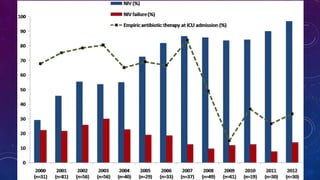
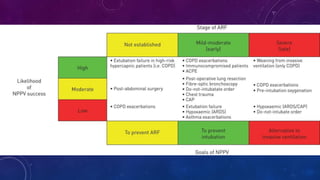
• The use of NPPV to treat acute respiratory failure (ARF)
has expanded tremendously over the world in the past two
decades in terms of the spectrum of diseases that can be
successfully managed, the locations of its application and
the achievable goals .
• NPPV has become the first-choice ventilator technique in
• AE-COPD,
• Cardiogenic pulmonary edema,
• Severe hypoxemia in immunosuppression conditions and
• Weaning from invasive mechanical ventilation (IMV).
• In fact, clinicians who do not apply NPPV in these
“golden” clinical indications within the right time-frame
and setting may be banned for malpractice
NPPV offer the same physiological effects of IMV delivered via
endotracheal intubation (ETI)
• Respiratory muscle unloading,
• Gas exchange improvement and
• Augmentation of alveolar ventilation but
• Avoiding the life-threatening risks correlated with the use of an artificial airway
Avoiding the life-threatening risks correlated with the use of
an artificial airway
• Eliminates the risks associated with upper airway trauma,
• Reduces patient discomfort and
• Minimizes risk of conditions such as VAP and the need for
sedation;
• It preserves airway clearance and swallowing and
Avoiding the life-threatening risks correlated with the use of
an artificial airway
• Allows oral patency and intermittent ventilation so that
normal eating, drinking and communication are
permitted; additionally,
• Breaks from ventilation can be used for nebulized
medication, physiotherapy and expectoration.
Theoretically, NIV could be delivered using all the
modalities used for invasive ventilation
But, in real life, most ventilators used for NIV deliver
either volume or pressure-targeted ventilation.
Recent Ventilators use Hybrid Modes
NIV has two unique characteristics:
• Non-hermetic nature of the system.
• Ventilator-lung assembly cannot be
considered as a single compartment
model
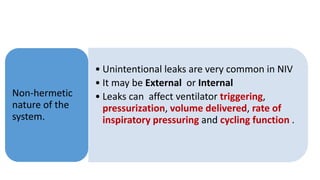
• Unintentional leaks are very common in NIV
• It may be External or Internal
• Leaks can affect ventilator triggering,
pressurization, volume delivered, rate of
inspiratory pressuring and cycling function .
Non-hermetic
nature of the
system.
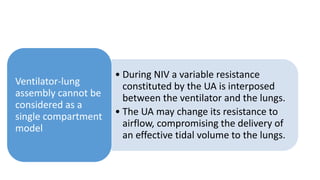
• During NIV a variable resistance
constituted by the UA is interposed
between the ventilator and the lungs.
• The UA may change its resistance to
airflow, compromising the delivery of
an effective tidal volume to the lungs.
Ventilator-lung
assembly cannot be
considered as a
single compartment
model
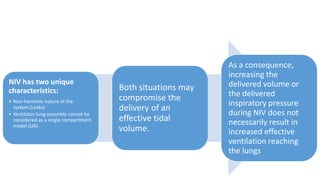
NIV has two unique
characteristics:
• Non-hermetic nature of the
system.(Leaks)
• Ventilator-lung assembly cannot be
considered as a single compartment
model (UA)
Both situations may
compromise the
delivery of an
effective tidal
volume.
As a consequence,
increasing the
delivered volume or
the delivered
inspiratory pressure
during NIV does not
necessarily result in
increased effective
ventilation reaching
the lungs
Modes Of Ventilation
• Theoretically, NIV can be delivered using all the modalities used in
invasive ventilation.
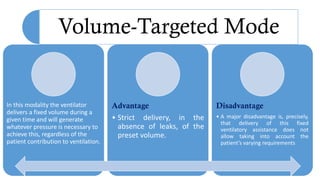
In this modality the ventilator
delivers a fixed volume during a
given time and will generate
whatever pressure is necessary to
achieve this, regardless of the
patient contribution to ventilation.
Advantage
• Strict delivery, in the
absence of leaks, of the
preset volume.
Disadvantage
• A major disadvantage is, precisely,
that delivery of this fixed
ventilatory assistance does not
allow taking into account the
patient’s varying requirements
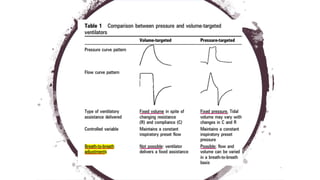
Volume-Targeted Mode
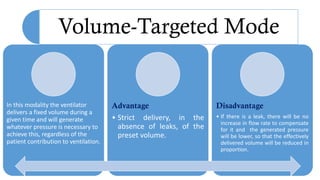
In this modality the ventilator
delivers a fixed volume during a
given time and will generate
whatever pressure is necessary to
achieve this, regardless of the
patient contribution to ventilation.
Advantage
• Strict delivery, in the
absence of leaks, of the
preset volume.
Disadvantage
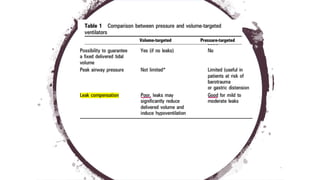
• If there is a leak, there will be no
increase in flow rate to compensate
for it and the generated pressure
will be lower, so that the effectively
delivered volume will be reduced in
proportion.
Volume-Targeted Mode
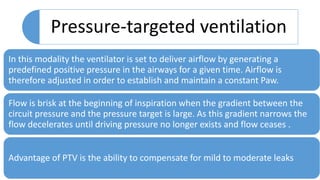
Pressure-targeted ventilation
In this modality the ventilator is set to deliver airflow by generating a
predefined positive pressure in the airways for a given time. Airflow is
therefore adjusted in order to establish and maintain a constant Paw.
Flow is brisk at the beginning of inspiration when the gradient between the
circuit pressure and the pressure target is large. As this gradient narrows the
flow decelerates until driving pressure no longer exists and flow ceases .
Advantage of PTV is the ability to compensate for mild to moderate leaks
NIV: Volume or Pressure Targeted?
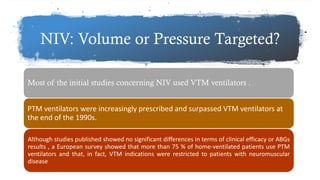
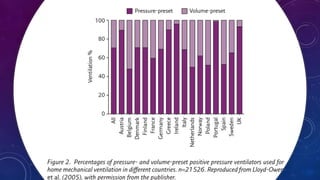
Most of the initial studies concerning NIV used VTM ventilators .
PTM ventilators were increasingly prescribed and surpassed VTM ventilators at
the end of the 1990s.
Although studies published showed no significant differences in terms of clinical efficacy or ABGs
results , a European survey showed that more than 75 % of home-ventilated patients use PTM
ventilators and that, in fact, VTM indications were restricted to patients with neuromuscular
disease
A limitation of pressure ventilation is that it cannot
guarantee a tidal volume delivered to the patient.
Volume targeting is a feature available in some new
ventilators that could allow this limitation to be
overcome.
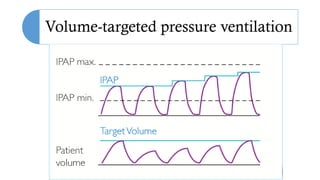
Volume-targeted pressure ventilation
A limitation of pressure ventilation is that it cannot
guarantee a tidal volume delivered to the patient.
Volume targeting is a feature available in some new
ventilators that could allow this limitation to be
overcome.
Volume-targeted pressure ventilation
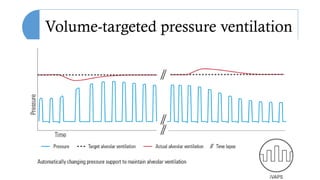
This hybrid modality combines features of pressure
and volume ventilation.
The ventilator estimates the delivered tidal volume
and adjusts its parameters to ensure a
predetermined target tidal volume.
Volume-targeted pressure ventilation
Common Setting Parameter
• Appropriate settings are decisive to obtain optimal patient
ventilator synchrony.
Common Setting Parameter
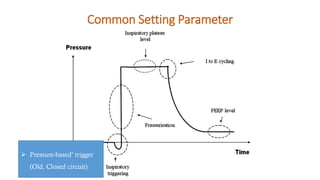
➢ Pressure-based’ trigger
(Old, Closed circuit)
Common Setting Parameter
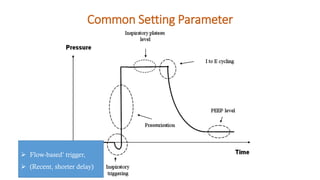
➢ Flow-based’ trigger,
➢ (Recent, shorter delay)
Common Setting Parameter
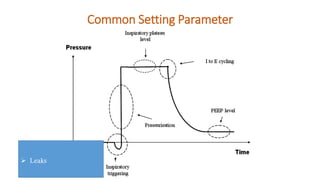
➢ Leaks
Common Setting Parameter
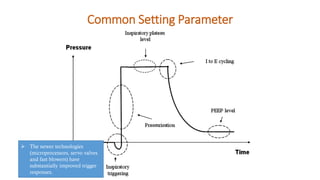
➢ The newer technologies
(microprocessors, servo valves
and fast blowers) have
substantially improved trigger
responses.
Common Setting Parameter
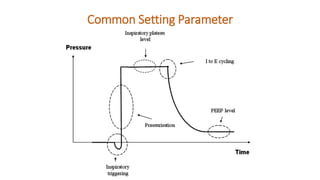
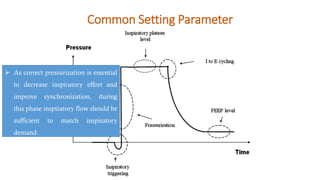
➢ As correct pressurization is essential
to decrease inspiratory effort and
improve synchronization, during
this phase inspiratory flow should be
sufficient to match inspiratory
demand.
Common Setting Parameter
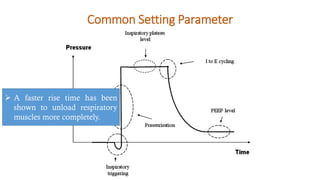
➢ A faster rise time has been
shown to unload respiratory
muscles more completely.
Common Setting Parameter
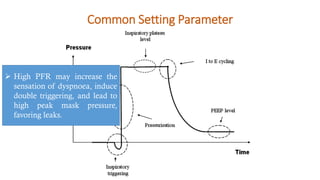
➢ High PFR may increase the
sensation of dyspnoea, induce
double triggering, and lead to
high peak mask pressure,
favoring leaks.
Common Setting Parameter
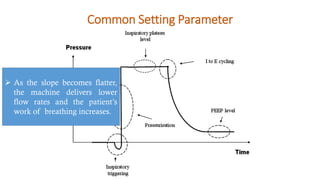
➢ As the slope becomes flatter,
the machine delivers lower
flow rates and the patient’s
work of breathing increases.
Common Setting Parameter
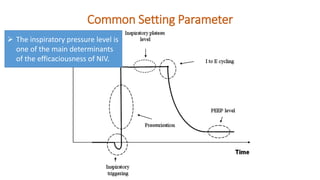
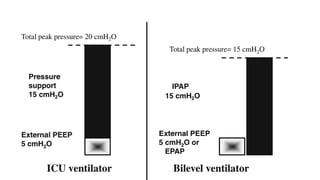
➢ The inspiratory pressure level is
one of the main determinants
of the efficaciousness of NIV.
Common Setting Parameter
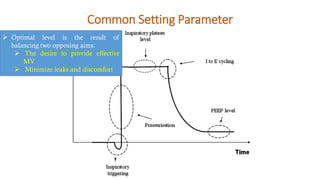
➢ Optimal level is the result of
balancing two opposing aims:
➢ The desire to provide effective
MV
➢ Minimize leaks and discomfort
Common Setting Parameter
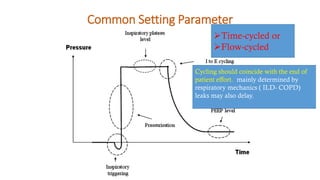
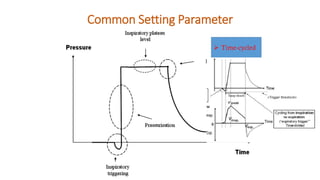
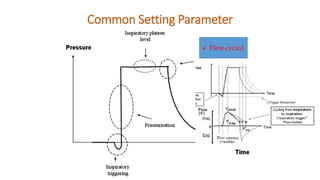
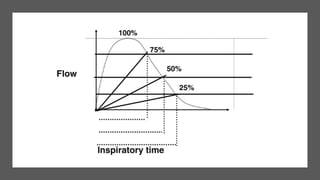
➢Time-cycled or
➢Flow-cycled
Cycling should coincide with the end of
patient effort. mainly determined by
respiratory mechanics ( ILD- COPD)
leaks may also delay.
Common Setting Parameter
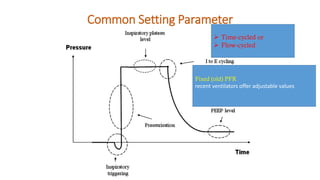
➢ Time-cycled or
➢ Flow-cycled
Fixed (old) PFR
recent ventilators offer adjustable values
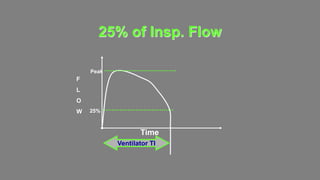
25% of Insp. Flow
F
L
O
W
Time
Ventilator TI
25%
Peak
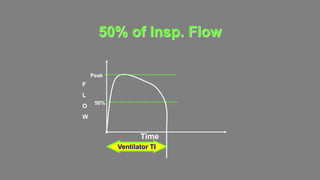
50% of Insp. Flow
F
L
O
W
Time
Ventilator TI
50%
Peak
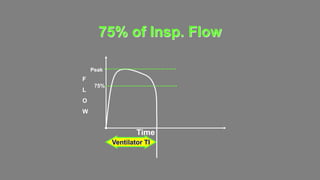
75% of Insp. Flow
F
L
O
W
Time
Ventilator TI
75%
Peak
Common Setting Parameter
➢ Time-cycled
Common Setting Parameter
➢ Flow-cycled
Common Setting Parameter
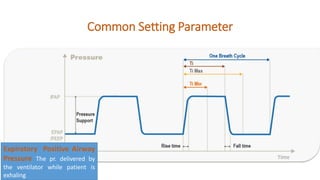
Expiratory Positive Airway
Pressure The pr. delivered by
the ventilator while patient is
exhaling
• EPAP assists with the maintenance of upper airway patency in
sleep, which may be important in patients with an unstable
upper airway (e.g. in OSA) and helps to recruit/maintain lung
volume, improving oxygenation.
• In obstructive lung disease, EPAP helps to overcome the
inspiratory threshold load when intrinsic PEEP is present,
reducing the WOB and maximizing effective triggering
How Do I Determine The Optimal EPAP Value?
• EPAP assists with the maintenance of upper airway patency in sleep,
which may be important in patients with an unstable upper airway (e.g. in
OSA) and helps to recruit/maintain lung volume, improving
oxygenation.
How do I determine the optimal EPAP value?
• EPAP: Expiratory Positive Airway Pressure
• Maintaining an expiratory flow through tubing mandatory to washout expired CO2
from single tube circuits and masks
• EPAP increases FRC (improves ventilation in obese subjects)
• EPAP prevents collapse of upper airways in subjects prone to sleep apnea-hypopnea
syndrome (« Pneumatic splint »)
• EPAP counteracts the negative effect of PEEPI on work of breathing
How do I determine the optimal EPAP value?
• Overlap syndromes and patients with sleep apnea-hypopnea
syndromes: EPAP values must be adjusted to stabilize upper
airway
• PEEPI: rarely > 4 cmH2O in COPD (but reported by group
of Nicholas Hart as potentially reaching 6-8 cmH2O); PEEPI
also present in severe obesity (OHS)
Some ventilators enable the clinician to set an EPAP range that adjusts the level of
PEEP applied in response to patient-related changes (auto-EPAP)
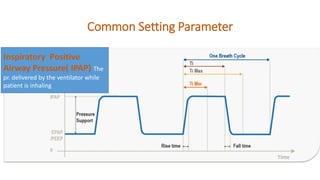
Common Setting Parameter
Inspiratory Positive
Airway Pressure( IPAP) The
pr. delivered by the ventilator while
patient is inhaling
How do I set the IPAP value?
• IPAP: Inspiratory Positive Airway Pressure
• IPAP – EPAP = Pressure support (or PS)
• PS = pressure support provided to the respiratory muscles to compensate for
their weakness and correct alveolar hypoventilation
• In a given subject, relationship between PS and tidal volume (VT) is  linear
• Limits: leaks, tolerance, glottic closure
• Titration of PS must aim to:
- normalize PCO2 (Arterial blood sample or PtcCO2) and/or
• - obtain a target VT of 7-8 ml/kg of ideal body weight
• NB: Reliability of estimation of tidal volume (VT) by ventilator softwares varies
considerably from one device to another, and depends on pressure levels and
leaks
How do I set the IPAP value?
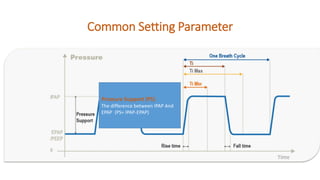
Common Setting Parameter
Pressure Support (PS)
The difference between IPAP And
EPAP (PS= IPAP-EPAP)
Common Setting Parameter
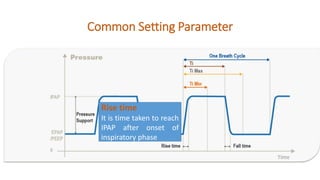
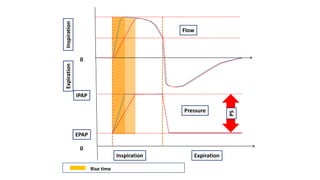
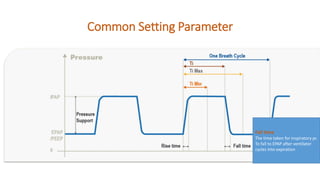
Rise time
It is time taken to reach
IPAP after onset of
inspiratory phase
Flow
Pressure
InspirationExpiration
IPAP
EPAP
0
0
PS
Inspiration Expiration
Rise time
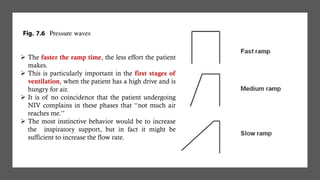
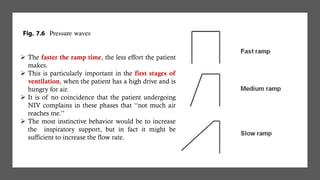
➢ The faster the ramp time, the less effort the patient
makes.
➢ This is particularly important in the first stages of
ventilation, when the patient has a high drive and is
hungry for air.
➢ It is of no coincidence that the patient undergoing
NIV complains in these phases that ‘‘not much air
reaches me.’’
➢ The most instinctive behavior would be to increase
the inspiratory support, but in fact it might be
sufficient to increase the flow rate.
➢ The faster the ramp time, the less effort the patient
makes.
➢ This is particularly important in the first stages of
ventilation, when the patient has a high drive and is
hungry for air.
➢ It is of no coincidence that the patient undergoing
NIV complains in these phases that ‘‘not much air
reaches me.’’
➢ The most instinctive behavior would be to increase
the inspiratory support, but in fact it might be
sufficient to increase the flow rate.
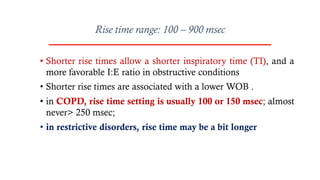
Rise time range: 100 – 900 msec
• Shorter rise times allow a shorter inspiratory time (TI), and a
more favorable I:E ratio in obstructive conditions
• Shorter rise times are associated with a lower WOB .
• in COPD, rise time setting is usually 100 or 150 msec; almost
never> 250 msec;
• in restrictive disorders, rise time may be a bit longer
Common Setting Parameter
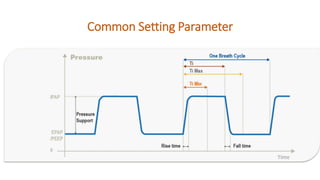
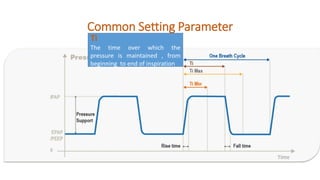
Ti
The time over which the
pressure is maintained , from
beginning to end of inspiration
Common Setting Parameter
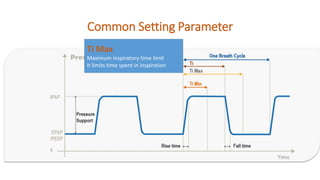
Ti Max
Maximum inspiratory time limit
It limits time spent in inspiration
Common Setting Parameter
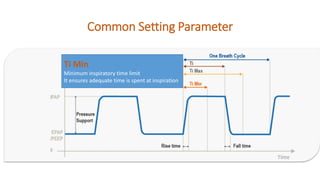
Ti Min
Minimum inspiratory time limit
It ensures adequate time is spent at inspiration
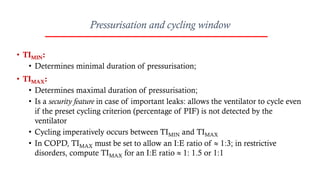
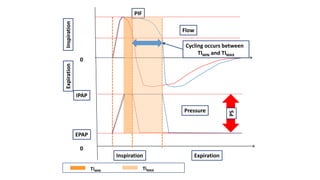
Pressurisation and cycling window
• TIMIN:
• Determines minimal duration of pressurisation;
• TIMAX:
• Determines maximal duration of pressurisation;
• Is a security feature in case of important leaks: allows the ventilator to cycle even
if the preset cycling criterion (percentage of PIF) is not detected by the
ventilator
• Cycling imperatively occurs between TIMIN and TIMAX
• In COPD, TIMAX must be set to allow an I:E ratio of  1:3; in restrictive
disorders, compute TIMAX for an I:E ratio  1: 1.5 or 1:1
Flow
Pressure
InspirationExpiration
IPAP
EPAP
0
0
PS
Inspiration Expiration
PIF
TiMIN TiMAX
Cycling occurs between
TIMIN and TIMAX
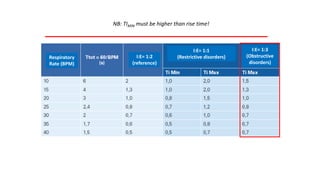
NB: TIMIN must be higher than rise time!
Respiratory
Rate (BPM)
I:E= 1:2
(reference)
I:E= 1:3
(Obstructive
disorders)
I:E= 1:1
(Restrictive disorders)
Common Setting Parameter
Fall time
The time taken for inspiratory pr.
To fall to EPAP after ventilator
cycles into expiration
Common Ventilatory Modes
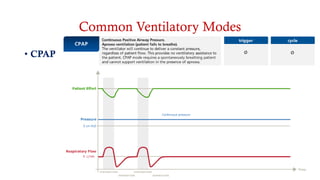
• CPAP
• S (Sponteous)
• S/T (Sponteous-Timed )
• PAC (Pressure Assist Control)
• T (Timed)
Common Ventilatory Modes
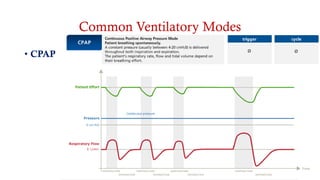
• CPAP
• S (Sponteous)
• S/T (Sponteous-Timed )
• PAC (Pressure Assist Control)
• T (Timed)
Common Ventilatory Modes
• CPAP
• S (Sponteous)
• S/T (Sponteous-Timed )
• PAC (Pressure Assist Control)
• T (Timed)
Common Ventilatory Modes
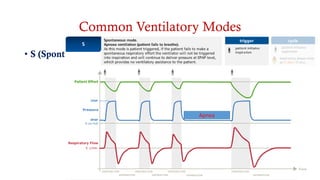
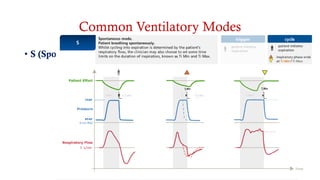
• S (Sponteous)
• In this mode, only available in PTV, the patient controls the beginning and
end of inspiration.
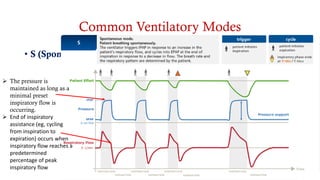
Common Ventilatory Modes
• S (Sponteous)
• S/T (Sponteous-Timed )
• PAC (Pressure Assist Control)
• T (Timed)
➢ The pressure is
maintained as long as a
minimal preset
inspiratory flow is
occurring.
➢ End of inspiratory
assistance (eg, cycling
from inspiration to
expiration) occurs when
inspiratory flow reaches a
predetermined
percentage of peak
inspiratory flow
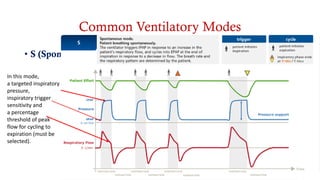
Common Ventilatory Modes
• S (Sponteous)
• S/T (Sponteous-Timed )
• PAC (Pressure Assist Control)
• T (Timed)
In this mode,
a targeted inspiratory
pressure,
inspiratory trigger
sensitivity and
a percentage
threshold of peak
flow for cycling to
expiration (must be
selected).
Common Ventilatory Modes
• S (Sponteous)
• S/T (Sponteous-Timed )
• PAC (Pressure Assist Control)
• T (Timed)
Apnea
Common Ventilatory Modes
• S (Sponteous)
• S/T (Sponteous-Timed )
• PAC (Pressure Assist Control)
• T (Timed)
Common Ventilatory Modes
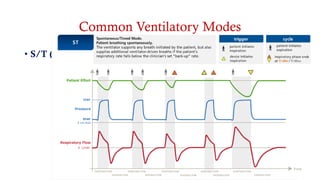
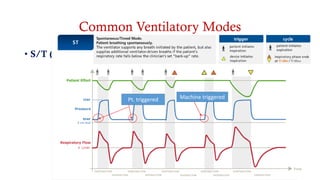
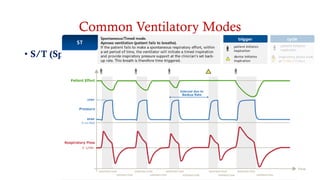
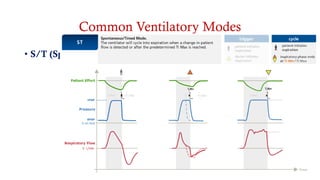
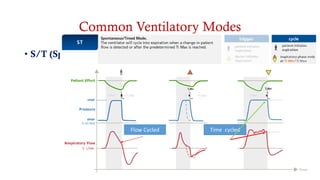
• S/T (Sponteous-Timed )
• In this particular mode, cycling from inspiration to expiration is flow-
limited in patient-triggered cycles and switches to time-limited when the
patient’s spontaneous RR falls below the back-up RR, and also when the
inspiratory time exceeds a predetermined maximal length during S
cycles.C (Pressure Assist Control)
• T (Timed)
Common Ventilatory Modes
• S/T (Sponteous-Timed )
• PAC (Pressure Assist Control)
• T (Timed)
Common Ventilatory Modes
• S/T (Sponteous-Timed )
• PAC (Pressure Assist Control)
• T (Timed)
Pt. triggered Machine triggered
Common Ventilatory Modes
• S/T (Sponteous-Timed )
• PAC (Pressure Assist Control)
• T (Timed)
Common Ventilatory Modes
• S/T (Sponteous-Timed )
• PAC (Pressure Assist Control)
• T (Timed)
Common Ventilatory Modes
• S/T (Sponteous-Timed )
• PAC (Pressure Assist Control)
• T (Timed)
Flow Cycled Time cycled
Common Ventilatory Modes
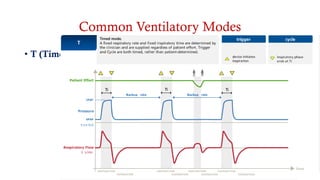
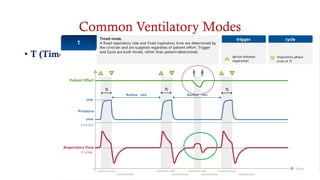
• T (Timed) ,Control mode (C)
• In the control mode there is a preset automatic cycle based on time.
• The ventilator controls the beginning and end of inspiration and thus the RR.
• With this mode, the entire work of breathing is supposed to be performed by
the ventilator.
Common Ventilatory Modes
• T (Timed)
Common Ventilatory Modes
• T (Timed)
Common Ventilatory Modes
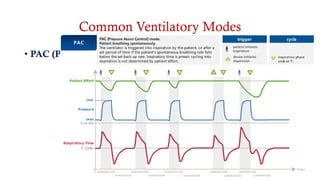
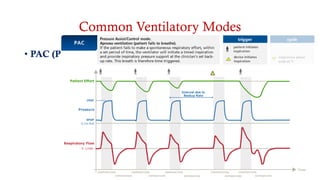
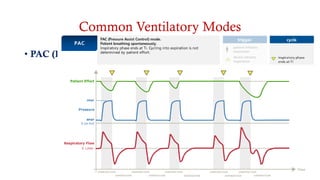
• PAC (Pressure Assist Control)
Common Ventilatory Modes
• PAC (Pressure Assist Control)
Common Ventilatory Modes
• PAC (Pressure Assist Control)
Common Ventilatory Modes
• PAC (Pressure Assist Control)
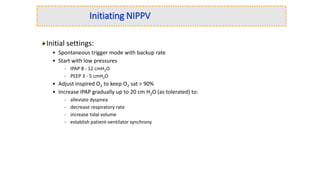
Initiating NIPPV
Initial settings:
• Spontaneous trigger mode with backup rate
• Start with low pressures
- IPAP 8 - 12 cmH2O
- PEEP 3 - 5 cmH2O
• Adjust inspired O2 to keep O2 sat > 90%
• Increase IPAP gradually up to 20 cm H2O (as tolerated) to:
- alleviate dyspnea
- decrease respiratory rate
- increase tidal volume
- establish patient-ventilator synchrony
Eight Rules To Remember When
Ventilating A Patient Non-Invasively
Everything Must be Ready, and Everything Must be Familiar
Eight Rules To Remember When
Ventilating A Patient Non-Invasively
• Patients have individual and unpredictable responses and so the
common practice is to use the ventilator and the method that enables
the predetermined therapeutic aim to be reached at the lowest
human and financial costs, with the fewest undesired effects for the
patient and with the best compliance and tolerance.
There is No Such Thing as the Best Method of Ventilation
Eight Rules To Remember When
Ventilating A Patient Non-Invasively
•
Choose the Ventilator According to the Patient’s Need
Eight Rules To Remember When
Ventilating A Patient Non-Invasively
• It is important to have as broad a range of types and sizes of
interfaces as possible, considering that all this has a cost for our
administrators, but that on the other hand, using NIV avoids other
more substantial expenses such as antibiotics to treat cases of
intubation associated pneumonia.
There is no Single Interface Valid for All Patients
Eight Rules To Remember When
Ventilating A Patient Non-Invasively
• When a patient is intubated, only the clinician’s brain is working,
whereas when we apply NIV this becomes a means of interaction
between the clinician’s brain ( through the ventilator) and that of the
patient.
• The patient is therefore an active and not passive part of the
ventilatory process during NIV
Explain What You Want to Do to the Patient
Eight Rules To Remember When
Ventilating A Patient Non-Invasively
• One of the tricks to facilitate the success of NIV is to explain the
technique to patients, especially those without gross changes to the
sensorium, before using it.
Explain What You Want to Do to the Patient
Eight Rules To Remember When
Ventilating A Patient Non-Invasively
• Resting the mask on the patient’s face, holding it there with a hand,
but not attaching it with elastics or head pieces and in the meantime
switching on the ventilator at a low pressure in order to demonstrate
what we are going to do.
• It must be said that sometimes a minimum of psychological warfare
can come in hand, for example, recounting the procedure of
intubation and its potential side effects if the NIV is not accepted
Explain What You Want to Do to the Patient
Eight Rules To Remember When
Ventilating A Patient Non-Invasively
• NIV is not a treatment given by a single person, but the work of a
team.
• The earliest period is the most critical one and the support of at least
two people is one of the keys to successful NIV
Never Work Alone
Eight Rules To Remember When
Ventilating A Patient Non-Invasively
• The time factor is crucial in medicine.
• A clinician’s greatest skill is that of clearly understanding how far he
can push without harming the patient.
Be Aware of Your Limits
Eight Rules To Remember When
Ventilating A Patient Non-Invasively
• There are objective limits to how far a trial of NIV can be
pushed;
Be Aware of Your Limits
Eight Rules To Remember When
Ventilating A Patient Non-Invasively
• Every therapy worthy of the name must be evaluated through
objective parameters.
• The fortune or misfortune of NIV is that its success or failure is
quickly predictable in most cases
• The probable improvements during NIV are seen within a few
minutes.
Monitor and Record What You Do
Eight Rules To Remember When
Ventilating A Patient Non-Invasively
• We must, know which parameter to monitor , when to monitor it
and above all why to monitor that sign.
• Remember to keep track of what has been done and record, write
and document the information, for the person who will look after
your patient when you are no longer there.
Monitor and Record What You Do
Niv ventilatory modes

Niv ventilatory modes

  • 1.
    NIV Ventilatory Modes MostafaElshazly Professor Of Pulmonary Medicine Chairman Of PCCU Kasr Alainy School Of Medicine Cairo University elshazly66@hotmail.com
  • 3.
    • NPPV mustbe considered as a rational art and not just as an application of science, which requires the ability of clinicians to both choose case-by-case the best “ingredients” for a “successful recipe” (i.e. patient selection, interface, ventilator, interface, etc.) and to avoid a delayed intubation if the ventilation attempt fails.
  • 5.
    • The useof NPPV to treat acute respiratory failure (ARF) has expanded tremendously over the world in the past two decades in terms of the spectrum of diseases that can be successfully managed, the locations of its application and the achievable goals .
  • 6.
    • NPPV hasbecome the first-choice ventilator technique in • AE-COPD, • Cardiogenic pulmonary edema, • Severe hypoxemia in immunosuppression conditions and • Weaning from invasive mechanical ventilation (IMV).
  • 8.
    • In fact,clinicians who do not apply NPPV in these “golden” clinical indications within the right time-frame and setting may be banned for malpractice
  • 9.
    NPPV offer thesame physiological effects of IMV delivered via endotracheal intubation (ETI) • Respiratory muscle unloading, • Gas exchange improvement and • Augmentation of alveolar ventilation but • Avoiding the life-threatening risks correlated with the use of an artificial airway
  • 10.
    Avoiding the life-threateningrisks correlated with the use of an artificial airway • Eliminates the risks associated with upper airway trauma, • Reduces patient discomfort and • Minimizes risk of conditions such as VAP and the need for sedation; • It preserves airway clearance and swallowing and
  • 11.
    Avoiding the life-threateningrisks correlated with the use of an artificial airway • Allows oral patency and intermittent ventilation so that normal eating, drinking and communication are permitted; additionally, • Breaks from ventilation can be used for nebulized medication, physiotherapy and expectoration.
  • 12.
    Theoretically, NIV couldbe delivered using all the modalities used for invasive ventilation But, in real life, most ventilators used for NIV deliver either volume or pressure-targeted ventilation. Recent Ventilators use Hybrid Modes
  • 13.
    NIV has twounique characteristics: • Non-hermetic nature of the system. • Ventilator-lung assembly cannot be considered as a single compartment model
  • 15.
    • Unintentional leaksare very common in NIV • It may be External or Internal • Leaks can affect ventilator triggering, pressurization, volume delivered, rate of inspiratory pressuring and cycling function . Non-hermetic nature of the system.
  • 16.
    • During NIVa variable resistance constituted by the UA is interposed between the ventilator and the lungs. • The UA may change its resistance to airflow, compromising the delivery of an effective tidal volume to the lungs. Ventilator-lung assembly cannot be considered as a single compartment model
  • 17.
    NIV has twounique characteristics: • Non-hermetic nature of the system.(Leaks) • Ventilator-lung assembly cannot be considered as a single compartment model (UA) Both situations may compromise the delivery of an effective tidal volume. As a consequence, increasing the delivered volume or the delivered inspiratory pressure during NIV does not necessarily result in increased effective ventilation reaching the lungs
  • 18.
    Modes Of Ventilation •Theoretically, NIV can be delivered using all the modalities used in invasive ventilation.
  • 19.
    In this modalitythe ventilator delivers a fixed volume during a given time and will generate whatever pressure is necessary to achieve this, regardless of the patient contribution to ventilation. Advantage • Strict delivery, in the absence of leaks, of the preset volume. Disadvantage • A major disadvantage is, precisely, that delivery of this fixed ventilatory assistance does not allow taking into account the patient’s varying requirements Volume-Targeted Mode
  • 20.
    In this modalitythe ventilator delivers a fixed volume during a given time and will generate whatever pressure is necessary to achieve this, regardless of the patient contribution to ventilation. Advantage • Strict delivery, in the absence of leaks, of the preset volume. Disadvantage • If there is a leak, there will be no increase in flow rate to compensate for it and the generated pressure will be lower, so that the effectively delivered volume will be reduced in proportion. Volume-Targeted Mode
  • 22.
    Pressure-targeted ventilation In thismodality the ventilator is set to deliver airflow by generating a predefined positive pressure in the airways for a given time. Airflow is therefore adjusted in order to establish and maintain a constant Paw. Flow is brisk at the beginning of inspiration when the gradient between the circuit pressure and the pressure target is large. As this gradient narrows the flow decelerates until driving pressure no longer exists and flow ceases . Advantage of PTV is the ability to compensate for mild to moderate leaks
  • 25.
    NIV: Volume orPressure Targeted? Most of the initial studies concerning NIV used VTM ventilators . PTM ventilators were increasingly prescribed and surpassed VTM ventilators at the end of the 1990s. Although studies published showed no significant differences in terms of clinical efficacy or ABGs results , a European survey showed that more than 75 % of home-ventilated patients use PTM ventilators and that, in fact, VTM indications were restricted to patients with neuromuscular disease
  • 27.
    A limitation ofpressure ventilation is that it cannot guarantee a tidal volume delivered to the patient. Volume targeting is a feature available in some new ventilators that could allow this limitation to be overcome.
  • 28.
    Volume-targeted pressure ventilation Alimitation of pressure ventilation is that it cannot guarantee a tidal volume delivered to the patient. Volume targeting is a feature available in some new ventilators that could allow this limitation to be overcome.
  • 29.
    Volume-targeted pressure ventilation Thishybrid modality combines features of pressure and volume ventilation. The ventilator estimates the delivered tidal volume and adjusts its parameters to ensure a predetermined target tidal volume.
  • 30.
  • 31.
  • 32.
    Common Setting Parameter •Appropriate settings are decisive to obtain optimal patient ventilator synchrony.
  • 33.
  • 34.
    Common Setting Parameter ➢Pressure-based’ trigger (Old, Closed circuit)
  • 35.
    Common Setting Parameter ➢Flow-based’ trigger, ➢ (Recent, shorter delay)
  • 36.
  • 37.
    Common Setting Parameter ➢The newer technologies (microprocessors, servo valves and fast blowers) have substantially improved trigger responses.
  • 38.
    Common Setting Parameter ➢As correct pressurization is essential to decrease inspiratory effort and improve synchronization, during this phase inspiratory flow should be sufficient to match inspiratory demand.
  • 39.
    Common Setting Parameter ➢A faster rise time has been shown to unload respiratory muscles more completely.
  • 40.
    Common Setting Parameter ➢High PFR may increase the sensation of dyspnoea, induce double triggering, and lead to high peak mask pressure, favoring leaks.
  • 41.
    Common Setting Parameter ➢As the slope becomes flatter, the machine delivers lower flow rates and the patient’s work of breathing increases.
  • 42.
    Common Setting Parameter ➢The inspiratory pressure level is one of the main determinants of the efficaciousness of NIV.
  • 43.
    Common Setting Parameter ➢Optimal level is the result of balancing two opposing aims: ➢ The desire to provide effective MV ➢ Minimize leaks and discomfort
  • 44.
    Common Setting Parameter ➢Time-cycledor ➢Flow-cycled Cycling should coincide with the end of patient effort. mainly determined by respiratory mechanics ( ILD- COPD) leaks may also delay.
  • 45.
    Common Setting Parameter ➢Time-cycled or ➢ Flow-cycled Fixed (old) PFR recent ventilators offer adjustable values
  • 46.
    25% of Insp.Flow F L O W Time Ventilator TI 25% Peak
  • 47.
    50% of Insp.Flow F L O W Time Ventilator TI 50% Peak
  • 48.
    75% of Insp.Flow F L O W Time Ventilator TI 75% Peak
  • 49.
  • 50.
  • 51.
  • 52.
    Common Setting Parameter ExpiratoryPositive Airway Pressure The pr. delivered by the ventilator while patient is exhaling
  • 53.
    • EPAP assistswith the maintenance of upper airway patency in sleep, which may be important in patients with an unstable upper airway (e.g. in OSA) and helps to recruit/maintain lung volume, improving oxygenation. • In obstructive lung disease, EPAP helps to overcome the inspiratory threshold load when intrinsic PEEP is present, reducing the WOB and maximizing effective triggering
  • 54.
    How Do IDetermine The Optimal EPAP Value? • EPAP assists with the maintenance of upper airway patency in sleep, which may be important in patients with an unstable upper airway (e.g. in OSA) and helps to recruit/maintain lung volume, improving oxygenation.
  • 55.
    How do Idetermine the optimal EPAP value? • EPAP: Expiratory Positive Airway Pressure • Maintaining an expiratory flow through tubing mandatory to washout expired CO2 from single tube circuits and masks • EPAP increases FRC (improves ventilation in obese subjects) • EPAP prevents collapse of upper airways in subjects prone to sleep apnea-hypopnea syndrome (« Pneumatic splint ») • EPAP counteracts the negative effect of PEEPI on work of breathing
  • 56.
    How do Idetermine the optimal EPAP value? • Overlap syndromes and patients with sleep apnea-hypopnea syndromes: EPAP values must be adjusted to stabilize upper airway • PEEPI: rarely > 4 cmH2O in COPD (but reported by group of Nicholas Hart as potentially reaching 6-8 cmH2O); PEEPI also present in severe obesity (OHS) Some ventilators enable the clinician to set an EPAP range that adjusts the level of PEEP applied in response to patient-related changes (auto-EPAP)
  • 57.
    Common Setting Parameter InspiratoryPositive Airway Pressure( IPAP) The pr. delivered by the ventilator while patient is inhaling
  • 58.
    How do Iset the IPAP value? • IPAP: Inspiratory Positive Airway Pressure • IPAP – EPAP = Pressure support (or PS) • PS = pressure support provided to the respiratory muscles to compensate for their weakness and correct alveolar hypoventilation • In a given subject, relationship between PS and tidal volume (VT) is  linear • Limits: leaks, tolerance, glottic closure
  • 59.
    • Titration ofPS must aim to: - normalize PCO2 (Arterial blood sample or PtcCO2) and/or • - obtain a target VT of 7-8 ml/kg of ideal body weight • NB: Reliability of estimation of tidal volume (VT) by ventilator softwares varies considerably from one device to another, and depends on pressure levels and leaks How do I set the IPAP value?
  • 60.
    Common Setting Parameter PressureSupport (PS) The difference between IPAP And EPAP (PS= IPAP-EPAP)
  • 62.
    Common Setting Parameter Risetime It is time taken to reach IPAP after onset of inspiratory phase
  • 63.
  • 64.
    ➢ The fasterthe ramp time, the less effort the patient makes. ➢ This is particularly important in the first stages of ventilation, when the patient has a high drive and is hungry for air. ➢ It is of no coincidence that the patient undergoing NIV complains in these phases that ‘‘not much air reaches me.’’ ➢ The most instinctive behavior would be to increase the inspiratory support, but in fact it might be sufficient to increase the flow rate.
  • 65.
    ➢ The fasterthe ramp time, the less effort the patient makes. ➢ This is particularly important in the first stages of ventilation, when the patient has a high drive and is hungry for air. ➢ It is of no coincidence that the patient undergoing NIV complains in these phases that ‘‘not much air reaches me.’’ ➢ The most instinctive behavior would be to increase the inspiratory support, but in fact it might be sufficient to increase the flow rate.
  • 66.
    Rise time range:100 – 900 msec • Shorter rise times allow a shorter inspiratory time (TI), and a more favorable I:E ratio in obstructive conditions • Shorter rise times are associated with a lower WOB . • in COPD, rise time setting is usually 100 or 150 msec; almost never> 250 msec; • in restrictive disorders, rise time may be a bit longer
  • 67.
    Common Setting Parameter Ti Thetime over which the pressure is maintained , from beginning to end of inspiration
  • 68.
    Common Setting Parameter TiMax Maximum inspiratory time limit It limits time spent in inspiration
  • 69.
    Common Setting Parameter TiMin Minimum inspiratory time limit It ensures adequate time is spent at inspiration
  • 70.
    Pressurisation and cyclingwindow • TIMIN: • Determines minimal duration of pressurisation; • TIMAX: • Determines maximal duration of pressurisation; • Is a security feature in case of important leaks: allows the ventilator to cycle even if the preset cycling criterion (percentage of PIF) is not detected by the ventilator • Cycling imperatively occurs between TIMIN and TIMAX • In COPD, TIMAX must be set to allow an I:E ratio of  1:3; in restrictive disorders, compute TIMAX for an I:E ratio  1: 1.5 or 1:1
  • 71.
  • 72.
    NB: TIMIN mustbe higher than rise time! Respiratory Rate (BPM) I:E= 1:2 (reference) I:E= 1:3 (Obstructive disorders) I:E= 1:1 (Restrictive disorders)
  • 73.
    Common Setting Parameter Falltime The time taken for inspiratory pr. To fall to EPAP after ventilator cycles into expiration
  • 75.
    Common Ventilatory Modes •CPAP • S (Sponteous) • S/T (Sponteous-Timed ) • PAC (Pressure Assist Control) • T (Timed)
  • 76.
    Common Ventilatory Modes •CPAP • S (Sponteous) • S/T (Sponteous-Timed ) • PAC (Pressure Assist Control) • T (Timed)
  • 77.
    Common Ventilatory Modes •CPAP • S (Sponteous) • S/T (Sponteous-Timed ) • PAC (Pressure Assist Control) • T (Timed)
  • 78.
    Common Ventilatory Modes •S (Sponteous) • In this mode, only available in PTV, the patient controls the beginning and end of inspiration.
  • 79.
    Common Ventilatory Modes •S (Sponteous) • S/T (Sponteous-Timed ) • PAC (Pressure Assist Control) • T (Timed) ➢ The pressure is maintained as long as a minimal preset inspiratory flow is occurring. ➢ End of inspiratory assistance (eg, cycling from inspiration to expiration) occurs when inspiratory flow reaches a predetermined percentage of peak inspiratory flow
  • 80.
    Common Ventilatory Modes •S (Sponteous) • S/T (Sponteous-Timed ) • PAC (Pressure Assist Control) • T (Timed) In this mode, a targeted inspiratory pressure, inspiratory trigger sensitivity and a percentage threshold of peak flow for cycling to expiration (must be selected).
  • 81.
    Common Ventilatory Modes •S (Sponteous) • S/T (Sponteous-Timed ) • PAC (Pressure Assist Control) • T (Timed) Apnea
  • 82.
    Common Ventilatory Modes •S (Sponteous) • S/T (Sponteous-Timed ) • PAC (Pressure Assist Control) • T (Timed)
  • 83.
    Common Ventilatory Modes •S/T (Sponteous-Timed ) • In this particular mode, cycling from inspiration to expiration is flow- limited in patient-triggered cycles and switches to time-limited when the patient’s spontaneous RR falls below the back-up RR, and also when the inspiratory time exceeds a predetermined maximal length during S cycles.C (Pressure Assist Control) • T (Timed)
  • 84.
    Common Ventilatory Modes •S/T (Sponteous-Timed ) • PAC (Pressure Assist Control) • T (Timed)
  • 85.
    Common Ventilatory Modes •S/T (Sponteous-Timed ) • PAC (Pressure Assist Control) • T (Timed) Pt. triggered Machine triggered
  • 86.
    Common Ventilatory Modes •S/T (Sponteous-Timed ) • PAC (Pressure Assist Control) • T (Timed)
  • 87.
    Common Ventilatory Modes •S/T (Sponteous-Timed ) • PAC (Pressure Assist Control) • T (Timed)
  • 88.
    Common Ventilatory Modes •S/T (Sponteous-Timed ) • PAC (Pressure Assist Control) • T (Timed) Flow Cycled Time cycled
  • 89.
    Common Ventilatory Modes •T (Timed) ,Control mode (C) • In the control mode there is a preset automatic cycle based on time. • The ventilator controls the beginning and end of inspiration and thus the RR. • With this mode, the entire work of breathing is supposed to be performed by the ventilator.
  • 90.
  • 91.
  • 92.
    Common Ventilatory Modes •PAC (Pressure Assist Control)
  • 93.
    Common Ventilatory Modes •PAC (Pressure Assist Control)
  • 94.
    Common Ventilatory Modes •PAC (Pressure Assist Control)
  • 95.
    Common Ventilatory Modes •PAC (Pressure Assist Control)
  • 96.
    Initiating NIPPV Initial settings: •Spontaneous trigger mode with backup rate • Start with low pressures - IPAP 8 - 12 cmH2O - PEEP 3 - 5 cmH2O • Adjust inspired O2 to keep O2 sat > 90% • Increase IPAP gradually up to 20 cm H2O (as tolerated) to: - alleviate dyspnea - decrease respiratory rate - increase tidal volume - establish patient-ventilator synchrony
  • 97.
    Eight Rules ToRemember When Ventilating A Patient Non-Invasively Everything Must be Ready, and Everything Must be Familiar
  • 98.
    Eight Rules ToRemember When Ventilating A Patient Non-Invasively • Patients have individual and unpredictable responses and so the common practice is to use the ventilator and the method that enables the predetermined therapeutic aim to be reached at the lowest human and financial costs, with the fewest undesired effects for the patient and with the best compliance and tolerance. There is No Such Thing as the Best Method of Ventilation
  • 99.
    Eight Rules ToRemember When Ventilating A Patient Non-Invasively • Choose the Ventilator According to the Patient’s Need
  • 100.
    Eight Rules ToRemember When Ventilating A Patient Non-Invasively • It is important to have as broad a range of types and sizes of interfaces as possible, considering that all this has a cost for our administrators, but that on the other hand, using NIV avoids other more substantial expenses such as antibiotics to treat cases of intubation associated pneumonia. There is no Single Interface Valid for All Patients
  • 101.
    Eight Rules ToRemember When Ventilating A Patient Non-Invasively • When a patient is intubated, only the clinician’s brain is working, whereas when we apply NIV this becomes a means of interaction between the clinician’s brain ( through the ventilator) and that of the patient. • The patient is therefore an active and not passive part of the ventilatory process during NIV Explain What You Want to Do to the Patient
  • 102.
    Eight Rules ToRemember When Ventilating A Patient Non-Invasively • One of the tricks to facilitate the success of NIV is to explain the technique to patients, especially those without gross changes to the sensorium, before using it. Explain What You Want to Do to the Patient
  • 103.
    Eight Rules ToRemember When Ventilating A Patient Non-Invasively • Resting the mask on the patient’s face, holding it there with a hand, but not attaching it with elastics or head pieces and in the meantime switching on the ventilator at a low pressure in order to demonstrate what we are going to do. • It must be said that sometimes a minimum of psychological warfare can come in hand, for example, recounting the procedure of intubation and its potential side effects if the NIV is not accepted Explain What You Want to Do to the Patient
  • 104.
    Eight Rules ToRemember When Ventilating A Patient Non-Invasively • NIV is not a treatment given by a single person, but the work of a team. • The earliest period is the most critical one and the support of at least two people is one of the keys to successful NIV Never Work Alone
  • 105.
    Eight Rules ToRemember When Ventilating A Patient Non-Invasively • The time factor is crucial in medicine. • A clinician’s greatest skill is that of clearly understanding how far he can push without harming the patient. Be Aware of Your Limits
  • 106.
    Eight Rules ToRemember When Ventilating A Patient Non-Invasively • There are objective limits to how far a trial of NIV can be pushed; Be Aware of Your Limits
  • 107.
    Eight Rules ToRemember When Ventilating A Patient Non-Invasively • Every therapy worthy of the name must be evaluated through objective parameters. • The fortune or misfortune of NIV is that its success or failure is quickly predictable in most cases • The probable improvements during NIV are seen within a few minutes. Monitor and Record What You Do
  • 108.
    Eight Rules ToRemember When Ventilating A Patient Non-Invasively • We must, know which parameter to monitor , when to monitor it and above all why to monitor that sign. • Remember to keep track of what has been done and record, write and document the information, for the person who will look after your patient when you are no longer there. Monitor and Record What You Do