

EC8451- ELECTROMAGNETIC FIELDS
Dr.K.G.SHANTHI
Professor/ECE
shanthiece@rmkcet.ac.in
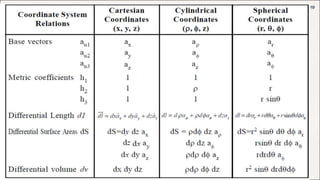
ORTHOGONAL COORDINATE SYSTEMS
 The physical quantities that are being dealt in Electromagnetics are
functions of space and time.
 In a three-dimensiona1 space, a point can be located as the intersection
of three surfaces.
 When these three surfaces are mutually perpendicular to one another,
then it is known as an orthogonal coordinate system.
 An orthogonal system is one in which the coordinates are mutually
perpendicular.
 The three orthogonal coordinate systems that are most common and
useful are:
1. Cartesian (or rectangular) coordinate system
2. Cylindrical coordinate system
3. Spherical coordinate system
2
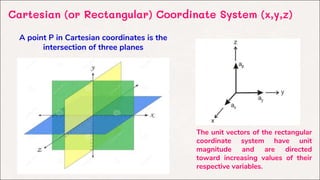
The unit vectors of the rectangular
coordinate system have unit
magnitude and are directed
toward increasing values of their
respective variables.
A point P in Cartesian coordinates is the
intersection of three planes
Cartesian (or Rectangular) Coordinate System (x,y,z)
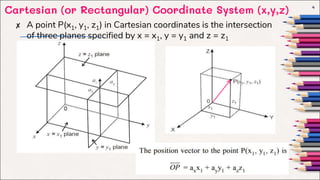
✘ A point P(x1, y1, z1) in Cartesian coordinates is the intersection
of three planes specified by x = x1, y = y1 and z = z1
4
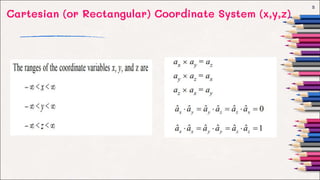
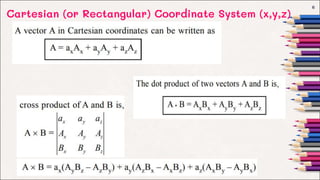
Cartesian (or Rectangular) Coordinate System (x,y,z)
5
Cartesian (or Rectangular) Coordinate System (x,y,z)
6
Cartesian (or Rectangular) Coordinate System (x,y,z) 7
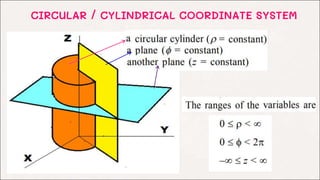
CIRCULAR / CYLINDRICAL COORDINATE SYSTEM
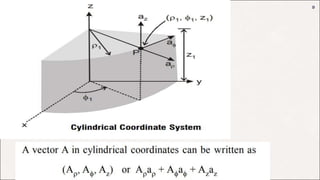
9
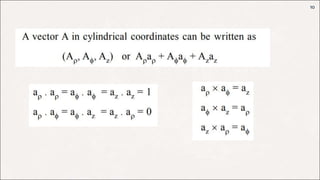
10
11
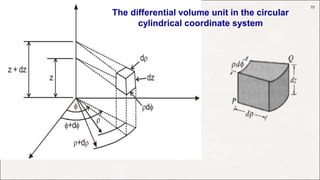
The differential volume unit in the circular
cylindrical coordinate system
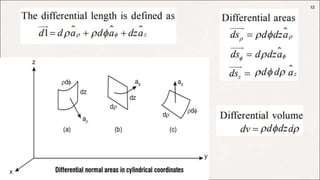
12
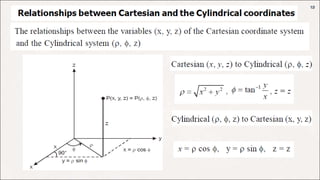
13
14
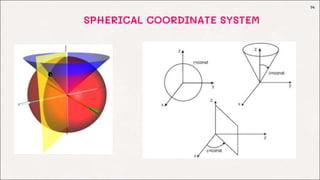
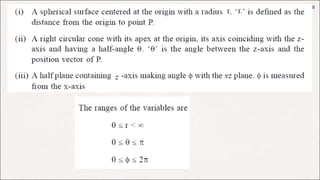
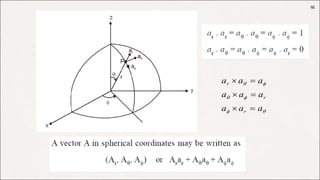
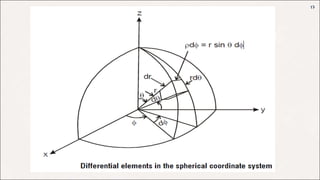
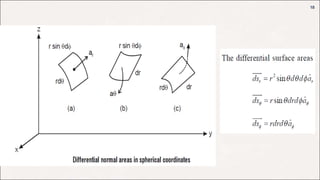
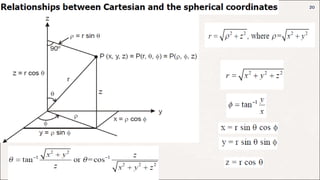
SPHERICAL COORDINATE SYSTEM
15
16






a
a
a
a
a
a
a
a
a
r
r
r






17
18
19
20
21
THANK YOU

Orthogonal coordinate systems- Cartesian ,Cylindrical ,Spherical